PH2001 Physics Department Winter 2013 - RM Harkins
"Combat Systems Science and Engineering Leadership. Physics Chairman Prof. Kevin Smith, Associate Chairs Prof. Joseph Hooper and Assoc. Prof. Dragoslav Grbovic. Curriculum Officer LCDR Robert Kerchner. Operational and Acquisition goals. Educational Skill Requirements for Combat Systems Analysis, Simulation, and Testing encompassing various fields such as Physics, Engineering, Acoustic and Electromagnetic Systems, Materials Science, Control Systems, Strategy and Policy, Weapons Systems, and Technical Specialization in Acoustics, Sensors, Weapons, and Energy. Explore the educational skill requirements for 570X P-Code Combat Systems."

Download Presentation

Please find below an Image/Link to download the presentation.
The content on the website is provided AS IS for your information and personal use only. It may not be sold, licensed, or shared on other websites without obtaining consent from the author. If you encounter any issues during the download, it is possible that the publisher has removed the file from their server.
You are allowed to download the files provided on this website for personal or commercial use, subject to the condition that they are used lawfully. All files are the property of their respective owners.
The content on the website is provided AS IS for your information and personal use only. It may not be sold, licensed, or shared on other websites without obtaining consent from the author.
E N D
Presentation Transcript
doc.: IEEE 802.11-22/1580r0 Sep 2022 A perspective on proposed Ultra-High Reliability (UHR) features for enterprise use cases 11 September 2022 Authors: Name Affiliation Phone email Brian Hart Cisco Systems brianh@cisco.com Pooya Monajemi Cisco Systems pmonajem@cisco.com Andrew Myles Cisco Systems Juan Carlos Zuniga Cisco Systems Peter Ecclesine Cisco Systems Stephen Orr Cisco Systems Jerome Henry Cisco Systems Submission Slide 1 Hart et al (Cisco Systems)
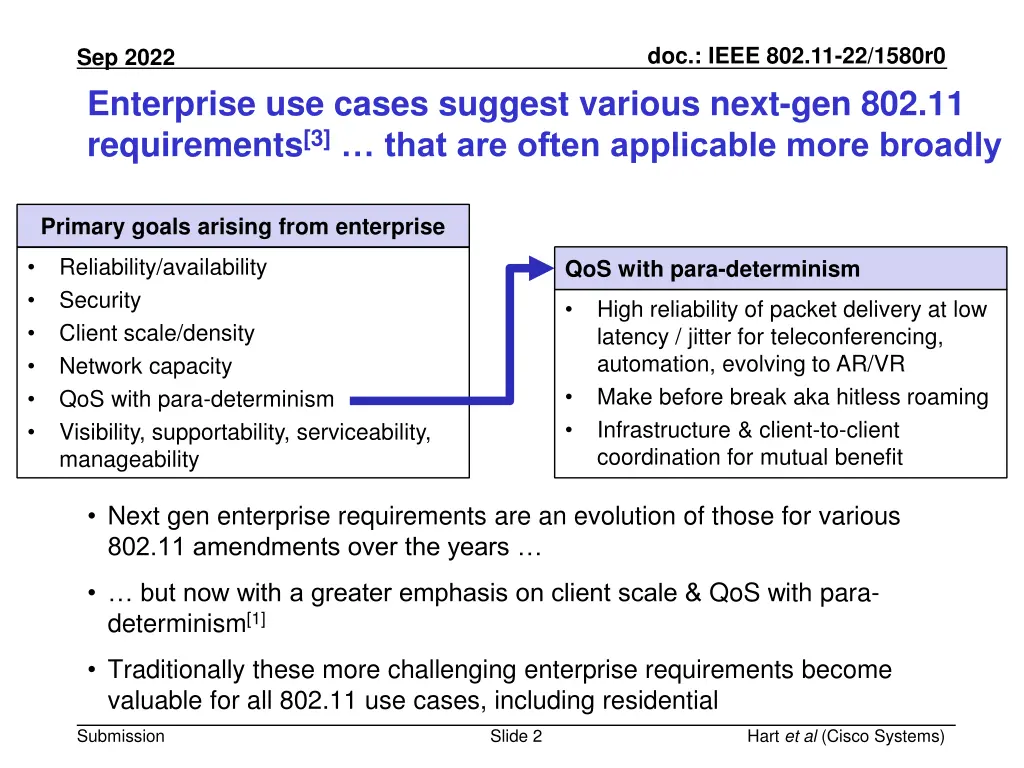
doc.: IEEE 802.11-22/1580r0 Sep 2022 Enterprise use cases suggest various next-gen 802.11 requirements[3] that are often applicable more broadly Primary goals arising from enterprise Reliability/availability Security Client scale/density Network capacity QoS with para-determinism Visibility, supportability, serviceability, manageability QoS with para-determinism High reliability of packet delivery at low latency / jitter for teleconferencing, automation, evolving to AR/VR Make before break aka hitless roaming Infrastructure & client-to-client coordination for mutual benefit Next gen enterprise requirements are an evolution of those for various 802.11 amendments over the years but now with a greater emphasis on client scale & QoS with para- determinism[1] Traditionally these more challenging enterprise requirements become valuable for all 802.11 use cases, including residential Submission Slide 2 Hart et al (Cisco Systems)
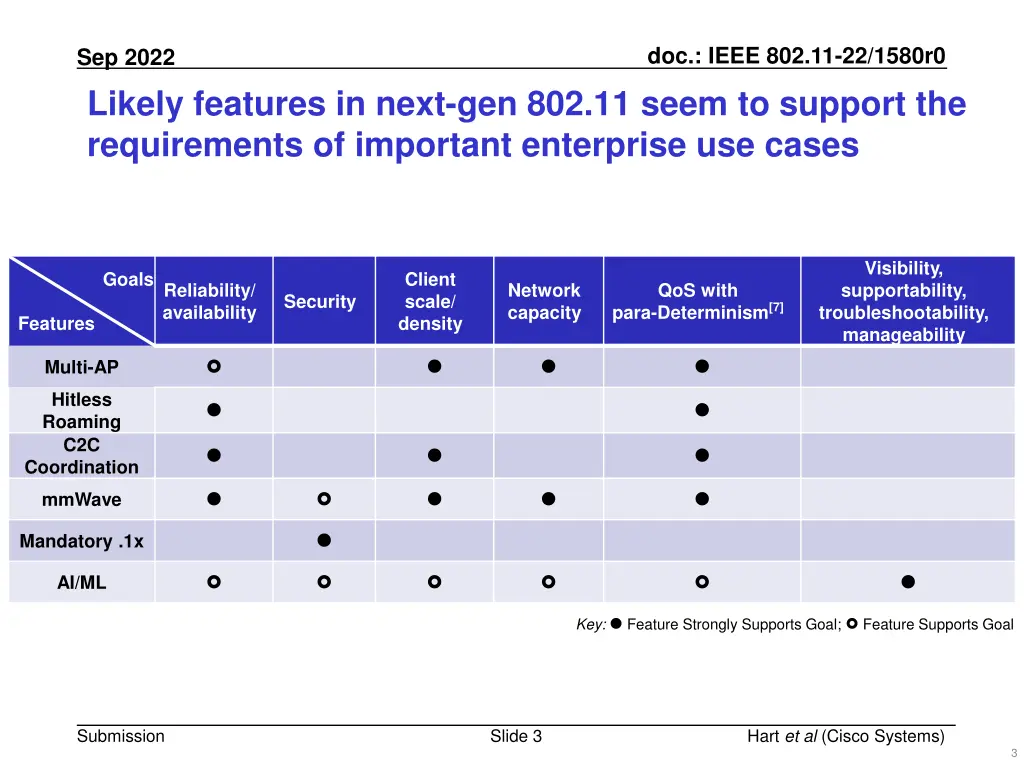
doc.: IEEE 802.11-22/1580r0 Sep 2022 Likely features in next-gen 802.11 seem to support the requirements of important enterprise use cases Visibility, supportability, troubleshootability, manageability Goals Client scale/ density Reliability/ availability Network capacity QoS with Security para-Determinism[7] Features Multi-AP Hitless Roaming C2C Coordination mmWave Mandatory .1x AI/ML Key: Feature Strongly Supports Goal; Feature Supports Goal Submission Slide 3 Hart et al (Cisco Systems) 3
doc.: IEEE 802.11-22/1580r0 Sep 2022 Multi-AP Submission Slide 4 Hart et al (Cisco Systems) 4
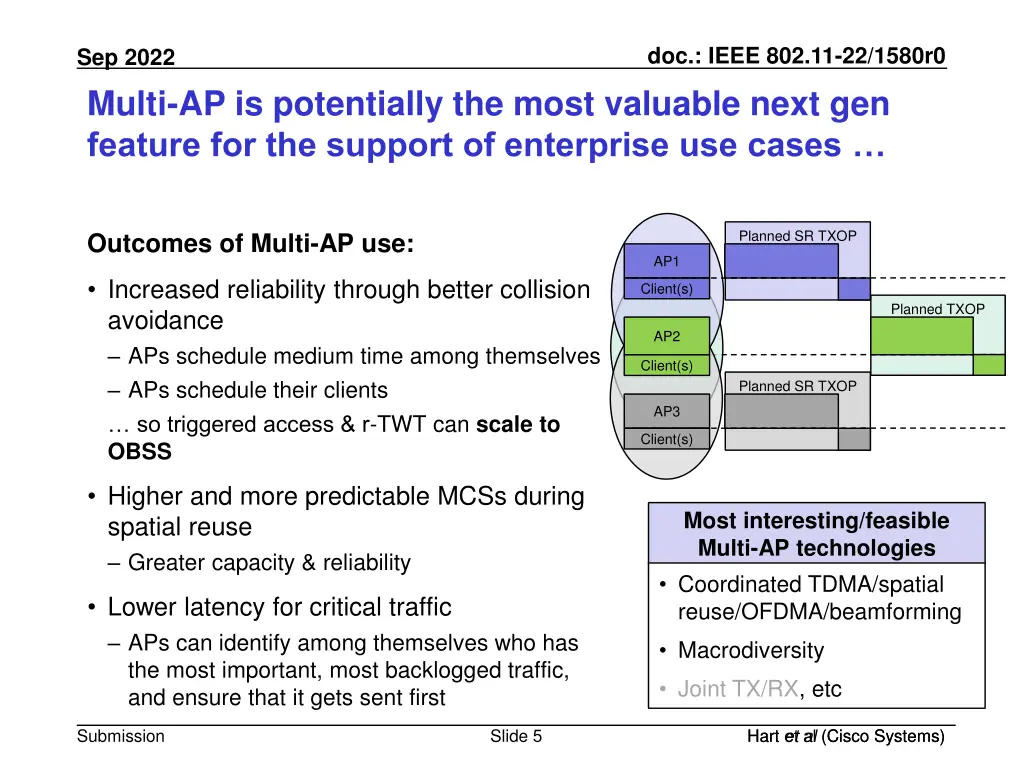
doc.: IEEE 802.11-22/1580r0 Sep 2022 Multi-AP is potentially the most valuable next gen feature for the support of enterprise use cases Planned SR TXOP Outcomes of Multi-AP use: AP1 Increased reliability through better collision avoidance APs schedule medium time among themselves APs schedule their clients so triggered access & r-TWT can scale to OBSS Client(s) Planned TXOP AP2 Client(s) Planned SR TXOP AP3 Client(s) Higher and more predictable MCSs during spatial reuse Greater capacity & reliability Most interesting/feasible Multi-AP technologies Coordinated TDMA/spatial reuse/OFDMA/beamforming Lower latency for critical traffic APs can identify among themselves who has the most important, most backlogged traffic, and ensure that it gets sent first Macrodiversity Joint TX/RX, etc Submission Slide 5 Hart et al (Cisco Systems) Hart et al (Cisco Systems)
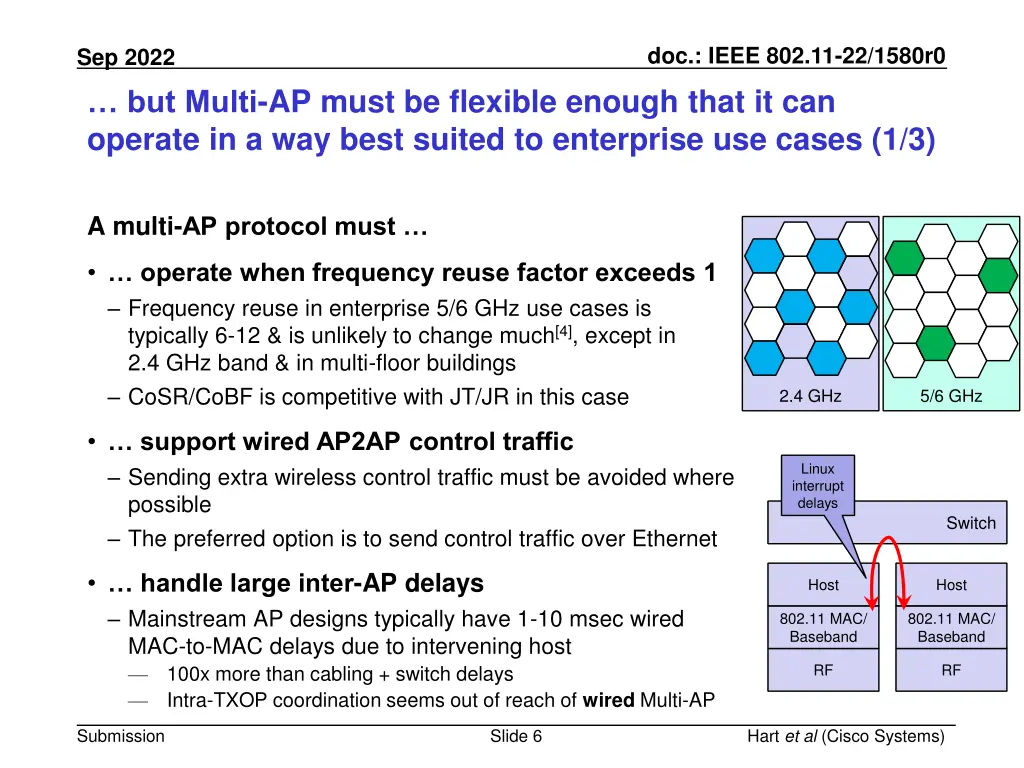
doc.: IEEE 802.11-22/1580r0 Sep 2022 but Multi-AP must be flexible enough that it can operate in a way best suited to enterprise use cases (1/3) A multi-AP protocol must operate when frequency reuse factor exceeds 1 Frequency reuse in enterprise 5/6 GHz use cases is typically 6-12 & is unlikely to change much[4], except in 2.4 GHz band & in multi-floor buildings CoSR/CoBF is competitive with JT/JR in this case 2.4 GHz 5/6 GHz support wired AP2AP control traffic Sending extra wireless control traffic must be avoided where possible The preferred option is to send control traffic over Ethernet Linux interrupt delays Switch handle large inter-AP delays Mainstream AP designs typically have 1-10 msec wired MAC-to-MAC delays due to intervening host 100x more than cabling + switch delays Intra-TXOP coordination seems out of reach of wired Multi-AP Host Host 802.11 MAC/ Baseband 802.11 MAC/ Baseband RF RF Submission Slide 6 Hart et al (Cisco Systems)
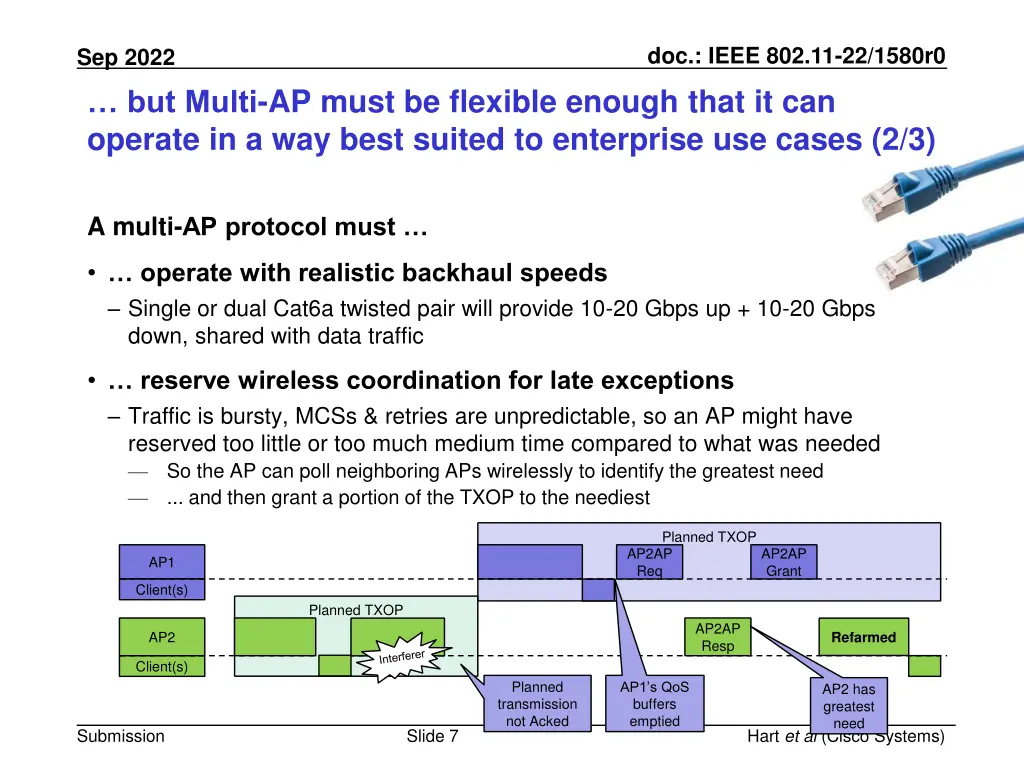
doc.: IEEE 802.11-22/1580r0 Sep 2022 but Multi-AP must be flexible enough that it can operate in a way best suited to enterprise use cases (2/3) A multi-AP protocol must operate with realistic backhaul speeds Single or dual Cat6a twisted pair will provide 10-20 Gbps up + 10-20 Gbps down, shared with data traffic reserve wireless coordination for late exceptions Traffic is bursty, MCSs & retries are unpredictable, so an AP might have reserved too little or too much medium time compared to what was needed So the AP can poll neighboring APs wirelessly to identify the greatest need ... and then grant a portion of the TXOP to the neediest Planned TXOP AP2AP Req AP2AP Grant AP1 Client(s) Planned TXOP AP2AP Resp Refarmed AP2 Client(s) Planned transmission not Acked AP1 s QoS buffers emptied AP2 has greatest need Submission Slide 7 Hart et al (Cisco Systems)
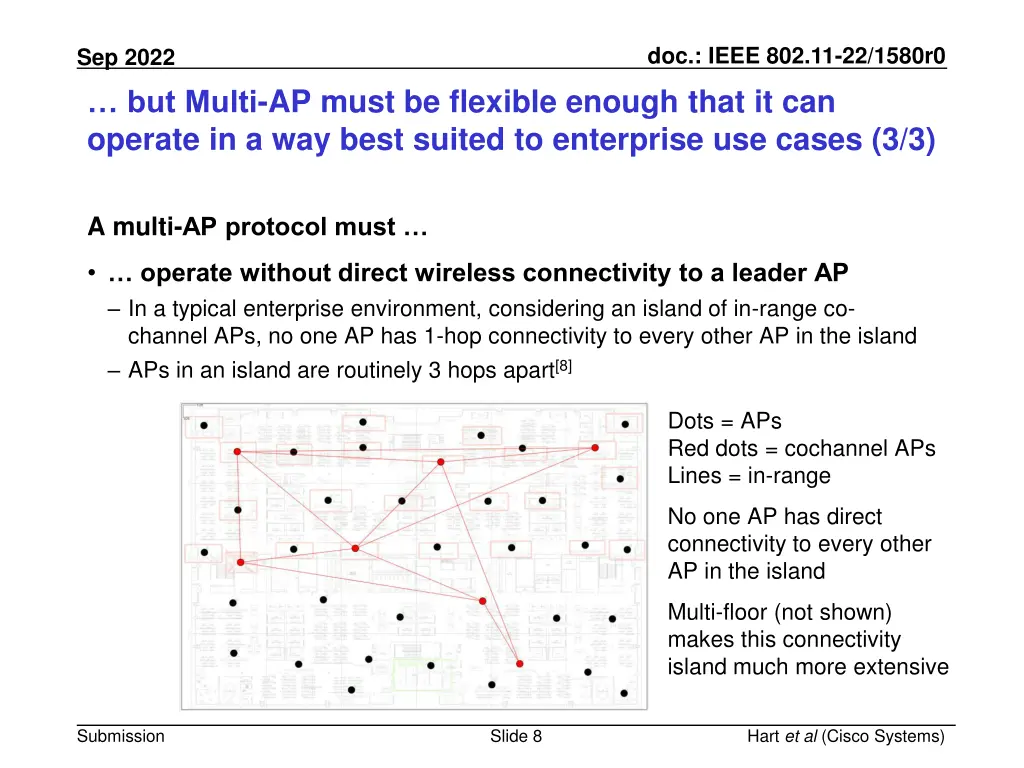
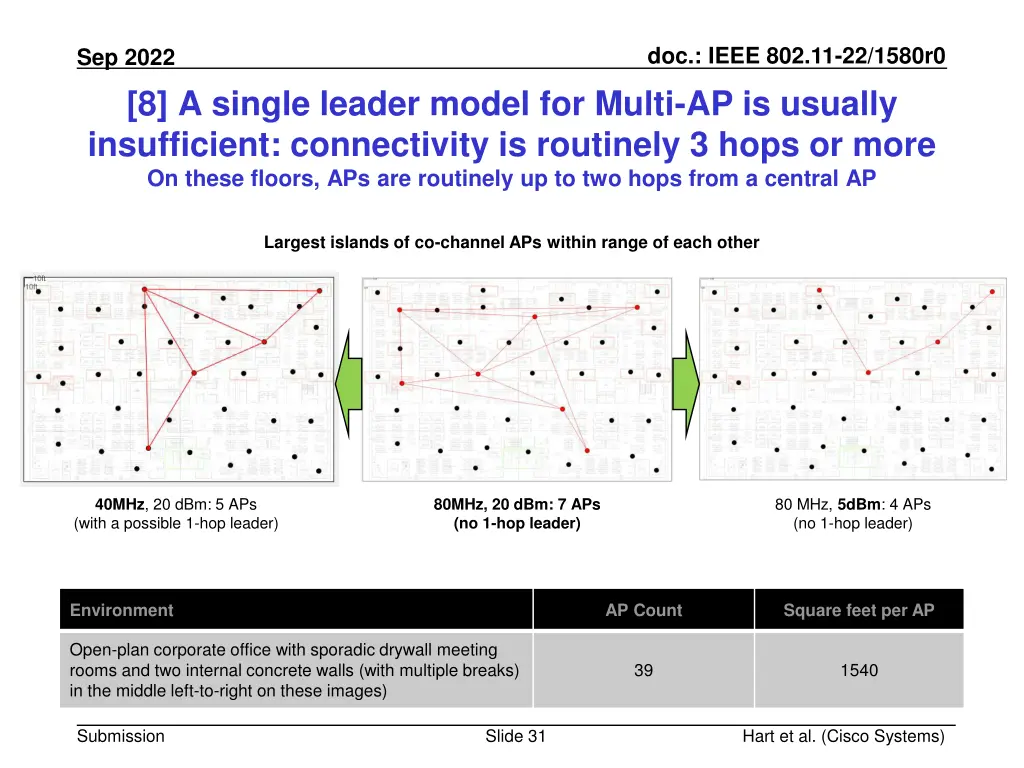
doc.: IEEE 802.11-22/1580r0 Sep 2022 but Multi-AP must be flexible enough that it can operate in a way best suited to enterprise use cases (3/3) A multi-AP protocol must operate without direct wireless connectivity to a leader AP In a typical enterprise environment, considering an island of in-range co- channel APs, no one AP has 1-hop connectivity to every other AP in the island APs in an island are routinely 3 hops apart[8] Dots = APs Red dots = cochannel APs Lines = in-range No one AP has direct connectivity to every other AP in the island Multi-floor (not shown) makes this connectivity island much more extensive Submission Slide 8 Hart et al (Cisco Systems)
doc.: IEEE 802.11-22/1580r0 Sep 2022 mmWave (and more Multi-AP) Submission Slide 9 Hart et al. (Cisco Systems) 9
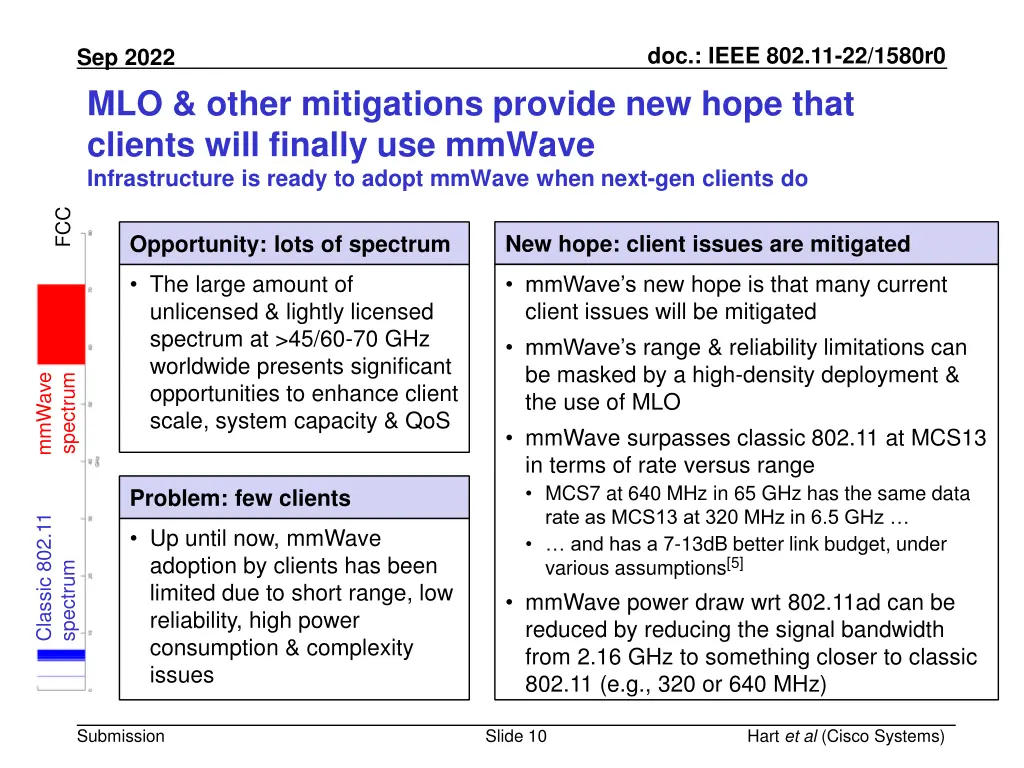
doc.: IEEE 802.11-22/1580r0 Sep 2022 MLO & other mitigations provide new hope that clients will finally use mmWave Infrastructure is ready to adopt mmWave when next-gen clients do FCC New hope: client issues are mitigated Opportunity: lots of spectrum mmWave s new hope is that many current client issues will be mitigated mmWave s range & reliability limitations can be masked by a high-density deployment & the use of MLO mmWave surpasses classic 802.11 at MCS13 in terms of rate versus range MCS7 at 640 MHz in 65 GHz has the same data rate as MCS13 at 320 MHz in 6.5 GHz and has a 7-13dB better link budget, under various assumptions[5] mmWave power draw wrt 802.11ad can be reduced by reducing the signal bandwidth from 2.16 GHz to something closer to classic 802.11 (e.g., 320 or 640 MHz) The large amount of unlicensed & lightly licensed spectrum at >45/60-70 GHz worldwide presents significant opportunities to enhance client scale, system capacity & QoS mmWave spectrum Problem: few clients Classic 802.11 Up until now, mmWave adoption by clients has been limited due to short range, low reliability, high power consumption & complexity issues spectrum Submission Slide 10 Hart et al (Cisco Systems)
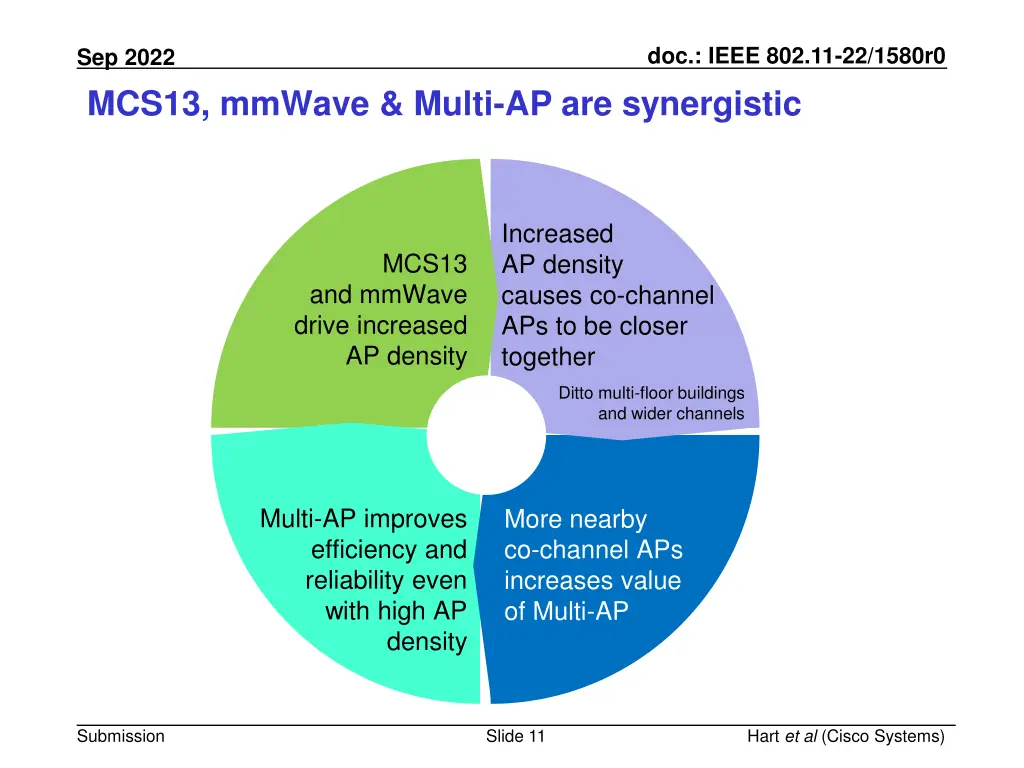
doc.: IEEE 802.11-22/1580r0 Sep 2022 MCS13, mmWave & Multi-AP are synergistic Increased AP density causes co-channel APs to be closer together MCS13 and mmWave drive increased AP density Ditto multi-floor buildings and wider channels Multi-AP improves efficiency and reliability even with high AP More nearby co-channel APs increases value of Multi-AP density Submission Slide 11 Hart et al (Cisco Systems)
doc.: IEEE 802.11-22/1580r0 Sep 2022 Hitless Roaming Submission Slide 12 Hart et al (Cisco Systems)
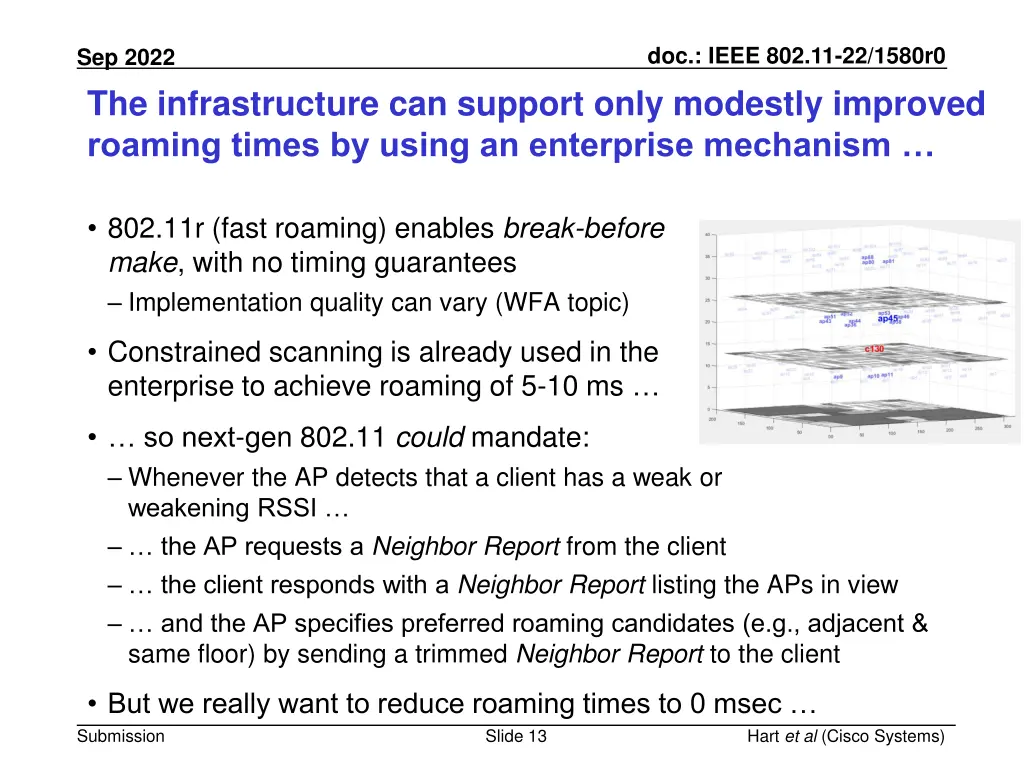
doc.: IEEE 802.11-22/1580r0 Sep 2022 The infrastructure can support only modestly improved roaming times by using an enterprise mechanism 802.11r (fast roaming) enables break-before make, with no timing guarantees Implementation quality can vary (WFA topic) Constrained scanning is already used in the enterprise to achieve roaming of 5-10 ms so next-gen 802.11 could mandate: Whenever the AP detects that a client has a weak or weakening RSSI the AP requests a Neighbor Report from the client the client responds with a Neighbor Report listing the APs in view and the AP specifies preferred roaming candidates (e.g., adjacent & same floor) by sending a trimmed Neighbor Report to the client But we really want to reduce roaming times to 0 msec Submission Slide 13 Hart et al (Cisco Systems)
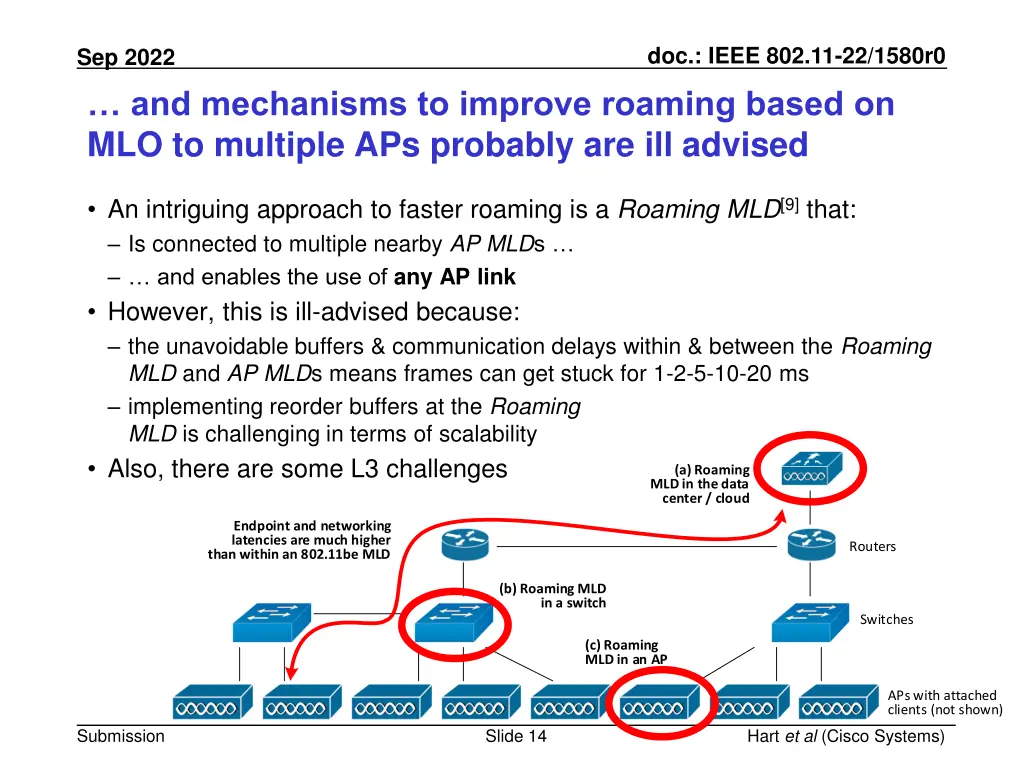
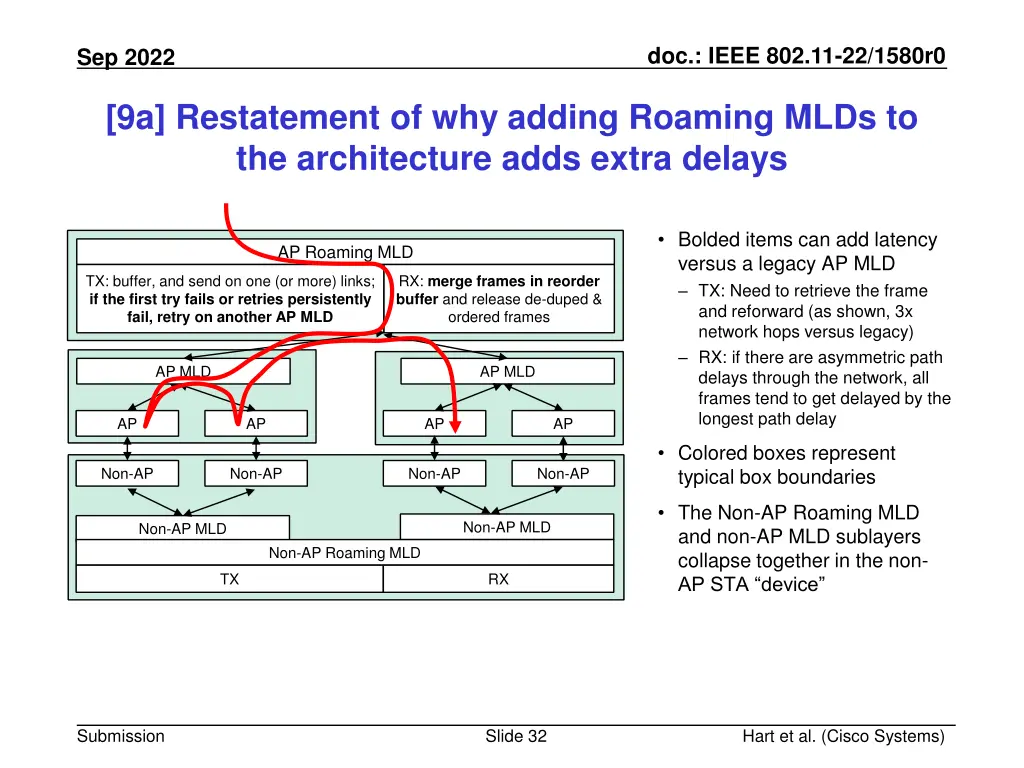
doc.: IEEE 802.11-22/1580r0 Sep 2022 and mechanisms to improve roaming based on MLO to multiple APs probably are ill advised An intriguing approach to faster roaming is a Roaming MLD[9]that: Is connected to multiple nearby AP MLDs and enables the use of any AP link However, this is ill-advised because: the unavoidable buffers & communication delays within & between the Roaming MLD and AP MLDs means frames can get stuck for 1-2-5-10-20 ms implementing reorder buffers at the Roaming MLD is challenging in terms of scalability Also, there are some L3 challenges (a) Roaming MLD in the data center / cloud Endpoint and networking latencies are much higher than within an 802.11be MLD Routers (b) Roaming MLD in a switch Switches (c) Roaming MLD in an AP APs with attached clients (not shown) Submission Slide 14 Hart et al (Cisco Systems)
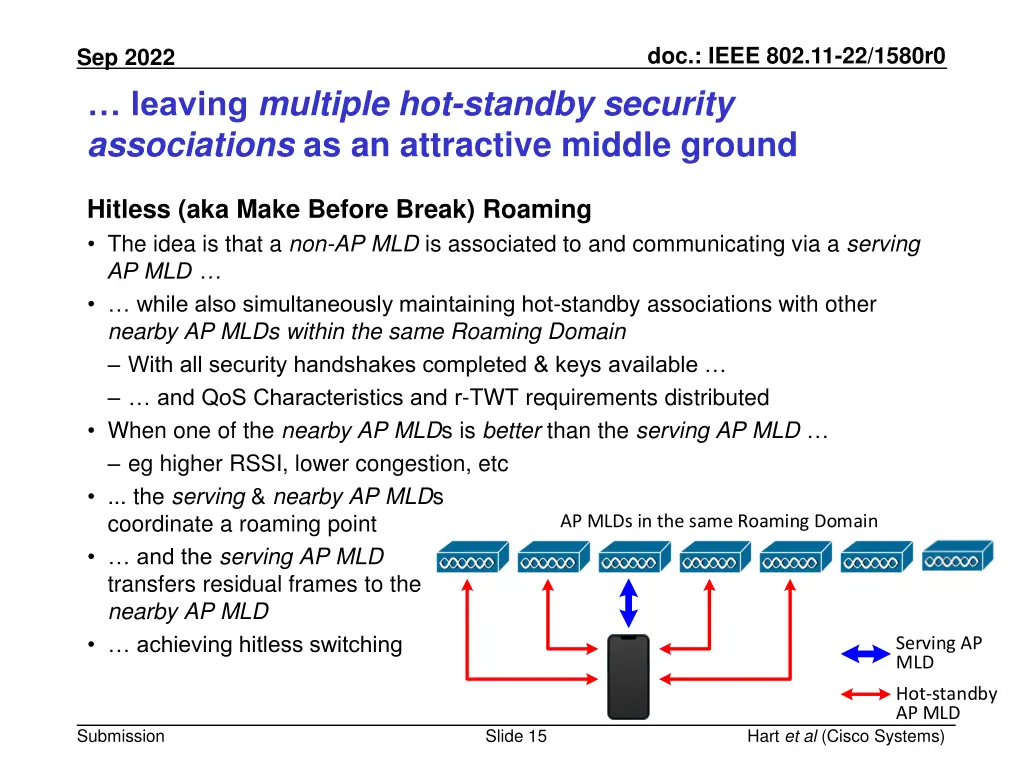
doc.: IEEE 802.11-22/1580r0 Sep 2022 leaving multiple hot-standby security associations as an attractive middle ground Hitless (aka Make Before Break) Roaming The idea is that a non-AP MLD is associated to and communicating via a serving AP MLD while also simultaneously maintaining hot-standby associations with other nearby AP MLDs within the same Roaming Domain With all security handshakes completed & keys available and QoS Characteristics and r-TWT requirements distributed When one of the nearby AP MLDsis better than the serving AP MLD eg higher RSSI, lower congestion, etc ... the serving & nearby AP MLDs coordinate a roaming point and the serving AP MLD transfers residual frames to the nearby AP MLD achieving hitless switching AP MLDs in the same Roaming Domain Serving AP MLD Hot-standby AP MLD Submission Slide 15 Hart et al (Cisco Systems)
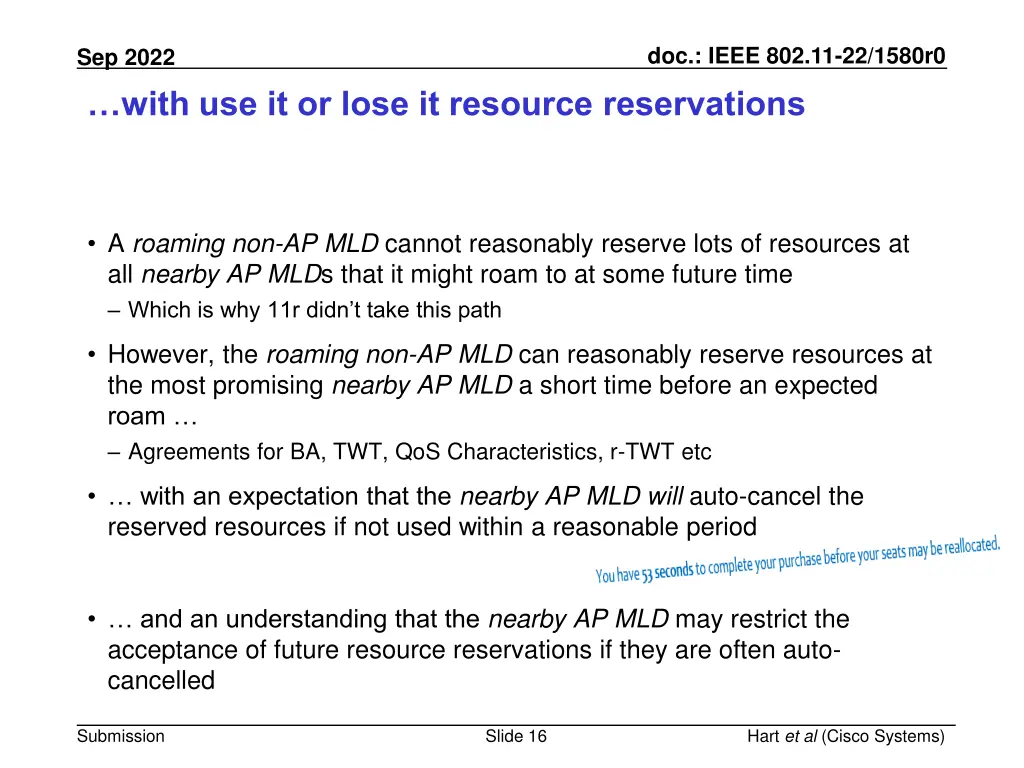
doc.: IEEE 802.11-22/1580r0 Sep 2022 with use it or lose it resource reservations A roaming non-AP MLD cannot reasonably reserve lots of resources at all nearby AP MLDs that it might roam to at some future time Which is why 11r didn t take this path However, the roaming non-AP MLD can reasonably reserve resources at the most promising nearby AP MLD a short time before an expected roam Agreements for BA, TWT, QoS Characteristics, r-TWT etc with an expectation that the nearby AP MLD will auto-cancel the reserved resources if not used within a reasonable period and an understanding that the nearby AP MLD may restrict the acceptance of future resource reservations if they are often auto- cancelled Submission Slide 16 Hart et al (Cisco Systems)
doc.: IEEE 802.11-22/1580r0 Sep 2022 Other Submission Slide 17 Hart et al. (Cisco Systems) 17
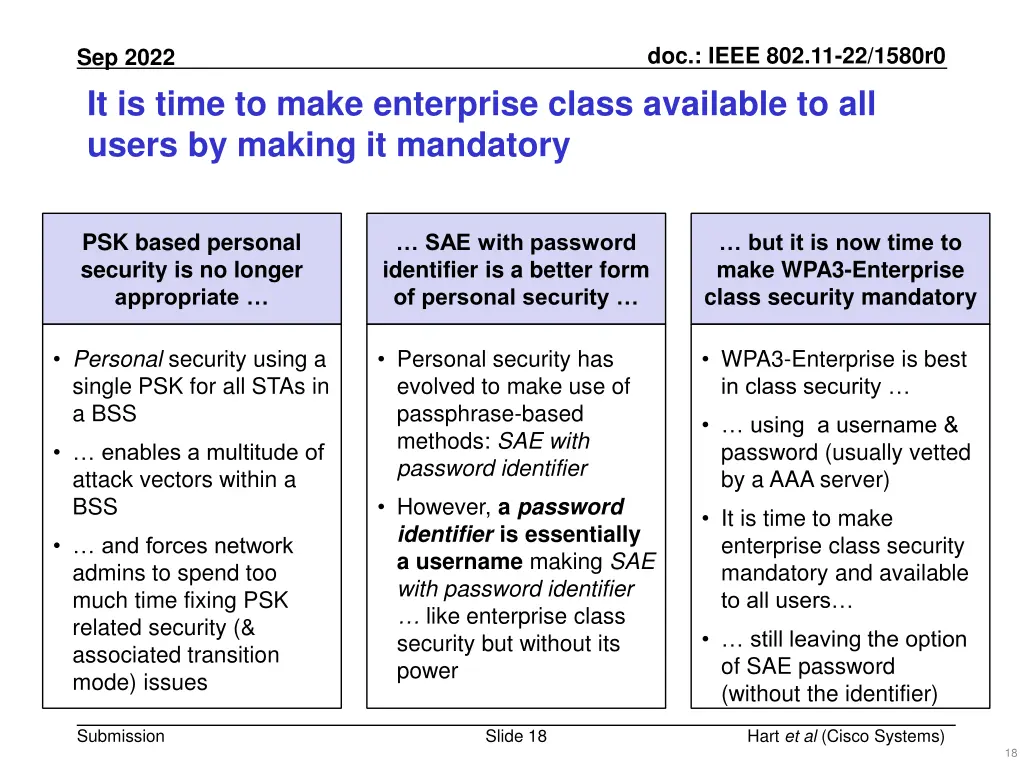
doc.: IEEE 802.11-22/1580r0 Sep 2022 It is time to make enterprise class available to all users by making it mandatory PSK based personal security is no longer appropriate SAE with password identifier is a better form of personal security but it is now time to make WPA3-Enterprise class security mandatory Personal security using a single PSK for all STAs in a BSS Personal security has evolved to make use of passphrase-based methods: SAE with password identifier WPA3-Enterprise is best in class security using a username & password (usually vetted by a AAA server) enables a multitude of attack vectors within a BSS However, a password identifier is essentially a username making SAE with password identifier like enterprise class security but without its power It is time to make enterprise class security mandatory and available to all users and forces network admins to spend too much time fixing PSK related security (& associated transition mode) issues still leaving the option of SAE password (without the identifier) Submission Slide 18 Hart et al (Cisco Systems) 18
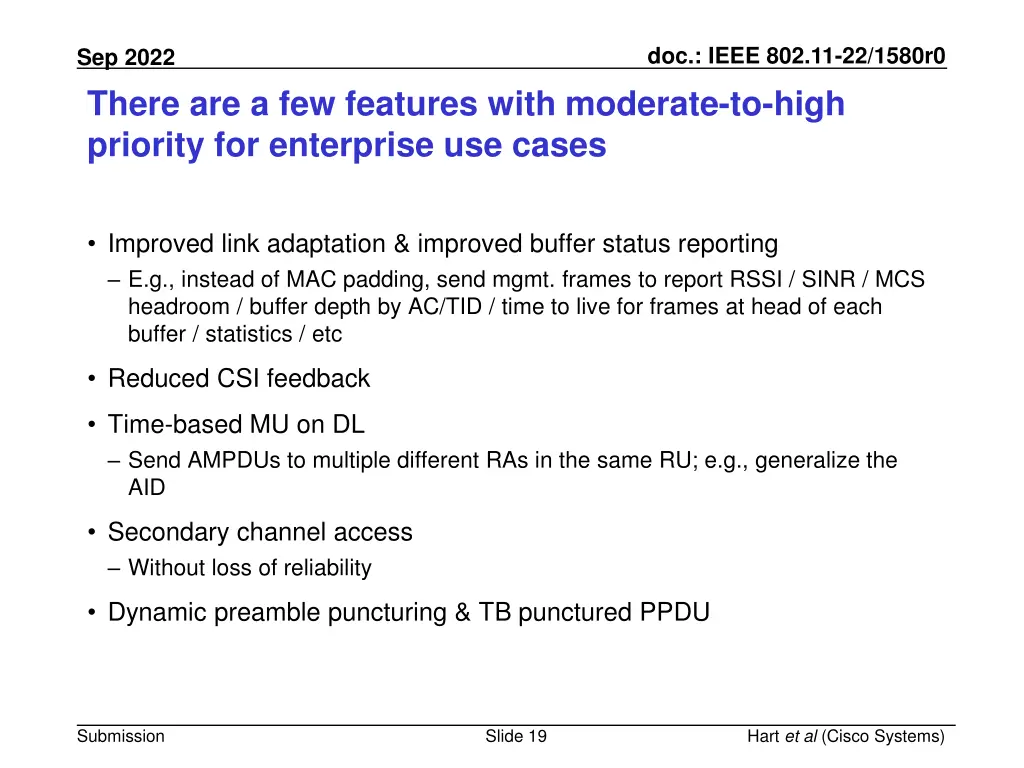
doc.: IEEE 802.11-22/1580r0 Sep 2022 There are a few features with moderate-to-high priority for enterprise use cases Improved link adaptation & improved buffer status reporting E.g., instead of MAC padding, send mgmt. frames to report RSSI / SINR / MCS headroom / buffer depth by AC/TID / time to live for frames at head of each buffer / statistics / etc Reduced CSI feedback Time-based MU on DL Send AMPDUs to multiple different RAs in the same RU; e.g., generalize the AID Secondary channel access Without loss of reliability Dynamic preamble puncturing & TB punctured PPDU Submission Slide 19 Hart et al (Cisco Systems)
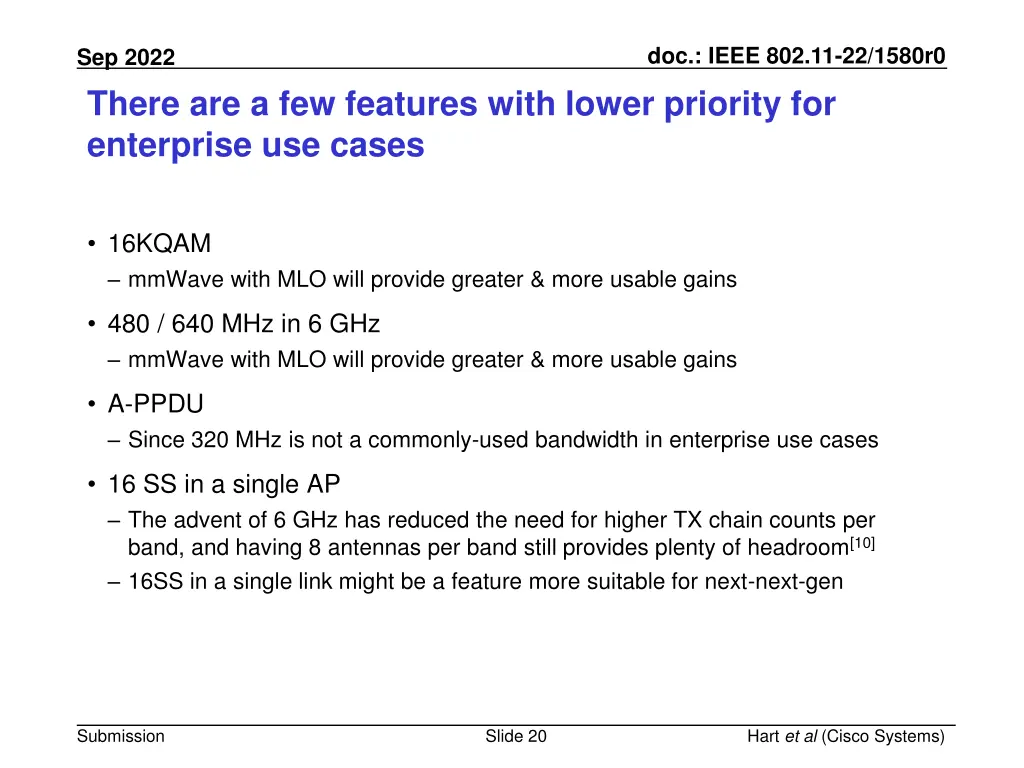
doc.: IEEE 802.11-22/1580r0 Sep 2022 There are a few features with lower priority for enterprise use cases 16KQAM mmWave with MLO will provide greater & more usable gains 480 / 640 MHz in 6 GHz mmWave with MLO will provide greater & more usable gains A-PPDU Since 320 MHz is not a commonly-used bandwidth in enterprise use cases 16 SS in a single AP The advent of 6 GHz has reduced the need for higher TX chain counts per band, and having 8 antennas per band still provides plenty of headroom[10] 16SS in a single link might be a feature more suitable for next-next-gen Submission Slide 20 Hart et al (Cisco Systems)
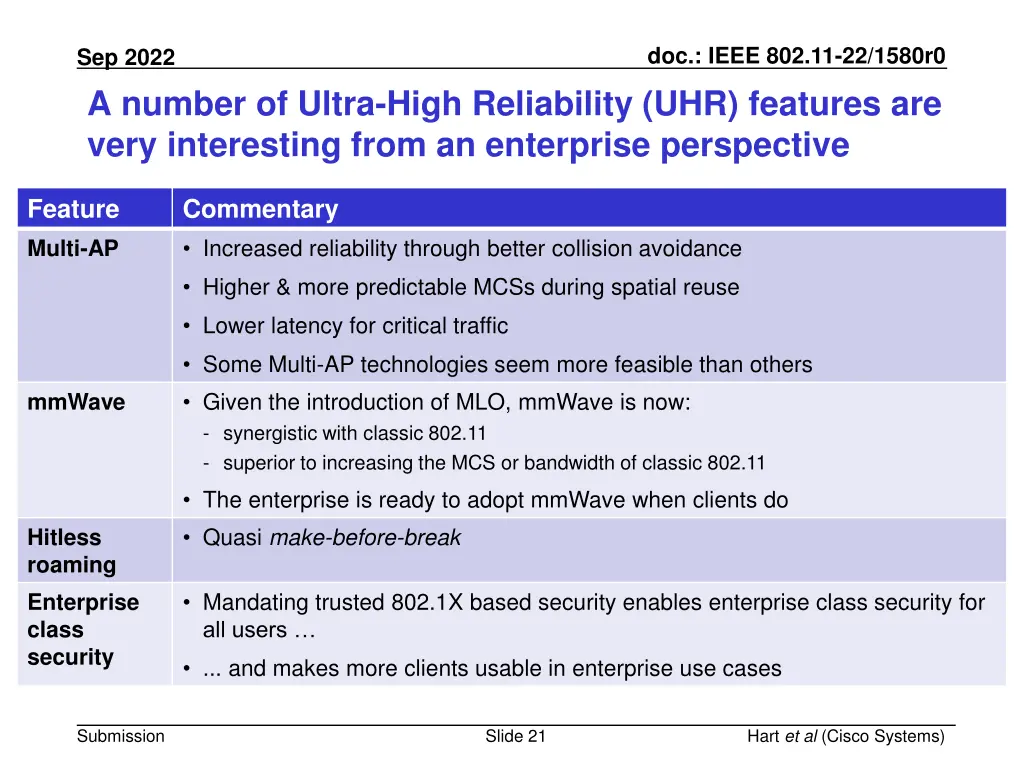
doc.: IEEE 802.11-22/1580r0 Sep 2022 A number of Ultra-High Reliability (UHR) features are very interesting from an enterprise perspective Feature Multi-AP Commentary Increased reliability through better collision avoidance Higher & more predictable MCSs during spatial reuse Lower latency for critical traffic Some Multi-AP technologies seem more feasible than others Given the introduction of MLO, mmWave is now: - synergistic with classic 802.11 - superior to increasing the MCS or bandwidth of classic 802.11 mmWave The enterprise is ready to adopt mmWave when clients do Quasi make-before-break Hitless roaming Enterprise class security Mandating trusted 802.1X based security enables enterprise class security for all users ... and makes more clients usable in enterprise use cases Submission Slide 21 Hart et al (Cisco Systems)
doc.: IEEE 802.11-22/1580r0 Sep 2022 Backup Submission Slide 22 Hart et al. (Cisco Systems) 22
doc.: IEEE 802.11-22/1580r0 Sep 2022 References [1] Many presentations at WNG from January 2022 to July 2022 at https://mentor.ieee.org/802.11/documents?is_group=0wng [2] Brian Hart (Cisco Systems), Candidate Technology Review , https://mentor.ieee.org/802.11/dcn/18/11-18-1549-00-0eht-candidate- technology-review.pptx // For higher footnotes, see rest of Backup Submission Slide 23 Hart et al. (Cisco Systems)
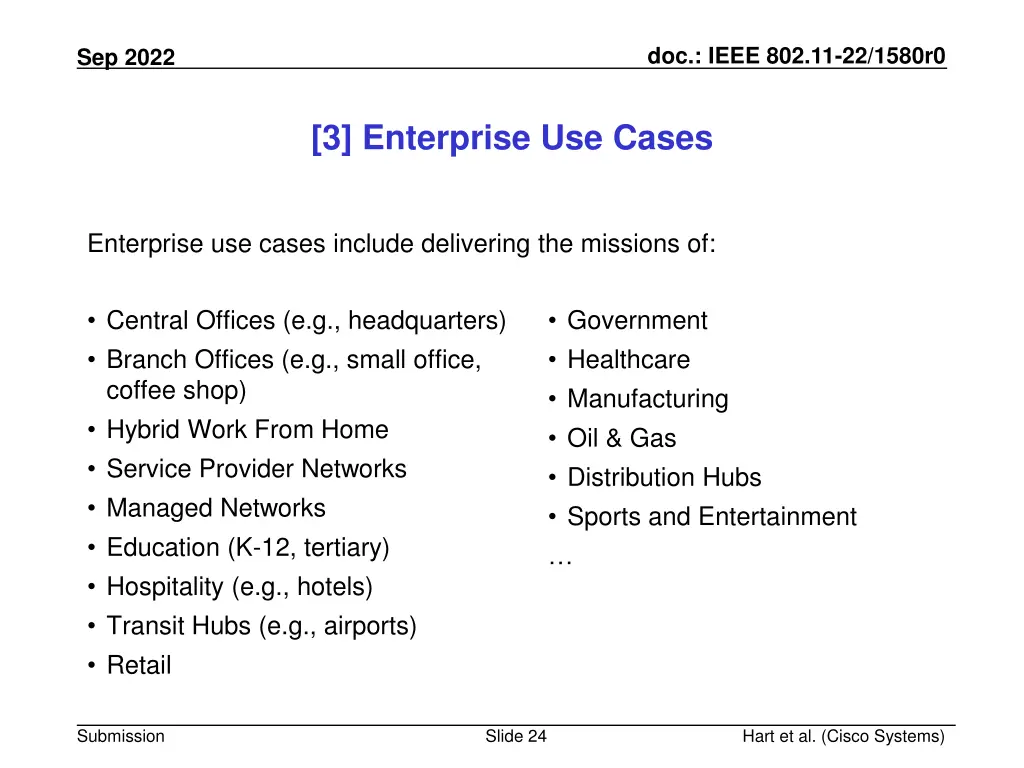
doc.: IEEE 802.11-22/1580r0 Sep 2022 [3] Enterprise Use Cases Enterprise use cases include delivering the missions of: Central Offices (e.g., headquarters) Branch Offices (e.g., small office, coffee shop) Hybrid Work From Home Service Provider Networks Managed Networks Education (K-12, tertiary) Hospitality (e.g., hotels) Transit Hubs (e.g., airports) Retail Government Healthcare Manufacturing Oil & Gas Distribution Hubs Sports and Entertainment Submission Slide 24 Hart et al. (Cisco Systems)
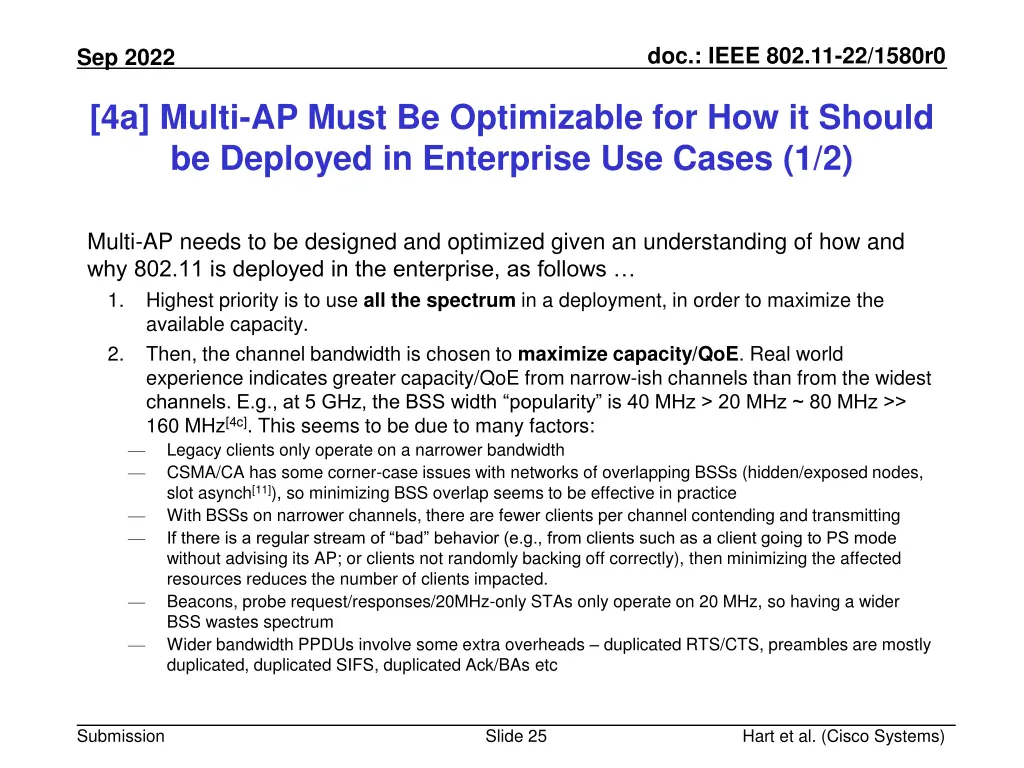
doc.: IEEE 802.11-22/1580r0 Sep 2022 [4a] Multi-AP Must Be Optimizable for How it Should be Deployed in Enterprise Use Cases (1/2) Multi-AP needs to be designed and optimized given an understanding of how and why 802.11 is deployed in the enterprise, as follows 1. Highest priority is to use all the spectrum in a deployment, in order to maximize the available capacity. 2. Then, the channel bandwidth is chosen to maximize capacity/QoE. Real world experience indicates greater capacity/QoE from narrow-ish channels than from the widest channels. E.g., at 5 GHz, the BSS width popularity is 40 MHz > 20 MHz ~ 80 MHz >> 160 MHz[4c]. This seems to be due to many factors: Legacy clients only operate on a narrower bandwidth CSMA/CA has some corner-case issues with networks of overlapping BSSs (hidden/exposed nodes, slot asynch[11]), so minimizing BSS overlap seems to be effective in practice With BSSs on narrower channels, there are fewer clients per channel contending and transmitting If there is a regular stream of bad behavior (e.g., from clients such as a client going to PS mode without advising its AP; or clients not randomly backing off correctly), then minimizing the affected resources reduces the number of clients impacted. Beacons, probe request/responses/20MHz-only STAs only operate on 20 MHz, so having a wider BSS wastes spectrum Wider bandwidth PPDUs involve some extra overheads duplicated RTS/CTS, preambles are mostly duplicated, duplicated SIFS, duplicated Ack/BAs etc Submission Slide 25 Hart et al. (Cisco Systems)
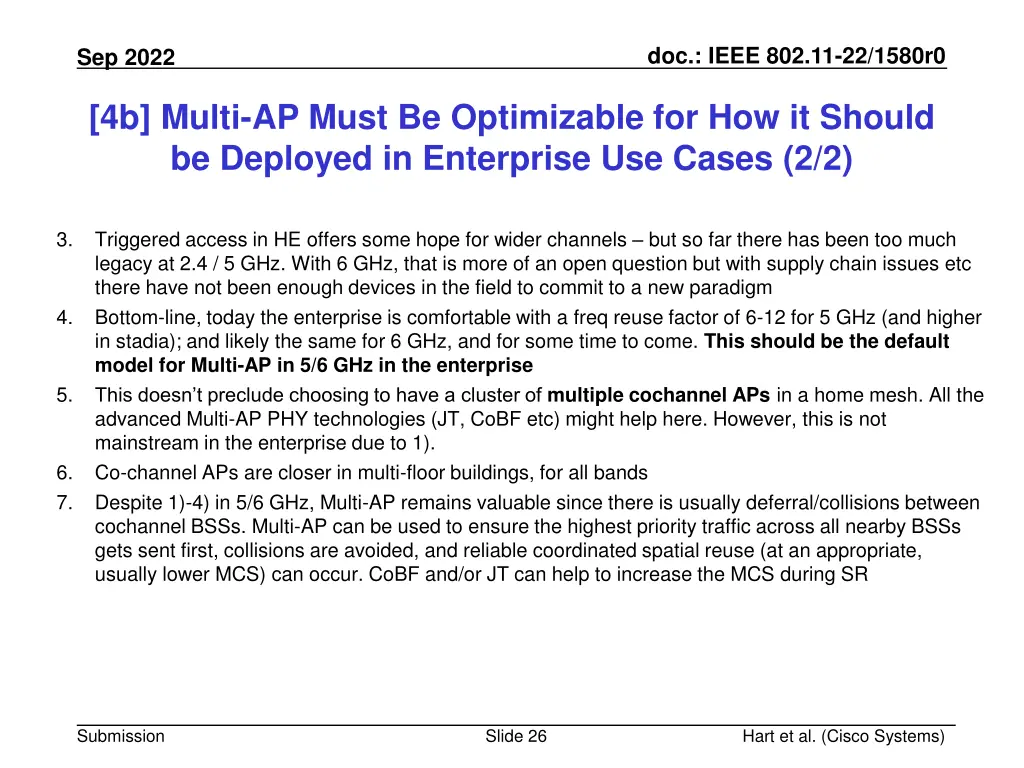
doc.: IEEE 802.11-22/1580r0 Sep 2022 [4b] Multi-AP Must Be Optimizable for How it Should be Deployed in Enterprise Use Cases (2/2) 3. Triggered access in HE offers some hope for wider channels but so far there has been too much legacy at 2.4 / 5 GHz. With 6 GHz, that is more of an open question but with supply chain issues etc there have not been enough devices in the field to commit to a new paradigm Bottom-line, today the enterprise is comfortable with a freq reuse factor of 6-12 for 5 GHz (and higher in stadia); and likely the same for 6 GHz, and for some time to come. This should be the default model for Multi-AP in 5/6 GHz in the enterprise This doesn t preclude choosing to have a cluster of multiple cochannel APs in a home mesh. All the advanced Multi-AP PHY technologies (JT, CoBF etc) might help here. However, this is not mainstream in the enterprise due to 1). Co-channel APs are closer in multi-floor buildings, for all bands Despite 1)-4) in 5/6 GHz, Multi-AP remains valuable since there is usually deferral/collisions between cochannel BSSs. Multi-AP can be used to ensure the highest priority traffic across all nearby BSSs gets sent first, collisions are avoided, and reliable coordinated spatial reuse (at an appropriate, usually lower MCS) can occur. CoBF and/or JT can help to increase the MCS during SR 4. 5. 6. 7. Submission Slide 26 Hart et al. (Cisco Systems)
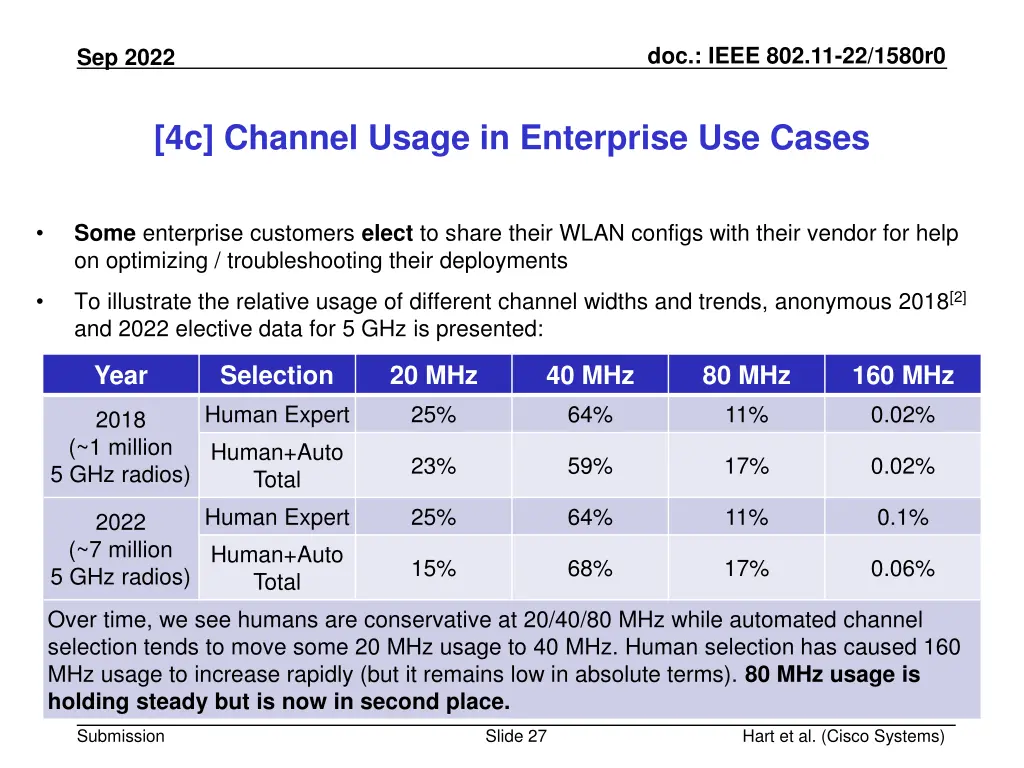
doc.: IEEE 802.11-22/1580r0 Sep 2022 [4c] Channel Usage in Enterprise Use Cases Some enterprise customers elect to share their WLAN configs with their vendor for help on optimizing / troubleshooting their deployments To illustrate the relative usage of different channel widths and trends, anonymous 2018[2] and 2022 elective data for 5 GHz is presented: Year Selection Human Expert Human+Auto Total Human Expert Human+Auto Total 20 MHz 25% 40 MHz 64% 80 MHz 11% 160 MHz 0.02% 2018 (~1 million 5 GHz radios) 23% 59% 17% 0.02% 25% 64% 11% 0.1% 2022 (~7 million 5 GHz radios) 15% 68% 17% 0.06% Over time, we see humans are conservative at 20/40/80 MHz while automated channel selection tends to move some 20 MHz usage to 40 MHz. Human selection has caused 160 MHz usage to increase rapidly (but it remains low in absolute terms). 80 MHz usage is holding steady but is now in second place. Submission Slide 27 Hart et al. (Cisco Systems)
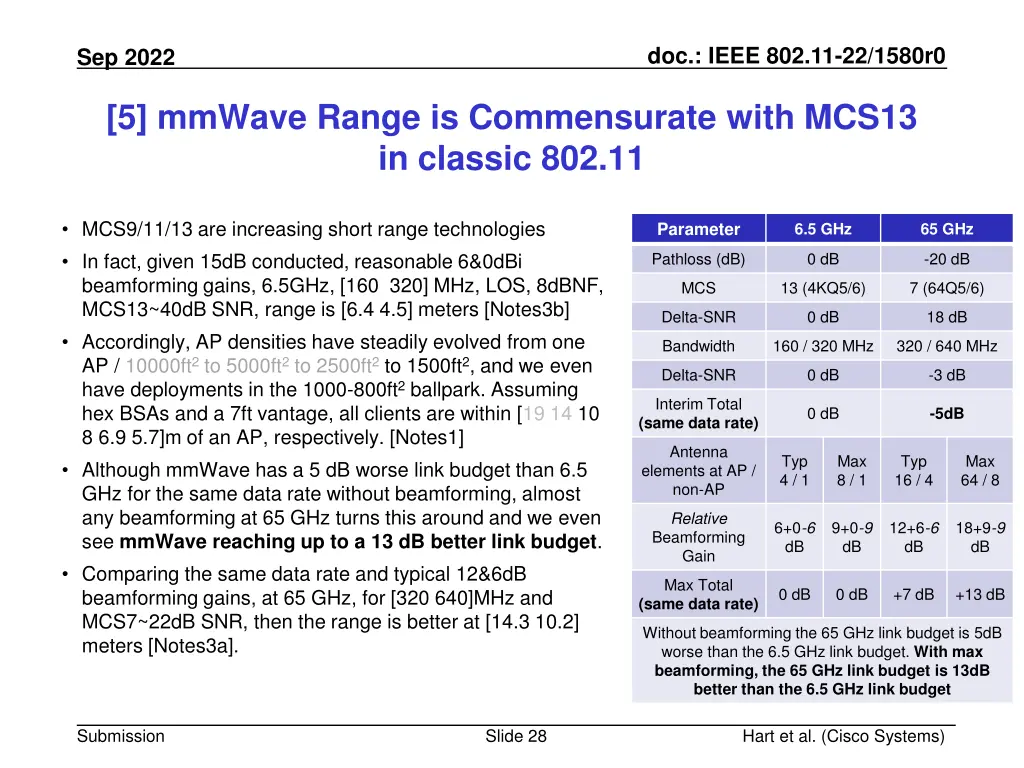
doc.: IEEE 802.11-22/1580r0 Sep 2022 [5] mmWave Range is Commensurate with MCS13 in classic 802.11 MCS9/11/13 are increasing short range technologies In fact, given 15dB conducted, reasonable 6&0dBi beamforming gains, 6.5GHz, [160 320] MHz, LOS, 8dBNF, MCS13~40dB SNR, range is [6.4 4.5] meters [Notes3b] Accordingly, AP densities have steadily evolved from one AP / 10000ft2 to 5000ft2 to 2500ft2 to 1500ft2, and we even have deployments in the 1000-800ft2 ballpark. Assuming hex BSAs and a 7ft vantage, all clients are within [19 14 10 8 6.9 5.7]m of an AP, respectively. [Notes1] Although mmWave has a 5 dB worse link budget than 6.5 GHz for the same data rate without beamforming, almost any beamforming at 65 GHz turns this around and we even see mmWave reaching up to a 13 dB better link budget. Comparing the same data rate and typical 12&6dB beamforming gains, at 65 GHz, for [320 640]MHz and MCS7~22dB SNR, then the range is better at [14.3 10.2] meters [Notes3a]. Parameter 6.5 GHz 65 GHz Pathloss (dB) 0 dB -20 dB MCS 13 (4KQ5/6) 7 (64Q5/6) Delta-SNR 0 dB 18 dB Bandwidth 160 / 320 MHz 320 / 640 MHz Delta-SNR 0 dB -3 dB Interim Total (same data rate) 0 dB -5dB Antenna elements at AP / non-AP Typ 4 / 1 Max 8 / 1 Typ 16 / 4 Max 64 / 8 Relative Beamforming Gain 6+0-6 dB 9+0-9 dB 12+6-6 dB 18+9-9 dB Max Total (same data rate) 0 dB 0 dB +7 dB +13 dB Without beamforming the 65 GHz link budget is 5dB worse than the 6.5 GHz link budget. With max beamforming, the 65 GHz link budget is 13dB better than the 6.5 GHz link budget Submission Slide 28 Hart et al. (Cisco Systems)
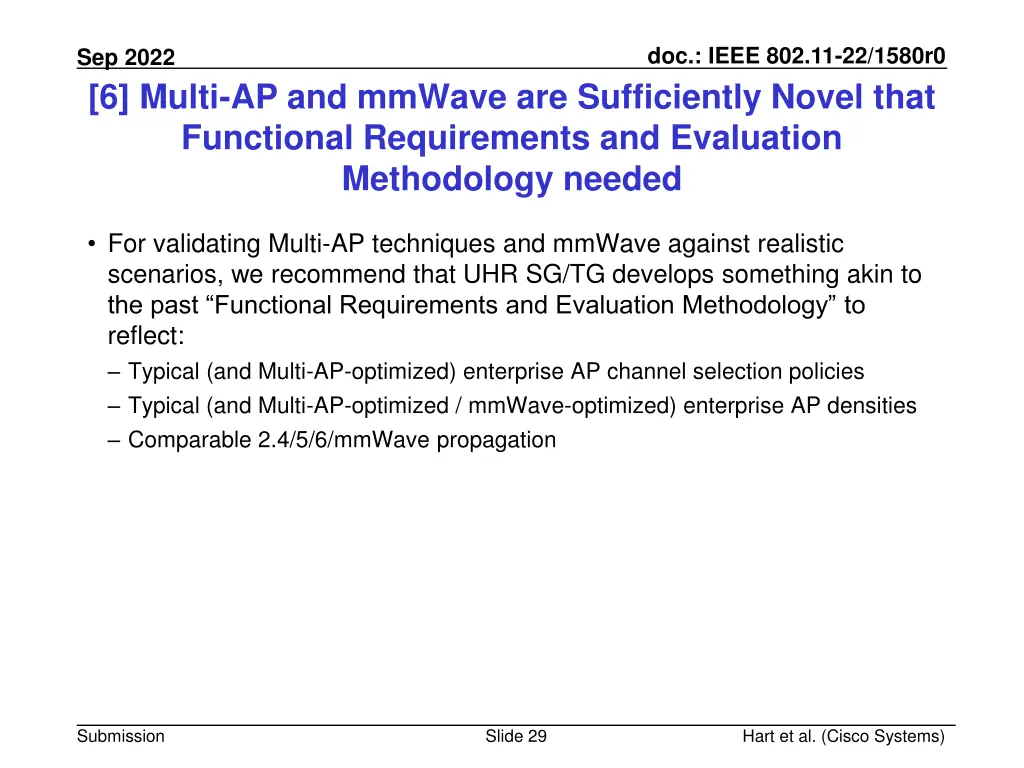
doc.: IEEE 802.11-22/1580r0 Sep 2022 [6] Multi-AP and mmWave are Sufficiently Novel that Functional Requirements and Evaluation Methodology needed For validating Multi-AP techniques and mmWave against realistic scenarios, we recommend that UHR SG/TG develops something akin to the past Functional Requirements and Evaluation Methodology to reflect: Typical (and Multi-AP-optimized) enterprise AP channel selection policies Typical (and Multi-AP-optimized / mmWave-optimized) enterprise AP densities Comparable 2.4/5/6/mmWave propagation Submission Slide 29 Hart et al. (Cisco Systems)
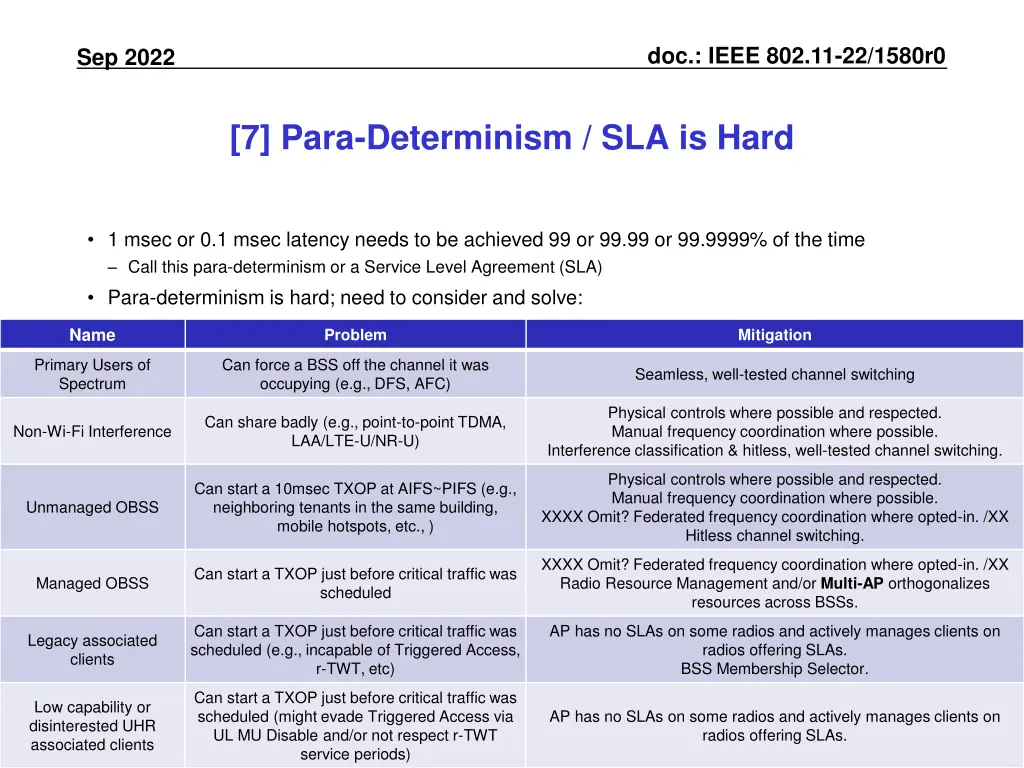
doc.: IEEE 802.11-22/1580r0 Sep 2022 [7] Para-Determinism / SLA is Hard 1 msec or 0.1 msec latency needs to be achieved 99 or 99.99 or 99.9999% of the time Call this para-determinism or a Service Level Agreement (SLA) Para-determinism is hard; need to consider and solve: Name Problem Mitigation Primary Users of Spectrum Can force a BSS off the channel it was occupying (e.g., DFS, AFC) Seamless, well-tested channel switching Physical controls where possible and respected. Manual frequency coordination where possible. Interference classification & hitless, well-tested channel switching. Can share badly (e.g., point-to-point TDMA, LAA/LTE-U/NR-U) Non-Wi-Fi Interference Physical controls where possible and respected. Manual frequency coordination where possible. XXXX Omit? Federated frequency coordination where opted-in. /XX Hitless channel switching. Can start a 10msec TXOP at AIFS~PIFS (e.g., neighboring tenants in the same building, mobile hotspots, etc., ) Unmanaged OBSS XXXX Omit? Federated frequency coordination where opted-in. /XX Radio Resource Management and/or Multi-AP orthogonalizes resources across BSSs. Can start a TXOP just before critical traffic was scheduled Managed OBSS Can start a TXOP just before critical traffic was scheduled (e.g., incapable of Triggered Access, r-TWT, etc) AP has no SLAs on some radios and actively manages clients on radios offering SLAs. BSS Membership Selector. Legacy associated clients Can start a TXOP just before critical traffic was scheduled (might evade Triggered Access via UL MU Disable and/or not respect r-TWT service periods) Low capability or disinterested UHR associated clients AP has no SLAs on some radios and actively manages clients on Submission Slide 30 Hart et al. (Cisco Systems) radios offering SLAs.
doc.: IEEE 802.11-22/1580r0 Sep 2022 [8] A single leader model for Multi-AP is usually insufficient: connectivity is routinely 3 hops or more On these floors, APs are routinely up to two hops from a central AP Largest islands of co-channel APs within range of each other 40MHz, 20 dBm: 5 APs (with a possible 1-hop leader) 80 MHz, 5dBm: 4 APs (no 1-hop leader) 80MHz, 20 dBm: 7 APs (no 1-hop leader) Environment AP Count Square feet per AP Open-plan corporate office with sporadic drywall meeting rooms and two internal concrete walls (with multiple breaks) in the middle left-to-right on these images) 39 1540 Submission Slide 31 Hart et al. (Cisco Systems)
doc.: IEEE 802.11-22/1580r0 Sep 2022 [9a] Restatement of why adding Roaming MLDs to the architecture adds extra delays Bolded items can add latency versus a legacy AP MLD TX: Need to retrieve the frame and reforward (as shown, 3x network hops versus legacy) RX: if there are asymmetric path delays through the network, all frames tend to get delayed by the longest path delay AP Roaming MLD TX: buffer, and send on one (or more) links; if the first try fails or retries persistently fail, retry on another AP MLD RX: merge frames in reorder buffer and release de-duped & ordered frames AP MLD AP MLD AP AP AP AP Colored boxes represent typical box boundaries Non-AP Non-AP Non-AP Non-AP The Non-AP Roaming MLD and non-AP MLD sublayers collapse together in the non- AP STA device Non-AP MLD Non-AP MLD Non-AP Roaming MLD TX RX Submission Slide 32 Hart et al. (Cisco Systems)
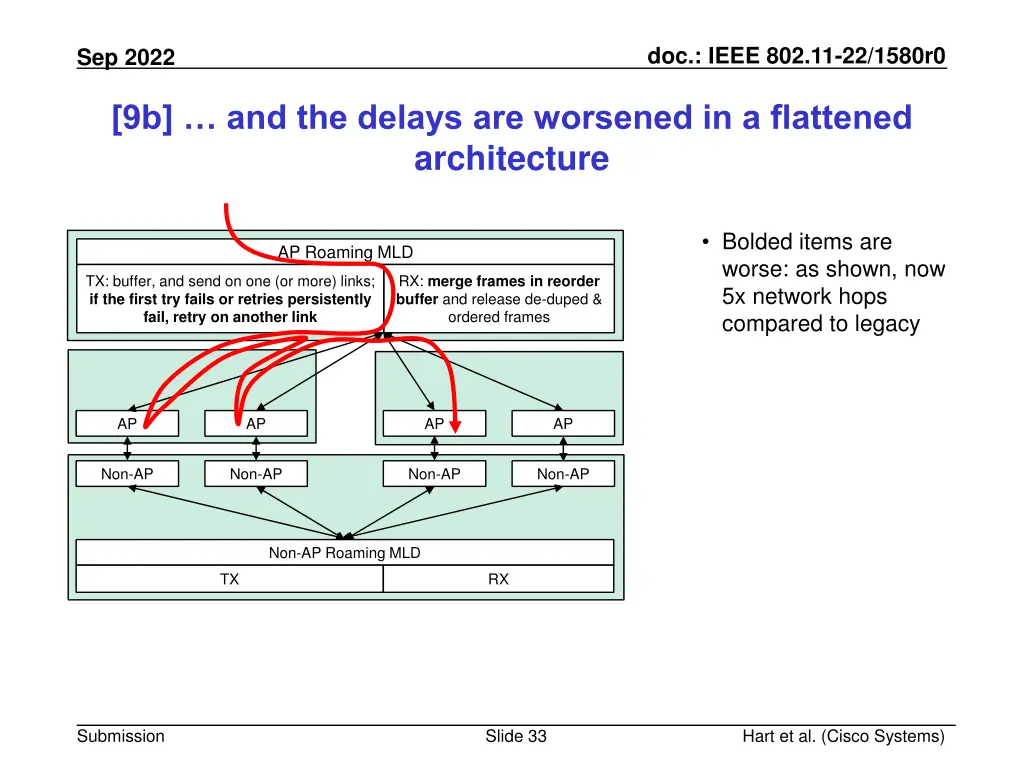
doc.: IEEE 802.11-22/1580r0 Sep 2022 [9b] and the delays are worsened in a flattened architecture Bolded items are worse: as shown, now 5x network hops compared to legacy AP Roaming MLD TX: buffer, and send on one (or more) links; if the first try fails or retries persistently fail, retry on another link RX: merge frames in reorder buffer and release de-duped & ordered frames AP AP AP AP Non-AP Non-AP Non-AP Non-AP Non-AP Roaming MLD TX RX Submission Slide 33 Hart et al. (Cisco Systems)
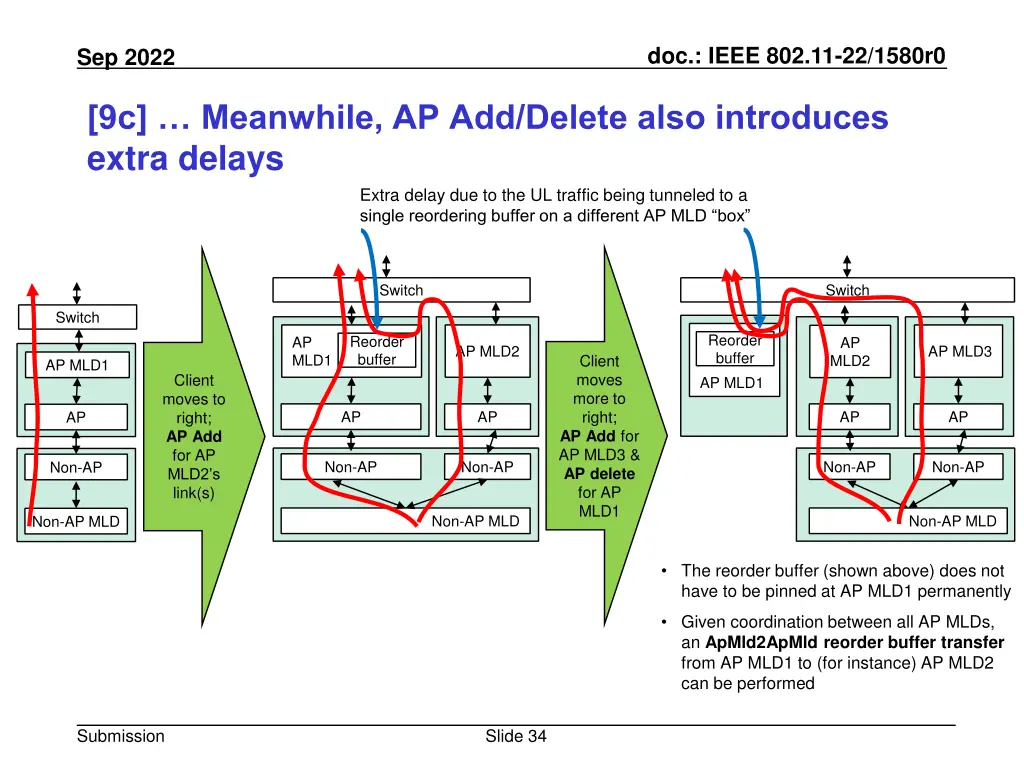
doc.: IEEE 802.11-22/1580r0 Sep 2022 [9c] Meanwhile, AP Add/Delete also introduces extra delays Extra delay due to the UL traffic being tunneled to a single reordering buffer on a different AP MLD box Switch Switch Switch Reorder buffer Reorder buffer AP MLD1 AP MLD2 AP MLD2 AP MLD3 Client moves more to right; AP Add for AP MLD3 & AP delete for AP MLD1 AP MLD1 Client moves to right; AP Add for AP MLD2 s link(s) AP MLD1 AP AP AP AP AP Non-AP Non-AP Non-AP Non-AP Non-AP Non-AP MLD Non-AP MLD Non-AP MLD The reorder buffer (shown above) does not have to be pinned at AP MLD1 permanently Given coordination between all AP MLDs, an ApMld2ApMld reorder buffer transfer from AP MLD1 to (for instance) AP MLD2 can be performed Submission Slide 34
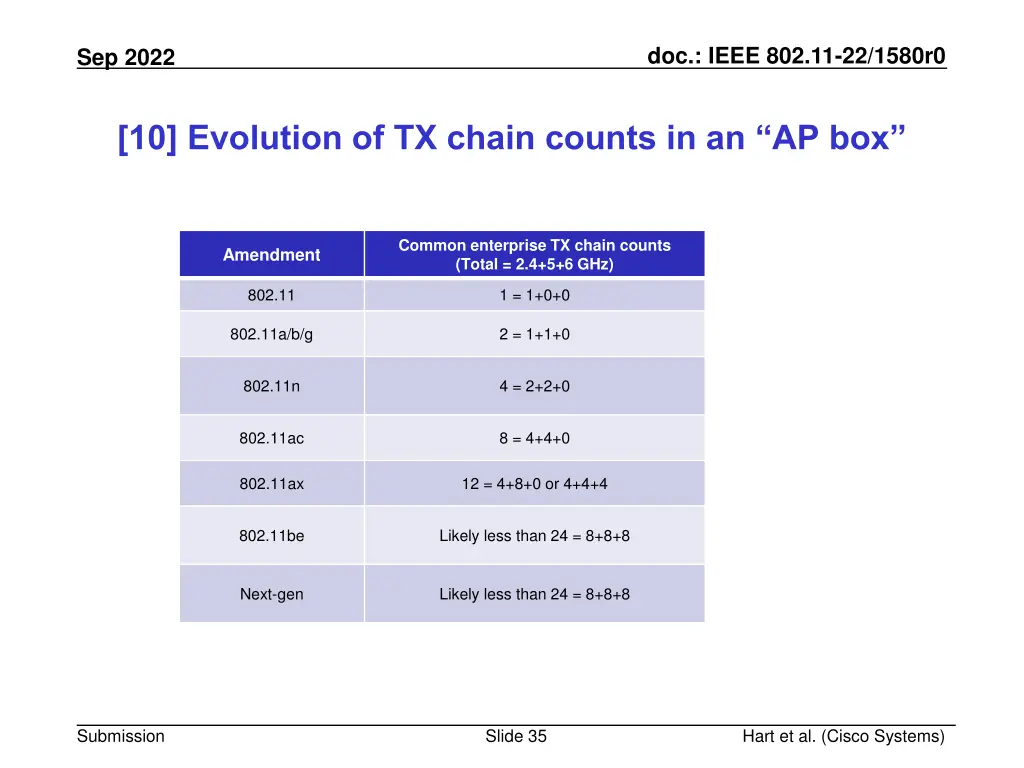
doc.: IEEE 802.11-22/1580r0 Sep 2022 [10] Evolution of TX chain counts in an AP box Common enterprise TX chain counts (Total = 2.4+5+6 GHz) Amendment 802.11 1 = 1+0+0 802.11a/b/g 2 = 1+1+0 802.11n 4 = 2+2+0 802.11ac 8 = 4+4+0 802.11ax 12 = 4+8+0 or 4+4+4 802.11be Likely less than 24 = 8+8+8 Next-gen Likely less than 24 = 8+8+8 Submission Slide 35 Hart et al. (Cisco Systems)
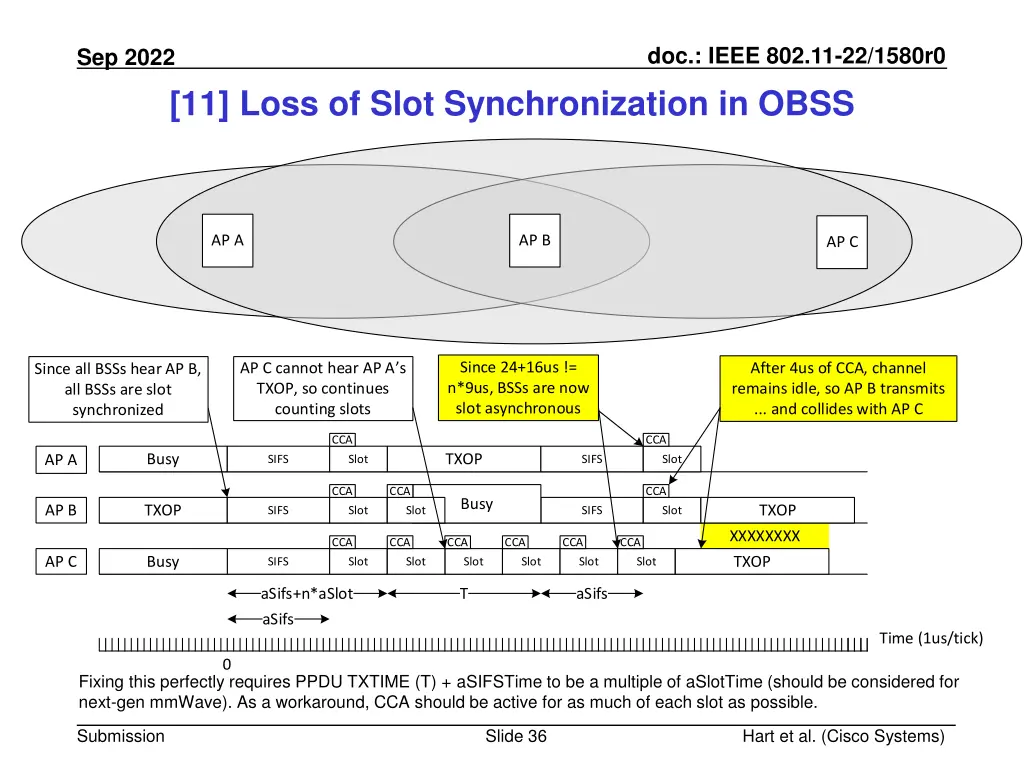
doc.: IEEE 802.11-22/1580r0 Sep 2022 [11] Loss of Slot Synchronization in OBSS AP A AP B AP C Since 24+16us != n*9us, BSSs are now slot asynchronous AP C cannot hear AP As TXOP, so continues counting slots After 4us of CCA, channel remains idle, so AP B transmits ... and collides with AP C Since all BSSs hear AP B, all BSSs are slot synchronized CCA CCA Busy TXOP AP A SIFS Slot SIFS Slot CCA CCA CCA Busy AP B TXOP TXOP SIFS Slot Slot SIFS Slot XXXXXXXX CCA CCA CCA CCA CCA CCA AP C Busy TXOP SIFS Slot Slot Slot Slot Slot Slot aSifs+n*aSlot T aSifs aSifs Time (1us/tick) 0 Fixing this perfectly requires PPDU TXTIME (T) + aSIFSTime to be a multiple of aSlotTime (should be considered for next-gen mmWave). As a workaround, CCA should be active for as much of each slot as possible. Submission Slide 36 Hart et al. (Cisco Systems)