Pharmaceutical Chemistry
Epilepsy, affecting over 0.5% of the global population, is characterized by recurrent seizures resulting from disturbances in brain electrical activity. Seizures arise from an imbalance between excitatory and inhibitory processes and may be caused by various factors including brain tumors, trauma, neurological diseases, or metabolic disorders. Classification of seizures includes primary generalized and partial seizures, with recommended therapies varying based on seizure types. Anticonvulsants' mechanisms involve modulation of ion channels, enhancement of GABA-mediated neurotransmission, and attenuation of excitatory activity.

Download Presentation

Please find below an Image/Link to download the presentation.
The content on the website is provided AS IS for your information and personal use only. It may not be sold, licensed, or shared on other websites without obtaining consent from the author.If you encounter any issues during the download, it is possible that the publisher has removed the file from their server.
You are allowed to download the files provided on this website for personal or commercial use, subject to the condition that they are used lawfully. All files are the property of their respective owners.
The content on the website is provided AS IS for your information and personal use only. It may not be sold, licensed, or shared on other websites without obtaining consent from the author.
E N D
Presentation Transcript
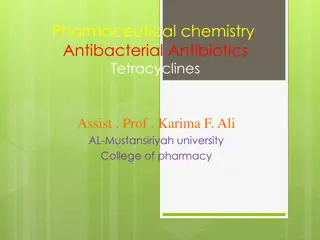
Pharmaceutical Chemistry Anticonvulsant Drugs By Assist. Prof. Karima Fadhil Ali Al mustansiriyah university College of pharmacy
: Anticonvulsant Drugs ( Anticonvulsant Drugs (AEDs) AEDs) Epilepsy is not a disease. It is the most prevalent neurological disorder affecting more than 0.5% of the world s population. It is characterized by recurrent seizures. Seizures, on the other hand, are symptoms of disturbed electrical activity in the brain characterized by episodes of abnormal, excessive, and synchronous discharge of a group of neurons within the brain that cause involuntary movement, sensation, or thought.
It is generally agreed that seizures may result from primary or acquired neurological disturbances of brain function as a result of an imbalance between excitatory and inhibitory processes in the brain. There are many possible causes of seizure including brain tumors or infections, head trauma, neurological diseases, systemic or metabolic disorders, alcohol abuse, drug overdose, or toxicities.
Classification of Epileptic Seizures and Classification of Epileptic Seizures and Recommended Initial Drug Therapy Recommended Initial Drug Therapy Seizures are classified, based on their initial signs and symptoms and the pattern seen on the electro- encephalogram (EEG), into two broad categories: Primary generalized seizures Two major types of generalized seizures are the primarily generalized tonic clonic seizures (grand mal) and the absence (petit mal) seizures. Partial seizures Major types of partial seizure are simple partial seizures (focal) and complex partial seizures (temporal lobe or psychomotor).
Mechanisms of action of anticonvulsants Mechanisms of action of anticonvulsants (A) Modulation of voltage-gated ion channels (Na, Ca2, and K). (B) Enhancement of - amino butyric acid (GABA)-mediated inhibitory neurotransmission. (C) Attenuation of excitatory (particularly glutamate-mediated) neurotransmission in the brain. Many of AEDs, especially the newer drugs, work by more than one of the above mechanisms of actions, therefore possessing a antiepileptic action. broader spectrum of
GABA A Receptors as Targets for Anticonvulsants It is now well recognized that cellular excitability leading to convulsive seizures can be attenuated by GABA ergic stimulation in the brain. The GABAA receptor is one of two ligand-gated ion channels responsible for mediating the effects of GABA, the major inhibitory neurotransmitter in the brain. Activation of the GABAA/benzodiazepine (BZD) receptors/chloride channel complex allows increased chloride conductance, thereby preventing the spread of neuronal excitations.
The potential targets for AEDs action on the GABA ergic inhibitory synapses include: (a)Drugs that enhance the biosynthesis of GABA(gabapentin, pregabalin, and VPA), (b) Drugs that inhibit GABA degradation (vigabatrin). (c) Drugs that inhibit the reuptake of GABA (tiagabine). (d) Drugs that bind to an allosteric site on the postsynaptic GABAA receptor complex that increase chloride conductance (barbiturates, BZDs).
Phenobarbital and Primidone (Mysoline) Although sedative hypnotic barbiturates commonly display anticonvulsant properties, only phenobarbital display enough anticonvulsant selectivity for use as antiepileptics.
Primidone (Mysoline) Is metabolized by CPY2C9/19 to phenobarbital and phenylethylmalonamide (PEMA) Both of these metabolites have anticonvulsant activities. However, it is generally believed that the pharmacological action of primidone is mainly a result of the minor metabolite, phenobarbital. Thus, primidone is much less potent/toxic than phenobarbital, because most of the drug is rapidly degraded to the less potent metabolite, PEMA.
Hydantoins Hydantoins
Hydantoin Drugs Hydantoin Drugs
Carbamazepine (Tegretol) The two phenyls substituted on the urea nitrogen fit the pharmacophore pattern suggested for binding to the VGSC. Like phenytoin, CBZ is useful in generalized tonic clonic and partial seizures. Carbamazepine stabilizes the inactivated state of voltage-gated sodium channels, making fewer of these channels available to subsequently open. This leaves the affected cells less excitable until the drug dissociates. Carbamazepine is also a GABA receptor agonist, as it has also been shown to potentiate GABA receptors made up of alpha1, beta2, and gamma2 subunits Oxcarbazepine (Trileptal) (OXC) is a newer AED with a similar mechanism of action to CBZ except for its metabolic inactivation pathway.
Metabolism of Carbamazepine and Metabolism of Carbamazepine and Oxcarbazepine Oxcarbazepine
Drugs that enhance the biosynthesis of GABA GABA, the major inhibitory neurotransmitter in the brain, is biosynthesized at the GABA ergic neurons by the decarboxylation of the amino acid, L- glutamic acid (itself an excitatory amino acid neurotransmitter in the brain). The rate-limiting enzyme that catalyzes this conversion is L-glutamic acid decarboxylase (GAD). A 3-substituted GABA, gabapentin and especially pregabalin, may have the ability to activate GAD, Both of these drugs are weak activators of GAD.
Gabapentin pregabalin, (S)-3-isobutyl-GABA are broad-spectrum anti consultants. with multiple mechanisms of action. In addition to modulating calcium influx and stimulate GABA biosynthesis, they also compete for the biosynthesis of L-glutamic acid because of their structural similarity to L-leucine. and its closely related analog
Valproic Acids (VPA), also elevates brain levels of GABA in patients with epilepsy. It is generally agreed that VPA inhibits SSADH, the enzyme responsible for conversion of SSA to succinic acid. The exact mechanism of action of how this inhibition enhances GABA levels in the brain is still the subject of much debate (i.e., from an indirect stimulation of GAD to an inhibition of GABA-T).
Drugs that inhibit GABA degradation Vigabatrin (-vinyl-GABA) is an irreversible inhibitor GABA-T, rationally designed biochemical mechanism of transamination reaction. Briefly, vigabatrin, because of its structural similarity, competes with GABA for binding to GABA-T and forms a Schiff base intermediate with the cofactor, pyridoxal phosphate similar to GABA. of based on the
However, unlike its substrate GABA, during the process of transferring the amino group to the pyridoxal phosphate, a reactive intermediate is formed with vigabatrin that immediately attaches itself to the active site of the enzyme, thereby irreversibly inhibiting GABA-T GABA levels in the brain. , It is marketed as an adjunctive treatment of patients with partial seizures. and increasing
Drugs that inhibit reuptake of GABA Tigabine: An uptake inhibitor. it blocks GABA reuptake as a major mode of its anticonvulsant activity. Its use is against partial seizures. Inhibitors of GABA transporter-1(GAT-1 inhibitors) increase extracellular GABA concentration in the hippocampus, striatum, and cortex, thereby prolonging the inhibitory action of GABA released synaptically.
Ethosuximide (zarontin) and Methsuximide (celontin) Ethosuximide is considered the prototypical anticonvulsant needed for treating patients with absence seizures. Ethosuximide and the N- dealkylated active metabolite of methsuximide work by blocking the low threshold T-type calcium channels, thereby reducing the hyper excitability of thalamic neurons that is specifically associated with absence seizure.
Benzodiazepines (acts on a selective molecular target) Clonazepam: is useful in absence seizures and in myoclonic seizures. Tolerance to the clonazepam often developed rather quickly, and it is a common problem with the BZDs. Diazepam: is given orally (Valium) or rectally (Diastat) as an adjunctive treatment in patients with generalized tonic clonic status epilepticus. anticonvulsant effect of the