Stay informed about the upcoming Conservation of Energy lab deadline, test date, and Chipotle night. Learn about power in physics, work calculations, and examples involving elevator and car scenarios. Explore goal-less problems to practice problem-solving skills. Get ready for class with resources on the class website.
Please find below an Image/Link to download the presentation.
The content on the website is provided AS IS for your information and personal use only. It may not be sold, licensed, or shared on other websites without obtaining consent from the author. If you encounter any issues during the download, it is possible that the publisher has removed the file from their server.
You are allowed to download the files provided on this website for personal or commercial use, subject to the condition that they are used lawfully. All files are the property of their respective owners.
The content on the website is provided AS IS for your information and personal use only. It may not be sold, licensed, or shared on other websites without obtaining consent from the author.
E N D
Presentation Transcript
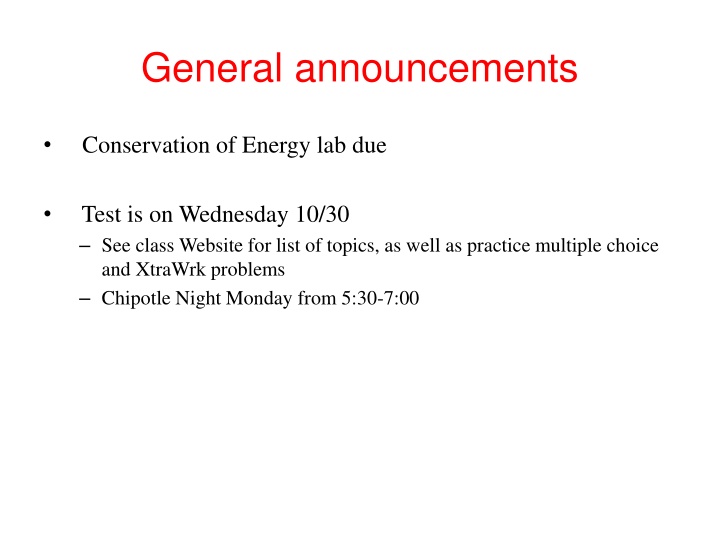
General announcements Conservation of Energy lab due Test is on Wednesday 10/30 See class Website for list of topics, as well as practice multiple choice and XtraWrk problems Chipotle Night Monday from 5:30-7:00
Power Although it s useful to know how much work a force field will do on an object traveling through it, it is often considerably more useful to know how much work per unit time the field is capable of doing (or actually does). Called power, this rate at which work is done per unit time is mathematically defined as: Pavg DW Dt or if you are talking incremental changes at an instant, . Pinst dW dt For a moving body with constant velocity v, the instantaneous power provided by a force on the body over a displacement will be: The units of power in the MKS system are joules per second, or the watt.
Example 1: An elevator of mass 1000 kg carries a load of 800 kg. It rises 12 meters in 8 seconds at essentially a constant speed. a.) Determine the minimum work the elevator motor must do in lifting the load. The weight of the elevator and occupants is This is the amount of force the elevator must provide to raise the system 12 meters at a constant speed. The work associated with that force is: ( )=17,640 N. mg= 1800 kg ( ) 9.8 m/s2 P =W b.) What must the motor s power rating be to affect this lift? t =211,680 = 26,460 watts 8 s c.) How many horsepower is that?There are 746 watt/HP, so ( )= 35.47 HP P = 26,460 watts ( )1 HP746 watt
Example 2: A 1000 kg car traveling at 15 m/s runs into a vat of jello. As the car proceeds, it slows to rest over a 18 second period. a.) How much work did the jello do on the car as it brought the car to rest? Assuming the jello was the only force acting on the car, the work it did will be the net work done on the car. Using the work/energy theorem, we can write: Wnet= DKE Wjello=1 2m vfinal = 0+1 21000 kg =115,500 J 2-1 ( ) ( ) 2 2m vinitial ) 15 m/s ( ( ) 2 b.) How much power did the jello provide to the system? P =Wt =115,500 J ( ) 18 sec ( ) = 6.417 watts
Goal-less problems A goal-less problem is just that: a problem that doesn t have a single, specific answer in mind. This is a lot more like what real-world science is like: you have some information about a situation, and you have to figure out what would be useful to do with that information. In a goal-less problem, there are many avenues you can take. Your job is to use as many skills as you can (preferably, from each unit we ve done so far: kinematics, forces, energy) to figure out stuff about the situation. Use equations, sketches/diagrams, graphs, blurbs, whatever. Everyone s solution will be different!
Goal-less problems 1.) An 80.0 kg box starts from rest and travels to the bottom of a 2.0 meter long, 20 degree ramp, opposed by a 150 newton force of friction. From this information, what can you tell about this system? q= 20o