Physics Problems Solutions on Pressure and Buoyancy
Get step-by-step solutions to various physics problems involving pressure, buoyancy, and density. Learn how to calculate forces, pressures, and depths in different scenarios like portholes in airplanes, beakers in mercury, and hot air balloons. Improve your understanding of physics concepts through detailed explanations and answers.

Download Presentation

Please find below an Image/Link to download the presentation.
The content on the website is provided AS IS for your information and personal use only. It may not be sold, licensed, or shared on other websites without obtaining consent from the author. If you encounter any issues during the download, it is possible that the publisher has removed the file from their server.
You are allowed to download the files provided on this website for personal or commercial use, subject to the condition that they are used lawfully. All files are the property of their respective owners.
The content on the website is provided AS IS for your information and personal use only. It may not be sold, licensed, or shared on other websites without obtaining consent from the author.
E N D
Presentation Transcript
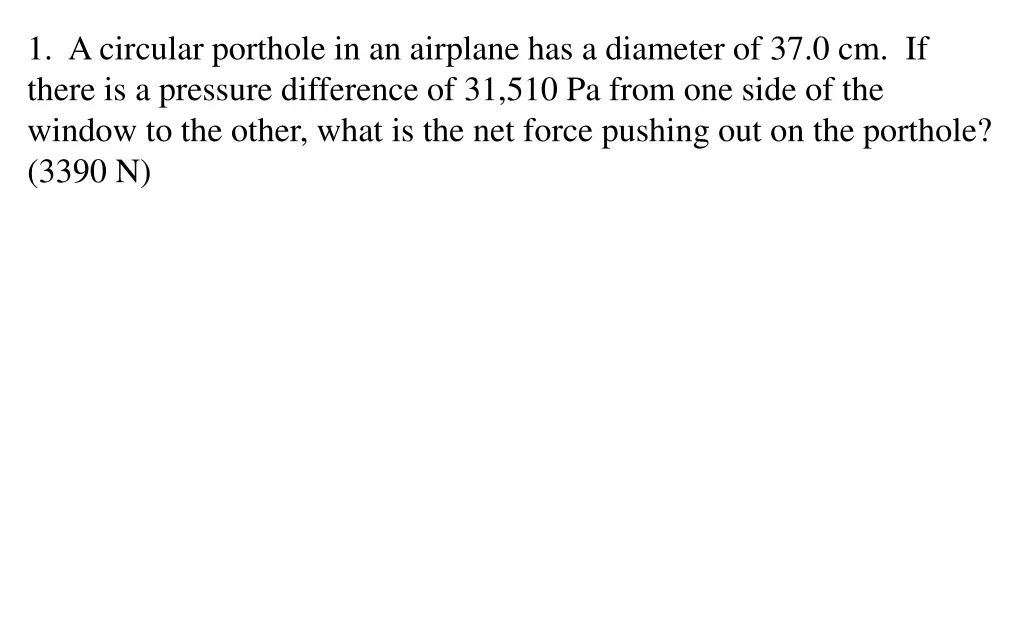
1. A circular porthole in an airplane has a diameter of 37.0 cm. If there is a pressure difference of 31,510 Pa from one side of the window to the other, what is the net force pushing out on the porthole? (3390 N)
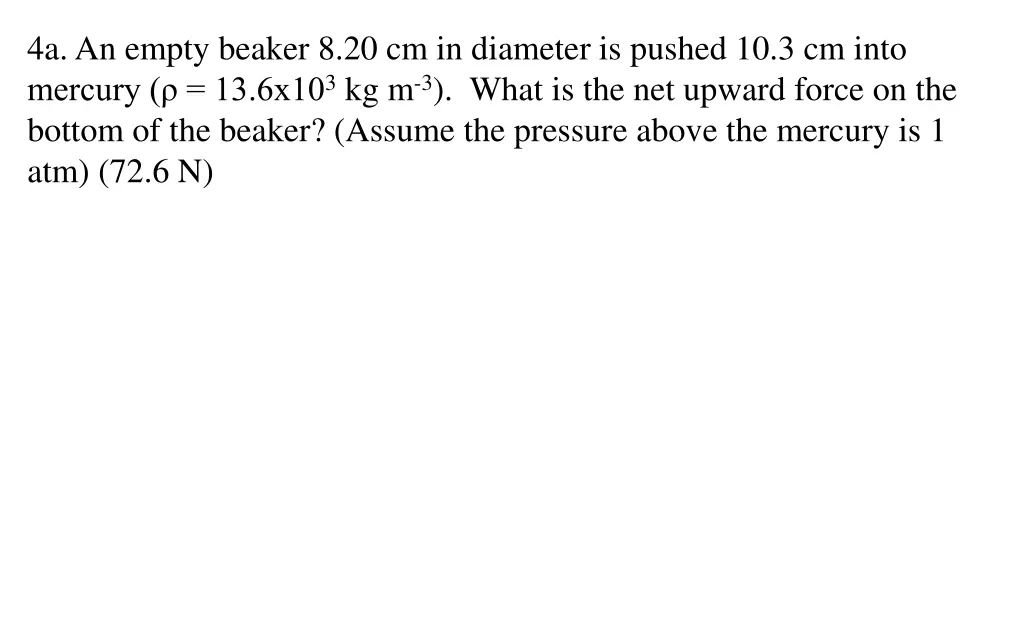
4a. An empty beaker 8.20 cm in diameter is pushed 10.3 cm into mercury ( = 13.6x10³ kg m-3). What is the net upward force on the bottom of the beaker? (Assume the pressure above the mercury is 1 atm) (72.6 N)
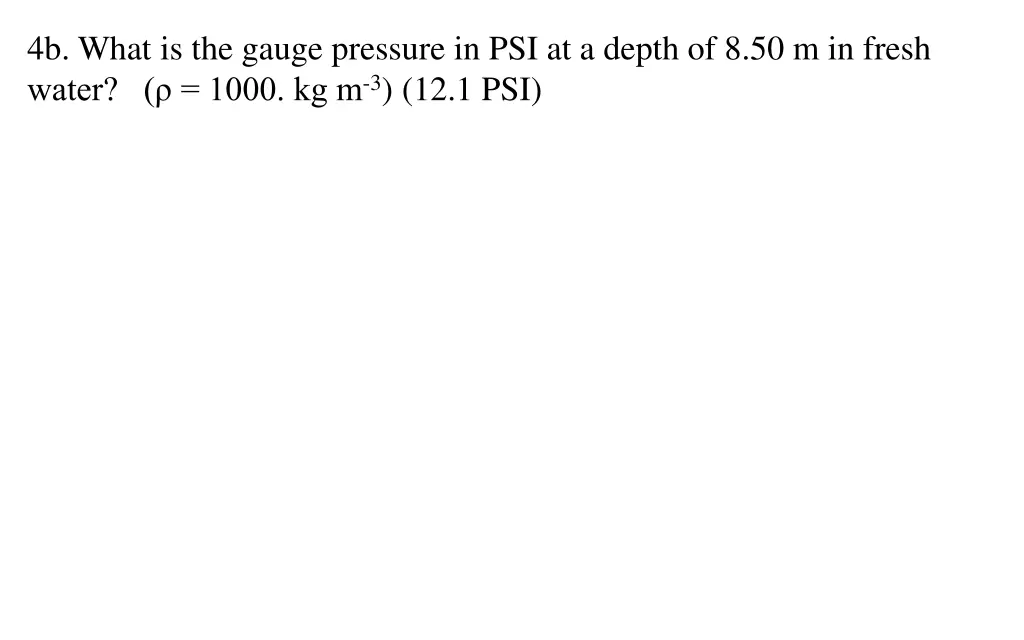
4b. What is the gauge pressure in PSI at a depth of 8.50 m in fresh water? ( = 1000. kg m-3) (12.1 PSI)
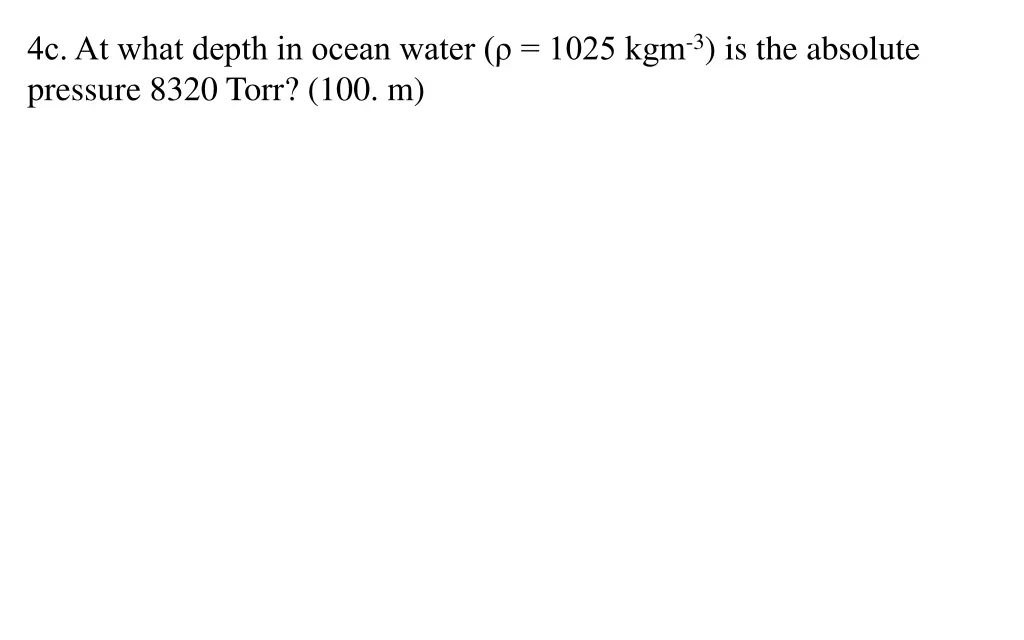
4c. At what depth in ocean water ( = 1025 kgm-3) is the absolute pressure 8320 Torr? (100. m)
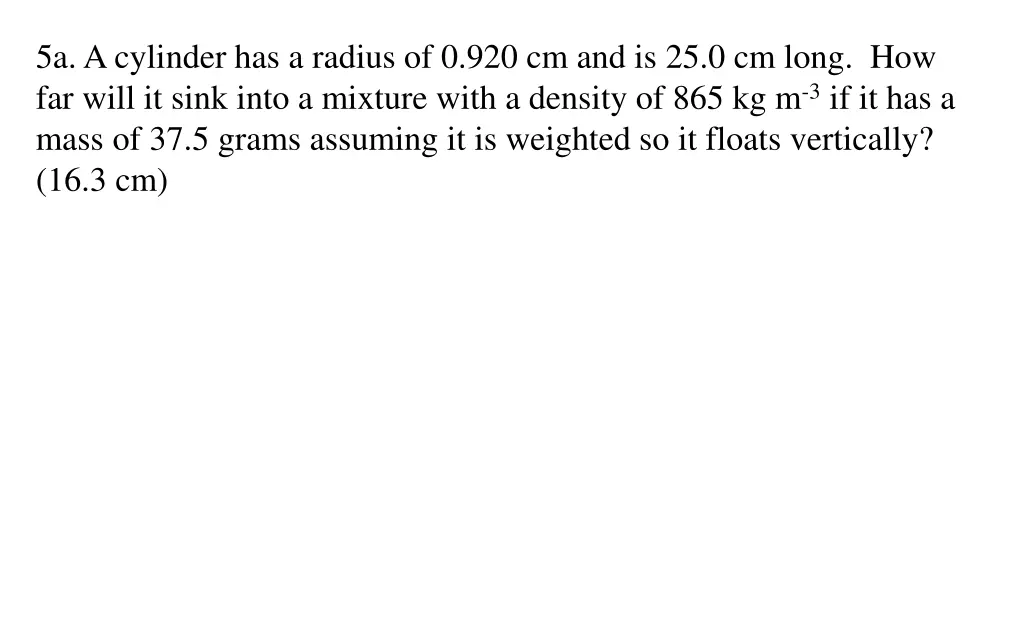
5a. A cylinder has a radius of 0.920 cm and is 25.0 cm long. How far will it sink into a mixture with a density of 865 kg m-3 if it has a mass of 37.5 grams assuming it is weighted so it floats vertically? (16.3 cm)
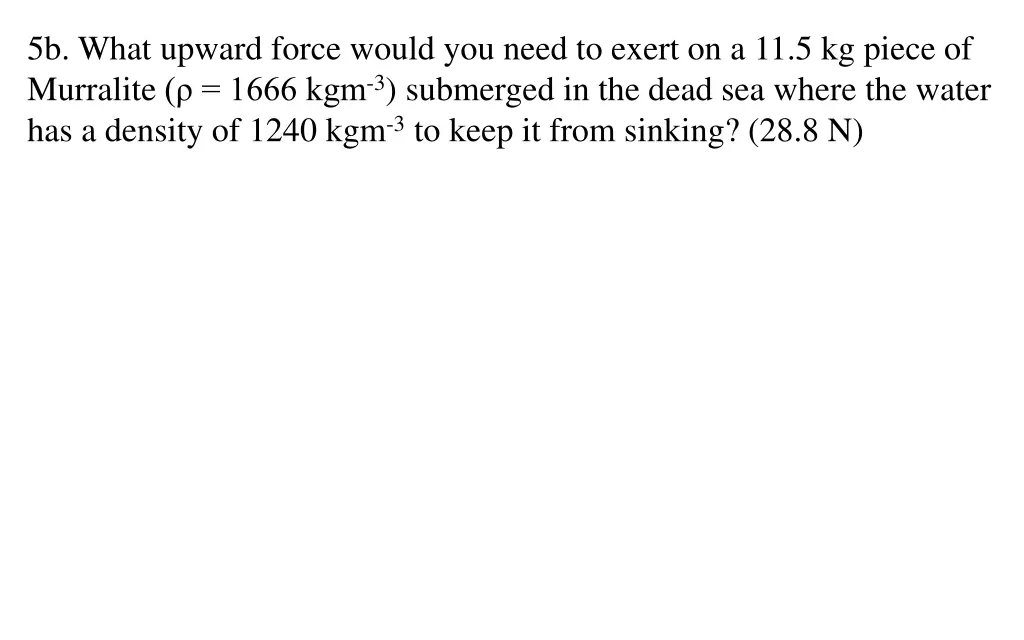
5b. What upward force would you need to exert on a 11.5 kg piece of Murralite ( = 1666 kgm-3) submerged in the dead sea where the water has a density of 1240 kgm-3 to keep it from sinking? (28.8 N)
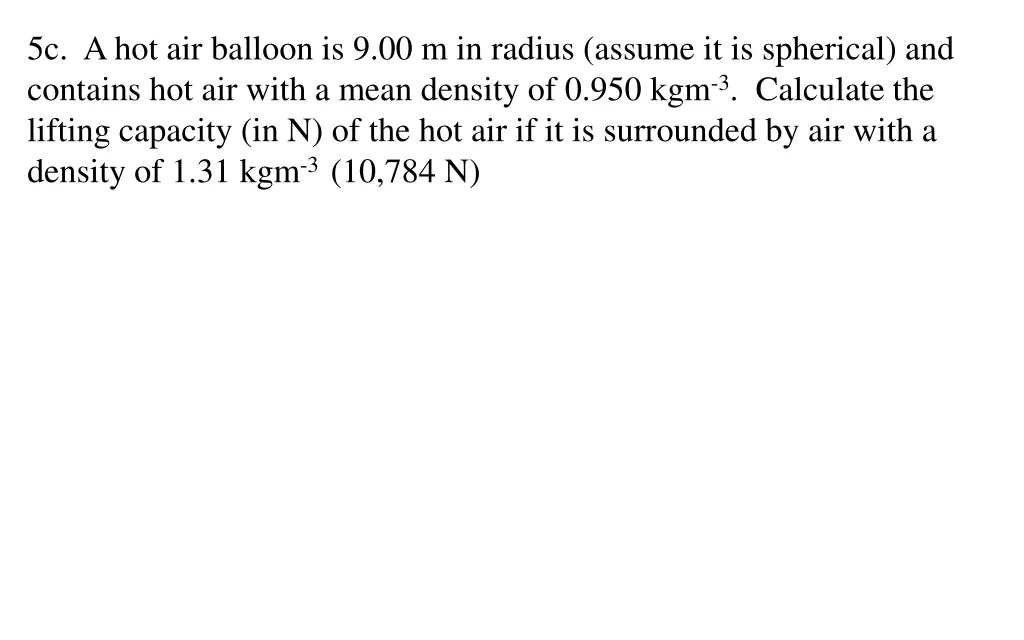
5c. A hot air balloon is 9.00 m in radius (assume it is spherical) and contains hot air with a mean density of 0.950 kgm-3. Calculate the lifting capacity (in N) of the hot air if it is surrounded by air with a density of 1.31 kgm-3 (10,784 N)