Explore the fascinating field of physiological psychology, delving into the intricate relationship between the brain and behavior. From the philosophical origins of dualism and monism to the study of neurons and types of neurons, this article provides insight into how physiological processes influence human behavior.
Please find below an Image/Link to download the presentation.
The content on the website is provided AS IS for your information and personal use only. It may not be sold, licensed, or shared on other websites without obtaining consent from the author. If you encounter any issues during the download, it is possible that the publisher has removed the file from their server.
You are allowed to download the files provided on this website for personal or commercial use, subject to the condition that they are used lawfully. All files are the property of their respective owners.
The content on the website is provided AS IS for your information and personal use only. It may not be sold, licensed, or shared on other websites without obtaining consent from the author.
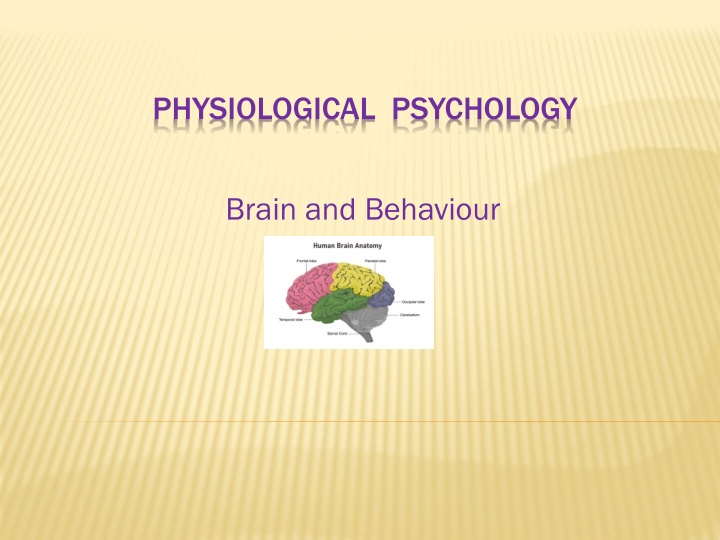
INTRODUCTION Physiological Psychology: Study of he physiological bases of psychological functions, like thinking, feeling and willing. It connects the physical operation of brain with our daily behaviour, with what we actually say and do.
PHILOSOPHICAL ORIGIN Dualism and Monism Dualism and Monism Ren Descartes ((1596 Ren Descartes ((1596 1650) Two substances: Two substances: 1650) (i) Primary (i) Primary (ii) Secondary (ii) Secondary Mind Matter Mind Matter Monism: Only one substance: Mind or matter Monism: Only one substance: Mind or matter
Mind- brain Identity theory Reductionism Physiological Psychology tries to explain behaviour in terms of physiological changes that occur inside the body. Any behaviour like running, singing songs, solving a puzzle etc. produces electrical or chemical changes in the nervous system.
Goal of physiological psychology is to discover the exact nature of the relation that exists between the these physiological processes that control behaviour. Most research is done on animals. Reason: Ethics. Methods of research: Somatic Intervention: Making changes in the structure or chemical organizarion of the brain and observe the behviour. Behavioural intervention: changing the behaviour and observing the changes in the structure or function of the brain.
Correlational approach: Tries to find our whether certain somatic or behavioural changes go together with certain brain ochanges. Methods to study the functioning of the living brain: 1. CT Scan(computerised Tomography 2. Contrast X-Ray 3. MRI (Magnetic Resonance imaging 4. PET (Positron Emission Tomography)
Neuron: What is a system? What is a Nervous system? Neuron:
Unipolar neurons have only one structure that extends away from the soma. These neurons found in vertebrates are modified cells with two extensions from cell- body Early stages of development: the extensions migrate to one side of the cell body and fuse to form a single extension. Where to find: In vertebrates in the dorsal root ganglia of the spinal nerves. Nature: Sensory. Conduct impulses from skin receptors to spinal nerves.
A bipolar neuron has one axon and one dendrite extending from the soma. In vertebrates the dendrite of a bipolar cell is branched, and axon is unbranched. An example of a bipolar neuron is a retinal bipolar cell, which receives signals from photoreceptor cells that are sensitive to light and transmits these signals to ganglion cells that carry the signal to the brain.
Multipolar neurons are the most common type of neuron. Each multipolar neuron contains one axon and multiple dendrites. In vertebrates there are several short and branched extensions, called dendrites and one long extension called Axon. Majority of vertebrates come under this category.
. Pseudounipolar cells share characteristics with both unipolar and bipolar cells. A pseudounipolar cell has a single process that extends from the soma, like a unipolar cell, but this process later branches into two distinct structures, like a bipolar cell. Most sensory neurons are pseudo-unipolar and have an axon that branches into two extensions: one connected to dendrites that receive sensory information and another that transmits this information to the spinal cord.
Nerve fibre: Individual neurons organised into tissues form a nerve. Hundreds of individual neurons groups together to form a nerve bundle and are surrounded by connective tissues. A nerve is an association of individual nerve fibres.
FUNCTIONAL CLASSIFICATION: Sensory/Afferent : Sensory nerves: Carry messages from sense receptors to CNS. Motor/efferent: carry messages from CNS to effectors (muscles). Some nerve trunks are composed to sensory, others of motor and still others of both sensory and motor nerve fibres. Neurons and their processes are formed by non- nervous glial cells.
A nervous impulse is an electro-chemical phenomenon a message carried along a neuron. A nerve is an electrical conductor. All or none law: 1987: Henry Pickering Bowdicth. The principle: For eliciting an impulse a minimum threshold of stimulation is required. Once stimulated the nervous impulse will be carried with maximum speed irrespective of the intensity of the stimulus.
SYNAPSE: Def: A junction between two nerve cells with a tiny gap across which the nervous impulses are carried on from one nerve cell to another. Sir Charles Sherrington: 1861 1954 Functional importance was established by McLennon in 1963. Close proximity between two nerves, but they are not anatomically continuous.
Pre-synaptic nerve: the nerve which contributes the axon involved in synapse is the pre-synaptic neuron, i.e. The nerve which sends the impulse is the Pre-synaptic nerve. Post-synaptic neuron: the nerve that provides dendritic site in the synaptic areas is the post- synaptic neuron, i.e. the nerve that receives the impulse is the post-synaptic nerve.
Impulse received from the pre-synaptic neurons is carried along the post-synaptic neuron. Gap between the two neurons involved in synaptic transmission is called synaptic cleft. A synapse is a combination of : Pre-synaptic endings Synaptic clefts Post-synaptic endings
Synaptic vesicles: Covered in membranes and contain neurotransmitters. Vesicles: When an action potential arrives at pre-synaptic terminal, vesicles activate voltage- gated calcium channels in the neurons membranes.
Calcium channels are concentated outside the neurons. When activated, the rush into the neuron. Ca2 allows the vesicles top fuse with the synaptic membrane which enables it to release neurotransmitters. transmitters bind the receptors of post-synaptic neuron. Receptors are activated leading either opening of closing of the ion channels. Polarising making the inside of the cell or positive; Depolarising: making inisde of the cell more negative.
SYNAPSE: Electrical: gap Less , around 3.5 nanometers; Direct physical connection between Pre and post synaptic nerves; Speed: instantaneous; Only excitatory; Signal strength: diminishes over time Chemical signals: Gap: 20 Chemical signals: Gap: 20 nanometers Speed: several milliseconds Speed: several milliseconds Excitatory or inhibitory Excitatory or inhibitory No loss of signal strength No loss of signal strength nanometers; ;
Excitatory: Excitatory neuro-transmitters increase the probability that the excitatory signal is sent to the post-synaptic cell e.g. Adrenalin both a hormone and and a neuro- transmitter has an excitatory effect. Inhibitory: Decreases the probability of neuron firing. Generally responsible for calming the mind and inducing sleep, like, Serotonin.
Synaptic transmission: Electrical Chemical Electrical: tight junction; electrical resisitance made as low as possible. Chemical: Made through chemical agents, like neurotransmitters. Transmitter substance; Acelylcholine & Cholineacetylase. Synaptic fatigue: in the absece of adequate supply of oxygen and due to the deficiency of Transmitter substance.
Properties of a synapse: One way transmission: from pre-synaptic to post- synaptic. Synaptic delay: it takes some time for the discharge of synaptic transmitter substance from synaptic vesicles. Time; 0.3 10 milliseconds. Fatigue: due to delay in the release of transmitte substance. Summation: Adding up of a number of pre-synaptic impulses to elicit an impulse in the post-synaptic neuron is called temporal summation. A number of pre-synaptic neurons may be associated with post-synaptic neuron. Hence, all the pre-synaptic neuron together produce an action potential in the post0synaptic neuron. This is called spatial summation.
NEUROLOGICAL DISORDERS: Parkinson s disease and Alzheimer s disease: Neurogenerative disorders; AD: Affects primarily : emotion Language Memory Thinking areas of the brain, i.e. hippocampus, basal forebrain, amygdala, and the cerebral cortex. ,
AD Neurodegeneration, neurofibrillary tangles and beta-amyloid deposits. Symptoms: begins as ordinary lapses of memory. Slowly becomes worse. Suffer delusions also. Unable to speak or comprehend language.
PD: Motor areas are affected; Sunstatia Nigra in particular degenerates. P develops tremors in hands; Rigidity in arms and legs; Trouble keeping balance; With the progress of the disease, walking becomes difficult. Later may becomes confined to wheelchair or bed.
AD and PD: both degenerative; Both occur generally in old age; Become worse with time. Environmental Factors also responsible for PD. Especially herbicide containing a chemical substance Paraquat.