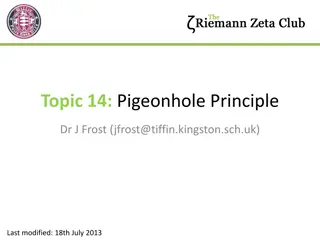
Learn how the Pigeonhole Principle is used to show that for every positive integer n, there exists a multiple of n with a decimal expansion consisting only of 0s and 1s.
Please find below an Image/Link to download the presentation.
The content on the website is provided AS IS for your information and personal use only. It may not be sold, licensed, or shared on other websites without obtaining consent from the author. If you encounter any issues during the download, it is possible that the publisher has removed the file from their server.
You are allowed to download the files provided on this website for personal or commercial use, subject to the condition that they are used lawfully. All files are the property of their respective owners.
The content on the website is provided AS IS for your information and personal use only. It may not be sold, licensed, or shared on other websites without obtaining consent from the author.
Solution Let n be a positive integer. Consider the n + 1 integers 1, 11, 111, . . . , 11 . . . 1 (where the last integer in this list is the integer with n + 1 1s in its decimal expansion). Note that there are n possible remainders when an integer is divided by n. Because there are n + 1 integers in this list, by the pigeonhole principle there must be two with the same remainder when divided by n. The larger of these integers less the smaller one is a multiple of n, which has a decimal expansion consisting entirely of 0s and 1s.
References Discrete Mathematics and Its Applications, McGraw-Hill; 7th edition (June 26, 2006). Kenneth Rosen Discrete Mathematics An Open Introduction, 2nd edition. Oscar Levin A Short Course in Discrete Mathematics, 01 Dec 2004, Edward Bender & S. Gill Williamson