Pipeline and Hazardous Materials Safety Administration Overview
Learn about the U.S. Department of Transportation's Pipeline and Hazardous Materials Safety Administration (PHMSA), its mission to ensure the safe transportation of energy and hazardous materials, the role of the Office of Chief Counsel, and the legal divisions within the organization.

Download Presentation

Please find below an Image/Link to download the presentation.
The content on the website is provided AS IS for your information and personal use only. It may not be sold, licensed, or shared on other websites without obtaining consent from the author. If you encounter any issues during the download, it is possible that the publisher has removed the file from their server.
You are allowed to download the files provided on this website for personal or commercial use, subject to the condition that they are used lawfully. All files are the property of their respective owners.
The content on the website is provided AS IS for your information and personal use only. It may not be sold, licensed, or shared on other websites without obtaining consent from the author.
E N D
Presentation Transcript
U.S. Department of Transportation Pipeline and Hazardous Materials Safety Administration Lithium Battery Air Safety Advisory Committee Meeting January 22, 2020 Paul Roberti Chief Counsel Office of Chief Counsel Pipeline and Hazardous Materials Safety Administration - 1 -
U.S. Department of Transportation Pipeline and Hazardous Materials Safety Administration Today s Discussion Background on the Pipeline and Hazardous Materials Safety Administration (PHMSA) and the Office of Chief Counsel The Federal Advisory Committee Act (FACA, 5 U.S.C. App. 2) Requirements - 2 -
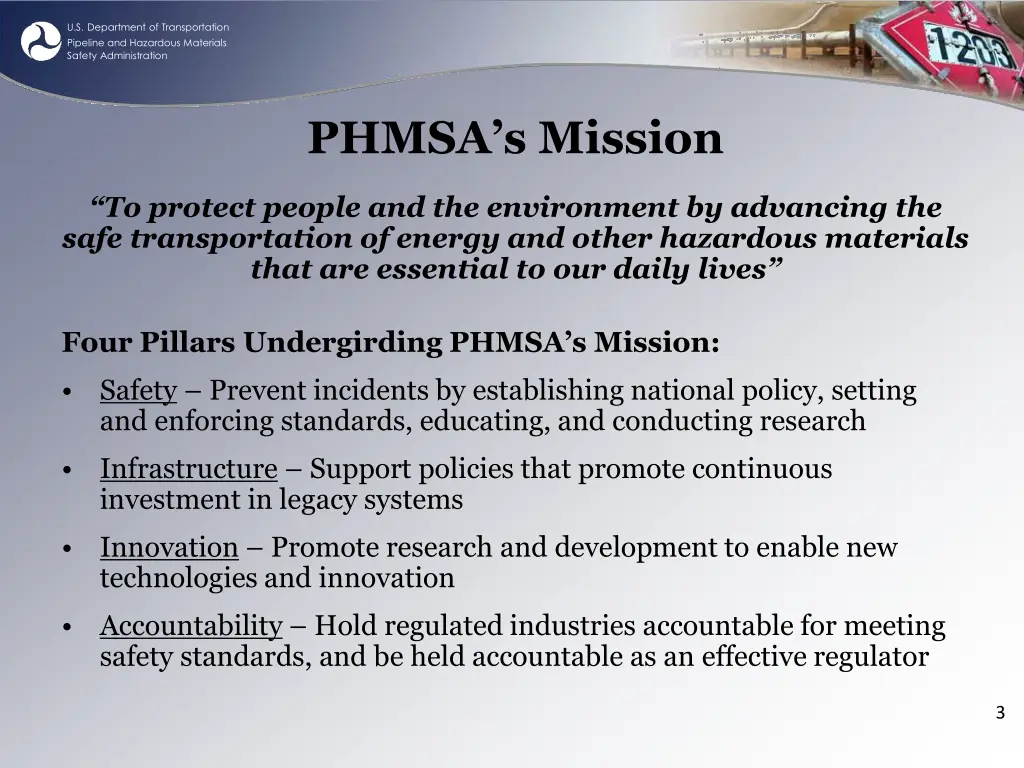
U.S. Department of Transportation Pipeline and Hazardous Materials Safety Administration PHMSA s Mission To protect people and the environment by advancing the safe transportation of energy and other hazardous materials that are essential to our daily lives Four Pillars Undergirding PHMSA s Mission: Safety Prevent incidents by establishing national policy, setting and enforcing standards, educating, and conducting research Infrastructure Support policies that promote continuous investment in legacy systems Innovation Promote research and development to enable new technologies and innovation Accountability Hold regulated industries accountable for meeting safety standards, and be held accountable as an effective regulator 3
U.S. Department of Transportation Pipeline and Hazardous Materials Safety Administration Office of Chief Counsel The Chief Counsel is the principal legal officer of PHMSA. The Office of Chief Counsel provides a comprehensive program of legal services and representation relating to all aspects of PHMSA s safety program activities and PHMSA administration and management. - 4 -
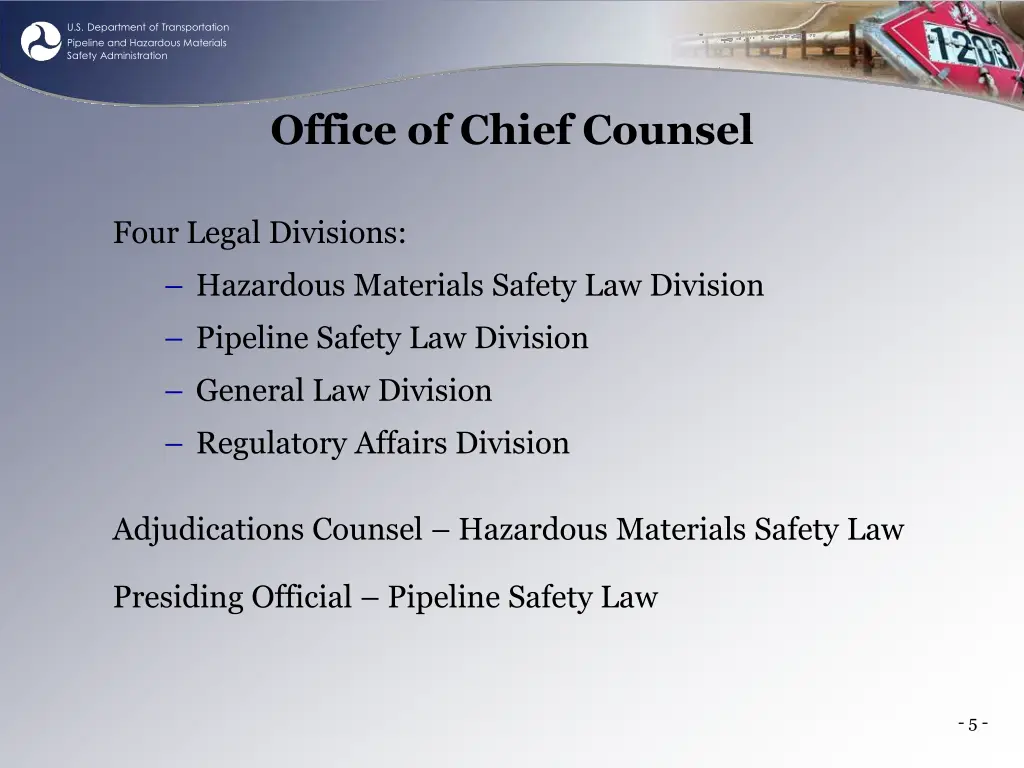
U.S. Department of Transportation Pipeline and Hazardous Materials Safety Administration Office of Chief Counsel Four Legal Divisions: Hazardous Materials Safety Law Division Pipeline Safety Law Division General Law Division Regulatory Affairs Division Adjudications Counsel Hazardous Materials Safety Law Presiding Official Pipeline Safety Law - 5 -
U.S. Department of Transportation Pipeline and Hazardous Materials Safety Administration Office of Chief Counsel s Role Supporting the Committee Attorneys from the Chief Counsel s Hazardous Materials Safety Law Division and Regulatory Affairs Division will be available to provide legal support and answer questions related to the substantive work of this committee. The Chief Counsel s General Law Division will be available to provide legal support and answer questions regarding compliance with FACA, and the other laws or policies applicable to the work of federal advisory committees. - 6 -
U.S. Department of Transportation Pipeline and Hazardous Materials Safety Administration The Federal Advisory Committee Act - 7 -
U.S. Department of Transportation Pipeline and Hazardous Materials Safety Administration What is an Advisory Committee? By definition: Any committee or any subcommittee, which is: (1)Established by statute or reorganization plan or (2)Established or utilized by the President, or (3)Established or utilized by one or more agencies, in the interest of obtaining advice or recommendations for the President or one or more agencies or officers of the Federal Government. - 8 -
U.S. Department of Transportation Pipeline and Hazardous Materials Safety Administration Overview of FACA Congress passed the Federal Advisory Committee Act (FACA) in 1972 to create an orderly process by which Federal agencies may seek advice and assistance from members of the public. With FACA s passage, Congress sought to assure that advisory committees: Provide advice that is relevant, objective, and open to the public; Act promptly to complete their work; and Comply with reasonable cost controls and record keeping requirements. Any time a Federal agency intends to establish or utilize an advisory group such as the Lithium Battery Air Safety Advisory Committee, the agency must comply with FACA and its implementing regulations. The General Services Administration (GSA) is responsible for these regulations, and monitoring all FACA committees. - 9 -
U.S. Department of Transportation Pipeline and Hazardous Materials Safety Administration FACA s Goals Increase openness and transparency regarding the ways federal entities receive advice from non-government entities. Ensure that the advice provided by advisory committees is objective and accessible to the public, and that proper committee records are kept. - 10 -
U.S. Department of Transportation Pipeline and Hazardous Materials Safety Administration FACA Requirements Committees must be chartered and charters must be renewed every two years. All committees must have a chairperson (appointed by PHMSA). Membership with balanced points of view. Open meetings (excluding preparatory or administrative work), and public access to documents made available to, or prepared for, or by the committee. Detailed minutes must be kept, and certified for accuracy by the committee chair, no later than 90 days following the meeting. Any committee reports must be written by the committee members. - 11 -
U.S. Department of Transportation Pipeline and Hazardous Materials Safety Administration Charters The charter specifies the mission, goals, objectives, and operational characteristics of the committee. The agency s Committee Management Office (CMO) must file a charter before the committee can meet, operate, or take any action; charters must be up-to-date. Committee charters and by-laws are prepared in accordance with guidance established by the GSA s Committee Management Secretariat. Charters are approved by the GSA and must be renewed every two years. This committee s charter is dated May 9, 2019, and will expire on May 9, 2021. - 12 -
U.S. Department of Transportation Pipeline and Hazardous Materials Safety Administration Membership Selection, Appointment and Compensation Members are appointed by the Secretary of Transportation, and may serve until their replacement is appointed. Members may be reappointed. Members meet the specific qualifications outlined in the statute (Section 333(d) of the FAA Reauthorization Act of 2018). Members may not be compensated but may be reimbursed for travel and per diem expenses. - 13 -
U.S. Department of Transportation Pipeline and Hazardous Materials Safety Administration Meetings Each advisory committee meeting shall be open to the public. Under FACA, the public must be permitted to provide written comment on meetings. PHMSA, and many other agencies, also allow verbal public comments during meetings. Subject to FOIA, the documents which were made available to, or prepared for, or by, each advisory committee shall be available for public inspection. - 14 -
U.S. Department of Transportation Pipeline and Hazardous Materials Safety Administration Subcommittees Subcommittees may be formed with the agency s approval, and may include individuals who are not members of the parent committee. There is no requirement for subcommittee meetings to be announced in the Federal Register or to allow public access to subcommittee meetings. Subcommittee records at the time they are presented to the full committee, however, must be made public. Subcommittees must report back to the parent committee (not to PHMSA or the Secretary). Parent Committee cannot rubber-stamp the advice or recommendations of subcommittees. This deprives the public of its opportunity to know about, and participate in, an advisory committee s deliberations. - 15 -
U.S. Department of Transportation Pipeline and Hazardous Materials Safety Administration What committee activities are not subject to FACA? Some activities performed by an advisory committee are excluded from FACA's notice and open meeting requirements, such as: Preparatory work Administrative Work - 16 -
U.S. Department of Transportation Pipeline and Hazardous Materials Safety Administration Administrative Work Administrative work Meetings of two or more advisory committee or subcommittee members convened solely to: discuss administrative matters of the advisory committee (such as logistical information), or to receive administrative information from a Federal officer or agency. - 17 -
U.S. Department of Transportation Pipeline and Hazardous Materials Safety Administration Preparatory Work Preparatory work Meetings of two or more advisory committee or subcommittee members convened solely to: gather information, conduct research, analyze relevant issues and facts in preparation for a meeting of the advisory committee, or to draft position papers for deliberation by the advisory committee. - 18 -
U.S. Department of Transportation Pipeline and Hazardous Materials Safety Administration Public Access to FACA Materials Section 10(b) of the FACA states that, subject to FOIA, any of the below which were made available to or prepared for or by an advisory committee must be made public: records reports transcripts minutes appendixes working papers drafts studies agendas other documents - - - - - - - - - - - 19 -
U.S. Department of Transportation Pipeline and Hazardous Materials Safety Administration When must materials be made available to the public? Whenever practicable,all committee materials (covered by Section 10(b) of FACA) must be available for public inspection and copying before or on the date of the advisory committee meeting to which they apply. Documents covered by Section 10(b) must be available for public inspection and copying at a single location in the offices of the advisory committee or the agency to which the advisory committee reports until the advisory committee ceases to exist. - 20 -
U.S. Department of Transportation Pipeline and Hazardous Materials Safety Administration Federal Records Management and Retention Official records generated by or for an advisory committee must be retained for the duration of the advisory committee. Committee records will be available at the following public PHMSA website: https://www.phmsa.dot.gov/hazmat/rulemakings/lithium- battery-air-safety-advisory-committee; and in Docket ID: PHMSA- 2019-0098 at www.regulations.gov, prior to or following each meeting. - 21 -
U.S. Department of Transportation Pipeline and Hazardous Materials Safety Administration FACA Resources Federal Advisory Committee Act (FACA) (5 U.S.C., App. 2, as amended) FACA Regulations (41 C.F.R. Part 102-3) Freedom of Information Act (FOIA) (5 U.S.C. 552) GSA s FACA website: https://www.gsa.gov/policy- regulations/policy/federal-advisory-committee-act-faca- management-overview - 22 -
U.S. Department of Transportation Pipeline and Hazardous Materials Safety Administration Overview of the Committee The Lithium Battery Air Safety Advisory Committee s statutory authority appears in Section 333(d) of the FAA Reauthorization Act of 2018 (Public Law 115-254) The Secretary of Transportation has delegated authority for managing this committee to PHMSA. This committee will be responsible for providing PHMSA and the Department with information regarding new technologies and transportation safety practices. - 23 -
U.S. Department of Transportation Pipeline and Hazardous Materials Safety Administration Overview of the Committee The committee will also: Develop policy positions for international forums (such as the International Civil Aviation Organization (ICAO)). Provide advice and recommendations on how to implement activities to increase awareness of safety requirements. Develop a report to the Secretary and Congress, not later than 180 days after the establishment of the committee, on the steps that private sector and international regulatory authorities can take for the safe air transportation of lithium batteries. - 24 -
U.S. Department of Transportation Pipeline and Hazardous Materials Safety Administration Questions? - 25 -
U.S. Department of Transportation Pipeline and Hazardous Materials Safety Administration Office of the Chief Counsel Pipeline and Hazardous Materials Safety Administration Paul Roberti Chief Counsel 1200 New Jersey Avenue, SE Washington, DC 20590 202-366-4400 - 26 -