Explore Kirkpatrick's point location algorithm and hierarchy, discussing the conversion of planar subdivisions to triangulations, vertex deletion, and independent sets to achieve constant complexity triangulations. Learn how to construct Kirkpatrick's hierarchy using an independent set lemma, leading to the outer triangle with minimal vertices. Dive into the intricacies of building a sequence of increasingly coarser triangulations while maintaining specific properties for efficient point location.
Please find below an Image/Link to download the presentation.
The content on the website is provided AS IS for your information and personal use only. It may not be sold, licensed, or shared on other websites without obtaining consent from the author. If you encounter any issues during the download, it is possible that the publisher has removed the file from their server.
You are allowed to download the files provided on this website for personal or commercial use, subject to the condition that they are used lawfully. All files are the property of their respective owners.
The content on the website is provided AS IS for your information and personal use only. It may not be sold, licensed, or shared on other websites without obtaining consent from the author.
E N D
Presentation Transcript
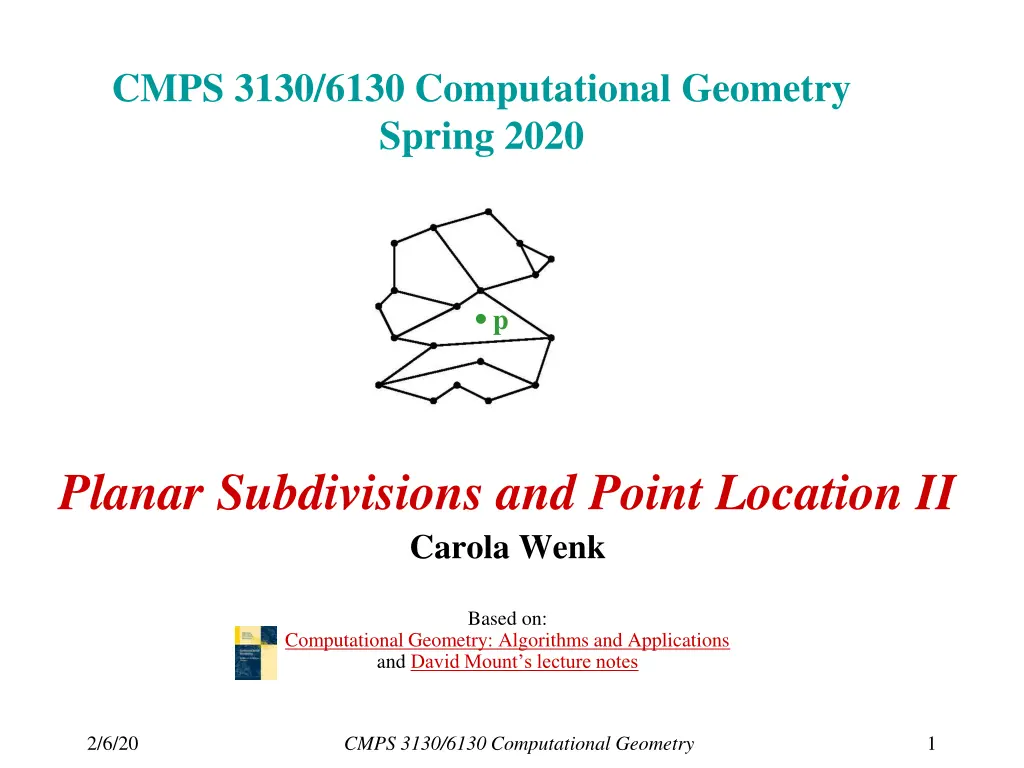
CMPS 3130/6130 Computational Geometry Spring 2020 p Planar Subdivisions and Point Location II Carola Wenk Based on: Computational Geometry: Algorithms and Applications and David Mount s lecture notes 2/6/20 1 CMPS 3130/6130 Computational Geometry
Kirkpatricks Point Location Algorithm Needs a triangulation as input. One can convert a planar subdivision with n vertices into a triangulation: Triangulate each face, keep same label as original face. If the outer face is not a triangle: Compute the convex hull of the subdivision. Triangulate pockets between the subdivision and the convex hull. Add a large triangle (new vertices a, b, c) around the convex hull, and triangulate the space in-between. b p a c The size of the triangulated planar subdivision is still O(n), by Euler s formula. The conversion can be done in O(n log n) time. Given p, if we find a triangle containing p we also know the (label of) the original subdivision face containing p. 2/6/20 2 CMPS 3130/6130 Computational Geometry
Kirkpatricks Hierarchy Compute a sequence T0, T1, , Tkof increasingly coarser triangulations such that the last one has constant complexity. The sequence T0, T1, , Tkshould have the following properties: T0is the input triangulation, Tkis the outer triangle k O(log n) Each triangle in Ti+1overlaps O(1) triangles in Ti How to build such a sequence? Need to delete vertices from Ti . Vertex deletion creates holes, which need to be re-triangulated. How do we go from T0of size O(n) to Tkof size O(1) in k=O(log n) steps? In each step, delete a constant fraction of vertices from Ti. We also need to ensure that each new triangle in Ti+1 overlaps with only O(1) triangles in Ti. 2/6/20 3 CMPS 3130/6130 Computational Geometry
Vertex Deletion and Independent Sets When creating Ti+1 from Ti , delete vertices from Ti that have the following properties: Constant degree: Each vertex v to be deleted has O(1) degree in the graph Ti . If v has degree d, the resulting hole can be re- triangulated with d-2 triangles Each new triangle in Ti+1 overlaps at most d original triangles in Ti Independent sets: No two deleted vertices are adjacent. Each hole can be re-triangulated independently. 2/6/20 4 CMPS 3130/6130 Computational Geometry
Independent Set Lemma Lemma: Every triangulated planar graph on n 4 vertices for contains an independent vertex set of size n/18 in which each vertex has degree at most 8. Such a set can be computed in O(n) time. b Use this lemma to construct Kirkpatrick s hierarchy: Start with T0, and select an independent set S of size n/18 in which each vertex has maximum degree 8. [Never pick the outer triangle vertices a, b, c.] Remove vertices of S, and re-triangulate holes. The resulting triangulation, T1, has at most 17/18n vertices. Repeat the process to build the hierarchy, until Tk equals the outer triangle with vertices a, b, c. The depth of the hierarchy is k = log18/17 n a c 2/6/20 5 CMPS 3130/6130 Computational Geometry
Hierarchy Example Use this lemma to construct Kirkpatrick s hierarchy: Start with T0, and select an independent set S of size n/18 in which each vertex has maximum degree 8. [Never pick the outer triangle vertices a, b, c.] Remove vertices of S, and re- triangulate holes. The resulting triangulation, T1, has at most 17/18n vertices. Repeat the process to build the hierarchy, until Tk equals the outer triangle with vertices a, b, c. The depth of the hierarchy is k = log18/17 n 2/6/20 6 CMPS 3130/6130 Computational Geometry
Hierarchy Data Structure Store the hierarchy as a DAG: The root is Tk . Nodes in each level correspond to triangles Ti . Each node for a triangle in Ti+1 stores pointers to all triangles of Ti that it overlaps. p How to locate point p in the DAG: Start at the root. If p is outside of Tk then p is in exterior face; done. Else, set to be the triangle at the current level that contains p. Check each of the at most 6 = 8-2 triangles of Tk-1 that overlap with , whether they contain p. Update and descend in the hierarchy until reaching T0 . Output . 2/6/20 7 CMPS 3130/6130 Computational Geometry
Analysis Query time is O(log n): There are O(log n) levels and it takes constant time to move between levels. Space complexity is O(n): Sum up sizes of all triangulations in hierarchy. Because of Euler s formula, it suffices to sum up the number of vertices. Total number of vertices: p n + 17/18 n + (17/18)2 n + (17/18)3 n + 1/(1-17/18) n = 18 n Preprocessing time is O(n log n): Triangulating the subdivision takes O(n log n) time. The time to build the DAG is proportional to its size. 2/6/20 8 8 CMPS 3130/6130 Computational Geometry
Independent Set Lemma Lemma: Every triangulated planar graph on n 4 vertices contains an independent vertex set of size n/18 in which each vertex has degree at most 8. Such a set can be computed in O(n) time. Proof: Greedy algorithm to construct an independent set: Mark all vertices of degree 9 While there is an unmarked vertex Let v be an unmarked vertex Add v to the independent set Mark v and all its neighbors Can be implemented in O(n) time: Keep list of unmarked vertices, and store the triangulation in a data structure (DCEL) that allows finding neighbors in O(1) time. v 2/6/20 9 CMPS 3130/6130 Computational Geometry
Independent Set Lemma Still need to prove existence of a large independent set. Euler s formula for a triangulated planar graph on n vertices: #edges = 3n 6 Sum over vertex degrees: deg(v) = 2 #edges = 6n 12 < 6n Claim: At least n/2 vertices have degree 8. Proof: By contradiction. So, suppose otherwise. n/2 vertices have degree 9. The remaining have degree 3. The sum of the degrees is 9 n/2 + 3 n/2 = 6n. Contradiction. v In the beginning of the algorithm, at least n/2 nodes are unmarked. Each picked vertex v marks 8 other vertices, so including itself 9. Therefore, the while loop can be repeated at least n/18 times. This shows that there is an independent set of size at least n/18 in which each node has degree 8. 2/6/20 10 CMPS 3130/6130 Computational Geometry
Summing Up Kirkpatrick s point location data structure needs O(n log n) preprocessing time, O(n) space, and has O(log n) query time. It involves high constant factors though. Next we will discuss a randomized point location scheme (based on trapezoidal maps) which is more efficient in practice. 2/6/20 11 CMPS 3130/6130 Computational Geometry