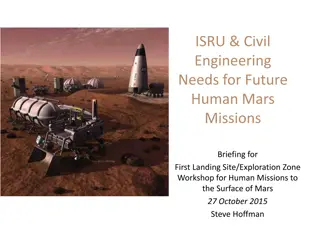
Explore the fascinating world of planetary science, including topics such as atmosphere, rotation, revolution, terrestrial and jovian planets, climate, carbon dioxide, and the solar system. Discover key facts about Mars, from its unique atmosphere dominated by carbon dioxide to its extreme temperature range. Uncover the mysteries of Mars and gain insight into the factors that could support life on the Red Planet.
Please find below an Image/Link to download the presentation.
The content on the website is provided AS IS for your information and personal use only. It may not be sold, licensed, or shared on other websites without obtaining consent from the author. If you encounter any issues during the download, it is possible that the publisher has removed the file from their server.
You are allowed to download the files provided on this website for personal or commercial use, subject to the condition that they are used lawfully. All files are the property of their respective owners.
The content on the website is provided AS IS for your information and personal use only. It may not be sold, licensed, or shared on other websites without obtaining consent from the author.
VOCABULARY Atmosphere Rotation Revolution Terrestrial Jovian Climate Carbon Dioxide Solar System
Atmosphere A layer of gases that surrounds a planet. This layer creates conditions needed for life on a planet.
Rotation The motion of a planet to spin around a central axis. This spinning is what turns day into night and night into day. One rotation is equal to one day.
Revolution The motion of a planet going around the sun. One revolution around the Sun is one year.
Solar System A group of planets that revolve around a central star (The Sun).
Terrestrial A planet within a solar system that has a solid rocky surface that you could stand on.
Jovian A planet within a Solar System that is not made from rock but is made of gases.
Climate The type of weather conditions on a planet over a long period of time (years).
Carbon Dioxide An atmospheric gas molecule that contains 1 Carbon atom and 2 oxygen atoms.
Atmosphere on Mars 96% of the total atmosphere on Mars is a gas known as Carbon Dioxide. The atmosphere on Earth has much less Carbon Dioxide with it being only .039% of the total. The % of Oxygen gas on Mars is 0%. The % of Oxygen gas on Earth is 21%.
How Hot/Cold is Mars? The high temperature can reach 81 F degrees and the low temperature can reach -225 F degrees.
The Rotation of Mars The spinning of a planet is called a rotation. One rotation is equal to 1 day. The Earth takes 24 hours to make one rotation. Mars takes 24.62 hours to make one rotation.
How old would you be on Mars? Your birthday comes along once a year. A year is caused by your planet going around the sun one time. The Earth revolves once every 365 days. Mars revolves once every 687 days. If you lived on mars you would be about your current age.
Solar System The solar system that we live in has 8 planets. Each planet goes around the Sun which is at the center. The order of the planets according to distance from the Sun is: Mercury, Venus, Earth, Mars, Jupiter, Saturn, Uranus, Neptune.
Distance to Mars from Earth To get from Earth to Mars you would have to travel 225,000,000 Kilometers. How many meters would this be? How many centimeters would this be?
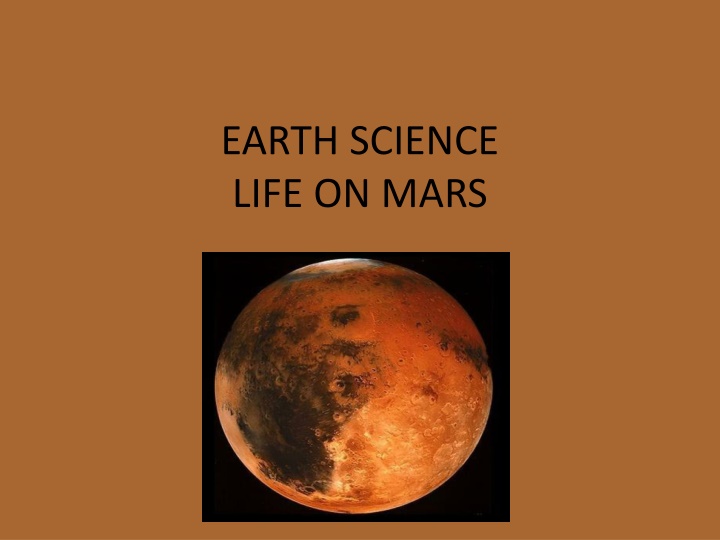
What is Mars Made Of? Mars is a solid rocky planet. The name given to solid planets is Terrestrial. Mercury, Venus, Earth, and Mars are all Rocky. The name given to gas planets is Jovian. Jupiter, Saturn, Uranus, and Neptune are all Gas. The rock on Mars is a red color. It is red because of rust.
How big is Mars? Mars is about half the size of Earth Diameter of Mars is 6,792 Km Your weight on Mars would be of your current weight on Earth.
What is the Climate like? The Climate on Mars is very dry and windy. Growing food in the red dirt would be impossible because there is no liquid water.
Missions to Mars No human being has ever been to Mars. However, humans have recently landed robots on the red rocky planet. There have been 18 total missions to send objects to mars. Curiosity was the last successful mission in 2012.