Planning for Recovery, Resilience, and Inclusion: Economic Developments and Sustainable Agenda
This presentation by Dr. Doyin Salami at the 20th JPB/NCDP Meeting focuses on recent economic developments in Nigeria, exploring poverty rates, GDP growth, and high-frequency indicators. It also delves into the sustainable development agenda, reviewing key resolutions and addressing challenges to coordination and data reliability. The way forward emphasizes effective implementation of programs and policies for inclusive growth and resilience.

Download Presentation

Please find below an Image/Link to download the presentation.
The content on the website is provided AS IS for your information and personal use only. It may not be sold, licensed, or shared on other websites without obtaining consent from the author. If you encounter any issues during the download, it is possible that the publisher has removed the file from their server.
You are allowed to download the files provided on this website for personal or commercial use, subject to the condition that they are used lawfully. All files are the property of their respective owners.
The content on the website is provided AS IS for your information and personal use only. It may not be sold, licensed, or shared on other websites without obtaining consent from the author.
E N D
Presentation Transcript
Planning for Recovery, Resilience and Inclusion Dr. Doyin Salami Chairman, PEAC at the 20th JPB/NCDP Meeting
Contents Introduction Recent economic developments where we are? - Poverty profile, security, growth rate, unemployment /underemployment and the fiscal context Nigeria s sustainable development agenda - Reviewing key resolutions of past NCDP Meetings - A national strategy: welfare, work and inclusion The way forward - Systems and processes (alignment and effective implementation of programmes & policies) Conclusion References
Introduction The theme of the 20thJPB/NCDP Meeting is Managing the Nigerian Economy for Sustainable Development in a Challenging Environment An important opportunity to bring together stakeholders across all tiers of government This presentation is structured in 3 parts: Section I: Recent economic developments Section II: A strategy for the sustainable development agenda Section III: The way forward
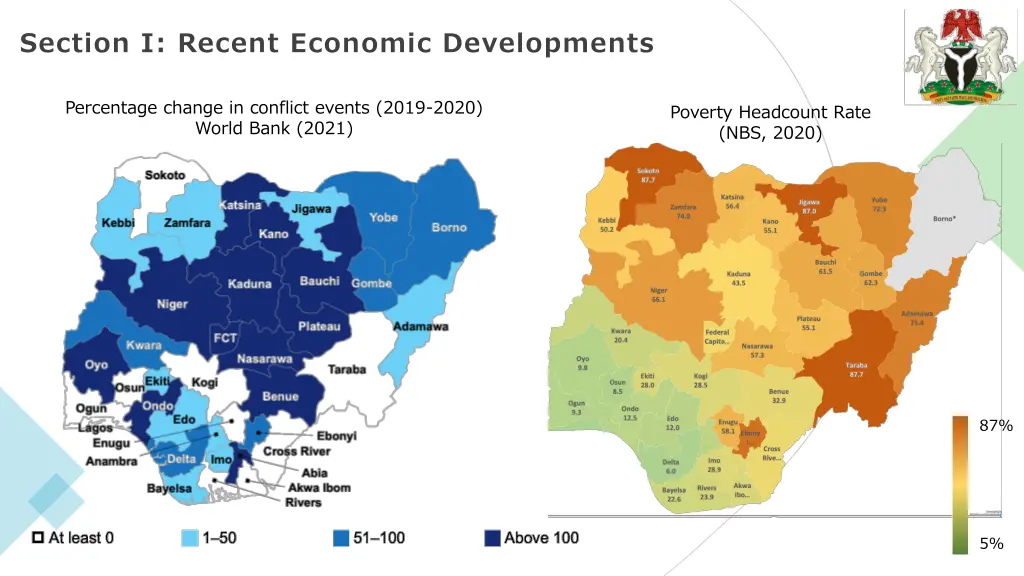
Section I: Recent Economic Developments Percentage change in conflict events (2019-2020) World Bank (2021) Poverty Headcount Rate (NBS, 2020) 87% 5%
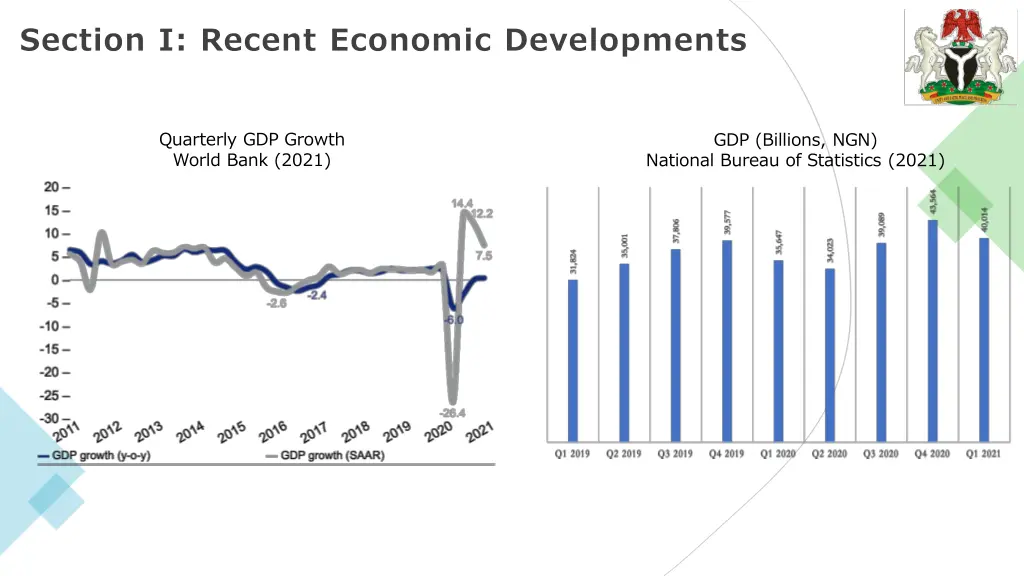
Section I: Recent Economic Developments Quarterly GDP Growth World Bank (2021) GDP (Billions, NGN) National Bureau of Statistics (2021)
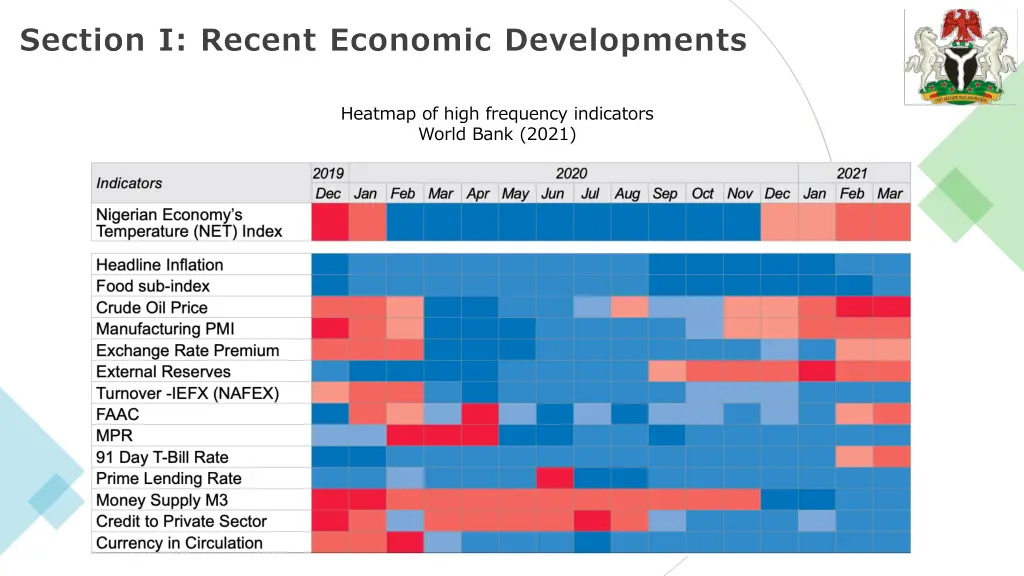
Section I: Recent Economic Developments Heatmap of high frequency indicators World Bank (2021)
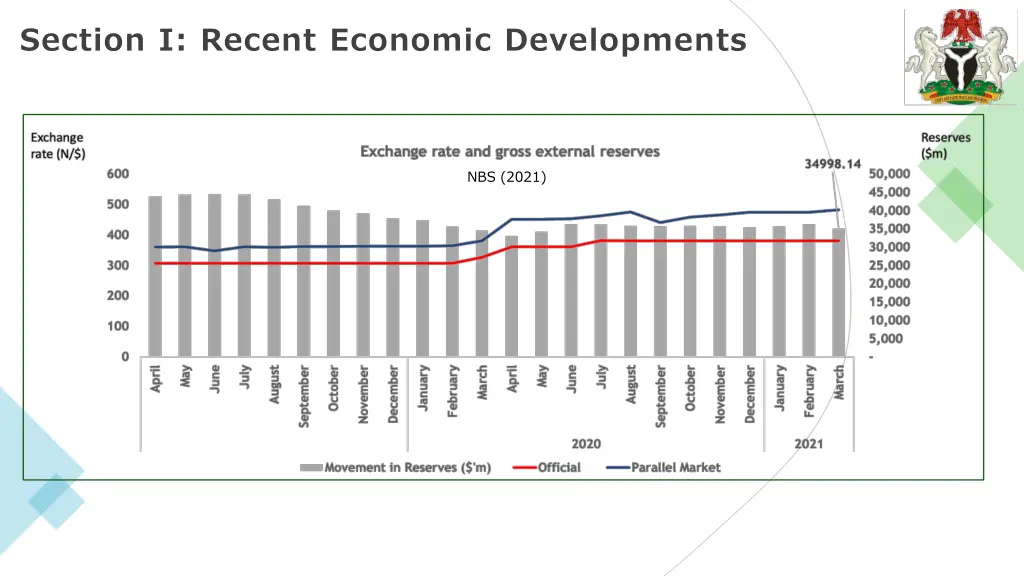
Section I: Recent Economic Developments NBS (2021)
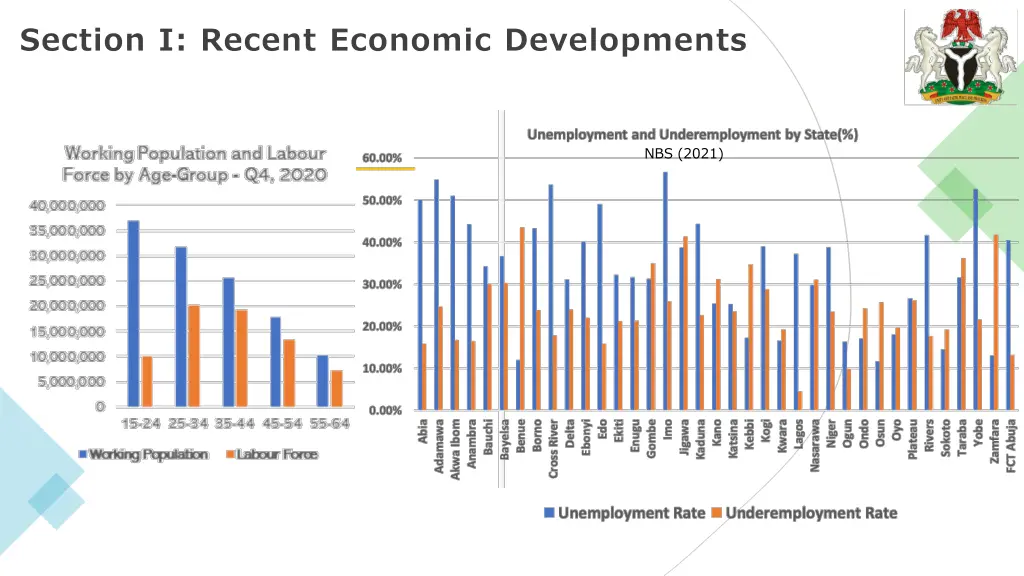
Section I: Recent Economic Developments NBS (2021)
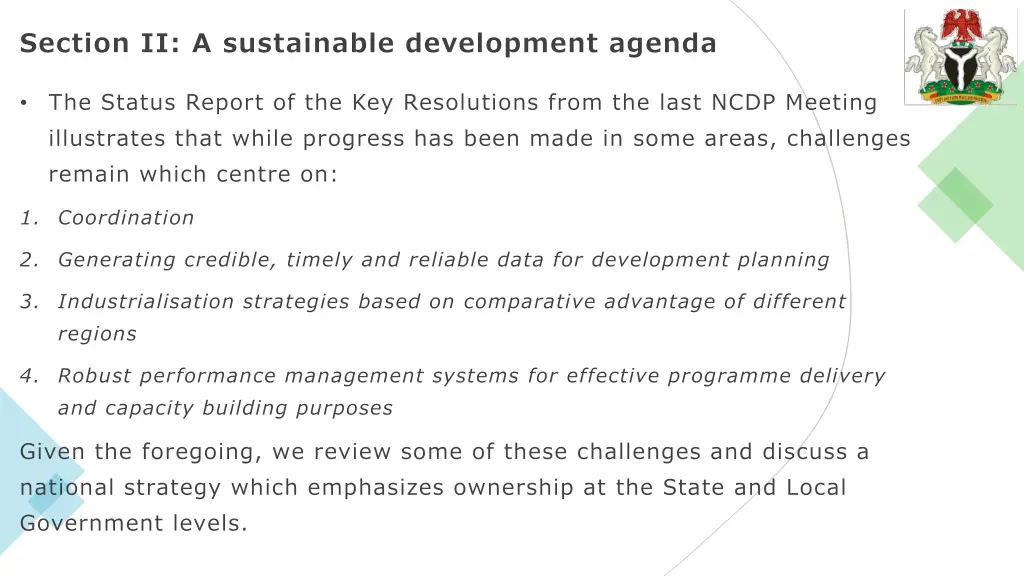
Section II: A sustainable development agenda The Status Report of the Key Resolutions from the last NCDP Meeting illustrates that while progress has been made in some areas, challenges remain which centre on: 1. Coordination 2. Generating credible, timely and reliable data for development planning 3. Industrialisation strategies based on comparative advantage of different regions 4. Robust performance management systems for effective programme delivery and capacity building purposes Given the foregoing, we review some of these challenges and discuss a national strategy which emphasizes ownership at the State and Local Government levels.
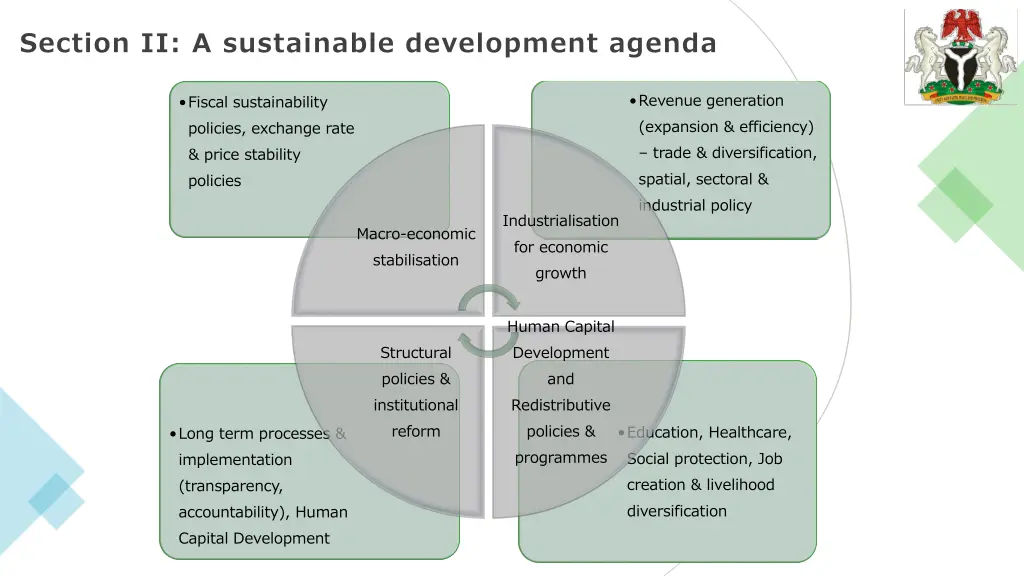
Section II: A sustainable development agenda Revenue generation (expansion & efficiency) trade & diversification, spatial, sectoral & industrial policy Fiscal sustainability policies, exchange rate & price stability policies Industrialisation for economic growth Macro-economic stabilisation Human Capital Development and Redistributive policies & programmes Structural policies & institutional reform Education, Healthcare, Social protection, Job creation & livelihood diversification Long term processes & implementation (transparency, accountability), Human Capital Development
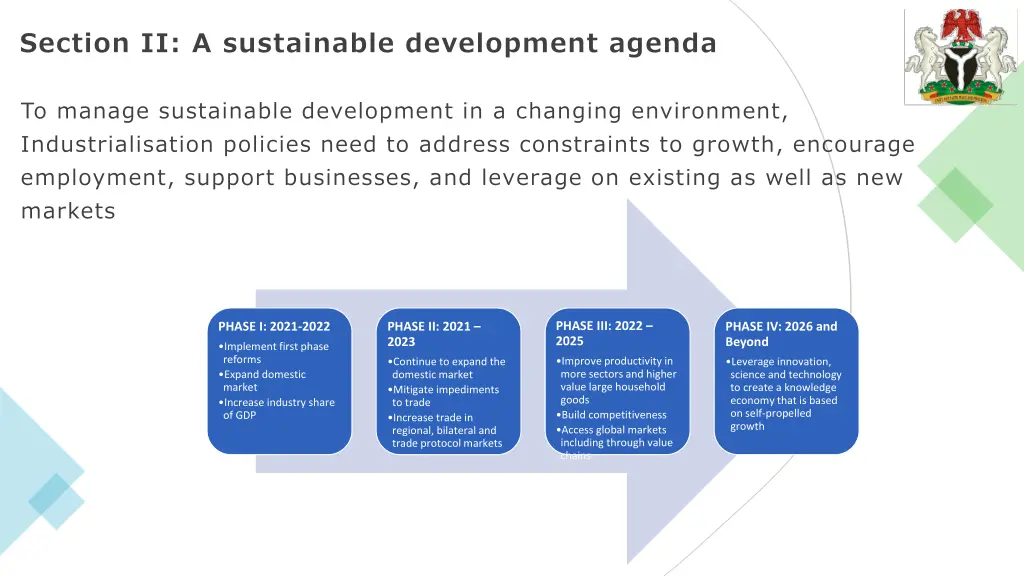
Section II: A sustainable development agenda To manage sustainable development in a changing environment, Industrialisation policies need to address constraints to growth, encourage employment, support businesses, and leverage on existing as well as new markets PHASE III: 2022 2025 PHASE I: 2021-2022 PHASE II: 2021 2023 PHASE IV: 2026 and Beyond Implement first phase reforms Expand domestic market Increase industry share of GDP Improve productivity in more sectors and higher value large household goods Build competitiveness Access global markets including through value chains Continue to expand the domestic market Mitigate impediments to trade Increase trade in regional, bilateral and trade protocol markets Leverage innovation, science and technology to create a knowledge economy that is based on self-propelled growth
Section III: The way forward Ensuring alignment across all levels of government (as well as the private sector) with national strategies practically speaking, the National Steering Committee (NSC) will serve to anchor collaborative efforts and provide oversight. In line with the Resolutions from the last NCDP Meetings, there should be consideration for different regional needs/strengths and incorporation of gender mainstreaming policies/programmes. Creating ecosystems based on the comparative advantage of different economic corridors is a central part of a national strategy. This approach can also help to reduce state dependence on allocations from FAAC improving internally generated revenue capacity at the subnational level. Reducing leakages introducing means testing and unique identification can help to improve targeting while also freeing up more resources for most vulnerable groups.
Section III: The way forward Strengthening monitoring and evaluation systems, and Management Information Systems (MIS) to enhance delivery of programmes as well as track impact. This can serve to support the work of the Implementation Monitoring Committee (IMC). Financing reducing the costs of government while enhancing revenue streams. Mobilising revenue from the private sector can help to finance budgetary shortfalls (NIG-Fund has been proposed in the NPRGS). The creation of a vehicle to facilitate non-debt private capital investment by consolidating development finance institutions in the country presents an opportunity to boost investment. The Fund can consider appropriate approaches in its investment strategy, such as: - Direct project financing through SPVs; - Co-financing (private-private partnerships) - Equity investments
Conclusion Successful development planning is dependent on mainstreaming and ensuring ownership of policies as well as programme delivery at all structures of government. The strategic role of the National Planning Commission in coordinating bottom-up national development plans, separate from the treasury functions of the FMF, will need to be revisited sooner than later. It is critical to consider the contextual needs and strengths of the different regions there is no one size fits all strategy. However, regions experience similar challenges in terms of institutional reforms in the public sector and governance. The fiscal environment requires a bold strategy cognizant of the challenges that have hindered FDI flows to Nigeria this paper highlights some fundamental pillars to facilitate reform, while also proposing potential avenues to generate and consolidate revenue streams.
References National Bureau for Statistics (2021): https://nigerianstat.gov.ng/elibrary National Poverty Reduction and Growth Initiative Strategy (2021) World Bank (2021). Nigeria Development Update: https://www.worldbank.org/en/country/nigeria/publication/nigeria- development-update-ndu