Population Estimates and Data Compilation Overview
Explore the detailed process of producing yearly population estimates by the Population Division, including the delivery deadlines, uses of estimates, and specialized models for health insurance and income/poverty data analysis. Learn about the decadal estimates and small area estimates for various regions and purposes. Access valuable insights on demographic trends and federal funding allocations.

Download Presentation

Please find below an Image/Link to download the presentation.
The content on the website is provided AS IS for your information and personal use only. It may not be sold, licensed, or shared on other websites without obtaining consent from the author. If you encounter any issues during the download, it is possible that the publisher has removed the file from their server.
You are allowed to download the files provided on this website for personal or commercial use, subject to the condition that they are used lawfully. All files are the property of their respective owners.
The content on the website is provided AS IS for your information and personal use only. It may not be sold, licensed, or shared on other websites without obtaining consent from the author.
E N D
Presentation Transcript
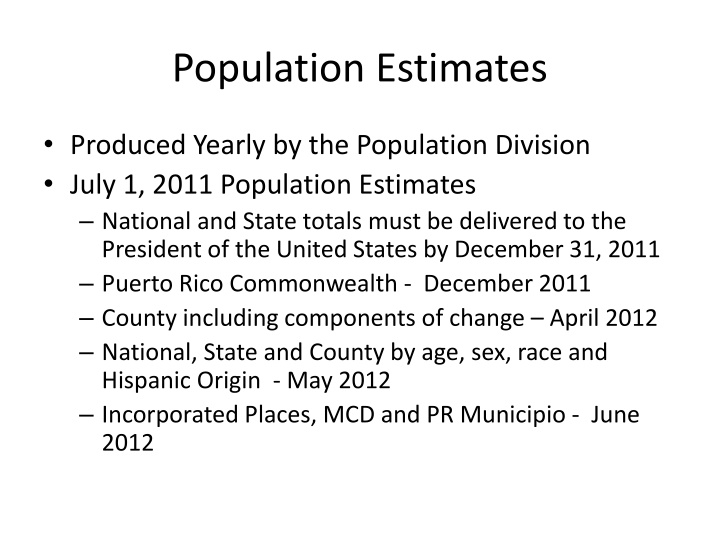
Population Estimates Produced Yearly by the Population Division July 1, 2011 Population Estimates National and State totals must be delivered to the President of the United States by December 31, 2011 Puerto Rico Commonwealth - December 2011 County including components of change April 2012 National, State and County by age, sex, race and Hispanic Origin - May 2012 Incorporated Places, MCD and PR Municipio - June 2012
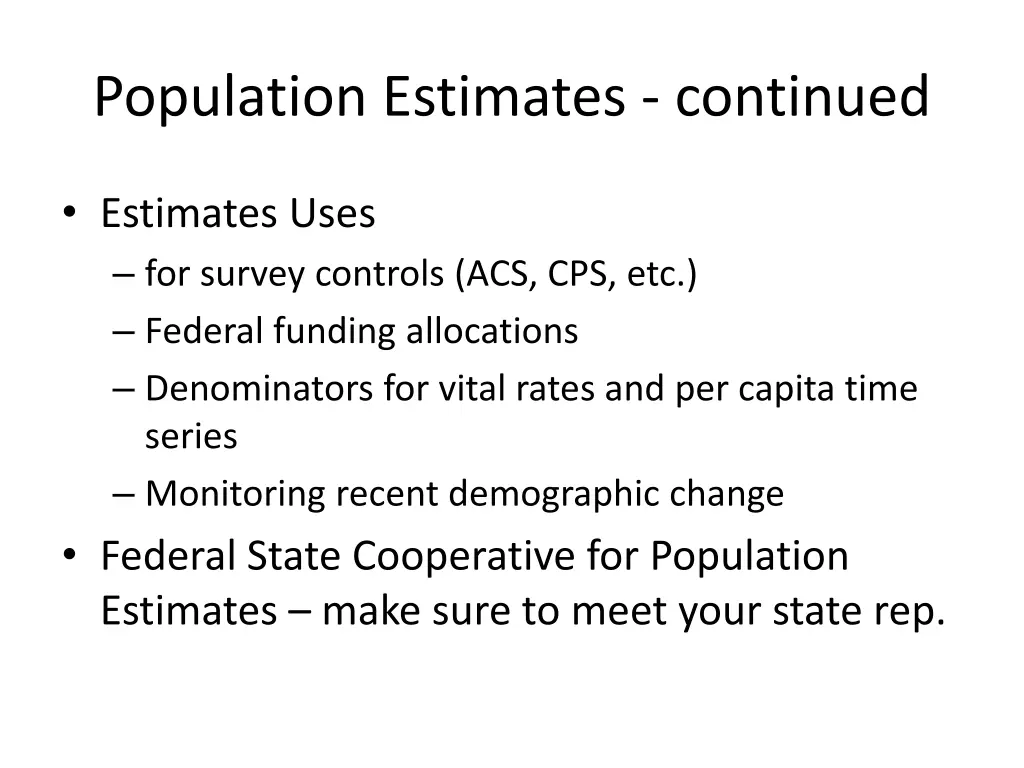
Population Estimates - continued Estimates Uses for survey controls (ACS, CPS, etc.) Federal funding allocations Denominators for vital rates and per capita time series Monitoring recent demographic change Federal State Cooperative for Population Estimates make sure to meet your state rep.
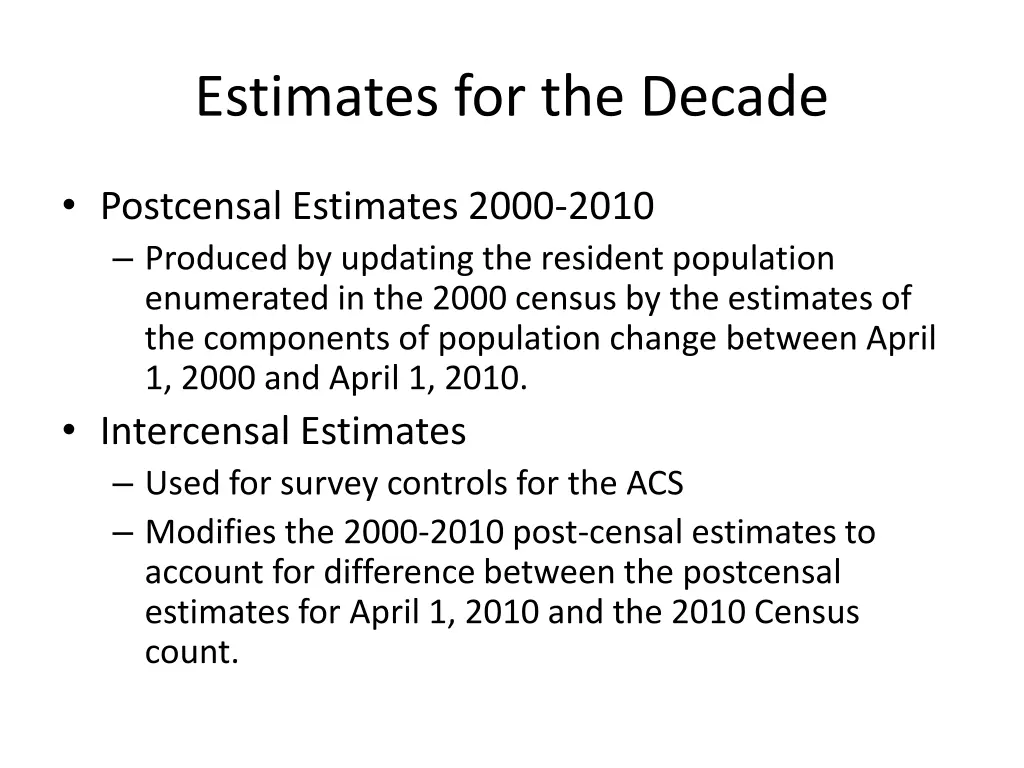
Estimates for the Decade Postcensal Estimates 2000-2010 Produced by updating the resident population enumerated in the 2000 census by the estimates of the components of population change between April 1, 2000 and April 1, 2010. Intercensal Estimates Used for survey controls for the ACS Modifies the 2000-2010 post-censal estimates to account for difference between the postcensal estimates for April 1, 2010 and the 2010 Census count.
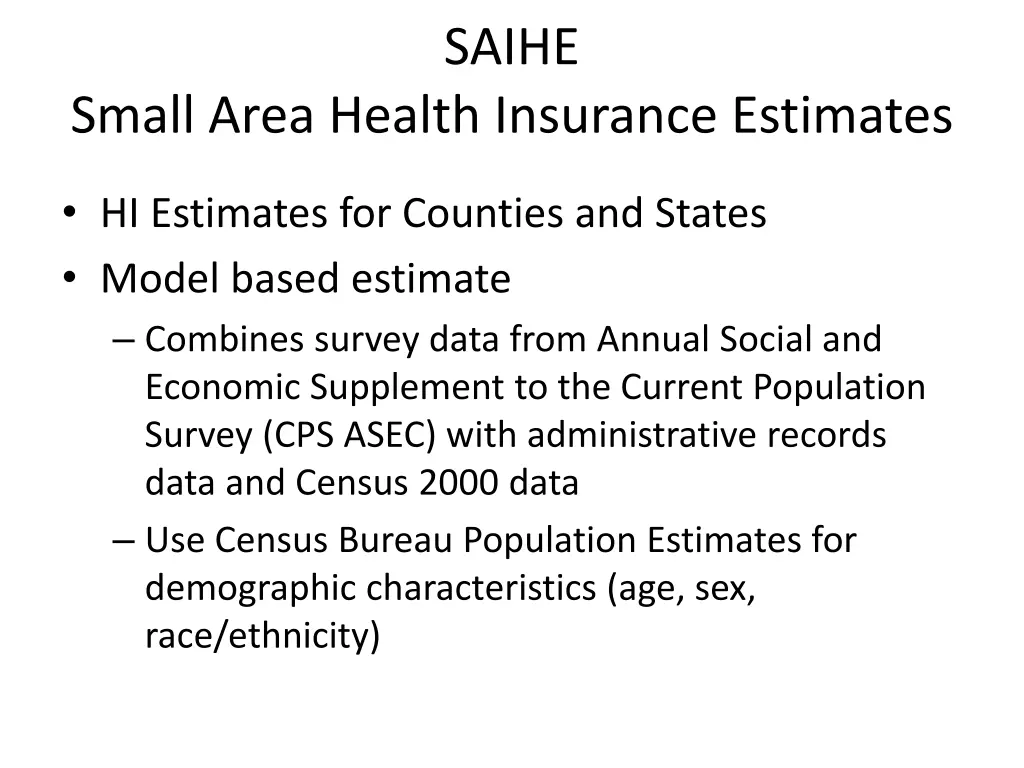
SAIHE Small Area Health Insurance Estimates HI Estimates for Counties and States Model based estimate Combines survey data from Annual Social and Economic Supplement to the Current Population Survey (CPS ASEC) with administrative records data and Census 2000 data Use Census Bureau Population Estimates for demographic characteristics (age, sex, race/ethnicity)
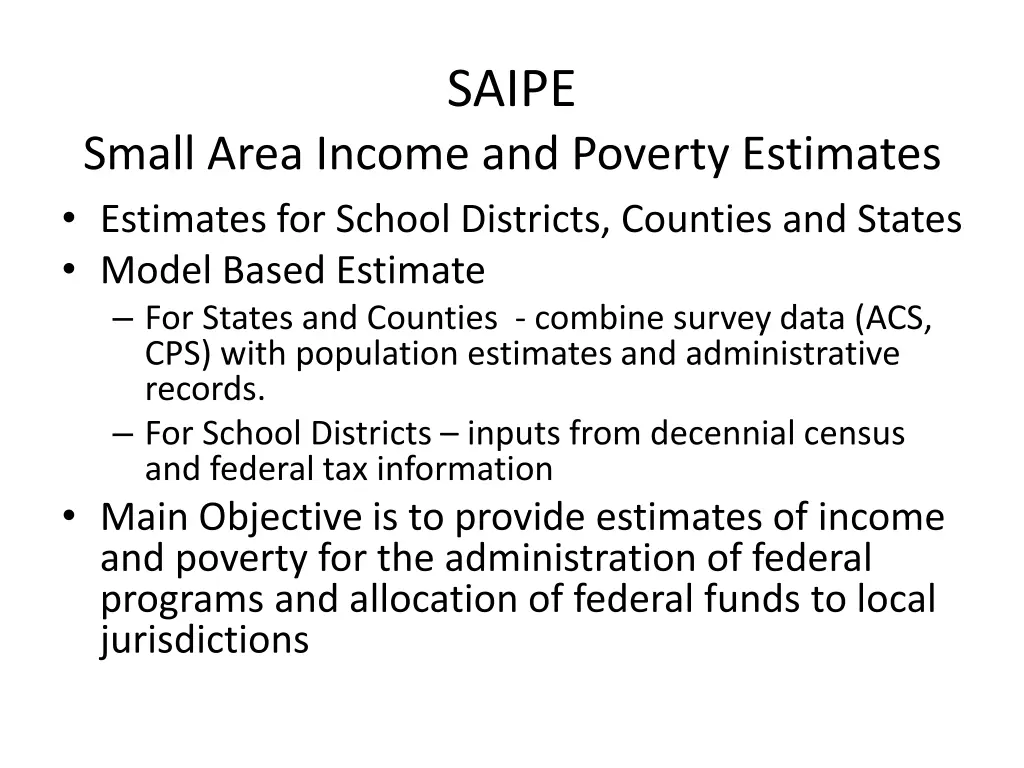
SAIPE Small Area Income and Poverty Estimates Estimates for School Districts, Counties and States Model Based Estimate For States and Counties - combine survey data (ACS, CPS) with population estimates and administrative records. For School Districts inputs from decennial census and federal tax information Main Objective is to provide estimates of income and poverty for the administration of federal programs and allocation of federal funds to local jurisdictions