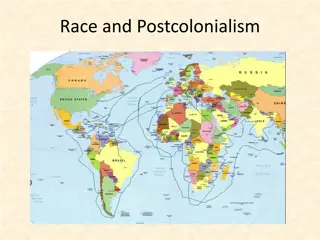
Explore the emergence of postcolonial theory and criticism from the experiences of oppressed nations seeking liberation. Delve into humanitarian, economic, political, and religious justifications shaping postcolonial discourse and critique. Understand the historical development, key assumptions, and criticisms associated with postcolonialism.
Please find below an Image/Link to download the presentation.
The content on the website is provided AS IS for your information and personal use only. It may not be sold, licensed, or shared on other websites without obtaining consent from the author. If you encounter any issues during the download, it is possible that the publisher has removed the file from their server.
You are allowed to download the files provided on this website for personal or commercial use, subject to the condition that they are used lawfully. All files are the property of their respective owners.
The content on the website is provided AS IS for your information and personal use only. It may not be sold, licensed, or shared on other websites without obtaining consent from the author.
E N D
Presentation Transcript
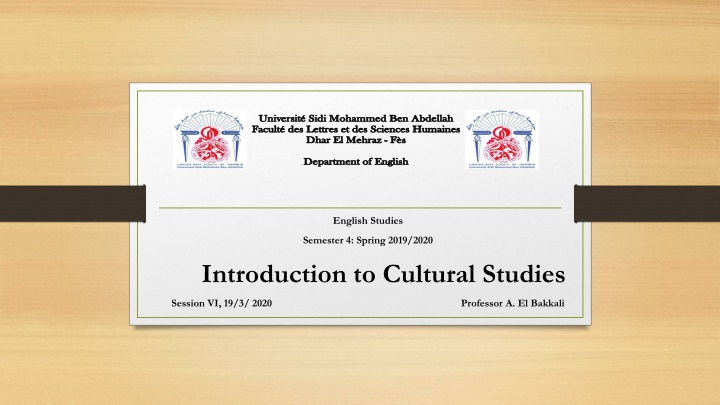
English Studies Semester 4: Spring 2019/2020 Introduction to Cultural Studies Session VI, 19/3/ 2020 Professor A. El Bakkali
Postcolonial Theory and Criticism Introduction A Formation of Postcolonial Theory Humanitarian justification Economic justification Political justification Religious justification Postcolonialism: The Empire Writes Back Historical Development Assumptions Criticism
Introduction (1) The final hour of colonialism has struck, and millions of inhabitants of Africa, Asia, and Latin America rise to meet a new life and demand their unrestricted right to self-determination. Che Guevara, speech to the United Nations, December 11, 1964 Postcolonial perspectives emerge from the colonial testimony of Third World countries and the discourses of minorities within the geopolitical divisions of East and West, North and South. They intervene in those ideological discourses of modernity that attempt to give a hegemonic normality to the uneven development and the differential, often disadvantaged, histories of nations, race, communities, peoples. Bhabha (1994:171)
Introduction (2) Postcolonial theory is built from the colonial experiences of people who engaged in liberation struggles around the world and particularly in the tri-continental countries in Africa, south and south East Asia and Latin America. Postcolonial critique is concerned with the history of colonialism only to the extent that history has determined the configurations and power structures of the present. Young (2001:1-11, 57-69)
A Formation of Postcolonial Theory Humanitarian justification Postcolonial theory as a political discourse emerged mainly from experiences of oppression and struggles for freedom after the tri- continental awakening in Africa, Asia and Latin America: the continents associated with poverty and conflict. Postcolonial criticism focuses on the oppression and coercive domination that operate in the contemporary world. (Young 2001:11).
Economic justification Marx s anti-imperialist theory was developed around capitalism. Marx discussed colonial expansion in relation to the economic effects of capitalism, but with no emancipatory programme for colonial revolution. Marx s preoccupation with the anti-colonial struggle was seen not as much from the plight of the colonised, but from the economic consequences at home that interfered with the feudal system. Young (2001:101-112)
Political justification Throughout the struggles of independence, the applicability of this declaration of human equality still faced a psychological barrier based on racial superiority and capability, which is still a challenge in the world today. It is also believed that no matter how good theories are, the will to change must prevail if any concrete and positive action is to be taken. Despite declarations of equal rights, oppression and economic exploitation still prevail in practice in today s world.
Religious justification Throughout the history of slavery, colonialism and even conventional wars, religious institutions and individuals have been accused of complicity, especially the accusation that religion went hand in hand with colonisation. Nevertheless, religious institutions and individuals often made untold sacrifices for the sake of justice and righteousness as part of campaigns against slavery and colonialism (Oliver & Fage 1972:137).
Postcolonialism: The empire Writes Back Postcolonialism consists of a set of theories in philosophy and various approaches to literary analysis that are concerned with literature written in English in countries that were or still are colonies of other countries. For the most part, postcolonial studies excludes literature that represents either British or American viewpoints and concentrates on writings from colonized or formerly colonized cultures in Australia, New Zealand, Africa, South America, and other places that were once dominated by, but remained outside of, the white, male, European cultural, political, and philosophical tradition. Referred to as third-world literature by Marxist critics and Commonwealth literature by others terms many contemporary critics think pejorative postcolonial theorists investigate what happens when two cultures clash and one of them, with its accessory ideology, empowers and deems itself superior to the other.
Historical Development (1) Rooted in colonial power and prejudice, postcolonialism develops from a four-thousand-year history of strained cultural relations between colonies in Africa and Asia and the Western world. Throughout this long history, the West became the colonizers, and many African and Asian countries and their peoples became the colonized. During the nineteenth century, Great Britain emerged as the largest colonizer and imperial power, quickly gaining control of almost one quarter of the earth s landmass.
Historical Development (2) Only after colonization occurs and the colonized people have had time to think and to write about their oppression and loss of cultural identity does postcolonial theory come into existence. Postcolonial theory is born out of the colonized peoples frustrations, their direct and personal cultural clashes with the conquering culture, and their fears, hopes, and dreams about the future and their own identities.
Historical Development (3) Having Princeton, Dartmouth, and the University of Chicago, Homi K. Bhabha (1949 ), one of the leading postcolonial theorists and critics built on Said s concept of the Other and Orientalism, emphasizes the concerns of the colonized. What of the individual who has been colonized? On the one hand, the colonized observes two somewhat distinct views of the world: that of the colonizer (the conqueror) and that of himself or herself, the colonized (the one who has been conquered). To what culture does this person belong? Seemingly, neither culture feels like home. taught at several prestigious universities, including
Historical Development (4) This feeling of homelessness, of being caught between two clashing cultures, Bhabha calls unhomeliness, a concept referred to as double consciousness by some postcolonial theorists. This feeling or perception of abandonment by both cultures causes the colonial subject (the colonized) to become a psychological psychological refugee uniquely blends his or her two cultures, no two writers who have been colonial subjects will interpret their culture(s) exactly alike. Hence, Bhabha argues against the tendency to essentialize third-world countries into a homogenous identity. refugee. Because each
Historical Development (5) Although Fanon, Said, and Bhabha lay much of the theoretical framework of postcolonialism, many others have joined them in continuing the dialogue between what Bhabha calls the Occident and the Orient. Concentrating on what some critics call the flows of culture, Postcolonialism divides into smaller theoretical schools identified by their choice of theoretical background and methodology.
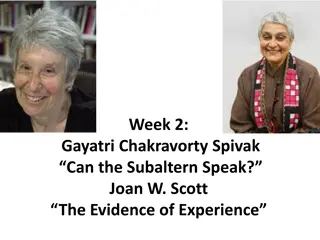
Historical Development (6) Marxism, psychoanalytic criticism (usually of the Lacanian variety) all influence postcolonial theory. For example, Gayatri Spivak, the publisher of the English translation of Jacques Derrida s Of Grammatology (1976), is a feminist, postcolonial critic who applies deconstructive interpretations of imperialism while simultaneously questioning the premises of the Marxism, feminism, and Derridean deconstruction that she espouses. poststructuralism, feminism, African-American, and
Historical Development (7) Postcolonialism is a varied approach to textual analysis assumes that literature, culture, and history all affect each other in significant ways. Postcolonial critics also believe in the unavoidability of subjective and political interpretations in literary studies, arguing that criticism and theory must be relevant to society as it really is. As such, these critics assert that colonialism was and is a cause of suffering and oppression, a cause that is inherently unjust.
Historical Development (7) Furthermore, colonialism is not a thing of the past, but continues today- how be it in subtler and less open ways- as a form of oppression and as such, must be opposed. As the contemporary critic Sam Durrant writes in Postcolonial Narrative and the Work of Mourning (2003), Post-colonialism as a praxis is grounded in an appeal to an ethical universal entailing a simple respect for human suffering and a fundamental revolt against it. Suffering and enslavement, maintain postcolonialists, are elements of oppression and are simply wrong.
Assumptions At the center of postcolonial theory exists an inherent tension among three categories of postcolonialists: (1) those who have been academically trained and are living in the West, (2) those who were raised in non-Western cultures but now reside in the West. (3) those subaltern writers living and writing in non-Western cultures.
Criticism Like other approaches to textual analysis, post-colonialism is not a homogenous school of literary theory and criticism, but a loosely defined set of theories and methodologies that seeks to uncover and discover what happens to the colonized once they have been conquered by the colonizers. Postcolonialism chiefly deals with literature that has been written by the colonized, in colonized countries. Its aim is to examine what has been missing from literary analyses by highlighting the interest of the colonized and the, destructive forces of the colonizer s hegemony as forced on the colonized. Whether the postcolonial critic embraces the tenets of psychoanalysis, Marxism, or any other theoretical framework, such a critic emphasizes each person s humanity and right to personal freedom. feminism,
References The formation of postcolonial theory, Lazare S Rukundwa & Andries G van https://www.academia.edu/30612579/Postcolonial_Criticism https://www.tandfonline.com/doi/abs/10.1076/ejes.6.3.289.14832?journalCode=neje20 https://www.pearsonhighered.com/assets/samplechapter/0/2/0/5/0205791697.pdf https://orbi.uliege.be/bitstream/2268/192385/1/Maes_Postcolonial-Criticism- Crossroads_2004.pdf