Practical Guidance on Using SARCoN: Experiences and Analysis
Explore the TECDOC on SARCoN, focusing on good practices and lessons learned. The document provides insights into the quantitative analysis and qualitative overview of Member States' experiences using SARCoN. Discover the importance of SARCoN as a tool for capacity building and regulatory competence.

Download Presentation

Please find below an Image/Link to download the presentation.
The content on the website is provided AS IS for your information and personal use only. It may not be sold, licensed, or shared on other websites without obtaining consent from the author. If you encounter any issues during the download, it is possible that the publisher has removed the file from their server.
You are allowed to download the files provided on this website for personal or commercial use, subject to the condition that they are used lawfully. All files are the property of their respective owners.
The content on the website is provided AS IS for your information and personal use only. It may not be sold, licensed, or shared on other websites without obtaining consent from the author.
E N D
Presentation Transcript
7thMeeting of the Steering Committee on Regulatory Capacity Building and Knowledge Management TECDOC ON EXPERIENCES USING SARCoN Vienna, 7-11 December 2015 Pierre MIGNOT
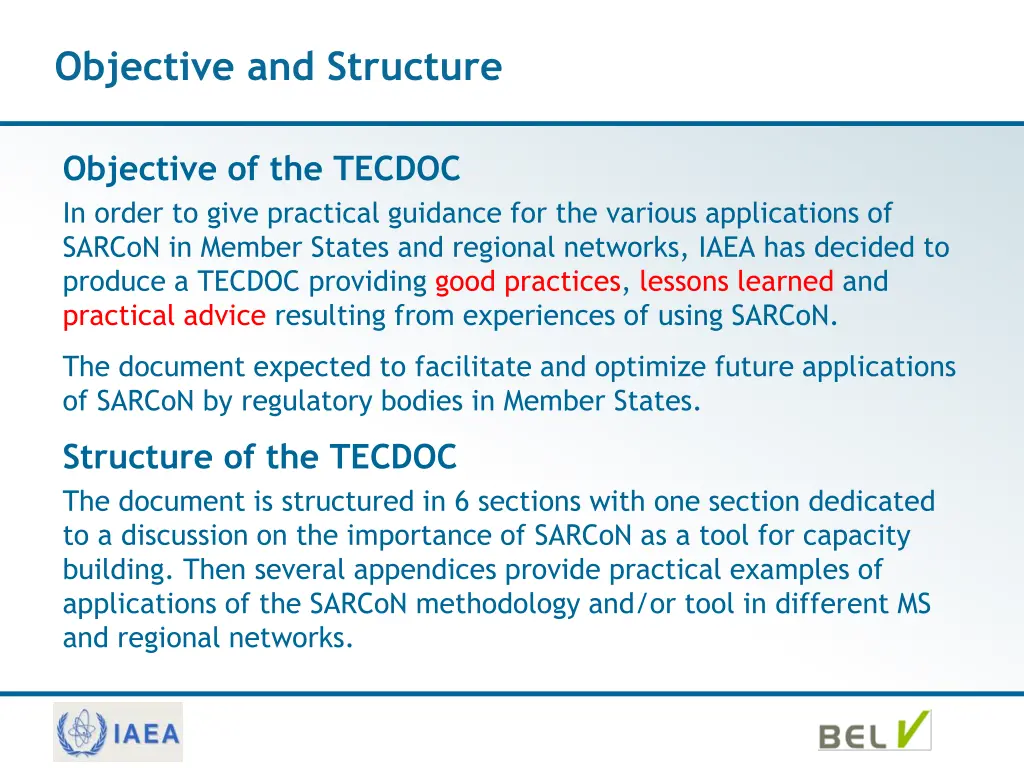
Objective and Structure Objective of the TECDOC In order to give practical guidance for the various applications of SARCoN in Member States and regional networks, IAEA has decided to produce a TECDOC providing good practices, lessons learned and practical advice resulting from experiences of using SARCoN. The document expected to facilitate and optimize future applications of SARCoN by regulatory bodies in Member States. Structure of the TECDOC The document is structured in 6 sections with one section dedicated to a discussion on the importance of SARCoN as a tool for capacity building. Then several appendices provide practical examples of applications of the SARCoN methodology and/or tool in different MS and regional networks.
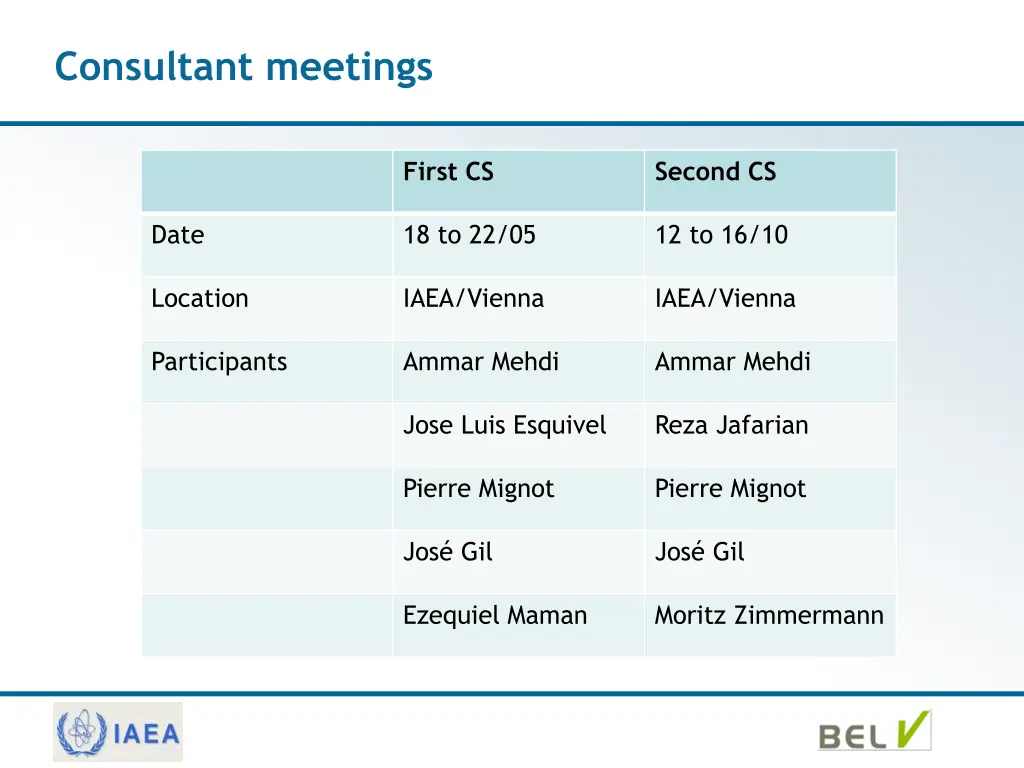
Consultant meetings First CS Second CS Date 18 to 22/05 12 to 16/10 Location IAEA/Vienna IAEA/Vienna Participants Ammar Mehdi Ammar Mehdi Jose Luis Esquivel Reza Jafarian Pierre Mignot Pierre Mignot Jos Gil Jos Gil Ezequiel Maman Moritz Zimmermann
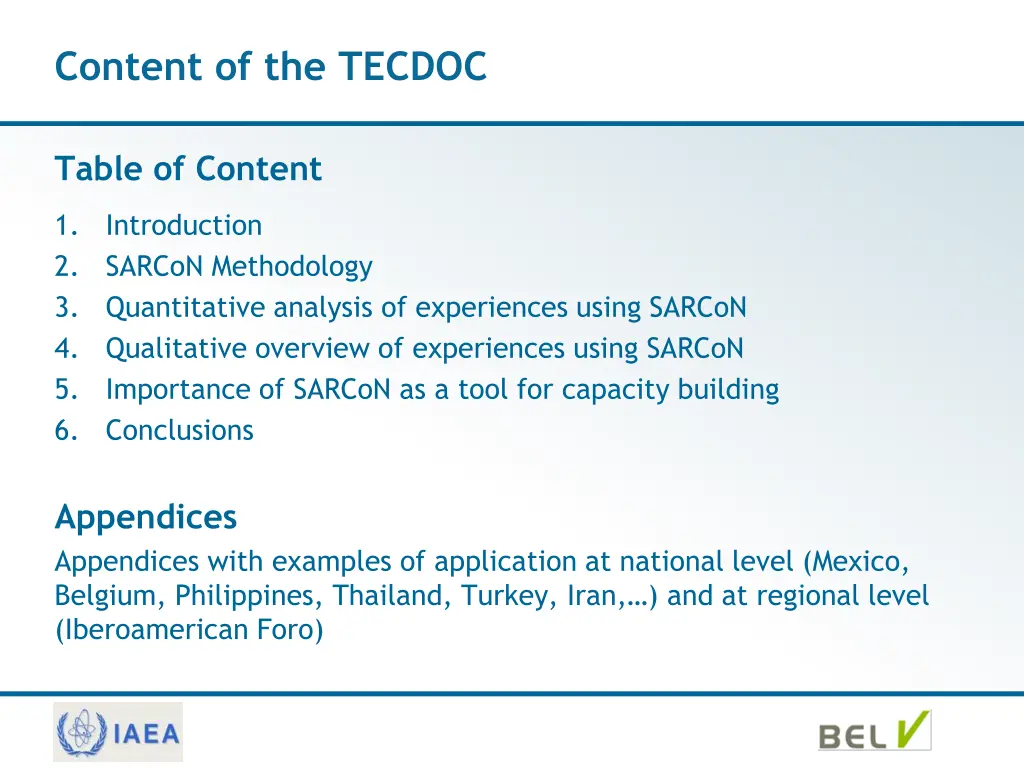
Content of the TECDOC Table of Content 1. 2. 3. 4. 5. 6. Introduction SARCoN Methodology Quantitative analysis of experiences using SARCoN Qualitative overview of experiences using SARCoN Importance of SARCoN as a tool for capacity building Conclusions Appendices Appendices with examples of application at national level (Mexico, Belgium, Philippines, Thailand, Turkey, Iran, ) and at regional level (Iberoamerican Foro)
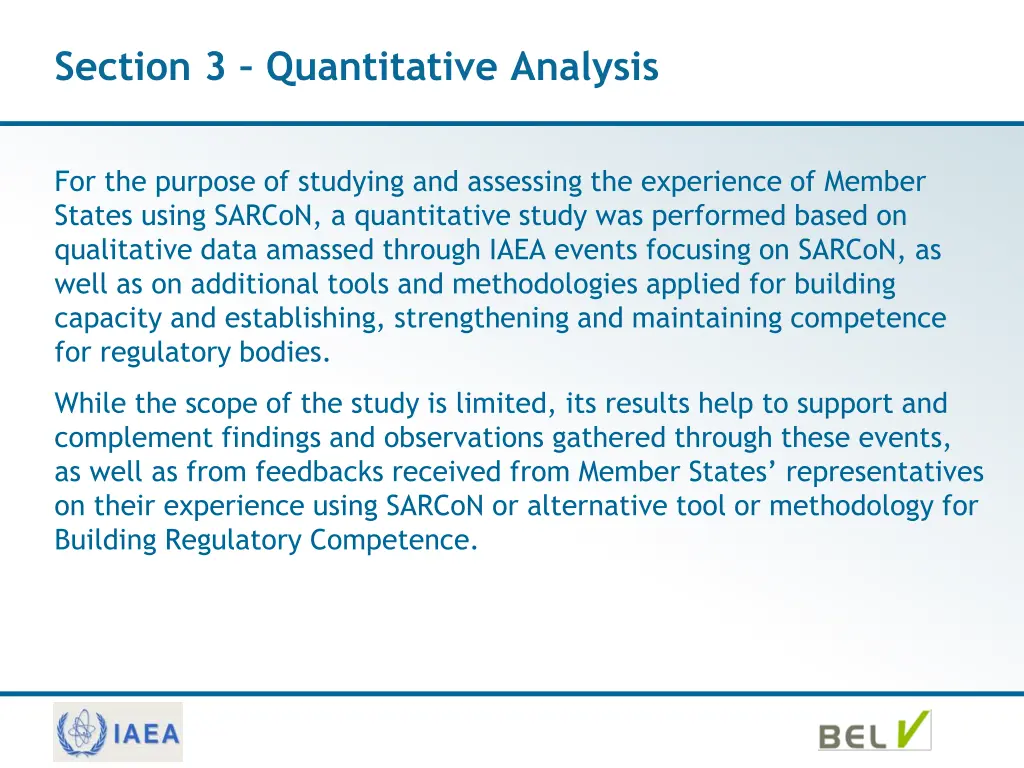
Section 3 Quantitative Analysis For the purpose of studying and assessing the experience of Member States using SARCoN, a quantitative study was performed based on qualitative data amassed through IAEA events focusing on SARCoN, as well as on additional tools and methodologies applied for building capacity and establishing, strengthening and maintaining competence for regulatory bodies. While the scope of the study is limited, its results help to support and complement findings and observations gathered through these events, as well as from feedbacks received from Member States representatives on their experience using SARCoN or alternative tool or methodology for Building Regulatory Competence.
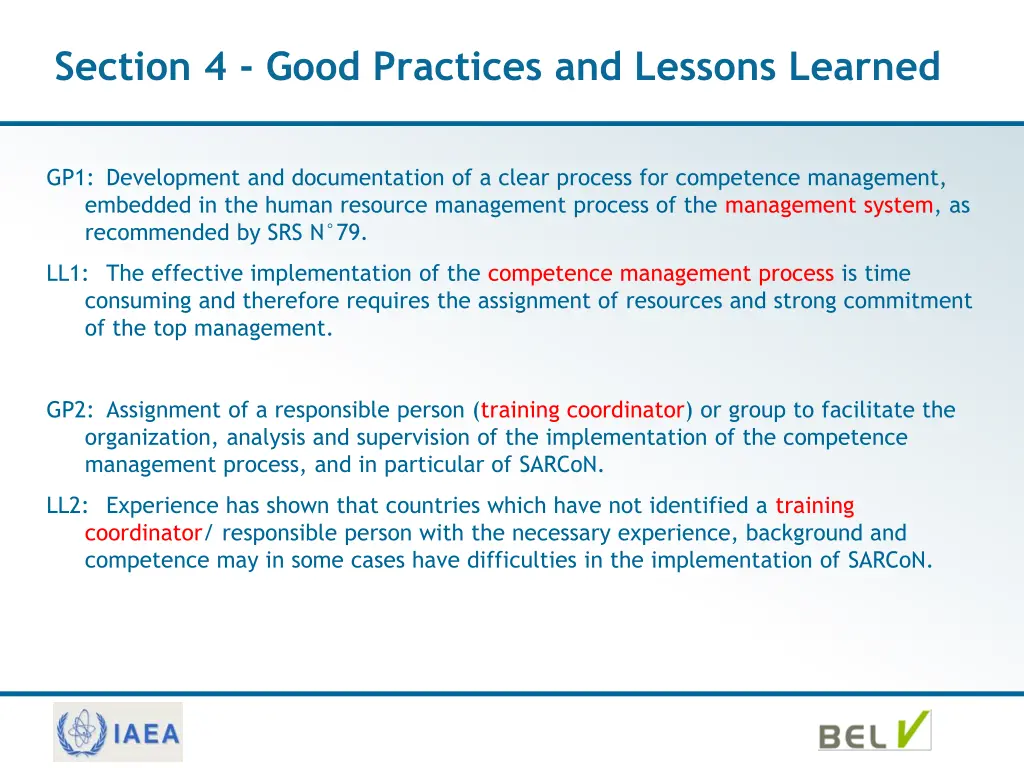
Section 4 - Good Practices and Lessons Learned GP1: Development and documentation of a clear process for competence management, embedded in the human resource management process of the management system, as recommended by SRS N 79. LL1: The effective implementation of the competence management process is time consuming and therefore requires the assignment of resources and strong commitment of the top management. GP2: Assignment of a responsible person (training coordinator) or group to facilitate the organization, analysis and supervision of the implementation of the competence management process, and in particular of SARCoN. LL2: Experience has shown that countries which have not identified a training coordinator/ responsible person with the necessary experience, background and competence may in some cases have difficulties in the implementation of SARCoN.
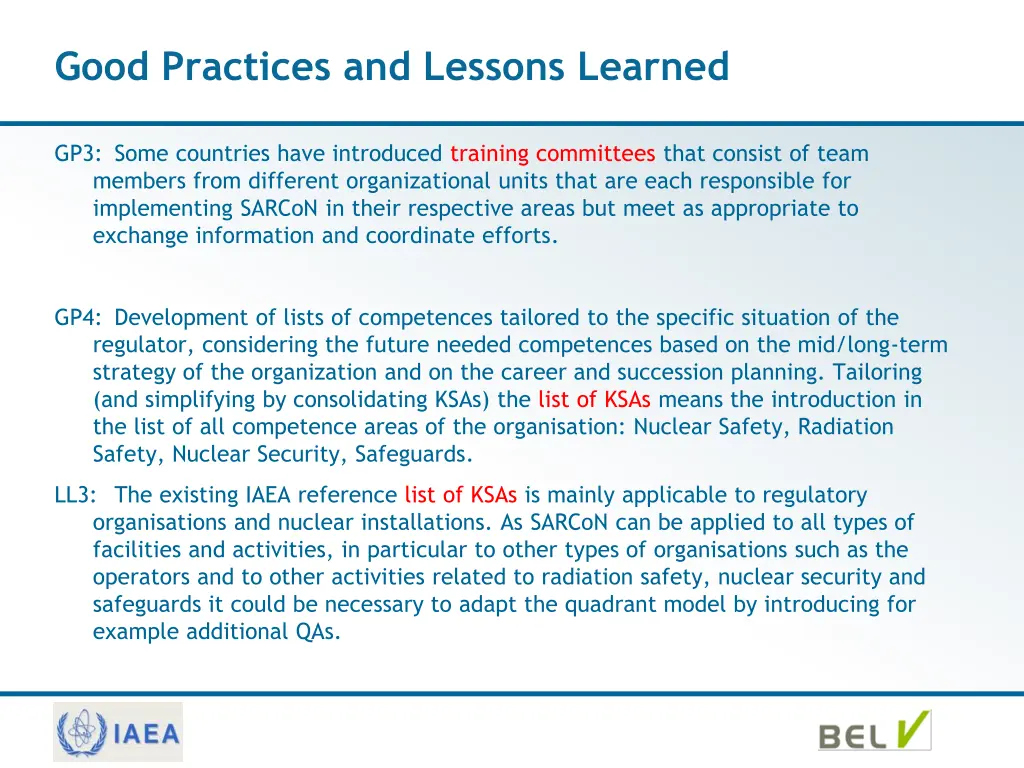
Good Practices and Lessons Learned GP3: Some countries have introduced training committees that consist of team members from different organizational units that are each responsible for implementing SARCoN in their respective areas but meet as appropriate to exchange information and coordinate efforts. GP4: Development of lists of competences tailored to the specific situation of the regulator, considering the future needed competences based on the mid/long-term strategy of the organization and on the career and succession planning. Tailoring (and simplifying by consolidating KSAs) the list of KSAs means the introduction in the list of all competence areas of the organisation: Nuclear Safety, Radiation Safety, Nuclear Security, Safeguards. LL3: The existing IAEA reference list of KSAs is mainly applicable to regulatory organisations and nuclear installations. As SARCoN can be applied to all types of facilities and activities, in particular to other types of organisations such as the operators and to other activities related to radiation safety, nuclear security and safeguards it could be necessary to adapt the quadrant model by introducing for example additional QAs.
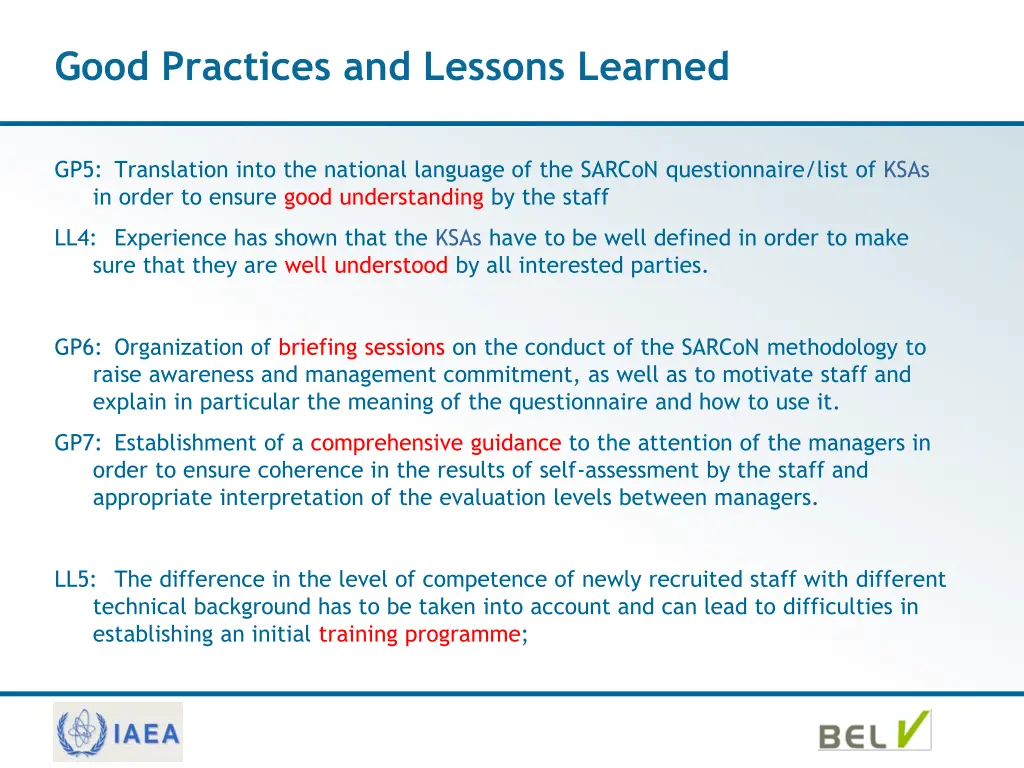
Good Practices and Lessons Learned GP5: Translation into the national language of the SARCoN questionnaire/list of KSAs in order to ensure good understanding by the staff LL4: Experience has shown that the KSAs have to be well defined in order to make sure that they are well understood by all interested parties. GP6: Organization of briefing sessions on the conduct of the SARCoN methodology to raise awareness and management commitment, as well as to motivate staff and explain in particular the meaning of the questionnaire and how to use it. GP7: Establishment of a comprehensive guidance to the attention of the managers in order to ensure coherence in the results of self-assessment by the staff and appropriate interpretation of the evaluation levels between managers. LL5: The difference in the level of competence of newly recruited staff with different technical background has to be taken into account and can lead to difficulties in establishing an initial training programme;
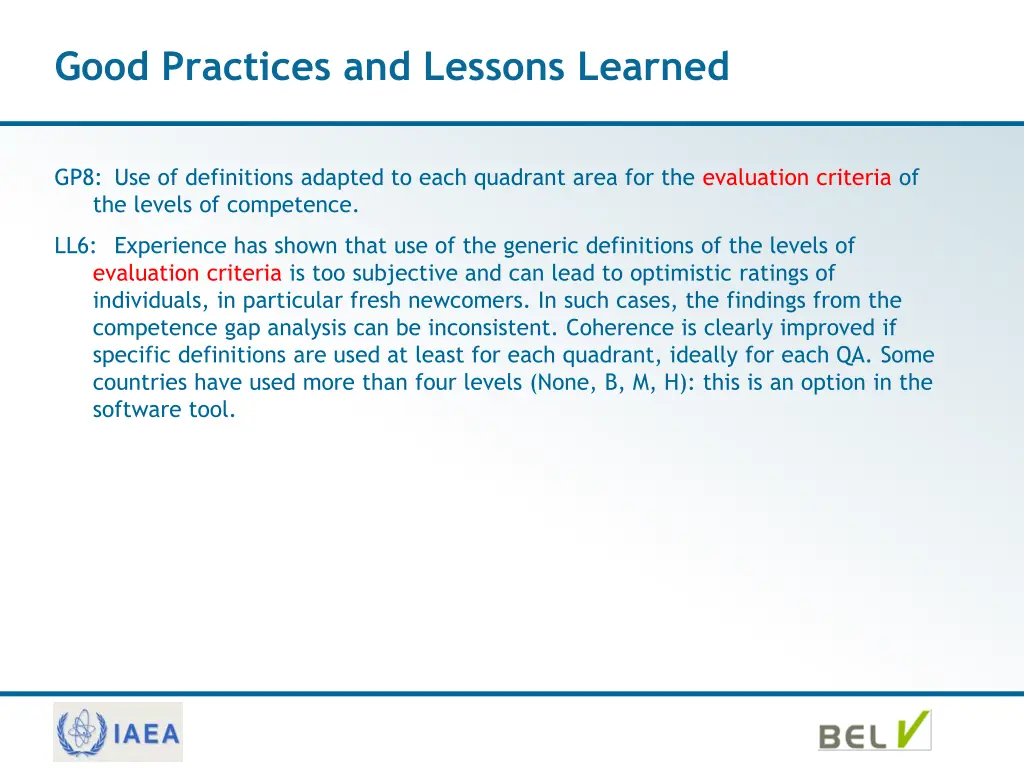
Good Practices and Lessons Learned GP8: Use of definitions adapted to each quadrant area for the evaluation criteria of the levels of competence. LL6: Experience has shown that use of the generic definitions of the levels of evaluation criteria is too subjective and can lead to optimistic ratings of individuals, in particular fresh newcomers. In such cases, the findings from the competence gap analysis can be inconsistent. Coherence is clearly improved if specific definitions are used at least for each quadrant, ideally for each QA. Some countries have used more than four levels (None, B, M, H): this is an option in the software tool.
Good Practices and Lessons Learned GP9: Use of the software tool for developing the competence profiles and development of such profiles for specific organizational units and generic job positions on the basis of the quadrant model of competences (at the level of QAs or KSAs. GP10: Use of the software tool for performing the competence gap analysis and prioritization and planning of actions at the level of the organization to be taken to fill the competence gaps. LL7: The software tool is easy to use by all interested parties: individuals, managers and training coordinator. The results consist of quantitative gaps: the values of the gaps have to be complemented by a sanity check by the manager or the training coordinator to ensure that the results make sense and are coherent. LL8: SARCoN can be used for defining competence profiles for embarking countries aiming at human resource planning and recruitment.
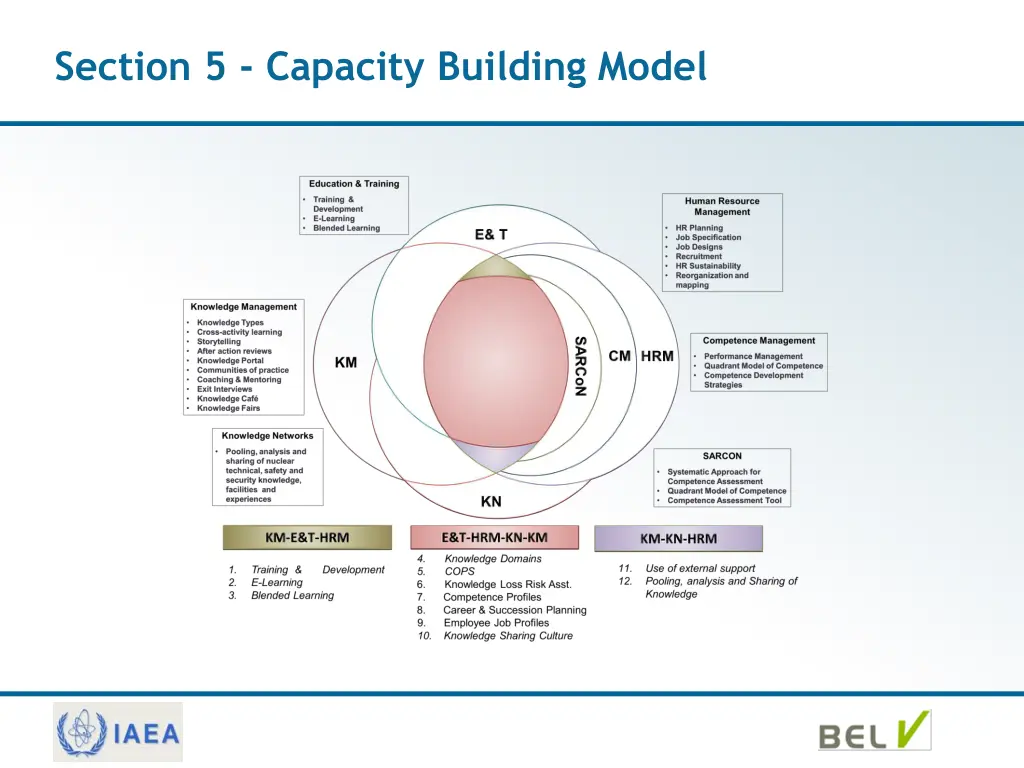
Good Practices and Lessons Learned GP11: Establishment of individual development plans (IDP), based on the results of SARCoN; GP12: Design of competence-based performance assessment tools in terms of reaching desired competence GP13: Implementation of Capacity Building projects based on SARCoN by regional networks such as FORO and ANSN. This is very useful for harmonizing concepts and definitions within a region and for developing standard competence profiles with the objective of sharing human and training resources, getting a common understanding of the approach and developing common solutions. LL9: When defining the specific KSAs for a regulator, it is important to keep in mind that training is the method mostly used for addressing the competence gaps. Establishment of an inventory of all possible training modes and existing internal or external training courses corresponding to each QA or KSA is an important step in the development of training programmes LL10: SARCoN can be used to support the capacity building model, in particular knowledge management
Practical advice 1. The methodology from TECDOC 1757 provides guidance for the systematic assessment of regulatory competence needs. The methodology is flexible such that It can be easily tailored to the specific situation and characteristics of an organization and it should be used only if its added value is recognized by the management and the staff and the KSAs and evaluation criteria are well understood. 2. In relation with GP1, the competence management process can be integrated in the management system or simply introduced in the management system by referring Development Plan (HRDP). In such cases a HRDP must be established and is a document complementing the management system. to a Human Resource 3. Section 4.3 to be completed
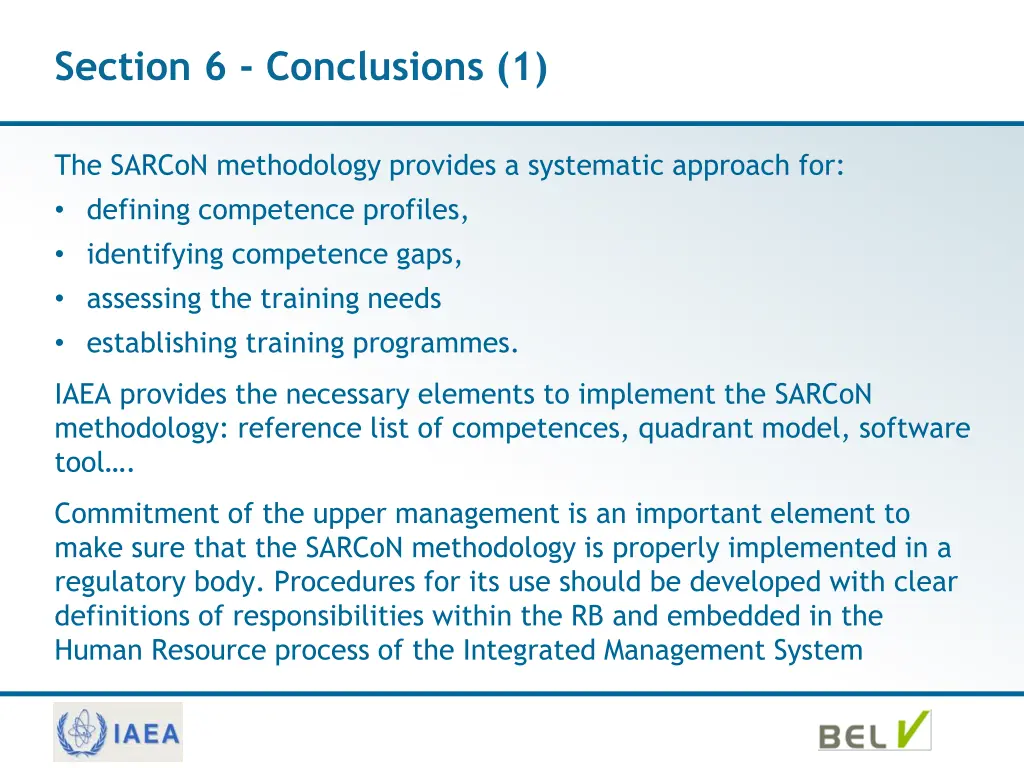
Section 6 - Conclusions (1) The SARCoN methodology provides a systematic approach for: defining competence profiles, identifying competence gaps, assessing the training needs establishing training programmes. IAEA provides the necessary elements to implement the SARCoN methodology: reference list of competences, quadrant model, software tool . Commitment of the upper management is an important element to make sure that the SARCoN methodology is properly implemented in a regulatory body. Procedures for its use should be developed with clear definitions of responsibilities within the RB and embedded in the Human Resource process of the Integrated Management System
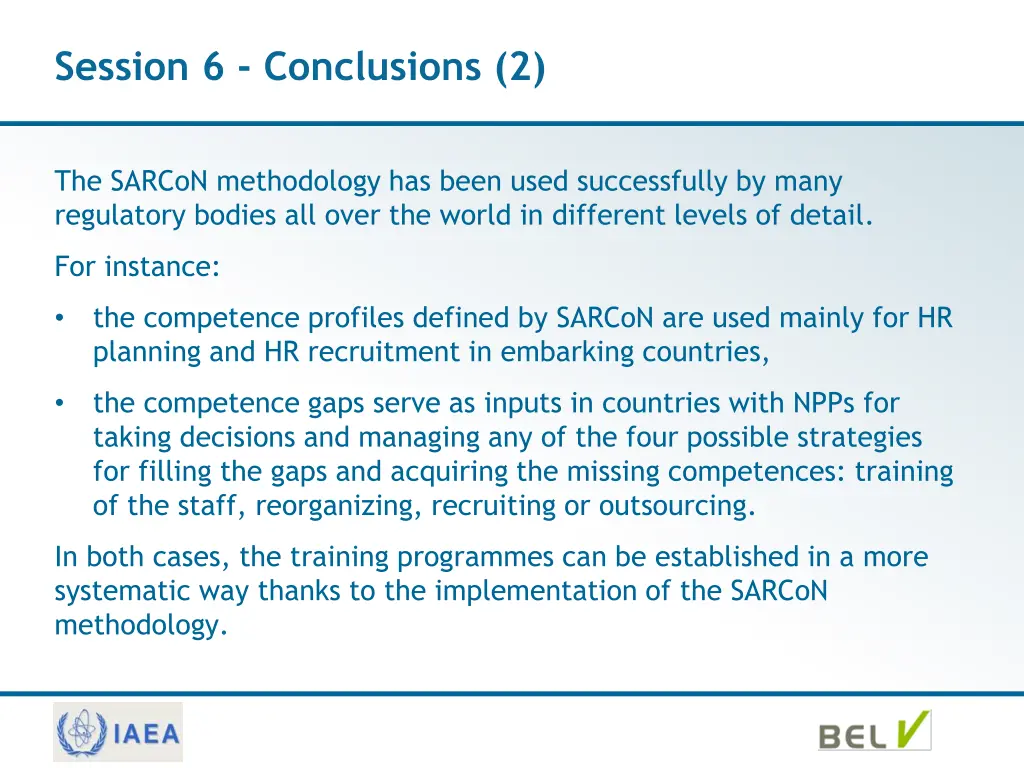
Session 6 - Conclusions (2) The SARCoN methodology has been used successfully by many regulatory bodies all over the world in different levels of detail. For instance: the competence profiles defined by SARCoN are used mainly for HR planning and HR recruitment in embarking countries, the competence gaps serve as inputs in countries with NPPs for taking decisions and managing any of the four possible strategies for filling the gaps and acquiring the missing competences: training of the staff, reorganizing, recruiting or outsourcing. In both cases, the training programmes can be established in a more systematic way thanks to the implementation of the SARCoN methodology.