Preparing for New Era in H-1B and L-1 On-Site Inspections
This content delves into the development, objectives, and compliance matters related to H-1B and L-1 on-site inspections, focusing on Fraud Detection and National Security initiatives. It covers the mission of FDNS, ASVVP, best practices, and compliance concerns, providing insights into the statistical data and site visit protocols.

Download Presentation

Please find below an Image/Link to download the presentation.
The content on the website is provided AS IS for your information and personal use only. It may not be sold, licensed, or shared on other websites without obtaining consent from the author.If you encounter any issues during the download, it is possible that the publisher has removed the file from their server.
You are allowed to download the files provided on this website for personal or commercial use, subject to the condition that they are used lawfully. All files are the property of their respective owners.
The content on the website is provided AS IS for your information and personal use only. It may not be sold, licensed, or shared on other websites without obtaining consent from the author.
E N D
Presentation Transcript
Act 41/H.518 Municipal Energy Resilience Program June 14, 2022 Board of Commissioners Sam Lash, CVRPC Climate & Energy Planner
Context Vermont s municipalities own and operate more than 2,000 buildings and facilities, Vermont s Global Warming Solutions Act sets aggressive targets for GHG emissions reductions, and the heating of buildings provide significant opportunities for meeting these targets The volatile cost of fossil fuel heating is often one of the largest line items in a municipal budget, State Energy Management Program can assist municipalities with responding to GHG emissions targets set forth in GWSA (29 V.S.A. section 168 2019) Connecting technical resources to the local, regional, and State level will promote the increased resilience and sustained connection to critical services for all Vermonters
Act 41/H.518 Municipal Energy Resilience Establishes a Municipal Energy Resilience Grant program To aid in the replacement of fossil fuel heating systems with more renewable and efficient heating systems (initial core focus) Includes comprehensive energy resilience assessment of covered municipal buildings and facilities Administered by Department of Buildings and General Services (BGS) in coordination with Efficiency Vermont, through the State Energy Management Program
Additional Bill Components Establishes the Municipal Energy Loan Program and Revolving Fund transferring $2.8M from Infrastructure Investment and Jobs Act to seed the Revolving fund Extends the relationship between BGS and Efficiency Vermont to implement the State Energy Management Program (SEMP) until 2027 TODAY s focus: the portion of the Act focused on the Municipal Energy Resilience Program
Grant Program 2 parts 1. Assessment = investment-grade audit (Ashrae Level II) starting September completed on or before 1/15/2024 2. Implementation = audited buildings and facilities will be assessed based on several criteria (next slides) and from this pool buildings will selected for implementation phase and awarded up to $500,000 for projects identified in the audits and selected in partnership between municipalities and BGS I. Complete by 2026 Application: Municipality shall submit an application to BGS to receive an assessment of its building and facilities (subsection e); municipalities may use the assistance of RPCs to develop plans as part of the application process
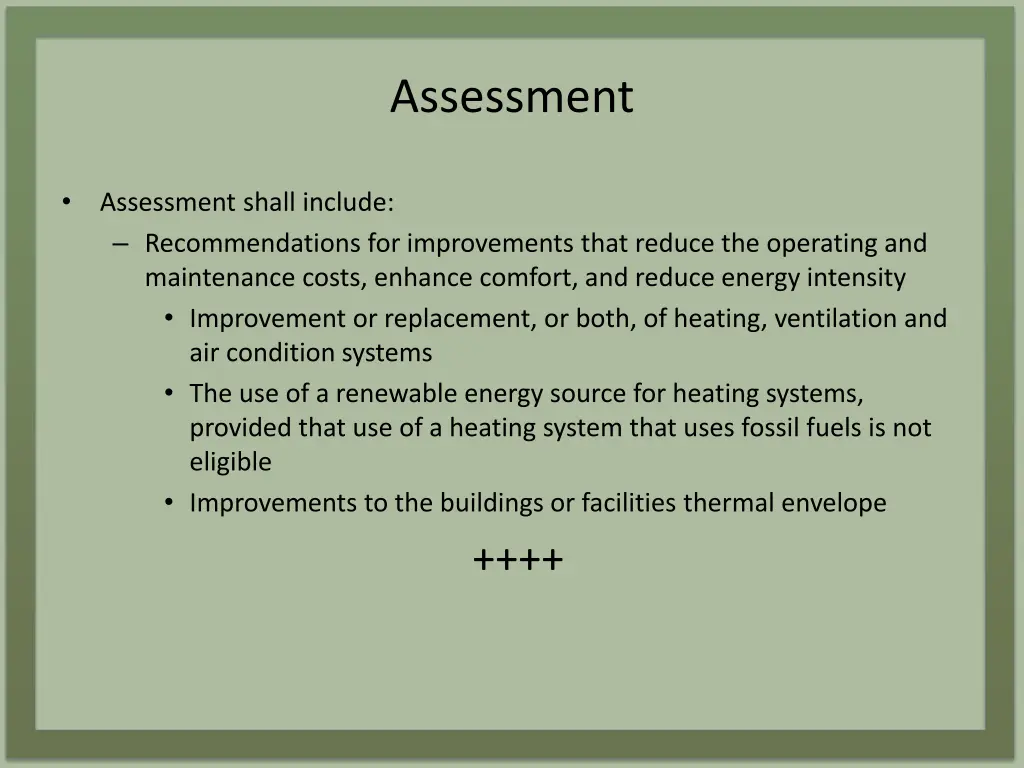
Assessment Assessment shall include: Recommendations for improvements that reduce the operating and maintenance costs, enhance comfort, and reduce energy intensity Improvement or replacement, or both, of heating, ventilation and air condition systems The use of a renewable energy source for heating systems, provided that use of a heating system that uses fossil fuels is not eligible Improvements to the buildings or facilities thermal envelope ++++
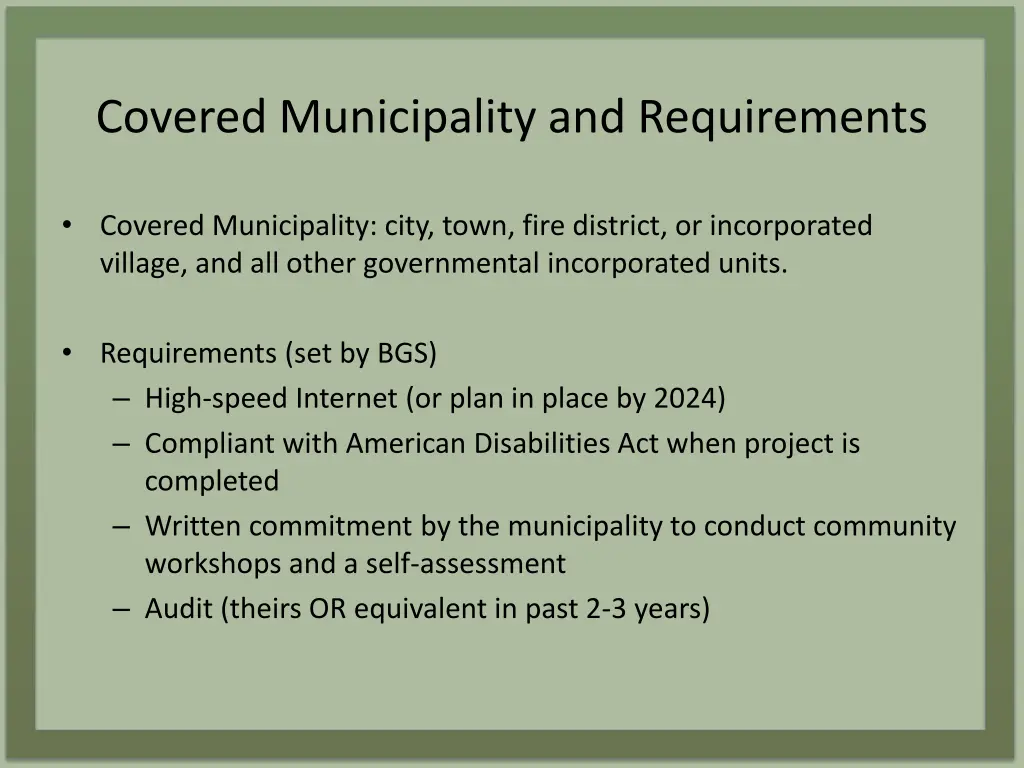
Covered Municipality and Requirements Covered Municipality: city, town, fire district, or incorporated village, and all other governmental incorporated units. Requirements (set by BGS) High-speed Internet (or plan in place by 2024) Compliant with American Disabilities Act when project is completed Written commitment by the municipality to conduct community workshops and a self-assessment Audit (theirs OR equivalent in past 2-3 years)
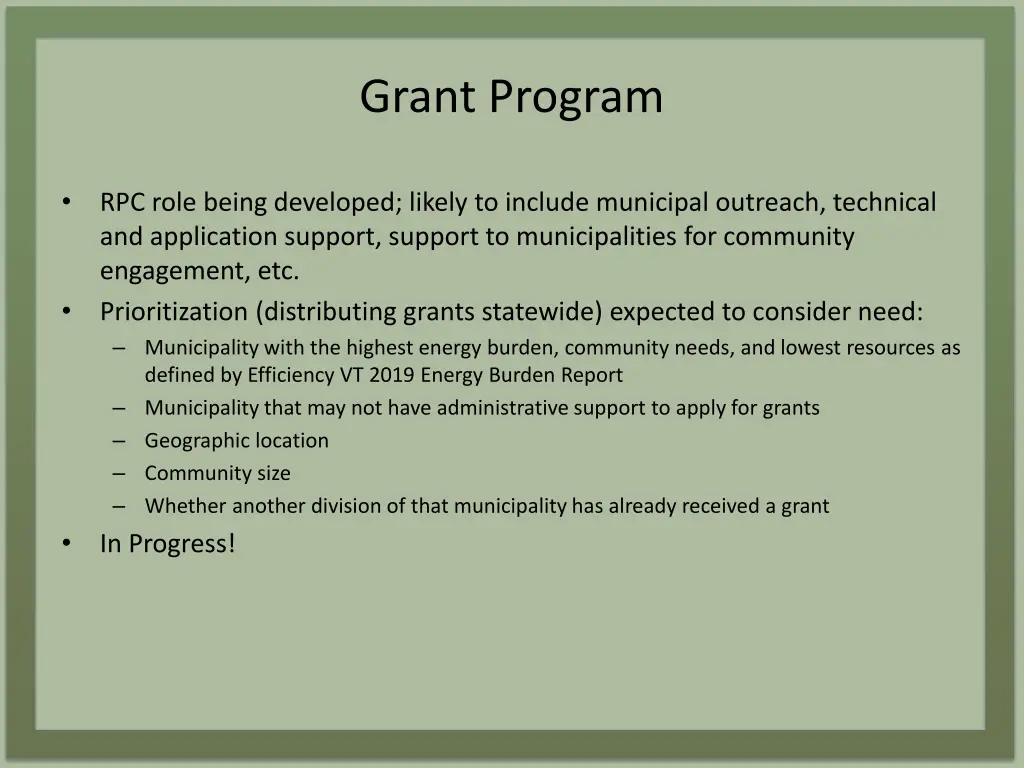
Grant Program RPC role being developed; likely to include municipal outreach, technical and application support, support to municipalities for community engagement, etc. Prioritization (distributing grants statewide) expected to consider need: Municipality with the highest energy burden, community needs, and lowest resources as defined by Efficiency VT 2019 Energy Burden Report Municipality that may not have administrative support to apply for grants Geographic location Community size Whether another division of that municipality has already received a grant In Progress!
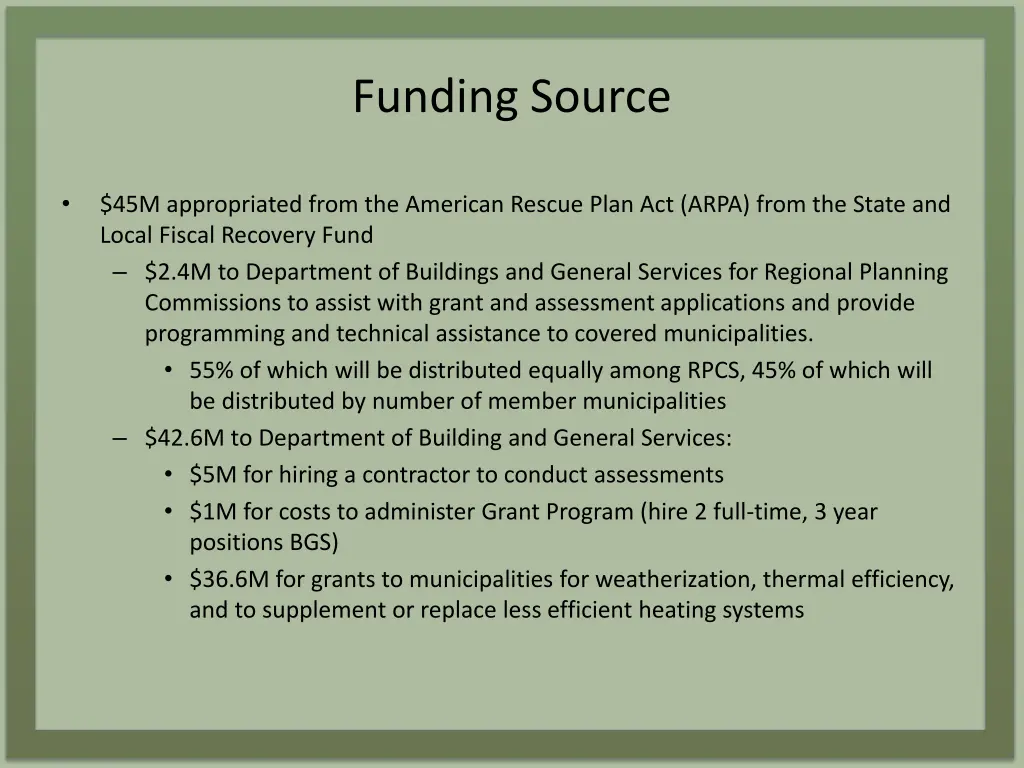
Funding Source $45M appropriated from the American Rescue Plan Act (ARPA) from the State and Local Fiscal Recovery Fund $2.4M to Department of Buildings and General Services for Regional Planning Commissions to assist with grant and assessment applications and provide programming and technical assistance to covered municipalities. 55% of which will be distributed equally among RPCS, 45% of which will be distributed by number of member municipalities $42.6M to Department of Building and General Services: $5M for hiring a contractor to conduct assessments $1M for costs to administer Grant Program (hire 2 full-time, 3 year positions BGS) $36.6M for grants to municipalities for weatherization, thermal efficiency, and to supplement or replace less efficient heating systems
Stay Tuned for grant & application workflow but in the meantime:
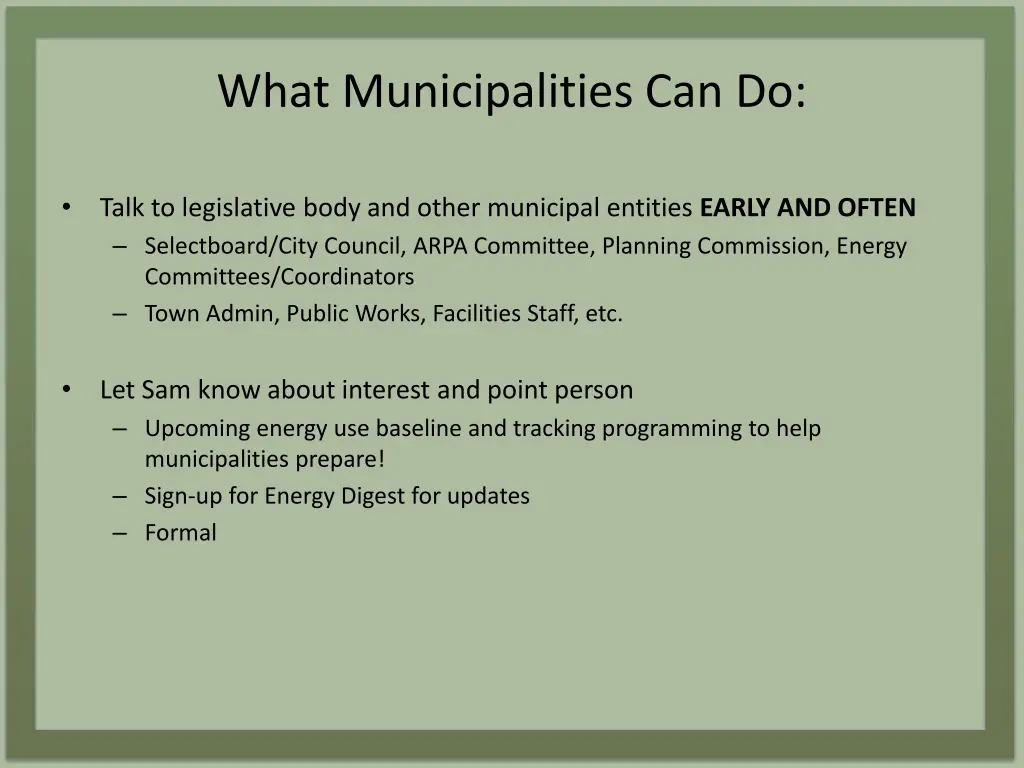
What Municipalities Can Do: Talk to legislative body and other municipal entities EARLY AND OFTEN Selectboard/City Council, ARPA Committee, Planning Commission, Energy Committees/Coordinators Town Admin, Public Works, Facilities Staff, etc. Let Sam know about interest and point person Upcoming energy use baseline and tracking programming to help municipalities prepare! Sign-up for Energy Digest for updates Formal
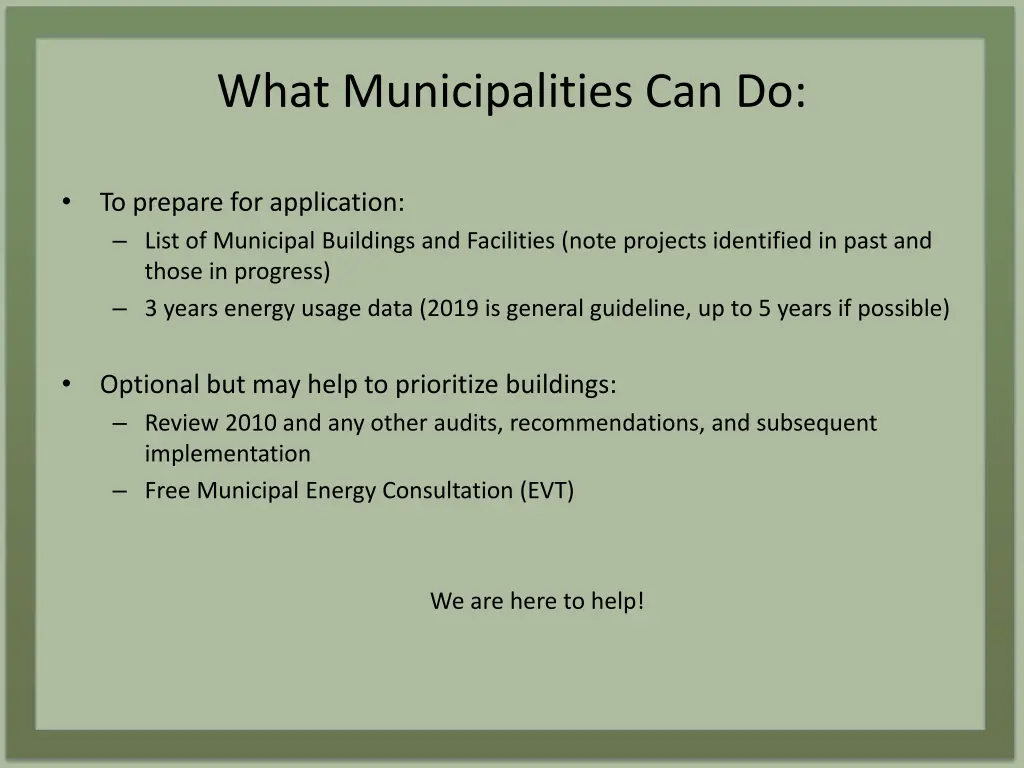
What Municipalities Can Do: To prepare for application: List of Municipal Buildings and Facilities (note projects identified in past and those in progress) 3 years energy usage data (2019 is general guideline, up to 5 years if possible) Optional but may help to prioritize buildings: Review 2010 and any other audits, recommendations, and subsequent implementation Free Municipal Energy Consultation (EVT) We are here to help!
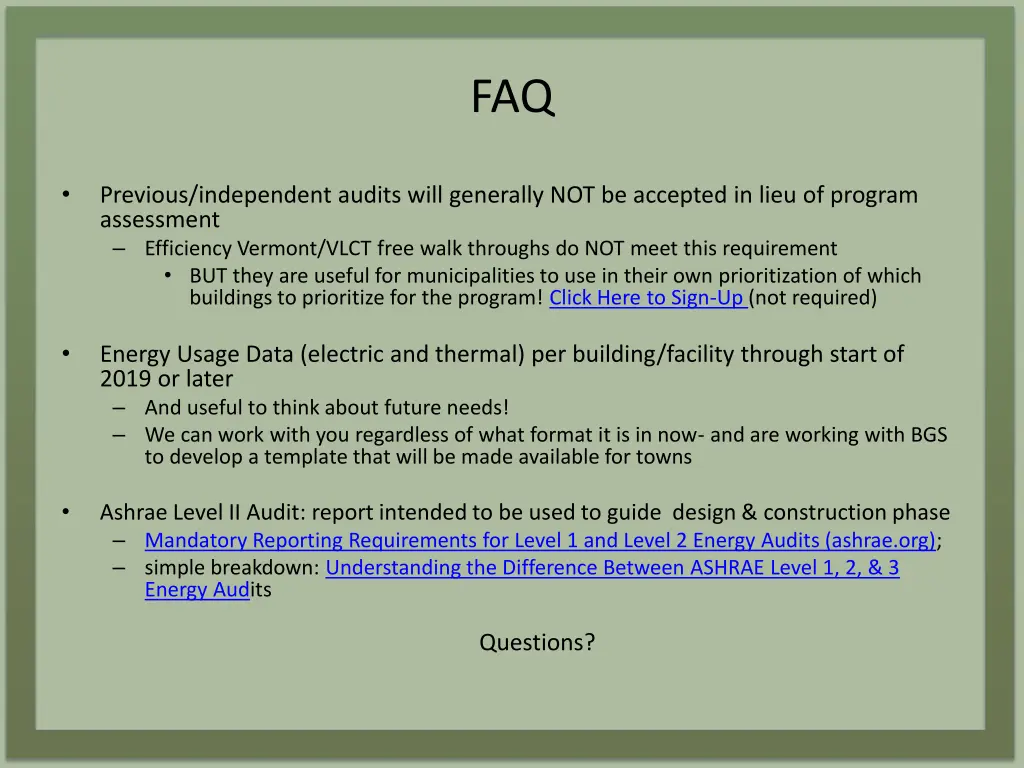
FAQ Previous/independent audits will generally NOT be accepted in lieu of program assessment Efficiency Vermont/VLCT free walk throughs do NOT meet this requirement BUT they are useful for municipalities to use in their own prioritization of which buildings to prioritize for the program! Click Here to Sign-Up (not required) Energy Usage Data (electric and thermal) per building/facility through start of 2019 or later And useful to think about future needs! We can work with you regardless of what format it is in now- and are working with BGS to develop a template that will be made available for towns Ashrae Level II Audit: report intended to be used to guide design & construction phase Mandatory Reporting Requirements for Level 1 and Level 2 Energy Audits (ashrae.org); simple breakdown: Understanding the Difference Between ASHRAE Level 1, 2, & 3 Energy Audits Questions?