Preparing Your ERC Proposal with Expert Guidance
Dive into the process of preparing a proposal for the European Research Council (ERC) with tips on accessing information, choosing panel evaluations, and debunking common myths. Familiarize yourself with the ERC's funding portal, download necessary templates, and engage with support resources to enhance your proposal's quality and chances of success in various scientific domains, from Physical Sciences to Social Sciences and Humanities.

Download Presentation

Please find below an Image/Link to download the presentation.
The content on the website is provided AS IS for your information and personal use only. It may not be sold, licensed, or shared on other websites without obtaining consent from the author.If you encounter any issues during the download, it is possible that the publisher has removed the file from their server.
You are allowed to download the files provided on this website for personal or commercial use, subject to the condition that they are used lawfully. All files are the property of their respective owners.
The content on the website is provided AS IS for your information and personal use only. It may not be sold, licensed, or shared on other websites without obtaining consent from the author.
E N D
Presentation Transcript
Foundations of HEMIS 2018 Higher Education: The big picture Prepared by Herman Visser 1
Acknowledgements Council for Higher Education documentation Department of Higher Education and Training documentation Presentations by the author on related aspects SOUTHERN AFRICAN ASSOCIATION FOR INSTITUTIONAL RESEARCH 2
Purpose The purpose of this session is to explain the nature and scope of the South African Higher Education Management Information System (HEMIS) and to locate it in the broader South African Higher Education context SOUTHERN AFRICAN ASSOCIATION FOR INSTITUTIONAL RESEARCH
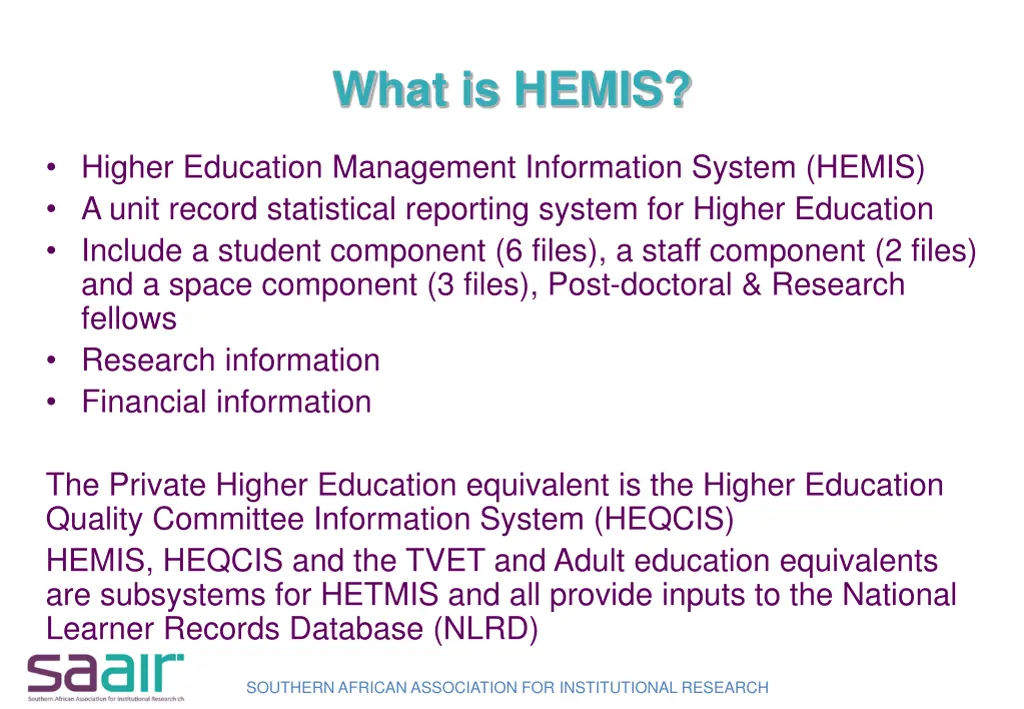
What is HEMIS? Higher Education Management Information System (HEMIS) A unit record statistical reporting system for Higher Education Include a student component (6 files), a staff component (2 files) and a space component (3 files), Post-doctoral & Research fellows Research information Financial information The Private Higher Education equivalent is the Higher Education Quality Committee Information System (HEQCIS) HEMIS, HEQCIS and the TVET and Adult education equivalents are subsystems for HETMIS and all provide inputs to the National Learner Records Database (NLRD) SOUTHERN AFRICAN ASSOCIATION FOR INSTITUTIONAL RESEARCH
Why is HEMIS necessary? Provide information for systemic planning purposes Provide information used in the funding of institutions Provide information that can be used for quality purposes Comparison between institutions Provide information for research purposes SOUTHERN AFRICAN ASSOCIATION FOR INSTITUTIONAL RESEARCH
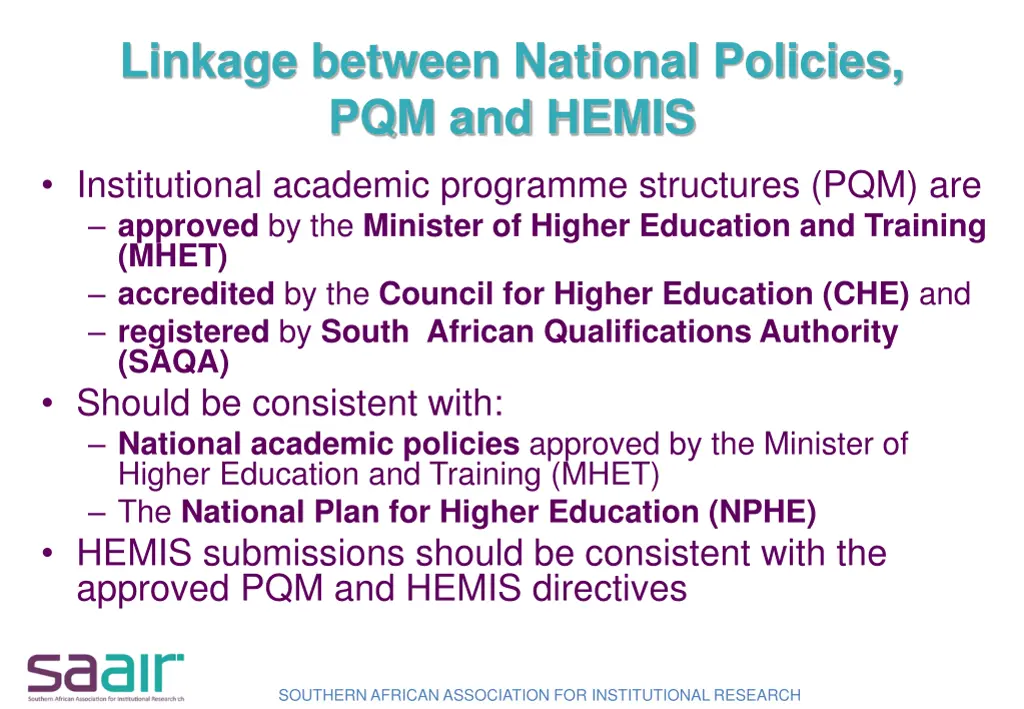
Linkage between National Policies, PQM and HEMIS Institutional academic programme structures (PQM) are approved by the Minister of Higher Education and Training (MHET) accredited by the Council for Higher Education (CHE) and registered by South African Qualifications Authority (SAQA) Should be consistent with: National academic policies approved by the Minister of Higher Education and Training (MHET) The National Plan for Higher Education (NPHE) HEMIS submissions should be consistent with the approved PQM and HEMIS directives SOUTHERN AFRICAN ASSOCIATION FOR INSTITUTIONAL RESEARCH
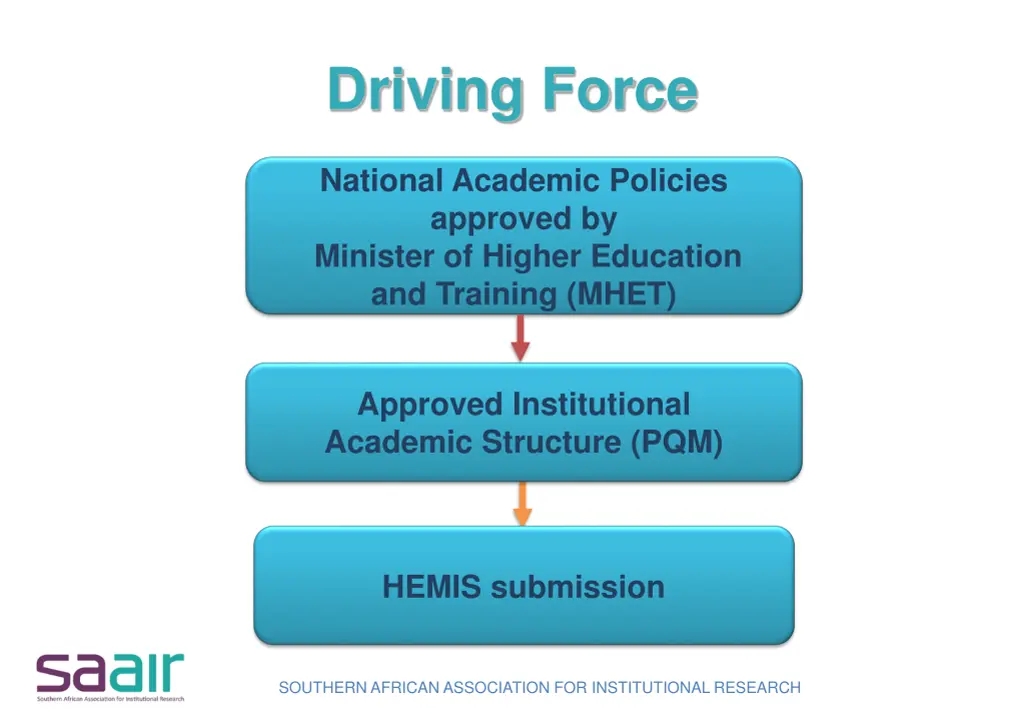
Driving Force National Academic Policies approved by Minister of Higher Education and Training (MHET) Approved Institutional Academic Structure (PQM) HEMIS submission SOUTHERN AFRICAN ASSOCIATION FOR INSTITUTIONAL RESEARCH
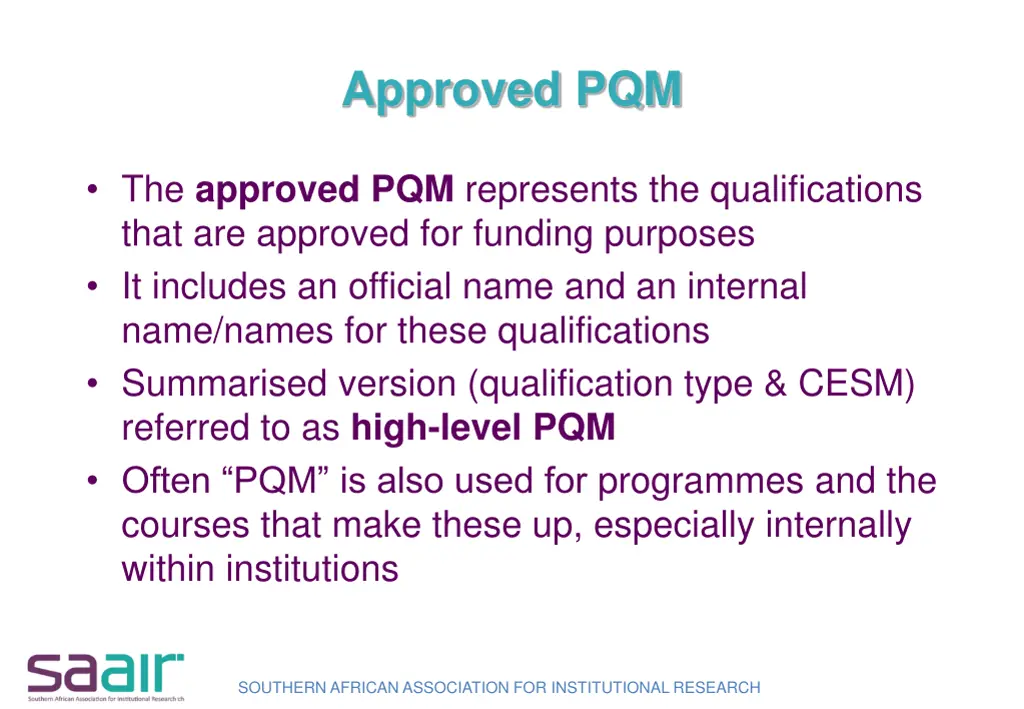
Approved PQM The approved PQM represents the qualifications that are approved for funding purposes It includes an official name and an internal name/names for these qualifications Summarised version (qualification type & CESM) referred to as high-level PQM Often PQM is also used for programmes and the courses that make these up, especially internally within institutions SOUTHERN AFRICAN ASSOCIATION FOR INSTITUTIONAL RESEARCH
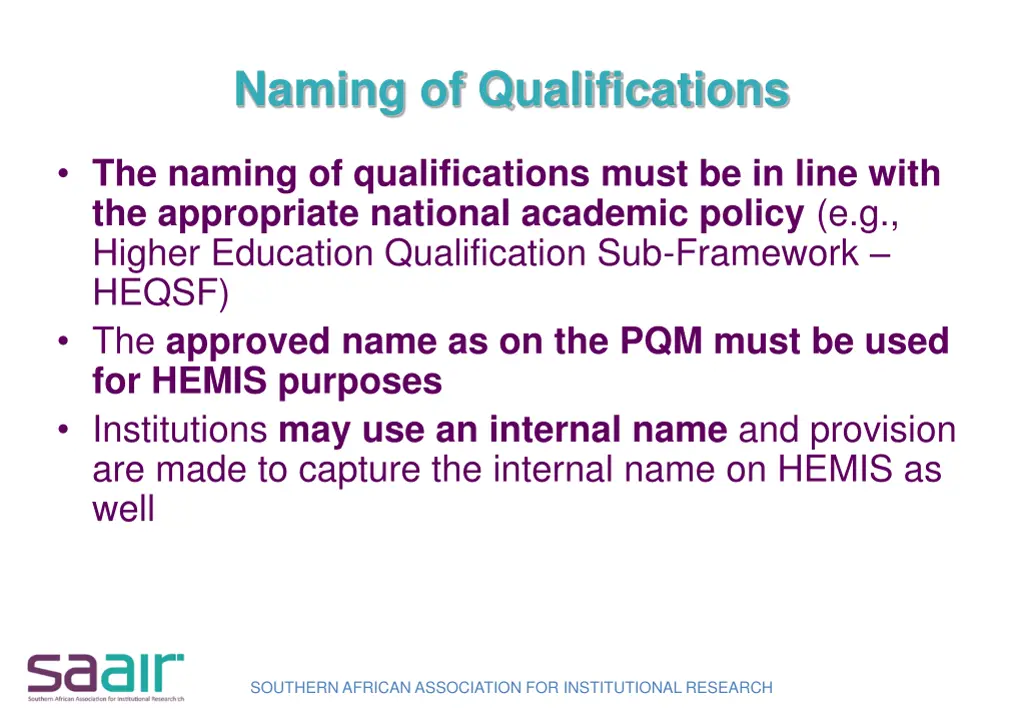
Naming of Qualifications The naming of qualifications must be in line with the appropriate national academic policy (e.g., Higher Education Qualification Sub-Framework HEQSF) The approved name as on the PQM must be used for HEMIS purposes Institutions may use an internal name and provision are made to capture the internal name on HEMIS as well SOUTHERN AFRICAN ASSOCIATION FOR INSTITUTIONAL RESEARCH
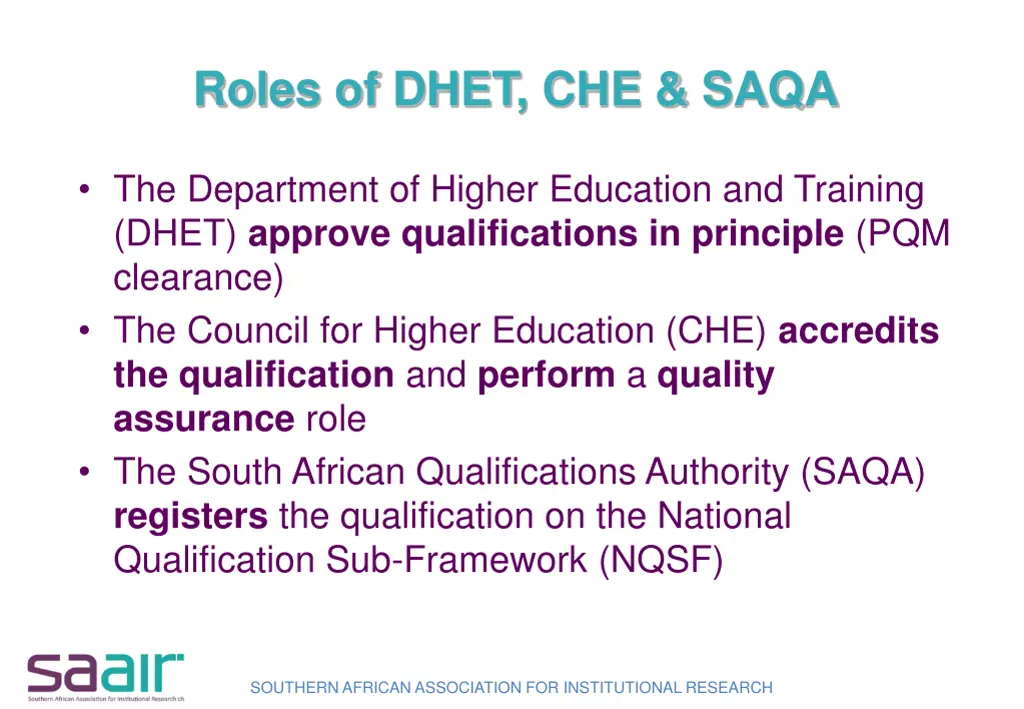
Roles of DHET, CHE & SAQA The Department of Higher Education and Training (DHET) approve qualifications in principle (PQM clearance) The Council for Higher Education (CHE) accredits the qualification and perform a quality assurance role The South African Qualifications Authority (SAQA) registers the qualification on the National Qualification Sub-Framework (NQSF) SOUTHERN AFRICAN ASSOCIATION FOR INSTITUTIONAL RESEARCH
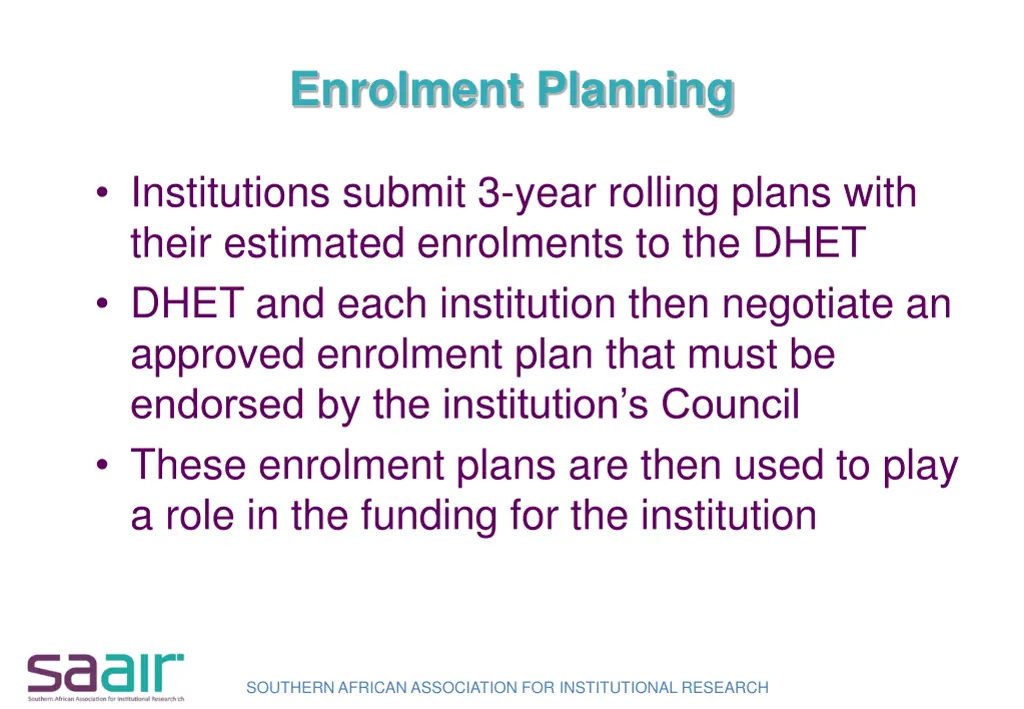
Enrolment Planning Institutions submit 3-year rolling plans with their estimated enrolments to the DHET DHET and each institution then negotiate an approved enrolment plan that must be endorsed by the institution s Council These enrolment plans are then used to play a role in the funding for the institution SOUTHERN AFRICAN ASSOCIATION FOR INSTITUTIONAL RESEARCH
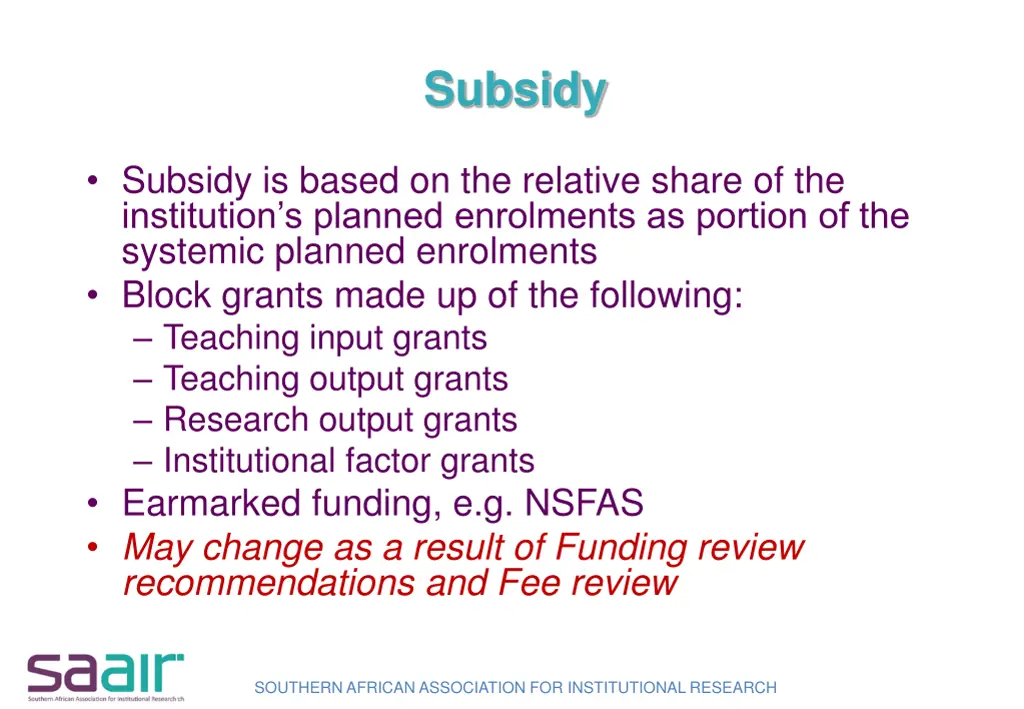
Subsidy Subsidy is based on the relative share of the institution s planned enrolments as portion of the systemic planned enrolments Block grants made up of the following: Teaching input grants Teaching output grants Research output grants Institutional factor grants Earmarked funding, e.g. NSFAS May change as a result of Funding review recommendations and Fee review SOUTHERN AFRICAN ASSOCIATION FOR INSTITUTIONAL RESEARCH
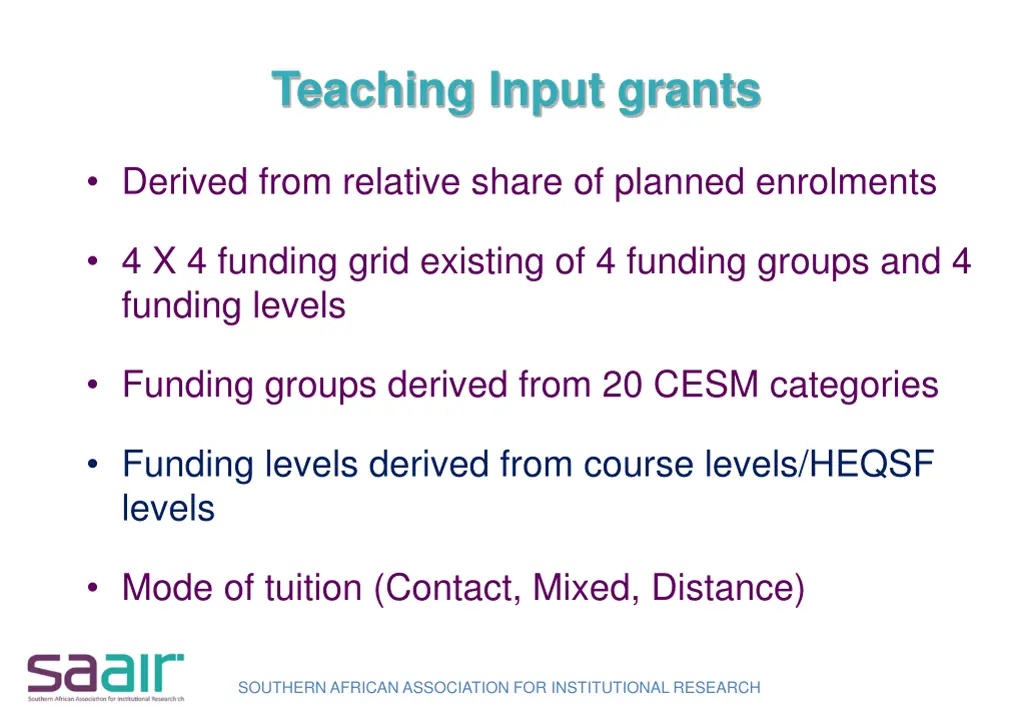
Teaching Input grants Derived from relative share of planned enrolments 4 X 4 funding grid existing of 4 funding groups and 4 funding levels Funding groups derived from 20 CESM categories Funding levels derived from course levels/HEQSF levels Mode of tuition (Contact, Mixed, Distance) SOUTHERN AFRICAN ASSOCIATION FOR INSTITUTIONAL RESEARCH
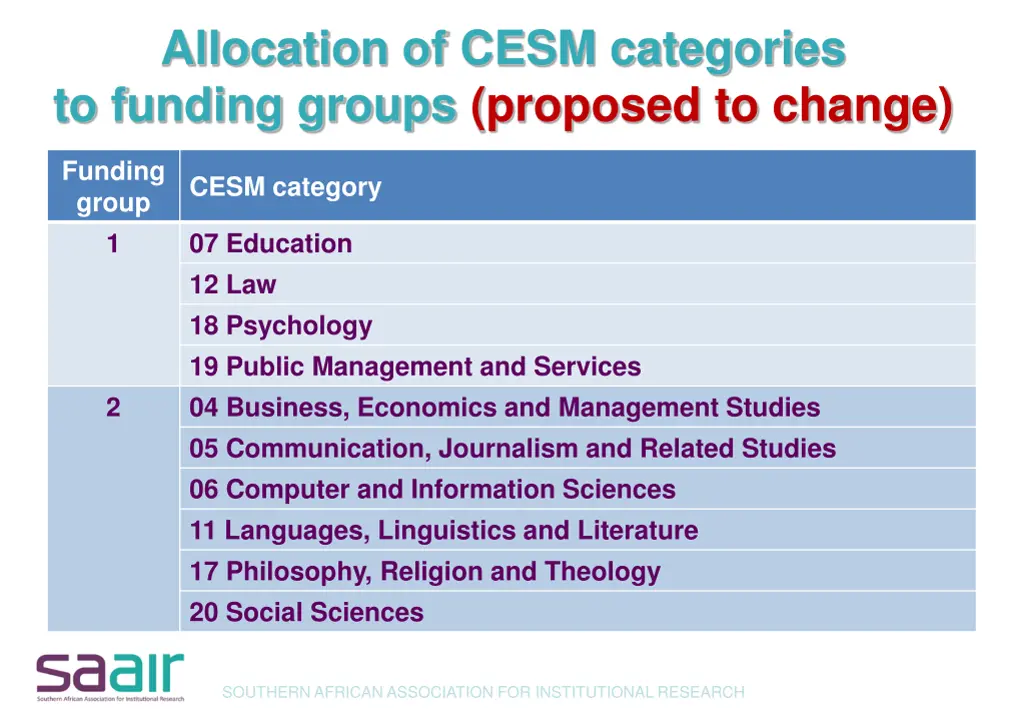
Allocation of CESM categories to funding groups (proposed to change) Funding group 1 CESM category 07 Education 12 Law 18 Psychology 19 Public Management and Services 04 Business, Economics and Management Studies 05 Communication, Journalism and Related Studies 06 Computer and Information Sciences 11 Languages, Linguistics and Literature 17 Philosophy, Religion and Theology 20 Social Sciences 2 SOUTHERN AFRICAN ASSOCIATION FOR INSTITUTIONAL RESEARCH
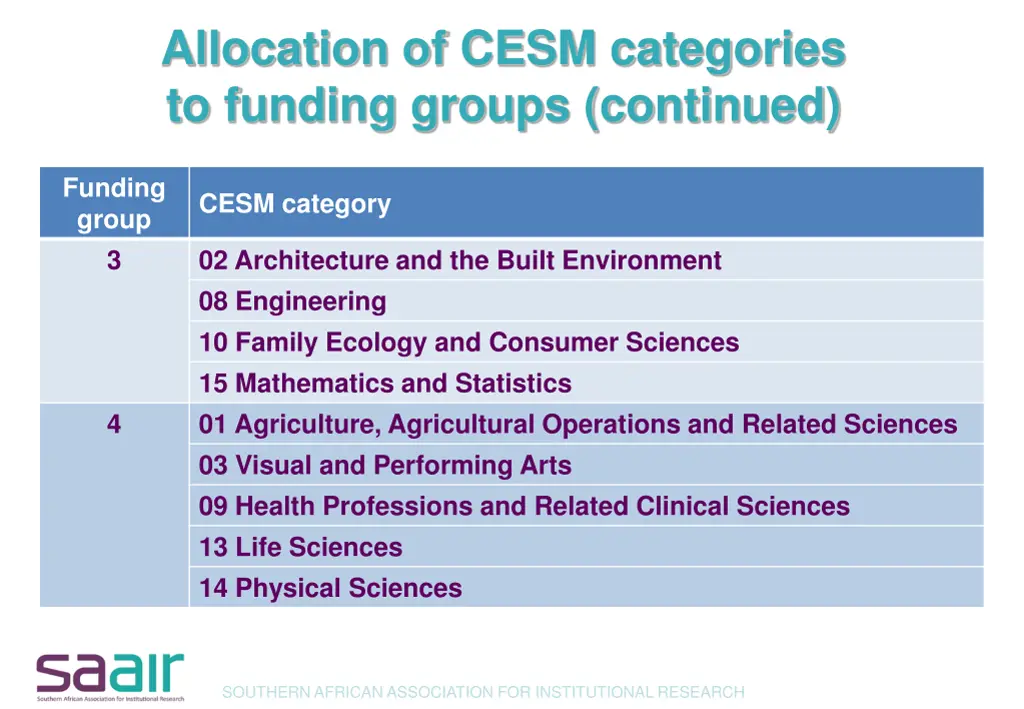
Allocation of CESM categories to funding groups (continued) Funding group 3 CESM category 02 Architecture and the Built Environment 08 Engineering 10 Family Ecology and Consumer Sciences 15 Mathematics and Statistics 01 Agriculture, Agricultural Operations and Related Sciences 03 Visual and Performing Arts 09 Health Professions and Related Clinical Sciences 13 Life Sciences 14 Physical Sciences 4 SOUTHERN AFRICAN ASSOCIATION FOR INSTITUTIONAL RESEARCH
CESM Southern African Association for Institutional Research
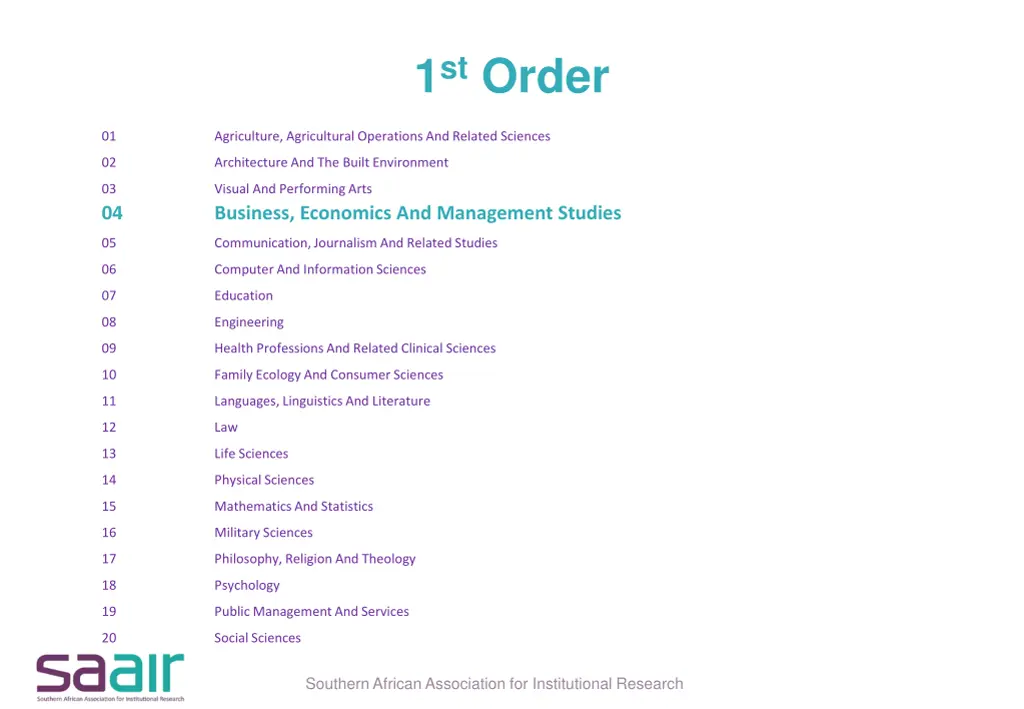
1st Order 01 Agriculture, Agricultural Operations And Related Sciences 02 Architecture And The Built Environment 03 04 Visual And Performing Arts Business, Economics And Management Studies 05 Communication, Journalism And Related Studies 06 Computer And Information Sciences 07 Education 08 Engineering 09 Health Professions And Related Clinical Sciences 10 Family Ecology And Consumer Sciences 11 Languages, Linguistics And Literature 12 Law 13 Life Sciences 14 Physical Sciences 15 Mathematics And Statistics 16 Military Sciences 17 Philosophy, Religion And Theology 18 Psychology 19 Public Management And Services 20 Social Sciences Southern African Association for Institutional Research
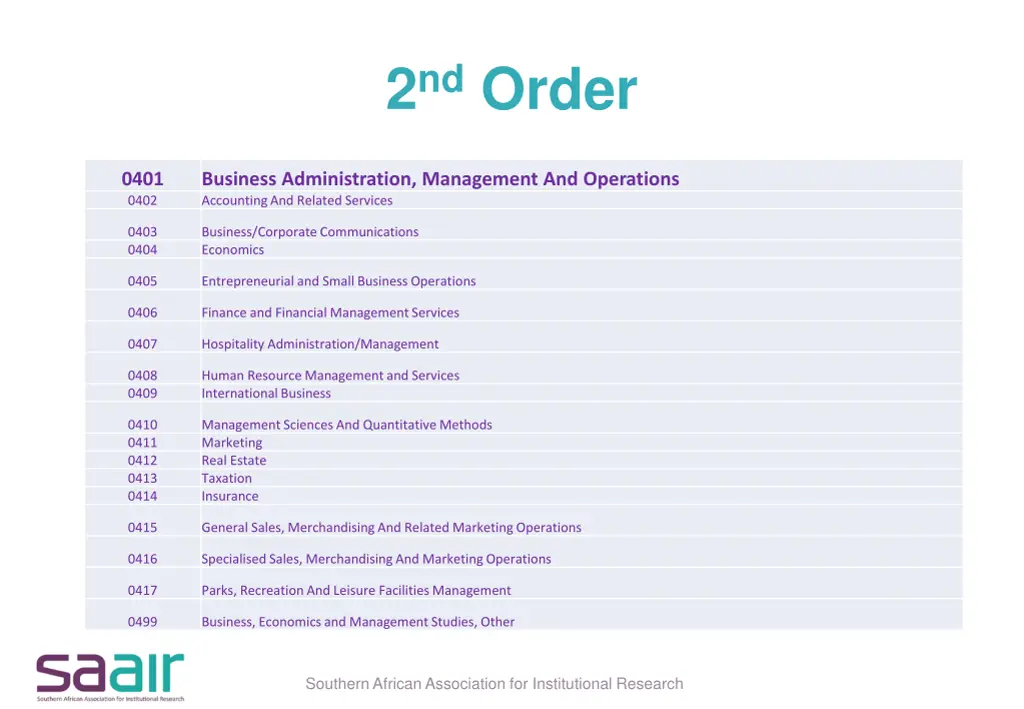
2nd Order 0401 0402 Business Administration, Management And Operations Accounting And Related Services 0403 0404 Business/Corporate Communications Economics 0405 Entrepreneurial and Small Business Operations 0406 Finance and Financial Management Services 0407 Hospitality Administration/Management 0408 0409 Human Resource Management and Services International Business 0410 0411 0412 0413 0414 Management Sciences And Quantitative Methods Marketing Real Estate Taxation Insurance 0415 General Sales, Merchandising And Related Marketing Operations 0416 Specialised Sales, Merchandising And Marketing Operations 0417 Parks, Recreation And Leisure Facilities Management 0499 Business, Economics and Management Studies, Other Southern African Association for Institutional Research
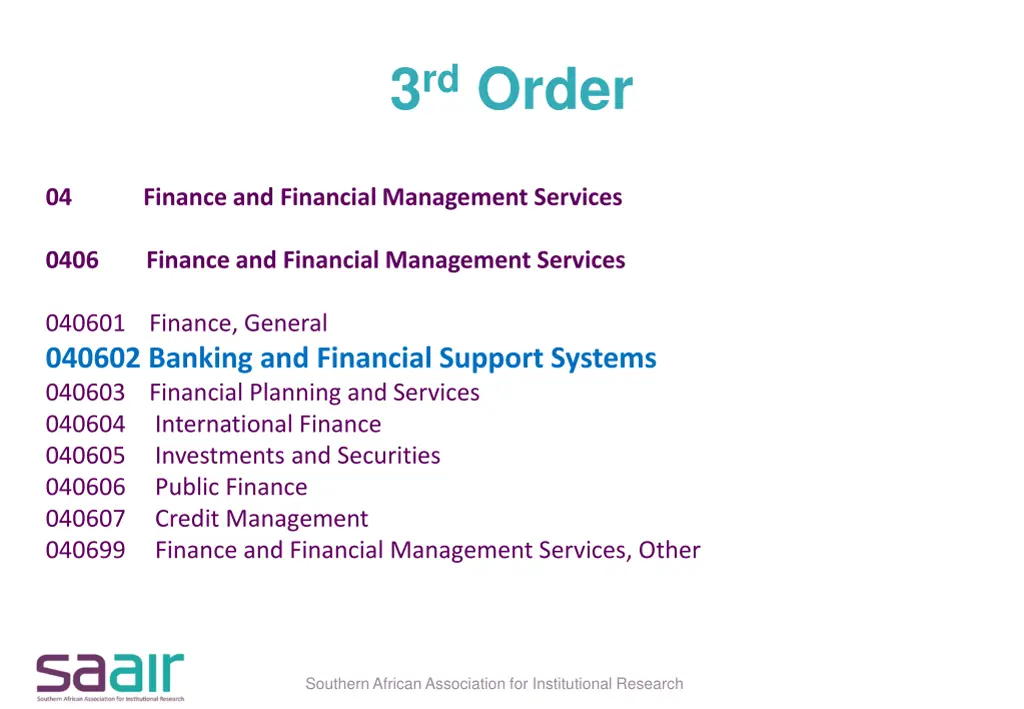
3rd Order 04 Finance and Financial Management Services 0406 Finance and Financial Management Services 040601 Finance, General 040602 Banking and Financial Support Systems 040603 Financial Planning and Services 040604 International Finance 040605 Investments and Securities 040606 Public Finance 040607 Credit Management 040699 Finance and Financial Management Services, Other Southern African Association for Institutional Research
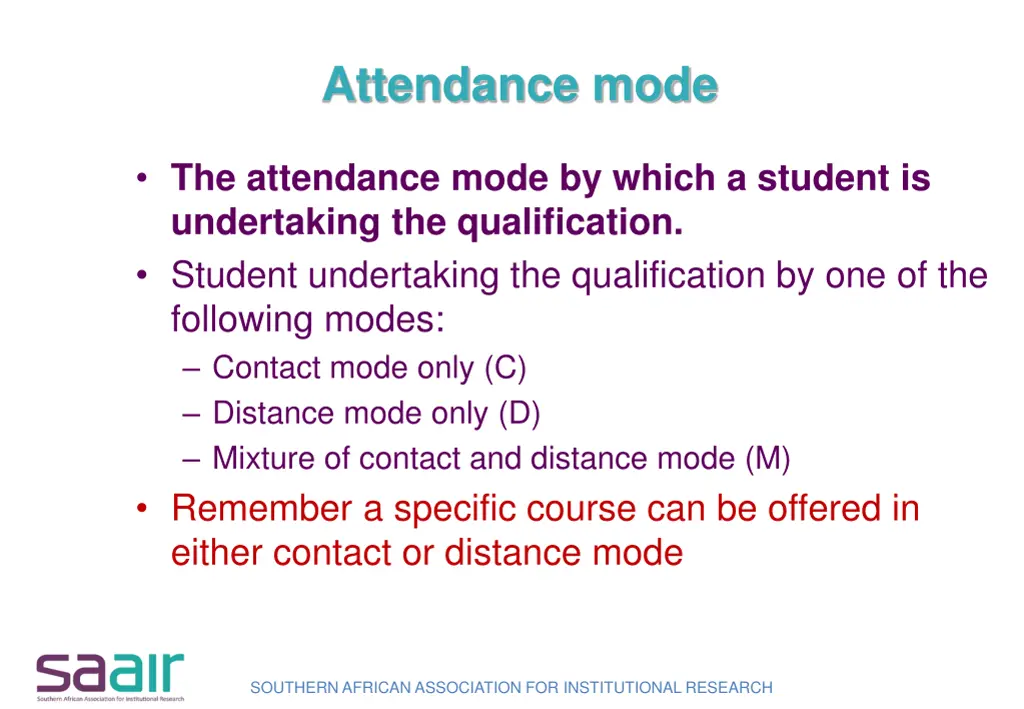
Attendance mode The attendance mode by which a student is undertaking the qualification. Student undertaking the qualification by one of the following modes: Contact mode only (C) Distance mode only (D) Mixture of contact and distance mode (M) Remember a specific course can be offered in either contact or distance mode SOUTHERN AFRICAN ASSOCIATION FOR INSTITUTIONAL RESEARCH
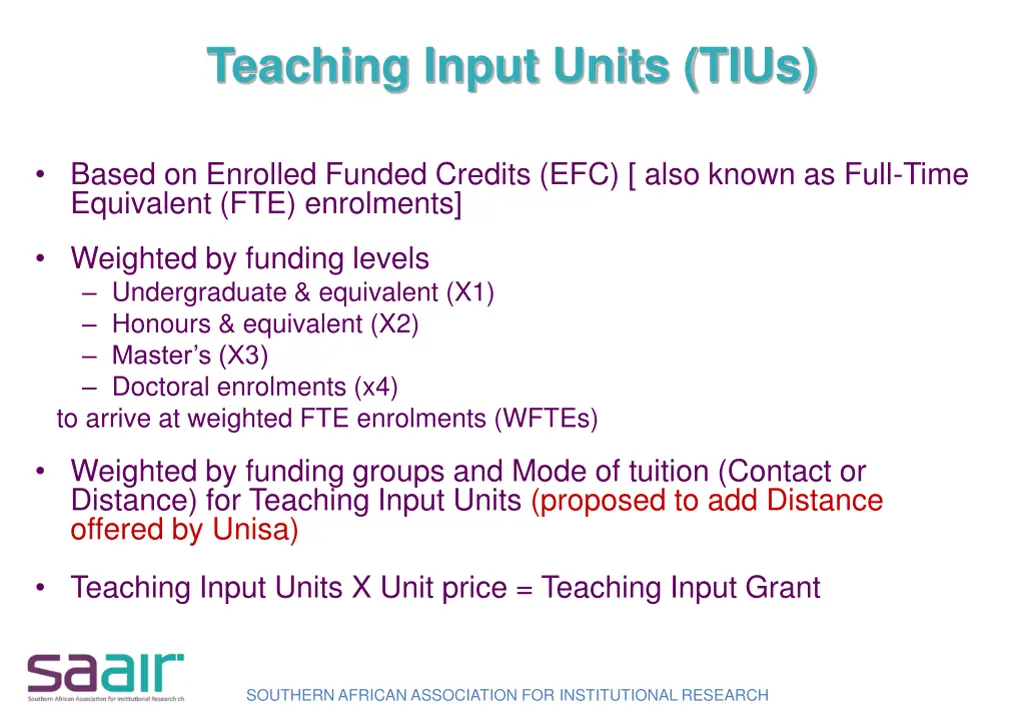
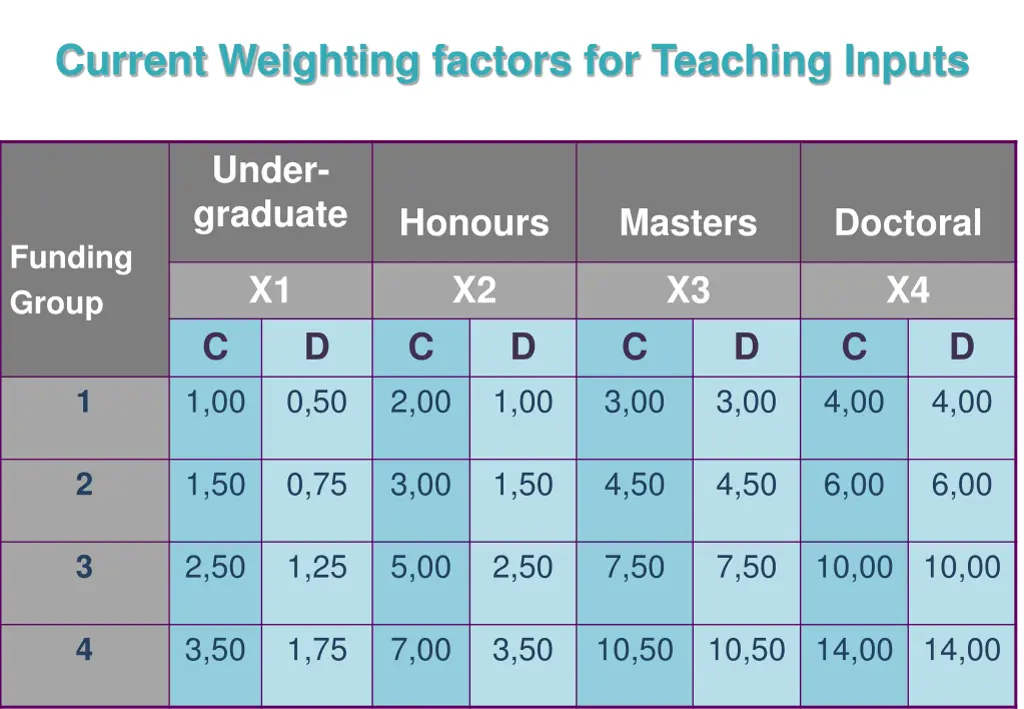
Teaching Input Units (TIUs) Based on Enrolled Funded Credits (EFC) [ also known as Full-Time Equivalent (FTE) enrolments] Weighted by funding levels Undergraduate & equivalent (X1) Honours & equivalent (X2) Master s (X3) Doctoral enrolments (x4) to arrive at weighted FTE enrolments (WFTEs) Weighted by funding groups and Mode of tuition (Contact or Distance) for Teaching Input Units (proposed to add Distance offered by Unisa) Teaching Input Units X Unit price = Teaching Input Grant SOUTHERN AFRICAN ASSOCIATION FOR INSTITUTIONAL RESEARCH
Current Weighting factors for Teaching Inputs Under- graduate Honours Masters Doctoral Funding Group X1 X2 X3 X4 C D C D C D C D 1,00 0,50 2,00 1,00 3,00 3,00 4,00 4,00 1 1,50 0,75 3,00 1,50 4,50 4,50 6,00 6,00 2 2,50 1,25 5,00 2,50 7,50 7,50 10,00 10,00 3 3,50 1,75 7,00 3,50 10,50 10,50 14,00 14,00 4 SOUTHERN AFRICAN ASSOCIATION FOR INSTITUTIONAL RESEARCH
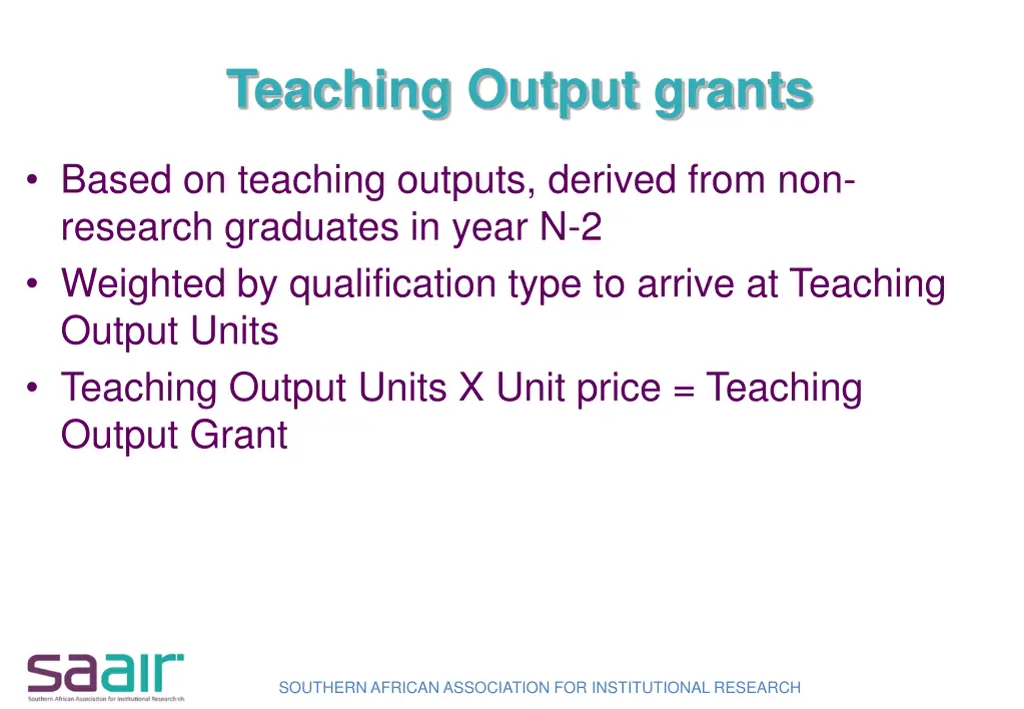
Teaching Output grants Based on teaching outputs, derived from non- research graduates in year N-2 Weighted by qualification type to arrive at Teaching Output Units Teaching Output Units X Unit price = Teaching Output Grant SOUTHERN AFRICAN ASSOCIATION FOR INSTITUTIONAL RESEARCH
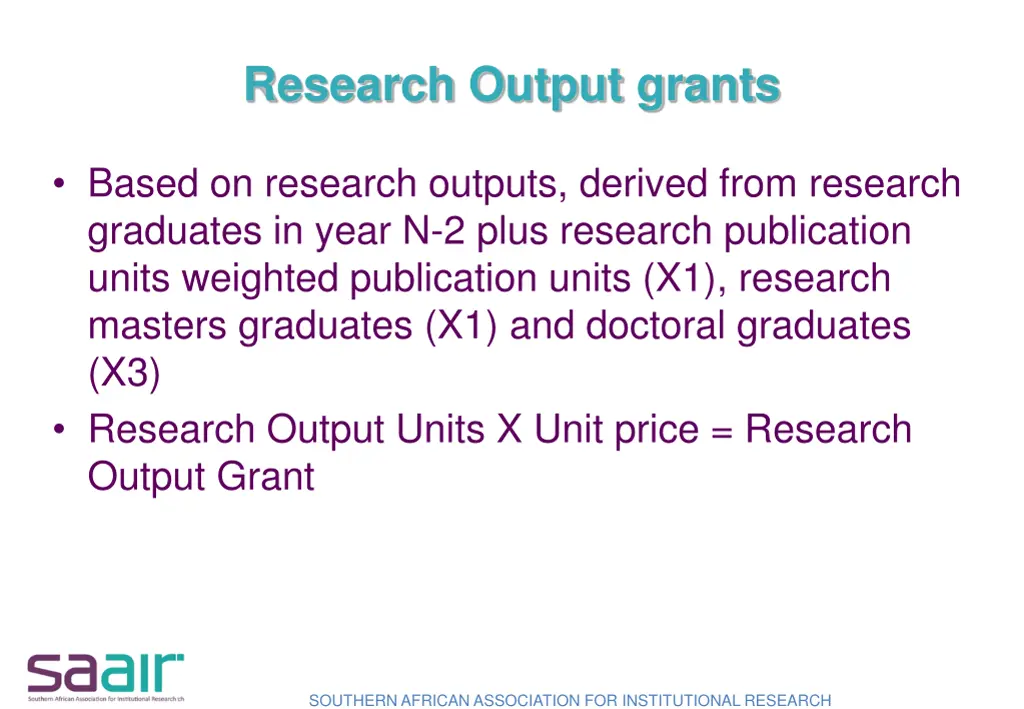
Research Output grants Based on research outputs, derived from research graduates in year N-2 plus research publication units weighted publication units (X1), research masters graduates (X1) and doctoral graduates (X3) Research Output Units X Unit price = Research Output Grant SOUTHERN AFRICAN ASSOCIATION FOR INSTITUTIONAL RESEARCH
University Development grants Earmarked grant Replace the former developments grants Teaching Development Research Development SOUTHERN AFRICAN ASSOCIATION FOR INSTITUTIONAL RESEARCH
Quality assurance Quality assurance falls under the auspices of the CHE s Higher Education Quality Committee (HEQC) Quality Enhancement Project HEMIS plays a significant role to benchmark between institutions SOUTHERN AFRICAN ASSOCIATION FOR INSTITUTIONAL RESEARCH
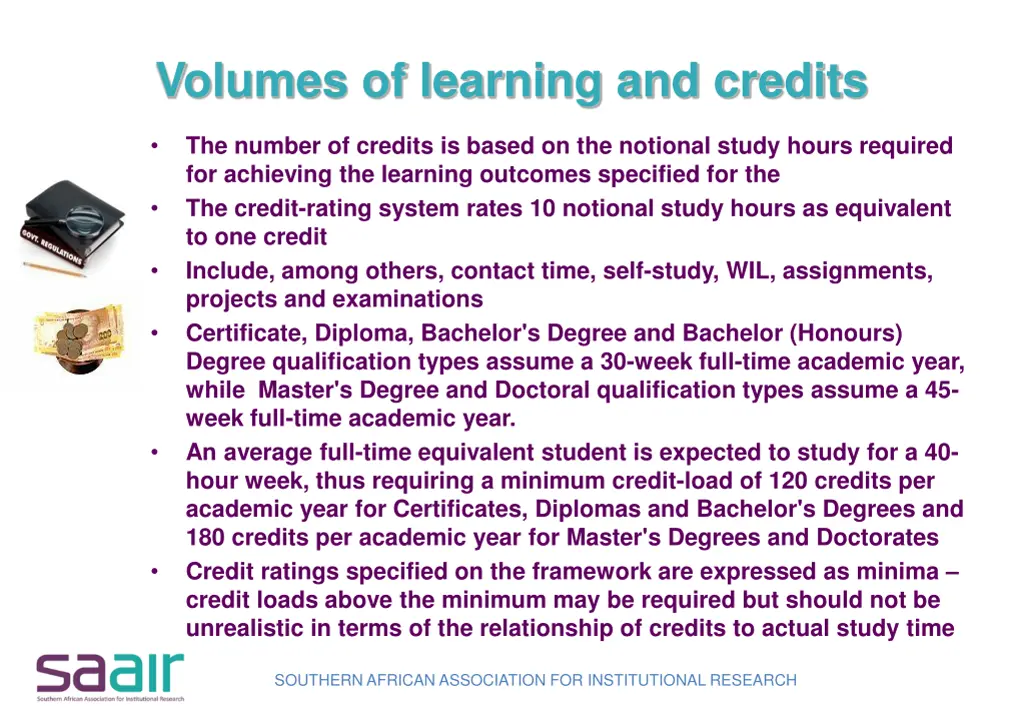
Volumes of learning and credits The number of credits is based on the notional study hours required for achieving the learning outcomes specified for the The credit-rating system rates 10 notional study hours as equivalent to one credit Include, among others, contact time, self-study, WIL, assignments, projects and examinations Certificate, Diploma, Bachelor's Degree and Bachelor (Honours) Degree qualification types assume a 30-week full-time academic year, while Master's Degree and Doctoral qualification types assume a 45- week full-time academic year. An average full-time equivalent student is expected to study for a 40- hour week, thus requiring a minimum credit-load of 120 credits per academic year for Certificates, Diplomas and Bachelor's Degrees and 180 credits per academic year for Master's Degrees and Doctorates Credit ratings specified on the framework are expressed as minima credit loads above the minimum may be required but should not be unrealistic in terms of the relationship of credits to actual study time SOUTHERN AFRICAN ASSOCIATION FOR INSTITUTIONAL RESEARCH
Funding credits The properties of a qualification determine the total number of units of state subsidy (funding credits) approved by the Minister of Higher Education and Training for that qualification: For the HEQSF this is based on the NQF credits SOUTHERN AFRICAN ASSOCIATION FOR INSTITUTIONAL RESEARCH
Qualification weight/ Funding credit For subsidy-purposes, all qualifications are given a weight relative to a first bachelor s degree Student/lecturing staff ratio For subsidy-purposes, different student/lecturing staff ratios have been introduced for the different subject matter areas (funding groups) SOUTHERN AFRICAN ASSOCIATION FOR INSTITUTIONAL RESEARCH
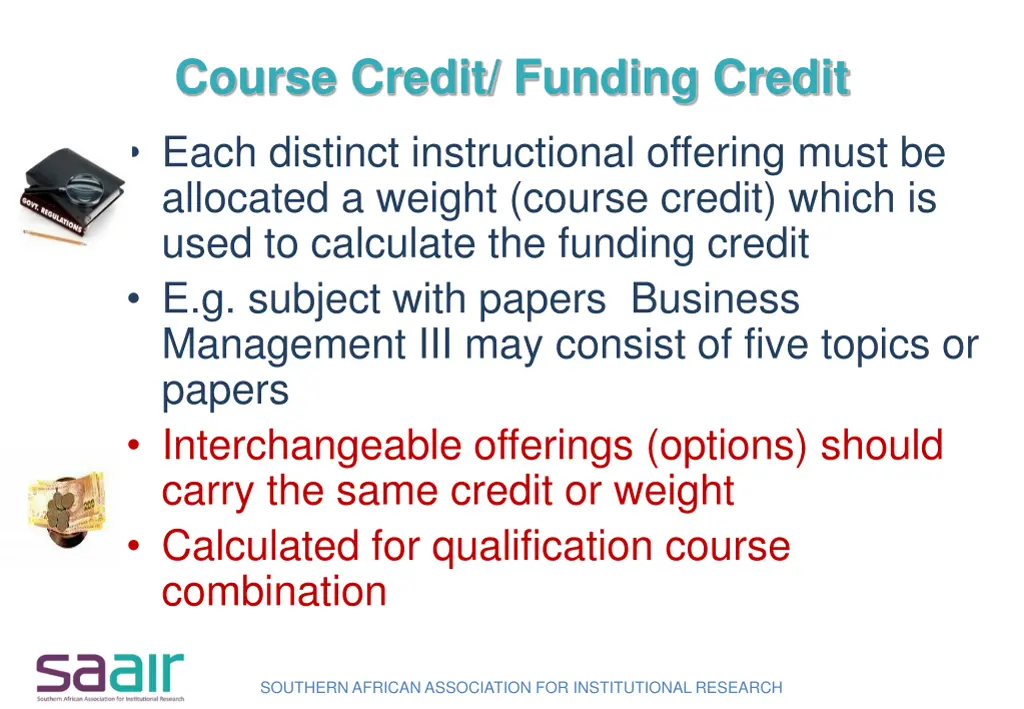
Course Credit/ Funding Credit Each distinct instructional offering must be allocated a weight (course credit) which is used to calculate the funding credit E.g. subject with papers Business Management III may consist of five topics or papers Interchangeable offerings (options) should carry the same credit or weight Calculated for qualification course combination SOUTHERN AFRICAN ASSOCIATION FOR INSTITUTIONAL RESEARCH
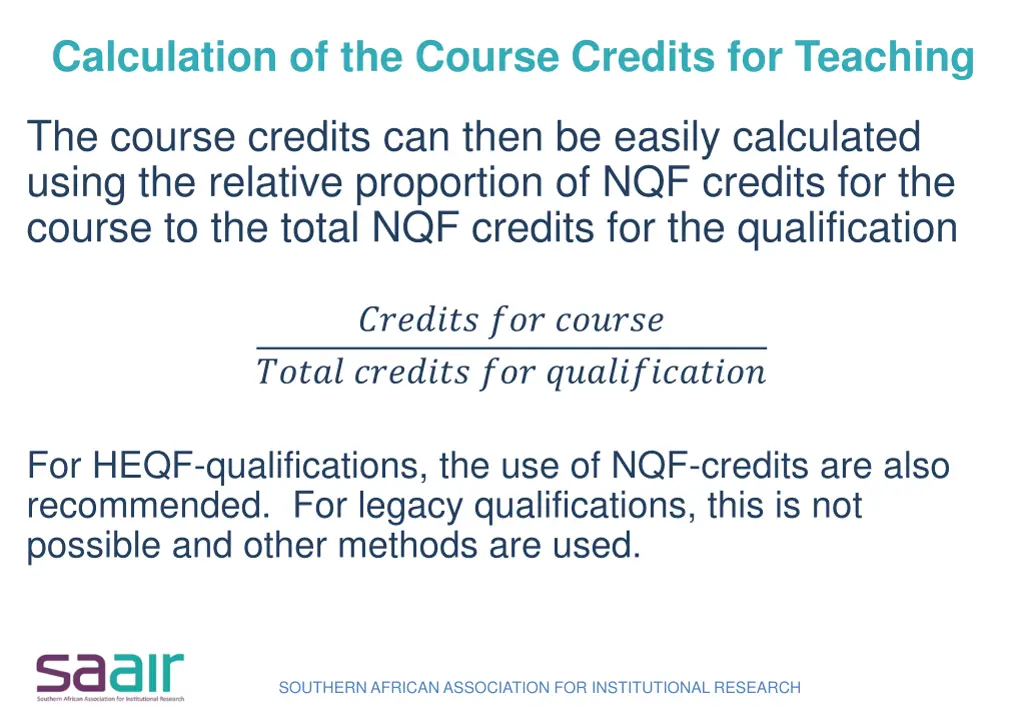
Calculation of the Course Credits for Teaching The course credits can then be easily calculated using the relative proportion of NQF credits for the course to the total NQF credits for the qualification ??????? ??? ?????? ????? ??????? ??? ????????????? For HEQF-qualifications, the use of NQF-credits are also recommended. For legacy qualifications, this is not possible and other methods are used. SOUTHERN AFRICAN ASSOCIATION FOR INSTITUTIONAL RESEARCH
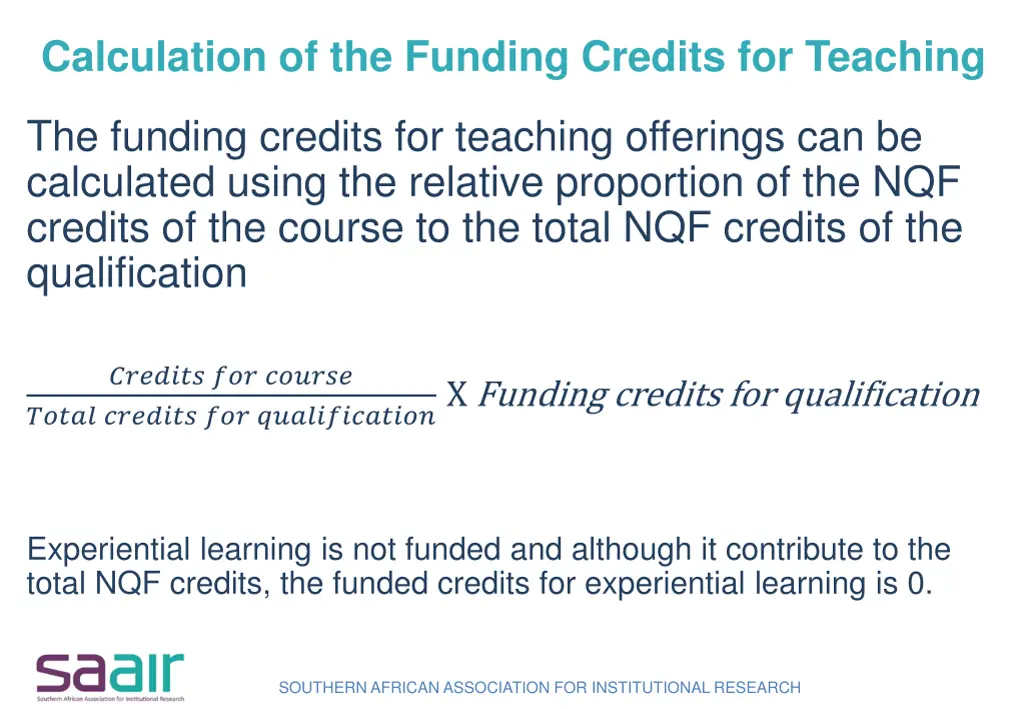
Calculation of the Funding Credits for Teaching The funding credits for teaching offerings can be calculated using the relative proportion of the NQF credits of the course to the total NQF credits of the qualification ??????? ??? ?????? ????? ??????? ??? ?????????????X Funding credits for qualification Experiential learning is not funded and although it contribute to the total NQF credits, the funded credits for experiential learning is 0. SOUTHERN AFRICAN ASSOCIATION FOR INSTITUTIONAL RESEARCH
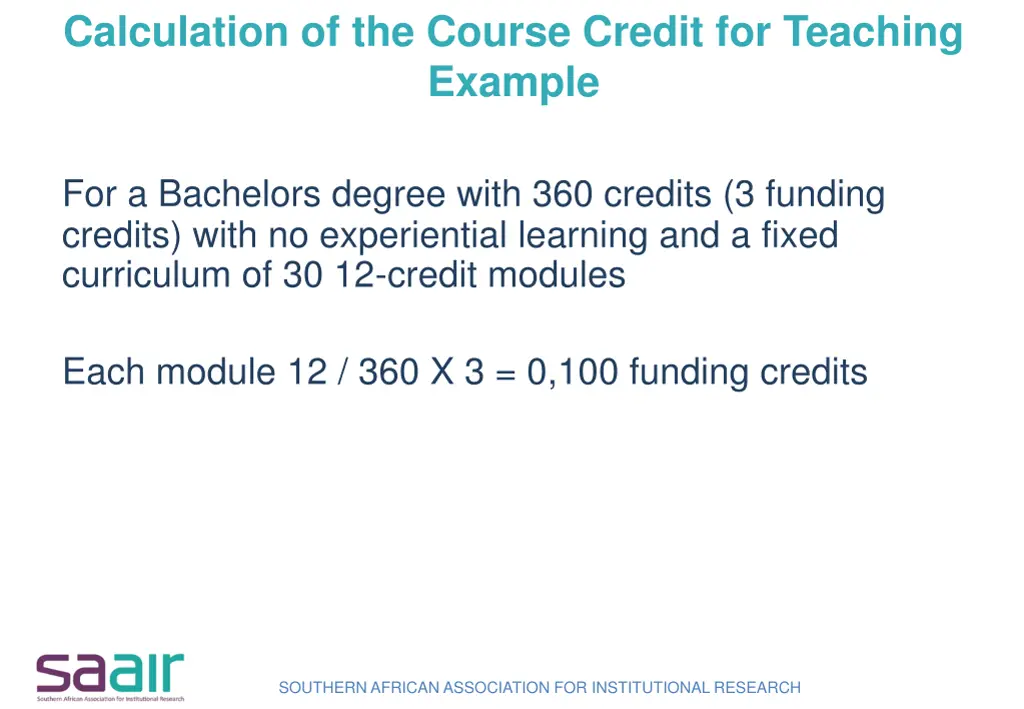
Calculation of the Course Credit for Teaching Example For a Bachelors degree with 360 credits (3 funding credits) with no experiential learning and a fixed curriculum of 30 12-credit modules Each module 12 / 360 X 3 = 0,100 funding credits SOUTHERN AFRICAN ASSOCIATION FOR INSTITUTIONAL RESEARCH
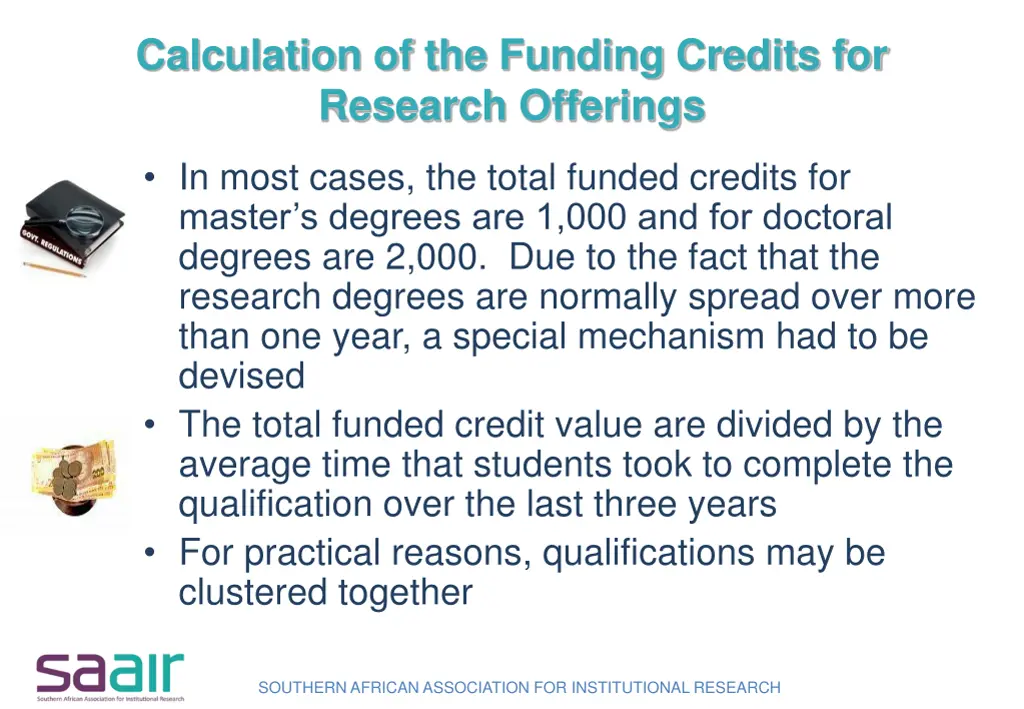
Calculation of the Funding Credits for Research Offerings In most cases, the total funded credits for master s degrees are 1,000 and for doctoral degrees are 2,000. Due to the fact that the research degrees are normally spread over more than one year, a special mechanism had to be devised The total funded credit value are divided by the average time that students took to complete the qualification over the last three years For practical reasons, qualifications may be clustered together SOUTHERN AFRICAN ASSOCIATION FOR INSTITUTIONAL RESEARCH
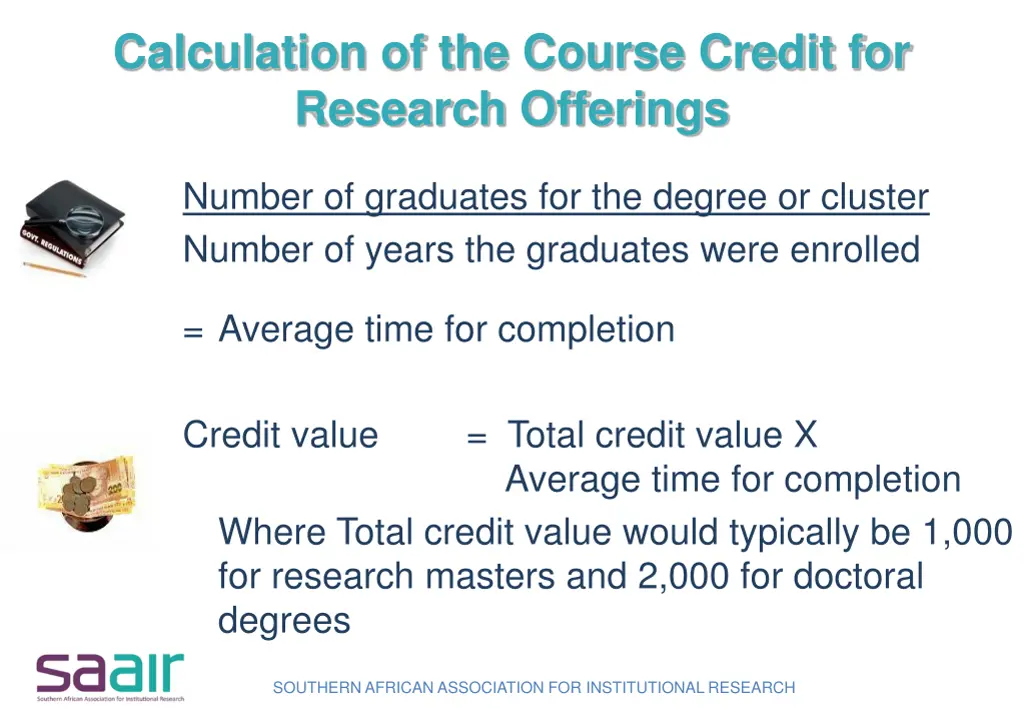
Calculation of the Course Credit for Research Offerings Number of graduates for the degree or cluster Number of years the graduates were enrolled = Average time for completion Credit value Where Total credit value would typically be 1,000 for research masters and 2,000 for doctoral degrees = Total credit value X Average time for completion SOUTHERN AFRICAN ASSOCIATION FOR INSTITUTIONAL RESEARCH
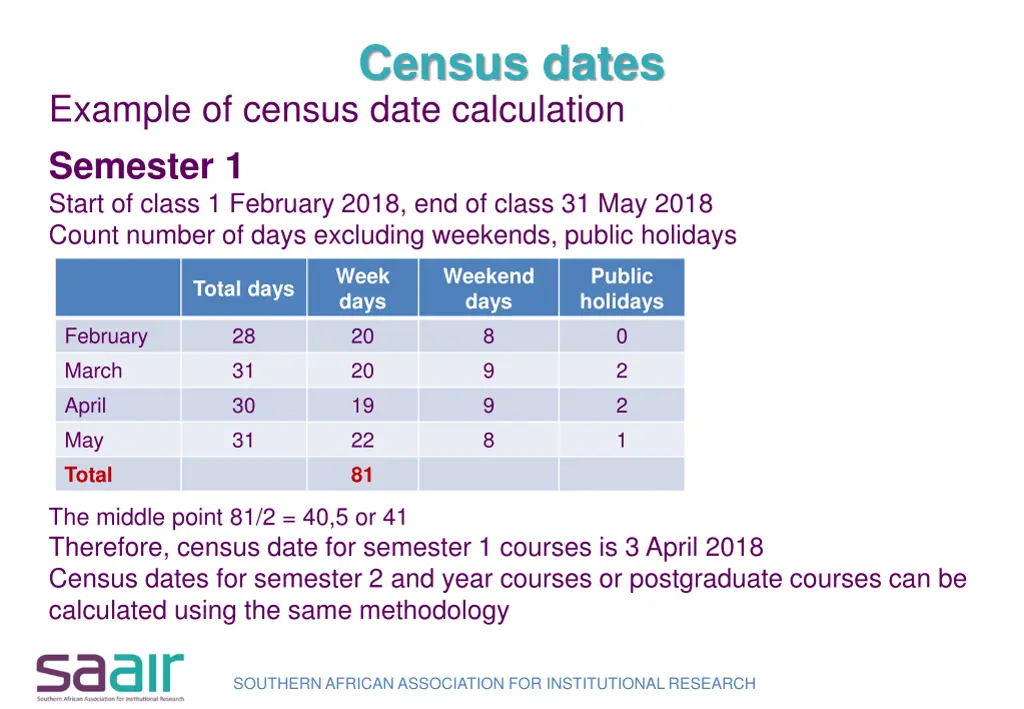
Census dates Example of census date calculation Semester 1 Start of class 1 February 2018, end of class 31 May 2018 Count number of days excluding weekends, public holidays Week days 20 20 19 22 81 Weekend days 8 9 9 8 Public holidays 0 2 2 1 Total days February March April May Total 28 31 30 31 The middle point 81/2 = 40,5 or 41 Therefore, census date for semester 1 courses is 3 April 2018 Census dates for semester 2 and year courses or postgraduate courses can be calculated using the same methodology SOUTHERN AFRICAN ASSOCIATION FOR INSTITUTIONAL RESEARCH
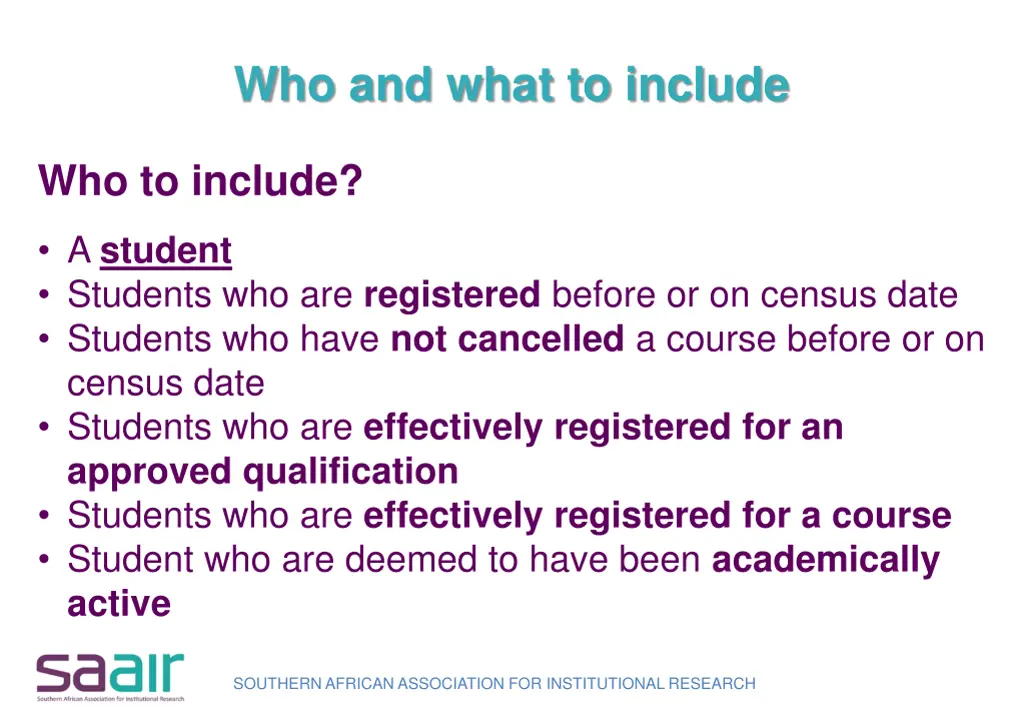
Who and what to include Who to include? A student Students who are registered before or on census date Students who have not cancelled a course before or on census date Students who are effectively registered for an approved qualification Students who are effectively registered for a course Student who are deemed to have been academically active SOUTHERN AFRICAN ASSOCIATION FOR INSTITUTIONAL RESEARCH
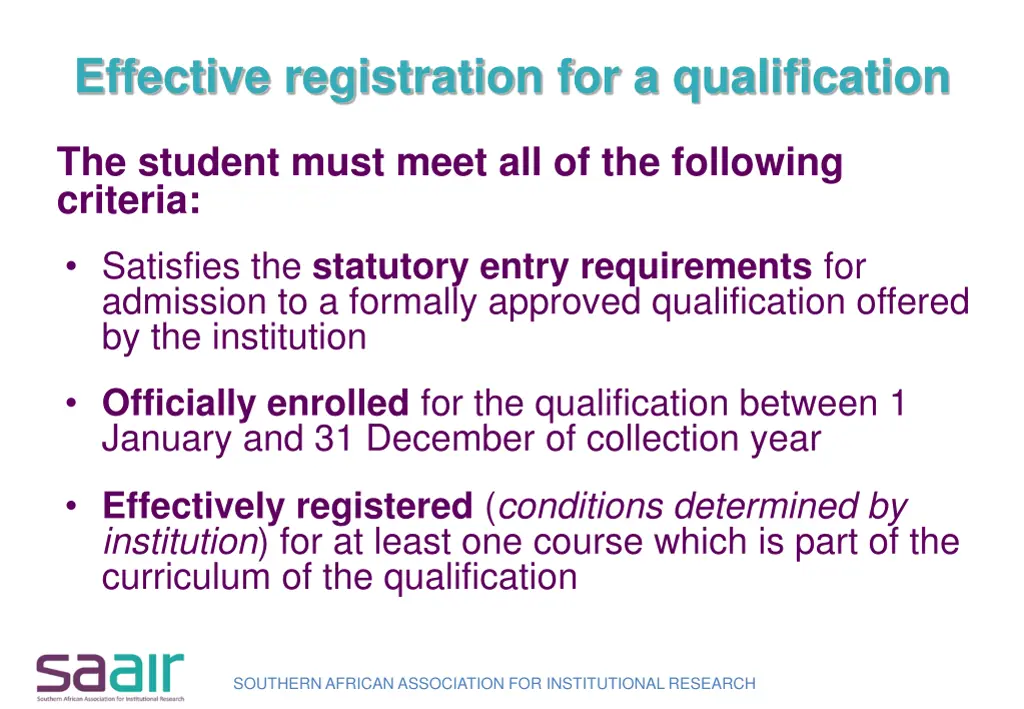
Effective registration for a qualification The student must meet all of the following criteria: Satisfies the statutory entry requirements for admission to a formally approved qualification offered by the institution Officially enrolled for the qualification between 1 January and 31 December of collection year Effectively registered (conditions determined by institution) for at least one course which is part of the curriculum of the qualification SOUTHERN AFRICAN ASSOCIATION FOR INSTITUTIONAL RESEARCH
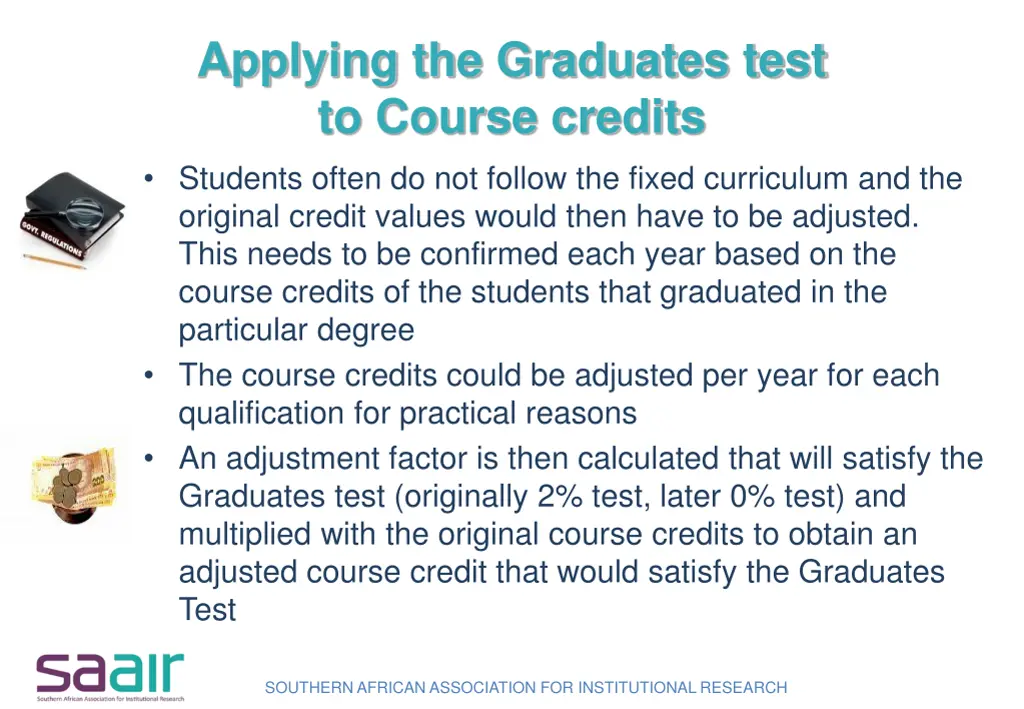
Applying the Graduates test to Course credits Students often do not follow the fixed curriculum and the original credit values would then have to be adjusted. This needs to be confirmed each year based on the course credits of the students that graduated in the particular degree The course credits could be adjusted per year for each qualification for practical reasons An adjustment factor is then calculated that will satisfy the Graduates test (originally 2% test, later 0% test) and multiplied with the original course credits to obtain an adjusted course credit that would satisfy the Graduates Test SOUTHERN AFRICAN ASSOCIATION FOR INSTITUTIONAL RESEARCH
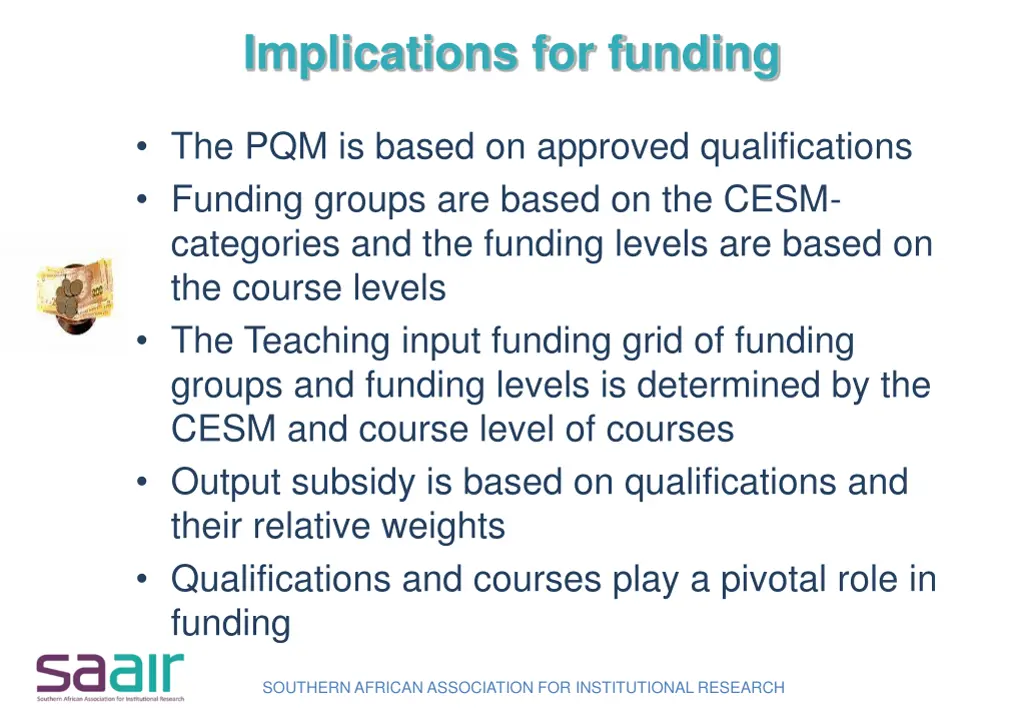
Implications for funding The PQM is based on approved qualifications Funding groups are based on the CESM- categories and the funding levels are based on the course levels The Teaching input funding grid of funding groups and funding levels is determined by the CESM and course level of courses Output subsidy is based on qualifications and their relative weights Qualifications and courses play a pivotal role in funding SOUTHERN AFRICAN ASSOCIATION FOR INSTITUTIONAL RESEARCH
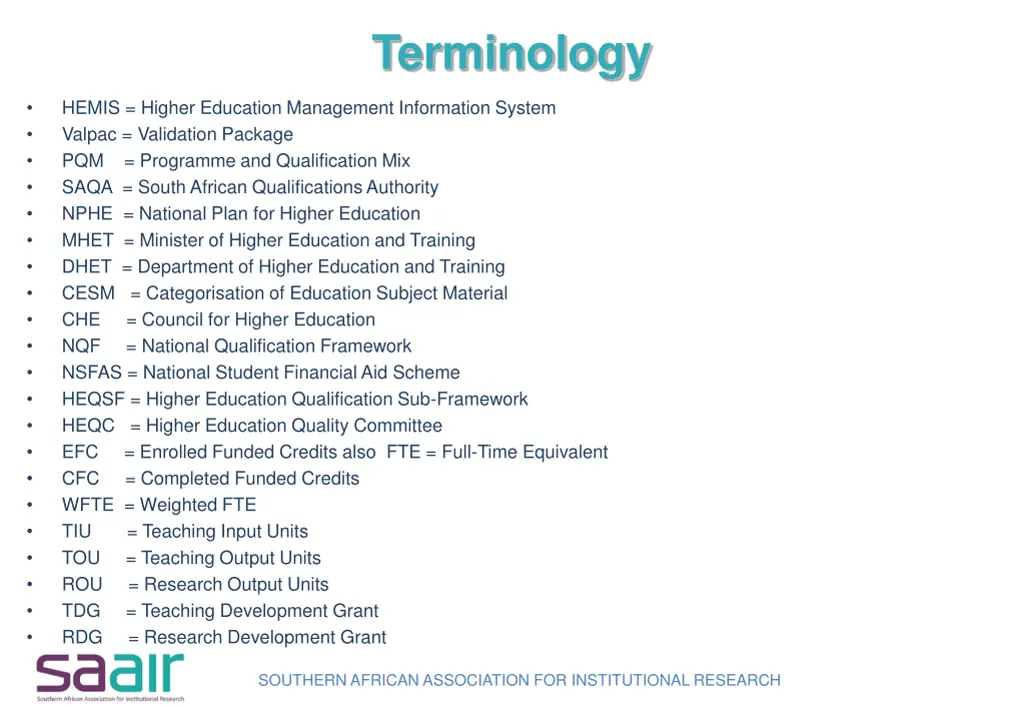
Terminology HEMIS = Higher Education Management Information System Valpac = Validation Package PQM = Programme and Qualification Mix SAQA = South African Qualifications Authority NPHE = National Plan for Higher Education MHET = Minister of Higher Education and Training DHET = Department of Higher Education and Training CESM = Categorisation of Education Subject Material CHE = Council for Higher Education NQF = National Qualification Framework NSFAS = National Student Financial Aid Scheme HEQSF = Higher Education Qualification Sub-Framework HEQC = Higher Education Quality Committee EFC = Enrolled Funded Credits also FTE = Full-Time Equivalent CFC = Completed Funded Credits WFTE = Weighted FTE TIU = Teaching Input Units TOU = Teaching Output Units ROU = Research Output Units TDG = Teaching Development Grant RDG = Research Development Grant SOUTHERN AFRICAN ASSOCIATION FOR INSTITUTIONAL RESEARCH