Present Continuous Tense in English Grammar
The Present Continuous tense is used to talk about actions happening now or in the future. Learn its structure, usage, and examples for better understanding.

Download Presentation

Please find below an Image/Link to download the presentation.
The content on the website is provided AS IS for your information and personal use only. It may not be sold, licensed, or shared on other websites without obtaining consent from the author.If you encounter any issues during the download, it is possible that the publisher has removed the file from their server.
You are allowed to download the files provided on this website for personal or commercial use, subject to the condition that they are used lawfully. All files are the property of their respective owners.
The content on the website is provided AS IS for your information and personal use only. It may not be sold, licensed, or shared on other websites without obtaining consent from the author.
E N D
Presentation Transcript
ENGLISH COURSE ASSiT. Lect. Noor Hasan Radhi
This lecture Grammar: Present Continuous. Past Continuous. Future. Conversation & Vocabulary Asking for and Giving Directions New idiom.
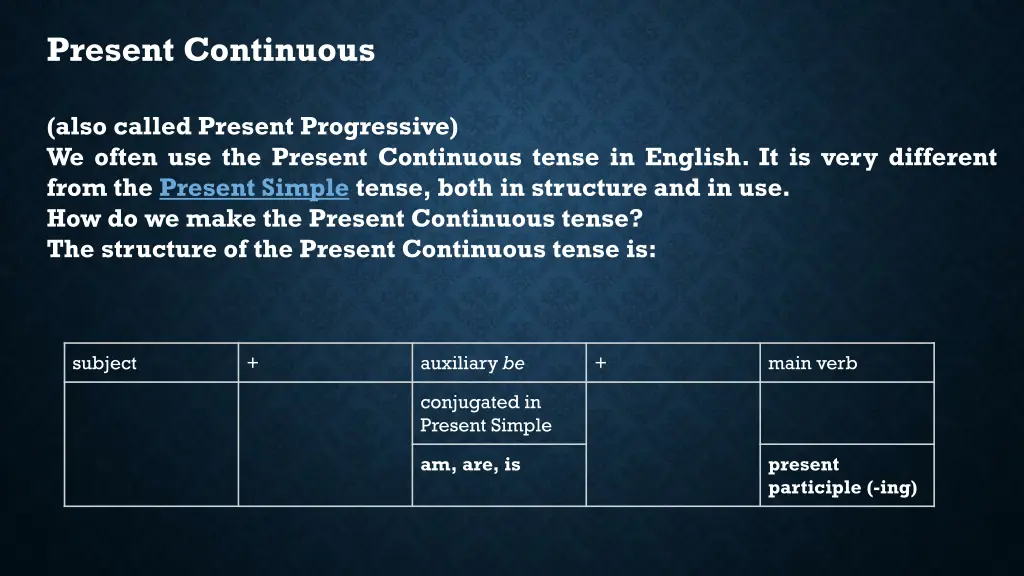
Present Continuous (also called Present Progressive) We often use the Present Continuous tense in English. It is very different from the Present Simple tense, both in structure and in use. How do we make the Present Continuous tense? The structure of the Present Continuous tense is: subject + auxiliary be + main verb conjugated in Present Simple am, are, is present participle (-ing)
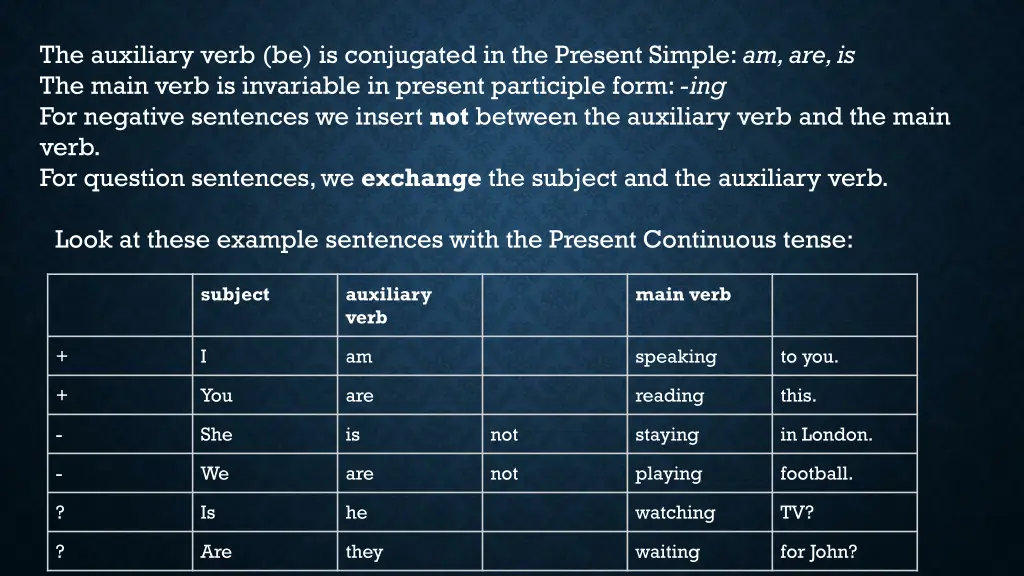
The auxiliary verb (be) is conjugated in the Present Simple:am, are, is The main verb is invariable in present participle form:-ing For negative sentences we insert not between the auxiliary verb and the main verb. For question sentences, we exchange the subject and the auxiliary verb. Look at these example sentences with the Present Continuous tense: subject auxiliary verb main verb + I am speaking to you. + You are reading this. - She is not staying in London. - We are not playing football. ? Is he watching TV? ? Are they waiting for John?
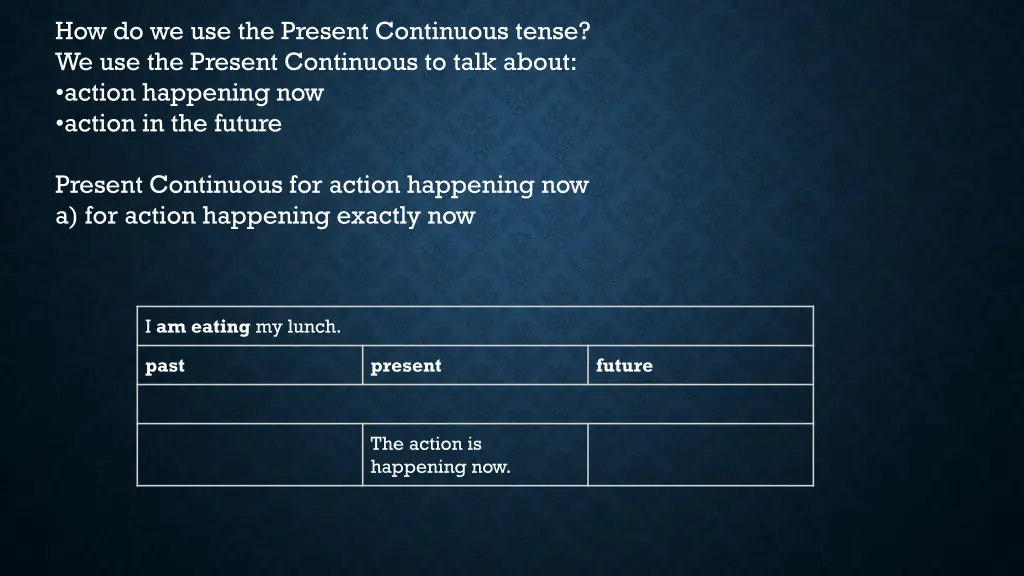
How do we use the Present Continuous tense? We use the Present Continuous to talk about: action happening now action in the future Present Continuous for action happening now a) for action happening exactly now I am eating my lunch. past present future The action is happening now.
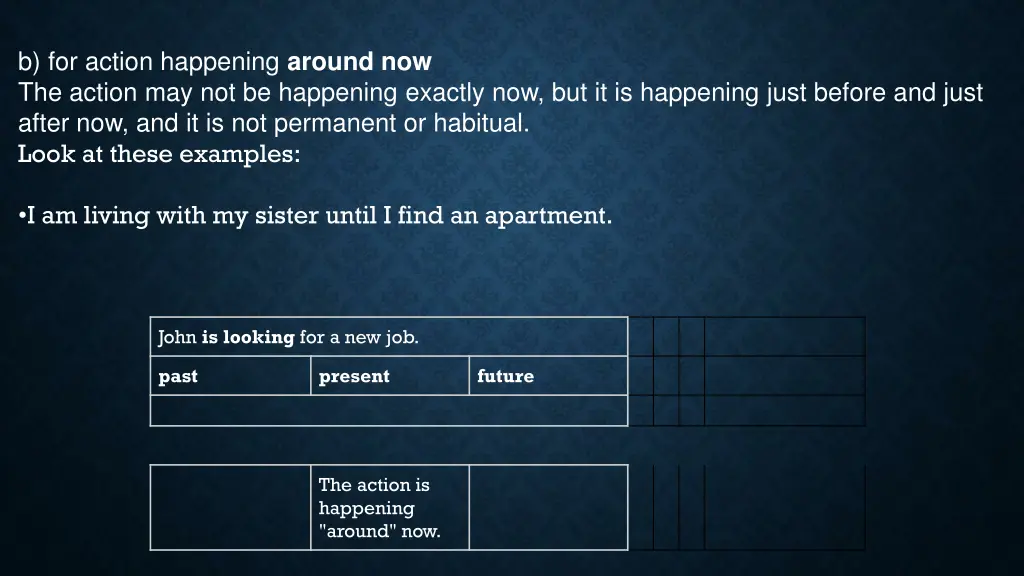
b) for action happening around now The action may not be happening exactly now, but it is happening just before and just after now, and it is not permanent or habitual. Look at these examples: I am living with my sister until I find an apartment. John is looking for a new job. past present future The action is happening "around" now.
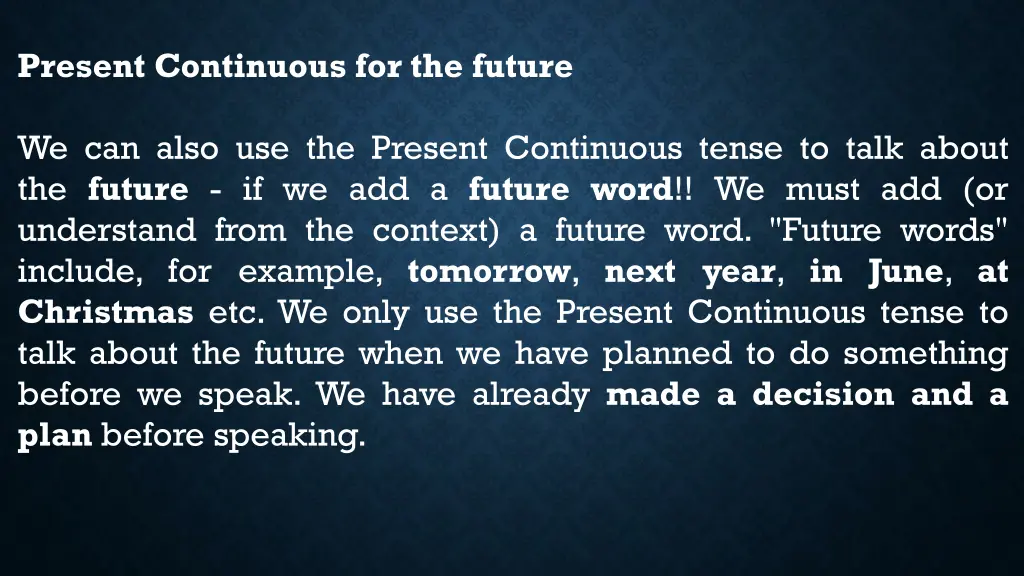
Present Continuous for the future We can also use the Present Continuous tense to talk about the future - if we add a future word!! We must add (or understand from the context) a future word. "Future words" include, for example, tomorrow, next year, in June, at Christmas etc. We only use the Present Continuous tense to talk about the future when we have planned to do something before we speak. We have already made a decision and a plan before speaking.
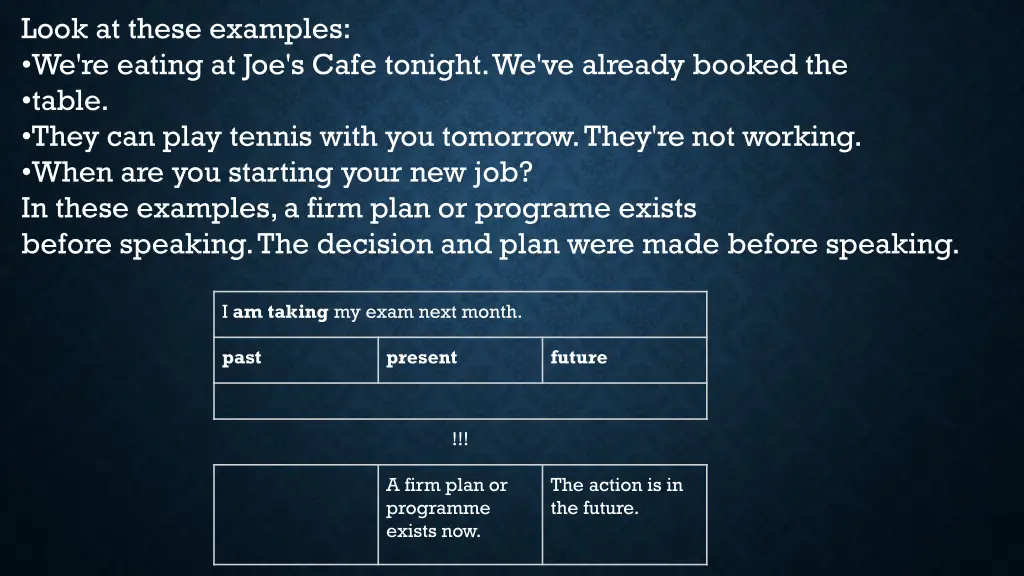
Look at these examples: We're eating at Joe's Cafe tonight. We've already booked the table. They can play tennis with you tomorrow. They're not working. When are you starting your new job? In these examples,a firm plan or programe exists before speaking. The decision and plan were made before speaking. I am taking my exam next month. past present future !!! A firm plan or programme exists now. The action is in the future.
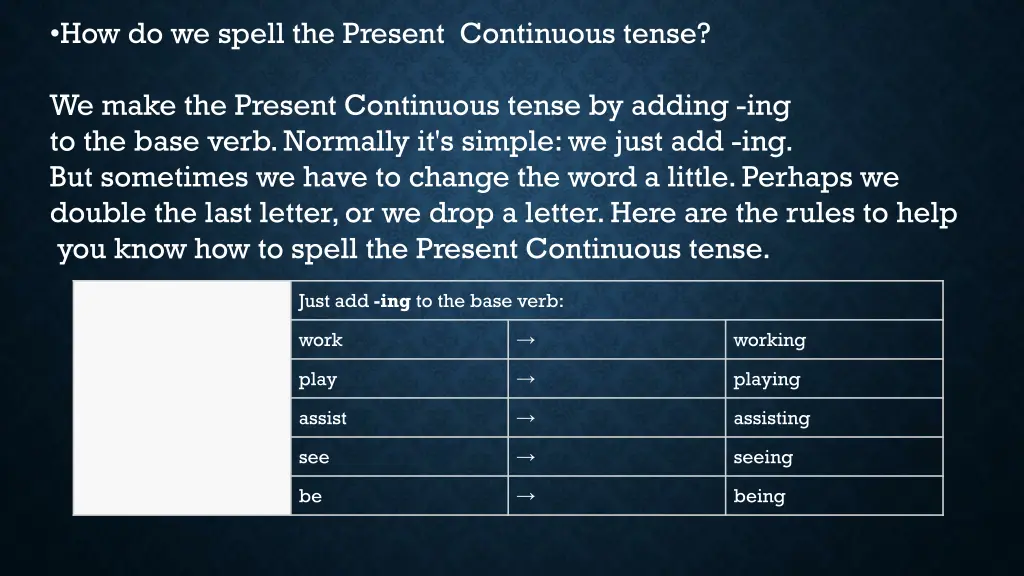
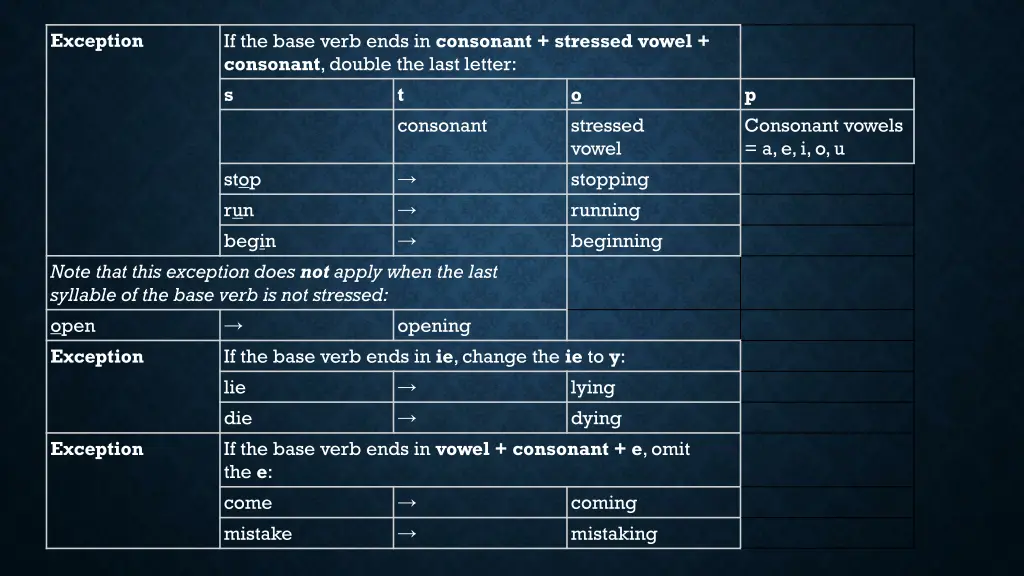
How do we spell the Present Continuous tense? We make the Present Continuous tense by adding -ing to the base verb. Normally it's simple: we just add -ing. But sometimes we have to change the word a little. Perhaps we double the last letter, or we drop a letter. Here are the rules to help you know how to spell the Present Continuous tense. Just add -ing to the base verb: work working play playing assist assisting see seeing be being
Exception If the base verb ends in consonant + stressed vowel + consonant, double the last letter: s t consonant o stressed vowel stopping running beginning p Consonant vowels = a, e, i, o, u stop run begin Note that this exception does not apply when the last syllable of the base verb is not stressed: open Exception If the base verb ends in ie, change the ie to y: lie die Exception If the base verb ends in vowel + consonant + e, omit the e: come mistake opening lying dying coming mistaking
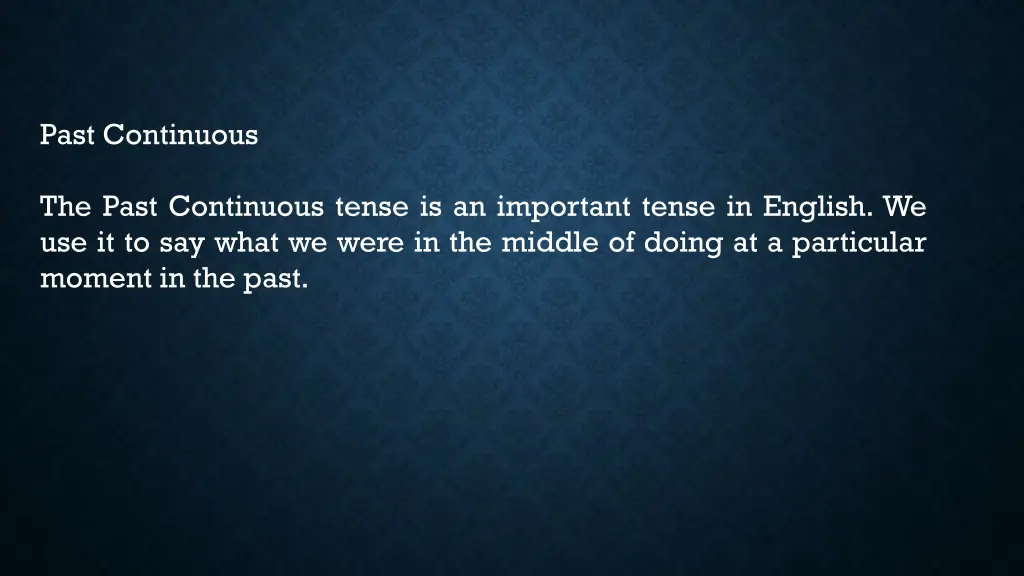
Past Continuous The Past Continuous tense is an important tense in English. We use it to say what we were in the middle of doing at a particular moment in the past.
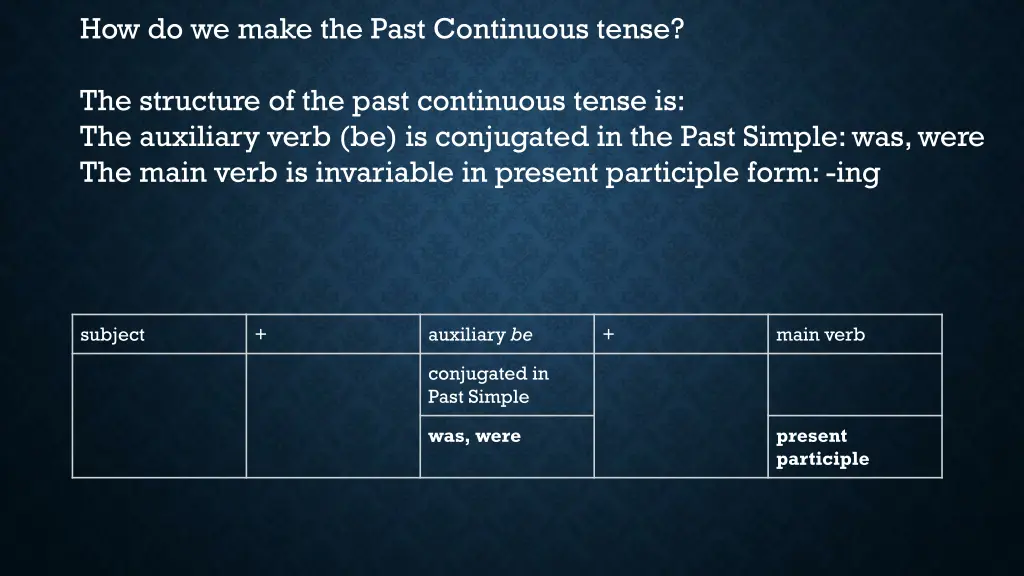
How do we make the Past Continuous tense? The structure of the past continuous tense is: The auxiliary verb (be) is conjugated in the Past Simple:was, were The main verb is invariable in present participle form:-ing subject + auxiliary be + main verb conjugated in Past Simple was, were present participle
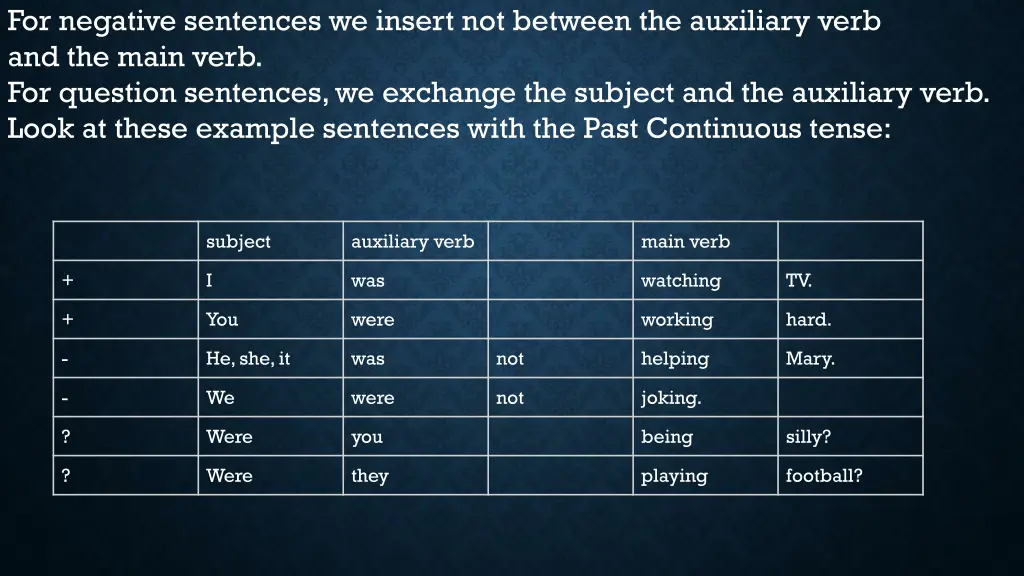
For negative sentences we insert not between the auxiliary verb and the main verb. For question sentences, we exchange the subject and the auxiliary verb. Look at these example sentences with the Past Continuous tense: subject auxiliary verb main verb + I was watching TV. + You were working hard. - He, she, it was not helping Mary. - We were not joking. ? Were you being silly? ? Were they playing football?
How do we use the Past Continuous tense? The Past Continuous tense expresses action at a particular moment in the past. The action started before that moment but has not finished at that moment.
When we use the Past Continuous tense, our listener usually knows or understands what time we are talking about. Look at these examples: I was working at 10pm last night. They were not playing football at 9am this morning. What were you doing at 10pm last night? What were you doing when he arrived? She was cooking when I telephoned her. We were having dinner when it started to rain. Ram went home early because it was snowing.
We often use the Past Continuous tense to "set the scene" in stories. We use it to describe the background situation at the moment when the action begins. Often, the story starts with the Past Continuous tense and then moves into the Past Simple tense. Here is an example: "James Bond was driving through town. It was raining. The wind was blowing hard. Nobody was walking in the streets. Suddenly, Bond saw the killer in a telephone box..."
Past Continuous + Past Simple We often use the Past Continuous tense with the Past Simple tense. We use the Past Continuous to express a long action. And we use the Past Simple to express a short action that happens in the middle of the long action. We can join the two ideas with when or while. In the following example, we have two actions: long action (watching TV), expressed with Past Continuous short action (telephoned), expressed with Past Simple
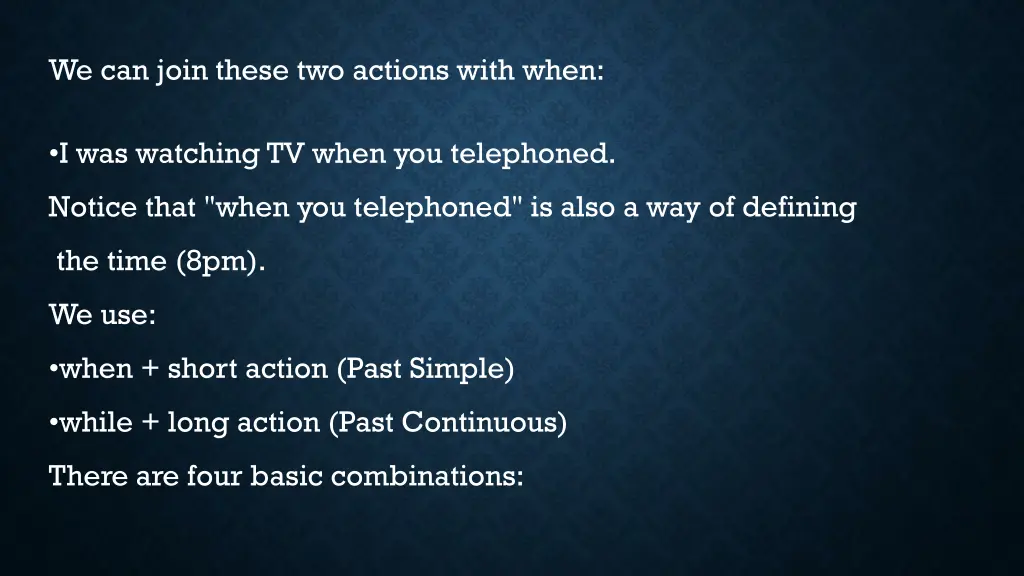
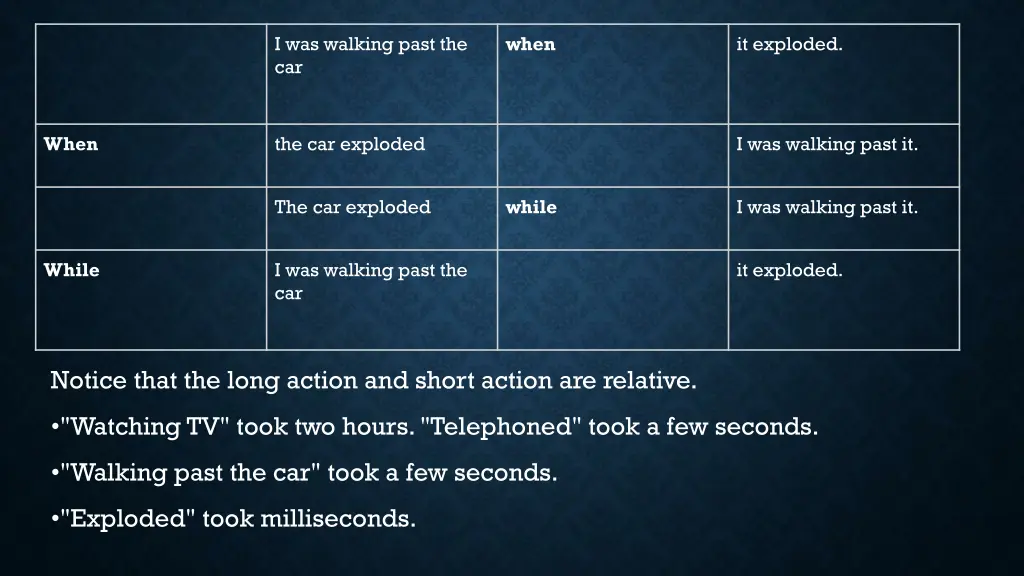
We can join these two actions with when: I was watching TV when you telephoned. Notice that "when you telephoned" is also a way of defining the time (8pm). We use: when + short action (Past Simple) while + long action (Past Continuous) There are four basic combinations:
I was walking past the car when it exploded. When the car exploded I was walking past it. The car exploded while I was walking past it. While I was walking past the car it exploded. Notice that the long action and short action are relative. "Watching TV" took two hours. "Telephoned" took a few seconds. "Walking past the car" took a few seconds. "Exploded" took milliseconds.
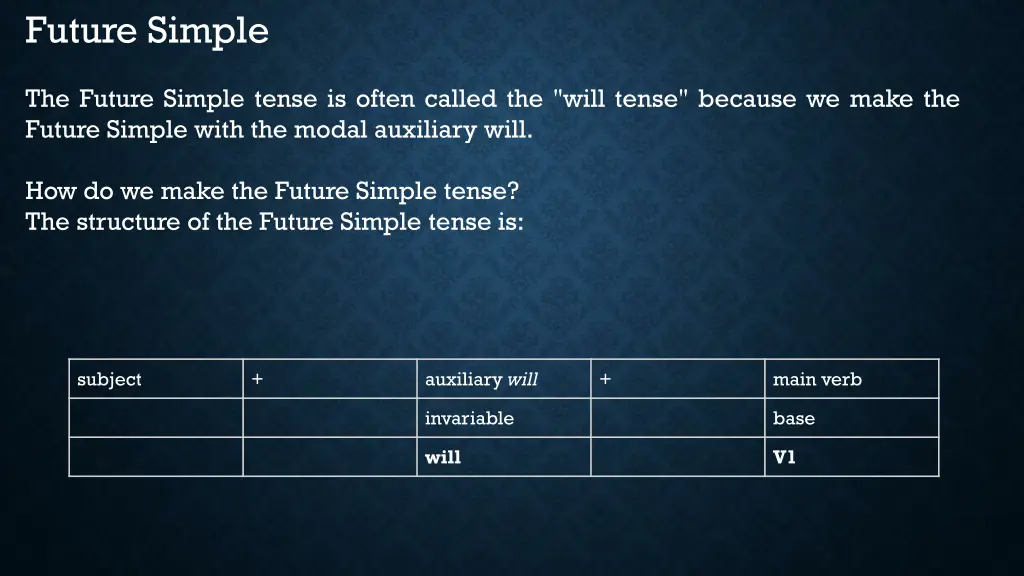
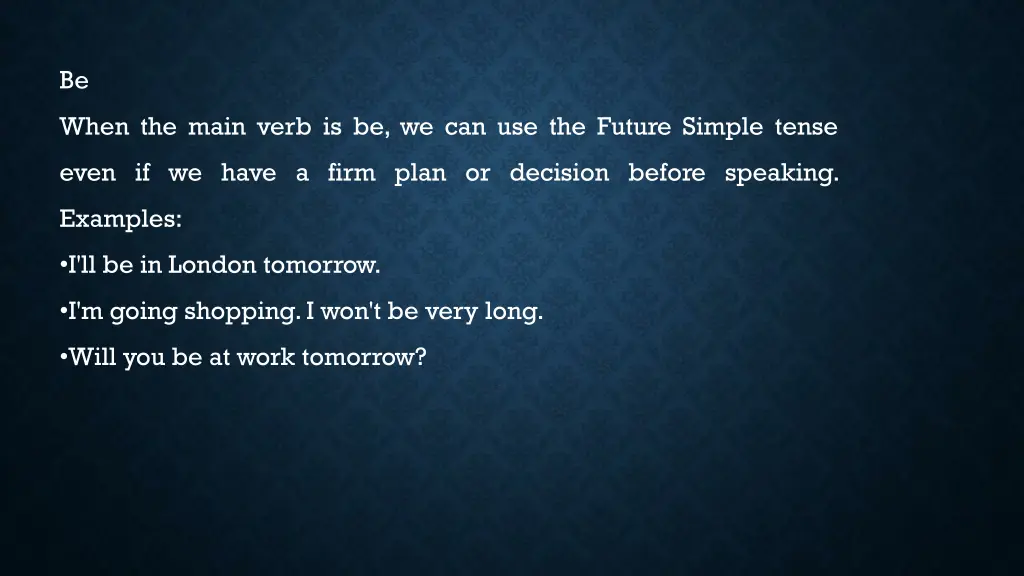
Future Simple The Future Simple tense is often called the "will tense" because we make the Future Simple with the modal auxiliary will. How do we make the Future Simple tense? The structure of the Future Simple tense is: subject + auxiliary will + main verb invariable base will V1
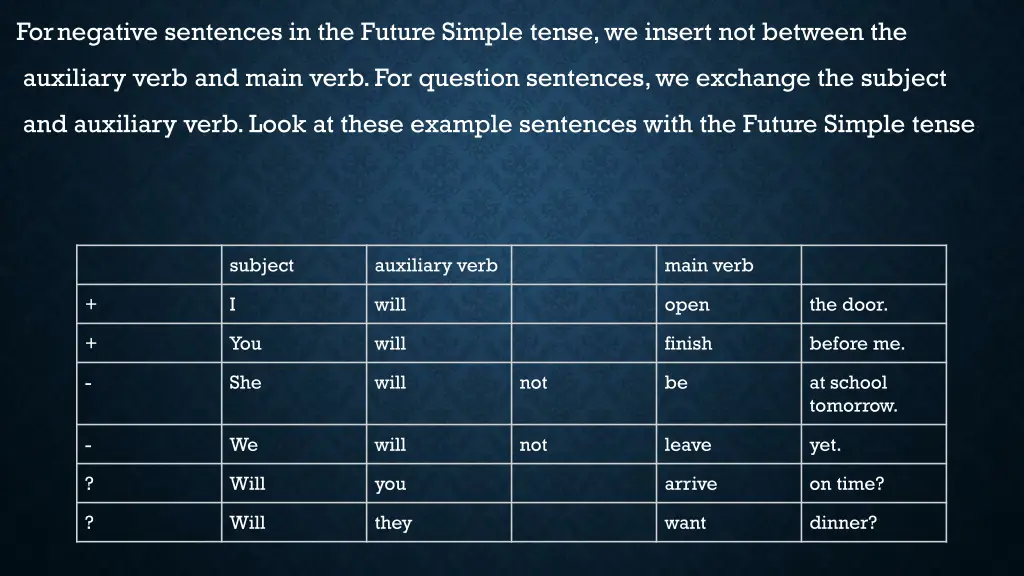
Fornegative sentences in the Future Simple tense, we insert not between the auxiliary verb and main verb. For question sentences, we exchange the subject and auxiliary verb. Look at these example sentences with the Future Simple tense: subject auxiliary verb main verb + I will open the door. + You will finish before me. - She will not be at school tomorrow. - We will not leave yet. ? Will you arrive on time? ? Will they want dinner?
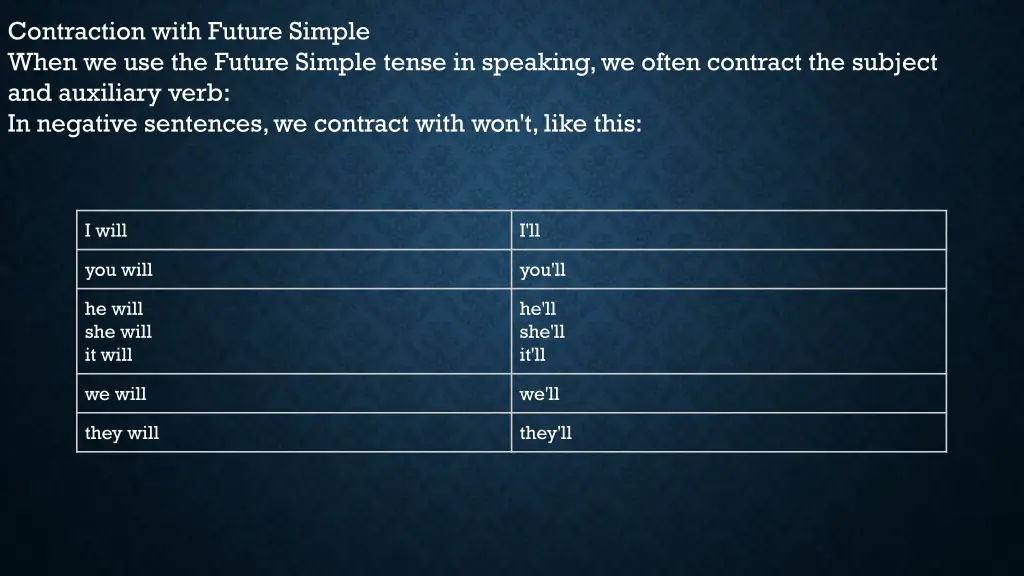
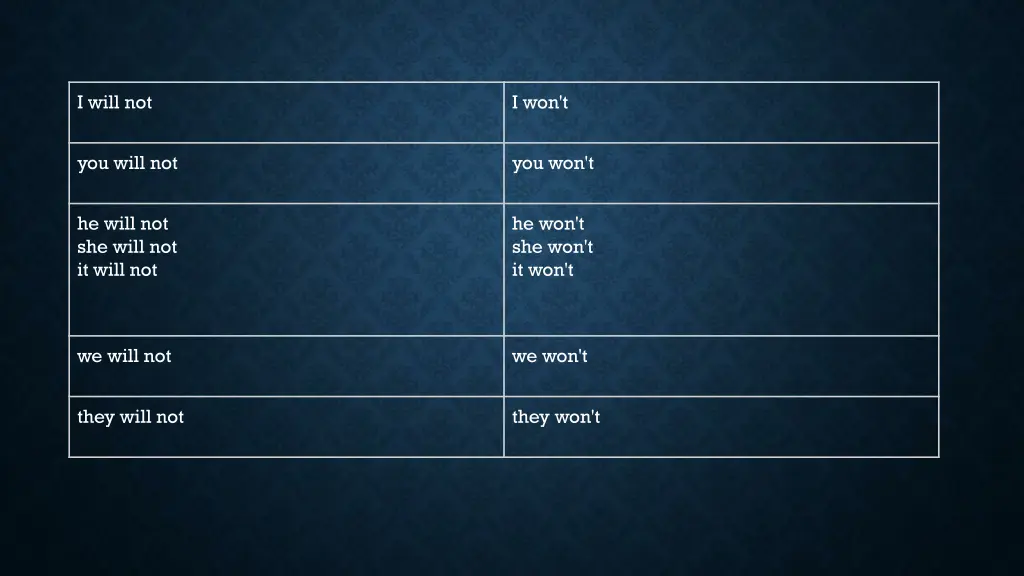
Contraction with Future Simple When we use the Future Simple tense in speaking, we often contract the subject and auxiliary verb: In negative sentences, we contract with won't, like this: I will I'll you will you'll he will she will it will he'll she'll it'll we will we'll they will they'll
I will not I won't you will not you won't he will not she will not it will not he won't she won't it won't we will not we won't they will not they won't
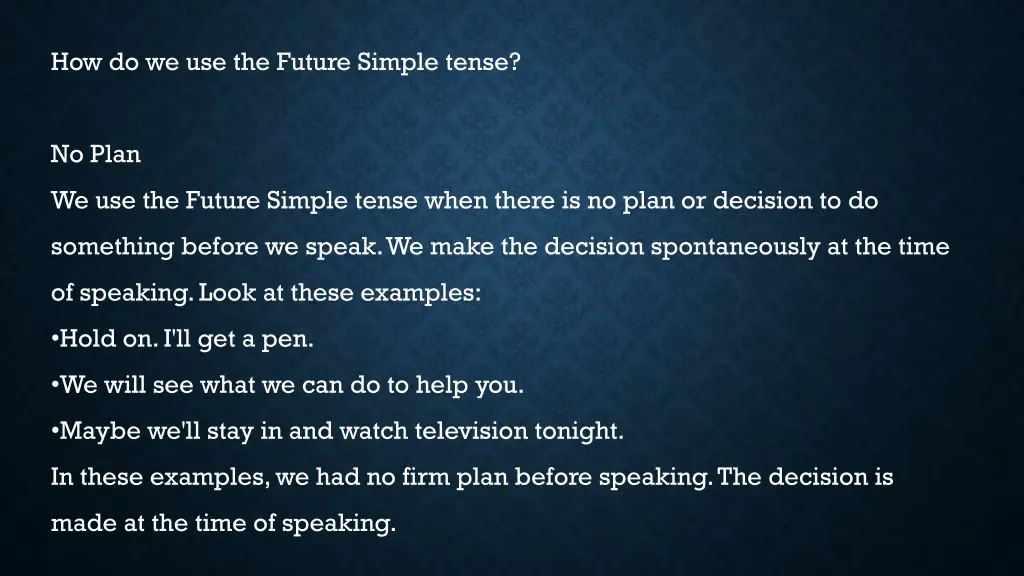
How do we use the Future Simple tense? No Plan We use the Future Simple tense when there is no plan or decision to do something before we speak. We make the decision spontaneously at the time of speaking. Look at these examples: Hold on. I'll get a pen. We will see what we can do to help you. Maybe we'll stay in and watch television tonight. In these examples, we had no firm plan before speaking. The decision is made at the time of speaking.
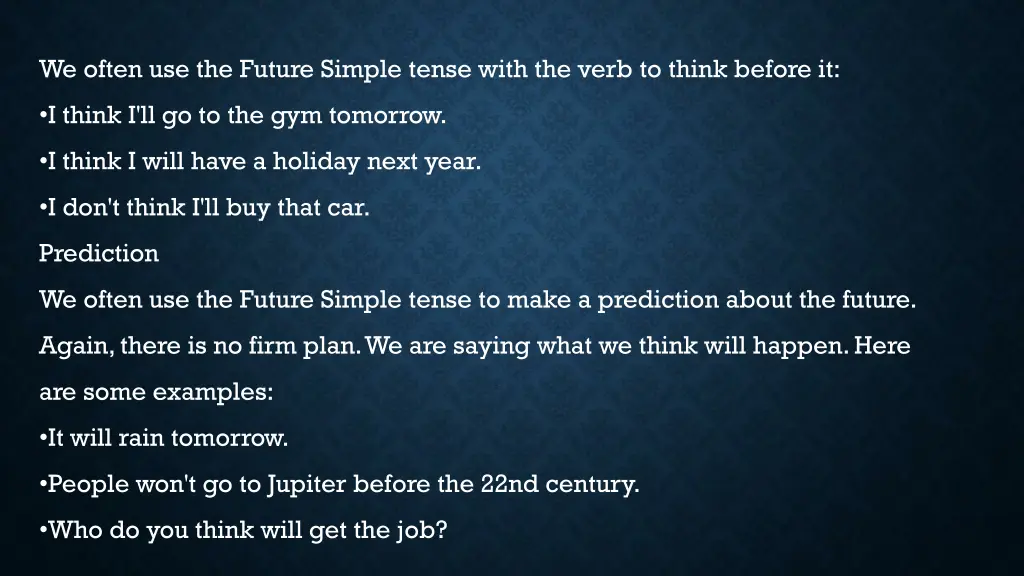
We often use the Future Simple tense with the verb to think before it: I think I'll go to the gym tomorrow. I think I will have a holiday next year. I don't think I'll buy that car. Prediction We often use the Future Simple tense to make a prediction about the future. Again, there is no firm plan. We are saying what we think will happen. Here are some examples: It will rain tomorrow. People won't go to Jupiter before the 22nd century. Who do you think will get the job?
Be When the main verb is be, we can use the Future Simple tense even if we have a firm plan or decision before speaking. Examples: I'll be in London tomorrow. I'm going shopping. I won't be very long. Will you be at work tomorrow?
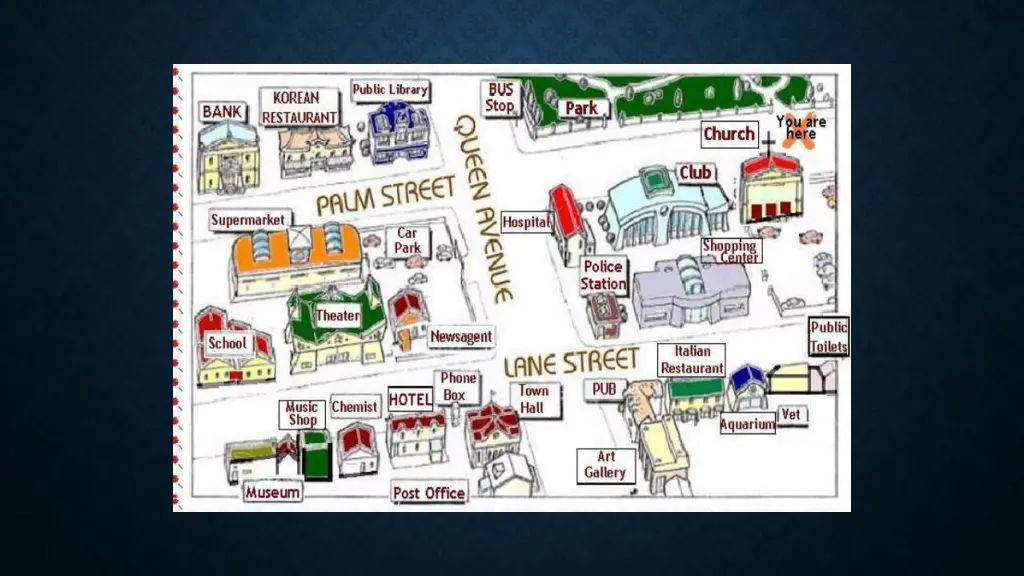
Conversation & Vocabulary Asking for and Giving Directions
Vocabulary Zoo, Bakery, Parking lot, Hospital, Cinema, Airport, School, Museum, Hotel, Swimming pool, Bus stop, Traffic light, Market, Library, Train station
Dialogue 1 James: Excuse me? Ben: Yes? James: How do I get to the bakery? Ben: Go past the hotel and turn left onto Main Street. Go one block and turn right. It's across from the library. James: Thank you very much.
Dialog 2 Man: Excuse me. How do I get to the supermarket? Bob: It's easy. Turn left at the corner onto Apple Street. Go one block. The supermarket is on the corner of First Avenue and Apple Street, next to the police station. Man: Thank you so much. Bob: You re welcome.
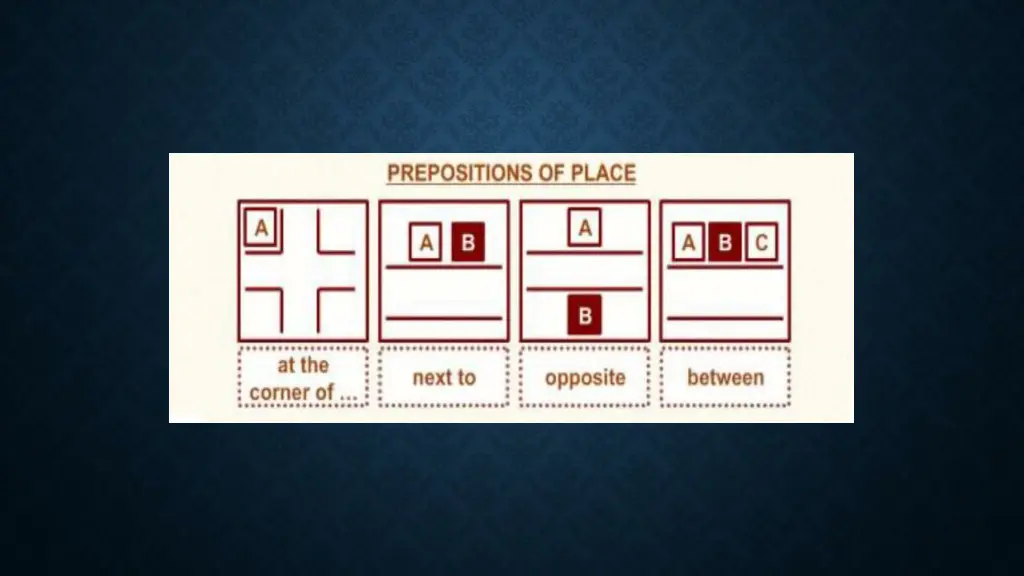
Useful expressions Preposition of places Where is the hotel? I m looking for the library Can / could you tell me how to get to the canteen, please? Where is it? Between On Close to Near
Where is the hotel? The hotel is between the zoo and the bakery. There is a hotel between the zoo and the bakery. Where is the bus stop? The bus stop is close to the park. There is a bus stop near the park. Where is the school? There is a school on First Avenue.
Where is the ice cream shop? The ice cream shop is just before the swimming pool. Where is the basketball court? There is a basketball court behind the park. Where is the school? The school is just after the hotel.
Dialogue 3 Ann: Excuse me. Is there a school near here? Boy: Yes. There's one near here. Ann: How do I get there? Boy: At the ice cream shop, go straight on. The school is just after the hotel. Ann: Thank you. Boy: You re welcome.
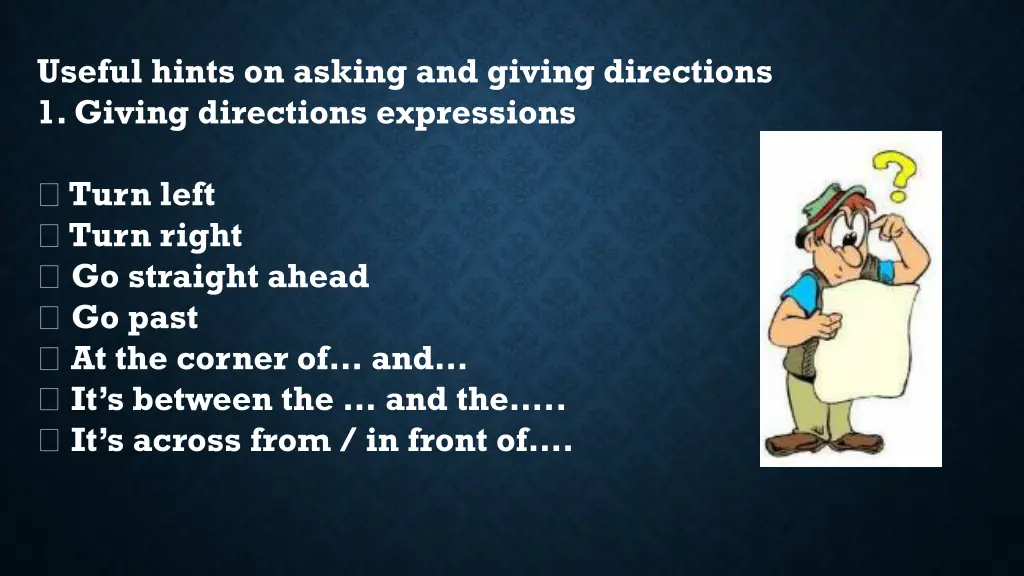
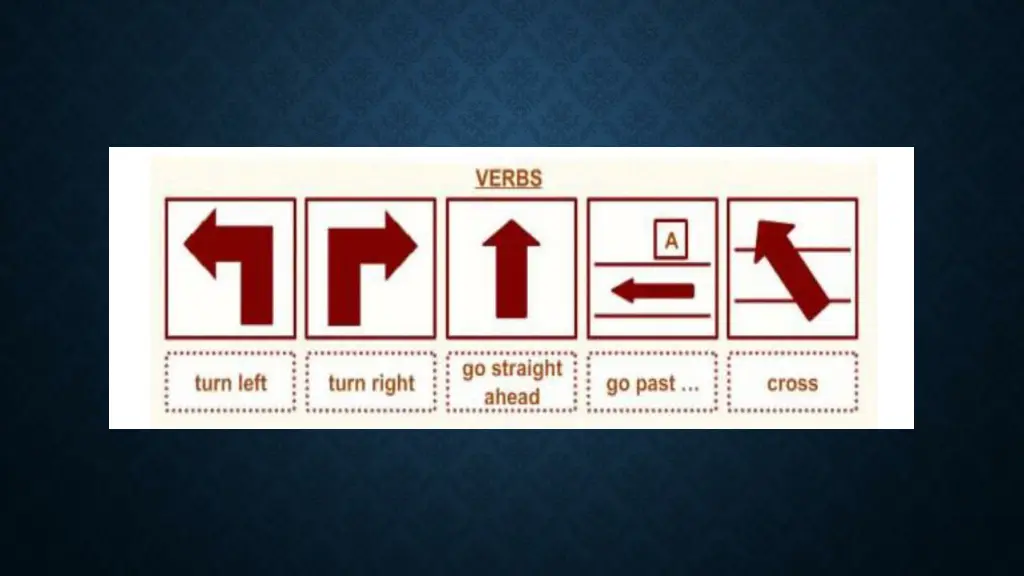
Useful hints on asking and giving directions 1. Giving directions expressions Turn left Turn right Go straight ahead Go past At the corner of and It s between the and the .. It s across from / in front of .
2. Transitions Use these words to connect the ideas After that . Then .. Next When you get to go . Finally ..
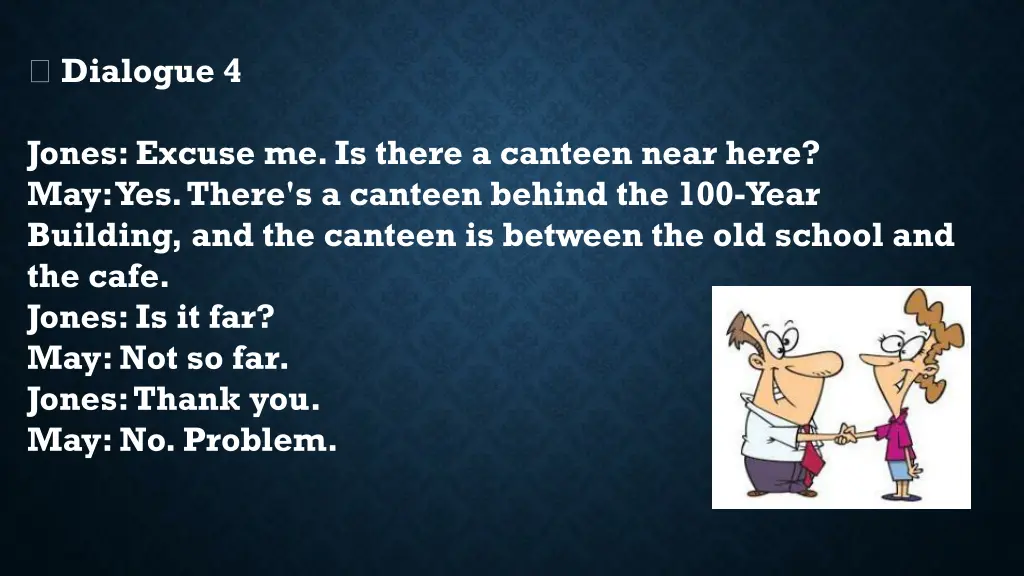
Dialogue 4 Jones: Excuse me. Is there a canteen near here? May: Yes. There's a canteen behind the 100-Year Building, and the canteen is between the old school and the cafe. Jones: Is it far? May: Not so far. Jones: Thank you. May: No. Problem.
Todays idiom. By Hook or by Crook