Presumption of Innocence in Romanian Criminal Proceedings
Explore the configuration and application of the presumption of innocence in Romanian criminal proceedings, focusing on the rebuttable nature of this principle, its link to evidence and proof matters, and the abbreviated trial procedure in cases of recognition of guilt. Discover how the presumption of innocence is intertwined with the judicial process, impartiality, and the protection of civil rights within the Romanian legal framework.

Download Presentation

Please find below an Image/Link to download the presentation.
The content on the website is provided AS IS for your information and personal use only. It may not be sold, licensed, or shared on other websites without obtaining consent from the author. If you encounter any issues during the download, it is possible that the publisher has removed the file from their server.
You are allowed to download the files provided on this website for personal or commercial use, subject to the condition that they are used lawfully. All files are the property of their respective owners.
The content on the website is provided AS IS for your information and personal use only. It may not be sold, licensed, or shared on other websites without obtaining consent from the author.
E N D
Presentation Transcript
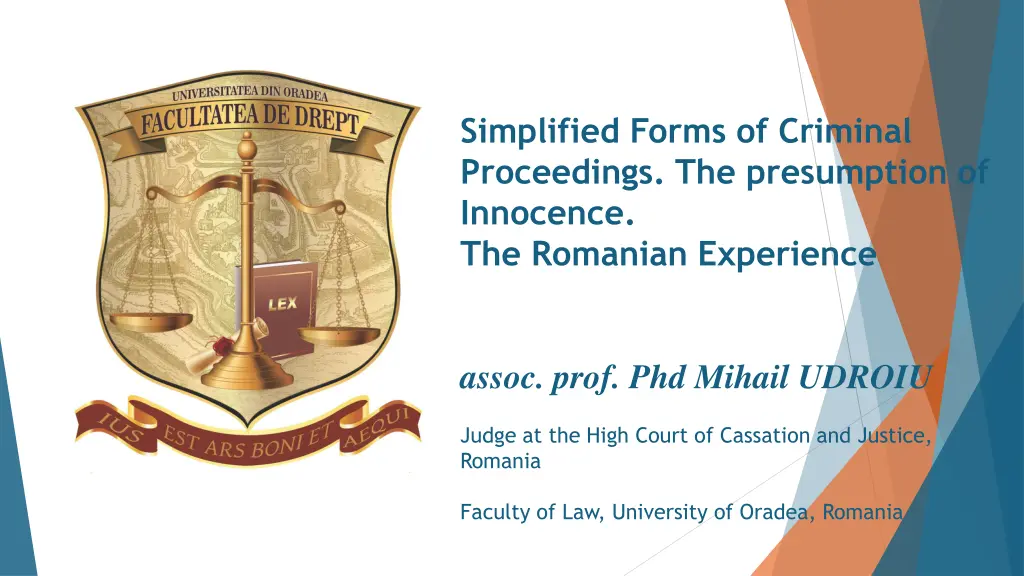
Simplified Forms of Criminal Proceedings. The presumption of Innocence. The Romanian Experience assoc. prof. Phd Mihail UDROIU Judge at the High Court of Cassation and Justice, Romania Faculty of Law, University of Oradea, Romania
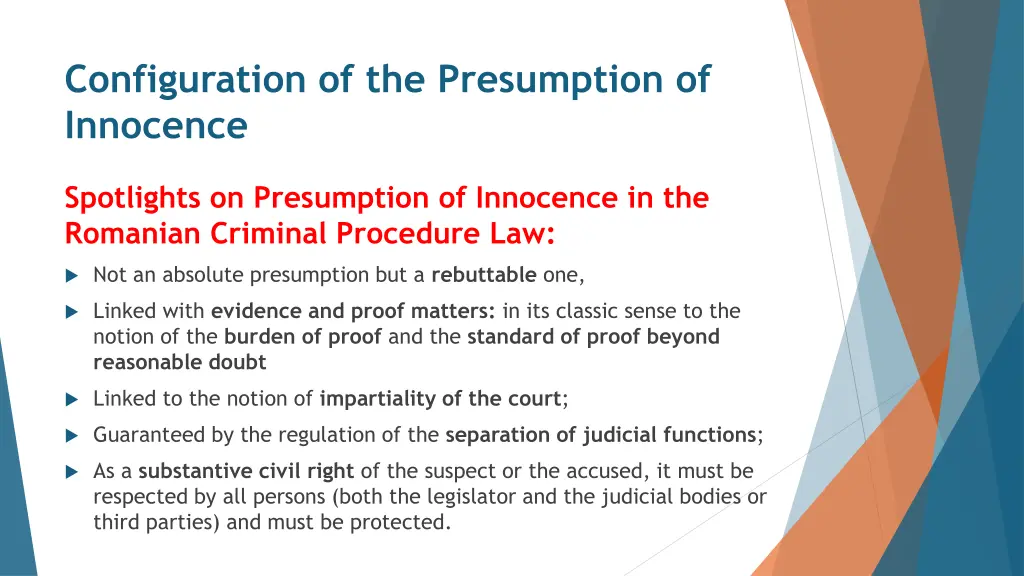
Configuration of the Presumption of Innocence Spotlights on Presumption of Innocence in the Romanian Criminal Procedure Law: Not an absolute presumption but a rebuttable one, Linked with evidence and proof matters: in its classic sense to the notion of the burden of proof and the standard of proof beyond reasonable doubt Linked to the notion of impartiality of the court; Guaranteed by the regulation of the separation of judicial functions; As a substantive civil right of the suspect or the accused, it must be respected by all persons (both the legislator and the judicial bodies or third parties) and must be protected.
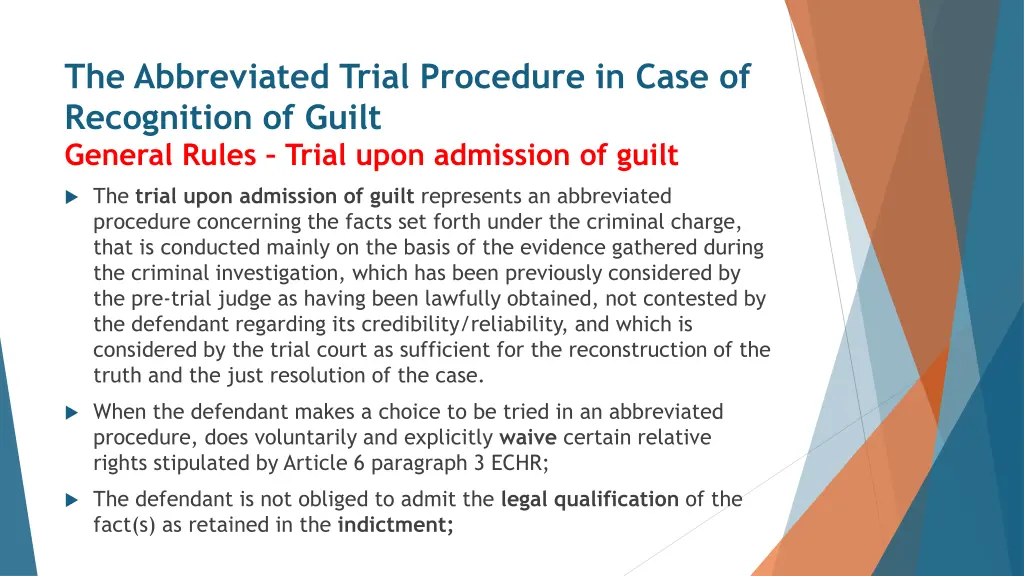
The Abbreviated Trial Procedure in Case of Recognition of Guilt General Rules Trial upon admission of guilt The trial upon admission of guilt represents an abbreviated procedure concerning the facts set forth under the criminal charge, that is conducted mainly on the basis of the evidence gathered during the criminal investigation, which has been previously considered by the pre-trial judge as having been lawfully obtained, not contested by the defendant regarding its credibility/reliability, and which is considered by the trial court as sufficient for the reconstruction of the truth and the just resolution of the case. When the defendant makes a choice to be tried in an abbreviated procedure, does voluntarily and explicitly waive certain relative rights stipulated by Article 6 paragraph 3 ECHR; The defendant is not obliged to admit the legal qualification of the fact(s) as retained in the indictment;
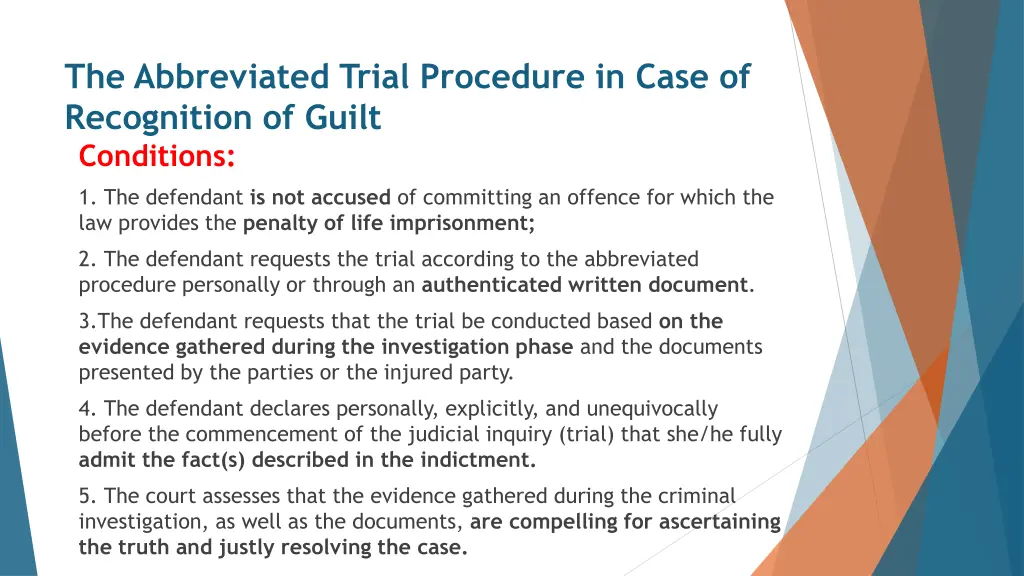
The Abbreviated Trial Procedure in Case of Recognition of Guilt Conditions: 1. The defendant is not accused of committing an offence for which the law provides the penalty of life imprisonment; 2. The defendant requests the trial according to the abbreviated procedure personally or through an authenticated written document. 3.The defendant requests that the trial be conducted based on the evidence gathered during the investigation phase and the documents presented by the parties or the injured party. 4. The defendant declares personally, explicitly, and unequivocally before the commencement of the judicial inquiry (trial) that she/he fully admit the fact(s) described in the indictment. 5. The court assesses that the evidence gathered during the criminal investigation, as well as the documents, are compelling for ascertaining the truth and justly resolving the case.
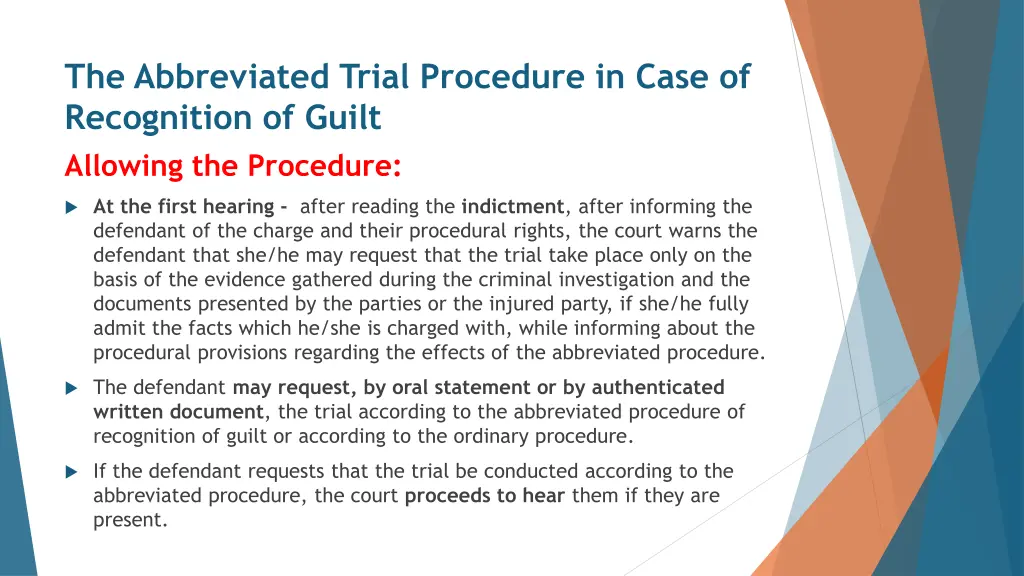
The Abbreviated Trial Procedure in Case of Recognition of Guilt Allowing the Procedure: At the first hearing - after reading the indictment, after informing the defendant of the charge and their procedural rights, the court warns the defendant that she/he may request that the trial take place only on the basis of the evidence gathered during the criminal investigation and the documents presented by the parties or the injured party, if she/he fully admit the facts which he/she is charged with, while informing about the procedural provisions regarding the effects of the abbreviated procedure. The defendant may request, by oral statement or by authenticated written document, the trial according to the abbreviated procedure of recognition of guilt or according to the ordinary procedure. If the defendant requests that the trial be conducted according to the abbreviated procedure, the court proceeds to hear them if they are present.
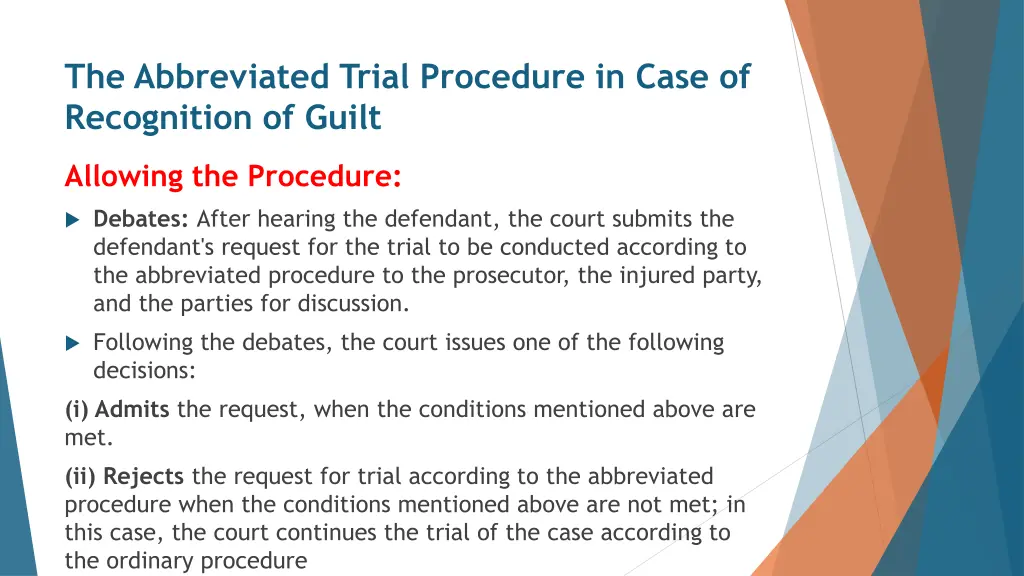
The Abbreviated Trial Procedure in Case of Recognition of Guilt Allowing the Procedure: Debates: After hearing the defendant, the court submits the defendant's request for the trial to be conducted according to the abbreviated procedure to the prosecutor, the injured party, and the parties for discussion. Following the debates, the court issues one of the following decisions: (i) Admits the request, when the conditions mentioned above are met. (ii) Rejects the request for trial according to the abbreviated procedure when the conditions mentioned above are not met; in this case, the court continues the trial of the case according to the ordinary procedure
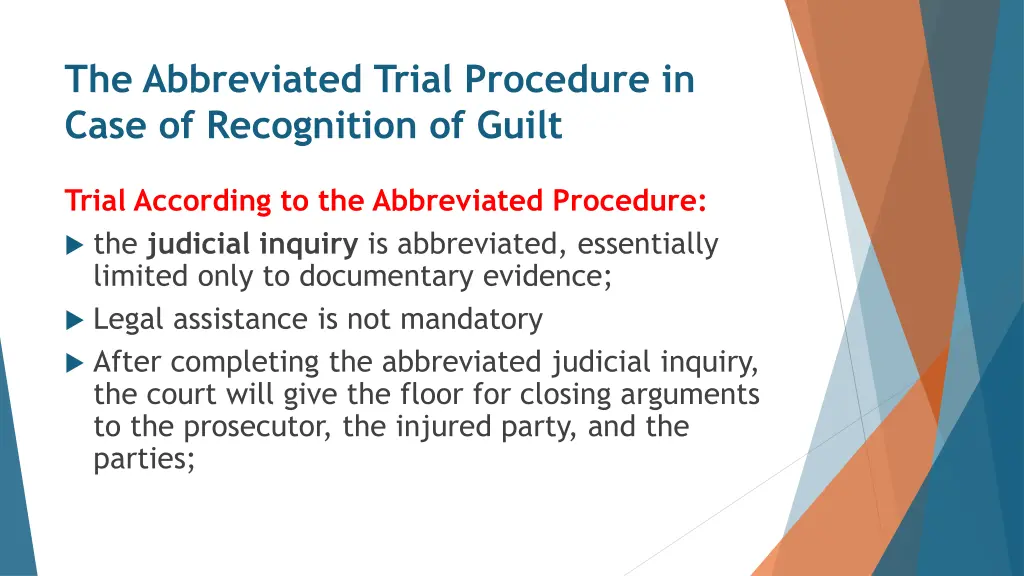
The Abbreviated Trial Procedure in Case of Recognition of Guilt Trial According to the Abbreviated Procedure: the judicial inquiry is abbreviated, essentially limited only to documentary evidence; Legal assistance is not mandatory After completing the abbreviated judicial inquiry, the court will give the floor for closing arguments to the prosecutor, the injured party, and the parties;
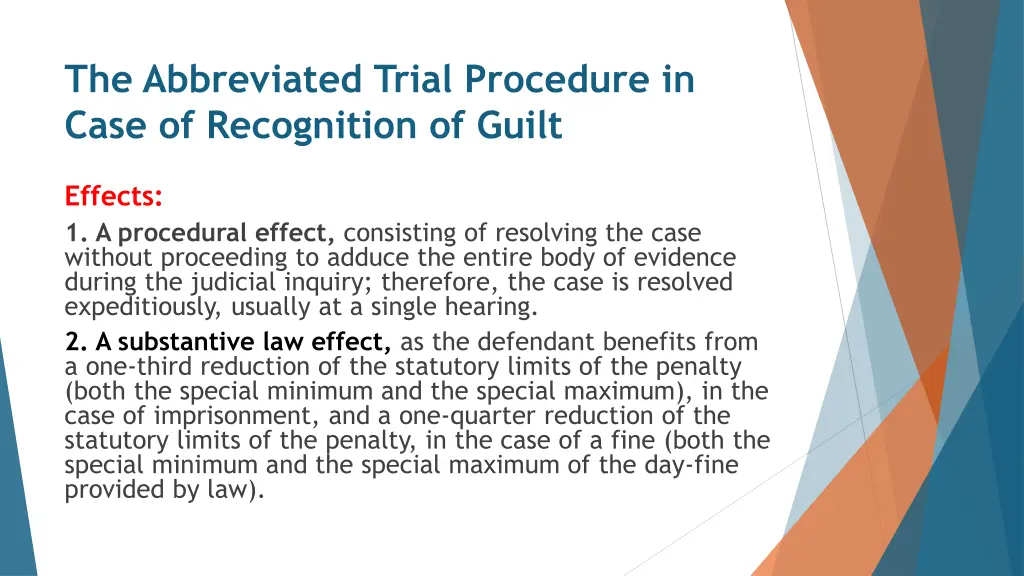
The Abbreviated Trial Procedure in Case of Recognition of Guilt Effects: 1. A procedural effect, consisting of resolving the case without proceeding to adduce the entire body of evidence during the judicial inquiry; therefore, the case is resolved expeditiously, usually at a single hearing. 2. A substantive law effect, as the defendant benefits from a one-third reduction of the statutory limits of the penalty (both the special minimum and the special maximum), in the case of imprisonment, and a one-quarter reduction of the statutory limits of the penalty, in the case of a fine (both the special minimum and the special maximum of the day-fine provided by law).
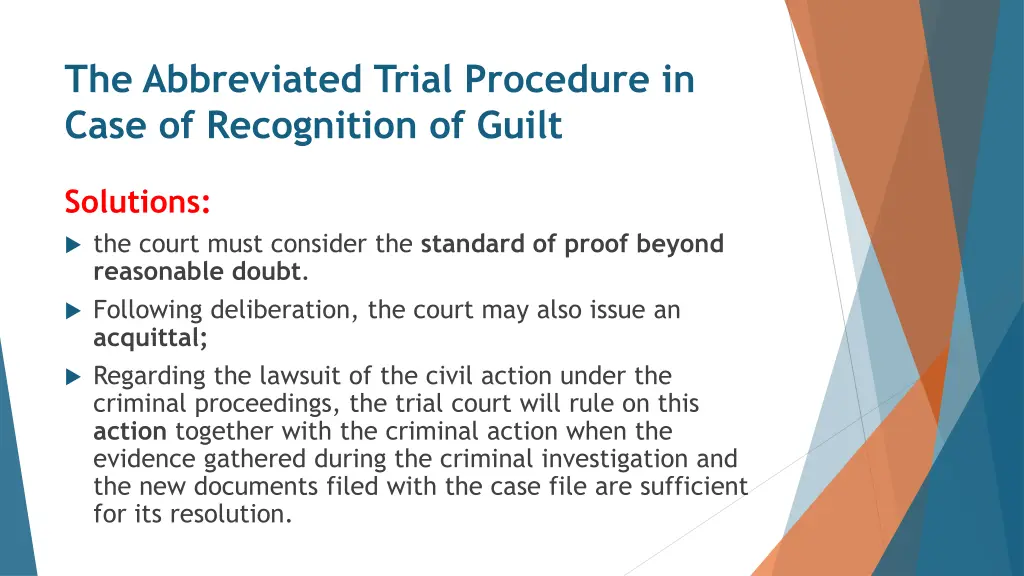
The Abbreviated Trial Procedure in Case of Recognition of Guilt Solutions: the court must consider the standard of proof beyond reasonable doubt. Following deliberation, the court may also issue an acquittal; Regarding the lawsuit of the civil action under the criminal proceedings, the trial court will rule on this action together with the criminal action when the evidence gathered during the criminal investigation and the new documents filed with the case file are sufficient for its resolution.
Plea Bargain Agreement General rules: the plea bargain agreement constitutes the referral of the case to the court concluded between the prosecutor and the defendant within a specific special procedure when the defendant intends to admit the facts of which she/he is accused and their legal qualification, and agrees during discussions with the prosecutor on a manner of individualising the sanctioning treatment. can be initiated either by the prosecutor, or by the defendant; the case prosecutor is the sole party able to decide whether a plea bargain agreement will be concluded; the defendant only has the right to initiate the conclusion of the agreement, not to obtain its conclusion.
Plea Bargain Agreement Conditions: a) Criminal proceedings must have been instituted. b) The defendant must have been heard. c) Mandatory legal assistance. d) Penalty: fine or imprisonment of up to 15 years, alternatively or not with a fine. e) Sufficient evidence adduced during the criminal investigation from which the existence of the act for which criminal proceedings were instituted and the defendant's guilt result. f)Written approval of the superior hierarchical. g) The case prosecutor and the defendant agree on the object of the agreement.
Plea Bargain Agreement Object: (i) The unconditional admission of committing the act(s) for which criminal proceedings were instituted/extended. (ii) The acceptance of the legal qualification of the act(s) for which criminal proceedings were instituted. (iii) The type and quantum of the penalty (principal, complementary, and accessory).
Plea Bargain Agreement Trial Procedure: the prosecutor sends the court the agreement, accompanied by the criminal investigation file; the panel that is to rule on the case will carry out a preliminary check on the regularity of the referral. Public hearing and contradictorial procedures; The defendant cannot retract the admission made during the criminal investigation, save for the existence of constraints, violence, or pressure from the criminal investigation bodies or the use by them of other unfair practices can be proved;
Plea Bargain Agreement Solutions: a) Admits the plea bargain agreement and pronounces the decision on which an agreement was reached. The court cannot order the admission of the agreement and the acquittal of the defendant; b) Rejects the plea bargain agreement and sends the case file to the prosecutor for the continuation of the criminal investigation if: I. Irregularity of the referral is found when: II. Although the referral is legally drawn up, the court considers that the solution agreed upon between the prosecutor and the defendant is unjustifiably lenient in relation to the seriousness of the offence or the dangerousness of the offender.
Compatibility of Simplified Procedures with the Presumption of Innocence Guarantees of a nature to ensure effective protection of the presumption of innocence: 1. The optional nature of both simplified procedures for the recognition of guilt. 2. Detailed information of the defendant regarding the factual and legal grounds of the accusation. 3. Ensuring an effective disclosure of the evidence gathered in the case file. 4.The necessity of an unequivocal and voluntary expression of will by the accused to admit the accusation and to follow the abbreviated procedures.
Compatibility of Simplified Procedures with the Presumption of Innocence Guarantees: 5. Establishment of limits of access to abbreviated procedures in the case of offences with a high degree of social dangerousness (offences for which the law provides the penalty of life imprisonment, respectively offences for which the law provides a prison sentence of 15 years or more); 6. The obligation of the prosecution to conduct an effective investigation that supports the accusation; 7. The establishment of the mandatory nature of legal assistance in the case of the plea bargain agreement.
Compatibility of Simplified Procedures with the Presumption of Innocence Guarantees: Active role of the Judge: Substantial judicial review of the procedure, of a nature to allow verification of whether the procedural rights of the accused have been respected, the publicity of the procedure, ensuring proportionality between the admitted act and the benefit obtained, or the legality of the penalty; The prohibition of using the defendant's statement of admission of guilt if the procedure of recognition of guilt is rejected or the plea bargain agreement is not validated. The possibility of ordering an acquittal when the admitted act is not provided for by criminal law or there is a justification or a cause of non-imputability within the procedure of recognition of guilt; Rejecting the plea bargain agreement if it is illegal, or if it does not have a sufficient factual basis or if there is a doubt regarding their guilt.





![Briefing on the Criminal Procedure Amendment Bill [B12-2021] to the Portfolio Committee on Justice and Correctional Services](/thumb/157093/briefing-on-the-criminal-procedure-amendment-bill-b12-2021-to-the-portfolio-committee-on-justice-and-correctional-services.jpg)