Primary Care Automation Grants 2022 Webinar Insights
Explore the world of process automation in primary care through Robotic Process Automation, intelligent automation, and artificial intelligence. Learn about automation technologies, use cases, and the impact on clinicians and administrators. Discover the benefits of automation in freeing up time for value-adding tasks in healthcare settings.

Download Presentation

Please find below an Image/Link to download the presentation.
The content on the website is provided AS IS for your information and personal use only. It may not be sold, licensed, or shared on other websites without obtaining consent from the author.If you encounter any issues during the download, it is possible that the publisher has removed the file from their server.
You are allowed to download the files provided on this website for personal or commercial use, subject to the condition that they are used lawfully. All files are the property of their respective owners.
The content on the website is provided AS IS for your information and personal use only. It may not be sold, licensed, or shared on other websites without obtaining consent from the author.
E N D
Presentation Transcript
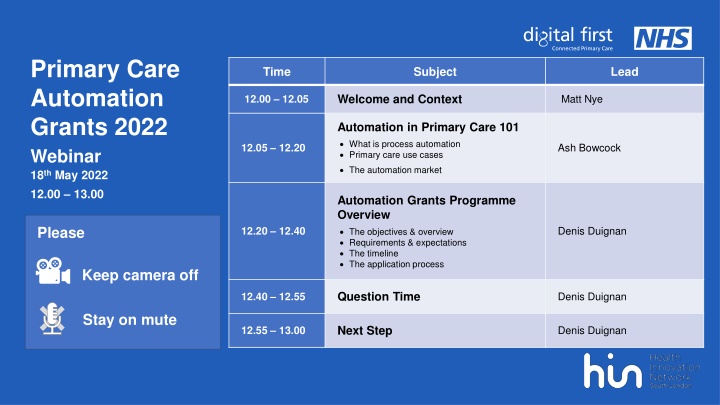
Primary Care Automation Grants 2022 Webinar 18th May 2022 12.00 13.00 Time Subject Lead Welcome and Context Matt Nye 12.00 12.05 Automation in Primary Care 101 What is process automation Primary care use cases The automation market Ash Bowcock 12.05 12.20 Automation Grants Programme Overview The objectives & overview Requirements & expectations The timeline The application process Please Denis Duignan 12.20 12.40 Keep camera off Question Time Denis Duignan 12.40 12.55 Stay on mute Next Step Denis Duignan 12.55 13.00
House Keeping Keep camera off Please stay muted Add questions in the chat Like questions you would like discussed
Welcome & Context Matt Nye Programme Director Digital First London Region NHS England & Improvement
Automation in Primary Care 101 Ashley Bowcock Project Manager Health Innovation Network
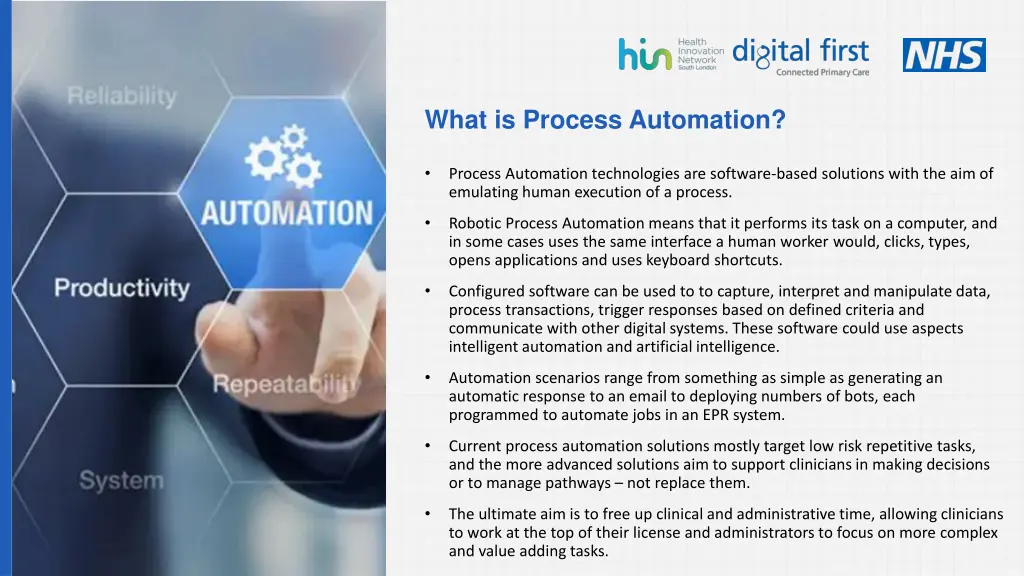
What is Process Automation? Process Automation technologies are software-based solutions with the aim of emulating human execution of a process. Robotic Process Automation means that it performs its task on a computer, and in some cases uses the same interface a human worker would, clicks, types, opens applications and uses keyboard shortcuts. Configured software can be used to to capture, interpret and manipulate data, process transactions, trigger responses based on defined criteria and communicate with other digital systems. These software could use aspects intelligent automation and artificial intelligence. Automation scenarios range from something as simple as generating an automatic response to an email to deploying numbers of bots, each programmed to automate jobs in an EPR system. Current process automation solutions mostly target low risk repetitive tasks, and the more advanced solutions aim to support clinicians in making decisions or to manage pathways not replace them. The ultimate aim is to free up clinical and administrative time, allowing clinicians to work at the top of their license and administrators to focus on more complex and value adding tasks.
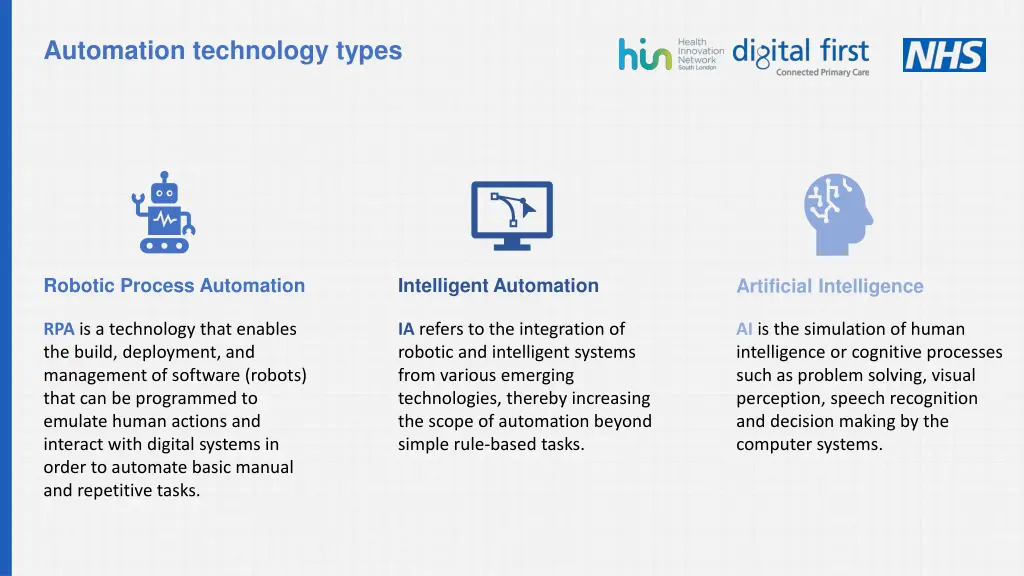
Automation technology types Robotic Process Automation Intelligent Automation Artificial Intelligence RPA is a technology that enables the build, deployment, and management of software (robots) that can be programmed to emulate human actions and interact with digital systems in order to automate basic manual and repetitive tasks. IA refers to the integration of robotic and intelligent systems from various emerging technologies, thereby increasing the scope of automation beyond simple rule-based tasks. AI is the simulation of human intelligence or cognitive processes such as problem solving, visual perception, speech recognition and decision making by the computer systems.
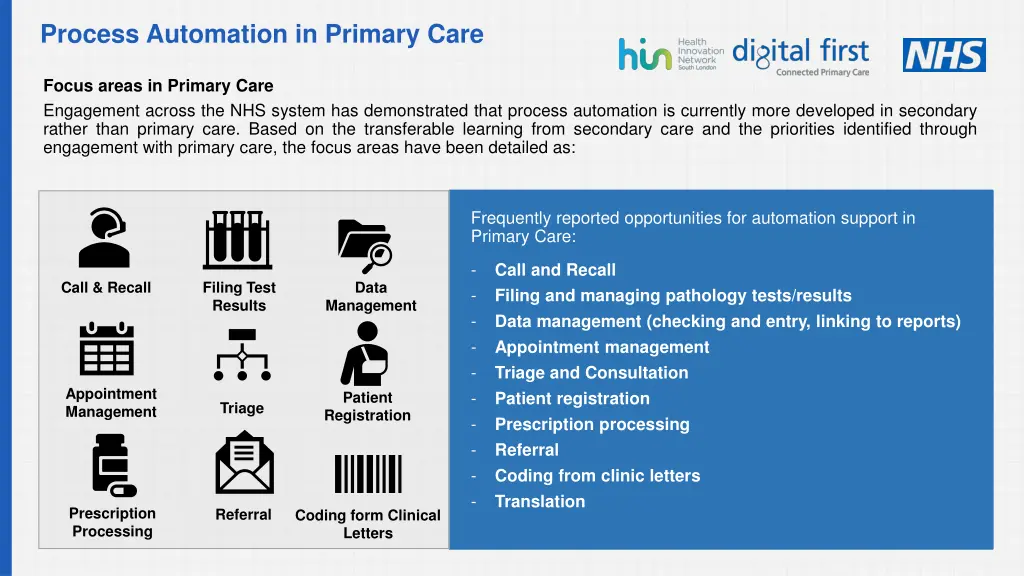
Process Automation in Primary Care Focus areas in Primary Care Engagement across the NHS system has demonstrated that process automation is currently more developed in secondary rather than primary care. Based on the transferable learning from secondary care and the priorities identified through engagement with primary care, the focus areas have been detailed as: Frequently reported opportunities for automation support in Primary Care: - - - - - - - - - - Call and Recall Filing and managing pathology tests/results Data management (checking and entry, linking to reports) Appointment management Triage and Consultation Patient registration Prescription processing Referral Coding from clinic letters Translation Call & Recall Filing Test Results Data Management Appointment Management Patient Registration Triage Prescription Processing Referral Coding form Clinical Letters
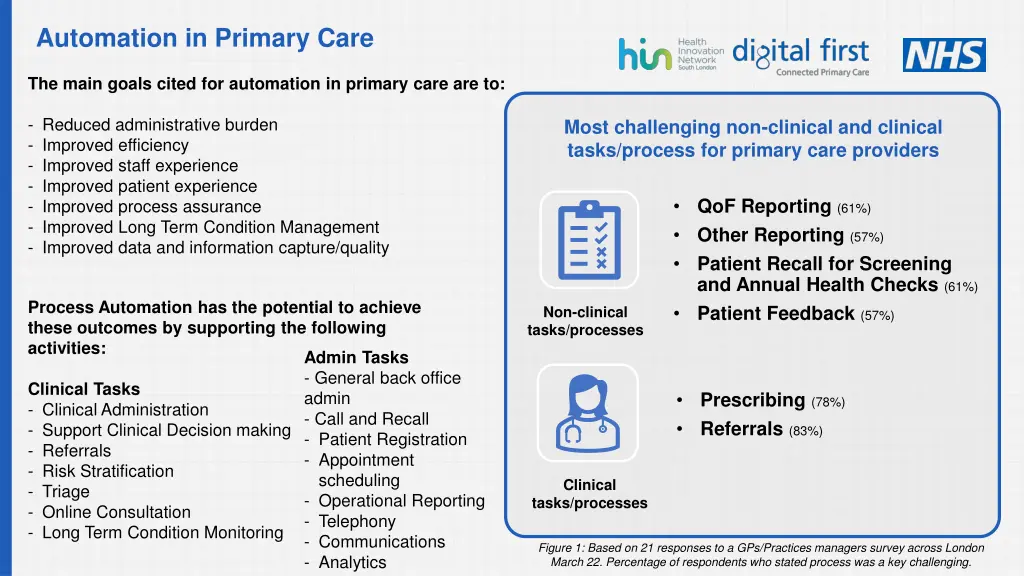
Automation in Primary Care The main goals cited for automation in primary care are to: - Reduced administrative burden - Improved efficiency - Improved staff experience - Improved patient experience - Improved process assurance - Improved Long Term Condition Management - Improved data and information capture/quality Most challenging non-clinical and clinical tasks/process for primary care providers QoF Reporting (61%) Other Reporting (57%) Patient Recall for Screening and Annual Health Checks (61%) Patient Feedback (57%) Process Automation has the potential to achieve these outcomes by supporting the following activities: Non-clinical tasks/processes Admin Tasks - General back office admin - Call and Recall - Patient Registration - Appointment scheduling - Operational Reporting - Telephony - Communications - Analytics Clinical Tasks - Clinical Administration - Support Clinical Decision making - Referrals - Risk Stratification - Triage - Online Consultation - Long Term Condition Monitoring Prescribing (78%) Referrals (83%) Clinical tasks/processes Figure 1: Based on 21 responses to a GPs/Practices managers survey across London March 22. Percentage of respondents who stated process was a key challenging.
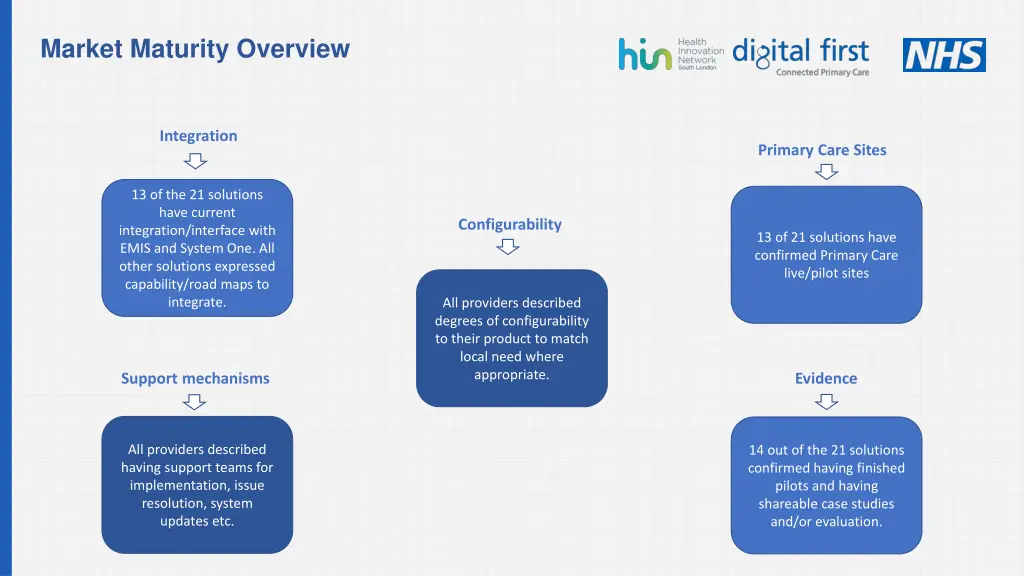
Market Maturity Overview Integration Primary Care Sites 13 of the 21 solutions have current integration/interface with EMIS and System One. All other solutions expressed capability/road maps to integrate. Configurability 13 of 21 solutions have confirmed Primary Care live/pilot sites All providers described degrees of configurability to their product to match local need where appropriate. Support mechanisms Evidence All providers described having support teams for implementation, issue resolution, system updates etc. 14 out of the 21 solutions confirmed having finished pilots and having shareable case studies and/or evaluation.
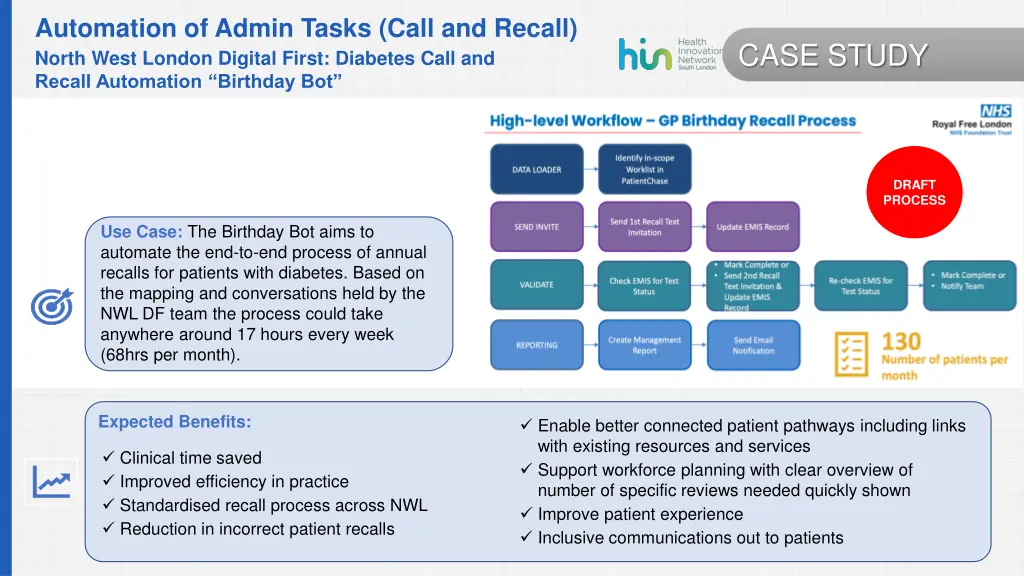
Automation of Admin Tasks (Call and Recall) CASE STUDY North West London Digital First: Diabetes Call and Recall Automation Birthday Bot DRAFT PROCESS Use Case: The Birthday Bot aims to automate the end-to-end process of annual recalls for patients with diabetes. Based on the mapping and conversations held by the NWL DF team the process could take anywhere around 17 hours every week (68hrs per month). Expected Benefits: Enable better connected patient pathways including links with existing resources and services Support workforce planning with clear overview of number of specific reviews needed quickly shown Improve patient experience Inclusive communications out to patients Clinical time saved Improved efficiency in practice Standardised recall process across NWL Reduction in incorrect patient recalls
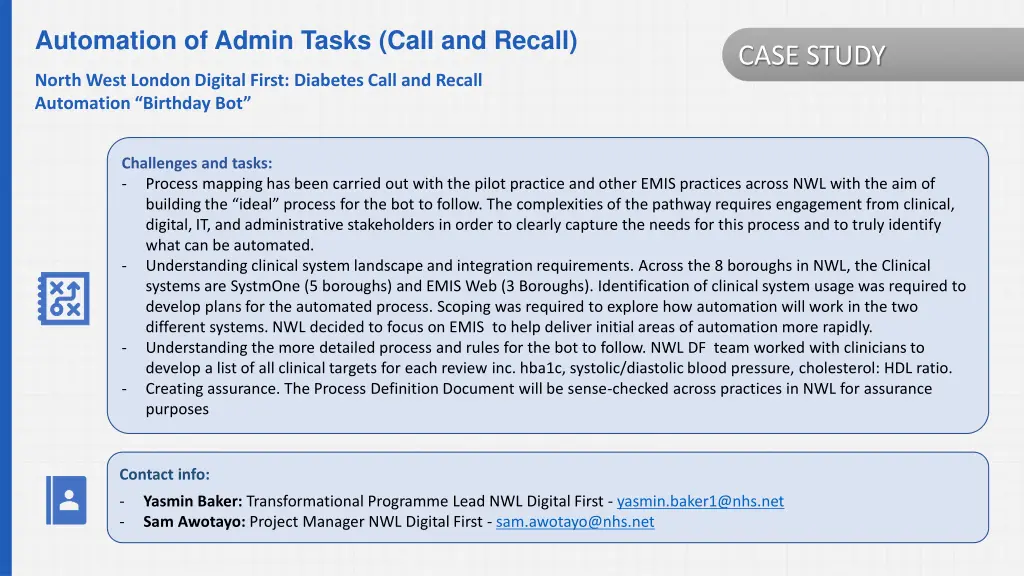
Automation of Admin Tasks (Call and Recall) CASE STUDY North West London Digital First: Diabetes Call and Recall Automation Birthday Bot Challenges and tasks: - Process mapping has been carried out with the pilot practice and other EMIS practices across NWL with the aim of building the ideal process for the bot to follow. The complexities of the pathway requires engagement from clinical, digital, IT, and administrative stakeholders in order to clearly capture the needs for this process and to truly identify what can be automated. - Understanding clinical system landscape and integration requirements. Across the 8 boroughs in NWL, the Clinical systems are SystmOne (5 boroughs) and EMIS Web (3 Boroughs). Identification of clinical system usage was required to develop plans for the automated process. Scoping was required to explore how automation will work in the two different systems. NWL decided to focus on EMIS to help deliver initial areas of automation more rapidly. - Understanding the more detailed process and rules for the bot to follow. NWL DF team worked with clinicians to develop a list of all clinical targets for each review inc. hba1c, systolic/diastolic blood pressure, cholesterol: HDL ratio. - Creating assurance. The Process Definition Document will be sense-checked across practices in NWL for assurance purposes Contact info: - - Yasmin Baker: Transformational Programme Lead NWL Digital First - yasmin.baker1@nhs.net Sam Awotayo: Project Manager NWL Digital First - sam.awotayo@nhs.net
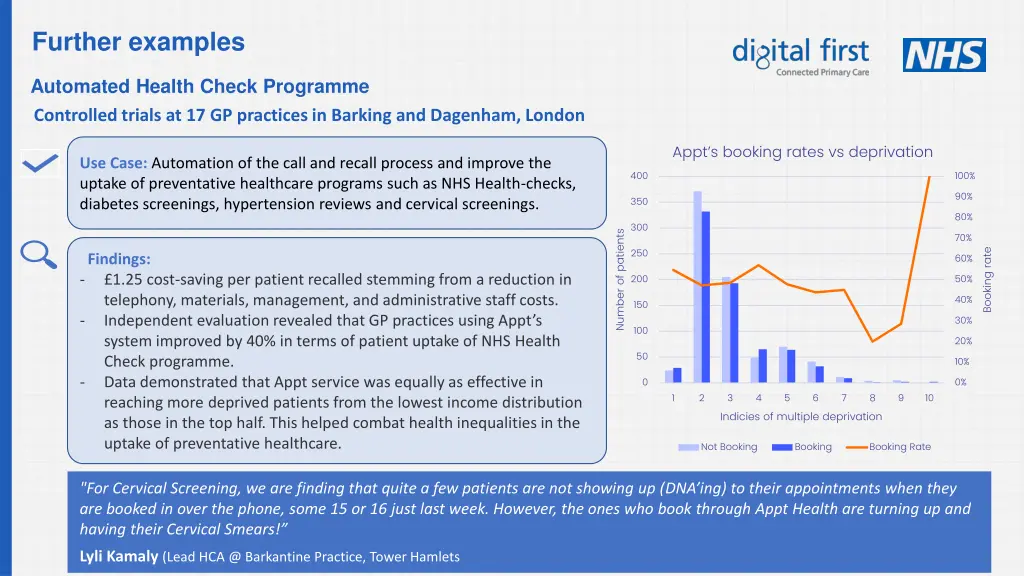
Further examples Automated Health Check Programme Controlled trials at 17 GP practices in Barking and Dagenham, London Appt s booking rates vs deprivation Use Case: Automation of the call and recall process and improve the uptake of preventative healthcare programs such as NHS Health-checks, diabetes screenings, hypertension reviews and cervical screenings. 400 100% 90% 350 80% 300 Number of patients 70% 250 Booking rate 60% Findings: 1.25 cost-saving per patient recalled stemming from a reduction in telephony, materials, management, and administrative staff costs. Independent evaluation revealed that GP practices using Appt s system improved by 40% in terms of patient uptake of NHS Health Check programme. Data demonstrated that Appt service was equally as effective in reaching more deprived patients from the lowest income distribution as those in the top half. This helped combat health inequalities in the uptake of preventative healthcare. - 200 50% 40% 150 - 30% 100 20% 50 10% - 0 0% 1 2 3 4 5 6 7 8 9 10 Indicies of multiple deprivation Not Booking Booking Booking Rate "For Cervical Screening, we are finding that quite a few patients are not showing up (DNA ing) to their appointments when they are booked in over the phone, some 15 or 16 just last week. However, the ones who book through Appt Health are turning up and having their Cervical Smears! Lyli Kamaly (Lead HCA @ Barkantine Practice, Tower Hamlets
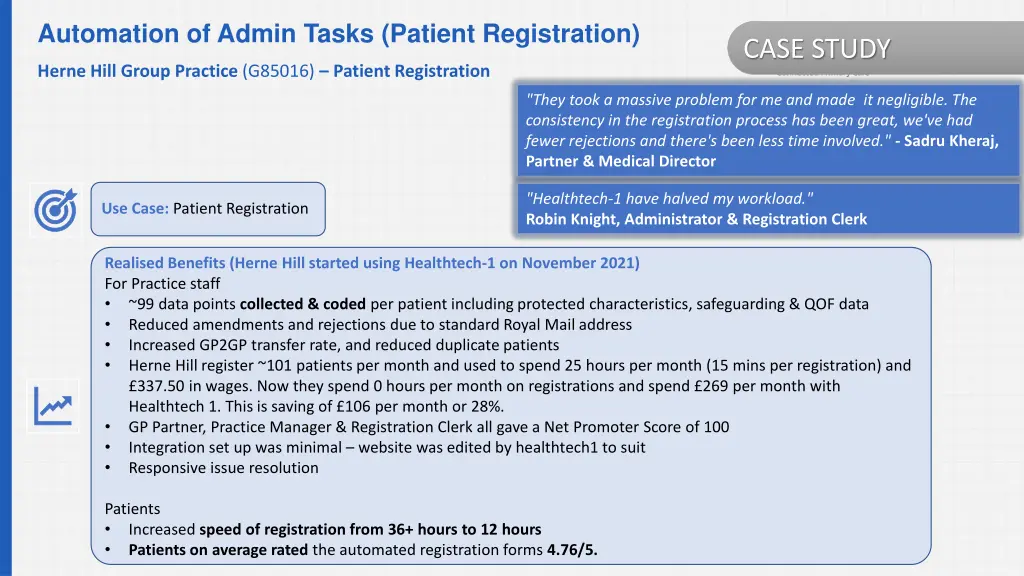
Automation of Admin Tasks (Patient Registration) CASE STUDY Herne Hill Group Practice (G85016) Patient Registration "They took a massive problem for me and made it negligible. The consistency in the registration process has been great, we've had fewer rejections and there's been less time involved."- Sadru Kheraj, Partner & Medical Director "Healthtech-1 have halved my workload." Robin Knight, Administrator & Registration Clerk Use Case: Patient Registration Realised Benefits (Herne Hill started using Healthtech-1 on November 2021) For Practice staff ~99 data points collected & coded per patient including protected characteristics, safeguarding & QOF data Reduced amendments and rejections due to standard Royal Mail address Increased GP2GP transfer rate, and reduced duplicate patients Herne Hill register ~101 patients per month and used to spend 25 hours per month (15 mins per registration) and 337.50 in wages. Now they spend 0 hours per month on registrations and spend 269 per month with Healthtech 1. This is saving of 106 per month or 28%. GP Partner, Practice Manager & Registration Clerk all gave a Net Promoter Score of 100 Integration set up was minimal website was edited by healthtech1 to suit Responsive issue resolution Patients Increased speed of registration from 36+ hours to 12 hours Patients on average rated the automated registration forms 4.76/5.
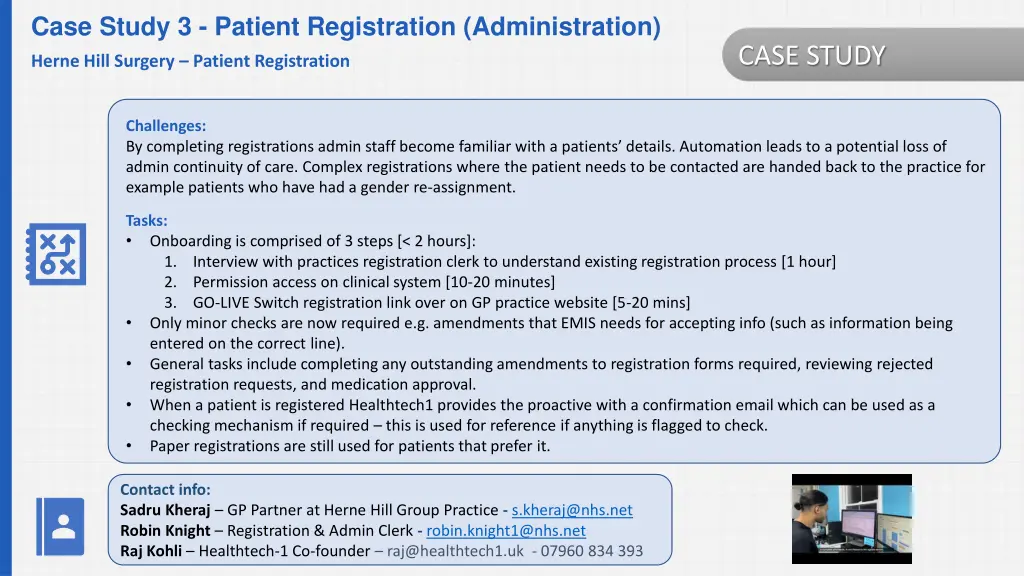
Case Study 3 - Patient Registration (Administration) CASE STUDY Herne Hill Surgery Patient Registration Challenges: By completing registrations admin staff become familiar with a patients details. Automation leads to a potential loss of admin continuity of care. Complex registrations where the patient needs to be contacted are handed back to the practice for example patients who have had a gender re-assignment. Tasks: Onboarding is comprised of 3 steps [< 2 hours]: 1. Interview with practices registration clerk to understand existing registration process [1 hour] 2. Permission access on clinical system [10-20 minutes] 3. GO-LIVE Switch registration link over on GP practice website [5-20 mins] Only minor checks are now required e.g. amendments that EMIS needs for accepting info (such as information being entered on the correct line). General tasks include completing any outstanding amendments to registration forms required, reviewing rejected registration requests, and medication approval. When a patient is registered Healthtech1 provides the proactive with a confirmation email which can be used as a checking mechanism if required this is used for reference if anything is flagged to check. Paper registrations are still used for patients that prefer it. Contact info: Sadru Kheraj GP Partner at Herne Hill Group Practice - s.kheraj@nhs.net Robin Knight Registration & Admin Clerk - robin.knight1@nhs.net Raj Kohli Healthtech-1 Co-founder raj@healthtech1.uk - 07960 834 393
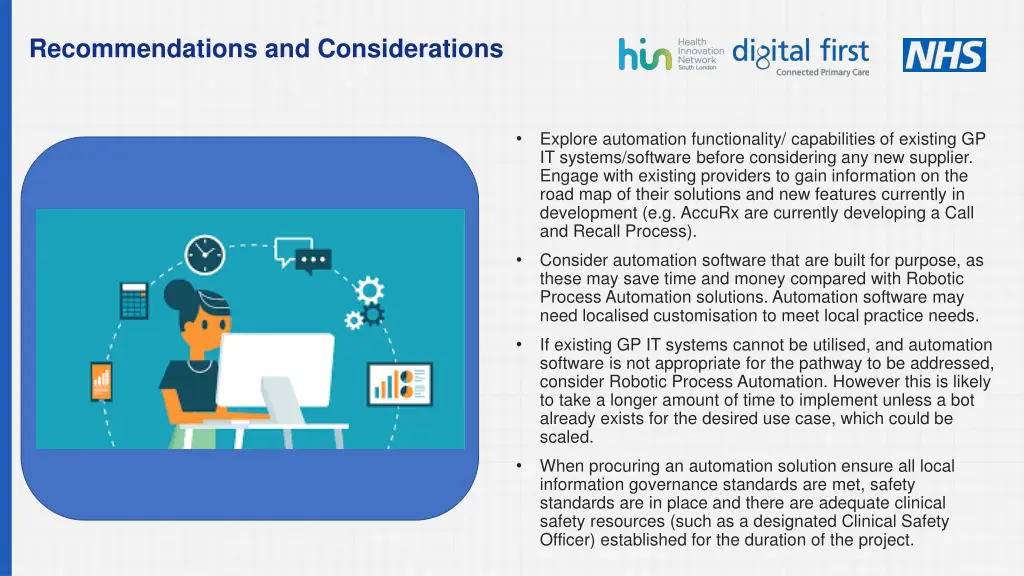
Recommendations and Considerations Explore automation functionality/ capabilities of existing GP IT systems/software before considering any new supplier. Engage with existing providers to gain information on the road map of their solutions and new features currently in development (e.g. AccuRx are currently developing a Call and Recall Process). Consider automation software that are built for purpose, as these may save time and money compared with Robotic Process Automation solutions. Automation software may need localised customisation to meet local practice needs. If existing GP IT systems cannot be utilised, and automation software is not appropriate for the pathway to be addressed, consider Robotic Process Automation. However this is likely to take a longer amount of time to implement unless a bot already exists for the desired use case, which could be scaled. When procuring an automation solution ensure all local information governance standards are met, safety standards are in place and there are adequate clinical safety resources (such as a designated Clinical Safety Officer) established for the duration of the project.
Grants Programme Overview Denis Duignan Head of Digital Transformation & Technology Health Innovation Network
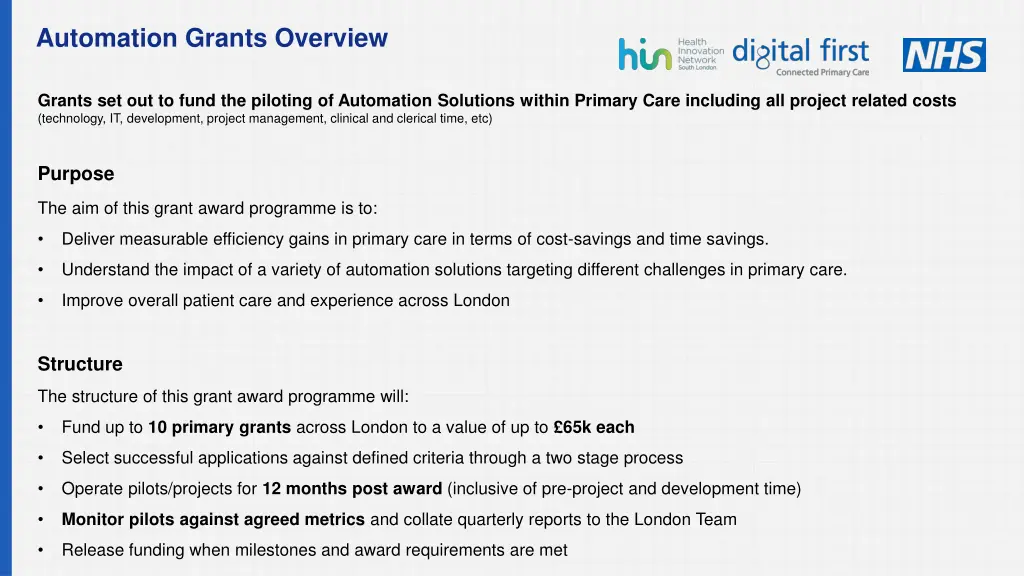
Automation Grants Overview Grants set out to fund the piloting of Automation Solutions within Primary Care including all project related costs (technology, IT, development, project management, clinical and clerical time, etc) Purpose The aim of this grant award programme is to: Deliver measurable efficiency gains in primary care in terms of cost-savings and time savings. Understand the impact of a variety of automation solutions targeting different challenges in primary care. Improve overall patient care and experience across London Structure The structure of this grant award programme will: Fund up to 10 primary grants across London to a value of up to 65k each Select successful applications against defined criteria through a two stage process Operate pilots/projects for 12 months post award (inclusive of pre-project and development time) Monitor pilots against agreed metrics and collate quarterly reports to the London Team Release funding when milestones and award requirements are met
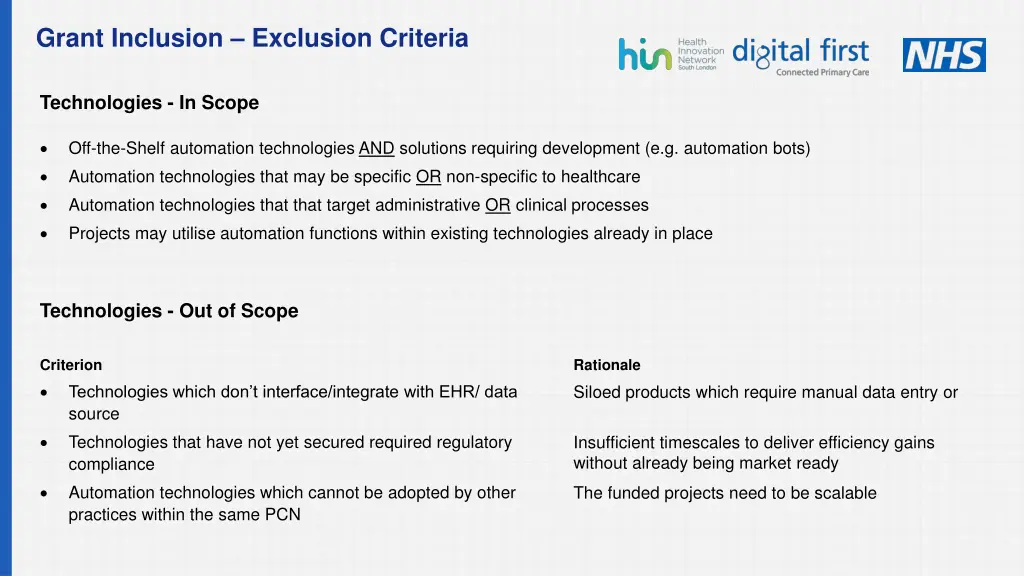
Grant Inclusion Exclusion Criteria Technologies - In Scope Off-the-Shelf automation technologies AND solutions requiring development (e.g. automation bots) Automation technologies that may be specific OR non-specific to healthcare Automation technologies that that target administrative OR clinical processes Projects may utilise automation functions within existing technologies already in place Technologies - Out of Scope Criterion Technologies which don t interface/integrate with EHR/ data source Technologies that have not yet secured required regulatory compliance Automation technologies which cannot be adopted by other practices within the same PCN Rationale Siloed products which require manual data entry or Insufficient timescales to deliver efficiency gains without already being market ready The funded projects need to be scalable
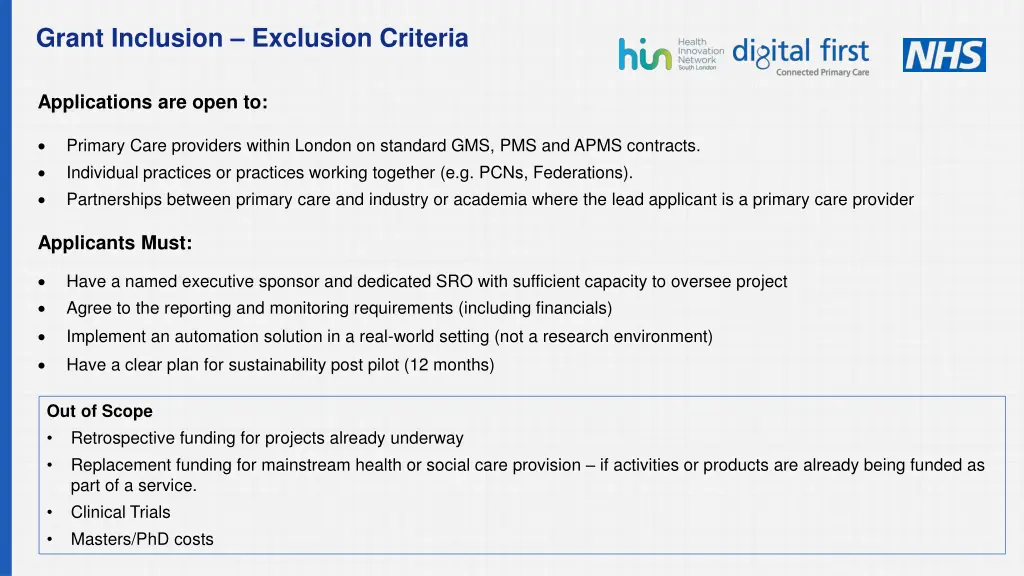
Grant Inclusion Exclusion Criteria Applications are open to: Primary Care providers within London on standard GMS, PMS and APMS contracts. Individual practices or practices working together (e.g. PCNs, Federations). Partnerships between primary care and industry or academia where the lead applicant is a primary care provider Applicants Must: Have a named executive sponsor and dedicated SRO with sufficient capacity to oversee project Agree to the reporting and monitoring requirements (including financials) Implement an automation solution in a real-world setting (not a research environment) Have a clear plan for sustainability post pilot (12 months) Out of Scope Retrospective funding for projects already underway Replacement funding for mainstream health or social care provision if activities or products are already being funded as part of a service. Clinical Trials Masters/PhD costs
Grants Timeline Key actions and milestones
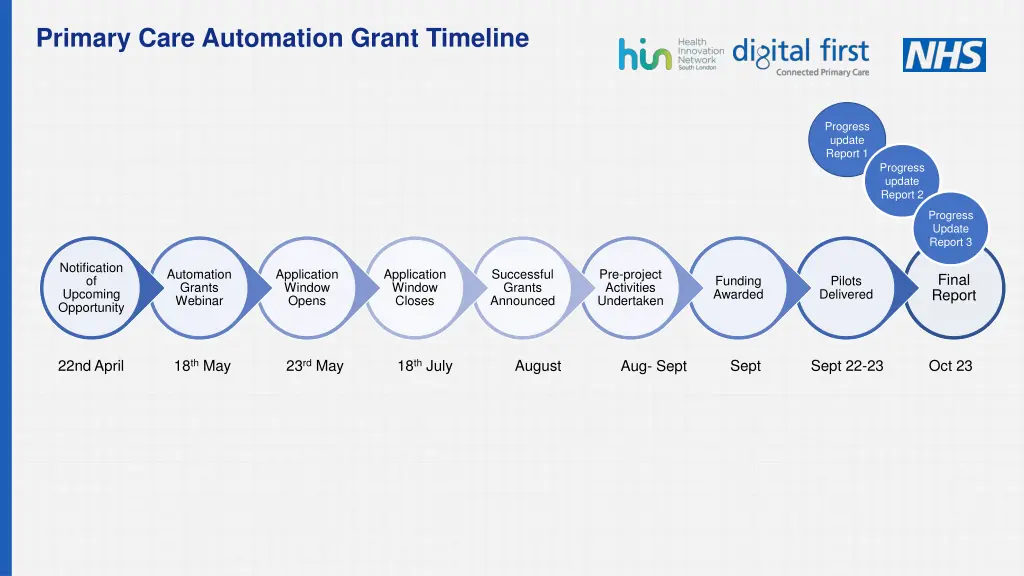
Primary Care Automation Grant Timeline Progress update Report 1 Progress update Report 2 Progress Update Report 3 Notification of Upcoming Opportunity Automation Grants Webinar Application Window Opens Application Window Closes Successful Grants Announced Pre-project Activities Undertaken Final Report Funding Awarded Pilots Delivered 22nd April 18th May 23rd May 18th July August Sept Sept 22-23 Oct 23 Aug- Sept
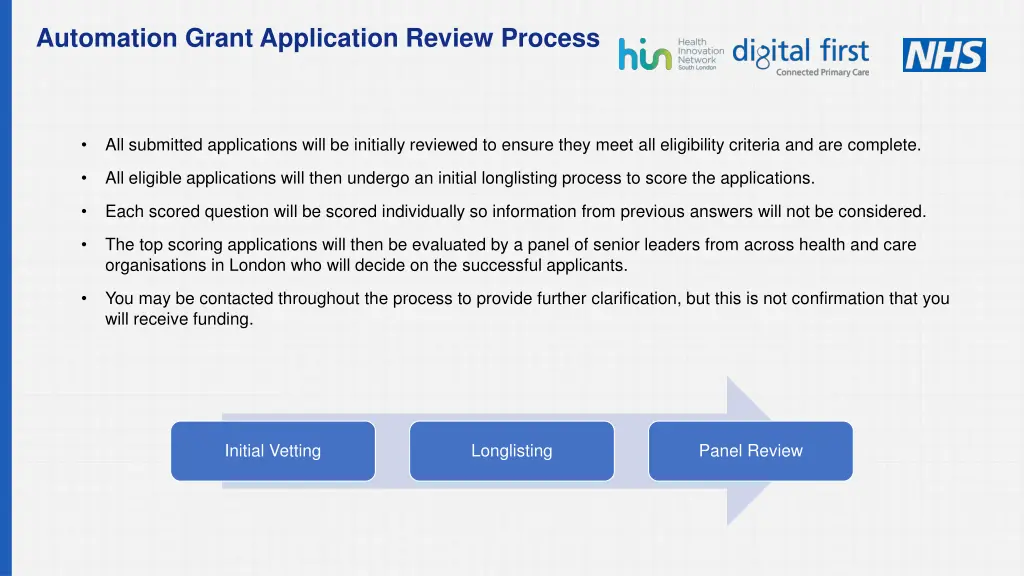
Automation Grant Application Review Process All submitted applications will be initially reviewed to ensure they meet all eligibility criteria and are complete. All eligible applications will then undergo an initial longlisting process to score the applications. Each scored question will be scored individually so information from previous answers will not be considered. The top scoring applications will then be evaluated by a panel of senior leaders from across health and care organisations in London who will decide on the successful applicants. You may be contacted throughout the process to provide further clarification, but this is not confirmation that you will receive funding. Initial Vetting Longlisting Panel Review
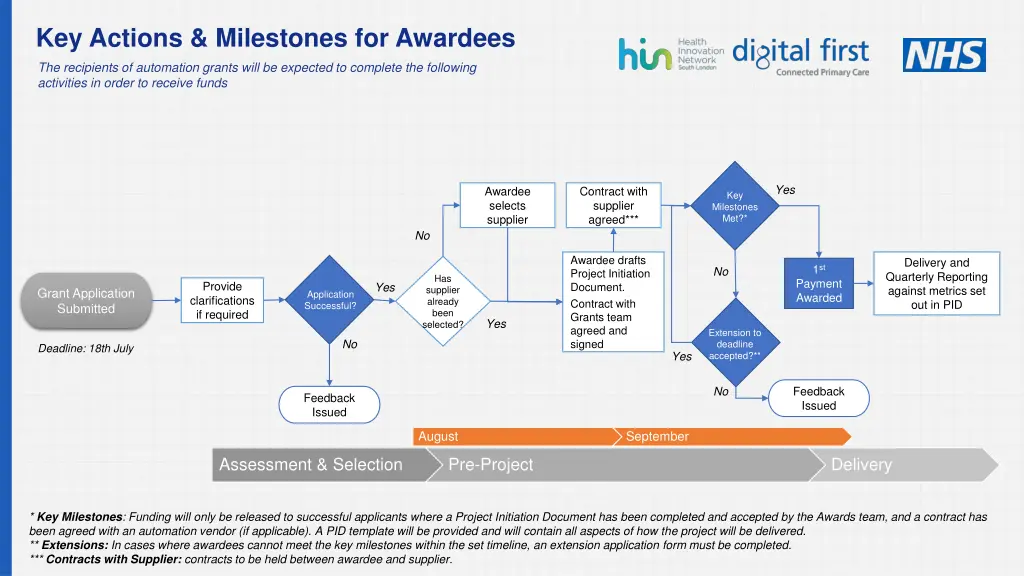
Key Actions & Milestones for Awardees The recipients of automation grants will be expected to complete the following activities in order to receive funds Yes Awardee selects supplier Contract with supplier agreed*** Key Milestones Met?* No Awardee drafts Project Initiation Document. Contract with Grants team agreed and signed Delivery and Quarterly Reporting against metrics set out in PID 1st No Has supplier already been selected? Payment Awarded Provide clarifications if required Yes Grant Application Submitted Application Successful? Yes Extension to deadline accepted?** No Deadline: 18th July Yes No Feedback Issued Feedback Issued August September Assessment & Selection Pre-Project Delivery * Key Milestones: Funding will only be released to successful applicants where a Project Initiation Document has been completed and accepted by the Awards team, and a contract has been agreed with an automation vendor (if applicable). A PID template will be provided and will contain all aspects of how the project will be delivered. ** Extensions: In cases where awardees cannot meet the key milestones within the set timeline, an extension application form must be completed. *** Contracts with Supplier: contracts to be held between awardee and supplier.
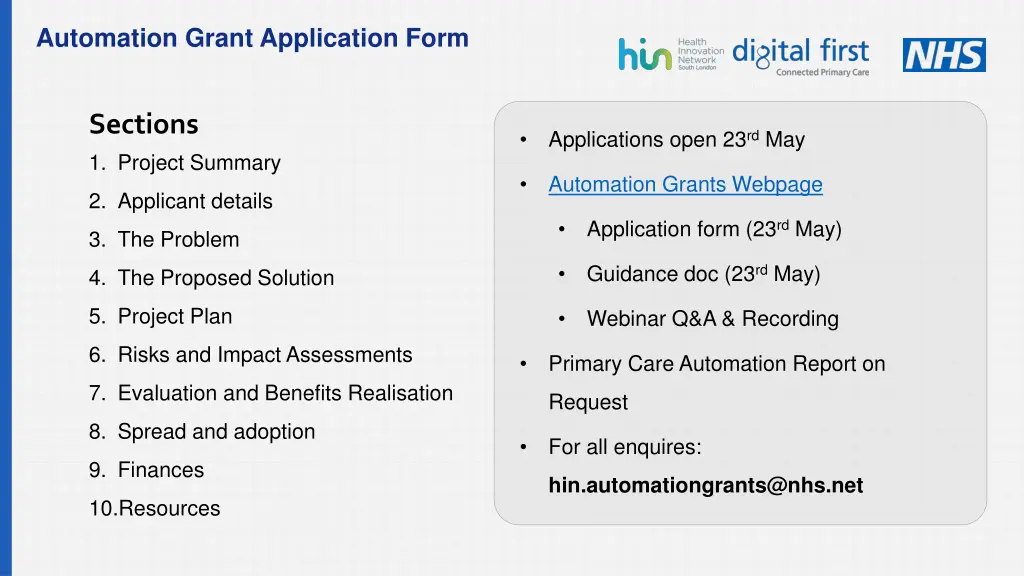
Automation Grant Application Form Sections 1. Project Summary Applications open 23rd May Automation Grants Webpage 2. Applicant details Application form (23rd May) 3. The Problem Guidance doc (23rd May) 4. The Proposed Solution 5. Project Plan Webinar Q&A & Recording 6. Risks and Impact Assessments Primary Care Automation Report on 7. Evaluation and Benefits Realisation Request 8. Spread and adoption For all enquires: 9. Finances hin.automationgrants@nhs.net 10.Resources
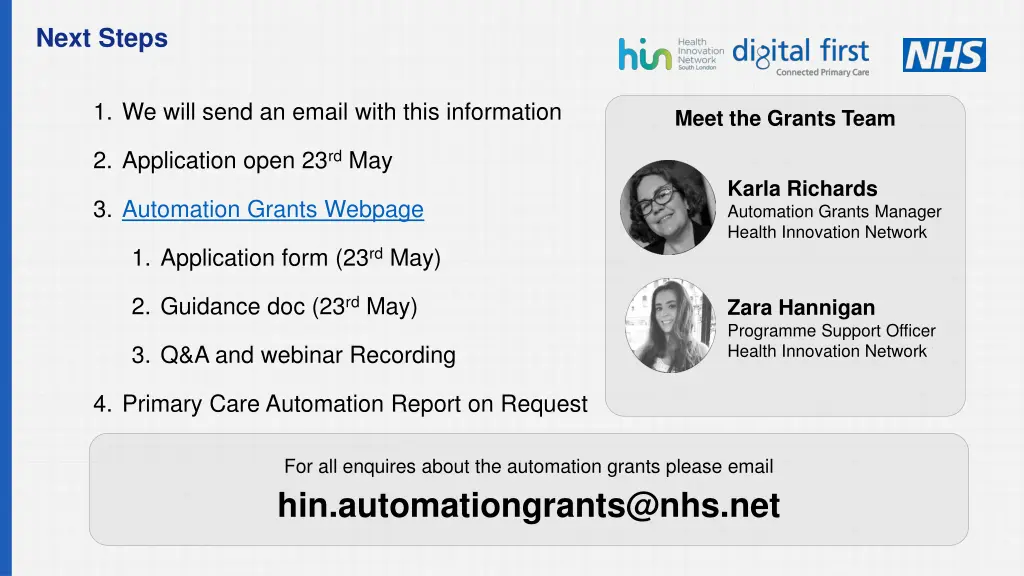
Next Steps 1. We will send an email with this information Meet the Grants Team 2. Application open 23rd May Karla Richards Automation Grants Manager Health Innovation Network 3. Automation Grants Webpage 1. Application form (23rd May) 2. Guidance doc (23rd May) Zara Hannigan Programme Support Officer Health Innovation Network 3. Q&A and webinar Recording 4. Primary Care Automation Report on Request For all enquires about the automation grants please email hin.automationgrants@nhs.net