Explore the key aims of assessment, quality assurance principles, and the role of assessment in academic standards. Understand how assessment benefits both students and staff, driving learning and improving teaching practices. Dive into the purposes of assessment, from formative to summative, with a practical case illustration in Animal Physiology. Enhance your assessment practice with valuable resources and insights.
Please find below an Image/Link to download the presentation.
The content on the website is provided AS IS for your information and personal use only. It may not be sold, licensed, or shared on other websites without obtaining consent from the author. If you encounter any issues during the download, it is possible that the publisher has removed the file from their server.
You are allowed to download the files provided on this website for personal or commercial use, subject to the condition that they are used lawfully. All files are the property of their respective owners.
The content on the website is provided AS IS for your information and personal use only. It may not be sold, licensed, or shared on other websites without obtaining consent from the author.
E N D
Presentation Transcript
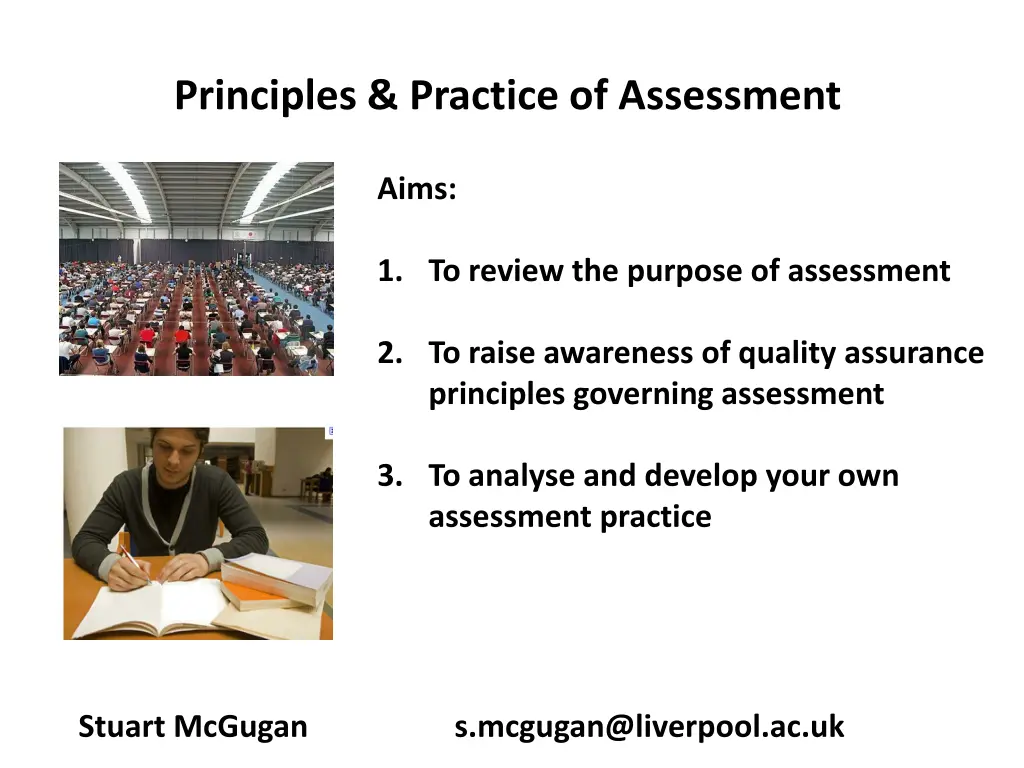
Principles & Practice of Assessment Aims: 1. To review the purpose of assessment 2. To raise awareness of quality assurance principles governing assessment 3. To analyse and develop your own assessment practice Stuart McGugan s.mcgugan@liverpool.ac.uk
Resources University Code of Practice on Assessment (and its many appendices[currently A-N) revised annually http://www.liv.ac.uk/tqsd/pol_strat_cop/cop_assess/code_of_practic e_on_assessment.pdf Understanding assessment: its role in safeguarding academic standards and quality in higher education.2nd edition (QAA Sept 2012) http://www.qaa.ac.uk/Publications/InformationAndGuidance/Pages/u nderstanding-assessment.aspx Developing effective assessment in Higher Education [electronic book] a practical guide / Sue Bloxham, Pete Boyd. Maidenhead : Open University Press, c2007
What is assessment used for? For students, assessment Enables them to demonstrate their learning For staff, assessment Provides an opportunity to give constructive and encouraging feedback to students in their learning Enables them to improve their learning and study skills Acts as a motivating factor by providing a focus for their learning activity with timescales and deadlines to work to Enables them to monitor the effectiveness of their teaching Enables them make decisions about whether students can progress through academic levels Provides intellectual challenge and can stimulate their interest in and around the subject Helps them decide the degree classifications they award Can provide opportunity for students to work collaboratively to achieve a common goal Ultimately decides the degree classification that they are awarded Butcher, Davies & Highton (2006) Designing learning: from module outline to effective teaching Routledge: London
Purposes for assessment: assessment as a driver for learning; (formative purpose/AFL) assessment to grade students. (summative purpose/AOL) Black and Wiliam (1998)
Case illustration UG Level 2 Animal Physiology Module Theory Module 18 lectures over 6 weeks 2010/2011 78 students Prior to 2010/11 - 100% final exam Assessment change Introduction of two staged online tests (20%) students have to do the formative tests before they can take the summative tests Final exam (80%) Improving student achievement
the assessment as a driver for learning Tasks capture sufficient student effort Effort is distributed evenly across weeks Students have clear goals which are perceived as challenging but possible Students regularly receive/apply feedback to address gaps in knowledge and understanding Encourages interaction
Quality assurance principles Validity The assessments set test what you are wanting to test Reliability Markers acting independently, using the same criteria, would reach the same judgment on a piece of work Fairness All students are treated equitably, and that they are given equivalent opportunities to demonstrate their achievement of the required standards QAA (2012, p.6/7)
Elton and Johnston (2002) argue that the focus on reliable assessment practices arise out of a positivist paradigm with its belief in the possibility of objectivity, scientific measurement and certainty However......... Some forms of student performance are easier to mark reliably than others.......
In some cases, such as problem sheets, the design of the assessment takes longer than the marking, and usually the scheme is fairly self-evident. The learning being tested is usually convergent, which means that correct answers are clear, and the only real problems concern half-correct answers: if someone has got the answer to a maths problem wrong, do you give credit for the fact that they only went wrong in the latter stages of the working? Whatever the decision, it is fairly easy to be consistent and hence reliable in its application. This is less true in the case of essay-type questions. In fact, one of their problems is that they are so easy to set most experienced teachers can think of an essay question off-the-cuff in fifteen seconds that we often have little clear idea of what we will get back. James Atherton Marking [online] http://www.learningandteaching.info/teaching/marking.htm
Possible factors .... Other performances Tiredness Confidence/experience Interest Knowledge of student Handwriting Culture of department
Approaching practice - some suggestions Engage with the assessment criteria/marking scheme Mark against criteria/scheme (use to guide feedback) Alert to possible biases e.g. handwriting, tiredness Mark individual questions/sections rather than complete performance Remark the last few students again at the start of a marking session Self moderate when finished checking for errors/consistency
Checks and balances Sample performance more than once using a range of methods Anonymous performance Double marking (judgment of student performance) Moderation internal and external (judgement of marking) Reasonable adjustments (e.g. scaling, profiling) Mitigating circumstances For more detail see relevant section CoPA (TQSD website)
Acknowledgements Black, P. & Wiliam, D. (1998). Assessment and classroom learning. Assessment in Higher Education 5(1), 7-74 Elton, L. & Johnston, B. (2002) Assessment in Universities: a critical review of research, LTSN generic Centre Gibbs G (1999) Using assessment strategically to change the way students learn, in Assessment Matters in Higher Education, eds Brown S and Glasner A, Society for Research into Higher Education and Open University Press, Maidenhead, pp 41-53 Voelkel, S. (2013) Combining the formative with the summative: the development of a two-stage online test to encourage engagement and provide personal feedback in large classes, Research in Learning Technology Vol, 21