Principles of Assessment and Feedback for Effective Learning

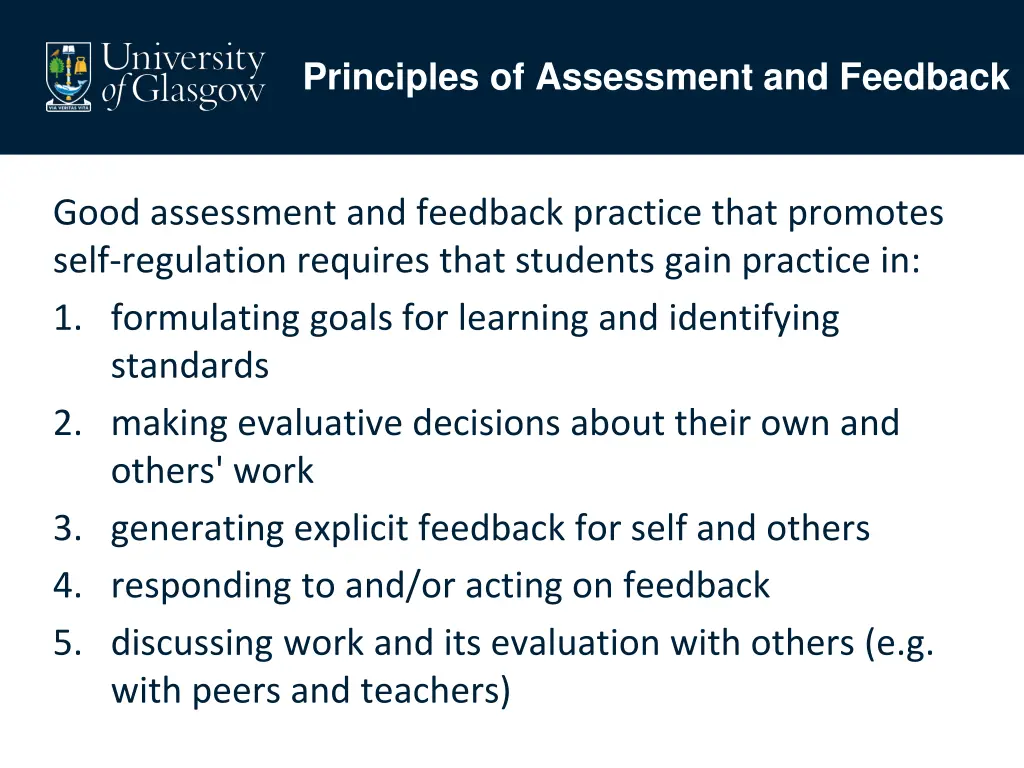
Good assessment and feedback practices play a crucial role in promoting self-regulation among students. This includes setting learning goals, making evaluative decisions, providing feedback, and engaging in discussions to enhance learning outcomes.

Download Presentation

Please find below an Image/Link to download the presentation.
The content on the website is provided AS IS for your information and personal use only. It may not be sold, licensed, or shared on other websites without obtaining consent from the author.If you encounter any issues during the download, it is possible that the publisher has removed the file from their server.
You are allowed to download the files provided on this website for personal or commercial use, subject to the condition that they are used lawfully. All files are the property of their respective owners.
The content on the website is provided AS IS for your information and personal use only. It may not be sold, licensed, or shared on other websites without obtaining consent from the author.
E N D
Presentation Transcript
Teaching Excellence Initiative Marking Rubrics Sarah Honeychurch Teaching Fellow Adam Smith Business School Sarah.Honeychurch@Glasgow.ac.uk
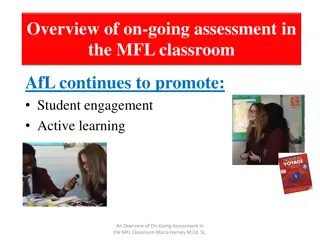
Principles of Assessment and Feedback Good assessment and feedback practice that promotes self-regulation requires that students gain practice in: 1. formulating goals for learning and identifying standards 2. making evaluative decisions about their own and others' work 3. generating explicit feedback for self and others 4. responding to and/or acting on feedback 5. discussing work and its evaluation with others (e.g. with peers and teachers)
What is a rubric? A rubric is an assessment tool that lists the criteria for a piece of work or what counts (for example, purpose, organization, details, voice, and mechanics often are what count in a written essay) and articulates gradations of quality for each criterion, from excellent to poor. (Andrade 2005)
What is a rubric? Criteria Definitions Grading strategy (Dawson 2017)
Teacher and learner motivations Why are you using a rubric? Teacher marking Teacher feedback A good rubric allows me to provide individualized, constructive critique in a manageable time frame. (Andrade 2005) Understanding a task Self assessment Peer assessment Using to teach
Learner engagement How will you ensure student engagement? Course documents Moodle In class
References Heidi Goodrich Andrade (2005) Teaching With Rubrics: The Good, the Bad, and the Ugly, College Teaching, 53:1, 27-31, DOI: 10.3200/CTCH.53.1.27-31 Phillip Dawson (2017) Assessment rubrics: towards clearer and more replicable design, research and practice, Assessment & Evaluation in Higher Education, 4 2:3, 347-360, DOI: 10.1080/02602938.2015.1111294 Peter Grainger, Michael Christie, Glyn Thomas, Shelley Dole, Deborah Heck, Margaret Marshman & Michael Carey (2017) Improving the quality of assessment by using a community of practice to explore the optimal construction of assessment rubrics, Reflective Practice, 18:3, 410-422, DOI: 10.1080/14623943.2017.1295931 Anastasiya A. Lipnevich, Leigh N. McCallen, Katharine Pace Miles and Jeffrey K. Smith (2014) Mind the gap! Students' use of exemplars and detailed rubrics as formative assessment. Instructional Science 42:4 539-559 https://www.jstor.org/stable/43575435
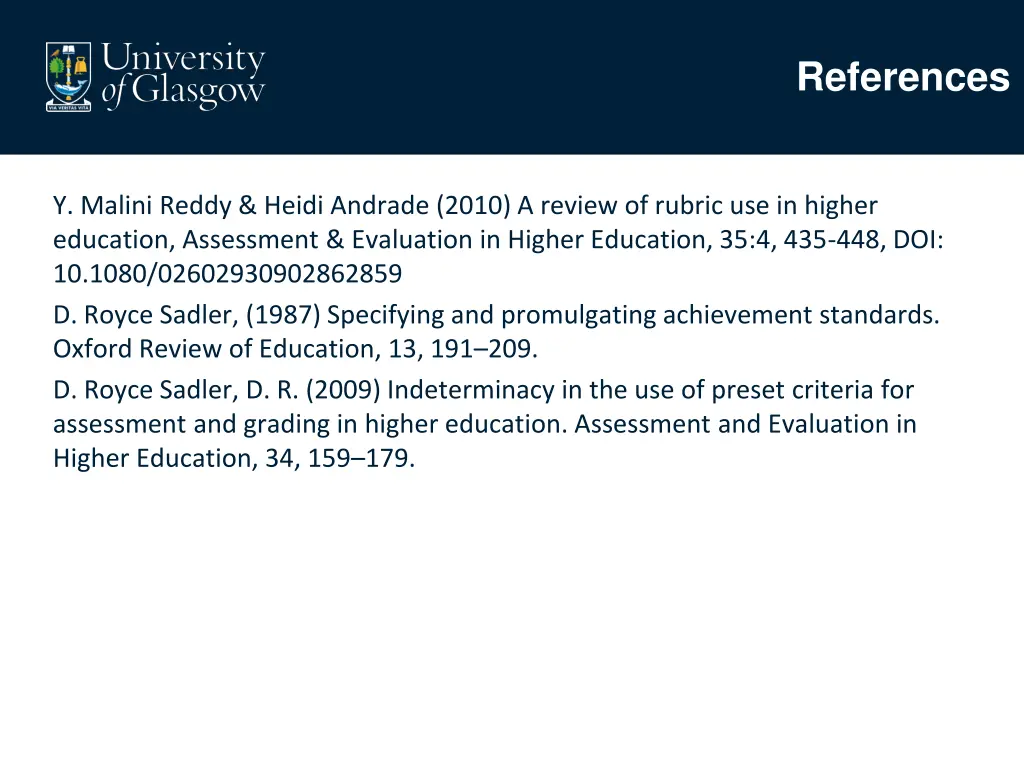
References Y. Malini Reddy & Heidi Andrade (2010) A review of rubric use in higher education, Assessment & Evaluation in Higher Education, 35:4, 435-448, DOI: 10.1080/02602930902862859 D. Royce Sadler, (1987) Specifying and promulgating achievement standards. Oxford Review of Education, 13, 191 209. D. Royce Sadler, D. R. (2009) Indeterminacy in the use of preset criteria for assessment and grading in higher education. Assessment and Evaluation in Higher Education, 34, 159 179.
Teaching Excellence Initiative Marking Rubrics Sarah Honeychurch Teaching Fellow Adam Smith Business School Sarah.Honeychurch@Glasgow.ac.uk