Principles of IOS Functioning and International Organizations

International Intergovernmental Organizations (IGOs) and Non-Governmental Organizations (NGOs) play a crucial role in the realm of international relations. This content delves into the classification, features, and functions of IGOs, shedding light on their formation steps and legal characteristics. Understanding the distinctions between IGOs and NGOs is essential for comprehending the dynamics of global governance.

Download Presentation

Please find below an Image/Link to download the presentation.
The content on the website is provided AS IS for your information and personal use only. It may not be sold, licensed, or shared on other websites without obtaining consent from the author.If you encounter any issues during the download, it is possible that the publisher has removed the file from their server.
You are allowed to download the files provided on this website for personal or commercial use, subject to the condition that they are used lawfully. All files are the property of their respective owners.
The content on the website is provided AS IS for your information and personal use only. It may not be sold, licensed, or shared on other websites without obtaining consent from the author.
E N D
Presentation Transcript
PRINCIPLES OF IOS FUNCTIONING
QUESTIONS 1. International Intergovernmental Organizations. 2. Major features of IGOs. 3. IGOs: Classification Patterns and Functions. 4. International Non-Governmental Organizations.
INTERNATIONAL INTERGOVERNMENTAL ORGANIZATIONS IOs classification of may be carried out according to various criteria. IOs may be classified into (a) intergovernmental (IGO) and (b) non-governmental (NGO) by their membership nature.
INTERNATIONAL INTERGOVERNMENTAL ORGANIZATIONS An IGO is the association of states which is: 1) Based on the international agreement; 2)Aimed at achieving any objectives established under international law; 3) Has a system of permanent bodies; 4) Vested with international legal personality.
INTERNATIONAL INTERGOVERNMENTAL ORGANIZATIONS: 1) Are subjects of international law; 2) Act on their own and not on behalf of their founders; 3) Are vested with full rights and obligations in accordance with international legal norms; 4) A nation state delegates a part of its sovereignty to an IGO; 5) Operate strictly within the limits of powers delegated by a nation state.
INTERNATIONAL INTERGOVERNMENTAL ORGANIZATIONS Formation of an IGO suggests the following steps: 1) Putting forward a proposal; 2) Working out constituent and organizational documents; 3) Forming organs and institutions; 4) Timing of its operation start; 5) Convening a constituent conference, congress, etc.
INTERNATIONAL INTERGOVERNMENTAL ORGANIZATIONS IGOs can be formed: 1) On the basis of an international agreement (most common); 2) On the basis of a decision of already existing IGOs (UNCTAD and UNDP established by the UN as the autonomous organizations.
INTERNATIONAL INTERGOVERNMENTAL ORGANIZATIONS The countries which are not the members of IGOs may send observers to participate in the activities of the institutions within the organizations if it is allowed by their charters. Some IGOs allow sending permanent observers by the countries not included in them (the right to participate in the work of the UN as observers now possess Switzerland and the Vatican City).
INTERNATIONAL INTERGOVERNMENTAL ORGANIZATIONS As a rule, the budget of IGOs is formed by: 1) The contributions from the member states; 2) Donations and assistance from other sources. The amount of contributions is determined by (a) the economic might of member countries, (b) the extent of their interest in the organization, etc. IGOs may also initiate programs and activities which are funded on a voluntary basis.
INTERNATIONAL INTERGOVERNMENTAL ORGANIZATIONS The functioning of IGOs ceases on the basis of an appropriate intergovernmental agreement of their participants (a protocol on the elimination of CMEA (operated since 1949) signed on 28 June 1991 in Budapest by its member states; denunciation of the Treaty of Friendship, Cooperation, and Mutual Assistance of 14 March 1955 at the meeting of the Political Consultative Committee of the Warsaw Pact Organization in Prague on 1 July 1991).
MAJOR FEATURES OF IGOS 1) Presence of three or more member states (the association of two countries is not an IGO formed to achieve certain objectives jointly, but rather a union).
MAJOR FEATURES OF IGOS 2) Respect for national sovereignty of the IGOs participants, non-interference with their home affairs (one of the fundamental features; it implies equal rights and obligations of the participating countries irrespective of their economic and military power, population, size of territory, and so on).
MAJOR FEATURES OF IGOS 3) Functioning on the basis of international agreements regulating the activities and the operation of IGOs; such agreements may be concluded by a nation state as well as by other subjects of international law (the EU is engaged into the activities of several international fishing organizations).
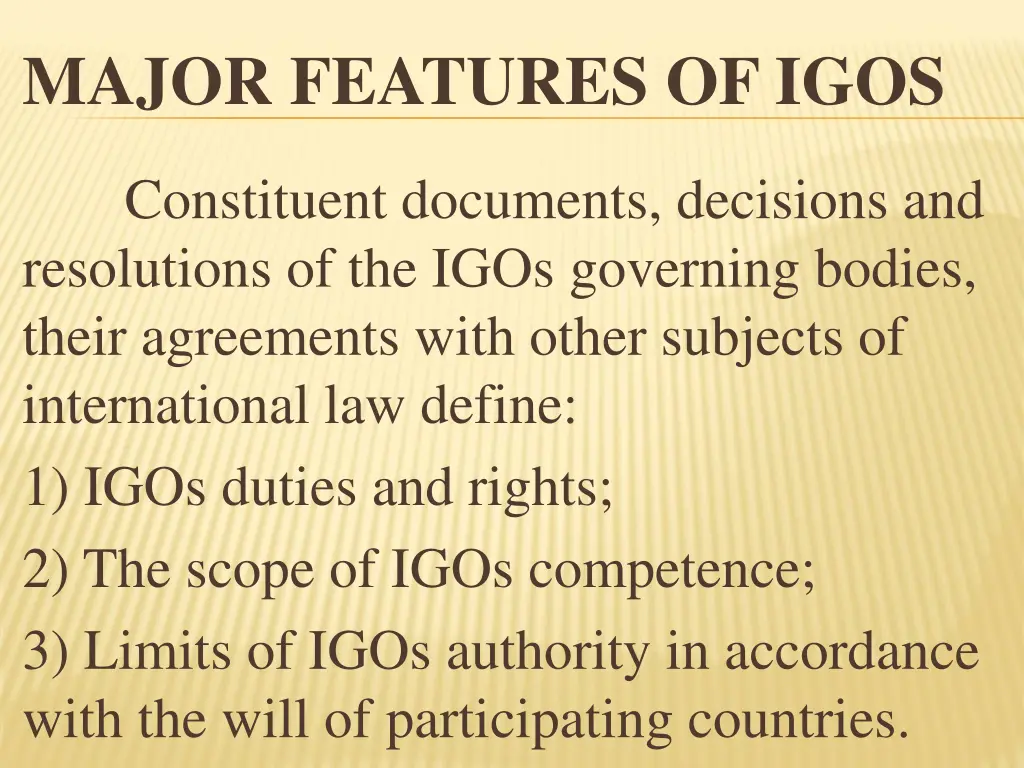
MAJOR FEATURES OF IGOS Constituent documents, decisions and resolutions of the IGOs governing bodies, their agreements with other subjects of international law define: 1) IGOs duties and rights; 2) The scope of IGOs competence; 3) Limits of IGOs authority in accordance with the will of participating countries.
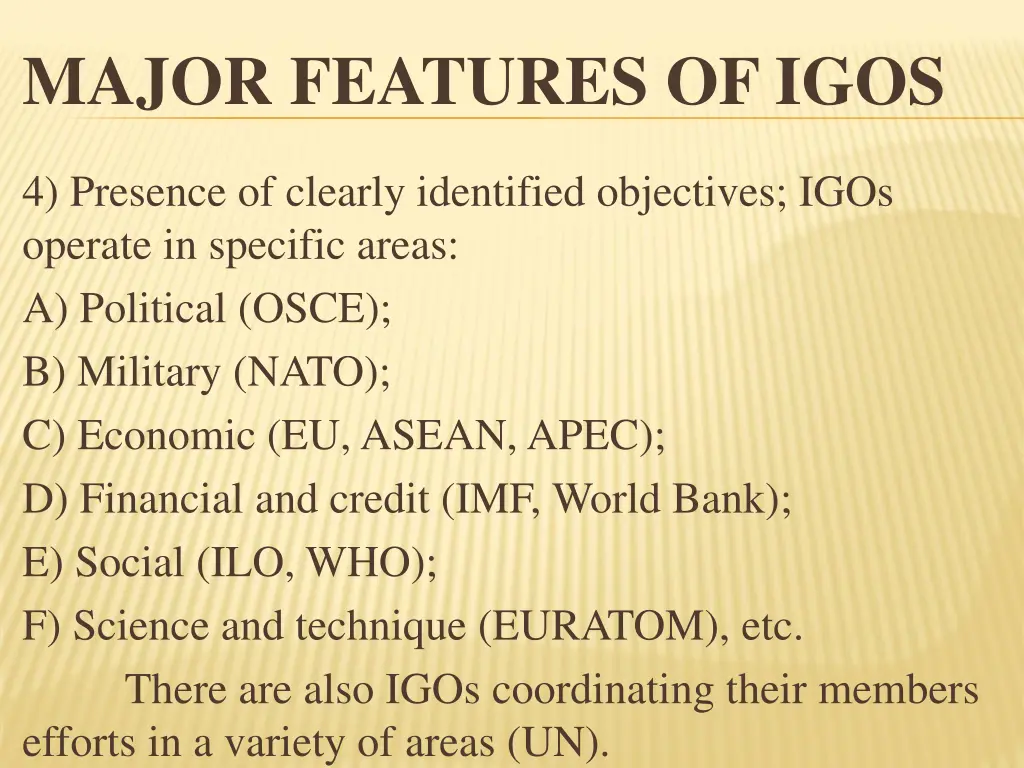
MAJOR FEATURES OF IGOS 4) Presence of clearly identified objectives; IGOs operate in specific areas: A) Political (OSCE); B) Military (NATO); C) Economic (EU, ASEAN, APEC); D) Financial and credit (IMF, World Bank); E) Social (ILO, WHO); F) Science and technique (EURATOM), etc. There are also IGOs coordinating their members efforts in a variety of areas (UN).
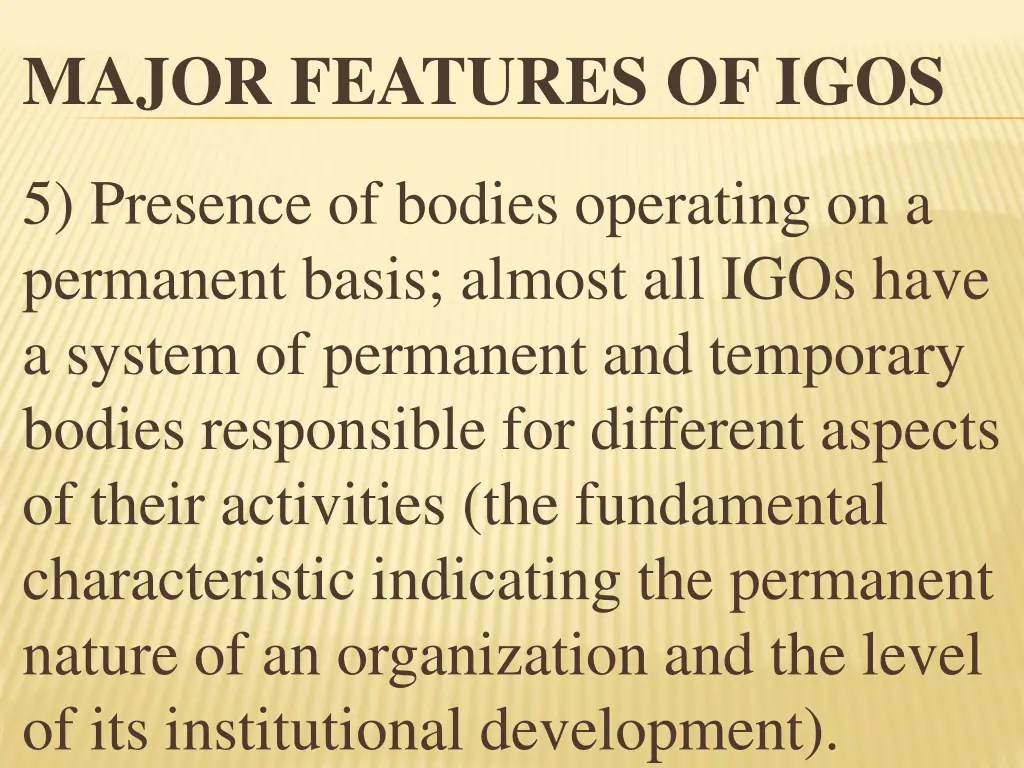
MAJOR FEATURES OF IGOS 5) Presence of bodies operating on a permanent basis; almost all IGOs have a system of permanent and temporary bodies responsible for different aspects of their activities (the fundamental characteristic indicating the permanent nature of an organization and the level of its institutional development).
MAJOR FEATURES OF IGOS The structure of an organization includes headquarters, principal and subordinate organs. A supreme body may be the assembly session convening at least once a year. The executive functions are assigned to the board of an organization, the management staff of full-time employees to the general or executive secretary.
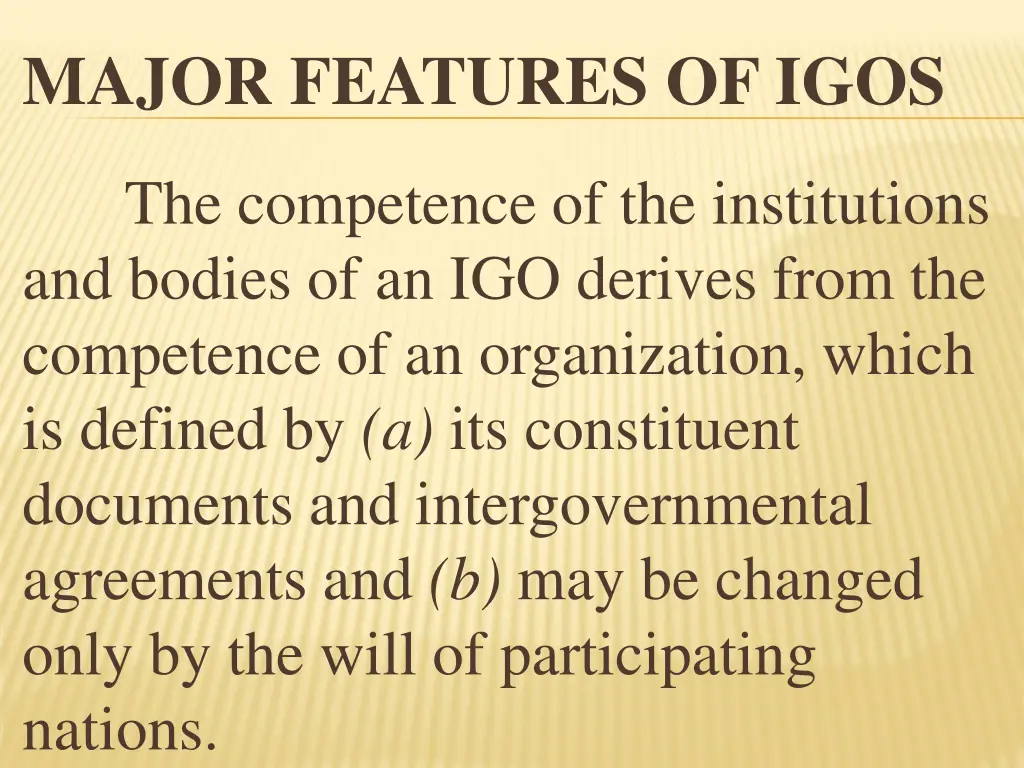
MAJOR FEATURES OF IGOS The competence of the institutions and bodies of an IGO derives from the competence of an organization, which is defined by (a) its constituent documents and intergovernmental agreements and (b) may be changed only by the will of participating nations.
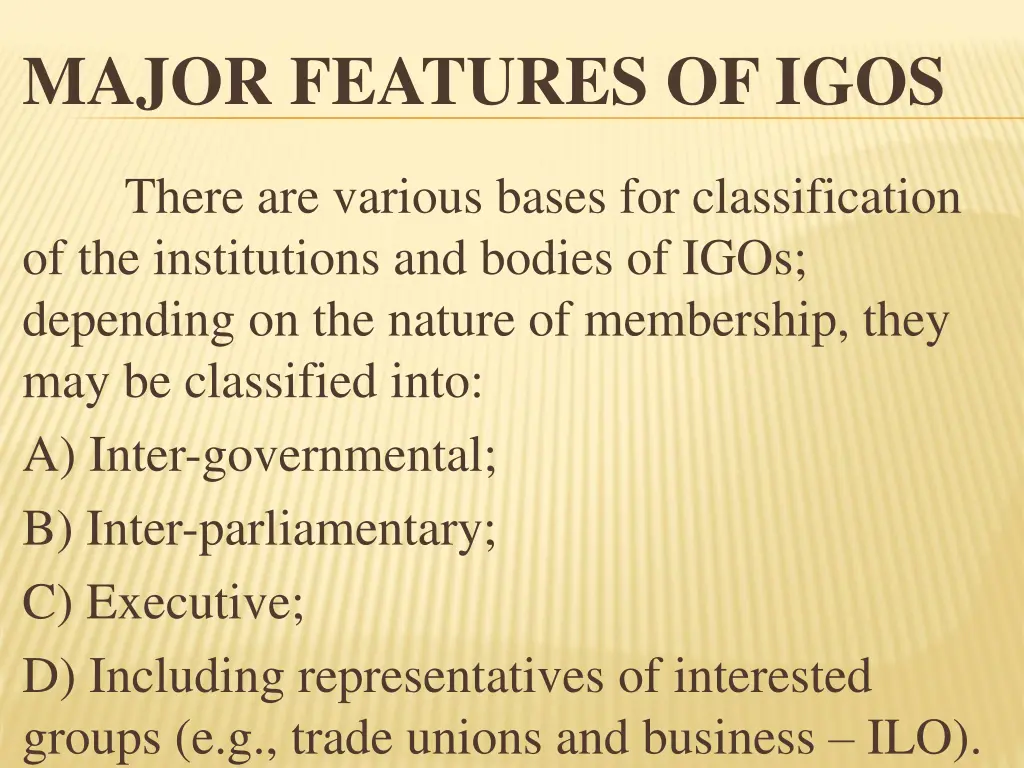
MAJOR FEATURES OF IGOS There are various bases for classification of the institutions and bodies of IGOs; depending on the nature of membership, they may be classified into: A) Inter-governmental; B) Inter-parliamentary; C) Executive; D) Including representatives of interested groups (e.g., trade unions and business ILO).
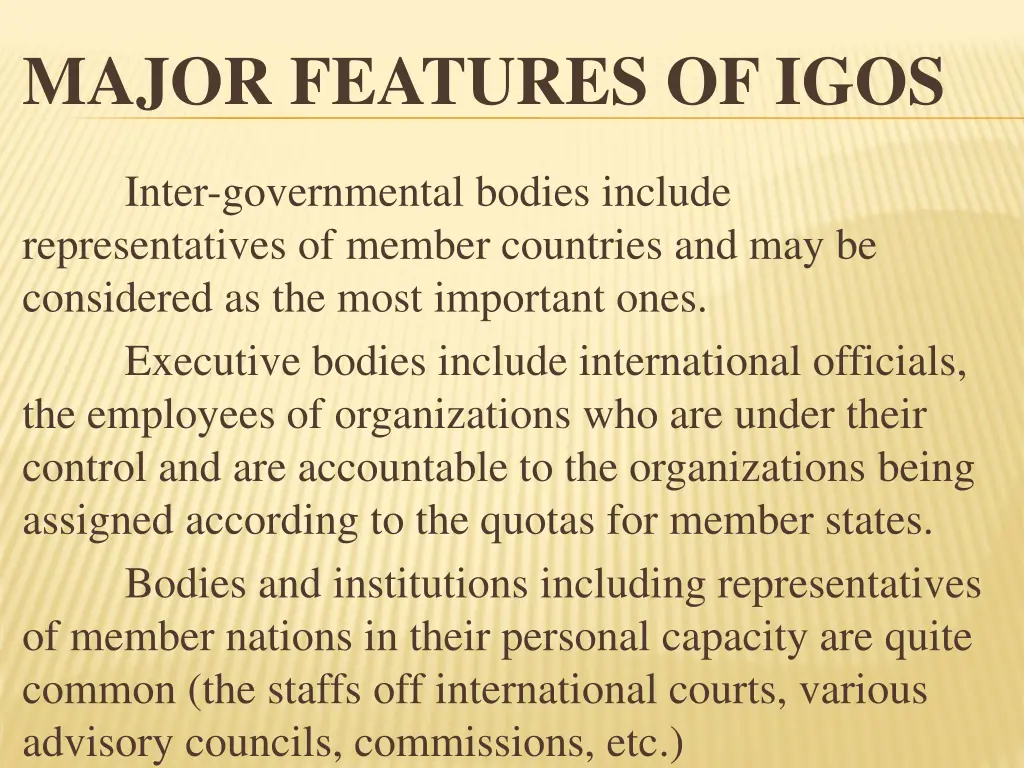
MAJOR FEATURES OF IGOS Inter-governmental bodies include representatives of member countries and may be considered as the most important ones. Executive bodies include international officials, the employees of organizations who are under their control and are accountable to the organizations being assigned according to the quotas for member states. Bodies and institutions including representatives of member nations in their personal capacity are quite common (the staffs off international courts, various advisory councils, commissions, etc.)
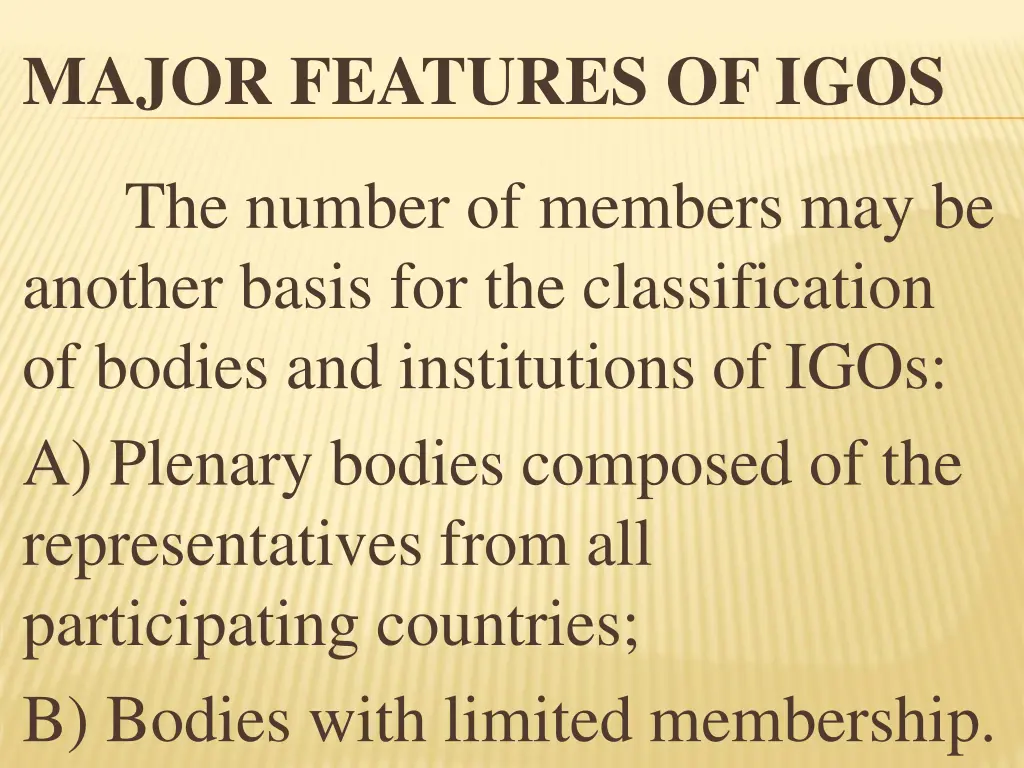
MAJOR FEATURES OF IGOS The number of members may be another basis for the classification of bodies and institutions of IGOs: A) Plenary bodies composed of the representatives from all participating countries; B) Bodies with limited membership.
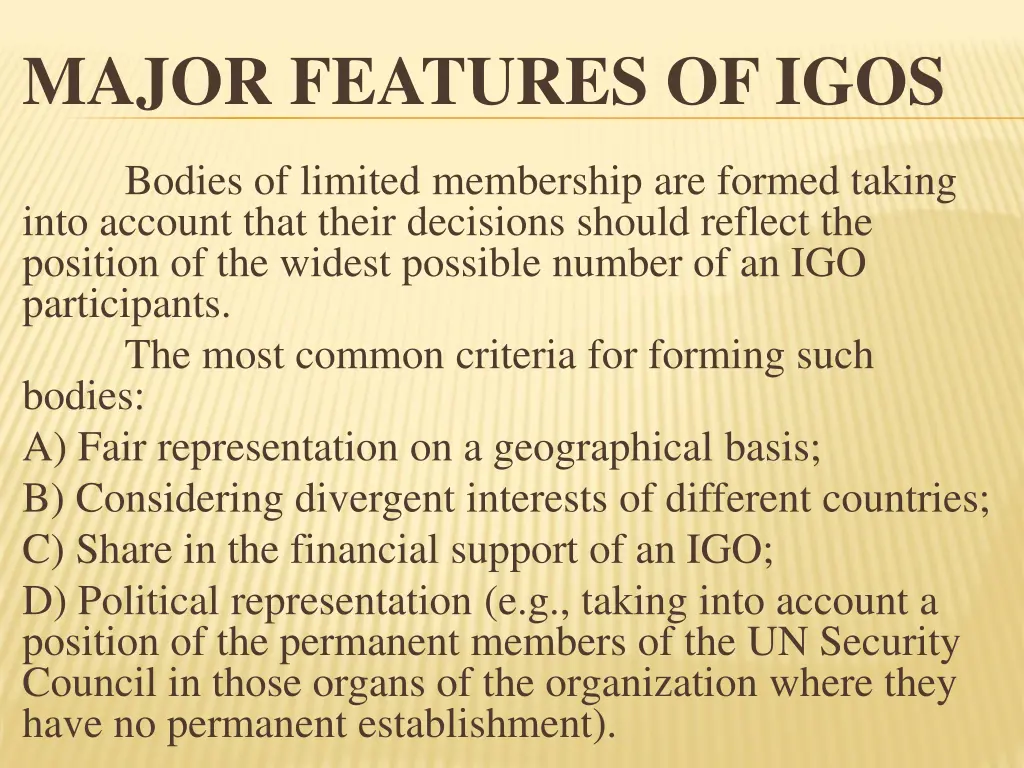
MAJOR FEATURES OF IGOS Bodies of limited membership are formed taking into account that their decisions should reflect the position of the widest possible number of an IGO participants. The most common criteria for forming such bodies: A) Fair representation on a geographical basis; B) Considering divergent interests of different countries; C) Share in the financial support of an IGO; D) Political representation (e.g., taking into account a position of the permanent members of the UN Security Council in those organs of the organization where they have no permanent establishment).
MAJOR FEATURES OF IGOS Formation of IGO bodies may be based on more than one criterion. Thus, the UN Security Council combines the principle of fair geographical representation with the degree and nature of the organization member participation in the implementation of its tasks. Another basis for classification of IGO bodies: A) Hierarchy (governing and secondary bodies); B) Frequency of their functions performance permanent, temporary, and so on.
MAJOR FEATURES OF IGOS 6) Possession of international legal personality: organizations acquire certain obligations and rights as a result of their delegation from the member states. One can talk about the emergence of the IGOs own will not always coinciding with the will of their members, which means that in their activities organizations are free to choose how to perform their duties and how to exercise their rights.
MAJOR FEATURES OF IGOS The responsibilities and rights of IGOs derive from the duties and rights of their members. Without their approval no organization may take any steps regarding the interests of member states having the right to ban virtually any action of an IGO. Thus, IGOs have no right to go beyond the powers granted by constituent documents.
MAJOR FEATURES OF IGOS 7) Operating on the basis of international law requires strict compliance of organizational and constituent documents with international law. IGOs creation against international law entails: A) Recognition of their constituent documents null and void; B) Termination of such organizations functioning in the shortest possible time.
MAJOR FEATURES OF IGOS 8) Strictly defined procedure for decision- making within organizations which means that there are established procedures for decision- making in most IGOs. The decision-making process is influenced by the following: A) Standards set by the founding documents; B) Procedural rules; C) Body composition and power balance in it.
MAJOR FEATURES OF IGOS The starting point in decision making is putting forward an initiative. Its source may be a member nation or a group of them, as well as individual agencies and officials of an IGO. Other members of an organization may also put forward their solutions. Then the draft decision is included in the agenda of the body in whose competence it is.
MAJOR FEATURES OF IGOS The stage of discussion plays a very important role in the course of decision making. Almost all the draft resolutions of IGOs are examined by auxiliary bodies before they are submitted to a plenary body for discussion.
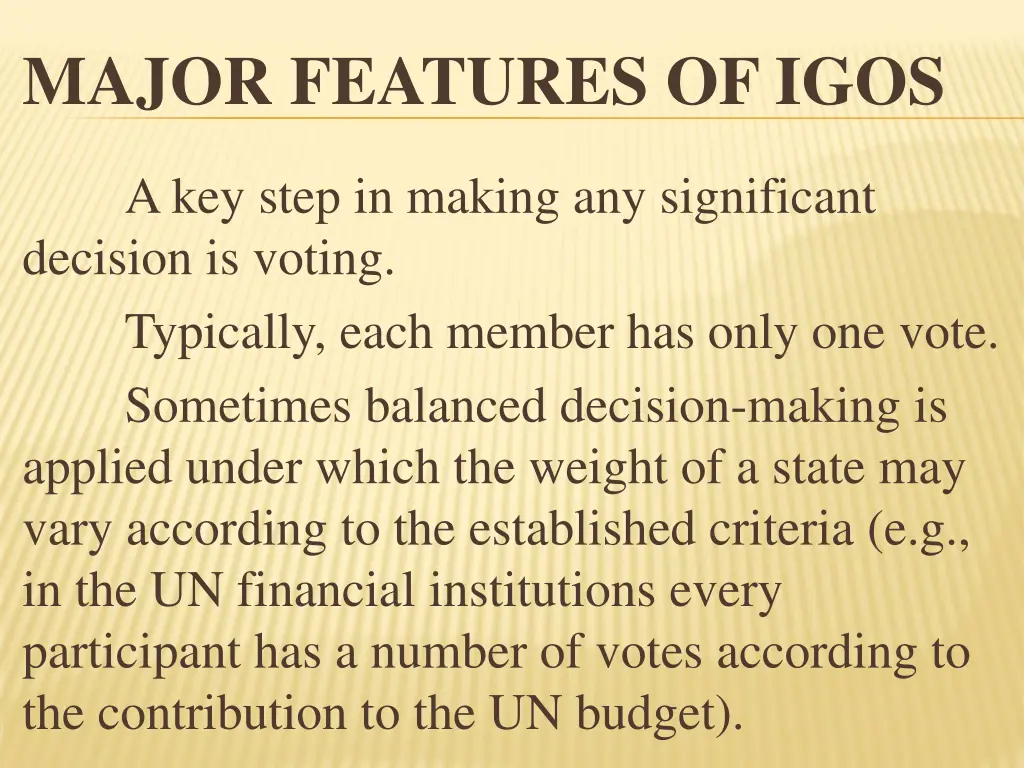
MAJOR FEATURES OF IGOS A key step in making any significant decision is voting. Typically, each member has only one vote. Sometimes balanced decision-making is applied under which the weight of a state may vary according to the established criteria (e.g., in the UN financial institutions every participant has a number of votes according to the contribution to the UN budget).
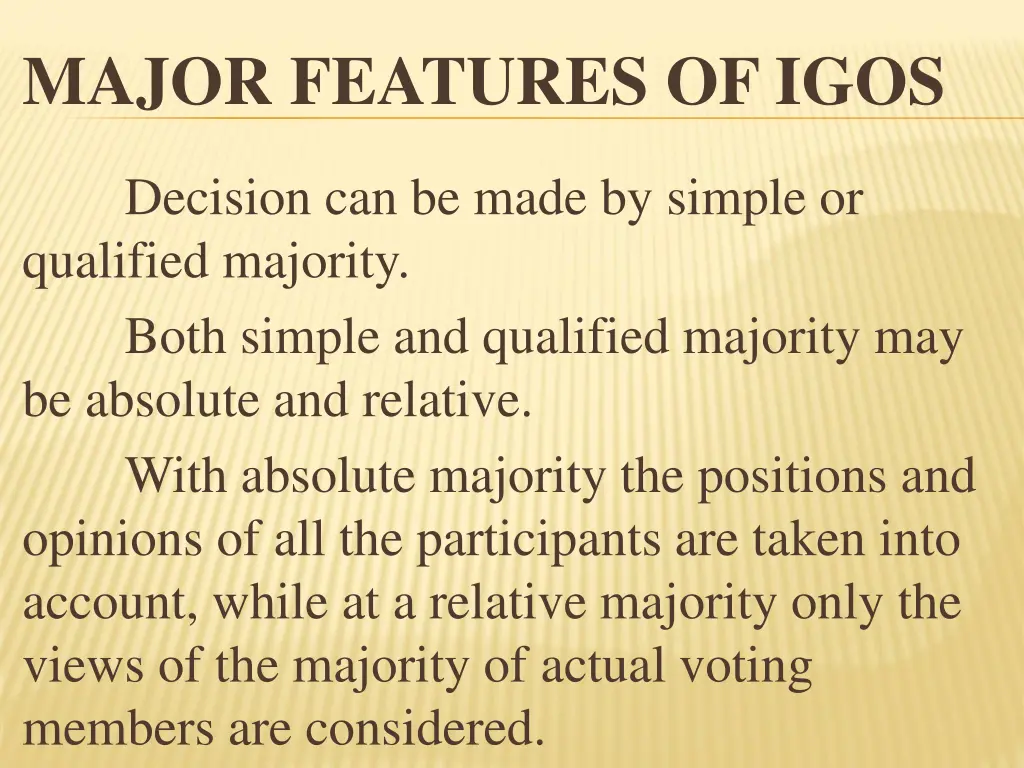
MAJOR FEATURES OF IGOS Decision can be made by simple or qualified majority. Both simple and qualified majority may be absolute and relative. With absolute majority the positions and opinions of all the participants are taken into account, while at a relative majority only the views of the majority of actual voting members are considered.
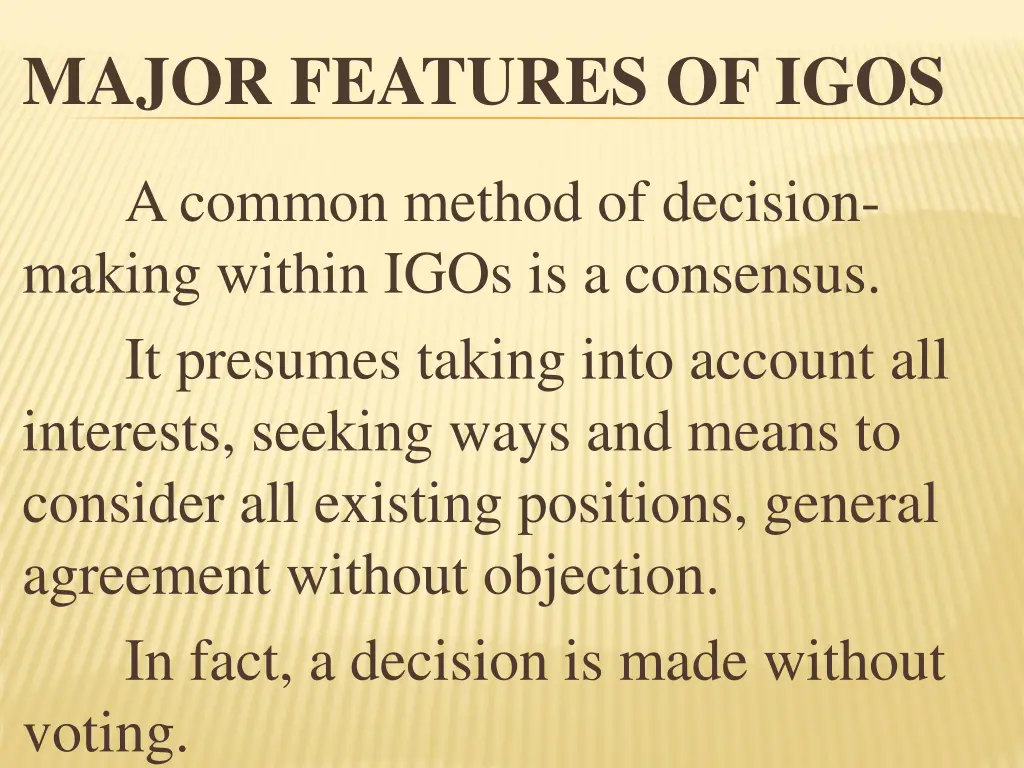
MAJOR FEATURES OF IGOS A common method of decision- making within IGOs is a consensus. It presumes taking into account all interests, seeking ways and means to consider all existing positions, general agreement without objection. In fact, a decision is made without voting.
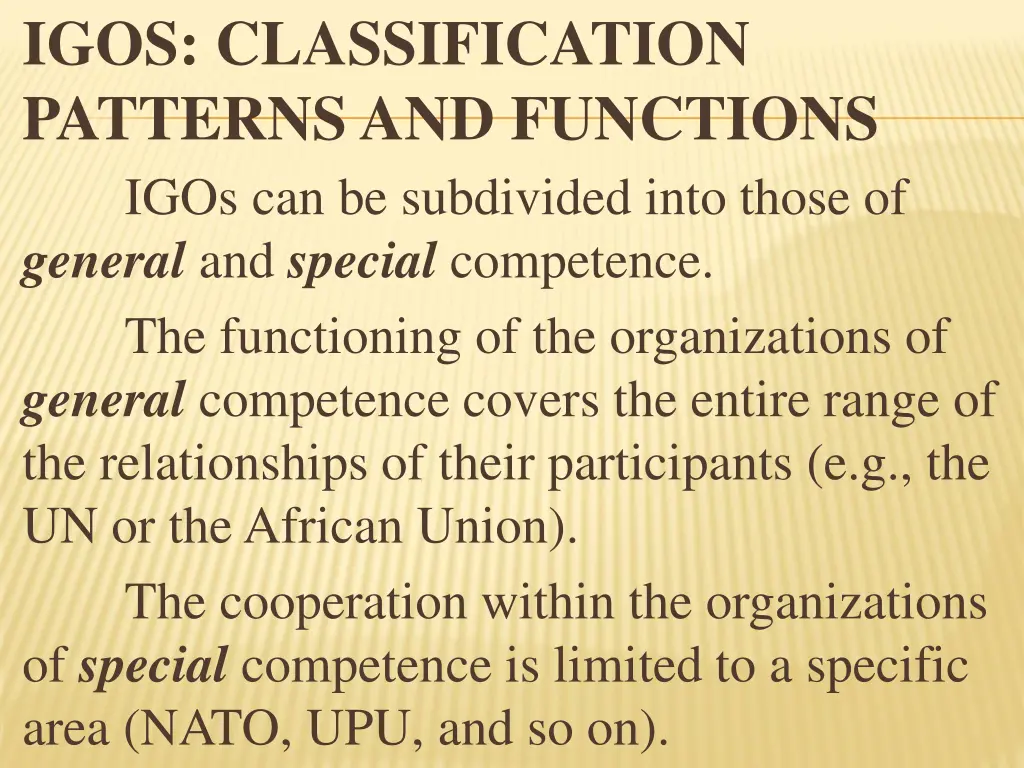
IGOS: CLASSIFICATION PATTERNS AND FUNCTIONS IGOs can be subdivided into those of general and special competence. The functioning of the organizations of general competence covers the entire range of the relationships of their participants (e.g., the UN or the African Union). The cooperation within the organizations of special competence is limited to a specific area (NATO, UPU, and so on).
IGOS: CLASSIFICATION PATTERNS AND FUNCTIONS One of the most common classifications of IGOs is based on their competence areas: politics, security, economy, trade, monetary and financial, health care, culture.
IGOS: CLASSIFICATION PATTERNS AND FUNCTIONS Classification of IGOs by their nature of authority involves distinguishing intergovernmental and supranational ones. The former include the bulk of IGOs whose job is to implement the cooperation between the states with full preservation of their sovereignty. The feature of the latter is delegating some sovereignty to the supranational level and the decisions of these institutions are obligatory to citizens and legal persons of their member states.
IGOS: CLASSIFICATION PATTERNS AND FUNCTIONS By the nature of their membership, IGOs may be classified as follows: 1) Open, if joining them is based on a unilateral decision to enter an association; 2) Half-open, if the decision to join an IGO is taken by a majority vote of their members; 3) Closed, if the new members access is possible only through the participants consensus.
IGOS: CLASSIFICATION PATTERNS AND FUNCTIONS According to the classification of IGOs by the geographical scope of their activities they are divided into: 1) Global, an access to which is open to any country (UN, WTO, WHO); 2) Regional, whose members may be only the countries located in certain regions (EU, NAFTA); 3) Sub-regional, which may be joined only by the countries of a certain part of a particular region (BSEC, GCC).
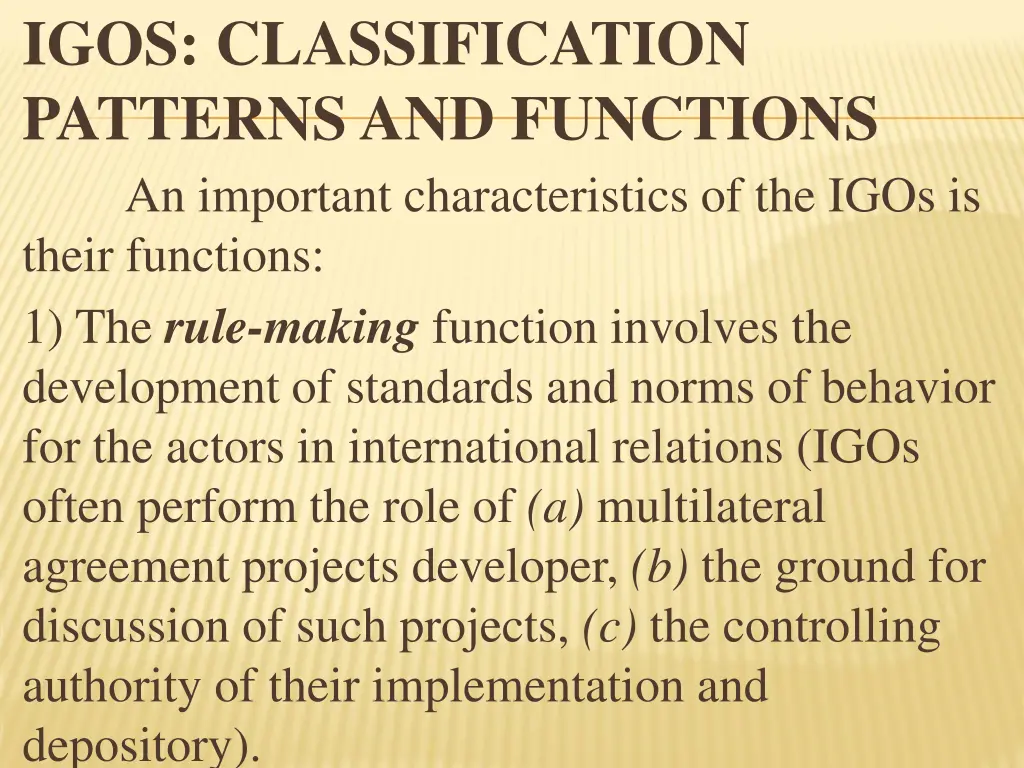
IGOS: CLASSIFICATION PATTERNS AND FUNCTIONS An important characteristics of the IGOs is their functions: 1) The rule-making function involves the development of standards and norms of behavior for the actors in international relations (IGOs often perform the role of (a) multilateral agreement projects developer, (b) the ground for discussion of such projects, (c) the controlling authority of their implementation and depository).
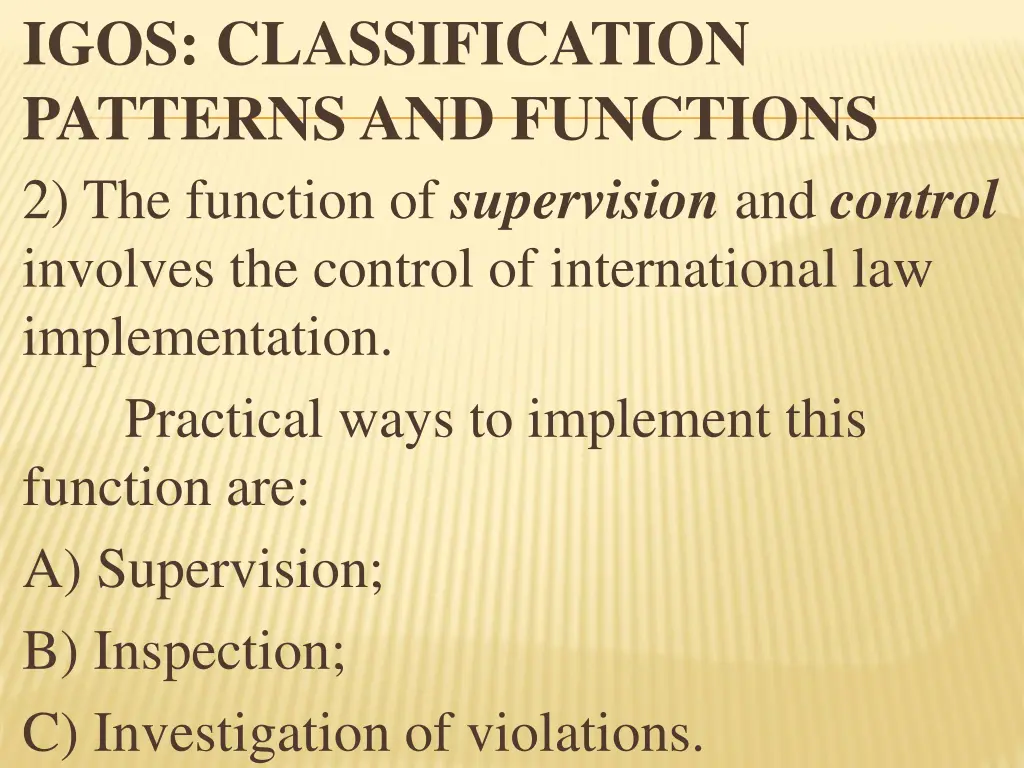
IGOS: CLASSIFICATION PATTERNS AND FUNCTIONS 2) The function of supervision and control involves the control of international law implementation. Practical ways to implement this function are: A) Supervision; B) Inspection; C) Investigation of violations.
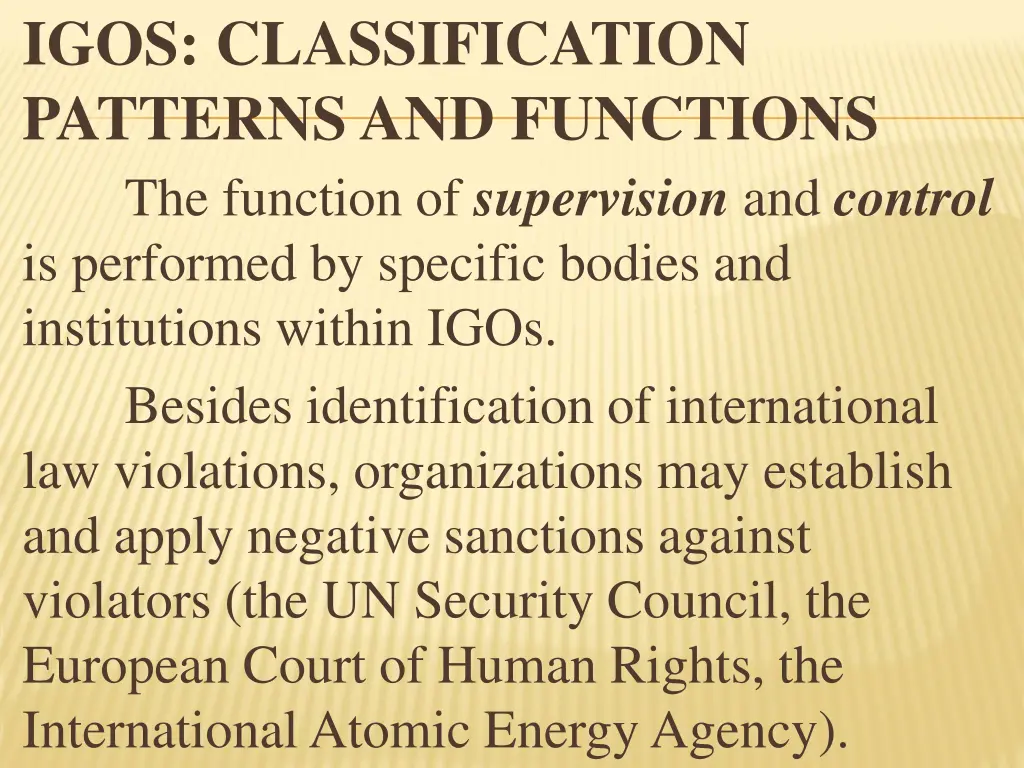
IGOS: CLASSIFICATION PATTERNS AND FUNCTIONS The function of supervision and control is performed by specific bodies and institutions within IGOs. Besides identification of international law violations, organizations may establish and apply negative sanctions against violators (the UN Security Council, the European Court of Human Rights, the International Atomic Energy Agency).
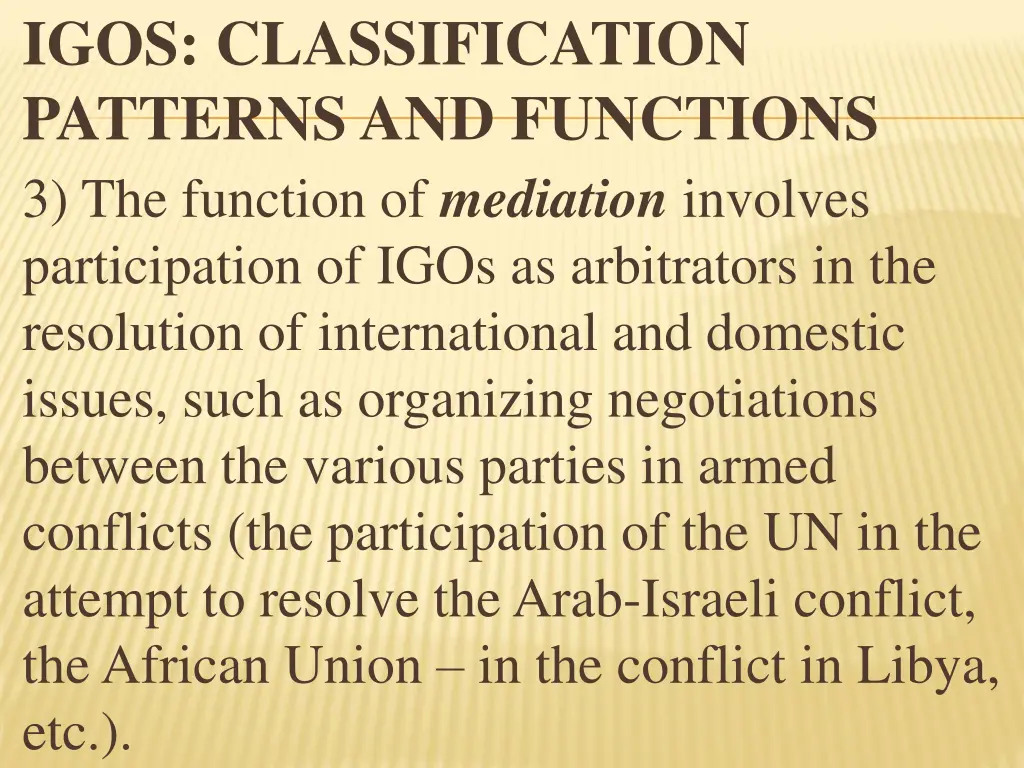
IGOS: CLASSIFICATION PATTERNS AND FUNCTIONS 3) The function of mediation involves participation of IGOs as arbitrators in the resolution of international and domestic issues, such as organizing negotiations between the various parties in armed conflicts (the participation of the UN in the attempt to resolve the Arab-Israeli conflict, the African Union in the conflict in Libya, etc.).
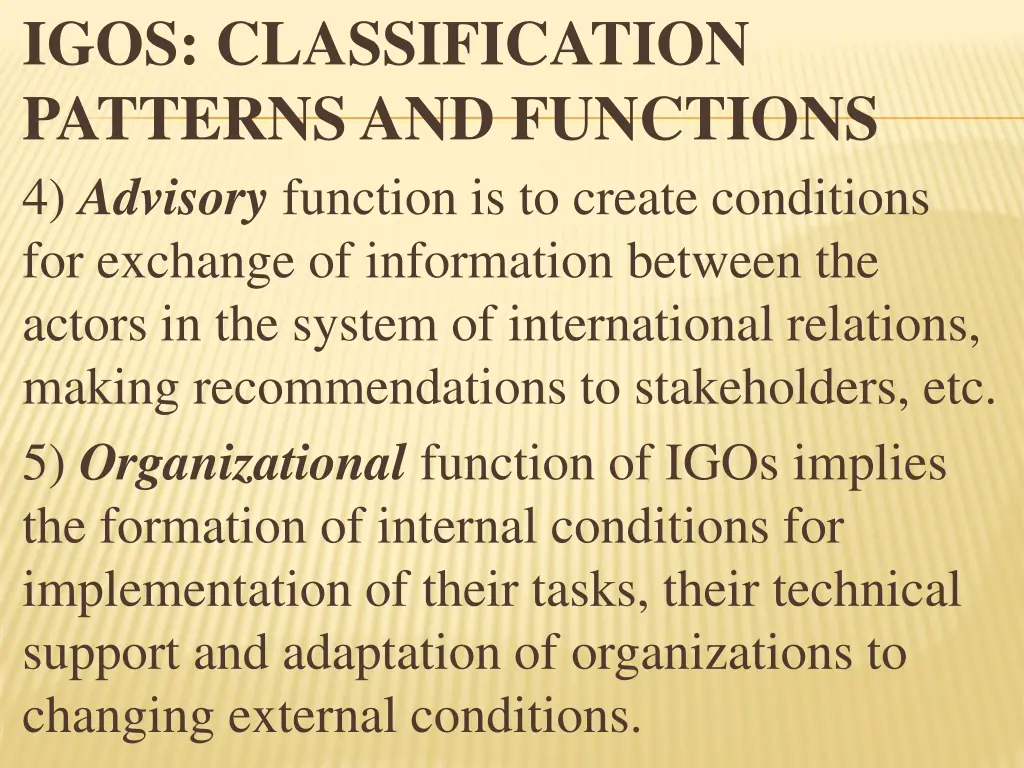
IGOS: CLASSIFICATION PATTERNS AND FUNCTIONS 4) Advisory function is to create conditions for exchange of information between the actors in the system of international relations, making recommendations to stakeholders, etc. 5) Organizational function of IGOs implies the formation of internal conditions for implementation of their tasks, their technical support and adaptation of organizations to changing external conditions.
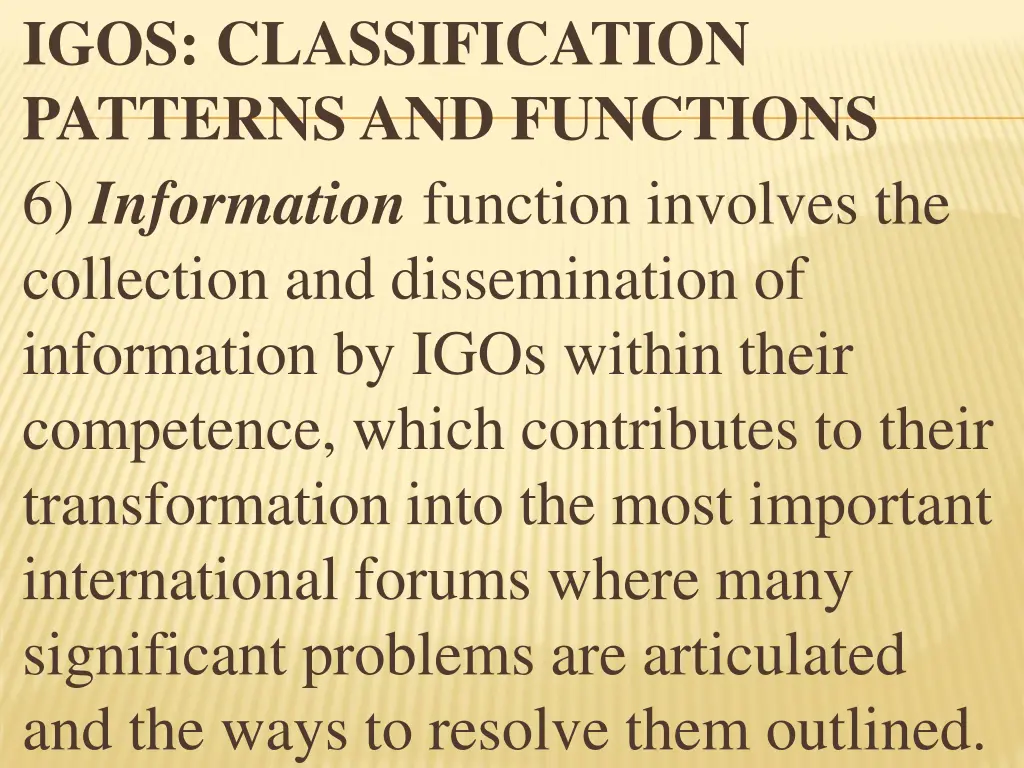
IGOS: CLASSIFICATION PATTERNS AND FUNCTIONS 6) Information function involves the collection and dissemination of information by IGOs within their competence, which contributes to their transformation into the most important international forums where many significant problems are articulated and the ways to resolve them outlined.
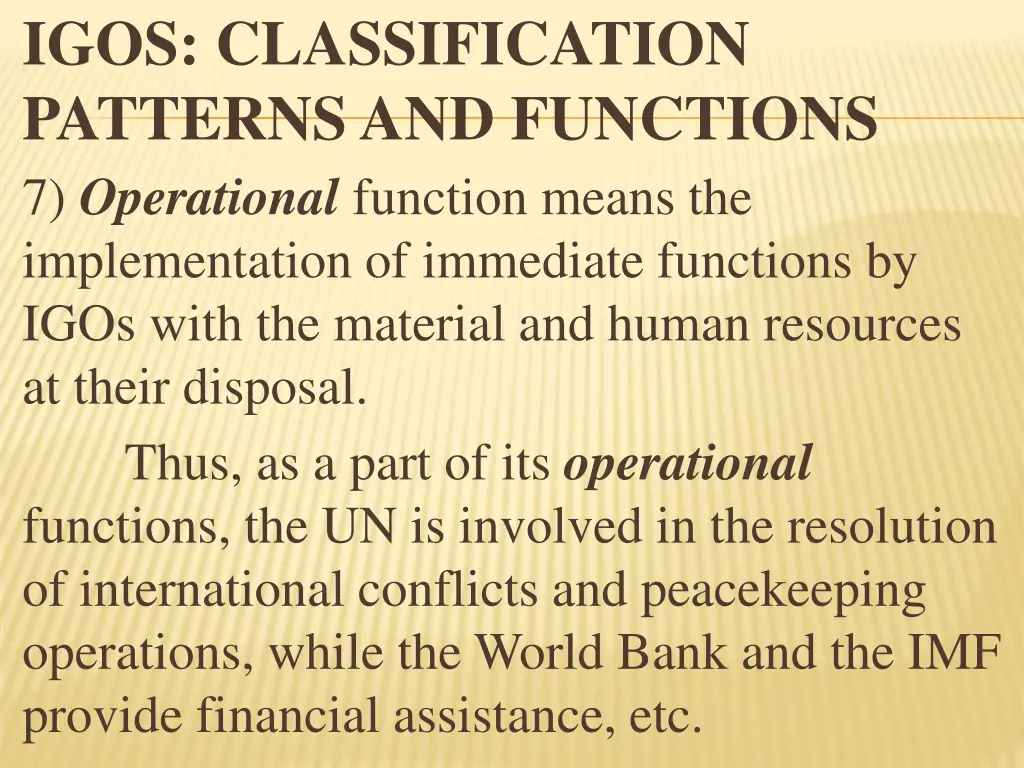
IGOS: CLASSIFICATION PATTERNS AND FUNCTIONS 7) Operational function means the implementation of immediate functions by IGOs with the material and human resources at their disposal. Thus, as a part of its operational functions, the UN is involved in the resolution of international conflicts and peacekeeping operations, while the World Bank and the IMF provide financial assistance, etc.
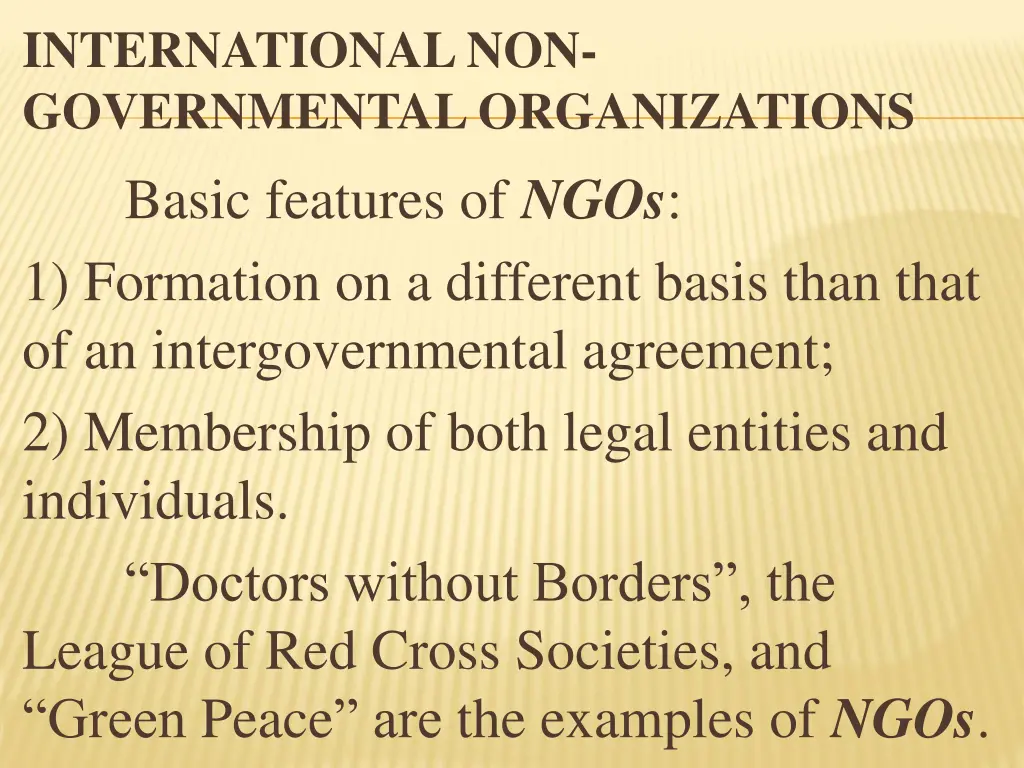
INTERNATIONAL NON- GOVERNMENTAL ORGANIZATIONS Basic features of NGOs: 1) Formation on a different basis than that of an intergovernmental agreement; 2) Membership of both legal entities and individuals. Doctors without Borders , the League of Red Cross Societies, and Green Peace are the examples of NGOs.