Privacy and Sensitivity in Education
Explore the impact of privacy breaches, laws, and professional roles in education. Learn about the importance of trauma-informed care and a strengths-based approach in schools. This content is part of the BRIGHTER FUTURE project funded by the European Commission.

Download Presentation

Please find below an Image/Link to download the presentation.
The content on the website is provided AS IS for your information and personal use only. It may not be sold, licensed, or shared on other websites without obtaining consent from the author. If you encounter any issues during the download, it is possible that the publisher has removed the file from their server.
You are allowed to download the files provided on this website for personal or commercial use, subject to the condition that they are used lawfully. All files are the property of their respective owners.
The content on the website is provided AS IS for your information and personal use only. It may not be sold, licensed, or shared on other websites without obtaining consent from the author.
E N D
Presentation Transcript
UNIT 6 Het verhaal van het kind op school: Persoonlijke informatie delen The BRIGHTER FUTURE project has been funded with support from the European Commission. This material reflects the views only of the authors, and the Commission cannot be held responsible for any use which may be made of the information contained therein. and the Commission cannot be held responsible for any use which may be made of the information contained therein. The BRIGHTER FUTURE project has been funded with support from the European Commission. This material reflects the views only of the authors,
Mijn persoonlijke leven/privacy_1 Wanneer krijg ik het gevoel dat mijn privacy wordt aangetast? The BRIGHTER FUTURE project has been funded with support from the European Commission. This material reflects the views only of the authors, and the Commission cannot be held responsible for any use which may be made of the information contained therein.
Mijn persoonlijke leven/privacy_2 - Landelijke wetten - Beperkingen met betrekking tot de professionele rol (d.w.z. leraren, opvoeders) - Institutioneel beleid - Professionele praktijken The BRIGHTER FUTURE project has been funded with support from the European Commission. This material reflects the views only of the authors, and the Commission cannot be held responsible for any use which may be made of the information contained therein.
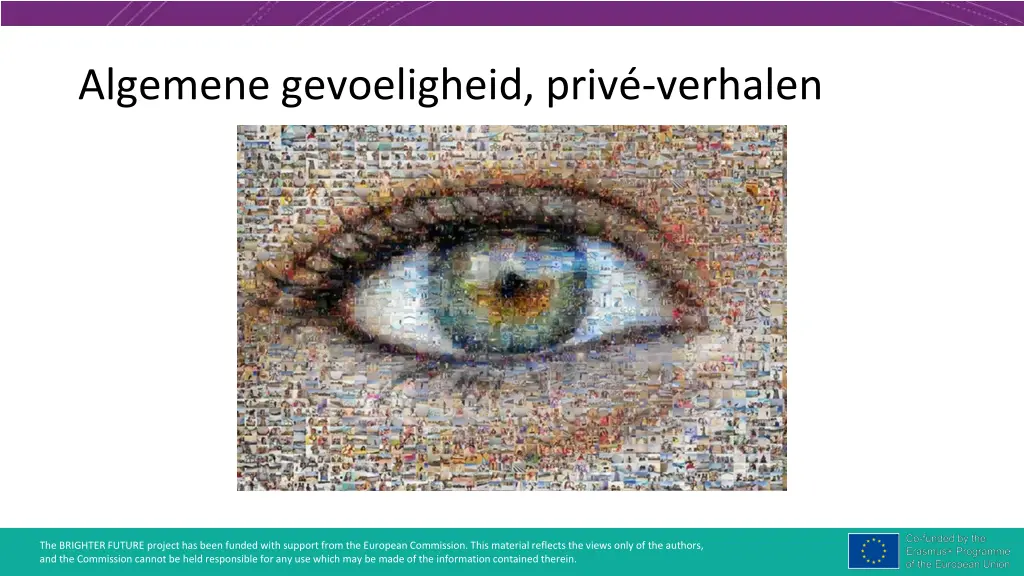
Algemene gevoeligheid, priv-verhalen The BRIGHTER FUTURE project has been funded with support from the European Commission. This material reflects the views only of the authors, and the Commission cannot be held responsible for any use which may be made of the information contained therein.
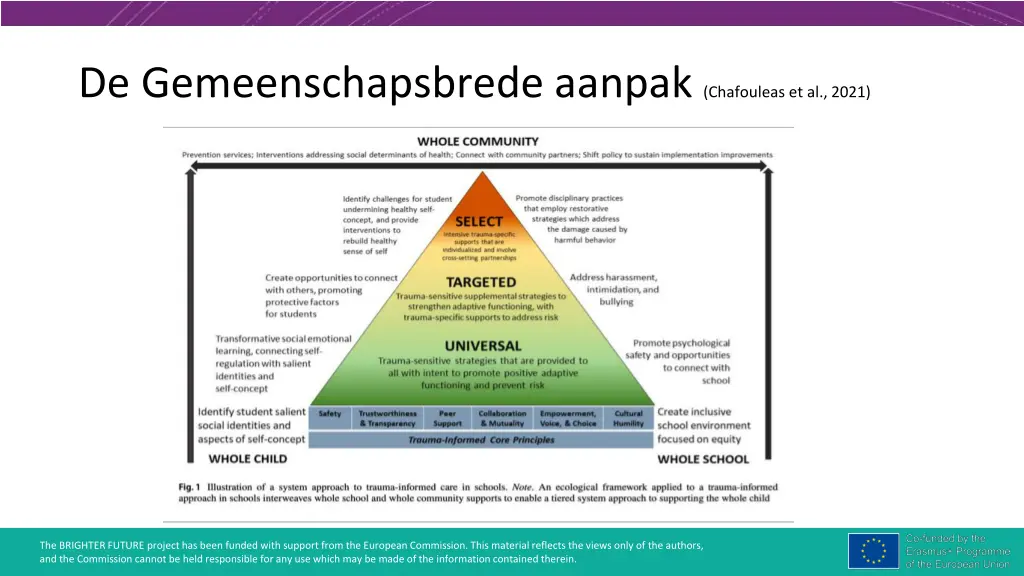
De Gemeenschapsbrede aanpak (Chafouleas et al., 2021) The BRIGHTER FUTURE project has been funded with support from the European Commission. This material reflects the views only of the authors, and the Commission cannot be held responsible for any use which may be made of the information contained therein.
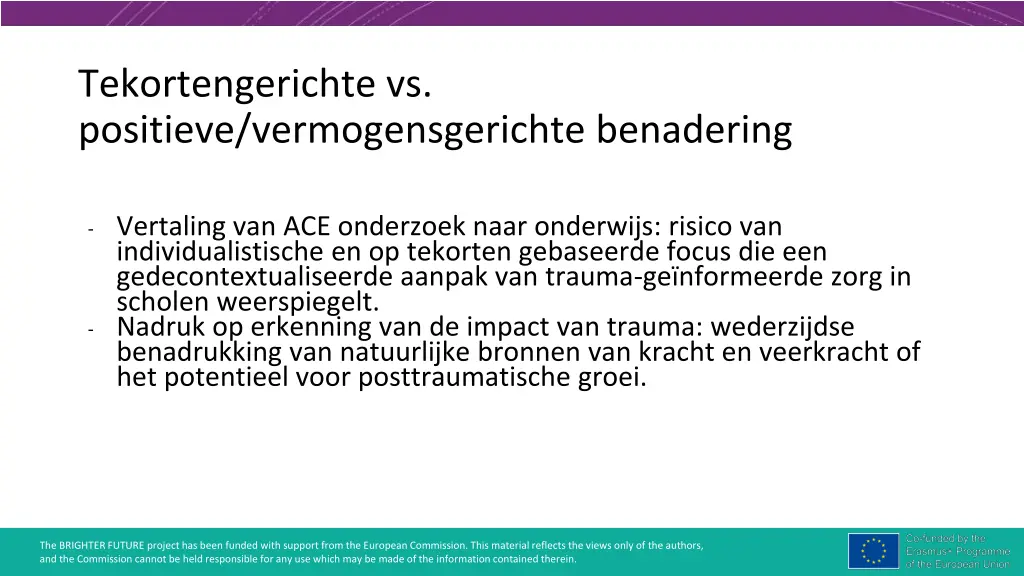
Tekortengerichte vs. positieve/vermogensgerichte benadering - Vertaling van ACE onderzoek naar onderwijs: risico van individualistische en op tekorten gebaseerde focus die een gedecontextualiseerde aanpak van trauma-ge nformeerde zorg in scholen weerspiegelt. - Nadruk op erkenning van de impact van trauma: wederzijdse benadrukking van natuurlijke bronnen van kracht en veerkracht of het potentieel voor posttraumatische groei. The BRIGHTER FUTURE project has been funded with support from the European Commission. This material reflects the views only of the authors, and the Commission cannot be held responsible for any use which may be made of the information contained therein.
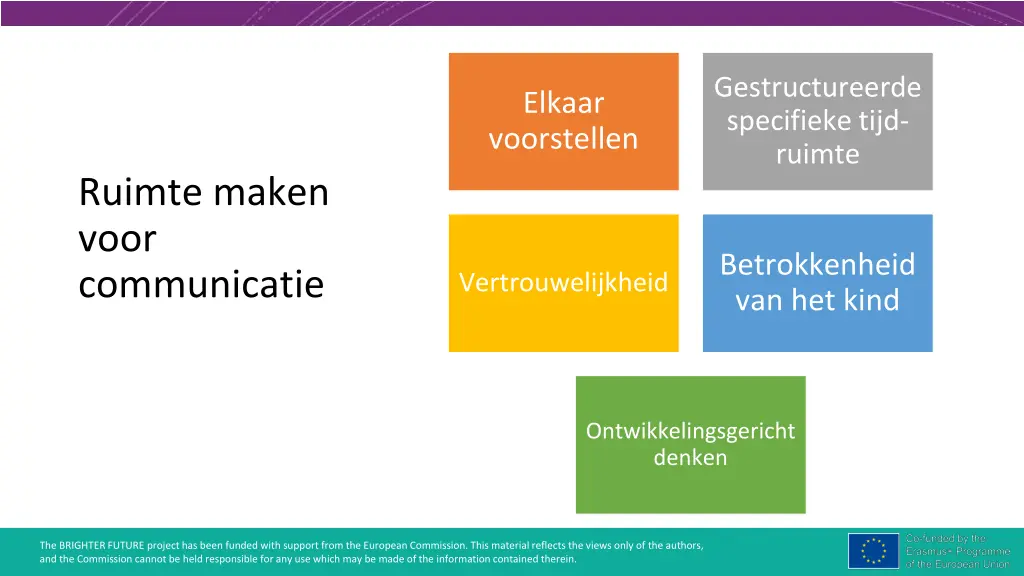
Gestructureerde specifieke tijd- ruimte Elkaar voorstellen Ruimte maken voor communicatie Betrokkenheid van het kind Vertrouwelijkheid Ontwikkelingsgericht denken The BRIGHTER FUTURE project has been funded with support from the European Commission. This material reflects the views only of the authors, and the Commission cannot be held responsible for any use which may be made of the information contained therein.
Stigma en self-fulfilling prophecy Mensen worden be nvloed door de verwachtingen die er van ze zijn The BRIGHTER FUTURE project has been funded with support from the European Commission. This material reflects the views only of the authors, and the Commission cannot be held responsible for any use which may be made of the information contained therein.
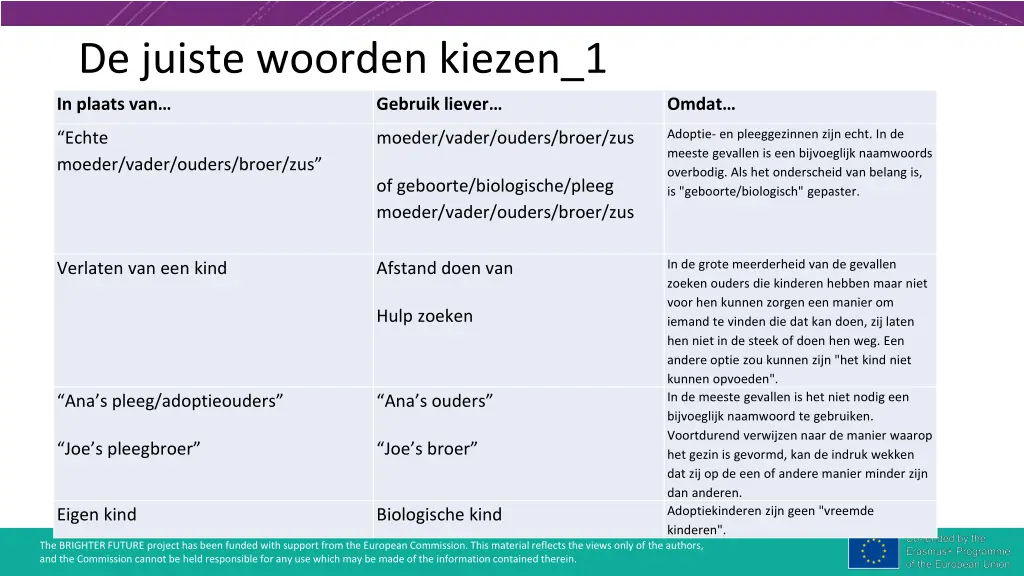
De juiste woorden kiezen_1 In plaats van Gebruik liever Omdat Adoptie- en pleeggezinnen zijn echt. In de meeste gevallen is een bijvoeglijk naamwoords overbodig. Als het onderscheid van belang is, is "geboorte/biologisch" gepaster. Echte moeder/vader/ouders/broer/zus moeder/vader/ouders/broer/zus of geboorte/biologische/pleeg moeder/vader/ouders/broer/zus In de grote meerderheid van de gevallen zoeken ouders die kinderen hebben maar niet voor hen kunnen zorgen een manier om iemand te vinden die dat kan doen, zij laten hen niet in de steek of doen hen weg. Een andere optie zou kunnen zijn "het kind niet kunnen opvoeden". In de meeste gevallen is het niet nodig een bijvoeglijk naamwoord te gebruiken. Voortdurend verwijzen naar de manier waarop het gezin is gevormd, kan de indruk wekken dat zij op de een of andere manier minder zijn dan anderen. Adoptiekinderen zijn geen "vreemde kinderen". Verlaten van een kind Afstand doen van Hulp zoeken Ana s pleeg/adoptieouders Ana s ouders Joe s pleegbroer Joe s broer Eigen kind Biologische kind The BRIGHTER FUTURE project has been funded with support from the European Commission. This material reflects the views only of the authors, and the Commission cannot be held responsible for any use which may be made of the information contained therein.
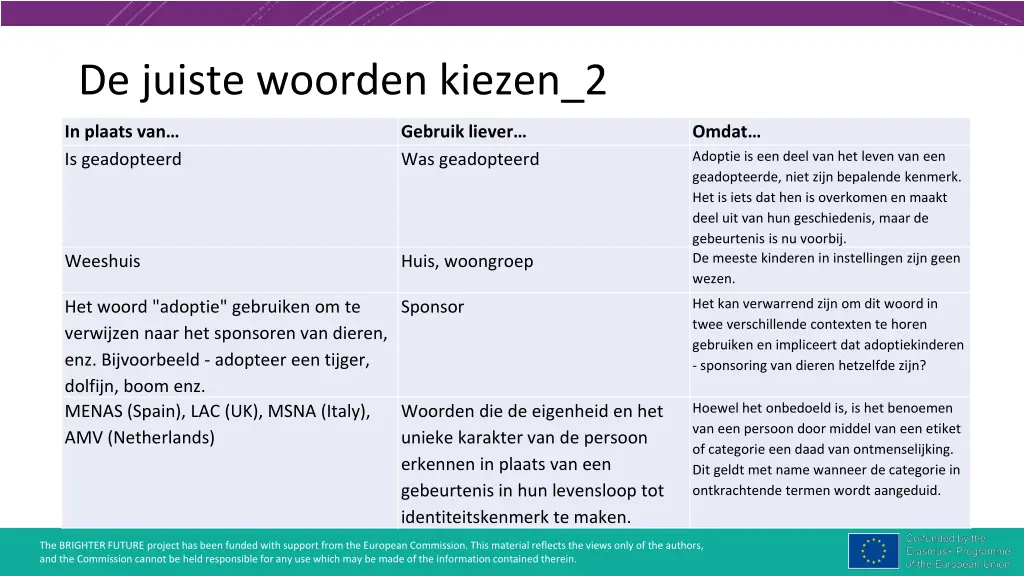
De juiste woorden kiezen_2 In plaats van Is geadopteerd Gebruik liever Was geadopteerd Omdat Adoptie is een deel van het leven van een geadopteerde, niet zijn bepalende kenmerk. Het is iets dat hen is overkomen en maakt deel uit van hun geschiedenis, maar de gebeurtenis is nu voorbij. De meeste kinderen in instellingen zijn geen wezen. Weeshuis Huis, woongroep Het kan verwarrend zijn om dit woord in twee verschillende contexten te horen gebruiken en impliceert dat adoptiekinderen - sponsoring van dieren hetzelfde zijn? Het woord "adoptie" gebruiken om te verwijzen naar het sponsoren van dieren, enz. Bijvoorbeeld - adopteer een tijger, dolfijn, boom enz. MENAS (Spain), LAC (UK), MSNA (Italy), AMV (Netherlands) Sponsor Hoewel het onbedoeld is, is het benoemen van een persoon door middel van een etiket of categorie een daad van ontmenselijking. Dit geldt met name wanneer de categorie in ontkrachtende termen wordt aangeduid. Woorden die de eigenheid en het unieke karakter van de persoon erkennen in plaats van een gebeurtenis in hun levensloop tot identiteitskenmerk te maken. The BRIGHTER FUTURE project has been funded with support from the European Commission. This material reflects the views only of the authors, and the Commission cannot be held responsible for any use which may be made of the information contained therein.
NOTES My personal life/privacy_1 Participants are asked to recall concrete situations when they felt exposed and disclosed in their private matters, starting with trivial everyday events with their colleagues and/or pupils. First in small groups participant debate about: What happened? How did I feel? What was my colleague s intention? How did s/he feel? How did I react? What could have been done differently by the other and my side? Then a plenary discussion where the main contents are reported and gathered according to the main topics. The group is asked to order the different topics/situations according to a hierarchy. Debriefing: We all have a 'sense of privacy', the content can be as important as the context (not what I say, but how/where), this sense of privacy is not objective and absolute, but is subjective and variable. When we occupy a professional role (teacher, social worker, educator, etc.), the sense of privacy and its boundaries depend not only on individual sensibilities but also on regulatory and professional constraints. My personal life/privacy_2 Within the EU countries, the right to privacy of personal data, private and family life is protected by a number of laws, which may vary from country to country. Similarly, there is a right to professional secrecy regarding information about health history and judicial decisions that affect people's lives. It is important then for professionals to be aware of the general legal framework ruling privacy issues of the country in which they work. Laws often constrain the professional role and are the basis on which the single institution defines specific policies on the matter. It is also important to remember that the concept of privacy is culturally informed. For this reason, it is essential, especially with families or pupils with a migrant background, never to take for granted a shared understanding of its meaning, of the forms and boundaries that privacy should take, as well as of the practices to respect it. To this end, figures such as cultural mediators can be essential resources. Provide specific information about the normative situation of the country. The right to privacy, however, is not only a legal and ethical obligation but also a pivotal relational tool for building interpersonal relationships based on trust. For this reason, confidentiality and sensitivity in respecting private areas of personal stories are crucial skills to build an effective relationship with families and kids. Overall sensitivity, private stories Awareness of how early adverse experiences can affect human functioning is essential for teachers to frame children s behavioursand for developing sensitivity to the variety of needs. However, developing awareness and sensitivity to the role that early adverse experiences can play in a child's life does not mean that it is necessary for every teacher or professional at school to know kids' personal history. The actors involved in the educational relationship may have different perceptions about the salience of information, the proper boundary of respect for confidentiality, the child's ability to decide for themselves. Family members or caregivers may, for example, feel that it is better to select or even not reveal specific information about the child's life at all. As a result, it may be that the school does not know that a pupil has a history of adoption or fostering, or that information about the pupil's relational difficulties is not shared. There may be several reasons for this: distrust of professionals due to previous negative experiences, fear of stigmatisation, expectation that in a new context the child can "start again", etc. The children themselves may show strong unease at the idea of strangers learning information that they themselves do not yet know how to deal with. Children may feel shame, anxiety, guilt, and aggression because of this, or the need to protect their families from external judgement. This need for privacy and control of one s own life can become critical in adolescence. In this phase of development, in fact, young people are engaged in the construction of an adult identity, breaking with their childhood identity,and the demand for independence from the adult world is central. In such circumstances, the way of presenting oneself to the world becomes a particularly sensitive element. Unlike children and caregivers, school staff may feel that knowing the details of personal stories is essential to protect the child and build a safe environment, feeling the need to share information with the educational team. It is therefore important to create a climate of collaboration and integration between the school, caregiver and child, aimed at having precise and constant monitoring of the child's functioning and well- being in the school context. The focus of the information exchange is therefore not the personal story, but a description of the child's current functioning, with their fragilities and strengths, where biographical elements provide a general interpretative framework of behavioural signals. The BRIGHTER FUTURE project has been funded with support from the European Commission. This material reflects the views only of the authors, and the Commission cannot be held responsible for any use which may be made of the information contained therein. Navigating the different perspectives can be challenging, taking in mind that collaboration with caregivers is crucial when the school encounters pupils who have experienced early adversity, and careful relational work is required by the school staff to build the trust necessary for open dialogue. Open and effective communicationis essential to identify support strategies highly individualised, shape realistic
The whole community approach Life experiences outside the classroom shape the context of students school experience, filtering their perceptions of self, others, and the importance of fully engaging in school (Huebner et al., 2001). The potential potent impact of ACEs on student outcomes has been documented, ranging from academic achievement (Slade & Wissow, 2007) to behavioural and emotional well-being (Hunt et al., 2017). The author suggeststhat framing this work as healing-centred offers a critical shift that orients toward system-level,culturally grounded, and asset-drivenwork. We propose an integrated whole child, culturally responsive, and healing-centered approach grounded in an ecological framework. Specifically, this integrated approach accounts for the adverse impact of ACEs, protective factors, and cultural factors influencing individuals and the environments in which they are situated to provide an opportunity for a more systemic approach to trauma-informed education. An ecological framework applied to a trauma-informed approach in schools interweaves whole school and whole community supports to enable a tiered system framework to supporting the whole child. Trauma-informed school systems attend to service delivery at both child and school levels, and are situated within community contexts that enhance service delivery to support whole child and school functioning. At the school level, all staff understand their role in enabling a positive and inclusive environment, and have the knowledge and skills to enact policies and practices that promote safety and connection, address issues of inequity, and avoid re-traumatization. At the child level, students are actively engaged in developing their social identities and self-concept through social emotional learning, are provided opportunities to connect and strengthen protective factors, and have access to intensive interventions that heal and rebuild a sense of self. Together, related bodies of the literature (e.g., exclusionary discipline, racism, social determinants) are integrated with ACE research in informing a complete system approach to trauma-informed care in schools. Such integration demonstrates how trauma-informed care is critical to articulated goals in education around inclusion, equity, and social justice (Ridgard et al., 2015). To accomplish this vision for integration, the continuum of strategies informing a trauma-informed approach must reflect an understanding of the cultural context shaping student life experiences. An emerging body of the literature suggests whole child support includes schoolpractices thatreflect holisticengagementof students socialidentitiesand accountfor cultural factorsshaping their academicexperience (Blitz et al., 2020; Jagers et al., 2019, Lewallen et al., 2015). Deficit-oriented vs affirmative/assets oriented approach Current actions have been more heavily focused on the effort to build awareness and empathy around traumatic experiences than on understanding the contributions of school environments and enacting systemchange acrosspolicy and practice. Organizational change requires alignment among the expected work of the organization, the people within the organization, the culture of the organization, and the structure of the organization (Nadler & Tushman,1980). Challenges arise when there is a lack of congruenceacrosscomponents,thus potentiallylimitingthe capacityto bring aboutdesired change Schools are embedded within community networks of support, services, and interfacing systems (e.g., health care, juvenile justice), all of which exert influence on policy and practice within schools. As such, schoolsencounterthe need for both horizontaland vertical congruenceto be fully responsive as a trauma-informedsystem We need an integrated whole child, culturally responsive, and healing-centered approach grounded in an ecological framework. Specifically, this integrated approach accounts for the adverse impact of ACEs, protective factors, and cultural factors influencing individuals and the environments in which they are situated to provide an opportunity for a more systemic approach to a trauma-informed education. Making room for communication Communication with those with a history of early adverse experiences and their caregivers cannot take place spontaneously or randomly, but needs to be thought out and planned. It requires the construction of dedicated and structured time-spaces. It is thanks to this constant exchange of information that teachers can orient their work, receive feedback and jointly evaluate its effectiveness. The information that children and caregivers can provide is, for example, very important for assessing the individual's levels of functionality and autonomy, regardless of abstract age-based references, thus helping to create a reliable and safe environment at school. At the same time, feedback on behaviour at school, the timing and manner of learning contents as well as social skills, can support the activities the child undertakes at home or in the community and the adults who care for him or her. The alliance and collaborative climate created between the school and the family helps to create to hold" the child, who thus perceives that the efforts of caregivers and teachers are moving towards common goals. The BRIGHTER FUTURE project has been funded with support from the European Commission. This material reflects the views only of the authors, and the Commission cannot be held responsible for any use which may be made of the information contained therein. In order to foster the development of a good alliance between the subjects involved in the relationship, it can be useful to have some points in mind:
Entering a new school can be highly challenging for children who experienced early adversity. In order to make them feel the school is a safe place from the very beginning it is recommended to arrange encounters with a reference person, before starting regular lessons. Having the possibility to get acquainted with the space, the people and the routines are a good way to lay the foundation for a good connection. An essential element in building a relationship of trust with the child and their caregiver is the guarantee of confidentiality of details concerning their story. The child must be master and responsible for sharing their life path, at a time and in a way that suits them. Maintain an evolutionary mentality. The difficulties and fragilities that children may show in learning tasks and social relationships do not complete their identity. Working on the development and consolidationof strengthsand talentscontributesto releasing the identity of these young people from trauma and pushing them towardsa future of new developmentalgoals. Stigma and self-fulfilling prophecy In order to provide a respectful and safe environmentat school,vocabulary is crucial. For example, we talk about 'early adversity' or 'trauma' to describe difficult and painful experiences that pupils have undergone. These words are a kind of framework that allows teachers to recognise and make sense of otherwise incomprehensible and confusing behaviours, cognitions and emotions. The words trauma and adversity do not indicate a specific and unique experience but name a wide range of possibleones. However, as the words circulate, they are loaded with other social meanings and so trauma often becomes an identity marker, encouraging an unnatural division between 'normal' and 'traumatised' people; that is, between those who need help and those who are able to offer it. A difficult past may help explain a specific way of functioning, but it does not define who a person is or who they will become.Focusingonly on the past may obscure the enormousresourcesand skillsthat learners bring with them, and classify them as 'needy' individuals who are unable to make a positivecontribution. In more general terms, often the lives of young people facing foster care, out-of-home care, and forced migration are described in negative terms, as lacking something, so that expectations of them are minimaland perhaps it is no coincidencethat their educationalsuccessis significantlylower than that of the young populationnot leaving home. Choosing the right words_1&2 Basic ideas for satisfyingthe curiosityof preschoolersand children in primary schoolaboutadoptive and fosterfamilies: Sometimes, some people have a child, but they are not prepared or they cannot take care of him or her. Around the first years of primary school, children begin to learn the basis of reproduction. They then may realize that there had to be other parents before a child was placed for adoption. By the same token, when they see a child with Asian traits who says mom to a woman who does not resemble them, they may need help to understand. It is important to clarify that there is no such thing as "real" and "fake" parents. We can talk about birth parents in the case of adopted children, and their adoptiveparents are of course real and will be their parents forever. The reasons why a child was placed in an adoptive or foster family do not have to do with how she or he is or was. Questions such as "Why did Kai's first mother not want to keep him?" are not uncommon in classes where there is an adopted child or a child living in a foster family. Peers need to know that sometimes a family has a child but they are not prepared or they cannot take care of him or her. This can happen for a number of different reasons. Birth parents may be too young or too ill to care for a child, or have another serious hindrance that prevents them from doing so. Regardless, it is crucial to stress that, whatever the reason, it has nothing to do with anything the child did. All children need to be cared for. For this reason, when their birth family cannot, another family is found to take over. When children are adopted, their new family becomes their family forever. Other times, they live with another family or in a residential facilityuntil their parents can take care of them again. Support the concerned child s way of Some children living in foster families call the people who take care of them mom or dad . Others use words like aunt or uncle or call them by their first name. There are different ways they make sense of their situationand all of them are fine. Teachers shouldpay attentionto the words children use, in order to avoid contradictingthem. When raising their children, all families do similar things regardless of the way their family was built or its composition. understanding and naming their family. The BRIGHTER FUTURE project has been funded with support from the European Commission. This material reflects the views only of the authors, and the Commission cannot be held responsible for any use which may be made of the information contained therein. Emphasizing that families do similar things for their children and that families are a place where they can share a feeling of being loved, protected, reassured and important can help young children better understand family diversity. Talking about what they do (such as caring, comforting when sad, taking them to school when they are too young to go on their own, etc.) allows them to understand that it is