Privacy-Preserving Bayes-Adaptive MDPs in Advanced Information Security
Explore Privacy-Preserving Bayes-Adaptive Markov Decision Processes (MDPs) in the realm of Advanced Information Security. This research delves into optimizing marketing strategies and load balancing using MDPs, with a focus on long-term profit and efficient decision-making. Learn about the application of reinforcement learning and the Bayesian modeling of unknown transition probabilities in MDPs for enhanced security measures.

Download Presentation

Please find below an Image/Link to download the presentation.
The content on the website is provided AS IS for your information and personal use only. It may not be sold, licensed, or shared on other websites without obtaining consent from the author. If you encounter any issues during the download, it is possible that the publisher has removed the file from their server.
You are allowed to download the files provided on this website for personal or commercial use, subject to the condition that they are used lawfully. All files are the property of their respective owners.
The content on the website is provided AS IS for your information and personal use only. It may not be sold, licensed, or shared on other websites without obtaining consent from the author.
E N D
Presentation Transcript
CS548 Advanced Information Security Spring 2010 Privacy-Preserving Bayes-Adaptive MDPs CS548 Term Project Kanghoon Lee, AIPR Lab., KAIST 2010.05.11. 1
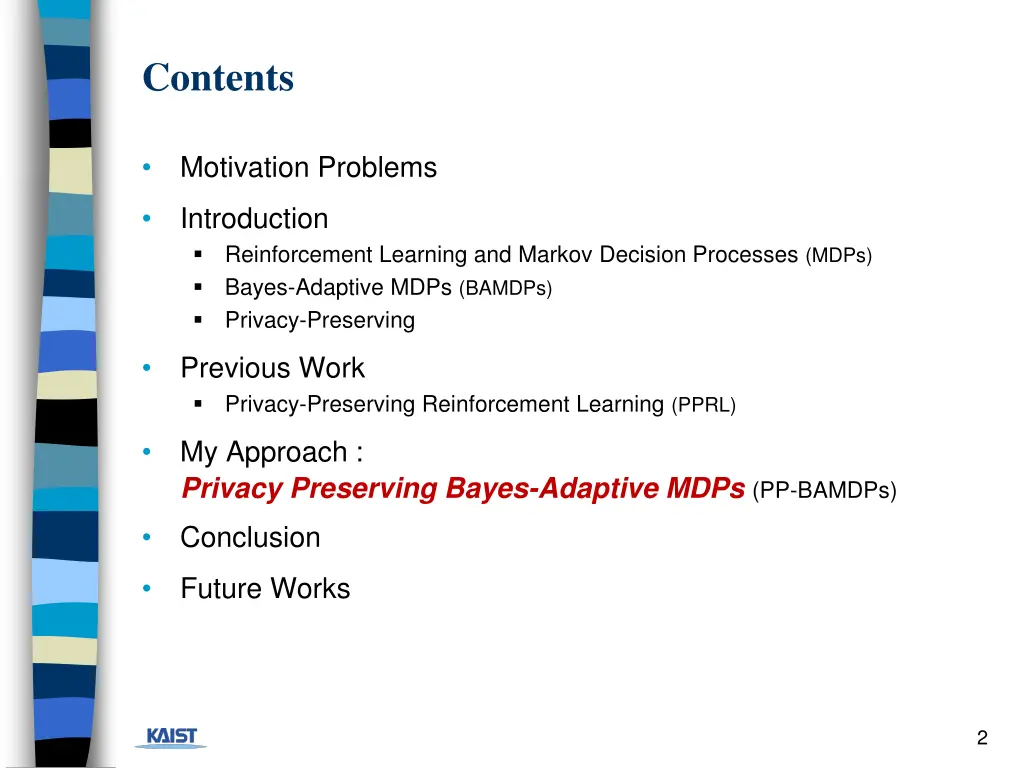
Contents Motivation Problems Introduction Reinforcement Learning and Markov Decision Processes (MDPs) Bayes-Adaptive MDPs (BAMDPs) Privacy-Preserving Previous Work Privacy-Preserving Reinforcement Learning (PPRL) My Approach : Privacy Preserving Bayes-Adaptive MDPs (PP-BAMDPs) Conclusion Future Works 2
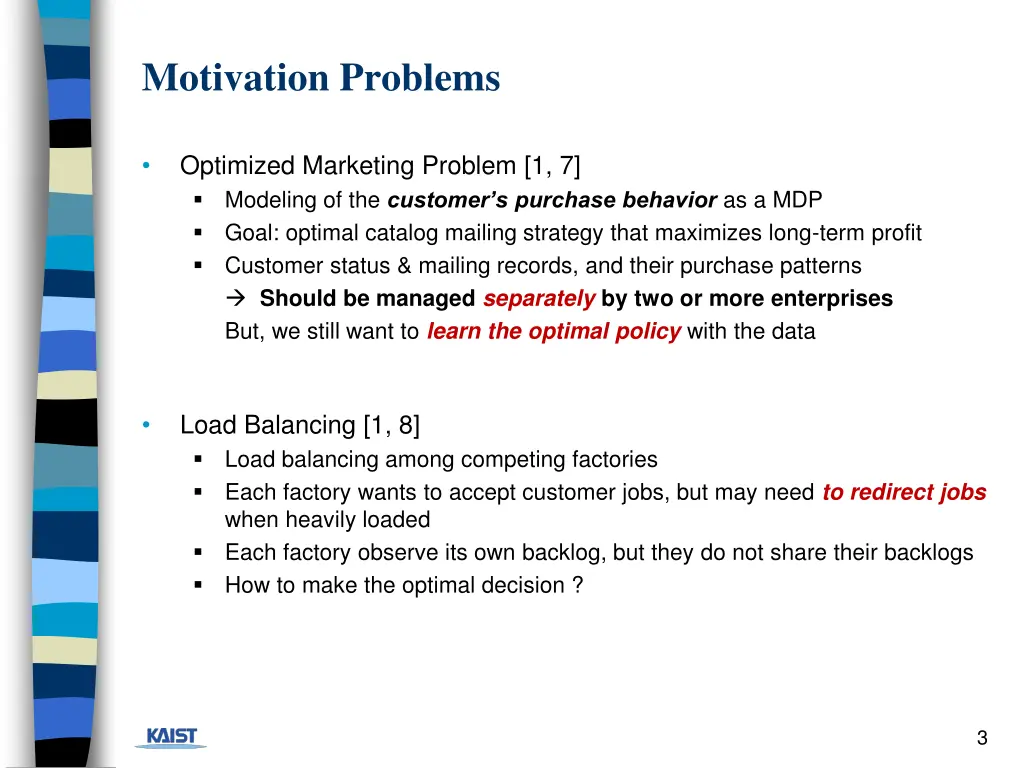
Motivation Problems Optimized Marketing Problem [1, 7] Modeling of the customer s purchase behavior as a MDP Goal: optimal catalog mailing strategy that maximizes long-term profit Customer status & mailing records, and their purchase patterns Should be managed separately by two or more enterprises But, we still want to learn the optimal policy with the data Load Balancing [1, 8] Load balancing among competing factories Each factory wants to accept customer jobs, but may need to redirect jobs when heavily loaded Each factory observe its own backlog, but they do not share their backlogs How to make the optimal decision ? 3
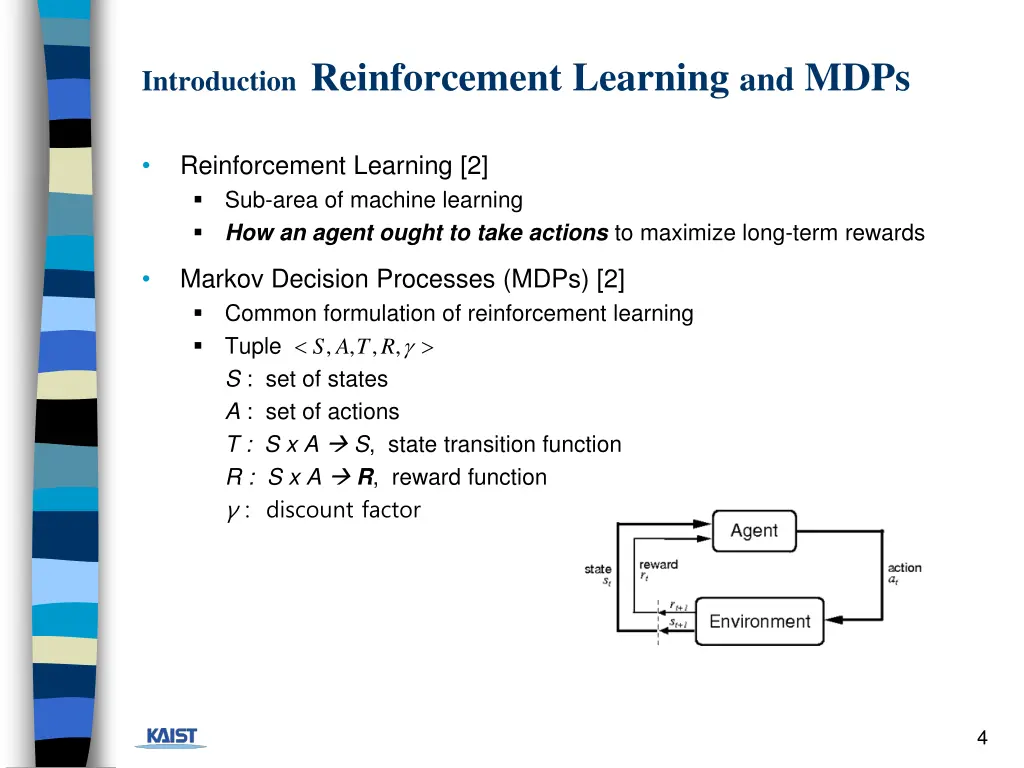
Introduction Reinforcement Learning and MDPs Reinforcement Learning [2] Sub-area of machine learning How an agent ought to take actions to maximize long-term rewards Markov Decision Processes (MDPs) [2] Common formulation of reinforcement learning Tuple S : set of states A : set of actions T : S x A S, state transition function R : S x A R, reward function : discount factor , R , , , S A T 4
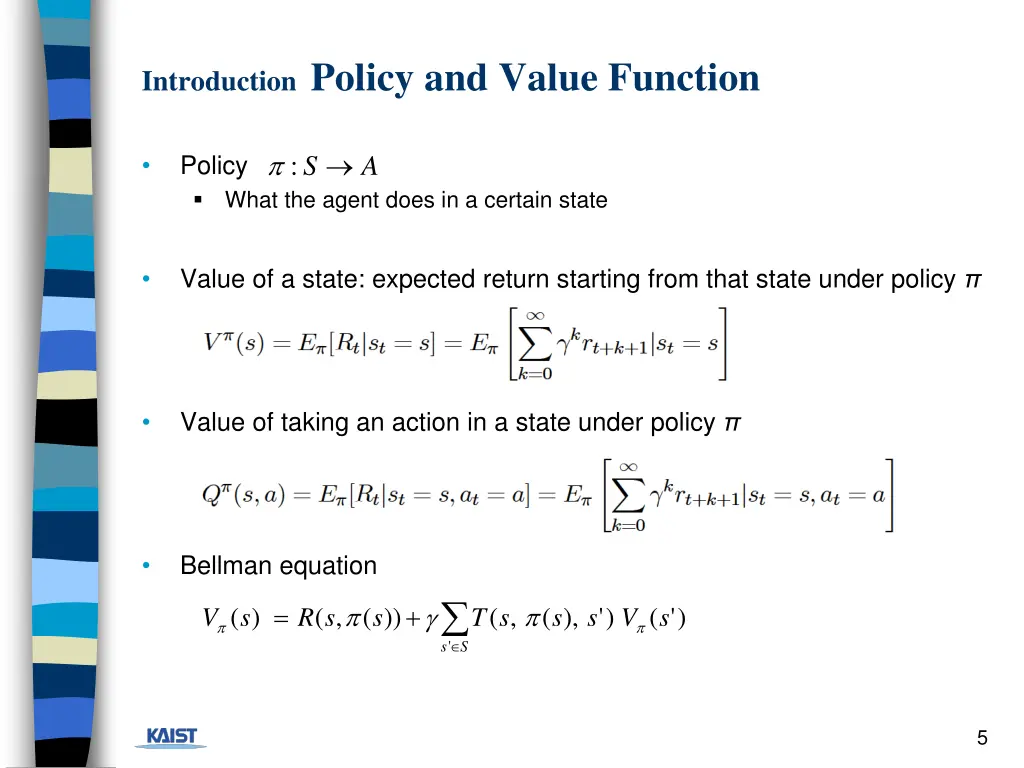
Introduction Policy and Value Function S : A Policy What the agent does in a certain state Value of a state: expected return starting from that state under policy Value of taking an action in a state under policy Bellman equation = + ( ) ( , ( )) ( , ( ), ) ' s ( ) ' s V s R s s T s s V ' s S 5
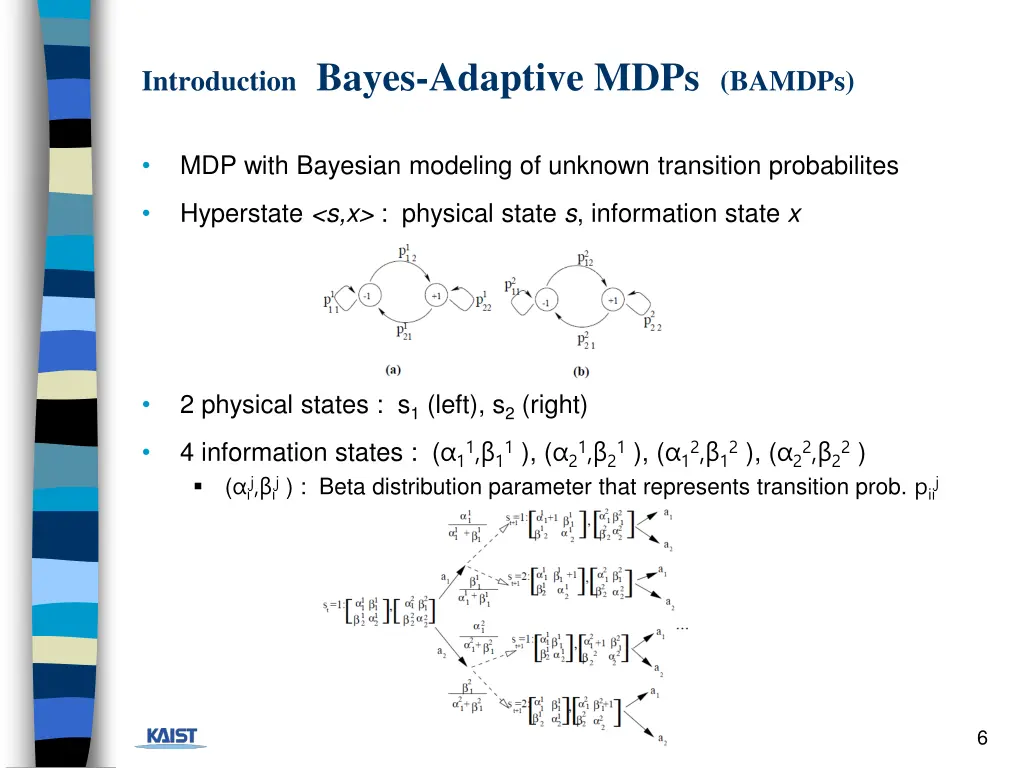
Introduction Bayes-Adaptive MDPs (BAMDPs) MDP with Bayesian modeling of unknown transition probabilites Hyperstate <s,x> : physical state s, information state x 2 physical states : s1(left), s2(right) 4 information states : ( 11, 11), ( 21, 21), ( 12, 12), ( 22, 22) ( ij, ij) : Beta distribution parameter that represents transition prob. piij 6
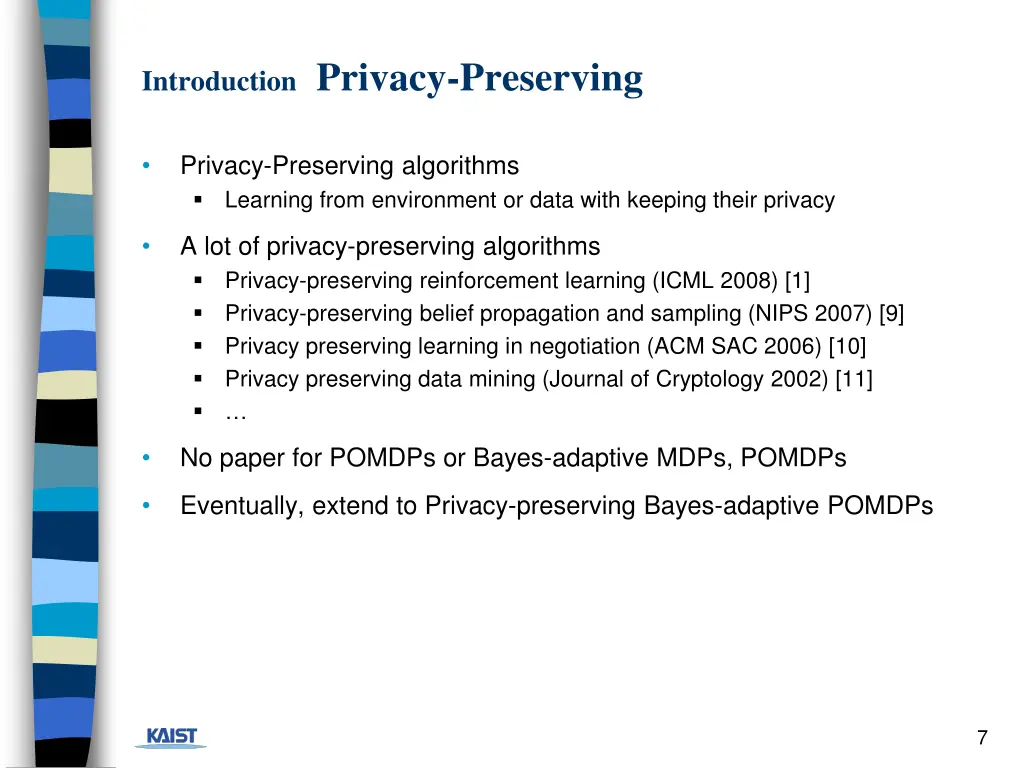
Introduction Privacy-Preserving Privacy-Preserving algorithms Learning from environment or data with keeping their privacy A lot of privacy-preserving algorithms Privacy-preserving reinforcement learning (ICML 2008) [1] Privacy-preserving belief propagation and sampling (NIPS 2007) [9] Privacy preserving learning in negotiation (ACM SAC 2006) [10] Privacy preserving data mining (Journal of Cryptology 2002) [11] No paper for POMDPs or Bayes-adaptive MDPs, POMDPs Eventually, extend to Privacy-preserving Bayes-adaptive POMDPs 7
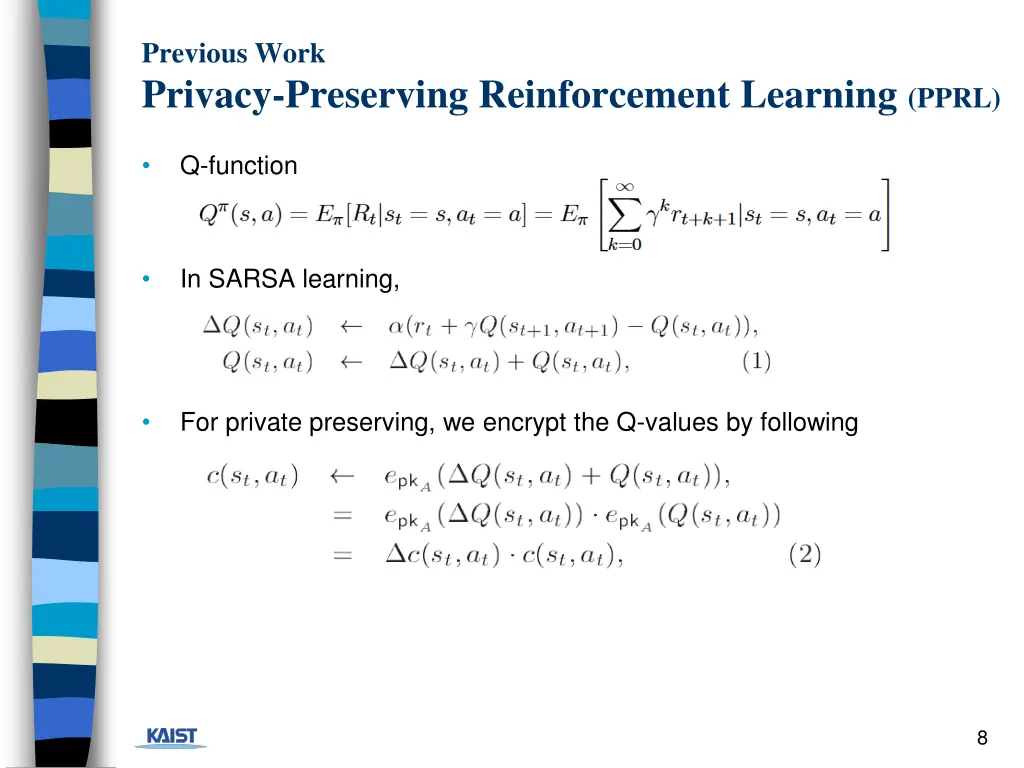
Previous Work Privacy-Preserving Reinforcement Learning (PPRL) Q-function In SARSA learning, For private preserving, we encrypt the Q-values by following 8
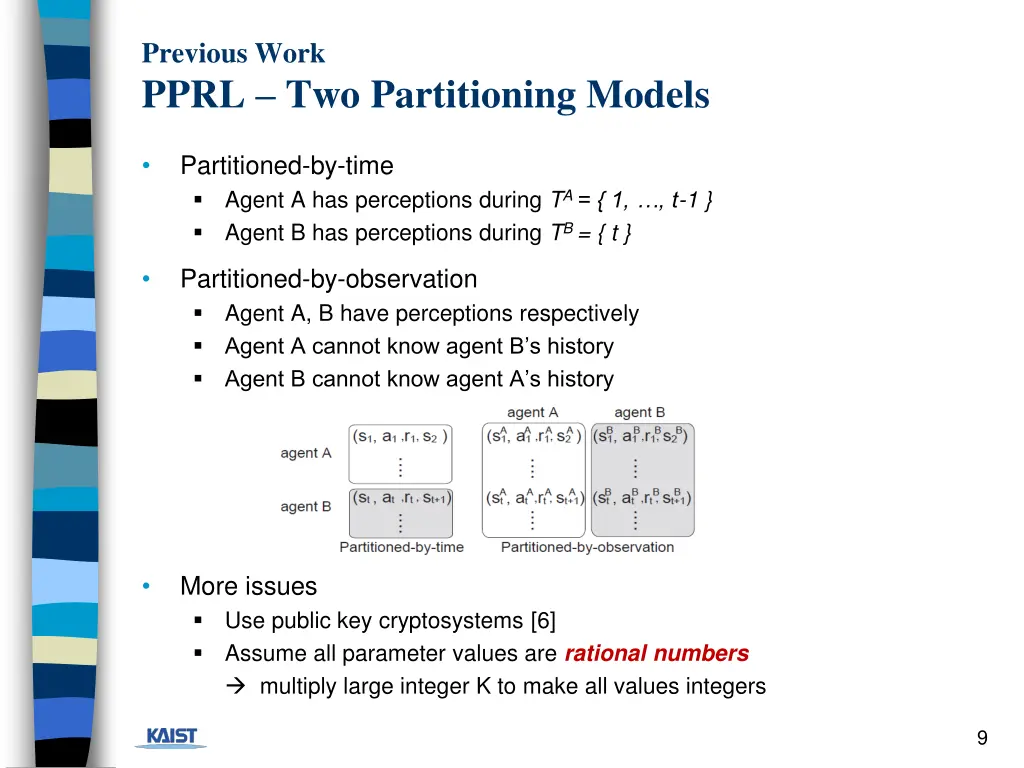
Previous Work PPRL Two Partitioning Models Partitioned-by-time Agent A has perceptions during TA = { 1, , t-1 } Agent B has perceptions during TB = { t } Partitioned-by-observation Agent A, B have perceptions respectively Agent A cannot know agent B s history Agent B cannot know agent A s history More issues Use public key cryptosystems [6] Assume all parameter values are rational numbers multiply large integer K to make all values integers 9
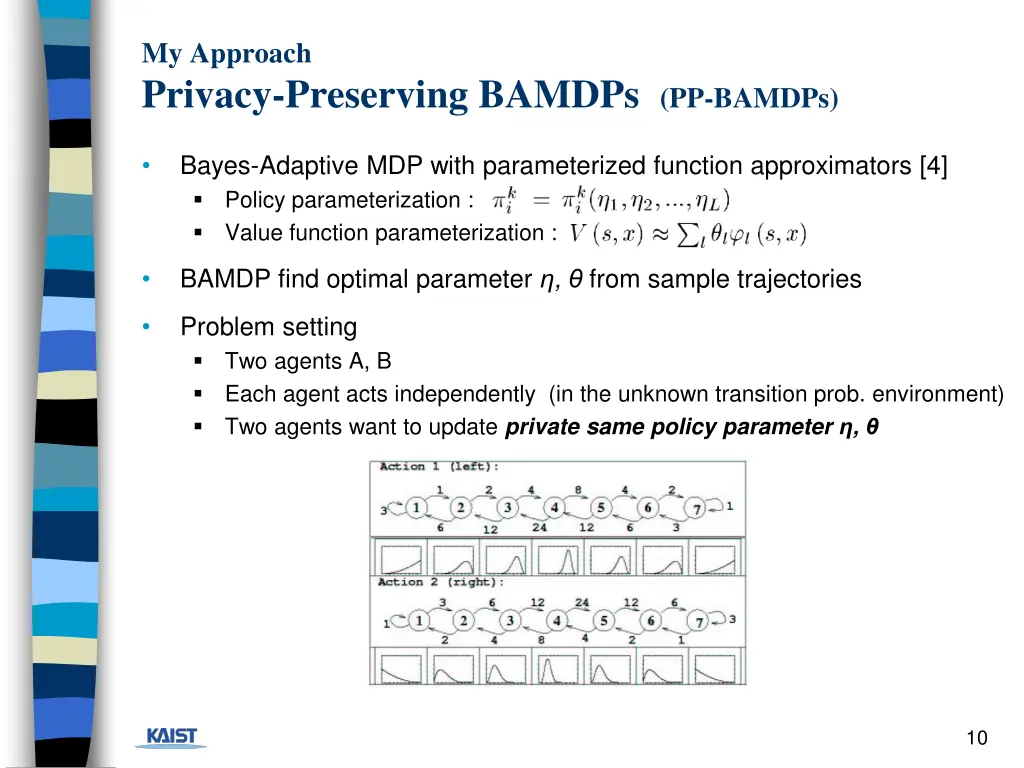
My Approach Privacy-Preserving BAMDPs (PP-BAMDPs) Bayes-Adaptive MDP with parameterized function approximators [4] Policy parameterization : Value function parameterization : BAMDP find optimal parameter , from sample trajectories Problem setting Two agents A, B Each agent acts independently (in the unknown transition prob. environment) Two agents want to update private same policy parameter , 10
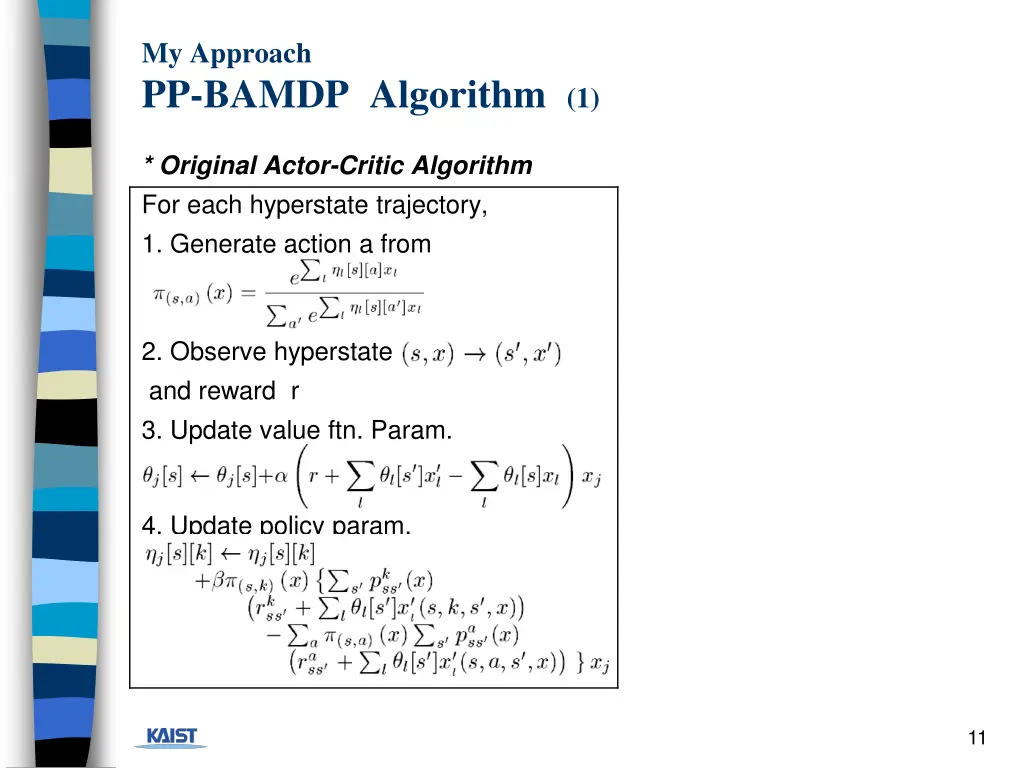
My Approach PP-BAMDP Algorithm (1) * Original Actor-Critic Algorithm For each hyperstate trajectory, 1. Generate action a from 2. Observe hyperstate and reward r 3. Update value ftn. Param. 4. Update policy param. 11
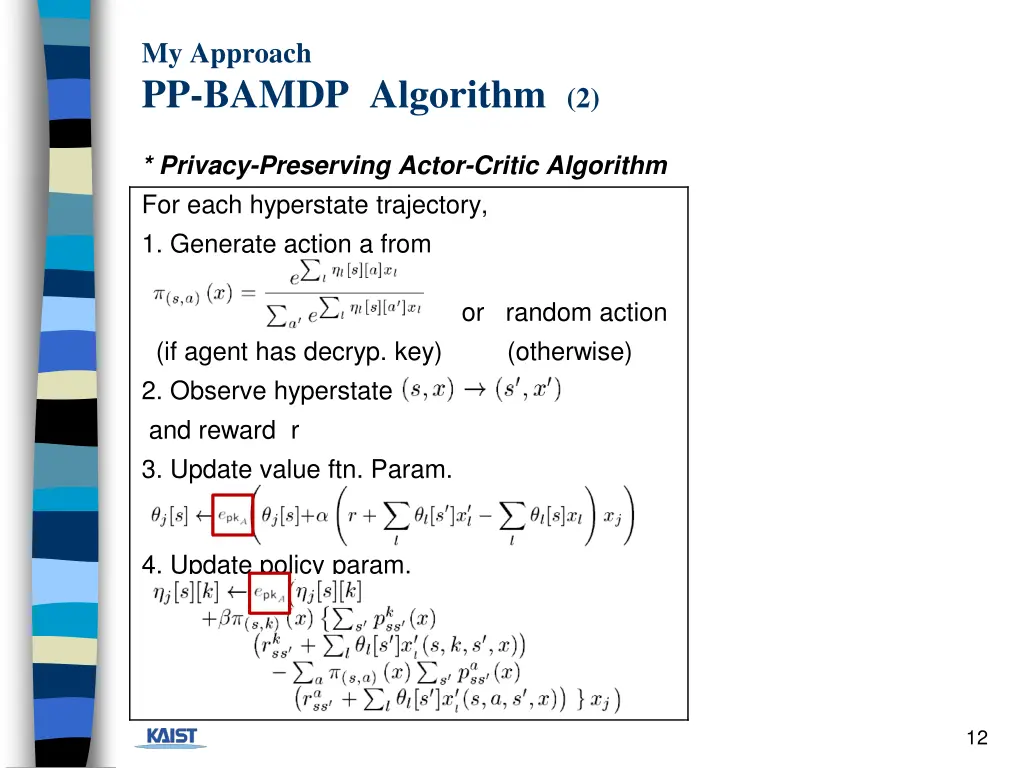
My Approach PP-BAMDP Algorithm (2) * Privacy-Preserving Actor-Critic Algorithm For each hyperstate trajectory, 1. Generate action a from or random action (if agent has decryp. key) (otherwise) 2. Observe hyperstate and reward r 3. Update value ftn. Param. 4. Update policy param. 12
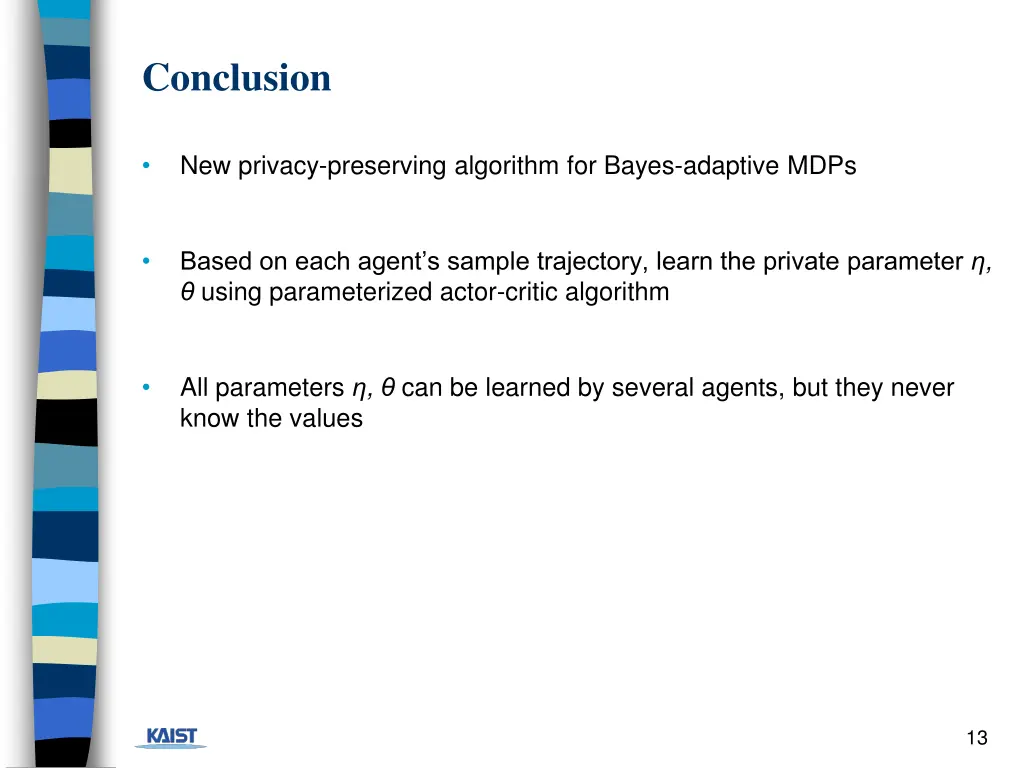
Conclusion New privacy-preserving algorithm for Bayes-adaptive MDPs Based on each agent s sample trajectory, learn the private parameter , using parameterized actor-critic algorithm All parameters , can be learned by several agents, but they never know the values 13
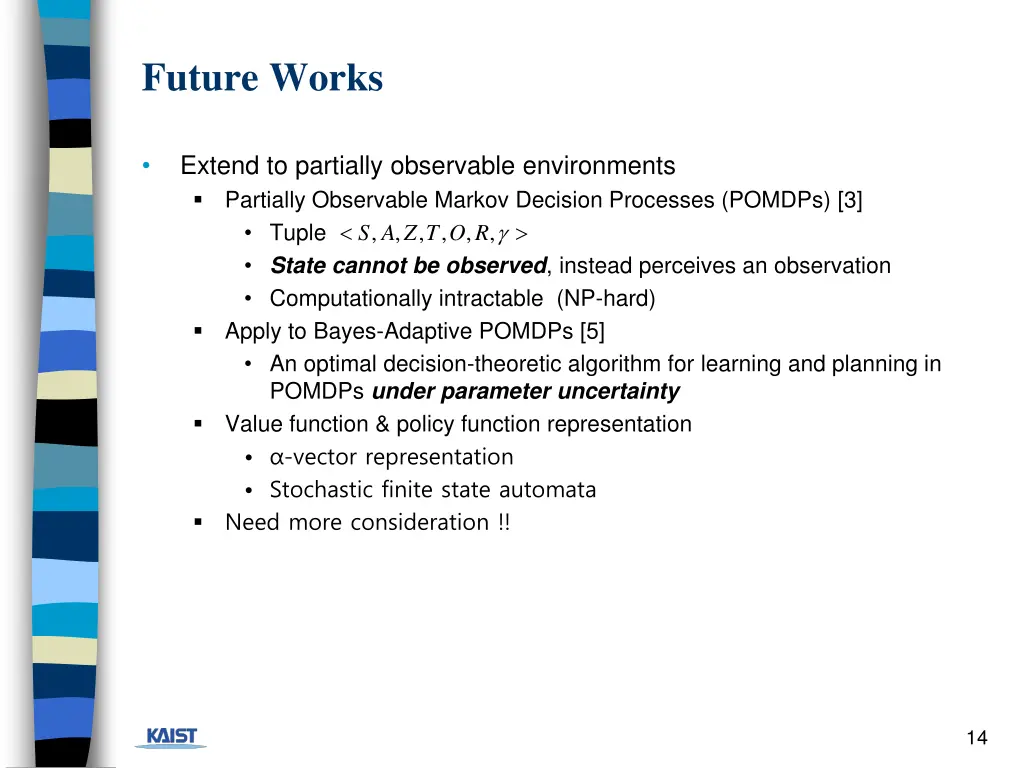
Future Works Extend to partially observable environments Partially Observable Markov Decision Processes (POMDPs) [3] Tuple State cannot be observed, instead perceives an observation Computationally intractable (NP-hard) Apply to Bayes-Adaptive POMDPs [5] An optimal decision-theoretic algorithm for learning and planning in POMDPs under parameter uncertainty Value function & policy function representation -vector representation Stochastic finite state automata Need more consideration !! , R , , , , , S A Z T O 14
References [1] Sakuma, J., Kobayashi, S, and Wright, R. N., Privacy-Preserving Reinforcement Learning, Proceedings of ICML, 2008 [2] Sutton, R. S., and Barto, A. G., Reinforcement Learning: An Introduction, MIT Press, 1998 [3] Kaelbling, L. P., Littman, M. L., and Cassandra, A. R., Planning and acting in partially observable stochastic domains, Journal of Artificial Intelligence, 1998 [4] Duff, M., Design for an Optimal Probe, Proceedings of ICML, 2003 [5] Ross, S., Chaib-draa, B., and Pineau, J., Bayes-Adaptive POMDPs, Proceedings of NIPS, 2007 [6] Damgard, I. and Jurik, M., A Generalization, a Simplification and Some Applications of Paillier s Probabilistic Public-Key System, Public Key Cryptography, 2001, Springer [7] Abe, N., Verma, N., Apte, C., and Schroko, R., Cross channel optimized marketing by reinforcement learning, ACM SIGKDD Int l Conf. on Knowledge Discovery and Data Mining, 2004 [8] Cogill, R., Rotkowitz, M., Van Roy, B., and Lall, S., An Approximate Dynamic Programming Approach to Decentralized Control of Stochastic Systems, LNCIS, 2006 [9] Kearns, M., Tan, J., and Wortman, J., Privacy-preserving belief propagation and sampling, NIPS, 2007 [10] Zhang, S., and Makedon, F., Privacy preserving learning in negotiation, ACM SAC, 2005 [11] Lindell, Y., and Pinkas, B., Privacy preserving data mining, Journal of Cryptology, 2002 15