Enhance Scout safety through proactive incident reporting. Learn why reporting is essential, promotes a culture of safety, and supports continuous improvement. Encourage reporting to prevent future incidents. Access the reporting link easily for quick submissions.
Please find below an Image/Link to download the presentation.
The content on the website is provided AS IS for your information and personal use only. It may not be sold, licensed, or shared on other websites without obtaining consent from the author. If you encounter any issues during the download, it is possible that the publisher has removed the file from their server.
You are allowed to download the files provided on this website for personal or commercial use, subject to the condition that they are used lawfully. All files are the property of their respective owners.
The content on the website is provided AS IS for your information and personal use only. It may not be sold, licensed, or shared on other websites without obtaining consent from the author.
E N D
Presentation Transcript
Scouting BSA Great Falls Council Incident Reporting Training October 2024 Presentation in Standard slide size to enable printing
Why Reporting is Important Why Reporting is Important We need to be proactive in preventing future problems! Information from incident and near miss reports can be used to identify risks, root causes and ways to fix them. The reports create support for needed changes and initiative to address problems. It helps promote a culture of safety. It s one of the ways to live the Scout Oath and Law. Adults should set an example on how to address safety concerns. A good safety track record can result in reduced insurance rates which means more funds can be available for scouting activities. The report enables insurance claims. It s how we support National s initiative to increase reporting. Reporting is not for assignment of blame; rather, a positive recognition for helping to prevent problems.
Why Reporting is Important Why Reporting is Important Continuous Improvement Continuous Improvement We improve is by identifying what needs to be fixed and working on it. Compiling information related to incidents and near misses gives councils information with which to better understand risks Identification and communication of new risks enable opportunities for continuous improvement across the council Everyone in Scouting can help by offering suggestions, and by reporting Incidents and Near-Misses This is how we help to prevent potential injuries and damage in the future! Training is another way by which we can continually improve. From myBSA: Timely and complete incident reporting provides BSA with an opportunity for analysis of incidents that occur and promotes continuous improvement of our programs. The sooner a clear, concise, and complete incident report is made, the sooner an appropriate response to the incident can occur. Help Identify Risks and Fix Them! Let s look out for each other and not have any regrets that we didn t speak up!
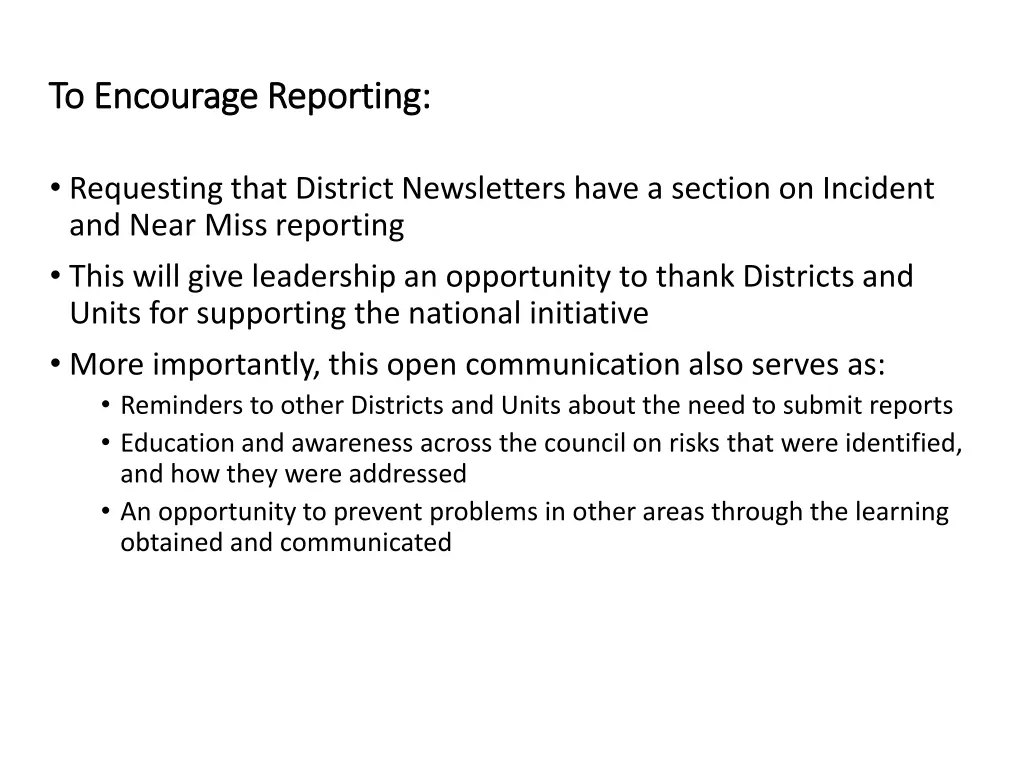
To Encourage Reporting: To Encourage Reporting: Requesting that District Newsletters have a section on Incident and Near Miss reporting This will give leadership an opportunity to thank Districts and Units for supporting the national initiative More importantly, this open communication also serves as: Reminders to other Districts and Units about the need to submit reports Education and awareness across the council on risks that were identified, and how they were addressed An opportunity to prevent problems in other areas through the learning obtained and communicated
Reporting Link Location Reporting Link Location Anyone Anyone can submit a report can submit a report it is very quick and easy it is very quick and easy Navigate to www.souting.org. Select Scouting Safely from top menu, then Incident Reporting from left side menu
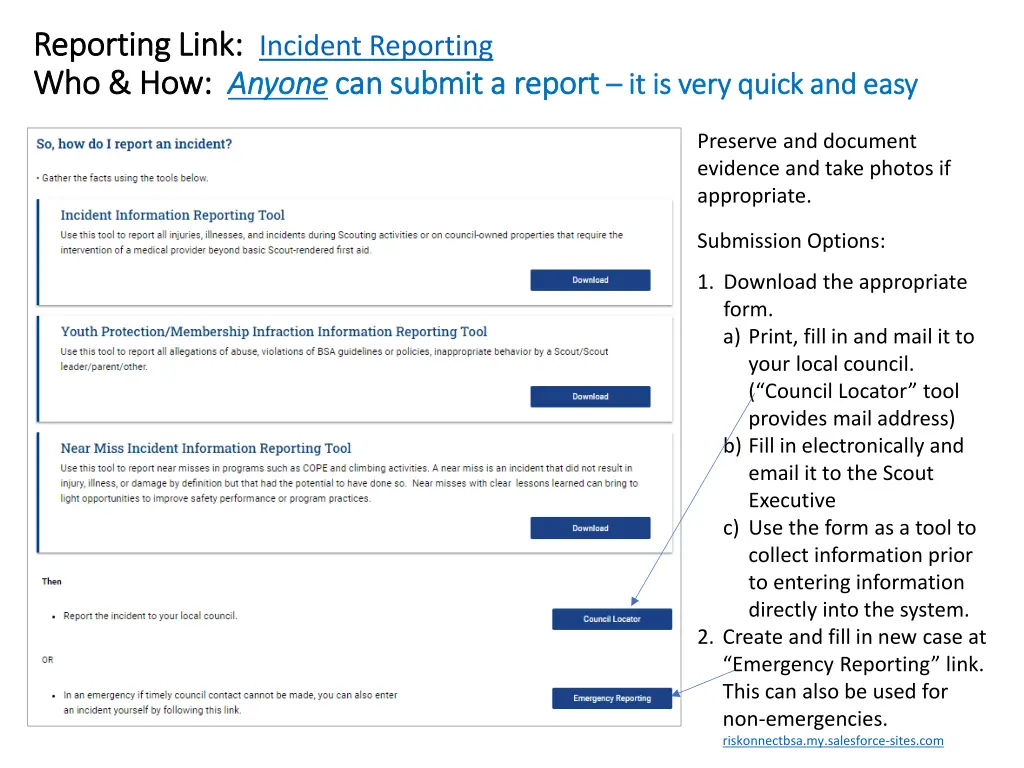
Reporting Link: Reporting Link: Incident Reporting Who & How: Who & How: Anyone Anyone can submit a report can submit a report it is very quick and easy it is very quick and easy Preserve and document evidence and take photos if appropriate. Submission Options: 1. Download the appropriate form. a) Print, fill in and mail it to your local council. ( Council Locator tool provides mail address) b) Fill in electronically and email it to the Scout Executive c) Use the form as a tool to collect information prior to entering information directly into the system. 2. Create and fill in new case at Emergency Reporting link. This can also be used for non-emergencies. riskonnectbsa.my.salesforce-sites.com
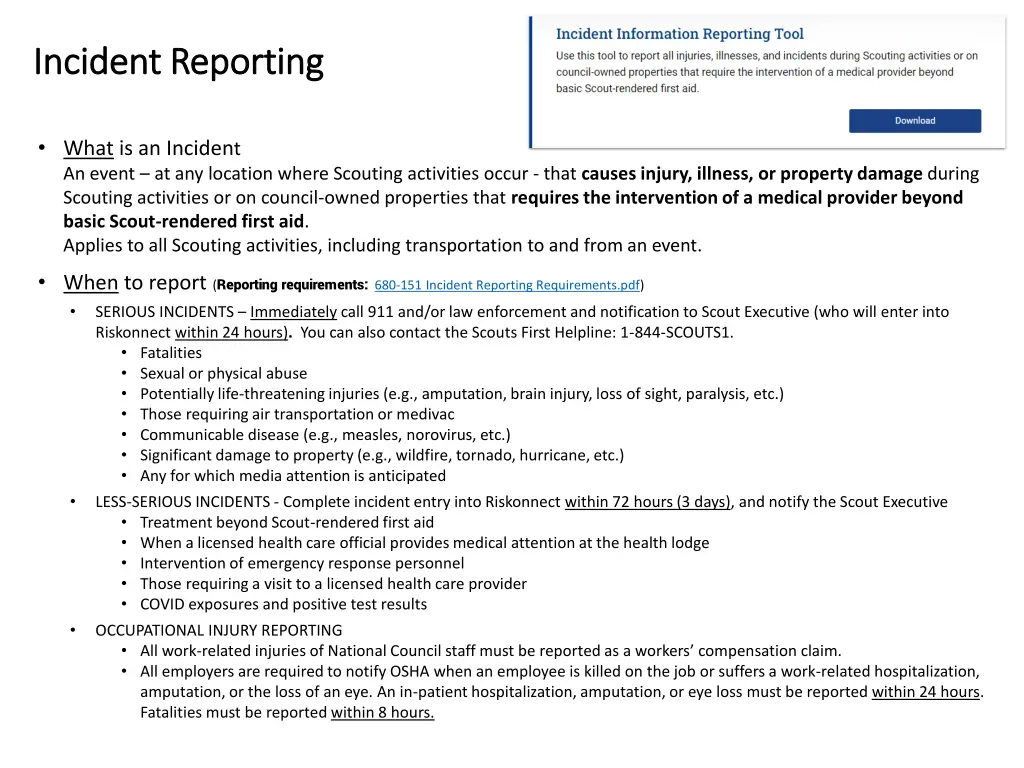
Incident Reporting Incident Reporting What is an Incident An event at any location where Scouting activities occur - that causes injury, illness, or property damage during Scouting activities or on council-owned properties that requires the intervention of a medical provider beyond basic Scout-rendered first aid. Applies to all Scouting activities, including transportation to and from an event. When to report (Reporting requirements: 680-151 Incident Reporting Requirements.pdf) SERIOUS INCIDENTS Immediately call 911 and/or law enforcement and notification to Scout Executive (who will enter into Riskonnect within 24 hours). You can also contact the Scouts First Helpline: 1-844-SCOUTS1. Fatalities Sexual or physical abuse Potentially life-threatening injuries (e.g., amputation, brain injury, loss of sight, paralysis, etc.) Those requiring air transportation or medivac Communicable disease (e.g., measles, norovirus, etc.) Significant damage to property (e.g., wildfire, tornado, hurricane, etc.) Any for which media attention is anticipated LESS-SERIOUS INCIDENTS - Complete incident entry into Riskonnect within 72 hours (3 days), and notify the Scout Executive Treatment beyond Scout-rendered first aid When a licensed health care official provides medical attention at the health lodge Intervention of emergency response personnel Those requiring a visit to a licensed health care provider COVID exposures and positive test results OCCUPATIONAL INJURY REPORTING All work-related injuries of National Council staff must be reported as a workers compensation claim. All employers are required to notify OSHA when an employee is killed on the job or suffers a work-related hospitalization, amputation, or the loss of an eye. An in-patient hospitalization, amputation, or eye loss must be reported within 24 hours. Fatalities must be reported within 8 hours.
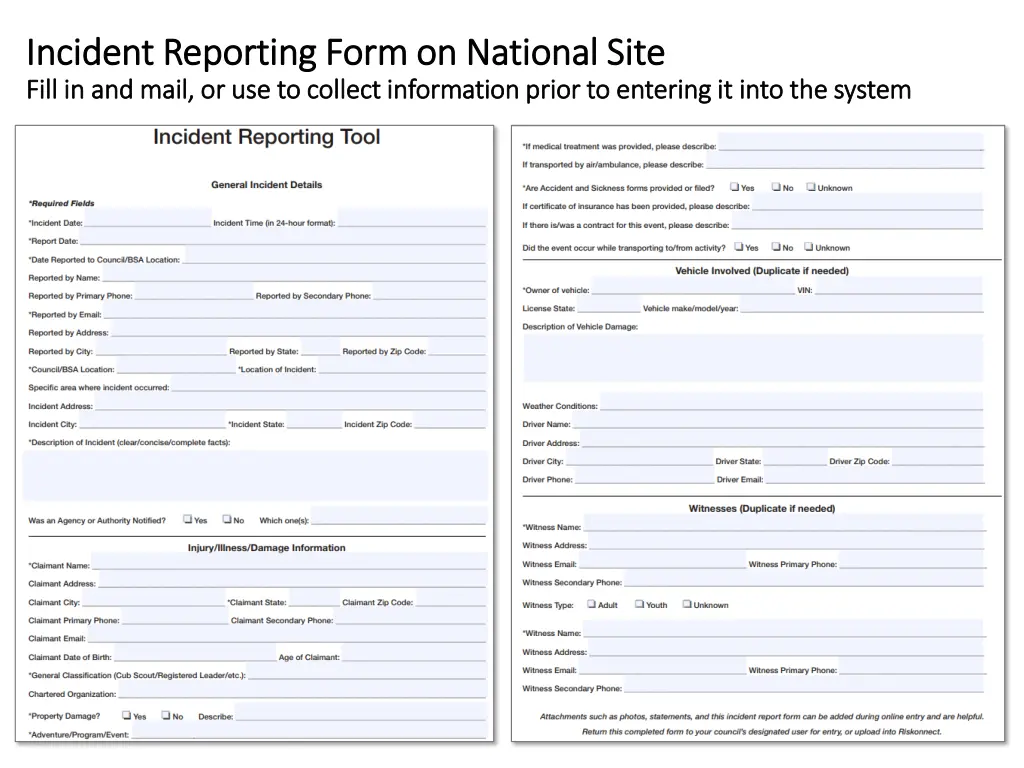
Incident Reporting Form on National Site Incident Reporting Form on National Site Fill in and mail, or use to collect information prior to entering it into the system Fill in and mail, or use to collect information prior to entering it into the system
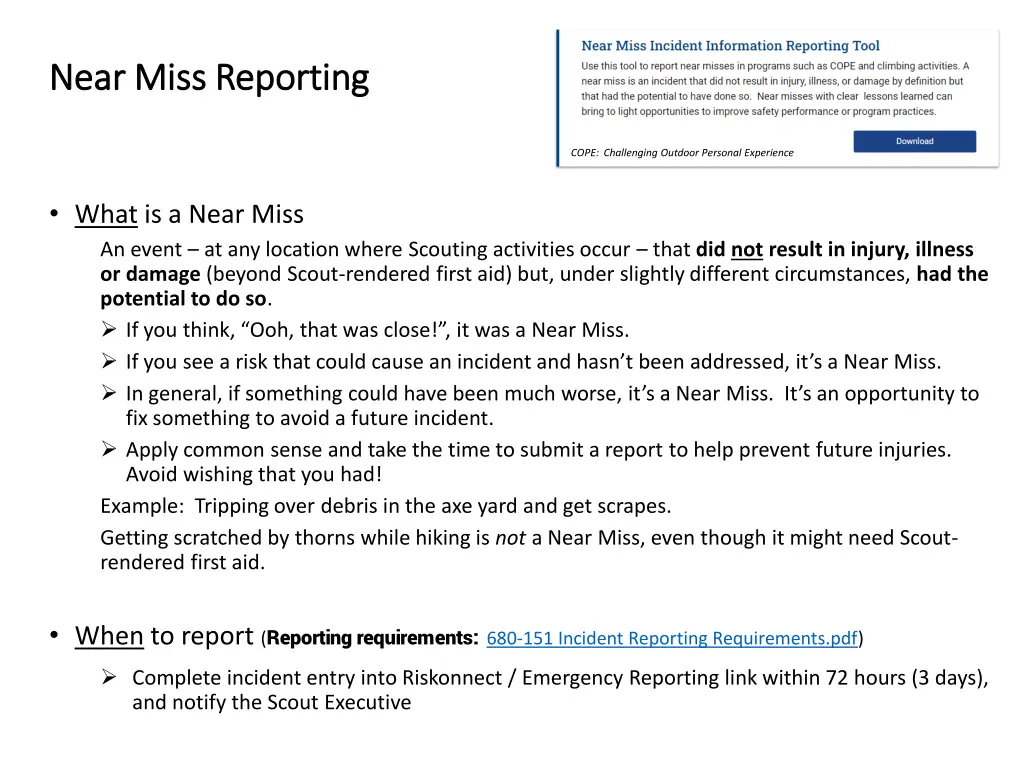
Near Miss Reporting Near Miss Reporting COPE: Challenging Outdoor Personal Experience What is a Near Miss An event at any location where Scouting activities occur that did not result in injury, illness or damage (beyond Scout-rendered first aid) but, under slightly different circumstances, had the potential to do so. If you think, Ooh, that was close! , it was a Near Miss. If you see a risk that could cause an incident and hasn t been addressed, it s a Near Miss. In general, if something could have been much worse, it s a Near Miss. It s an opportunity to fix something to avoid a future incident. Apply common sense and take the time to submit a report to help prevent future injuries. Avoid wishing that you had! Example: Tripping over debris in the axe yard and get scrapes. Getting scratched by thorns while hiking is not a Near Miss, even though it might need Scout- rendered first aid. When to report (Reporting requirements: 680-151 Incident Reporting Requirements.pdf) Complete incident entry into Riskonnect / Emergency Reporting link within 72 hours (3 days), and notify the Scout Executive
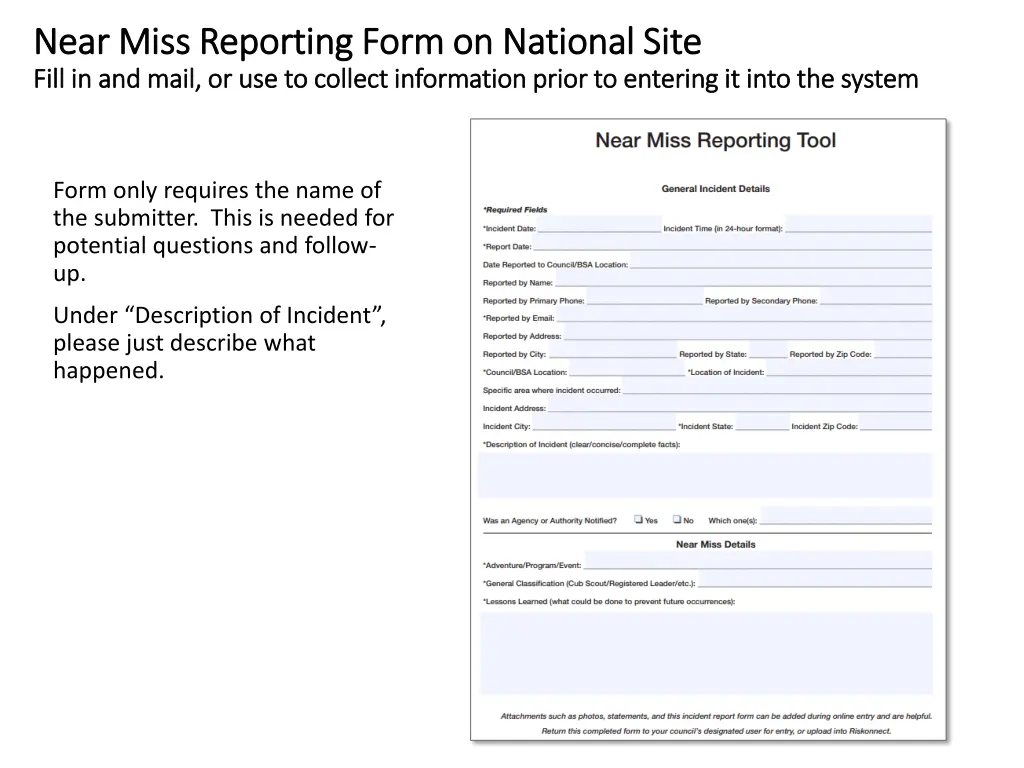
Near Miss Reporting Form on National Site Near Miss Reporting Form on National Site Fill in and mail, or use to collect information prior to entering it into the system Fill in and mail, or use to collect information prior to entering it into the system Form only requires the name of the submitter. This is needed for potential questions and follow- up. Under Description of Incident , please just describe what happened.
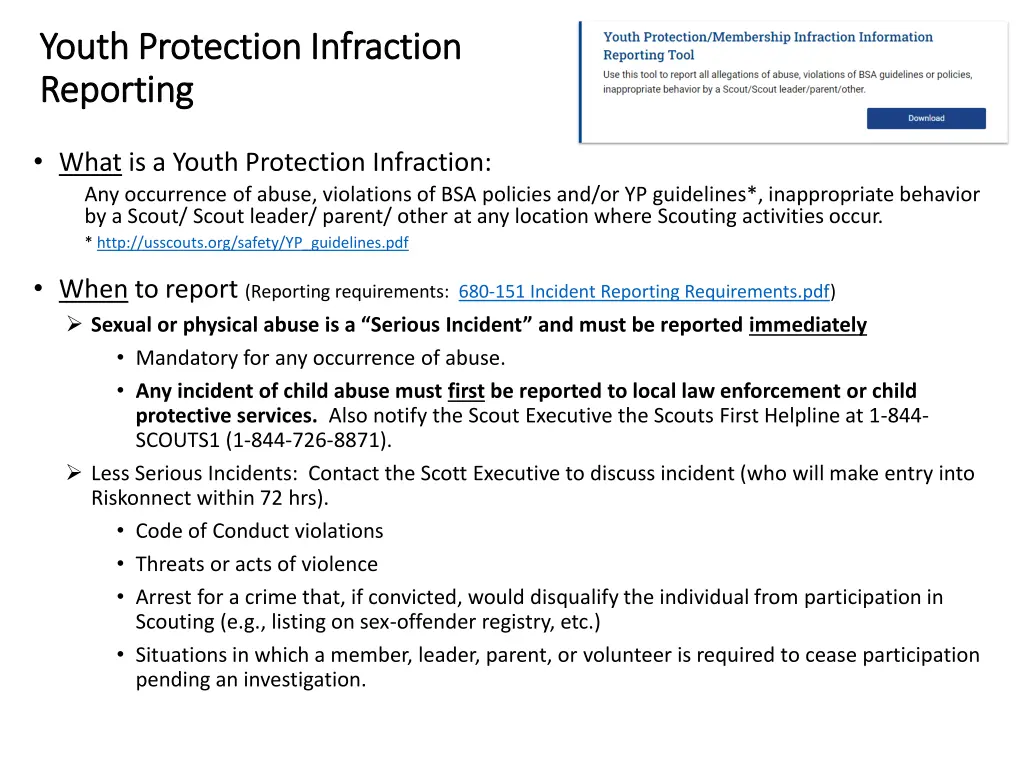
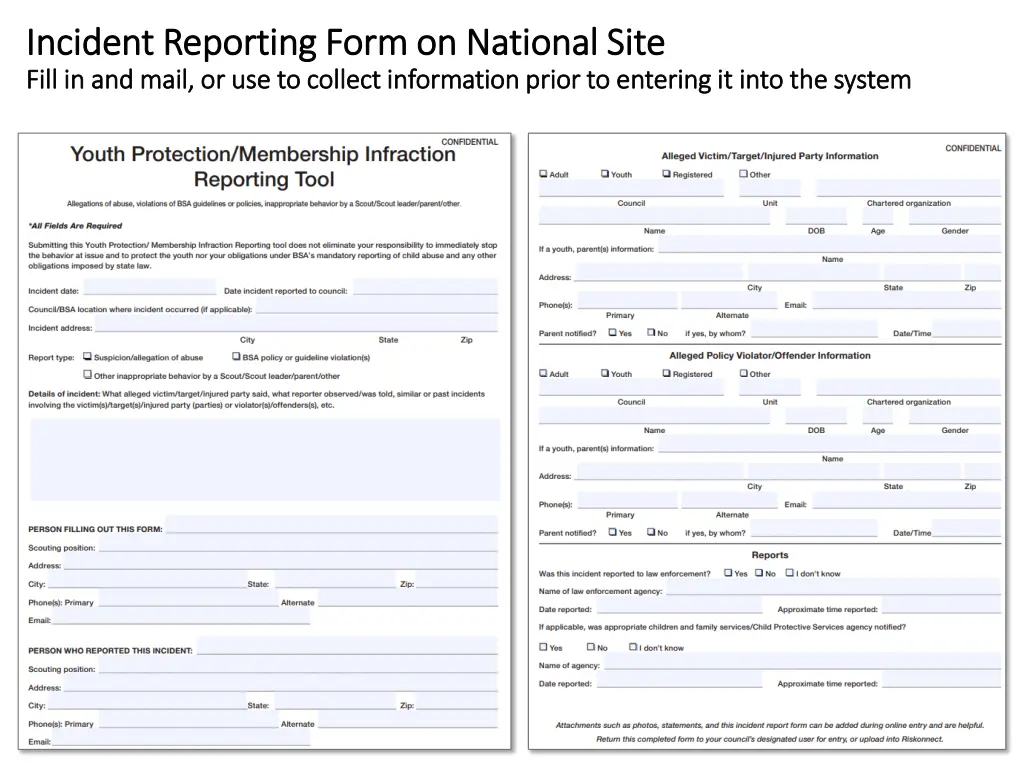
Youth Protection Infraction Youth Protection Infraction Reporting Reporting What is a Youth Protection Infraction: Any occurrence of abuse, violations of BSA policies and/or YP guidelines*, inappropriate behavior by a Scout/ Scout leader/ parent/ other at any location where Scouting activities occur. * http://usscouts.org/safety/YP_guidelines.pdf When to report (Reporting requirements: 680-151 Incident Reporting Requirements.pdf) Sexual or physical abuse is a Serious Incident and must be reported immediately Mandatory for any occurrence of abuse. Any incident of child abuse must first be reported to local law enforcement or child protective services. Also notify the Scout Executive the Scouts First Helpline at 1-844- SCOUTS1 (1-844-726-8871). Less Serious Incidents: Contact the Scott Executive to discuss incident (who will make entry into Riskonnect within 72 hrs). Code of Conduct violations Threats or acts of violence Arrest for a crime that, if convicted, would disqualify the individual from participation in Scouting (e.g., listing on sex-offender registry, etc.) Situations in which a member, leader, parent, or volunteer is required to cease participation pending an investigation.
Incident Reporting Form on National Site Incident Reporting Form on National Site Fill in and mail, or use to collect information prior to entering it into the system Fill in and mail, or use to collect information prior to entering it into the system
Incident Reporting Flowchart Incident Reporting Flowchart Use to determine what type of report to file Use to determine what type of report to file Incident/Near Miss Reporting Flowchart: Incident-Reporting- Infographic.pdf (scouting.org) Start at the top and answer each question until you reach a point where a report is recommended or not. For the Great Falls Council, if an event is a Near Miss, it should be reported.
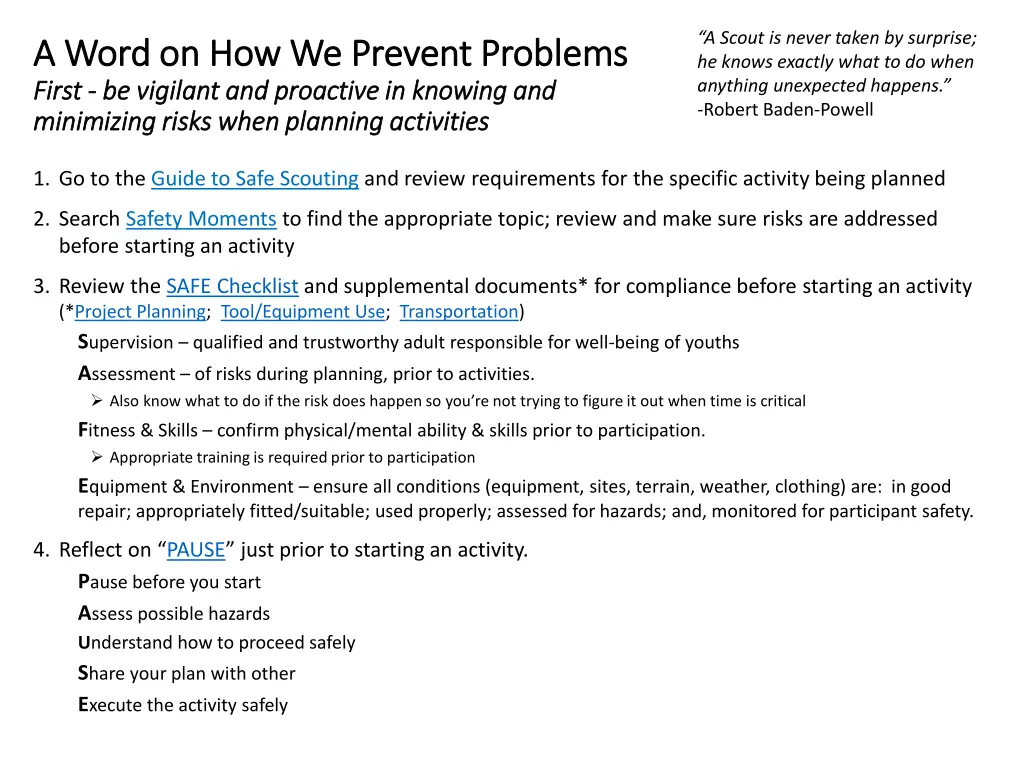
A Scout is never taken by surprise; he knows exactly what to do when anything unexpected happens. -Robert Baden-Powell A Word on How We Prevent Problems A Word on How We Prevent Problems First First - - be vigilant and proactive in knowing and be vigilant and proactive in knowing and minimizing risks when planning activities minimizing risks when planning activities 1. Go to the Guide to Safe Scouting and review requirements for the specific activity being planned 2. Search Safety Moments to find the appropriate topic; review and make sure risks are addressed before starting an activity 3. Review the SAFE Checklist and supplemental documents* for compliance before starting an activity (*Project Planning; Tool/Equipment Use; Transportation) Supervision qualified and trustworthy adult responsible for well-being of youths Assessment of risks during planning, prior to activities. Also know what to do if the risk does happen so you re not trying to figure it out when time is critical Fitness & Skills confirm physical/mental ability & skills prior to participation. Appropriate training is required prior to participation Equipment & Environment ensure all conditions (equipment, sites, terrain, weather, clothing) are: in good repair; appropriately fitted/suitable; used properly; assessed for hazards; and, monitored for participant safety. 4. Reflect on PAUSE just prior to starting an activity. Pause before you start Assess possible hazards Understand how to proceed safely Share your plan with other Execute the activity safely