Proactive Transport in Datacenters
Explore the challenges of congestion control in datacenters and the shift towards proactive solutions like Proactive Congestion Control (PCC). Learn about existing PCC solutions and their key ideas in revolutionizing network transfer scheduling for improved efficiency and performance in high-speed DCNs.

Download Presentation

Please find below an Image/Link to download the presentation.
The content on the website is provided AS IS for your information and personal use only. It may not be sold, licensed, or shared on other websites without obtaining consent from the author. If you encounter any issues during the download, it is possible that the publisher has removed the file from their server.
You are allowed to download the files provided on this website for personal or commercial use, subject to the condition that they are used lawfully. All files are the property of their respective owners.
The content on the website is provided AS IS for your information and personal use only. It may not be sold, licensed, or shared on other websites without obtaining consent from the author.
E N D
Presentation Transcript
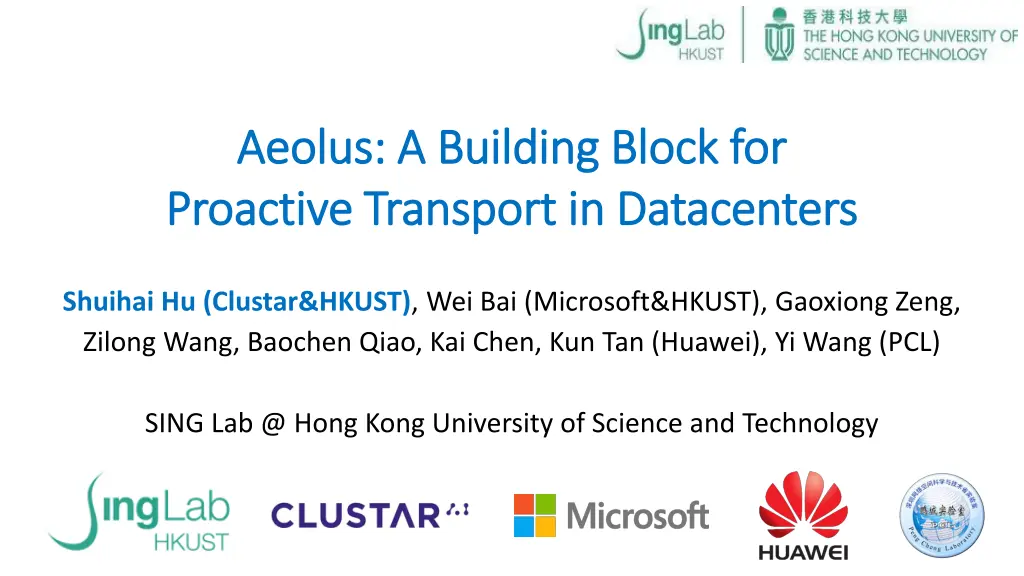
Aeolus: A Building Block for Aeolus: A Building Block for Proactive Transport in Datacenters Proactive Transport in Datacenters Shuihai Hu (Clustar&HKUST), Wei Bai (Microsoft&HKUST), Gaoxiong Zeng, Zilong Wang, Baochen Qiao, Kai Chen, Kun Tan (Huawei), Yi Wang (PCL) SING Lab @ Hong Kong University of Science and Technology 1
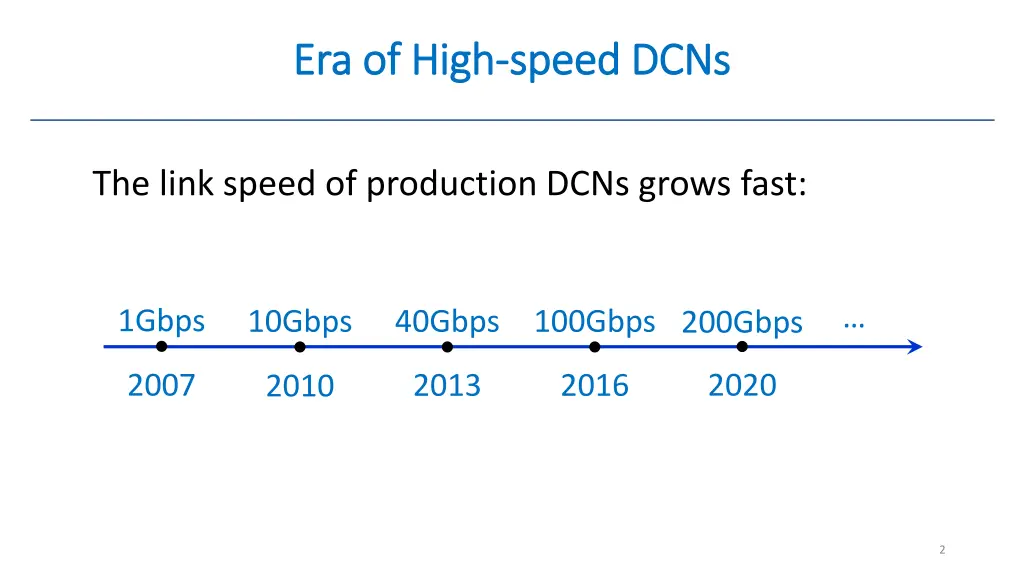
Era of High Era of High- -speed DCNs speed DCNs The link speed of production DCNs grows fast: 1Gbps 10Gbps 40Gbps 100Gbps 200Gbps 2007 2020 2013 2016 2010 2
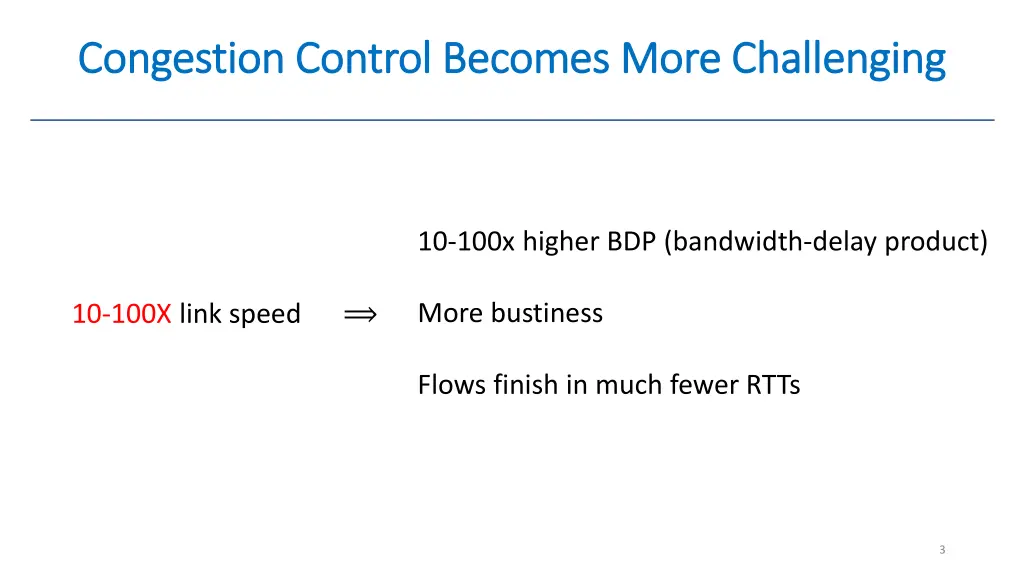
Congestion Control Becomes More Challenging Congestion Control Becomes More Challenging 10-100x higher BDP (bandwidth-delay product) More bustiness 10-100X link speed Flows finish in much fewer RTTs 3
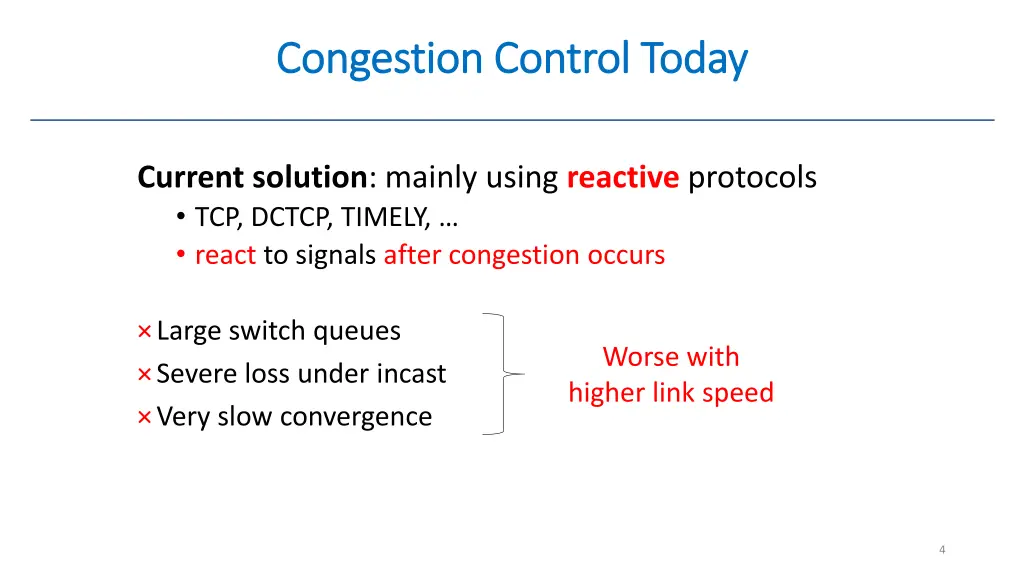
Congestion Control Today Congestion Control Today Current solution: mainly using reactive protocols TCP, DCTCP, TIMELY, react to signals after congestion occurs Large switch queues Severe loss under incast Very slow convergence Worse with higher link speed 4
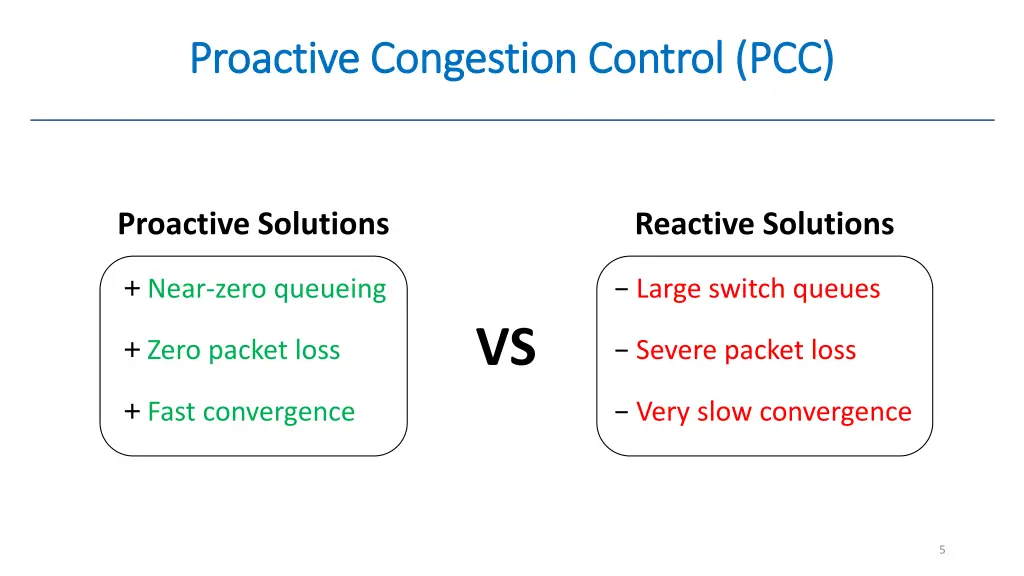
Proactive Congestion Control (PCC) Proactive Congestion Control (PCC) Proactive Solutions Reactive Solutions Near-zero queueing Large switch queues VS Zero packet loss Severe packet loss Fast convergence Very slow convergence 5
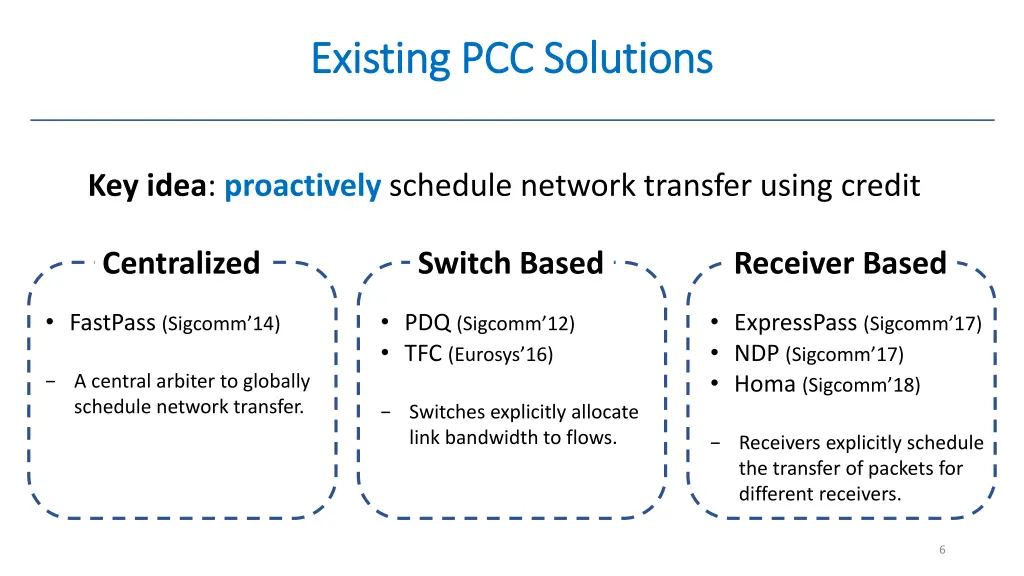
Existing PCC Solutions Existing PCC Solutions Key idea: proactively schedule network transfer using credit Centralized Switch Based Receiver Based FastPass (Sigcomm 14) PDQ (Sigcomm 12) TFC (Eurosys 16) ExpressPass (Sigcomm 17) NDP (Sigcomm 17) Homa (Sigcomm 18) A central arbiter to globally schedule network transfer. Switches explicitly allocate link bandwidth to flows. Receivers explicitly schedule the transfer of packets for different receivers. 6
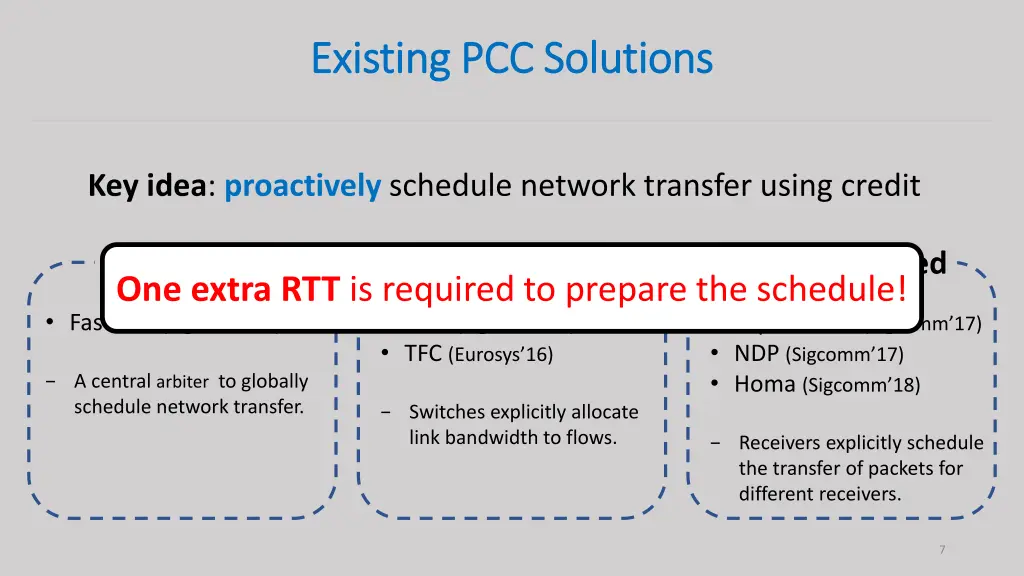
Existing PCC Solutions Existing PCC Solutions Key idea: proactively schedule network transfer using credit Centralized One extra RTT is required to prepare the schedule! Switch Based Receiver Based FastPass (Sigcomm 14) PDQ (Sigcomm 12) TFC (Eurosys 16) ExpressPass (Sigcomm 17) NDP (Sigcomm 17) Homa (Sigcomm 18) A central arbiter to globally schedule network transfer. Switches explicitly allocate link bandwidth to flows. Receivers explicitly schedule the transfer of packets for different receivers. 7
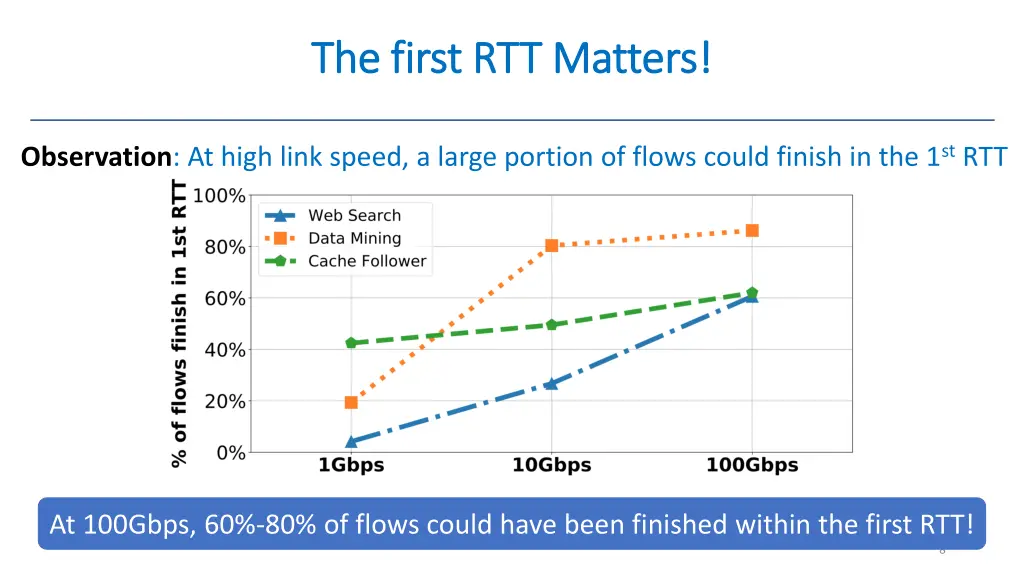
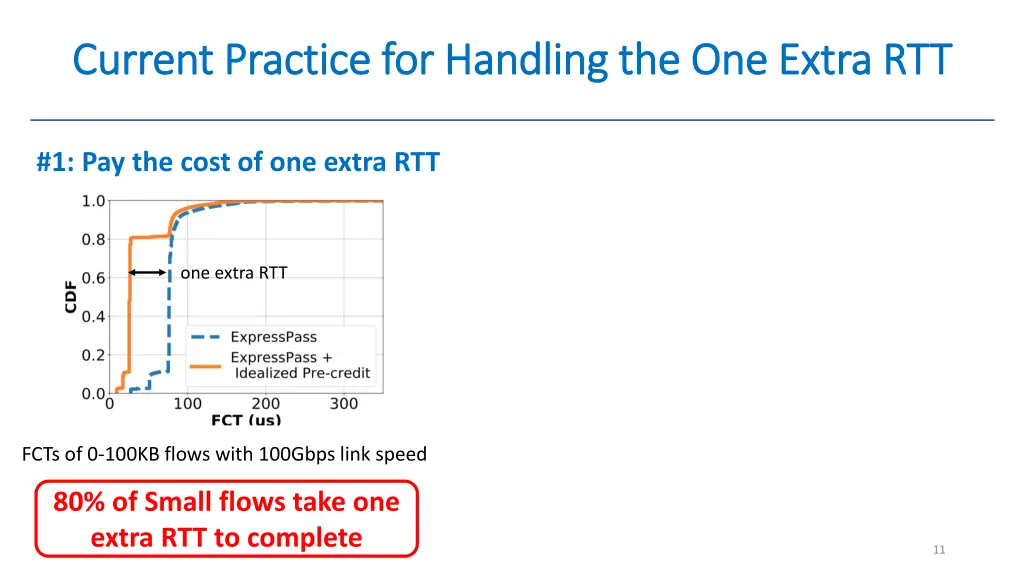
The first RTT The first RTT Matters! Matters! Observation: At high link speed, a large portion of flows could finish in the 1st RTT At 100Gbps, 60%-80% of flows could have been finished within the first RTT! 8
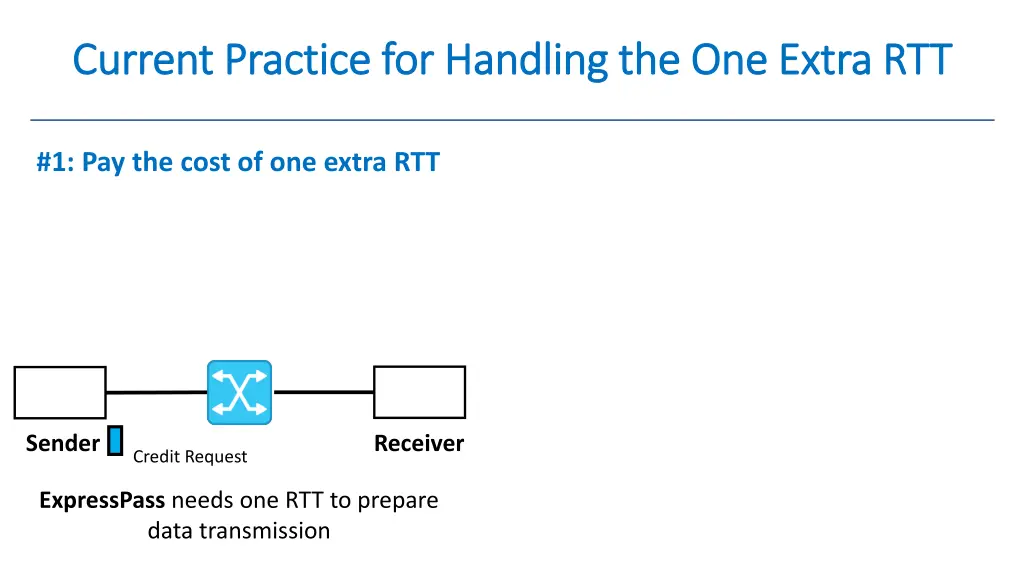
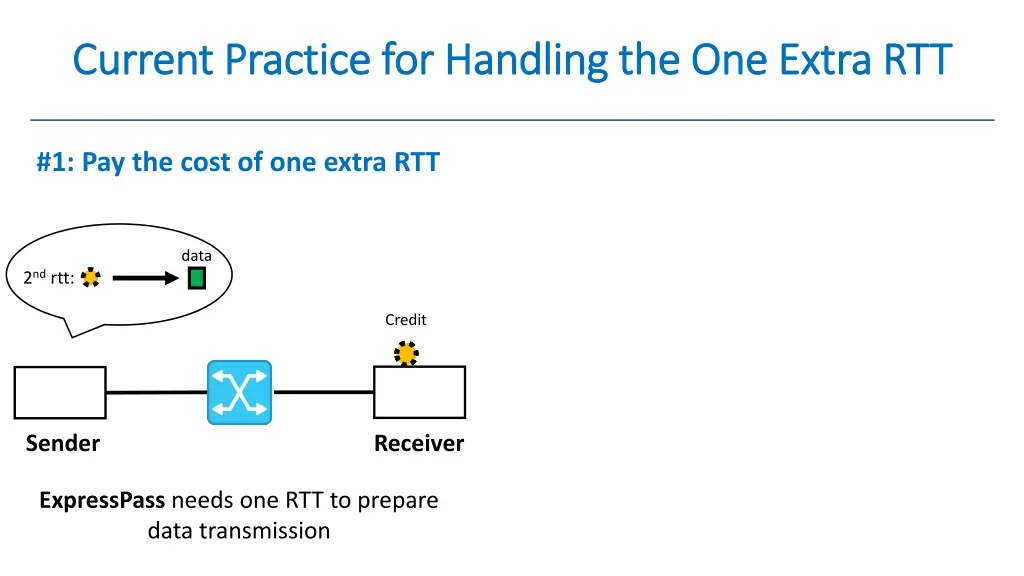
Current Practice for Handling the One Extra RTT Current Practice for Handling the One Extra RTT #1: Pay the cost of one extra RTT Sender Receiver Credit Request ExpressPass needs one RTT to prepare data transmission
Current Practice for Handling the One Extra RTT Current Practice for Handling the One Extra RTT #1: Pay the cost of one extra RTT data 2nd rtt: Credit Sender Receiver ExpressPass needs one RTT to prepare data transmission
Current Practice for Handling the One Extra RTT Current Practice for Handling the One Extra RTT #1: Pay the cost of one extra RTT one extra RTT FCTs of 0-100KB flows with 100Gbps link speed 80% of Small flows take one extra RTT to complete 11
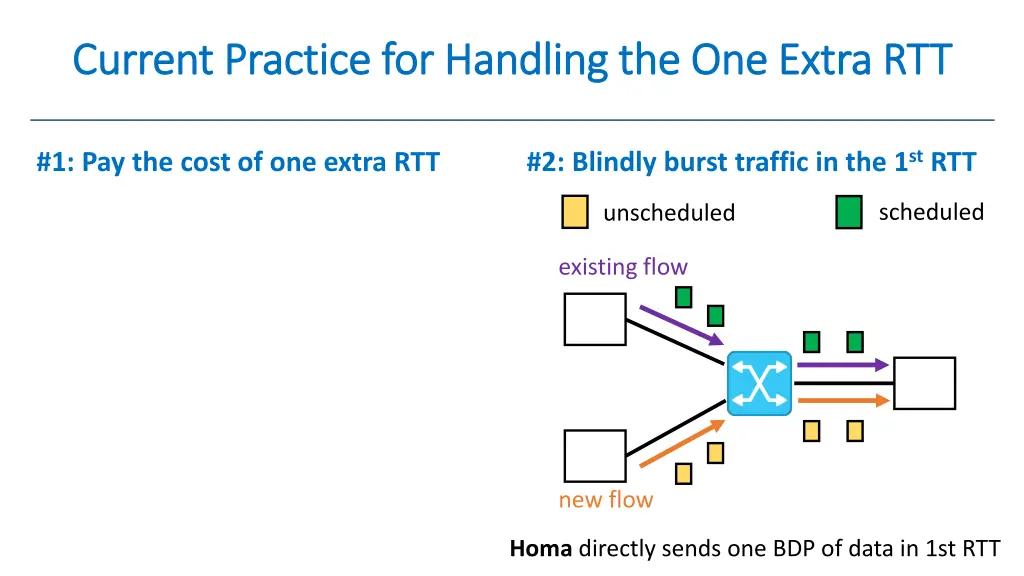
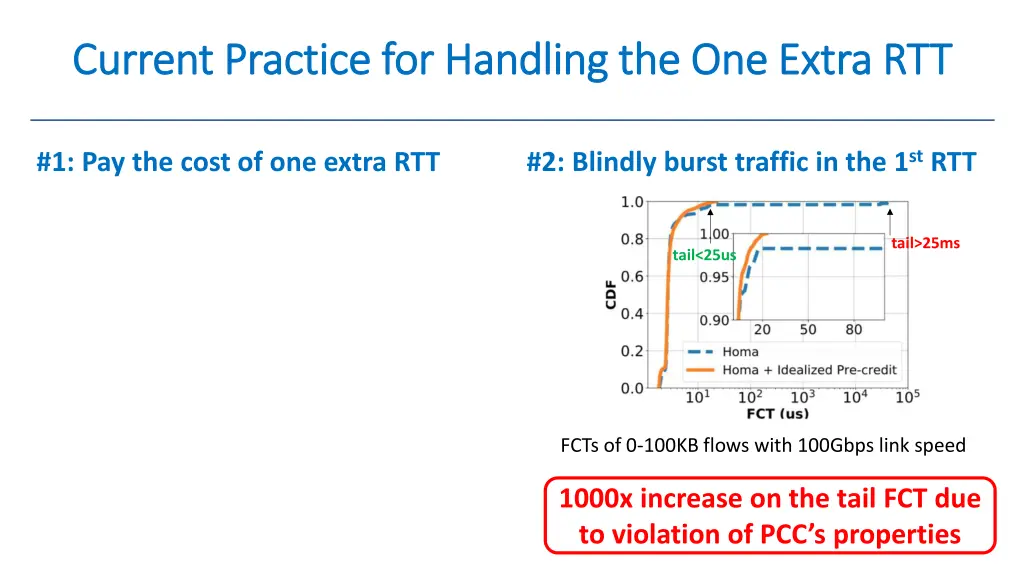
Current Practice for Handling the One Extra RTT Current Practice for Handling the One Extra RTT #2: Blindly burst traffic in the 1st RTT #1: Pay the cost of one extra RTT scheduled unscheduled existing flow new flow Homa directly sends one BDP of data in 1st RTT
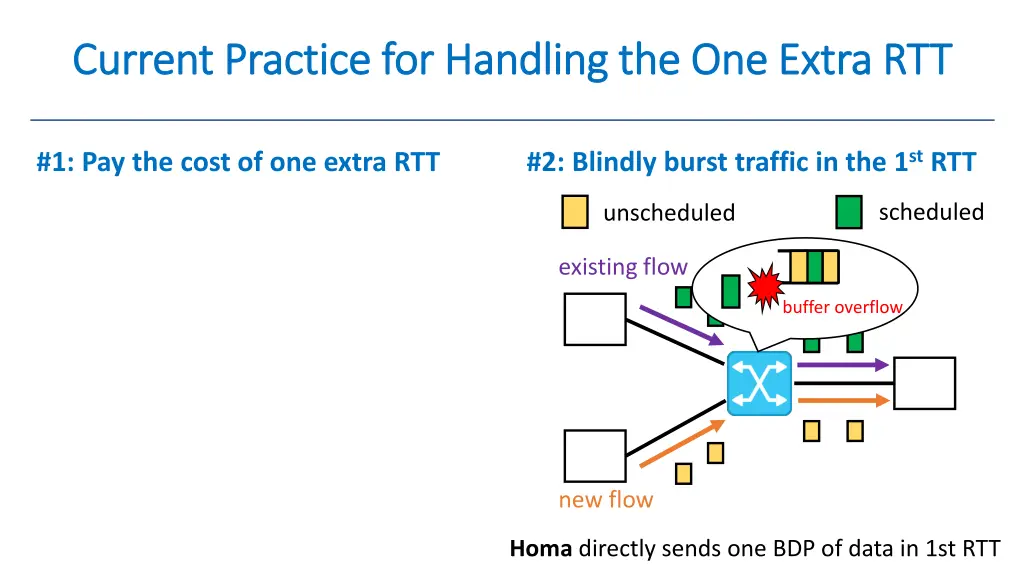
Current Practice for Handling the One Extra RTT Current Practice for Handling the One Extra RTT #2: Blindly burst traffic in the 1st RTT #1: Pay the cost of one extra RTT scheduled unscheduled existing flow buffer overflow new flow Homa directly sends one BDP of data in 1st RTT
Current Practice for Handling the One Extra RTT Current Practice for Handling the One Extra RTT #2: Blindly burst traffic in the 1st RTT #1: Pay the cost of one extra RTT tail>25ms tail<25us FCTs of 0-100KB flows with 100Gbps link speed 1000x increase on the tail FCT due to violation of PCC s properties
Can we eliminate 1 RTT extra delay while preserving all the good properties of PCC? Our answer: Aeolus Aeolus 15
AEOLUS DESIGN AEOLUS DESIGN 16
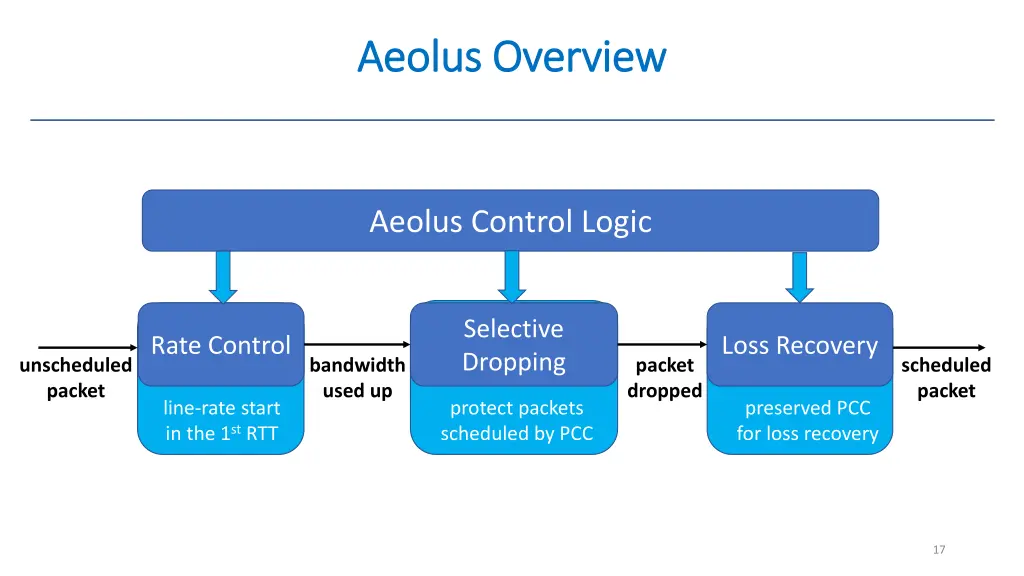
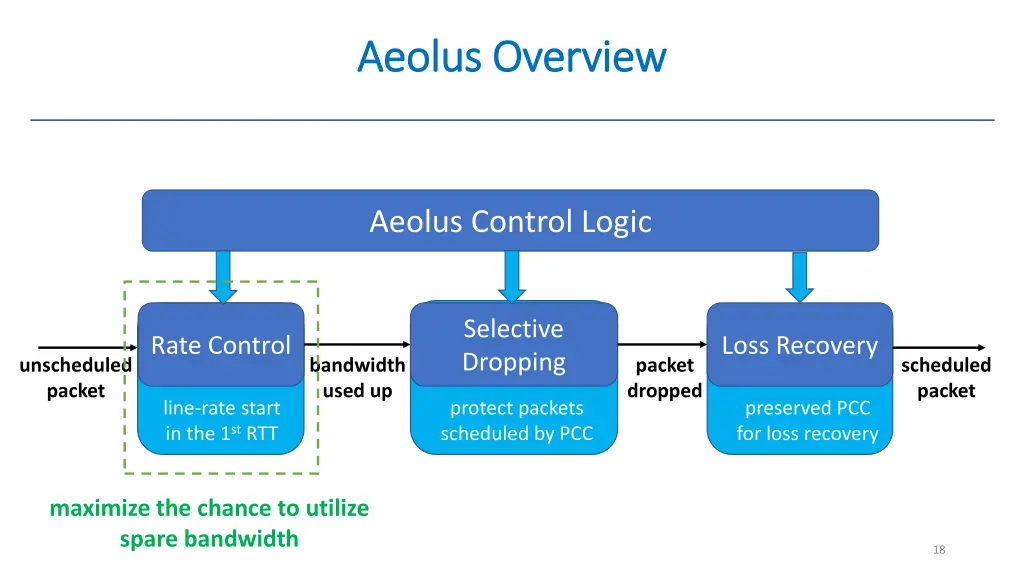
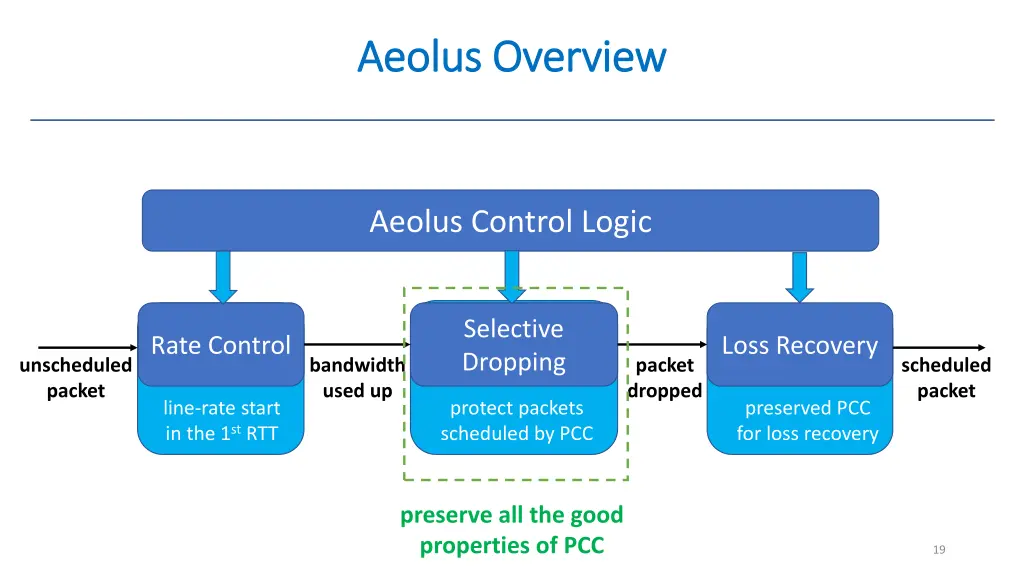
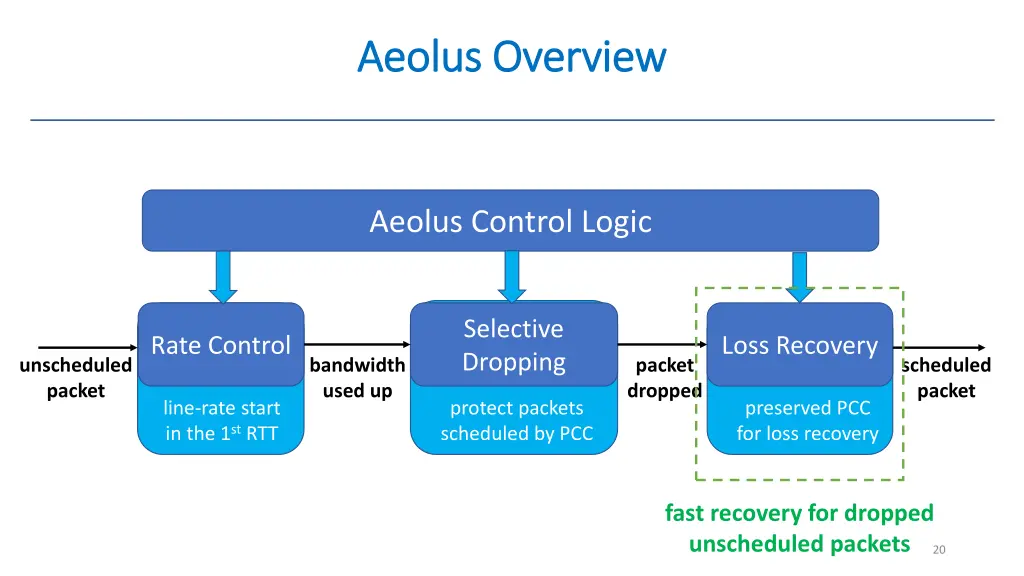
Aeolus Overview Aeolus Overview Aeolus Control Logic Selective Dropping Rate Control Loss Recovery unscheduled packet bandwidth used up packet dropped scheduled packet line-rate start in the 1st RTT protect packets scheduled by PCC preserved PCC for loss recovery 17
Aeolus Overview Aeolus Overview Aeolus Control Logic Selective Dropping Rate Control Loss Recovery unscheduled packet bandwidth used up packet dropped scheduled packet line-rate start in the 1st RTT protect packets scheduled by PCC preserved PCC for loss recovery maximize the chance to utilize spare bandwidth 18
Aeolus Overview Aeolus Overview Aeolus Control Logic Selective Dropping Rate Control Loss Recovery unscheduled packet bandwidth used up packet dropped scheduled packet line-rate start in the 1st RTT protect packets scheduled by PCC preserved PCC for loss recovery preserve all the good properties of PCC 19
Aeolus Overview Aeolus Overview Aeolus Control Logic Selective Dropping Rate Control Loss Recovery unscheduled packet bandwidth used up packet dropped scheduled packet line-rate start in the 1st RTT protect packets scheduled by PCC preserved PCC for loss recovery fast recovery for dropped unscheduled packets 20
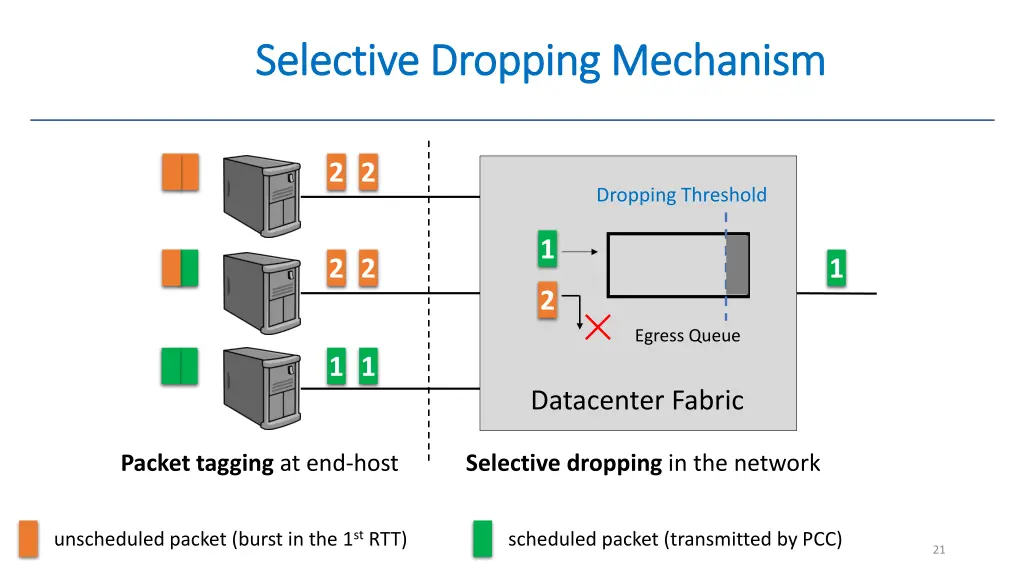
Selective Dropping Mechanism Selective Dropping Mechanism 2 2 Dropping Threshold 1 2 2 1 2 Egress Queue 1 1 Datacenter Fabric Packet tagging at end-host Selective dropping in the network unscheduled packet (burst in the 1st RTT) scheduled packet (transmitted by PCC) 21
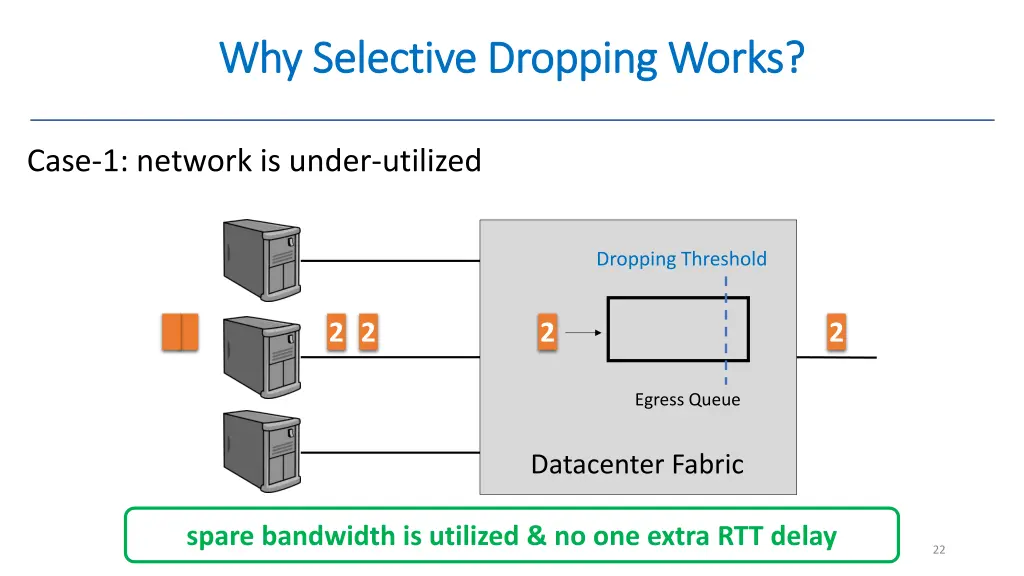
Why Selective Dropping Works? Why Selective Dropping Works? Case-1: network is under-utilized Dropping Threshold 2 2 2 2 Egress Queue Datacenter Fabric spare bandwidth is utilized & no one extra RTT delay 22
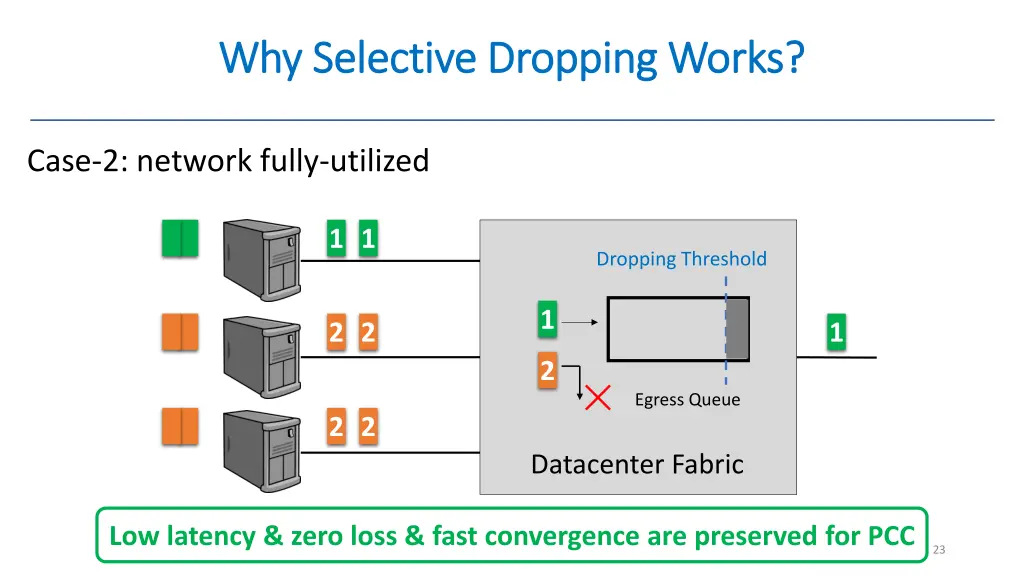
Why Selective Dropping Works? Why Selective Dropping Works? Case-2: network fully-utilized 1 1 Dropping Threshold 1 2 2 1 2 Egress Queue 2 2 Datacenter Fabric Low latency & zero loss & fast convergence are preserved for PCC 23
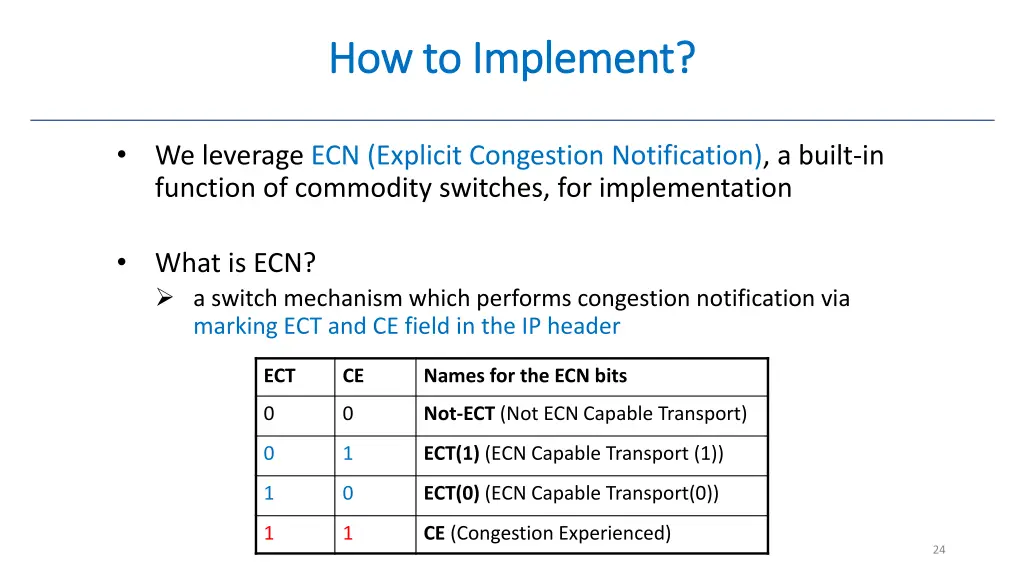
How to Implement? How to Implement? We leverage ECN (Explicit Congestion Notification), a built-in function of commodity switches, for implementation What is ECN? a switch mechanism which performs congestion notification via marking ECT and CE field in the IP header ECT CE Names for the ECN bits 0 0 Not-ECT (Not ECN Capable Transport) 0 1 ECT(1) (ECN Capable Transport (1)) 1 0 ECT(0) (ECN Capable Transport(0)) 1 1 CE (Congestion Experienced) 24
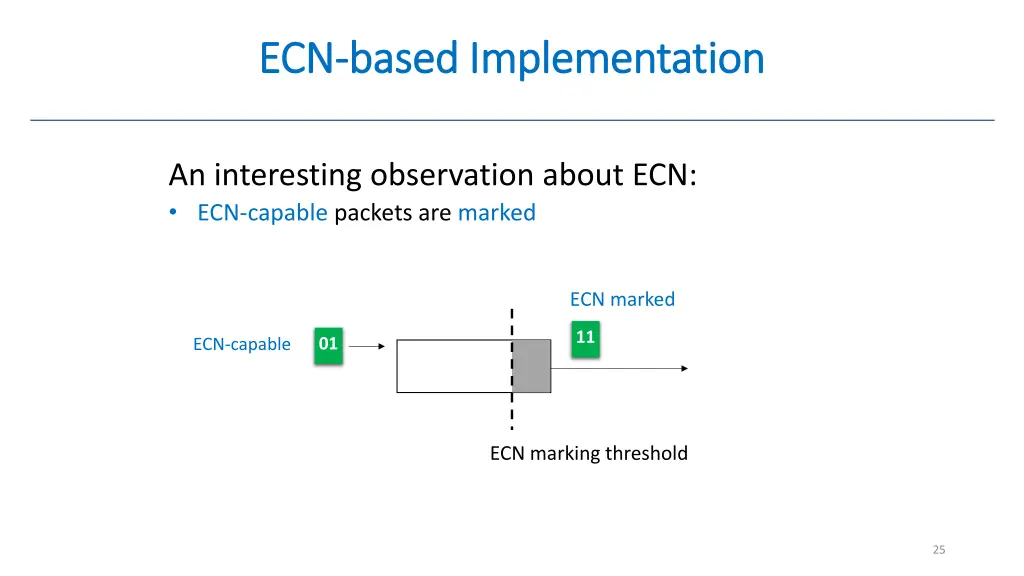
ECN ECN- -based Implementation based Implementation An interesting observation about ECN: ECN-capable packets are marked ECN marked 11 01 ECN-capable ECN marking threshold 25
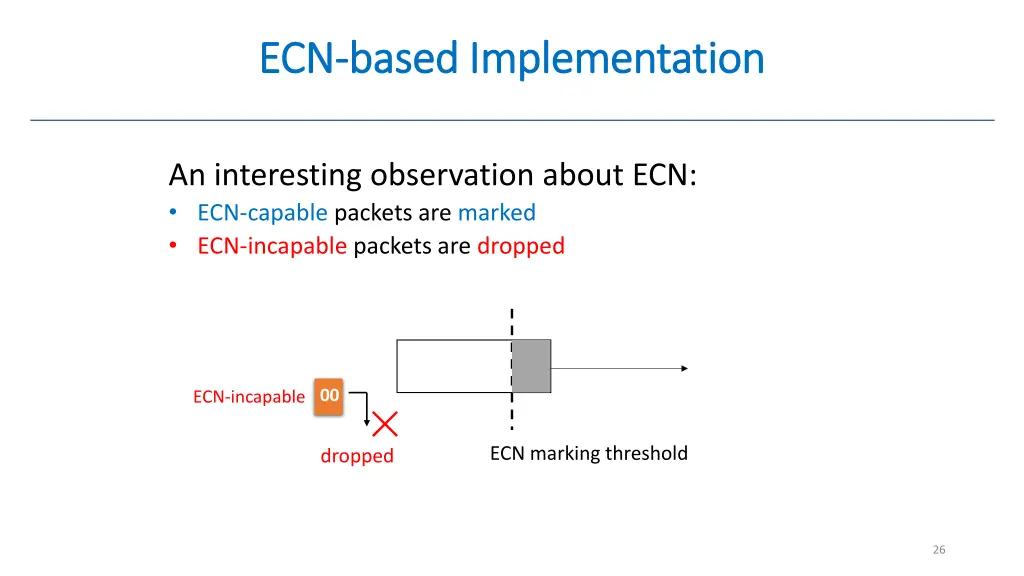
ECN ECN- -based Implementation based Implementation An interesting observation about ECN: ECN-capable packets are marked ECN-incapable packets are dropped ECN-incapable 00 ECN marking threshold dropped 26
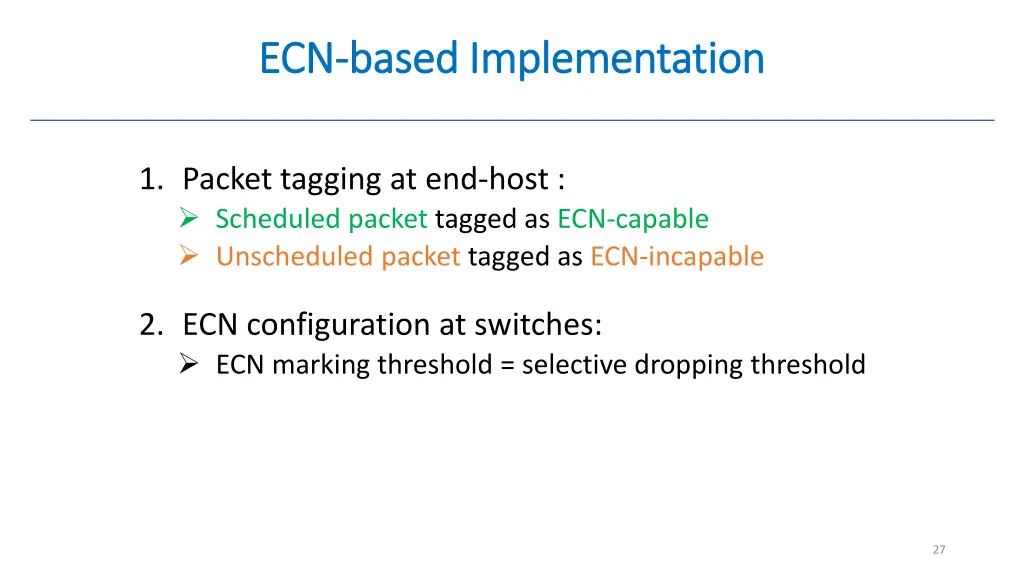
ECN ECN- -based Implementation based Implementation 1. Packet tagging at end-host : Scheduled packet tagged as ECN-capable Unscheduled packet tagged as ECN-incapable 2. ECN configuration at switches: ECN marking threshold = selective dropping threshold 27
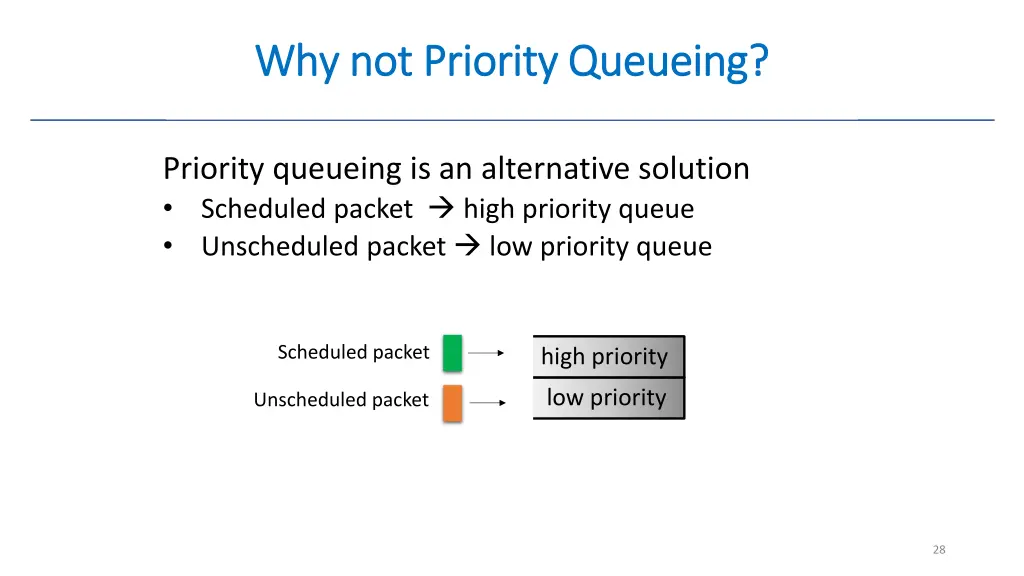
Why not Priority Queueing? Why not Priority Queueing? Priority queueing is an alternative solution Scheduled packet high priority queue Unscheduled packet low priority queue Scheduled packet high priority low priority Unscheduled packet 28
Why not Priority Queueing? Why not Priority Queueing? Drawback #1: 1 additional queue per service class # of supported service classes reduced by half 29
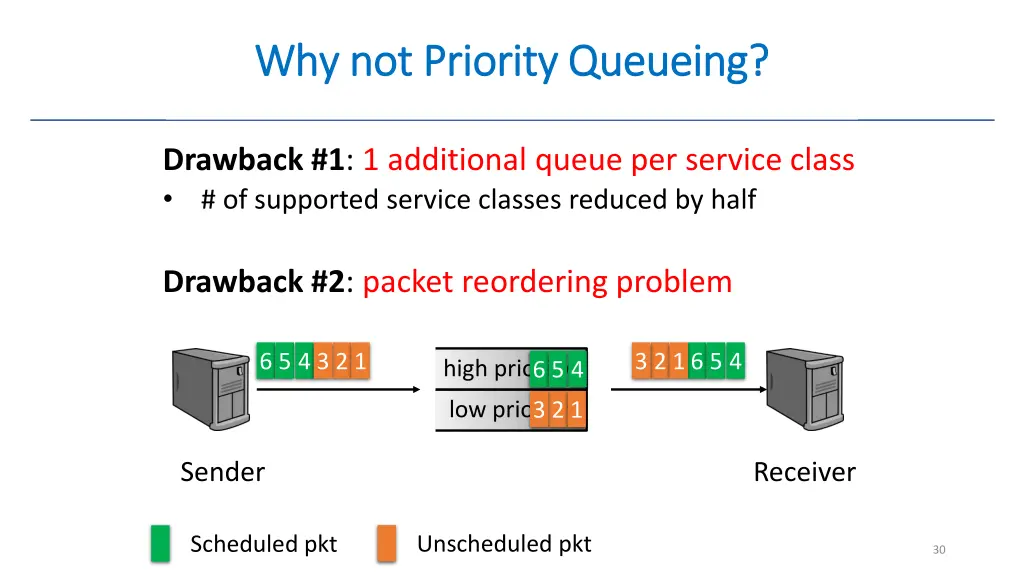
Why not Priority Queueing? Why not Priority Queueing? Drawback #1: 1 additional queue per service class # of supported service classes reduced by half Drawback #2: packet reordering problem 6 5 4 3 2 1 3 2 1 6 5 4 high priority 6 5 4 low priority 3 2 1 Sender Receiver Unscheduled pkt Scheduled pkt 30
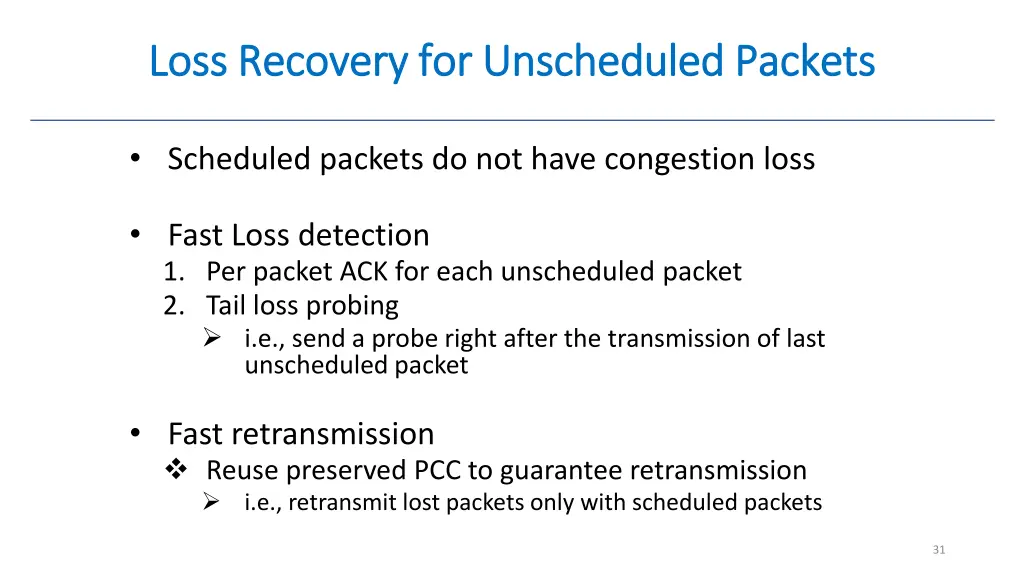
Loss Recovery for Unscheduled Packets Loss Recovery for Unscheduled Packets Scheduled packets do not have congestion loss Fast Loss detection 1. Per packet ACK for each unscheduled packet 2. Tail loss probing i.e., send a probe right after the transmission of last unscheduled packet Fast retransmission Reuse preserved PCC to guarantee retransmission i.e., retransmit lost packets only with scheduled packets 31
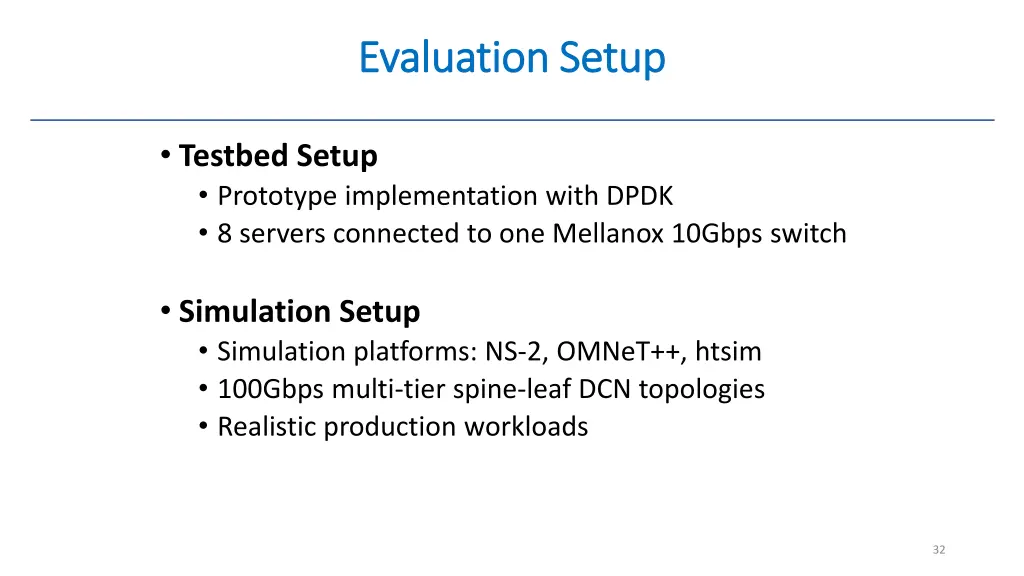
Evaluation Setup Evaluation Setup Testbed Setup Prototype implementation with DPDK 8 servers connected to one Mellanox 10Gbps switch Simulation Setup Simulation platforms: NS-2, OMNeT++, htsim 100Gbps multi-tier spine-leaf DCN topologies Realistic production workloads 32
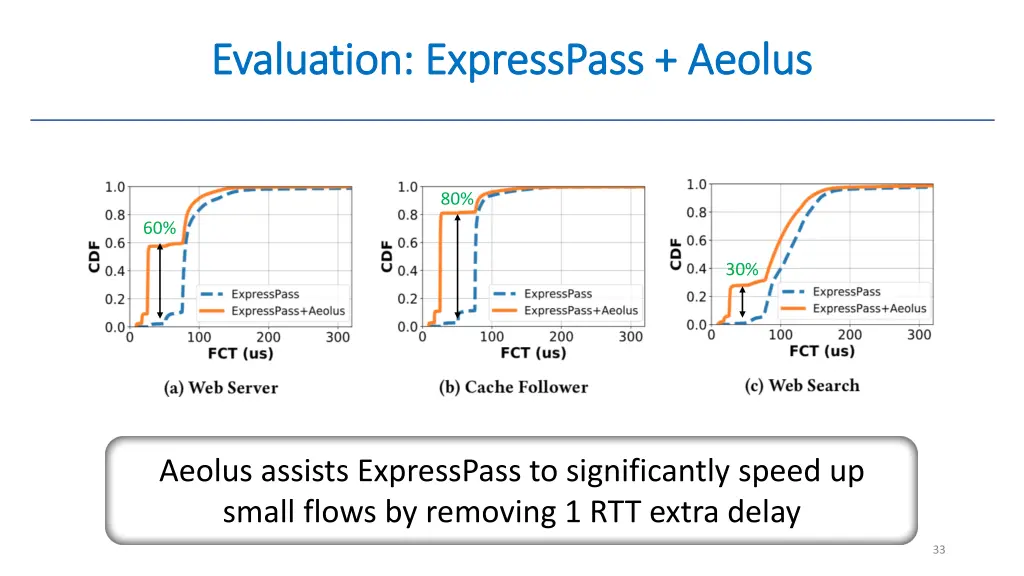
Evaluation: Evaluation: ExpressPass ExpressPass + Aeolus + Aeolus 80% 60% 30% Aeolus assists ExpressPass to significantly speed up small flows by removing 1 RTT extra delay 33
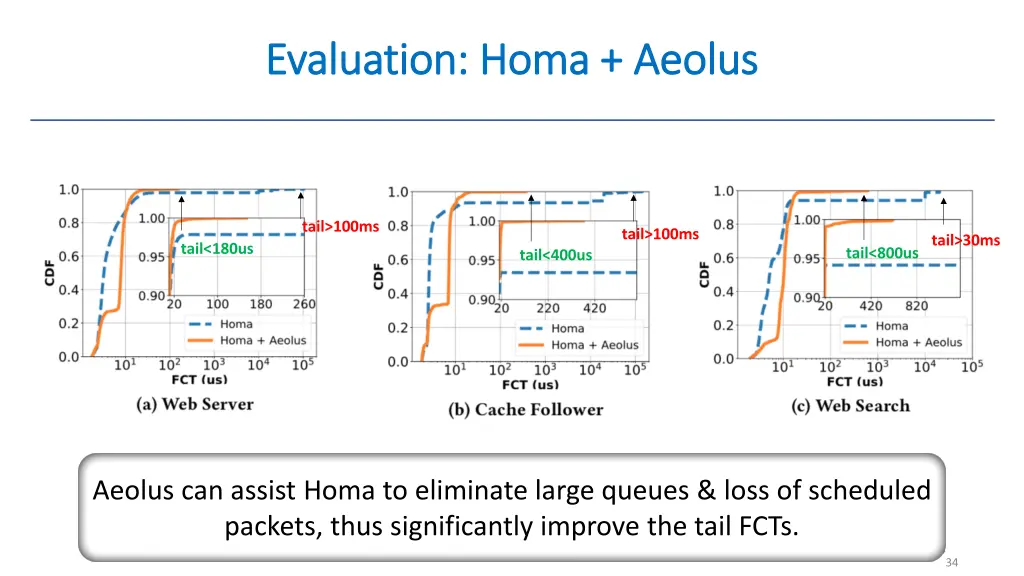
Evaluation: Evaluation: Homa Homa + Aeolus + Aeolus tail>100ms tail>100ms tail>30ms tail<180us tail<800us tail<400us Aeolus can assist Homa to eliminate large queues & loss of scheduled packets, thus significantly improve the tail FCTs. 34 34
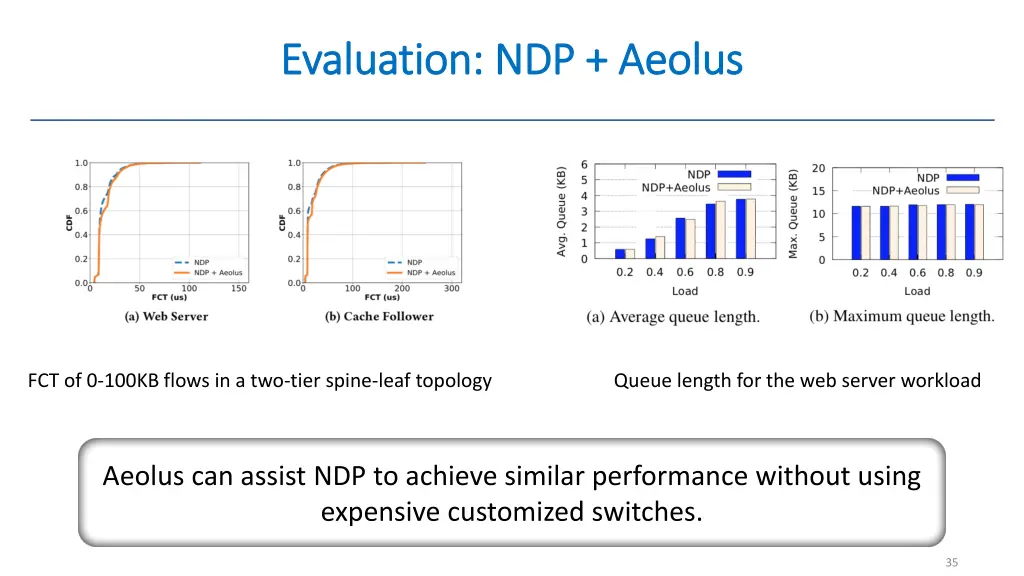
Evaluation: NDP + Aeolus Evaluation: NDP + Aeolus FCT of 0-100KB flows in a two-tier spine-leaf topology Queue length for the web server workload Aeolus can assist NDP to achieve similar performance without using expensive customized switches. 35
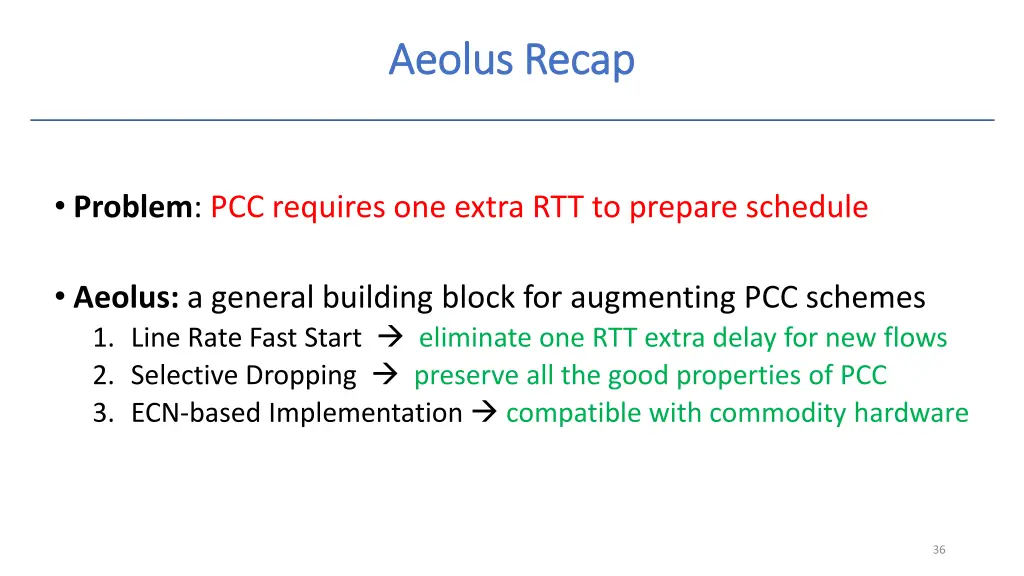
Aeolus Recap Aeolus Recap Problem: PCC requires one extra RTT to prepare schedule Aeolus: a general building block for augmenting PCC schemes 1. Line Rate Fast Start eliminate one RTT extra delay for new flows 2. Selective Dropping preserve all the good properties of PCC 3. ECN-based Implementation compatible with commodity hardware 36
Thanks! Thanks! 37