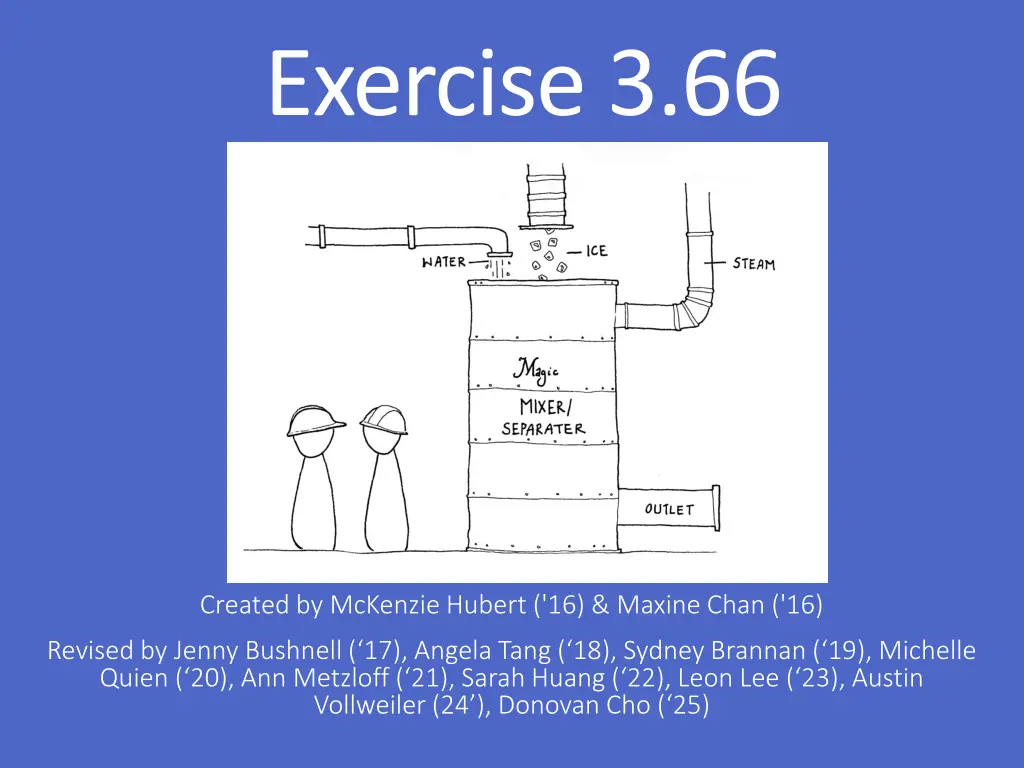
Explore the process involving water, ice, and steam in a mixer, analyzing temperature and composition changes, mass balances, and energy conservation. Learn about cooling, warming, condensing, and more in this comprehensive study.
Please find below an Image/Link to download the presentation.
The content on the website is provided AS IS for your information and personal use only. It may not be sold, licensed, or shared on other websites without obtaining consent from the author. If you encounter any issues during the download, it is possible that the publisher has removed the file from their server.
You are allowed to download the files provided on this website for personal or commercial use, subject to the condition that they are used lawfully. All files are the property of their respective owners.
The content on the website is provided AS IS for your information and personal use only. It may not be sold, licensed, or shared on other websites without obtaining consent from the author.
E N D
Presentation Transcript
Exercise 3.66 Created by McKenzie Hubert ('16) & Maxine Chan ('16) Revised by Jenny Bushnell ( 17), Angela Tang ( 18), Sydney Brannan ( 19), Michelle Quien ( 20), Ann Metzloff ( 21), Sarah Huang ( 22), Leon Lee ( 23), Austin Vollweiler (24 ), Donovan Cho ( 25)
Overview Find: 1. FT,4 2. T4 3. Composition Water at 16 C 10. kg/min 1 Ice at -12 C 4.0 kg/min Mixer 2 4 Steam at 215 C 6.0 kg/min 3
FT,4 Mass Balance Water at 16 C 10. kg/min 1 Rate in = Rate out No chemical rxns Ice at -12 C 4.0 kg/min FT,1 + FT, 2 + FT, 3 = FT,4 10. + 4.0 + 6.0 = FT,4 FT,4 = 20. kg/min 2 4 Mixer Steam at 215 C 6.0 kg/min 3
Temperature and Composition Process with 3 inputs: water, ice, steam What are possible combinations leaving? All steam Water + steam All water Water + ice All ice heat of vaporization (joules mol-1) Thermodynamic properties for H2O P = 1 atm P = 0.005 atm (joules C-1 mol-1)* 33. (solid) 33. (solid) C P 75. (liquid) 75. (liquid) 35. (vapor) 33. (vapor) boiling point ( C) 100 -2 melting point ( C) 0 -2 4.1 104 4.5 104 heat of melting (joules mol-1) 6.0 103 6.8 103 Energy is conserved in the mixer! C * varies with temperature. These values are valid to two significant figures in the range 50 C to 200 C. P
Again, Our Process Water at 16 C 10. kg/min 1 Ice at -12 C 4.0 kg/min Mixer 2 Assume Water at ?? C 20. kg/min Steam at 215 C 6.0 kg/min 3 4
No external heat input equivalent mixer qcooler Water at 16 C 10. kg/min Water at 0 C 1a 1 Cooler qwarmer+melter Ice at -12 C 4.0 kg/min Water at 0 C 2 2a Warmer Melter 3b qcondendser+cooler qtotal Steam at 215 C 6.0 kg/min Water at ?? C 20. kg/min Water at 0 C 3a 3 4 Cooler Warmer Condenser Cooler Warm/cool each stream to 0C water, then warm up to final temperature
Warmer + Melter qwarmer+melter Ice at -12 C 4.0 kg/min 2a 2 Warmer Melter
Repeat Analysis for Other Streams Condenser + Cooler 1) Cool steam to 100 C 2) Condense steam to water 3) Cool water from 100 C to 0 C
equivalent mixer qcooler Water at 16 C 10. kg/min Water at 0 C 1a 1 Cooler qwarmer+melter Ice at -12 C 4.0 kg/min Water at 0 C 2 2a Warmer Melter 3b qcondendser+cooler qtotal Steam at 215 C 6.0 kg/min Water at ?? C 20. kg/min Water at 0 C 3a 3 4 Cooler Warmer Condenser Cooler
Determine Exit Temperature qwarmer+melter Balance around Combiner rate of energy in = rate of energy out qcooler + qcondenser+cooler= qtotal + qwarmer+melter qtotal = +16,756 kJ/min qtotal qcooler qcondenser+cooler Balance around Warmer rate of energy in = rate of energy out qtotal = q4 q3 = FT,4CP,water(T4 T3a) T4 = 201 C BUT WAIT! H2O isn t liquid at 201 C! Let s check our assumptions qtotal Water at ?? C 20. kg/min warmer 3a 4
What are possible combinations leaving? All ice Water + ice All water Water + steam All steam We started here Started with the middle condition all water If T>100 C, must have some (or all) steam If T<0 C, must have some (or all) ice
equivalent mixer qcooler Water at 16 C 10. kg/min 1a 1 cooler qtotal qwarmer+melter Ice at -12 C 4.0 kg/min warmer + melter 2 2a 2b qcondendser+cooler Steam at 215 C 6.0 kg/min Water at 0 C cooler + condenser + cooler 3 3a warmer 3b Water 100 C 3c 3d 3e 4 boiler We predicted water + steam for final product
Energy Balances Energy goes into heating the water to 100C and then vaporizing the water qwarmer Water 100 C warmer 3b 3c Around the Warmer: q3b + qwarmer = q3c qwarmer = q3c q3b = FT,3bCP,water(T3c-T3b) qwarmer = +8333 kJ/min qtotal Around the Splitter: qboiler = qtotal qwarmer qboiler = +8423 kJ/min qwarmer qboiler
How much water converted to steam? qboiler boiler 3d 3e Balance around Boiler q3d + qboiler = q3e qboiler = q3e q3d = FT,3d Hvap FT,3d = qboiler/ Hvap = 3.7 kg/min FT,3d FT,4 so T4 = 100 C Xsteam = FT,3d/FT,4 = 19 wt% steam Xwater = 81 wt% water
Takeaways Break down complicated processes into simple units. Check your signs/directionality! Is heat entering or leaving the stream? Coolers/Condensers Heat is leaving Warmers/Melters/Vaporizers Heat is entering Units! kJ vs. J kg vs. moles (heat capacities) Questions?