Professional Growth & Development for Student Learning
Promote high standards for professional personnel in West Virginia schools to enhance student learning outcomes. Establish evaluation systems for teachers, principals, and counselors based on performance levels and goals.

Download Presentation

Please find below an Image/Link to download the presentation.
The content on the website is provided AS IS for your information and personal use only. It may not be sold, licensed, or shared on other websites without obtaining consent from the author.If you encounter any issues during the download, it is possible that the publisher has removed the file from their server.
You are allowed to download the files provided on this website for personal or commercial use, subject to the condition that they are used lawfully. All files are the property of their respective owners.
The content on the website is provided AS IS for your information and personal use only. It may not be sold, licensed, or shared on other websites without obtaining consent from the author.
E N D
Presentation Transcript
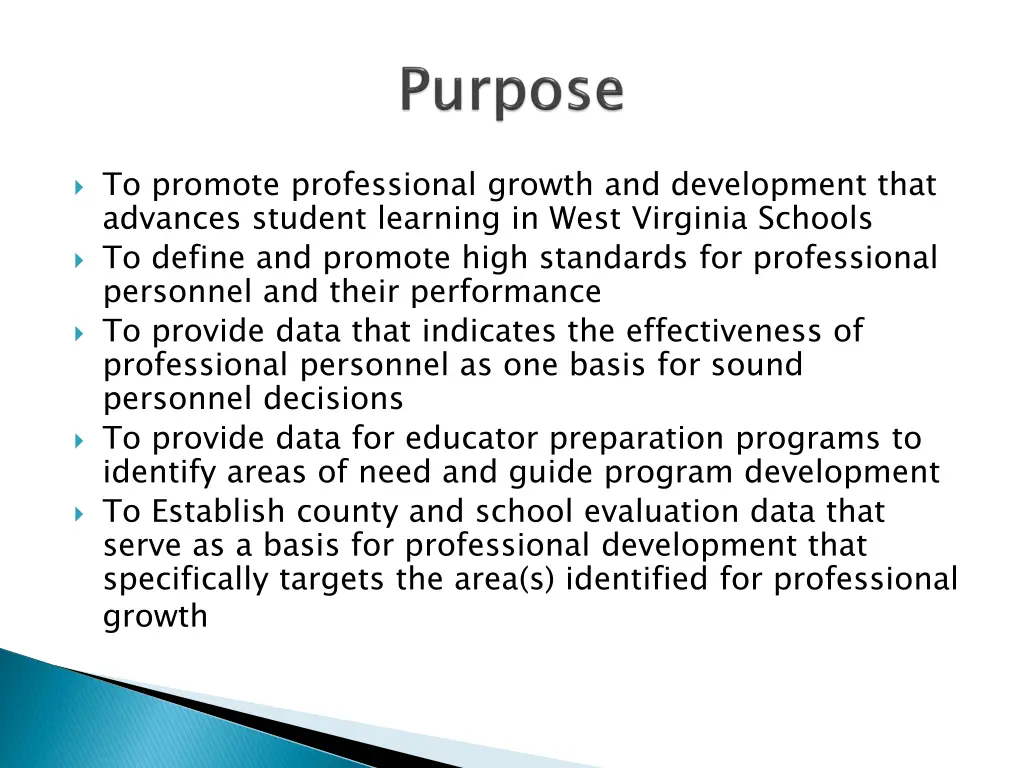
To promote professional growth and development that advances student learning in West Virginia Schools To define and promote high standards for professional personnel and their performance To provide data that indicates the effectiveness of professional personnel as one basis for sound personnel decisions To provide data for educator preparation programs to identify areas of need and guide program development To Establish county and school evaluation data that serve as a basis for professional development that specifically targets the area(s) identified for professional growth
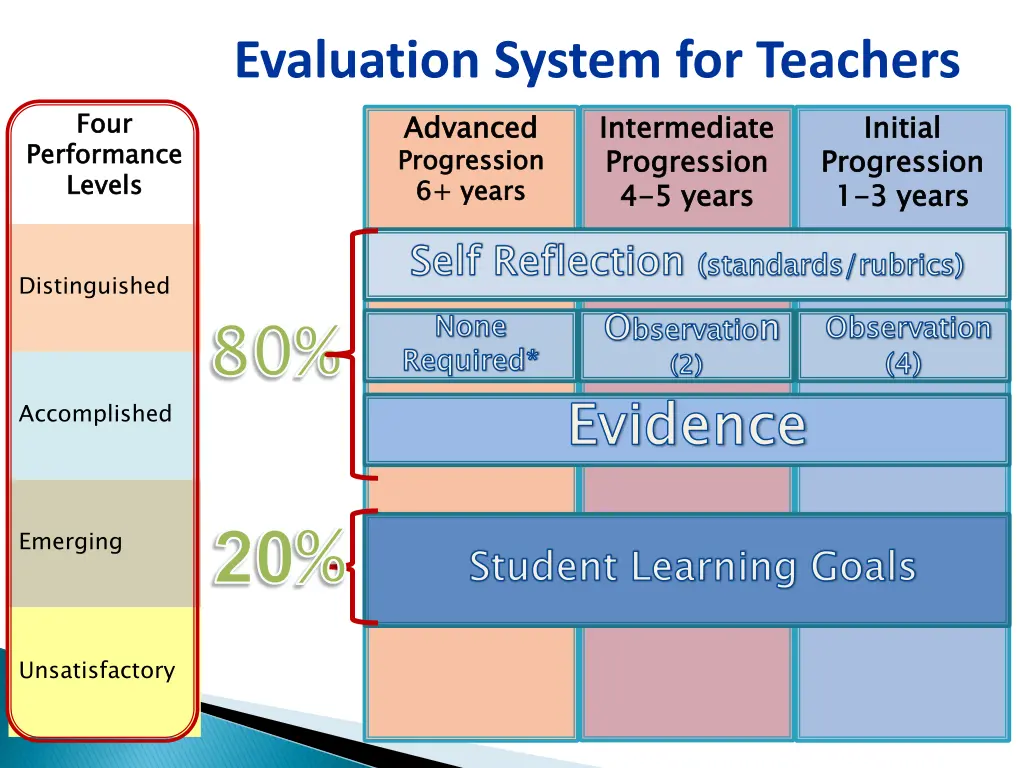
Evaluation System for Teachers Four Four Advanced Progression 6+ years Advanced Progression 6+ years Intermediate Progression 5 years Intermediate Progression 4 4- -5 years Initial Progression 1 1- -3 years Initial Performance Levels Performance Levels Progression 3 years Self Reflection None Required* Self Reflection (standards/rubrics) O Observatio (2) (standards/rubrics) bservation (2) Distinguished 80% 80% n None Required* Observation (4) Observation (4) Evidence Evidence Accomplished 20% % Emerging Student Learning Goals Student Learning Goals Unsatisfactory
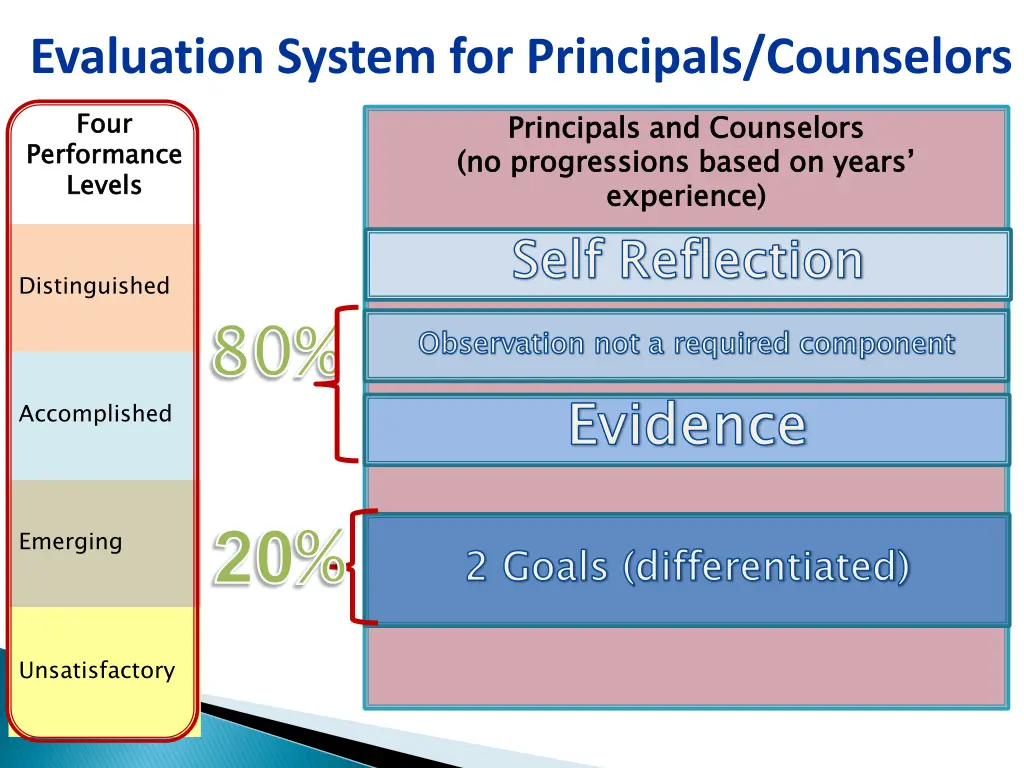
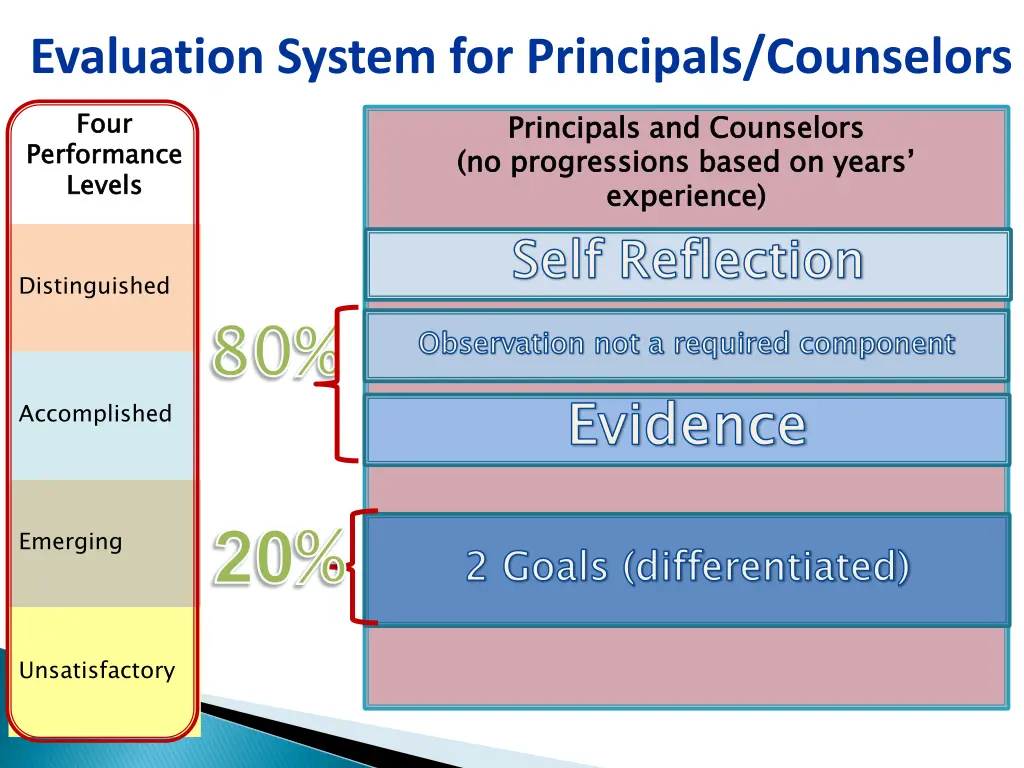
Evaluation System for Principals/Counselors Four Four Principals and Counselors (no progressions based on years experience) Self Reflection Principals and Counselors (no progressions based on years experience) Self Reflection Performance Levels Performance Levels Distinguished 80% 80% Observation not a required component Observation not a required component Evidence Evidence Accomplished 20% % Emerging 2 Goals (differentiated) 2 Goals (differentiated) Unsatisfactory
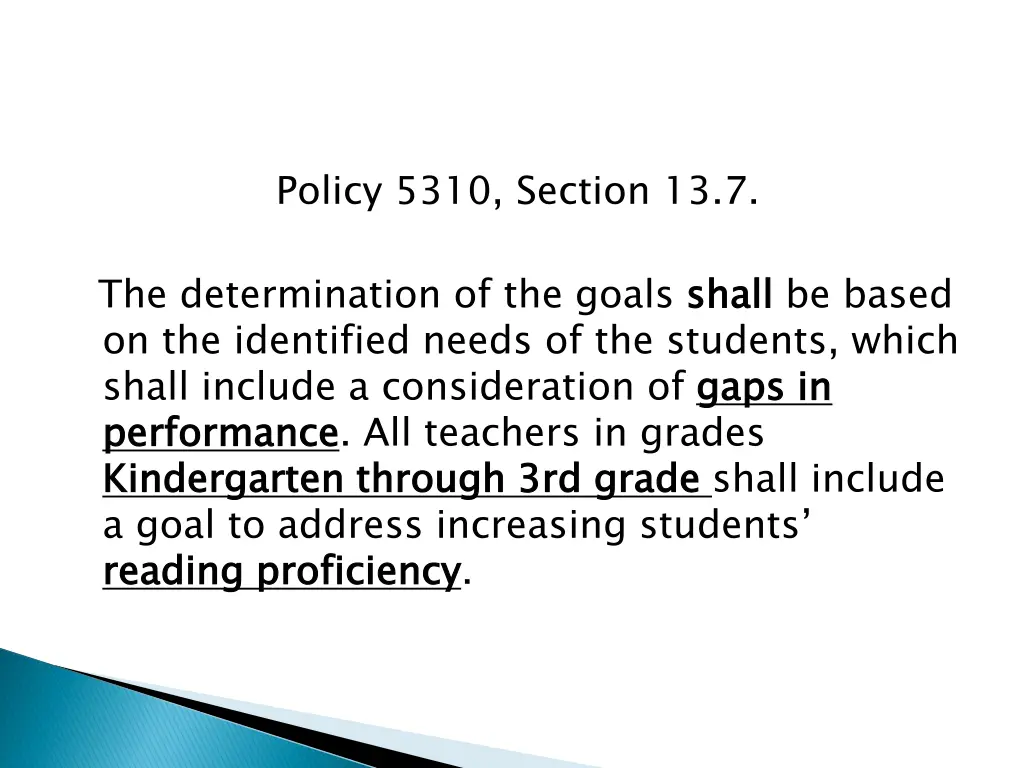
Policy 5310, Section 13.7. The determination of the goals shall on the identified needs of the students, which shall include a consideration of gaps in performance Kindergarten through 3rd grade a goal to address increasing students reading proficiency shall be based gaps in performance. All teachers in grades Kindergarten through 3rd grade shall include reading proficiency.
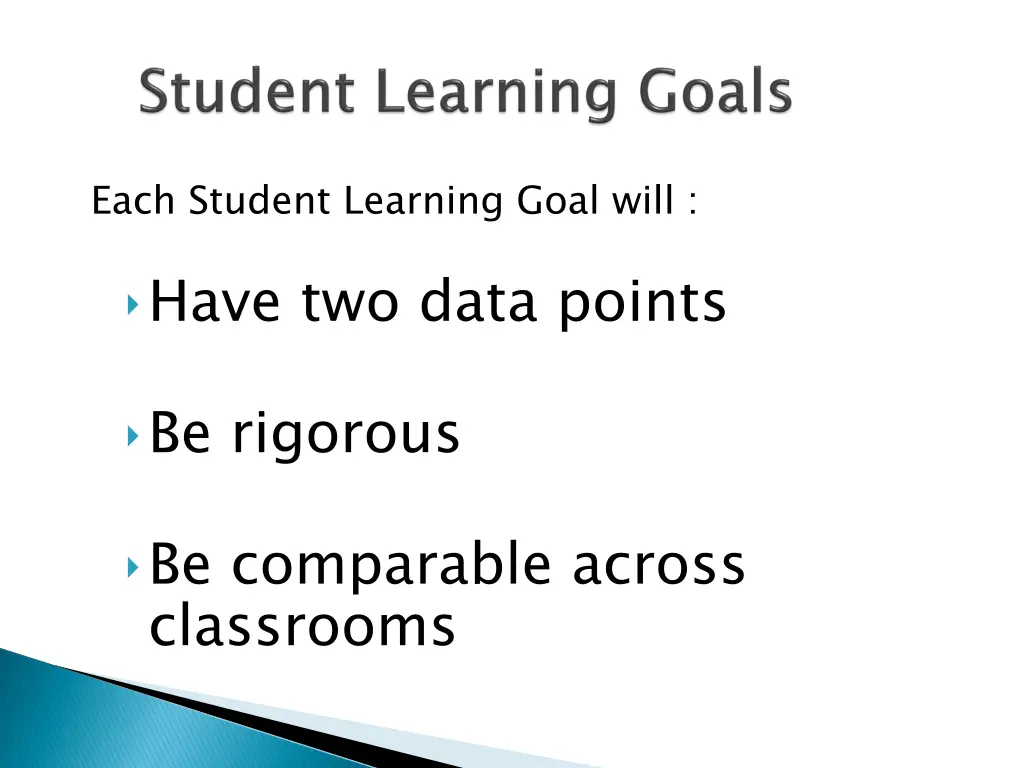
Each Student Learning Goal will : Have two data points Be rigorous Be comparable across classrooms
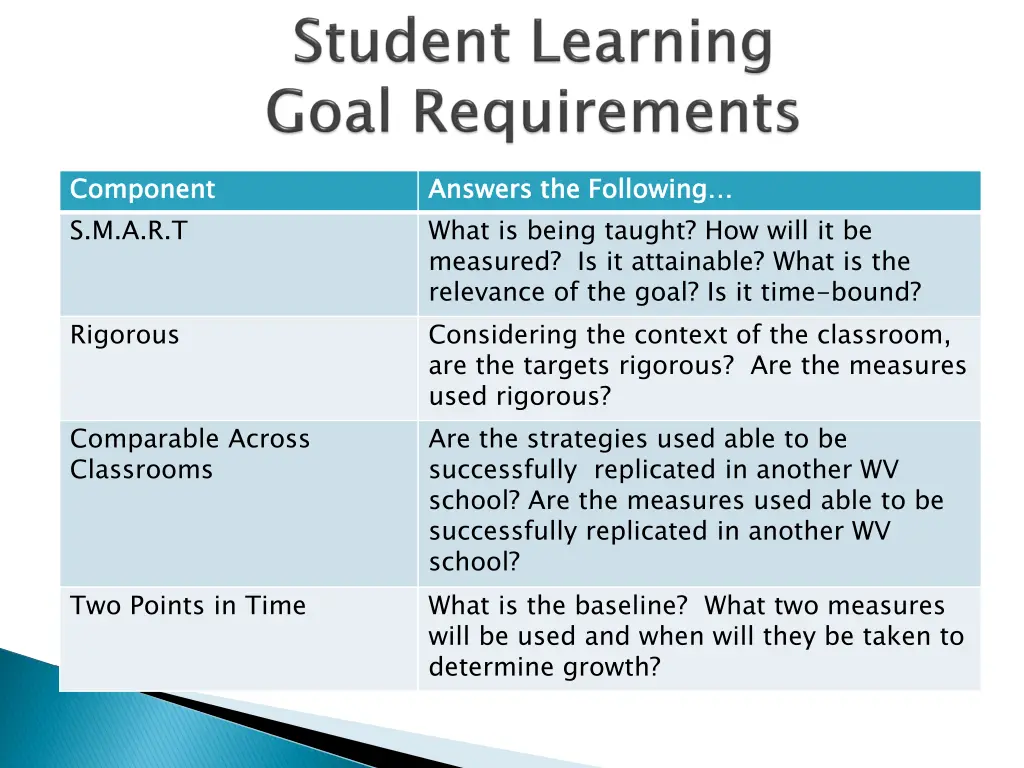
Component S.M.A.R.T Component Answers the Following What is being taught? How will it be measured? Is it attainable? What is the relevance of the goal? Is it time-bound? Considering the context of the classroom, are the targets rigorous? Are the measures used rigorous? Are the strategies used able to be successfully replicated in another WV school? Are the measures used able to be successfully replicated in another WV school? What is the baseline? What two measures will be used and when will they be taken to determine growth? Answers the Following Rigorous Comparable Across Classrooms Two Points in Time
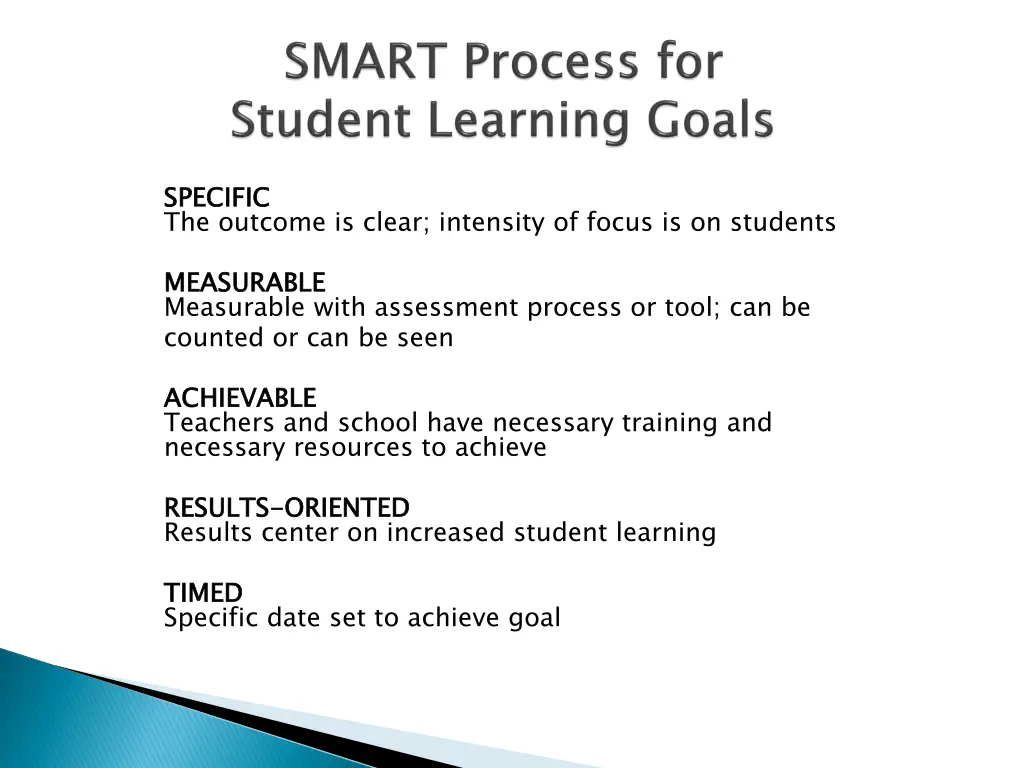
SPECIFIC The outcome is clear; intensity of focus is on students SPECIFIC MEASURABLE Measurable with assessment process or tool; can be counted or can be seen MEASURABLE ACHIEVABLE ACHIEVABLE Teachers and school have necessary training and necessary resources to achieve RESULTS Results center on increased student learning RESULTS- -ORIENTED ORIENTED TIMED Specific date set to achieve goal TIMED
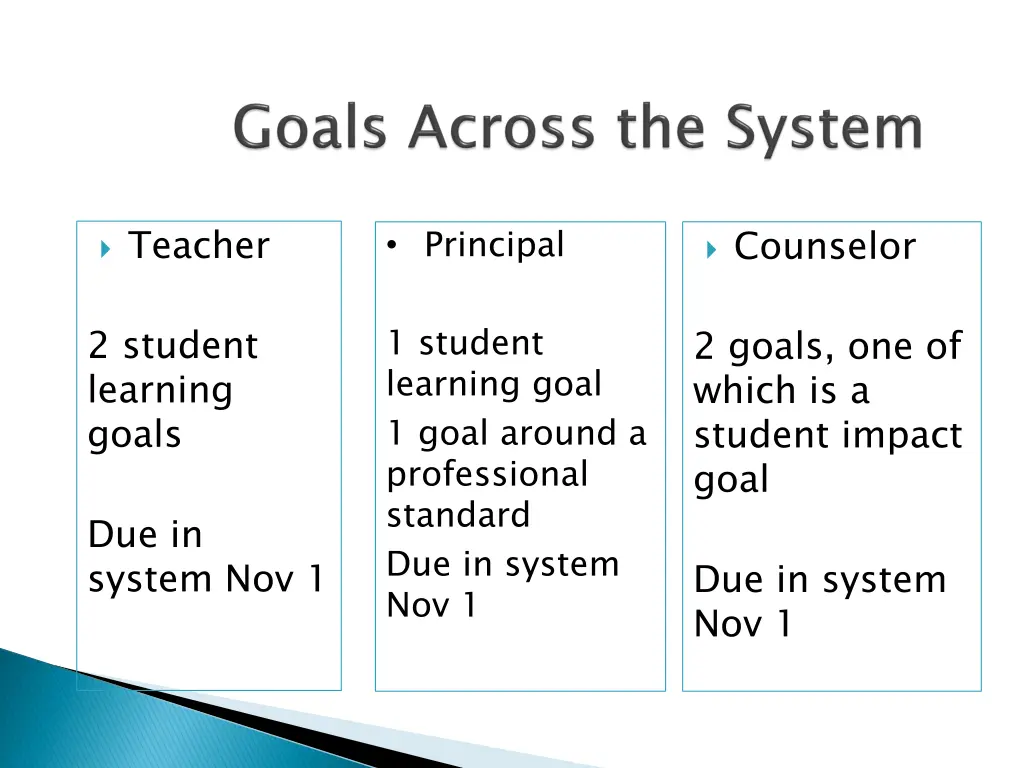
Teacher Counselor Principal 1 student learning goal 1 goal around a professional standard Due in system Nov 1 2 student learning goals 2 goals, one of which is a student impact goal Due in system Nov 1 Due in system Nov 1
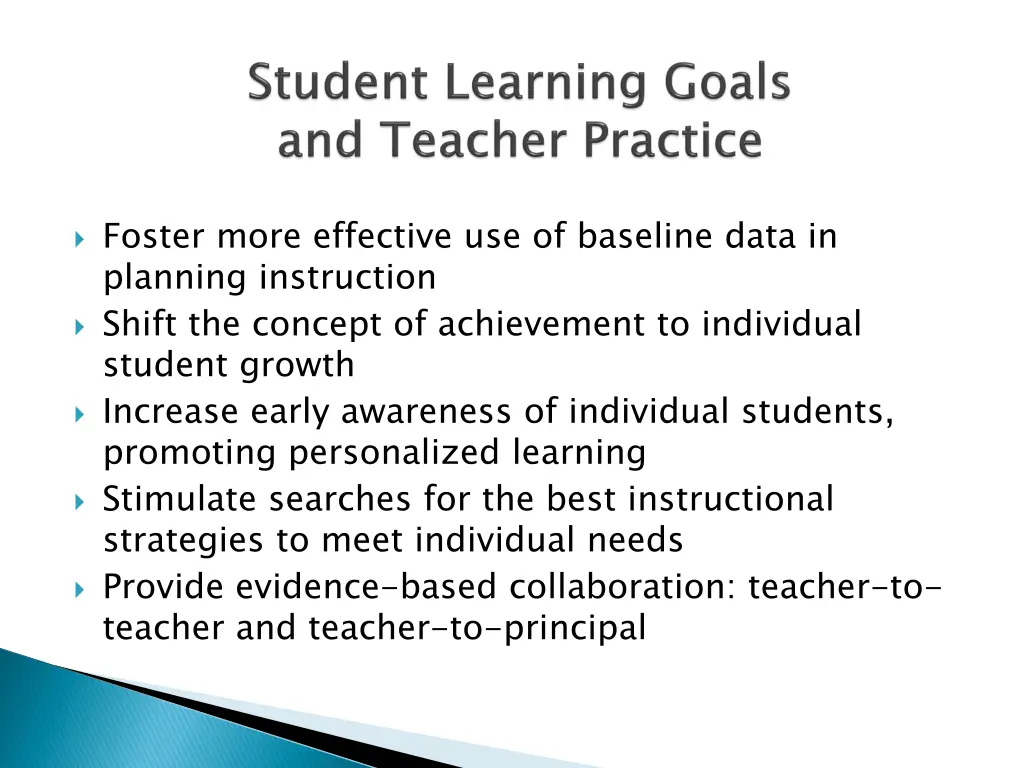
Foster more effective use of baseline data in planning instruction Shift the concept of achievement to individual student growth Increase early awareness of individual students, promoting personalized learning Stimulate searches for the best instructional strategies to meet individual needs Provide evidence-based collaboration: teacher-to- teacher and teacher-to-principal
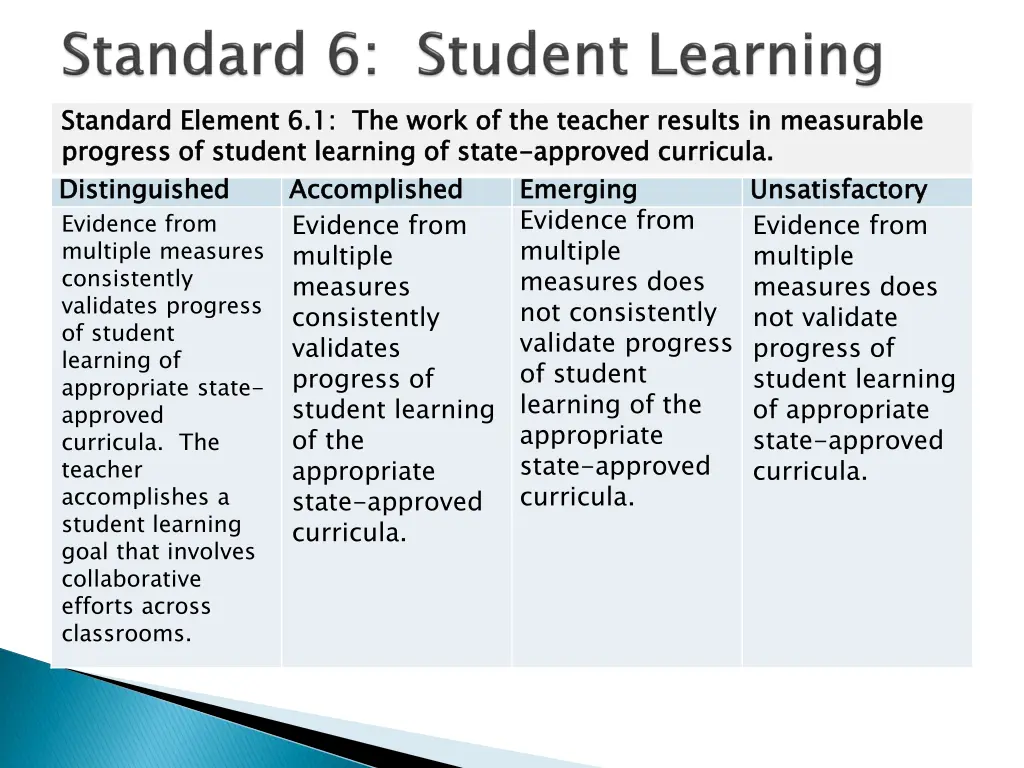
Standard Element 6.1: The work of the teacher results in measurable progress of student learning of state Distinguished Evidence from multiple measures consistently validates progress of student learning of appropriate state- approved curricula. The teacher accomplishes a student learning goal that involves collaborative efforts across classrooms. Standard Element 6.1: The work of the teacher results in measurable progress of student learning of state- -approved curricula. Distinguished Evidence from multiple measures consistently validates progress of student learning of the appropriate state-approved curricula. approved curricula. Emerging Evidence from multiple measures does not consistently validate progress of student learning of the appropriate state-approved curricula. Accomplished Accomplished Emerging Unsatisfactory Evidence from multiple measures does not validate progress of student learning of appropriate state-approved curricula. Unsatisfactory
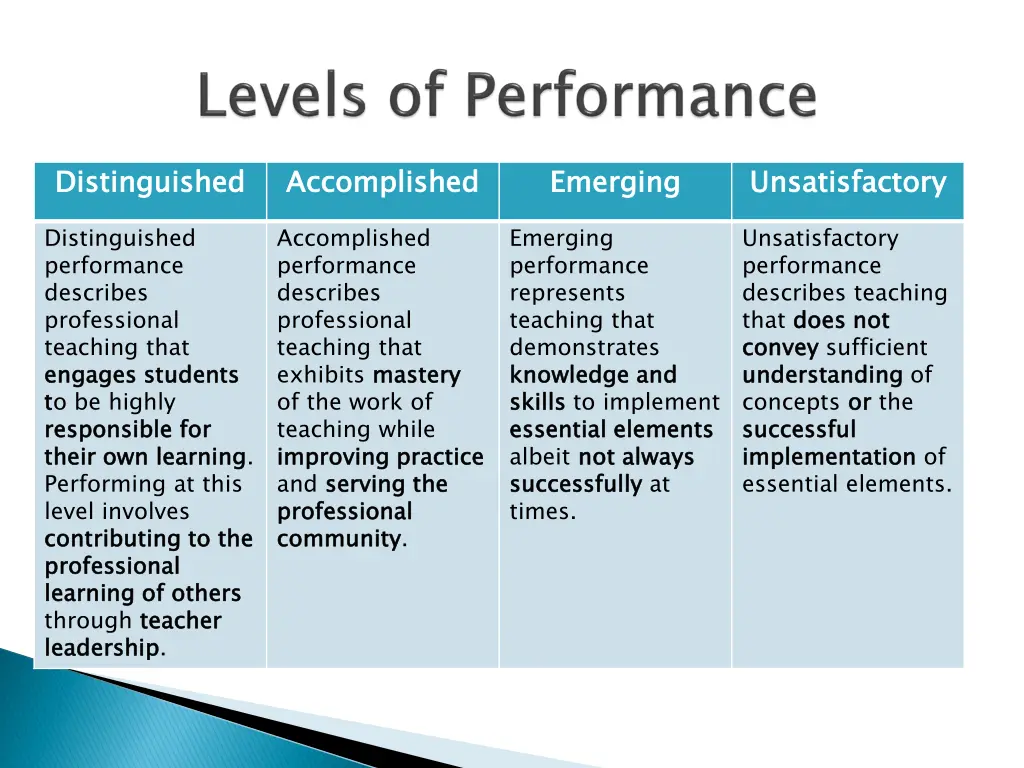
Distinguished Distinguished Accomplished Accomplished Emerging Emerging Unsatisfactory Unsatisfactory Distinguished performance describes professional teaching that engages students t to be highly responsible for their own learning Performing at this level involves contributing to the professional learning of others through teacher leadership Accomplished performance describes professional teaching that exhibits mastery of the work of teaching while improving practice and serving the professional community Emerging performance represents teaching that demonstrates knowledge and skills essential elements albeit not always successfully times. Unsatisfactory performance describes teaching that does not convey understanding concepts or successful implementation essential elements. does not convey sufficient understanding of engages students mastery knowledge and skills to implement essential elements not always successfully at or the responsible for their own learning. successful implementation of improving practice serving the professional community. contributing to the professional learning of others teacher leadership.
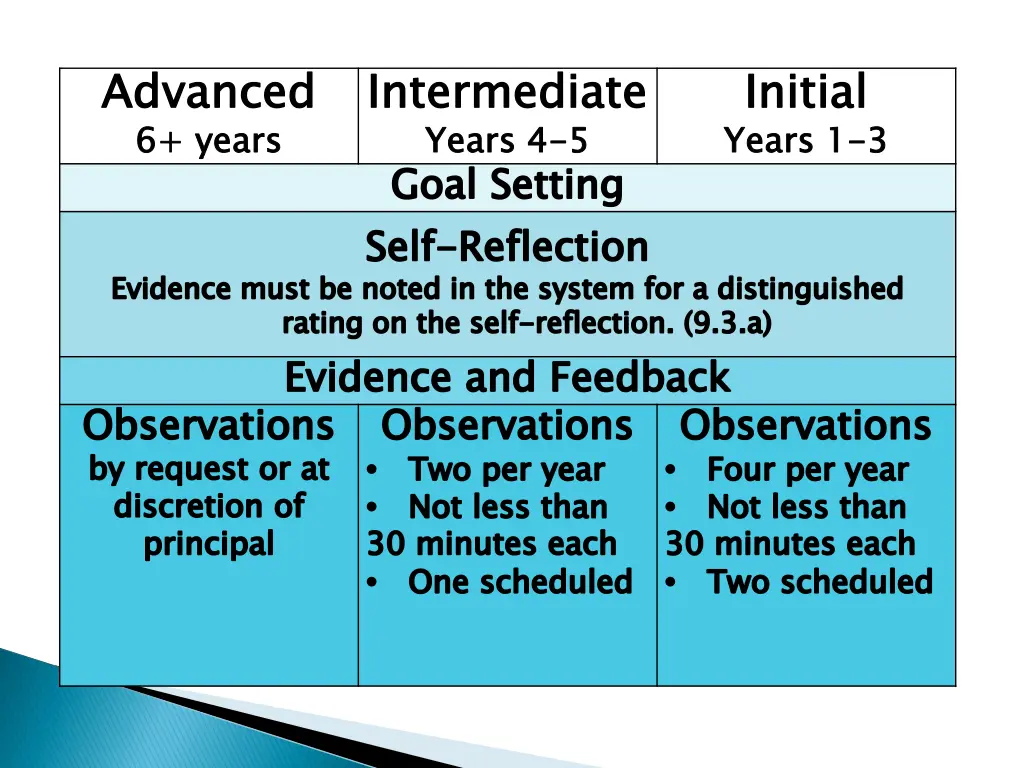
Advanced 6+ years Advanced 6+ years Intermediate Years 4 Goal Setting Self-Reflection Intermediate Years 4- -5 5 Initial Years Initial Years 1 1- -3 3 Evidence must be noted in the system for a distinguished rating on the self-reflection. (9.3.a) Evidence and Feedback Observations by request or at discretion of principal One scheduled Observations Two per year Not less than 30 minutes each Observations Four per year Not less than 30 minutes each Two scheduled
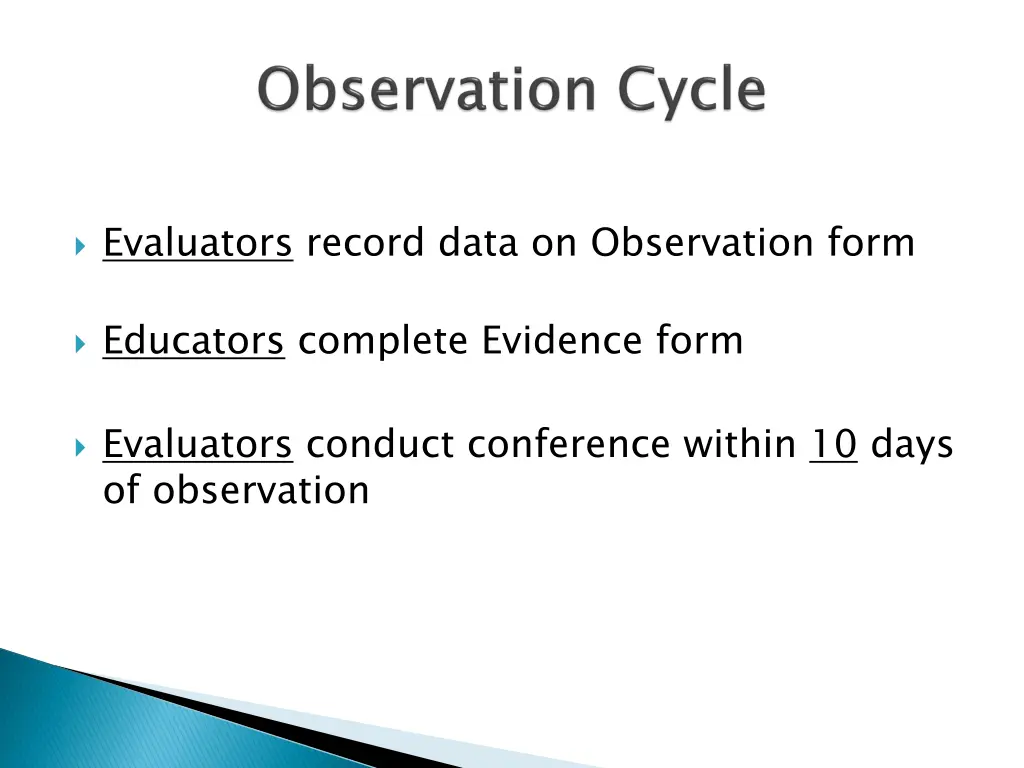
Evaluators record data on Observation form Educators complete Evidence form Evaluators conduct conference within 10 days of observation
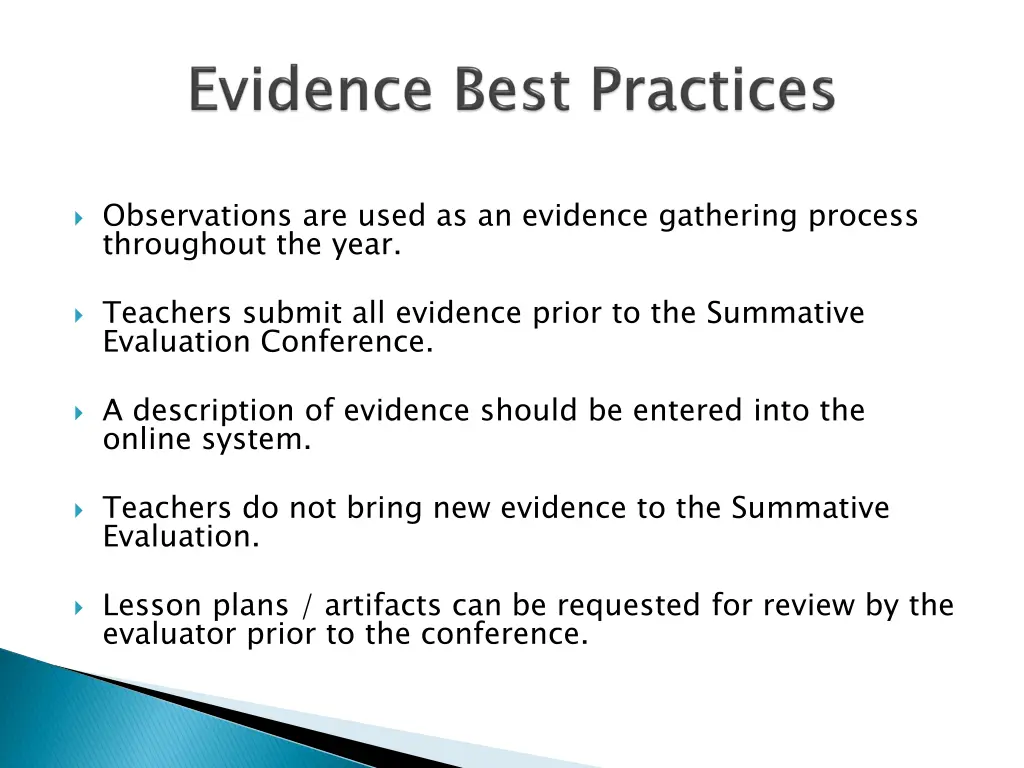
Observations are used as an evidence gathering process throughout the year. Teachers submit all evidence prior to the Summative Evaluation Conference. A description of evidence should be entered into the online system. Teachers do not bring new evidence to the Summative Evaluation. Lesson plans / artifacts can be requested for review by the evaluator prior to the conference.
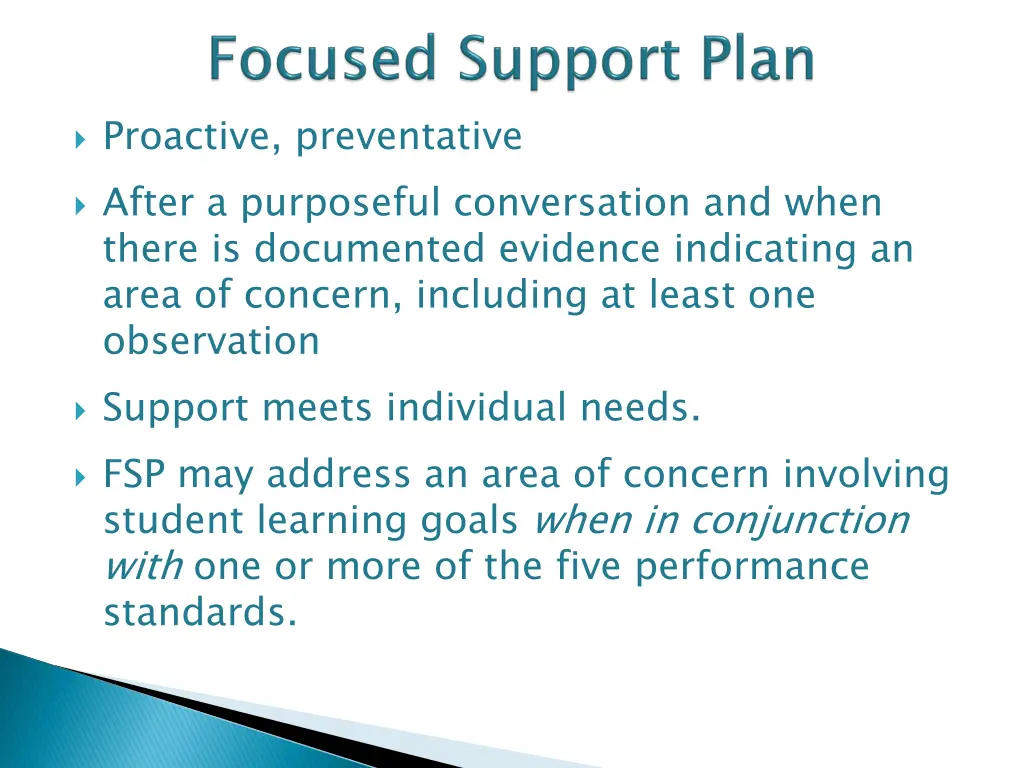
Proactive, preventative After a purposeful conversation and when there is documented evidence indicating an area of concern, including at least one observation Support meets individual needs. FSP may address an area of concern involving student learning goals when in conjunction with one or more of the five performance standards.
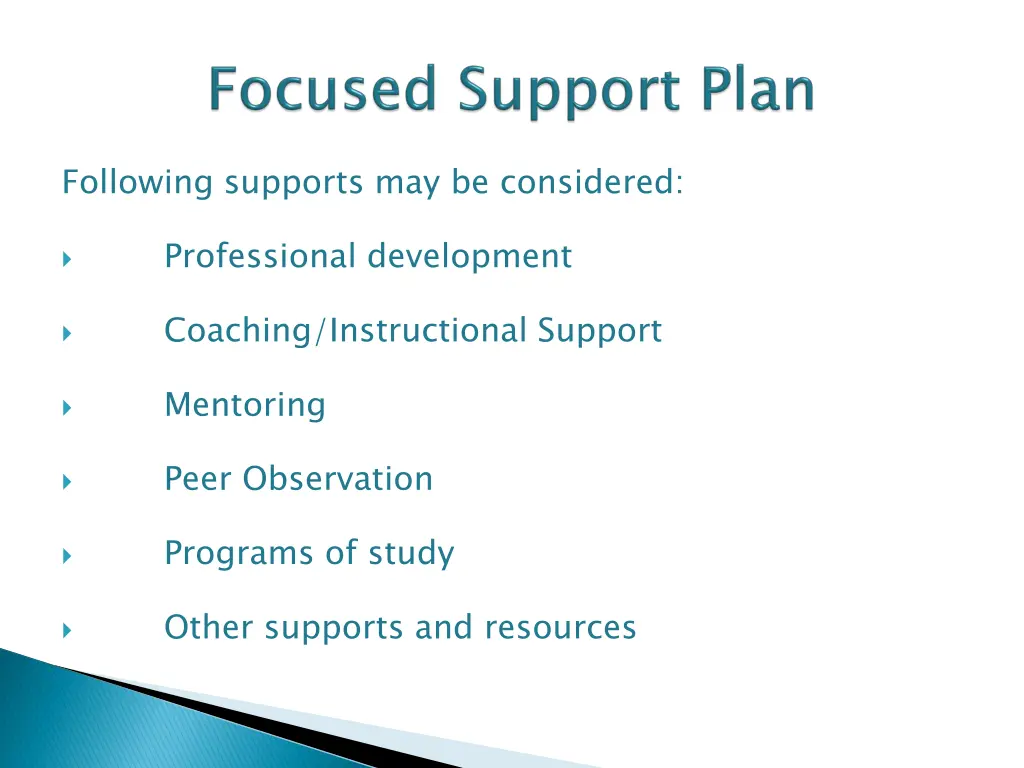
Following supports may be considered: Professional development Coaching/Instructional Support Mentoring Peer Observation Programs of study Other supports and resources
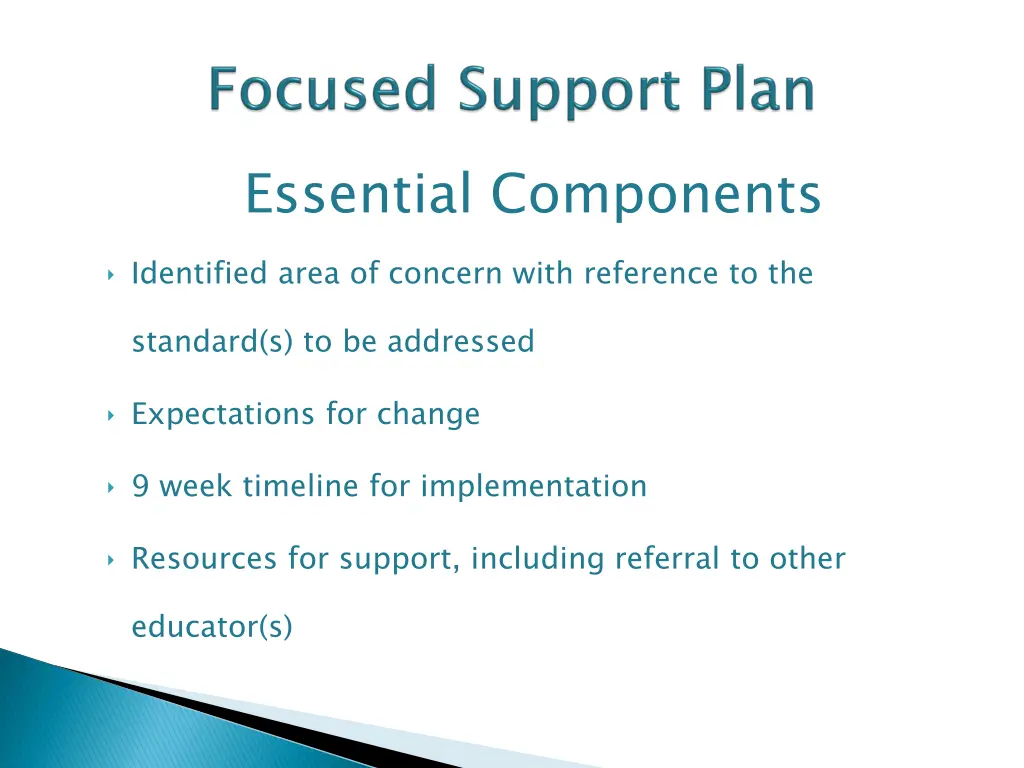
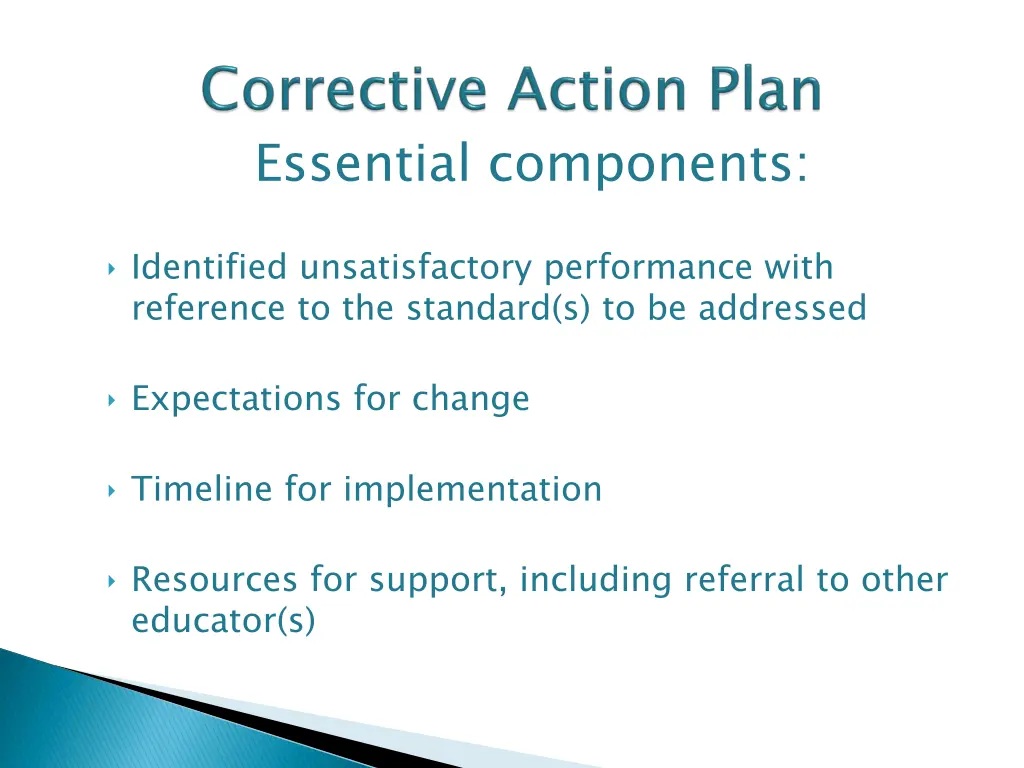
Essential Components Identified area of concern with reference to the standard(s) to be addressed Expectations for change 9 week timeline for implementation Resources for support, including referral to other educator(s)
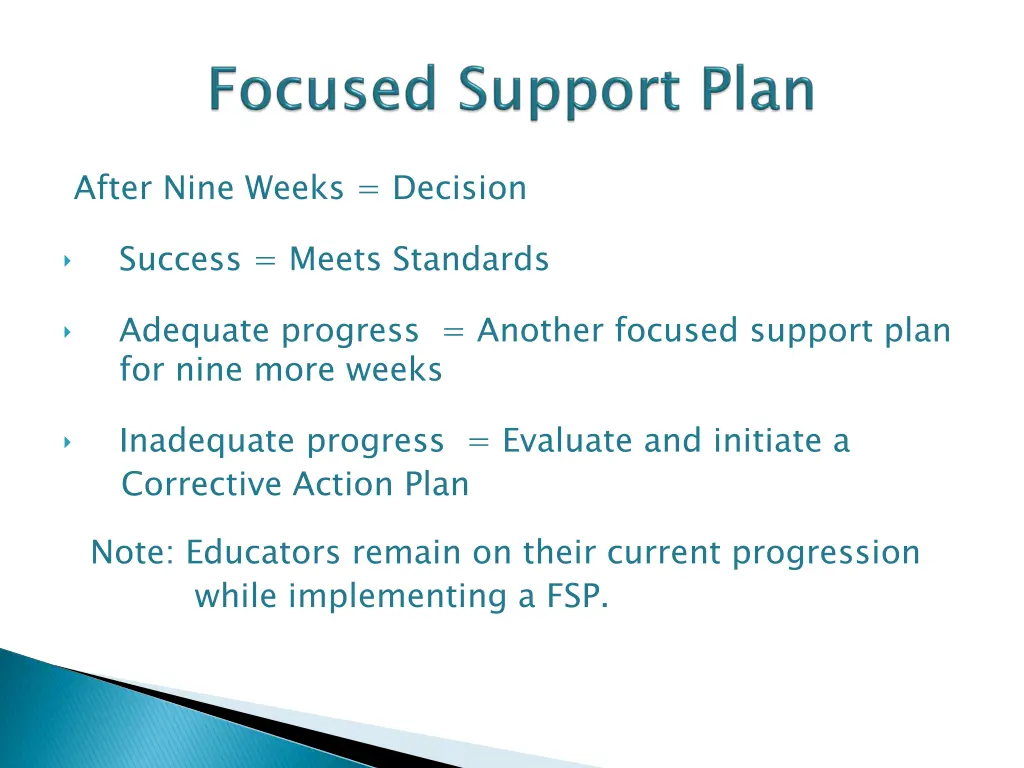
After Nine Weeks = Decision Success = Meets Standards Adequate progress = Another focused support plan for nine more weeks Inadequate progress = Evaluate and initiate a Corrective Action Plan Note: Educators remain on their current progression while implementing a FSP.
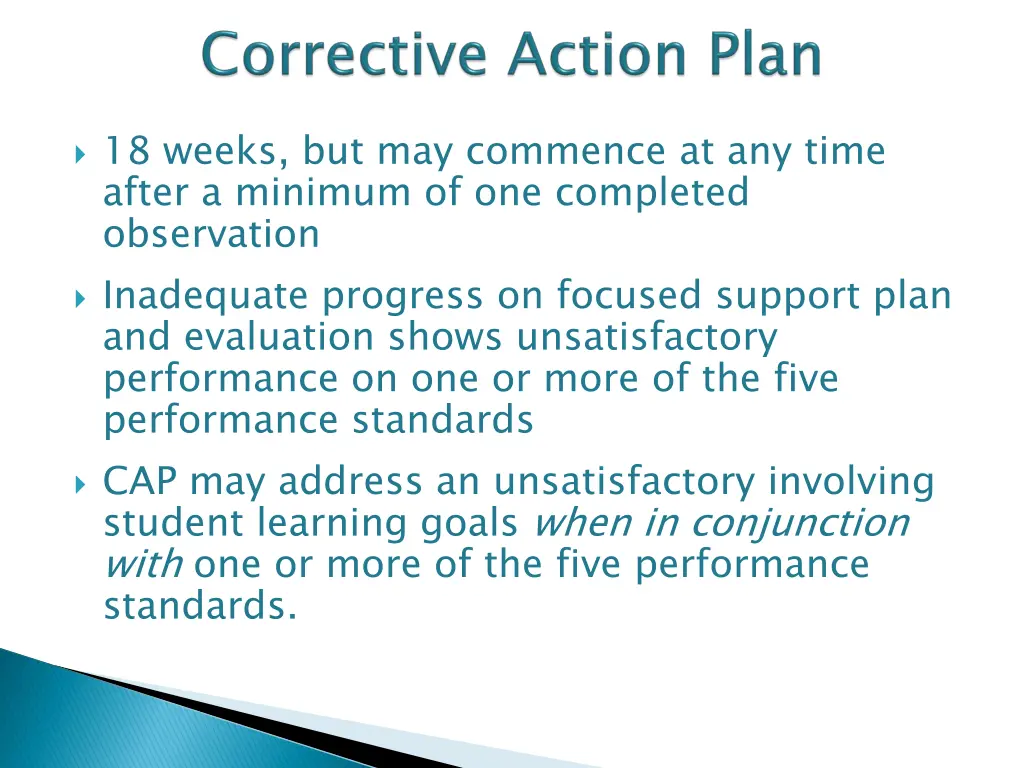
18 weeks, but may commence at any time after a minimum of one completed observation Inadequate progress on focused support plan and evaluation shows unsatisfactory performance on one or more of the five performance standards CAP may address an unsatisfactory involving student learning goals when in conjunction with one or more of the five performance standards.
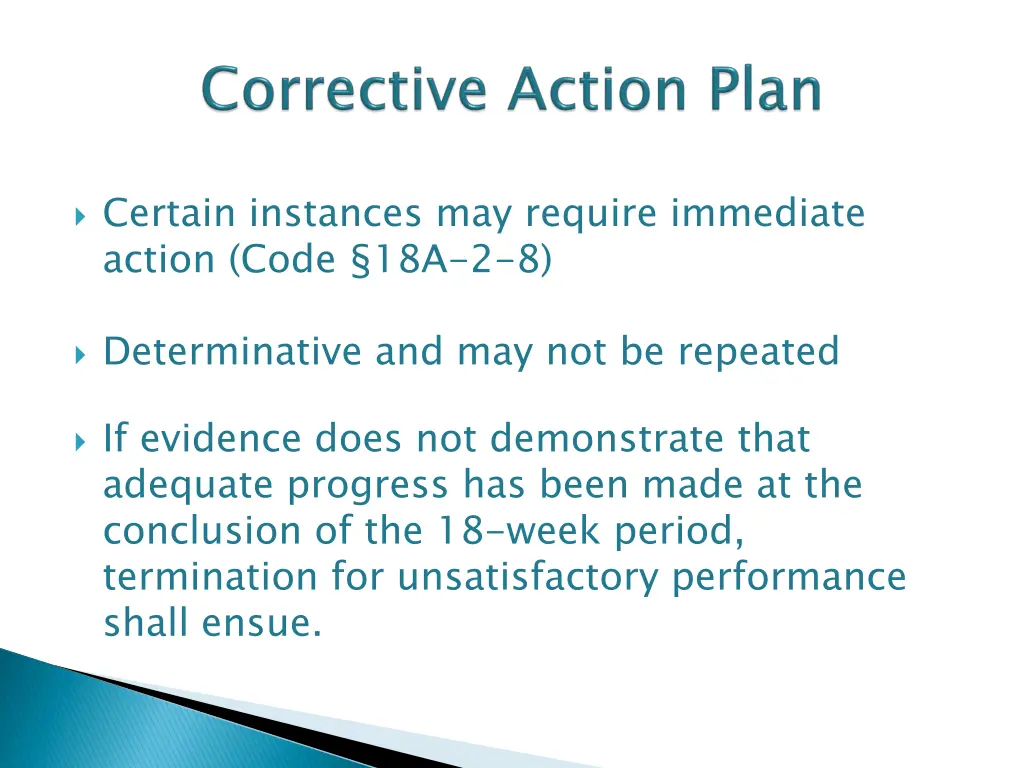
Certain instances may require immediate action (Code 18A-2-8) Determinative and may not be repeated If evidence does not demonstrate that adequate progress has been made at the conclusion of the 18-week period, termination for unsatisfactory performance shall ensue.
Essential components: Identified unsatisfactory performance with reference to the standard(s) to be addressed Expectations for change Timeline for implementation Resources for support, including referral to other educator(s)
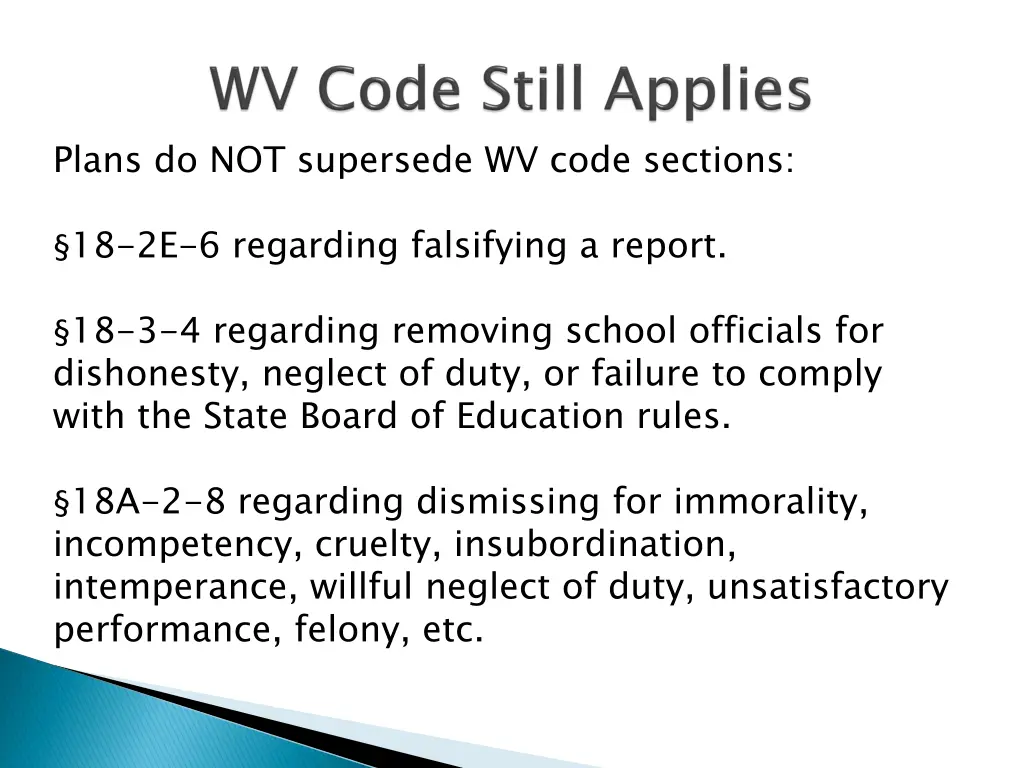
Plans do NOT supersede WV code sections: 18-2E-6 regarding falsifying a report. 18-3-4 regarding removing school officials for dishonesty, neglect of duty, or failure to comply with the State Board of Education rules. 18A-2-8 regarding dismissing for immorality, incompetency, cruelty, insubordination, intemperance, willful neglect of duty, unsatisfactory performance, felony, etc.
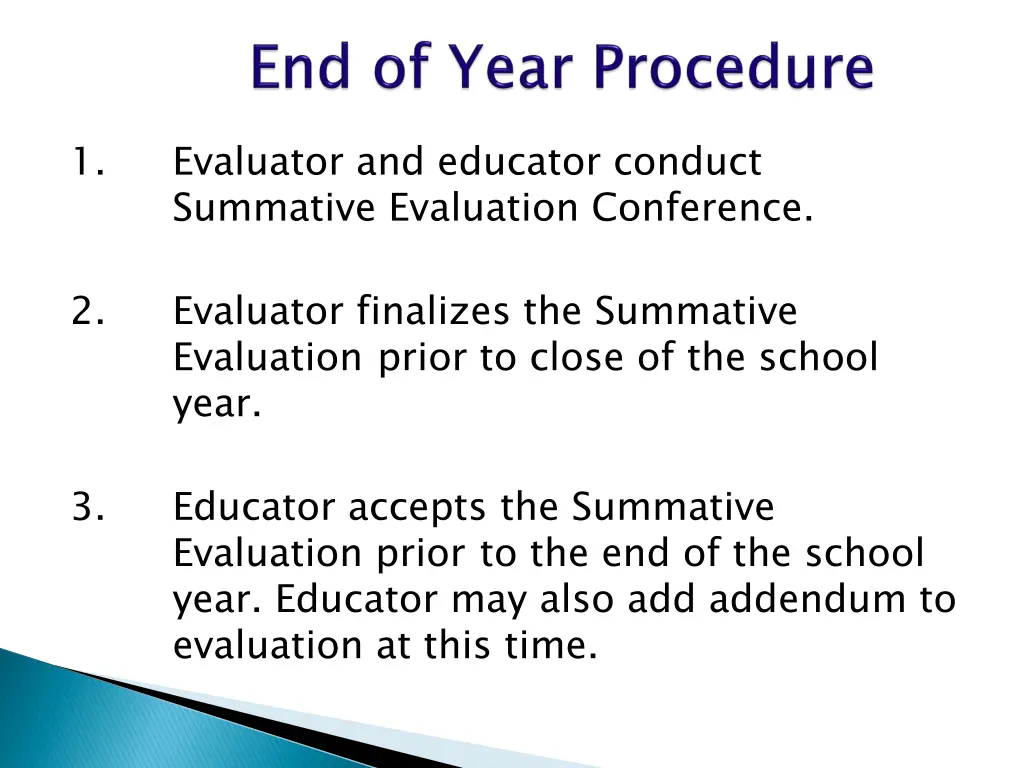
1. Evaluator and educator conduct Summative Evaluation Conference. 2. Evaluator finalizes the Summative Evaluation prior to close of the school year. 3. Educator accepts the Summative Evaluation prior to the end of the school year. Educator may also add addendum to evaluation at this time.
Evaluation System for Principals/Counselors Four Four Principals and Counselors (no progressions based on years experience) Self Reflection Principals and Counselors (no progressions based on years experience) Self Reflection Performance Levels Performance Levels Distinguished 80% 80% Observation not a required component Observation not a required component Evidence Evidence Accomplished 20% % Emerging 2 Goals (differentiated) 2 Goals (differentiated) Unsatisfactory
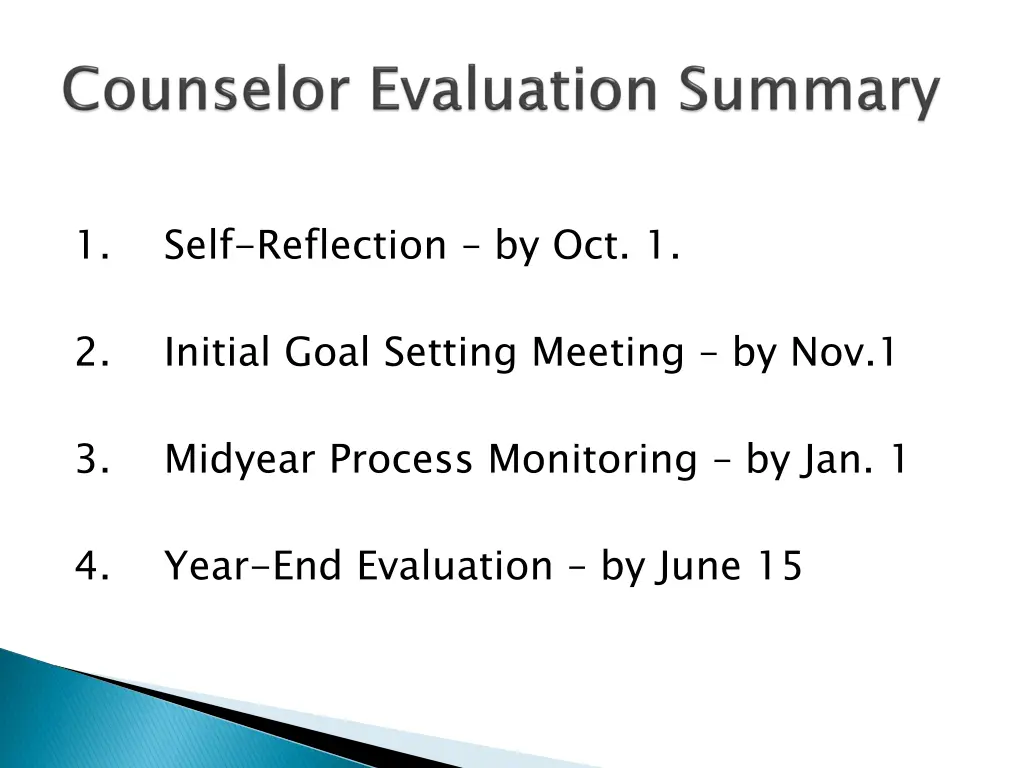
1. Self-Reflection by Oct. 1. 2. Initial Goal Setting Meeting by Nov.1 3. Midyear Process Monitoring by Jan. 1 4. Year-End Evaluation by June 15
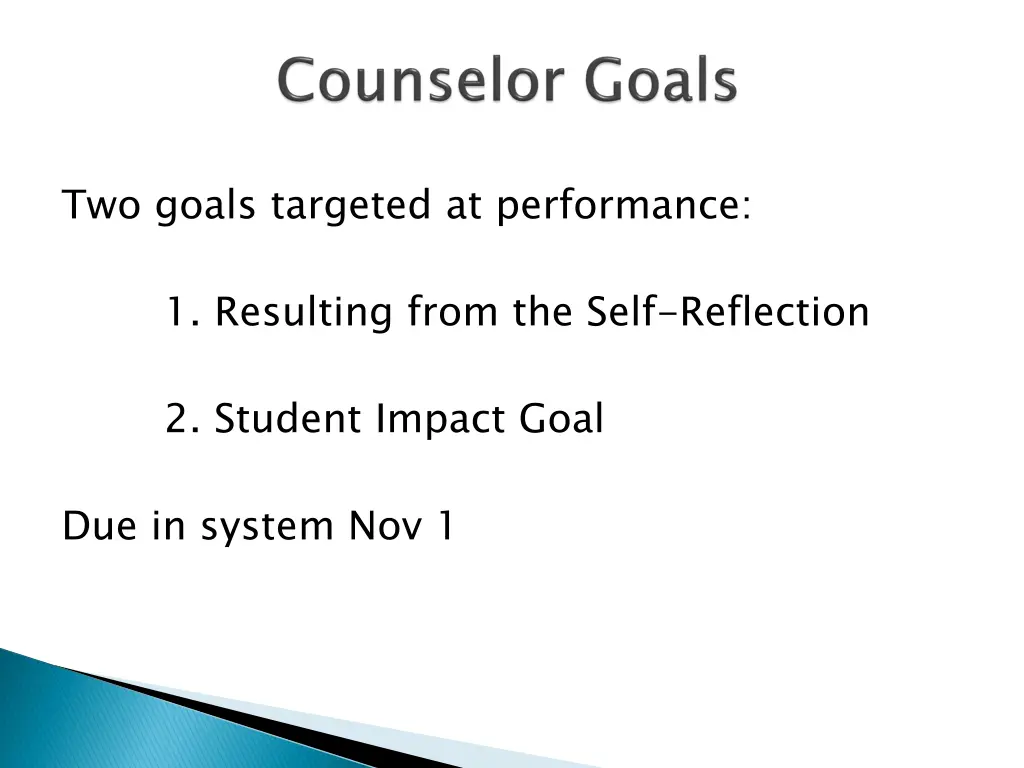
Two goals targeted at performance: 1. Resulting from the Self-Reflection 2. Student Impact Goal Due in system Nov 1
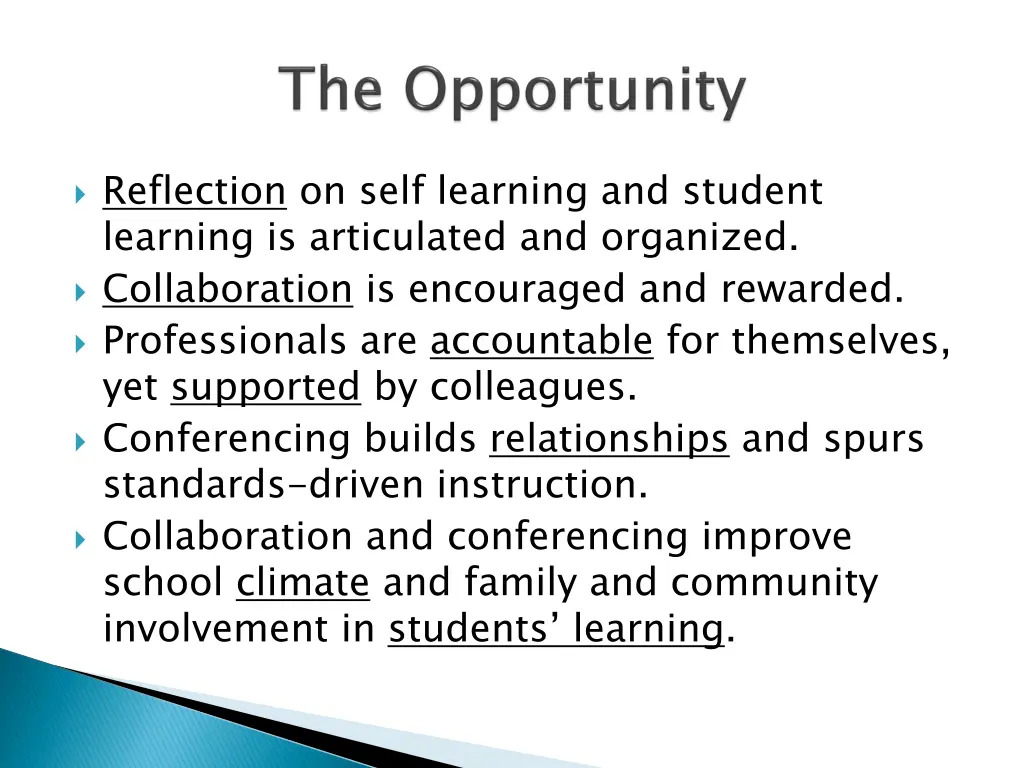
Reflection on self learning and student learning is articulated and organized. Collaboration is encouraged and rewarded. Professionals are accountable for themselves, yet supported by colleagues. Conferencing builds relationships and spurs standards-driven instruction. Collaboration and conferencing improve school climate and family and community involvement in students learning.
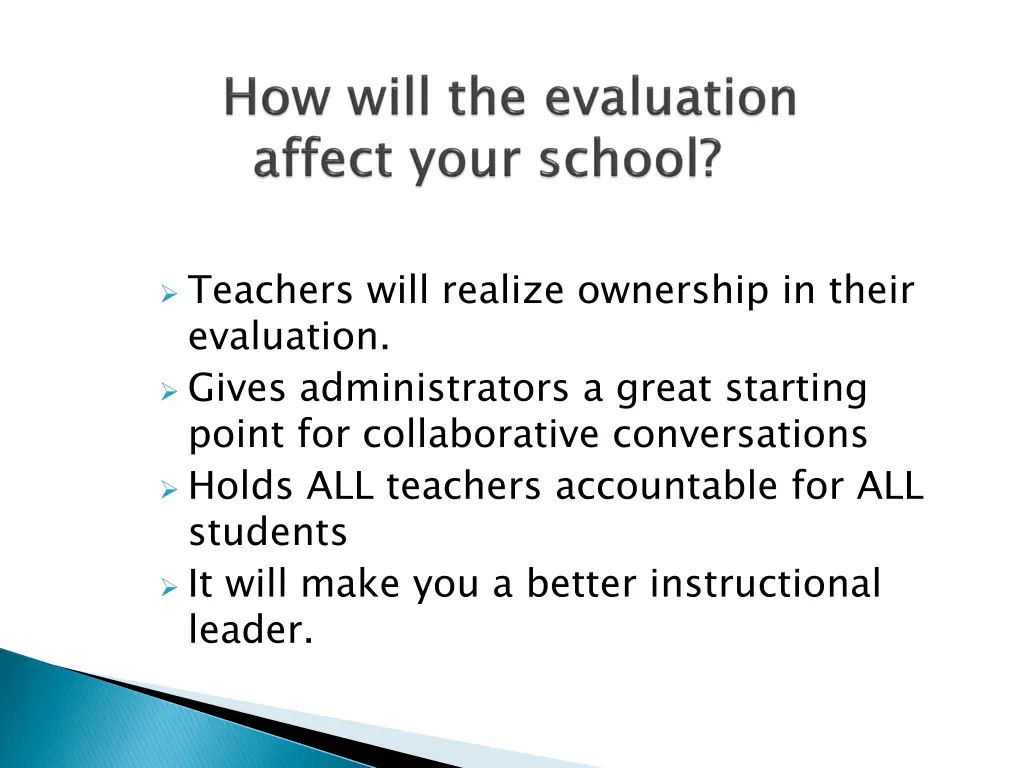
Teachers will realize ownership in their evaluation. Gives administrators a great starting point for collaborative conversations Holds ALL teachers accountable for ALL students It will make you a better instructional leader.