Explore the current practices in program evaluation using the Zero-Based Budgeting approach as showcased at the event held on December 6, 2016, in Pasig City. The presentation covers the origin, rationale, criteria, objectives, and impact of studies related to program evaluations moving forward.
Please find below an Image/Link to download the presentation.
The content on the website is provided AS IS for your information and personal use only. It may not be sold, licensed, or shared on other websites without obtaining consent from the author. If you encounter any issues during the download, it is possible that the publisher has removed the file from their server.
You are allowed to download the files provided on this website for personal or commercial use, subject to the condition that they are used lawfully. All files are the property of their respective owners.
The content on the website is provided AS IS for your information and personal use only. It may not be sold, licensed, or shared on other websites without obtaining consent from the author.
E N D
Presentation Transcript
Current Practice in the Conduct of Evaluations and Utilization of Evaluation Findings Program Evaluation using the Zero-Based Budgeting Approach (2011 2015) December 6, 2016 Crowne Plaza Hotel, Pasig City 3
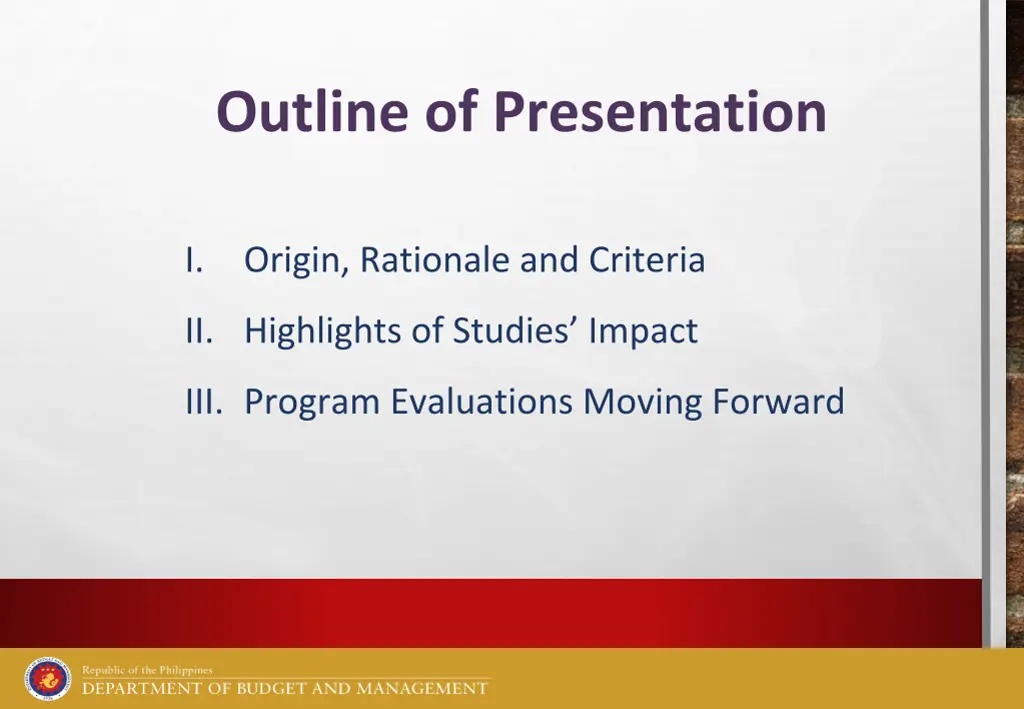
Outline of Presentation I. Origin, Rationale and Criteria II. Highlights of Studies Impact III. Program Evaluations Moving Forward 4
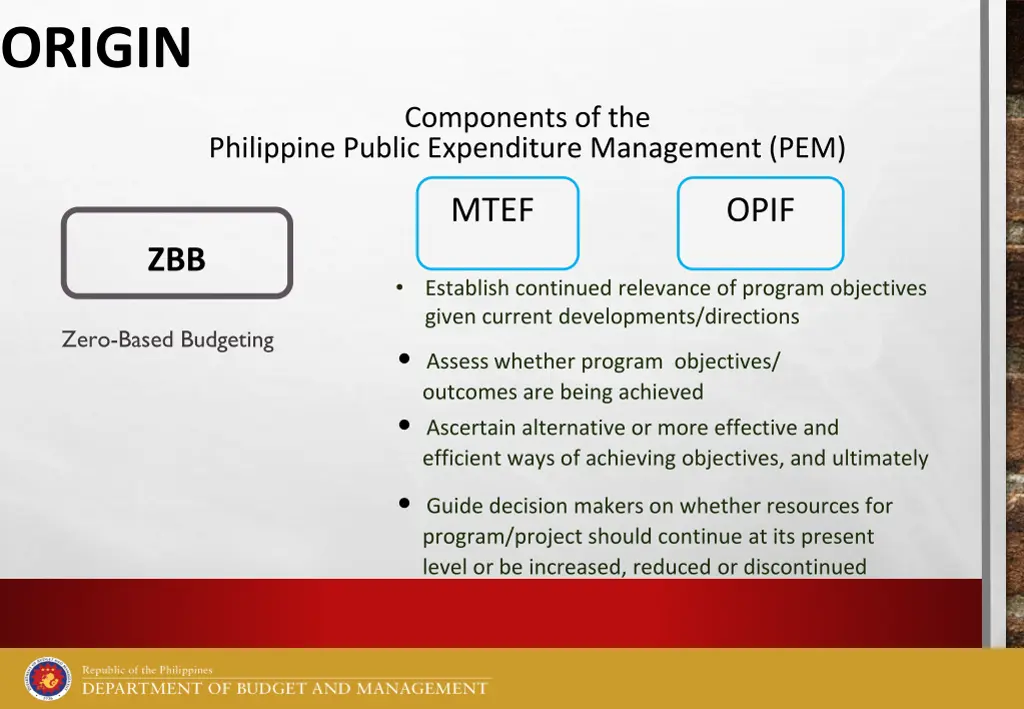
ORIGIN Components of the Philippine Public Expenditure Management (PEM) MTEF OPIF MTEF Establish continued relevance of program objectives given current developments/directions OPIF ZBB Zero-Based Budgeting Assess whether program objectives/ outcomes are being achieved Ascertain alternative or more effective and efficient ways of achieving objectives, and ultimately Guide decision makers on whether resources for program/project should continue at its present level or be increased, reduced or discontinued
ZBB Objectives To establish continued relevance of program objectives; To assess whether program objectives/outcomes are being achieved; To ascertain alternative or more effective and efficient ways of achieving the objectives; To guide decision makers during budget preparation 8
Rationale Input to formulation of National Budget Basis to terminate, expand and modify programs/ projects, thus, improving budget effectiveness Avenue to improve allocation of funds through savings generated Tool for budget accountability; can provide indication if outputs and outcomes are being delivered 8
Criteria 1) Potential leakages and inefficiencies based on COA Reports 2) Large magnitude of funds provided 3) Weak performance over the past years 4) Critical programs of the Administration 9
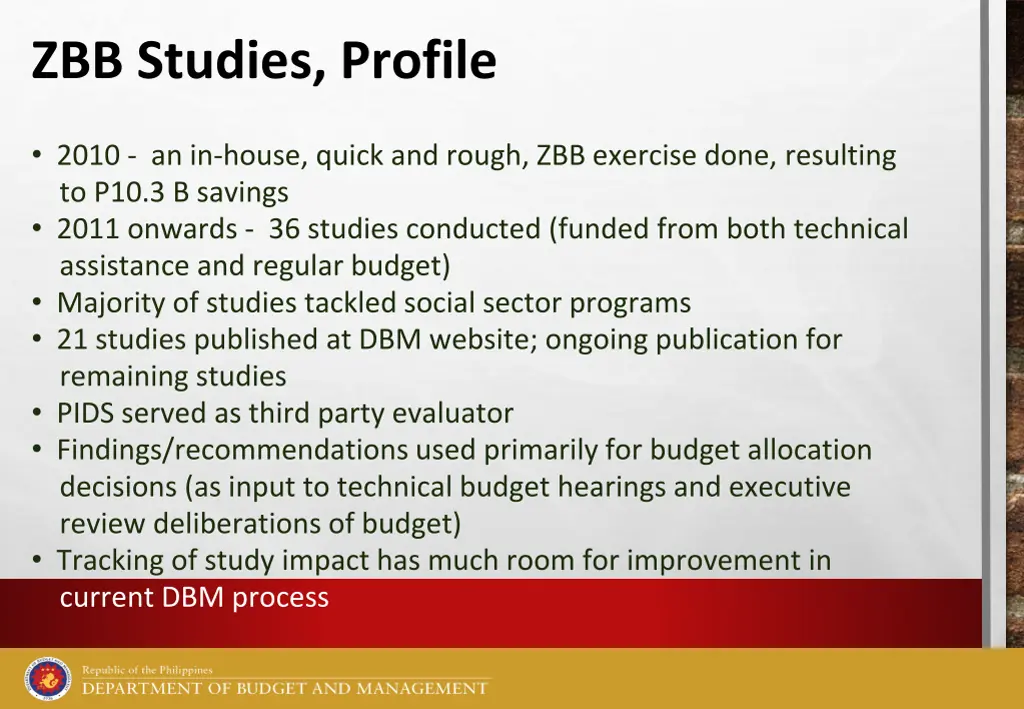
ZBB Studies, Profile 2010 - an in-house, quick and rough, ZBB exercise done, resulting to P10.3 B savings 2011 onwards - 36 studies conducted (funded from both technical assistance and regular budget) Majority of studies tackled social sector programs 21 studies published at DBM website; ongoing publication for remaining studies PIDS served as third party evaluator Findings/recommendations used primarily for budget allocation decisions (as input to technical budget hearings and executive review deliberations of budget) Tracking of study impact has much room for improvement in current DBM process 11
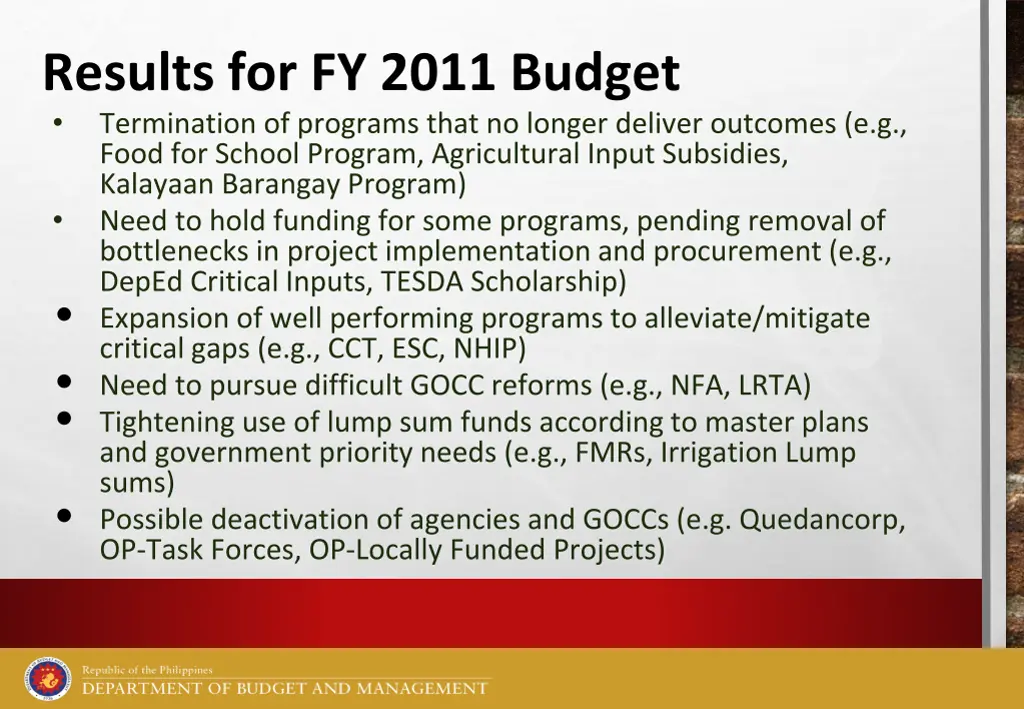
Results for FY 2011 Budget Termination of programs that no longer deliver outcomes (e.g., Food for School Program, Agricultural Input Subsidies, Kalayaan Barangay Program) Need to hold funding for some programs, pending removal of bottlenecks in project implementation and procurement (e.g., DepEd Critical Inputs, TESDA Scholarship) Expansion of well performing programs to alleviate/mitigate critical gaps (e.g., CCT, ESC, NHIP) Need to pursue difficult GOCC reforms (e.g., NFA, LRTA) Tightening use of lump sum funds according to master plans and government priority needs (e.g., FMRs, Irrigation Lump sums) Possible deactivation of agencies and GOCCs (e.g. Quedancorp, OP-Task Forces, OP-Locally Funded Projects) 12
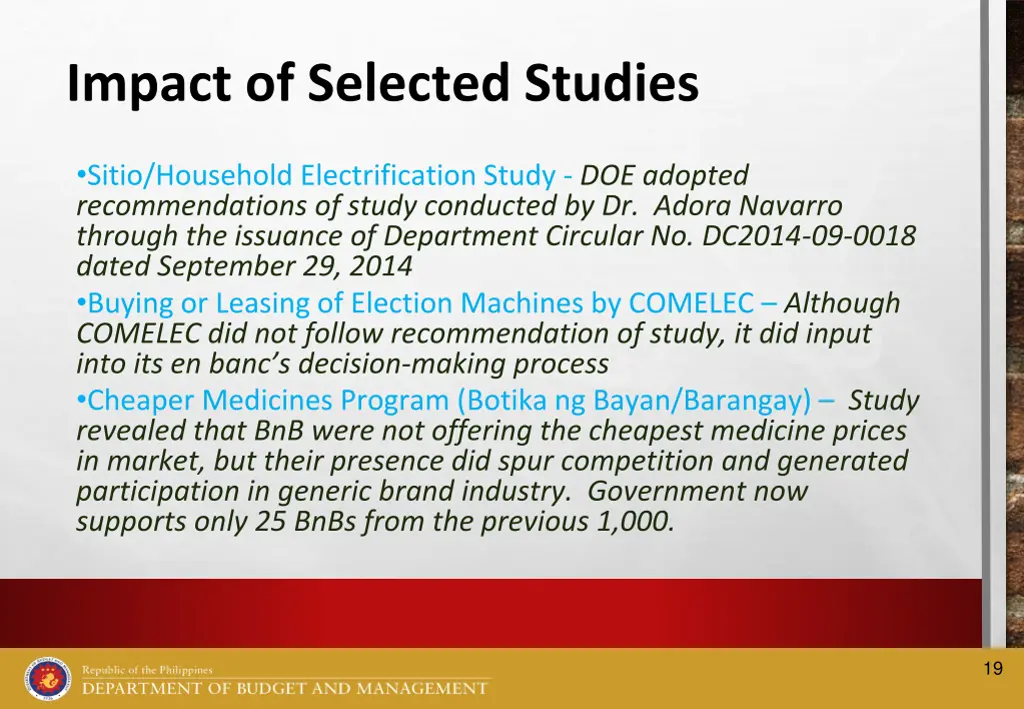
Impact of Selected Studies Sitio/Household Electrification Study - DOE adopted recommendations of study conducted by Dr. Adora Navarro through the issuance of Department Circular No. DC2014-09-0018 dated September 29, 2014 Buying or Leasing of Election Machines by COMELEC Although COMELEC did not follow recommendation of study, it did input into its en banc s decision-making process Cheaper Medicines Program (Botika ng Bayan/Barangay) Study revealed that BnB were not offering the cheapest medicine prices in market, but their presence did spur competition and generated participation in generic brand industry. Government now supports only 25 BnBs from the previous 1,000. 19
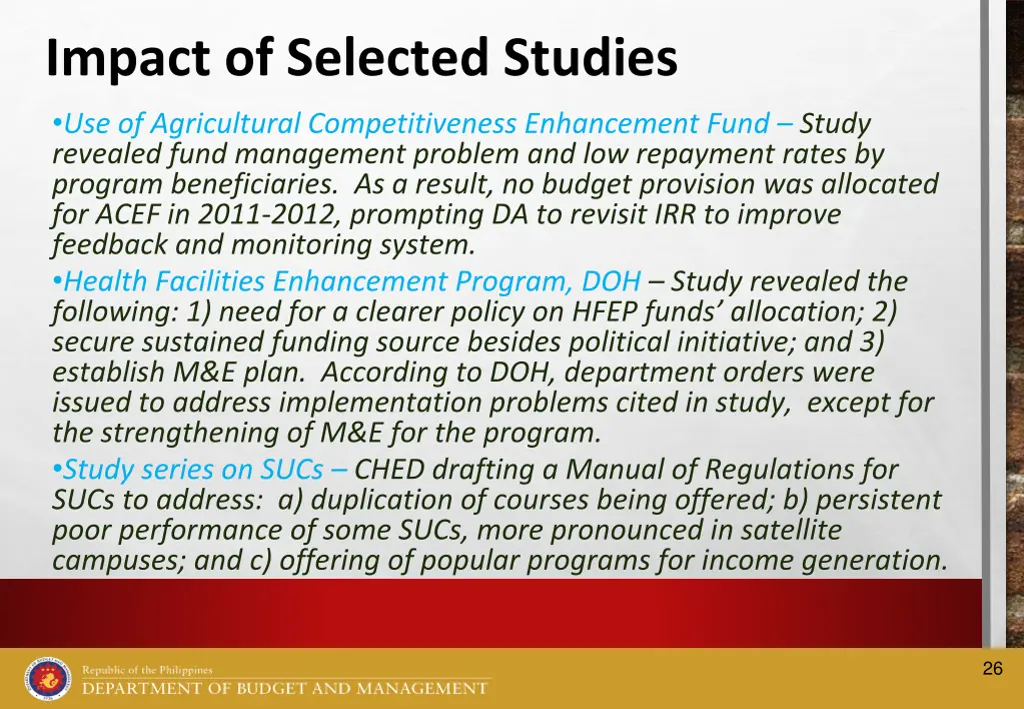
Impact of Selected Studies Use of Agricultural Competitiveness Enhancement Fund Study revealed fund management problem and low repayment rates by program beneficiaries. As a result, no budget provision was allocated for ACEF in 2011-2012, prompting DA to revisit IRR to improve feedback and monitoring system. Health Facilities Enhancement Program, DOH Study revealed the following: 1) need for a clearer policy on HFEP funds allocation; 2) secure sustained funding source besides political initiative; and 3) establish M&E plan. According to DOH, department orders were issued to address implementation problems cited in study, except for the strengthening of M&E for the program. Study series on SUCs CHED drafting a Manual of Regulations for SUCs to address: a) duplication of courses being offered; b) persistent poor performance of some SUCs, more pronounced in satellite campuses; and c) offering of popular programs for income generation. 26
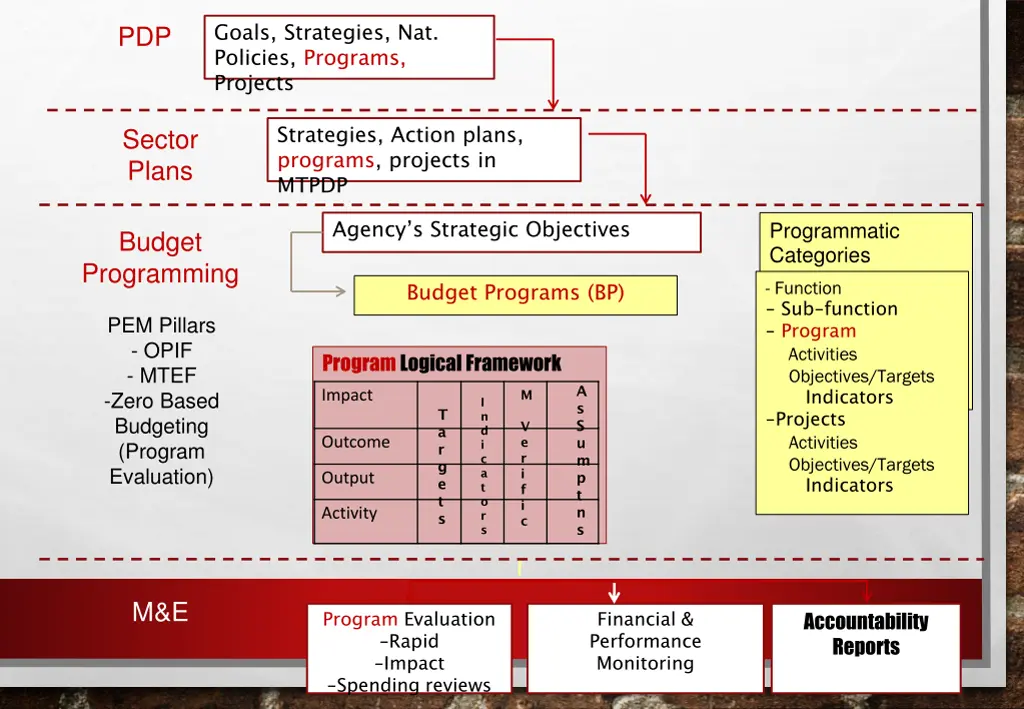
PDP Goals, Strategies, Nat. Policies, Programs, Projects Sector Plans Strategies, Action plans, programs, projects in MTPDP Programmatic Categories Agency s Strategic Objectives Budget Programming - Function - Sub-function - Program Activities Objectives/Targets Indicators -Projects Activities Objectives/Targets Indicators Budget Programs (BP) PEM Pillars - OPIF - MTEF -Zero Based Budgeting (Program Evaluation) ProgramLogical Framework A s S u m p t n s Impact M I n d i c a t o r s T a r g e t s V e r i f i c Outcome Output Activity M&E Accountability Reports Program Evaluation -Rapid -Impact -Spending reviews Financial & Performance Monitoring
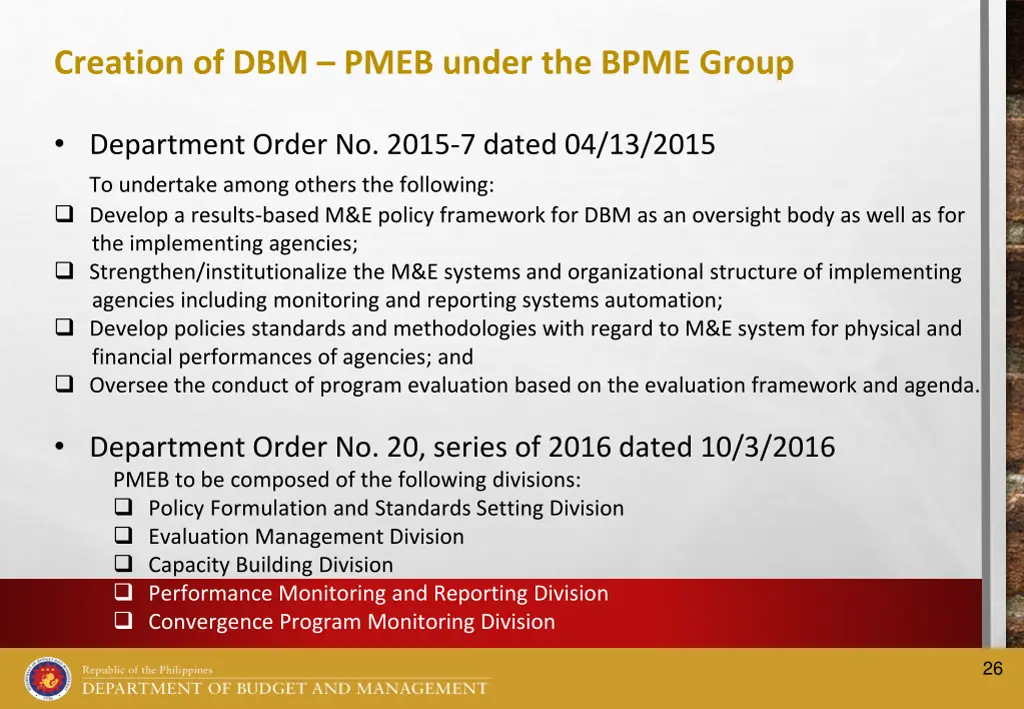
Creation of DBM PMEB under the BPME Group Department Order No. 2015-7 dated 04/13/2015 To undertake among others the following: Develop a results-based M&E policy framework for DBM as an oversight body as well as for the implementing agencies; Strengthen/institutionalize the M&E systems and organizational structure of implementing agencies including monitoring and reporting systems automation; Develop policies standards and methodologies with regard to M&E system for physical and financial performances of agencies; and Oversee the conduct of program evaluation based on the evaluation framework and agenda. Department Order No. 20, series of 2016 dated 10/3/2016 PMEB to be composed of the following divisions: Policy Formulation and Standards Setting Division Evaluation Management Division Capacity Building Division Performance Monitoring and Reporting Division Convergence Program Monitoring Division 26
THANK YOU! December 6, 2016 Crowne Plaza Hotel, Pasig City 3
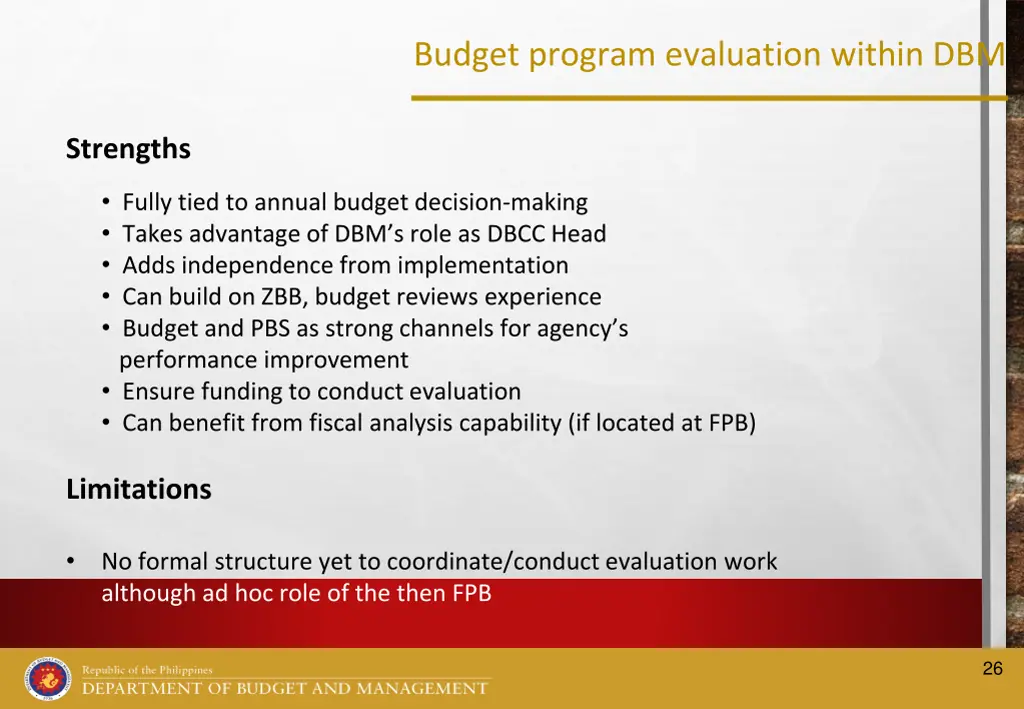
Budget program evaluation within DBM Strengths Fully tied to annual budget decision-making Takes advantage of DBM s role as DBCC Head Adds independence from implementation Can build on ZBB, budget reviews experience Budget and PBS as strong channels for agency s performance improvement Ensure funding to conduct evaluation Can benefit from fiscal analysis capability (if located at FPB) Limitations No formal structure yet to coordinate/conduct evaluation work although ad hoc role of the then FPB 26