Progressive Encoding-Decoding Using Convolutional Autoencoder - Research Internship Insights
Explore the innovative research on image compression using neural networks, specifically Progressive Encoding-Decoding with a Convolutional Autoencoder. The approach involves a Deep CNN-based encoder and decoder to achieve different compression rates without retraining the entire network. Results show that the algorithm competes with JPEG at lower compression ratios but degrades at higher rates. The study indicates potential for further improvements in image compression algorithms beyond traditional methods like JPEG. Exciting areas of research with GANs and RNNs are highlighted, promising even better compression results.

Download Presentation

Please find below an Image/Link to download the presentation.
The content on the website is provided AS IS for your information and personal use only. It may not be sold, licensed, or shared on other websites without obtaining consent from the author. If you encounter any issues during the download, it is possible that the publisher has removed the file from their server.
You are allowed to download the files provided on this website for personal or commercial use, subject to the condition that they are used lawfully. All files are the property of their respective owners.
The content on the website is provided AS IS for your information and personal use only. It may not be sold, licensed, or shared on other websites without obtaining consent from the author.
E N D
Presentation Transcript
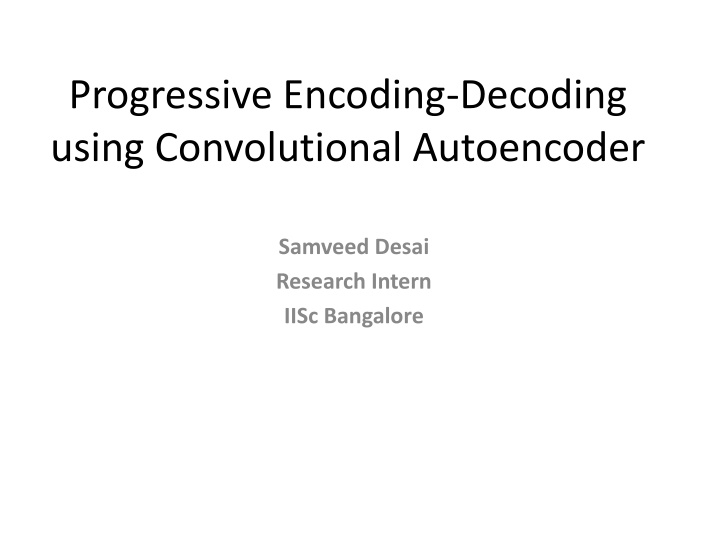
Progressive Encoding-Decoding using Convolutional Autoencoder Samveed Desai Research Intern IISc Bangalore
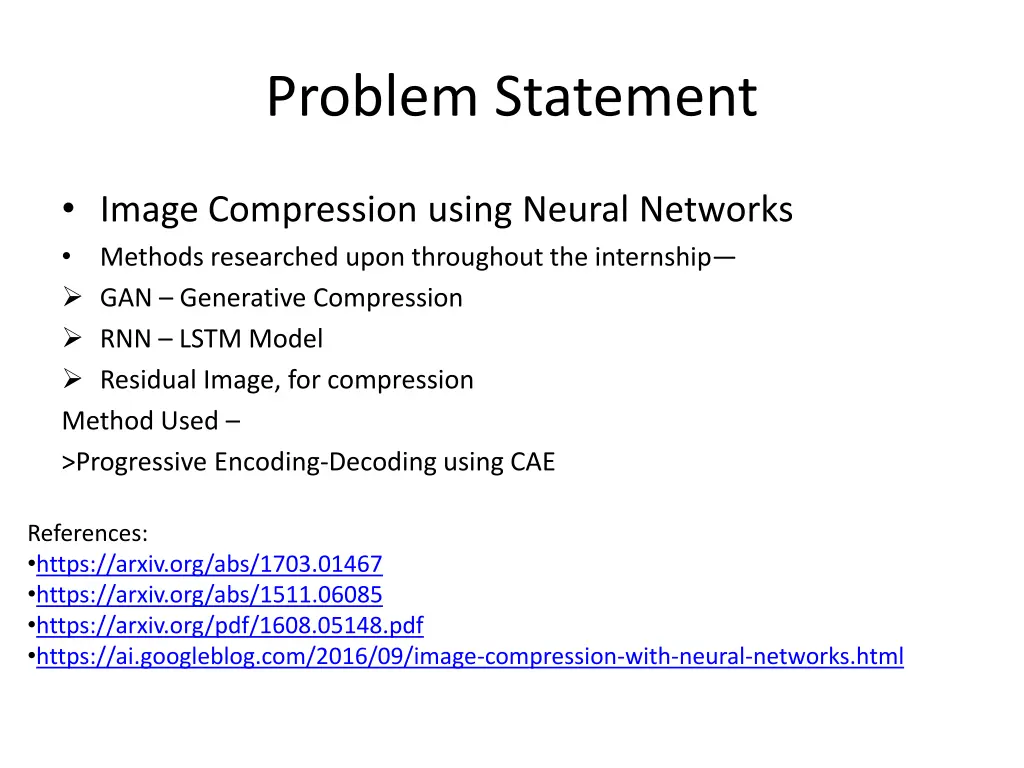
Problem Statement Image Compression using Neural Networks Methods researched upon throughout the internship GAN Generative Compression RNN LSTM Model Residual Image, for compression Method Used >Progressive Encoding-Decoding using CAE References: https://arxiv.org/abs/1703.01467 https://arxiv.org/abs/1511.06085 https://arxiv.org/pdf/1608.05148.pdf https://ai.googleblog.com/2016/09/image-compression-with-neural-networks.html
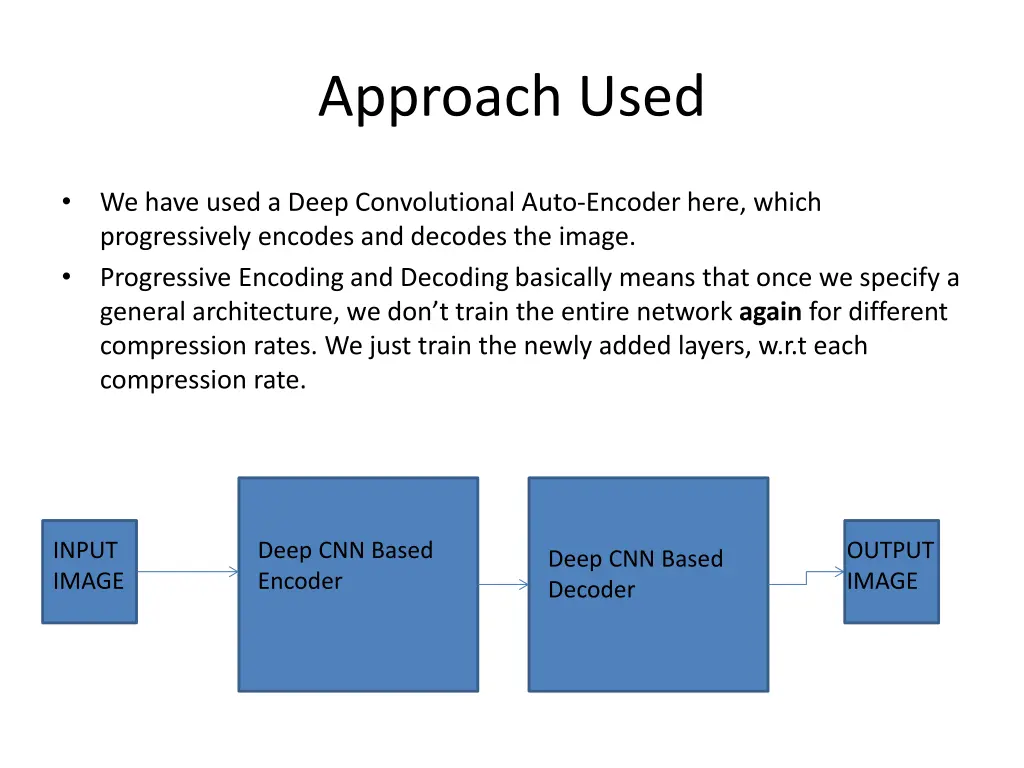
Approach Used We have used a Deep Convolutional Auto-Encoder here, which progressively encodes and decodes the image. Progressive Encoding and Decoding basically means that once we specify a general architecture, we don t train the entire network again for different compression rates. We just train the newly added layers, w.r.t each compression rate. INPUT IMAGE Deep CNN Based Encoder OUTPUT IMAGE Deep CNN Based Decoder
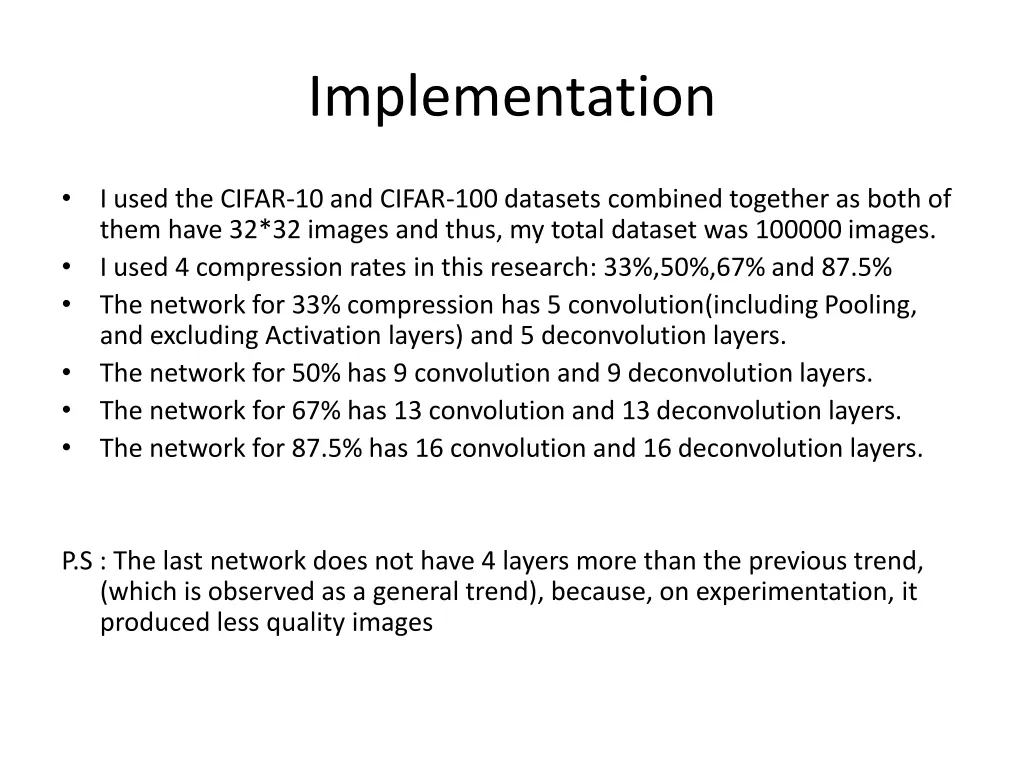
Implementation I used the CIFAR-10 and CIFAR-100 datasets combined together as both of them have 32*32 images and thus, my total dataset was 100000 images. I used 4 compression rates in this research: 33%,50%,67% and 87.5% The network for 33% compression has 5 convolution(including Pooling, and excluding Activation layers) and 5 deconvolution layers. The network for 50% has 9 convolution and 9 deconvolution layers. The network for 67% has 13 convolution and 13 deconvolution layers. The network for 87.5% has 16 convolution and 16 deconvolution layers. P.S : The last network does not have 4 layers more than the previous trend, (which is observed as a general trend), because, on experimentation, it produced less quality images
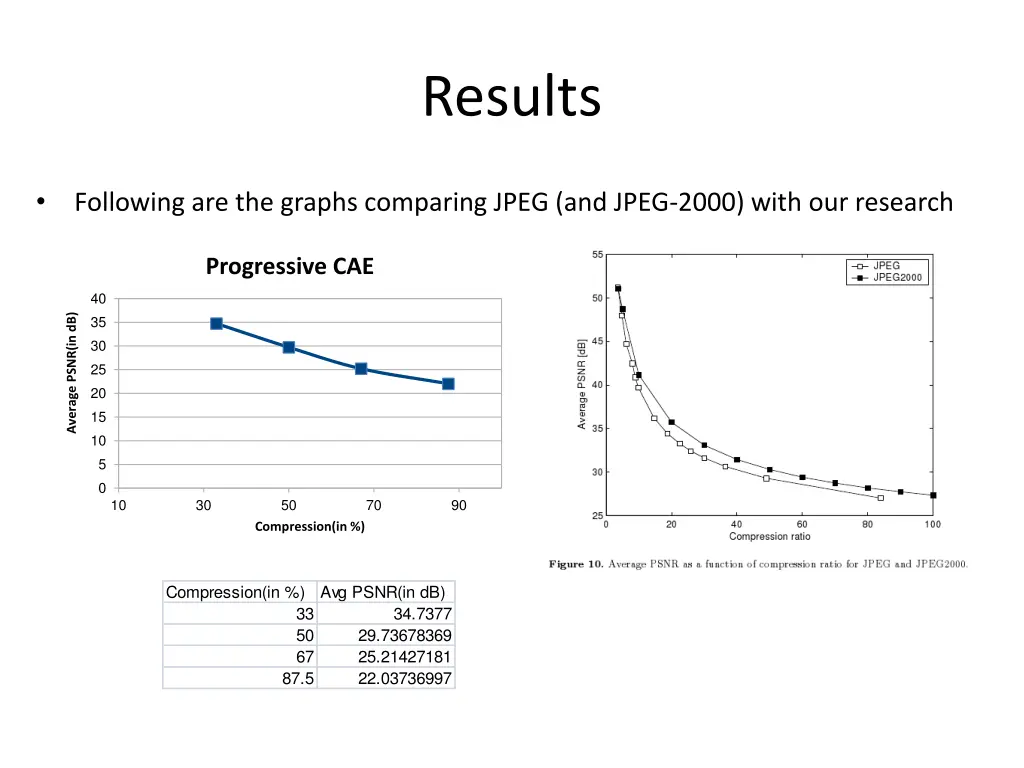
Results Following are the graphs comparing JPEG (and JPEG-2000) with our research Progressive CAE 40 Average PSNR(in dB) 35 30 25 20 15 10 5 0 10 30 50 70 90 Compression(in %) Compression(in %) Avg PSNR(in dB) 33 50 67 87.5 34.7377 29.73678369 25.21427181 22.03736997
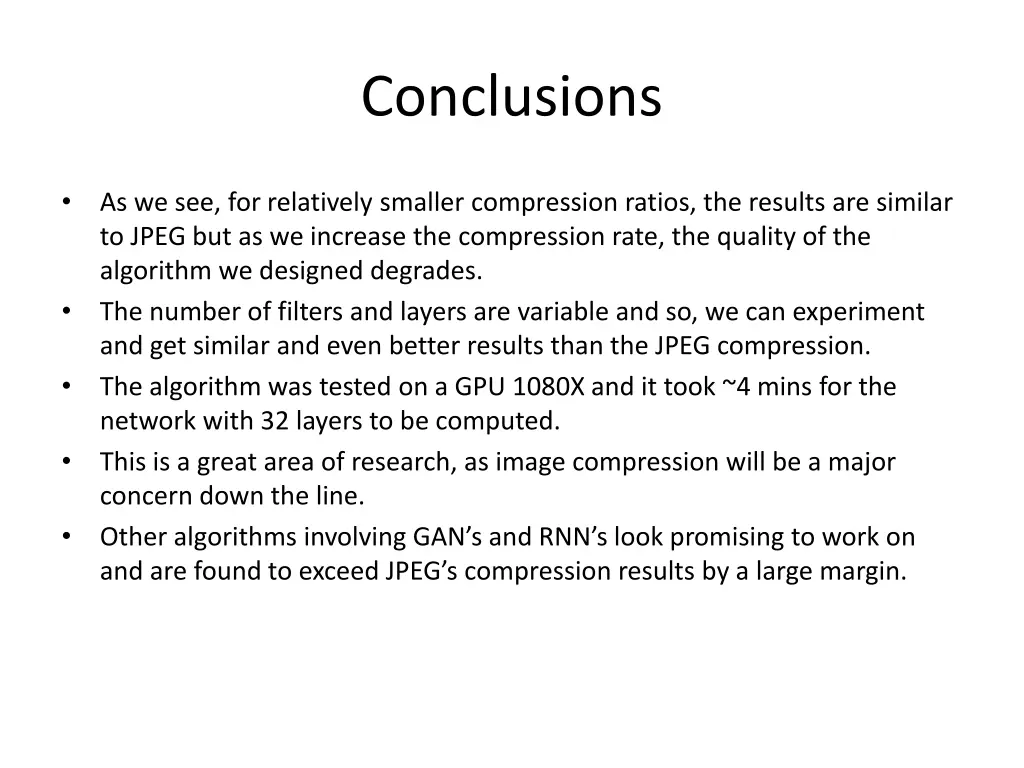
Conclusions As we see, for relatively smaller compression ratios, the results are similar to JPEG but as we increase the compression rate, the quality of the algorithm we designed degrades. The number of filters and layers are variable and so, we can experiment and get similar and even better results than the JPEG compression. The algorithm was tested on a GPU 1080X and it took ~4 mins for the network with 32 layers to be computed. This is a great area of research, as image compression will be a major concern down the line. Other algorithms involving GAN s and RNN s look promising to work on and are found to exceed JPEG s compression results by a large margin.
I would like to thank my instructor, Rajiv Sir, for helping me out always and making me understand the basics, regarding the problem statement. I would also like to thank all the Mtech s and PhD s present in the lab, who always helped me, even though they were busy and took time to help me understand. THANK YOU!!