Project Time-Cost Trade-Offs and Strategies
Explore the relationship between project completion time and cost, reasons to shorten project durations, methods for reducing project timelines, and the significance of time-cost trade-offs in project management. Discover key insights for effective project crashing and compression techniques.

Download Presentation

Please find below an Image/Link to download the presentation.
The content on the website is provided AS IS for your information and personal use only. It may not be sold, licensed, or shared on other websites without obtaining consent from the author. If you encounter any issues during the download, it is possible that the publisher has removed the file from their server.
You are allowed to download the files provided on this website for personal or commercial use, subject to the condition that they are used lawfully. All files are the property of their respective owners.
The content on the website is provided AS IS for your information and personal use only. It may not be sold, licensed, or shared on other websites without obtaining consent from the author.
E N D
Presentation Transcript
ENGINEERING MANAGEMENT (GE 404) 1 LECTURE # LECTURE #8 8 Time-Cost Trade-Offs March 19, 2025 GE 404 (Engineering Management)
Contents 2 Objectives of the present lecture Time-Cost Trade-offs Reasons to reduce project duration Methods to reduce project duration Types of Costs and project time-cost relationship Project crashing and cost slope Compression or Crashing the project schedule Basic steps in project crashing Network interaction limit (Nil) Network compression algorithm Problem Further reading March 19, 2025 GE 404 (Engineering Management)
Objectives of the Present lecture 3 To discuss project time-cost relationship To explain the steps involved in project crashing March 19, 2025 GE 404 (Engineering Management)
Time-Cost Trade-offs (Time-Cost Relationship) 4 There is a relationship between a project s time to completion and its cost. By understanding the time-cost relationship, one is better able to predict the impact of a schedule change on project cost. Time-cost trade-off, in fact, is an important management tool for overcoming one of the critical path method limitations of being unable to bring the project schedule to a specified duration. March 19, 2025 GE 404 (Engineering Management)
Reasons to Reduce Project Durations 5 To avoid late penalties To realize incentives for timely or early competition of a project To beat the competition to the market (influences Bid price) To free resources for use on other projects To reduce the indirect costs To complete a project when weather conditions make it less expensive March 19, 2025 GE 404 (Engineering Management)
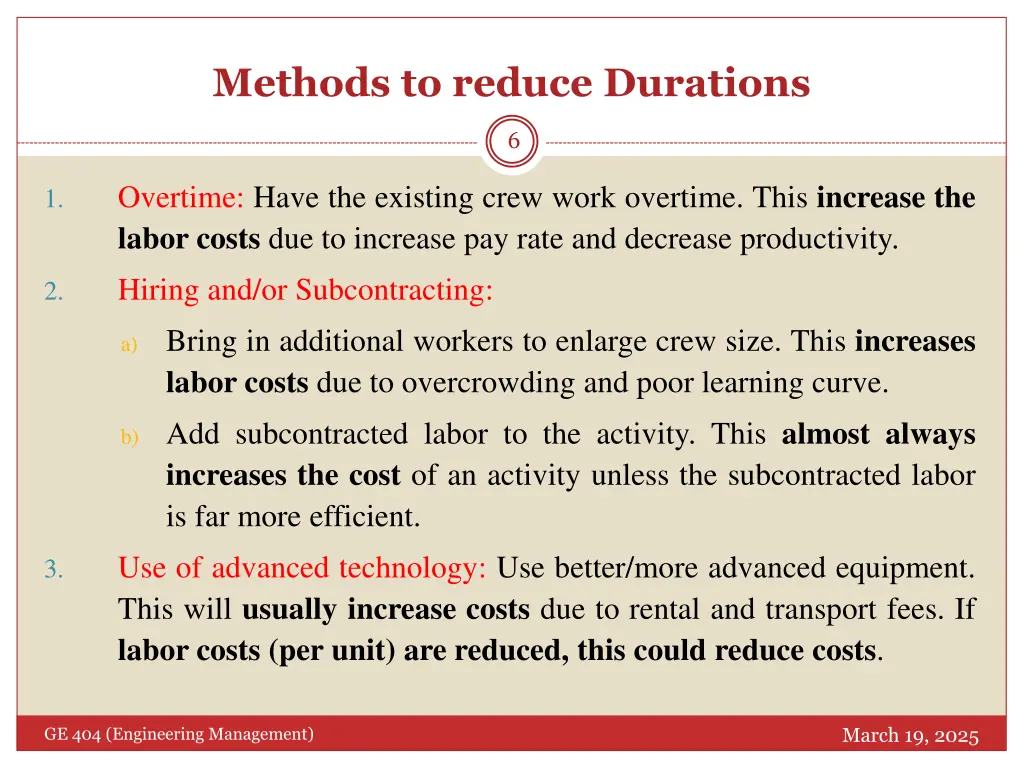
Methods to reduce Durations 6 Overtime: Have the existing crew work overtime. This increase the labor costs due to increase pay rate and decrease productivity. 1. Hiring and/or Subcontracting: Bring in additional workers to enlarge crew size. This increases labor costs due to overcrowding and poor learning curve. 2. a) b) Add subcontracted labor to the activity. This almost always increases the cost of an activity unless the subcontracted labor is far more efficient. Use of advanced technology: Use better/more advanced equipment. This will usually increase costs due to rental and transport fees. If labor costs (per unit) are reduced, this could reduce costs. 3. March 19, 2025 GE 404 (Engineering Management)
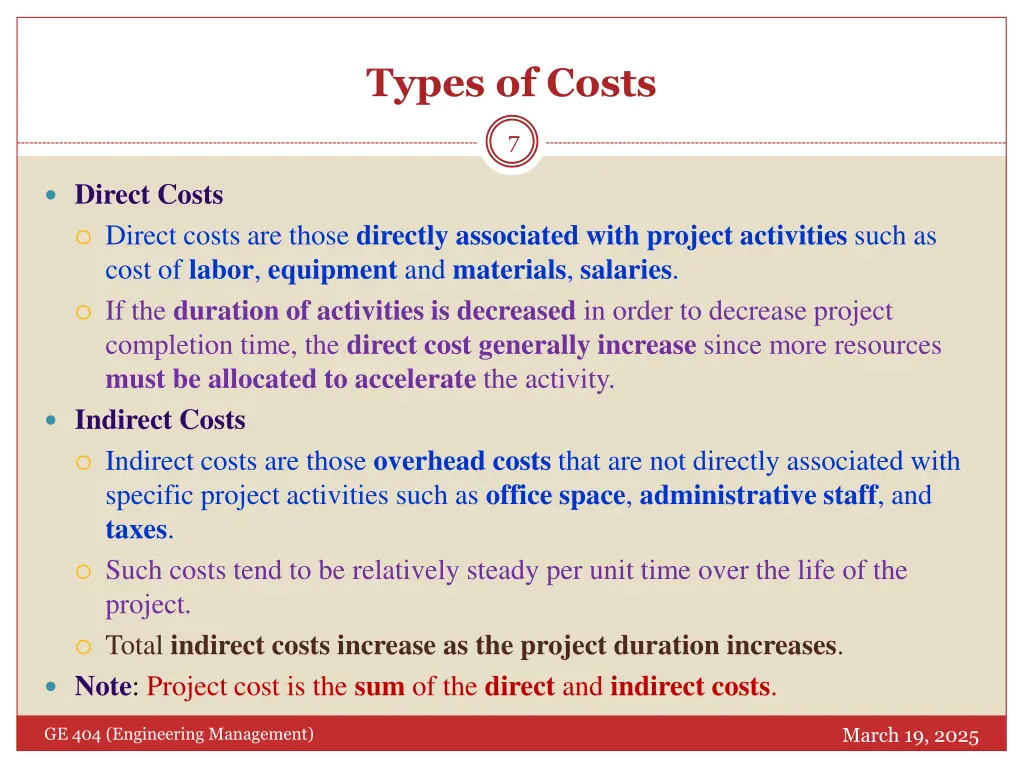
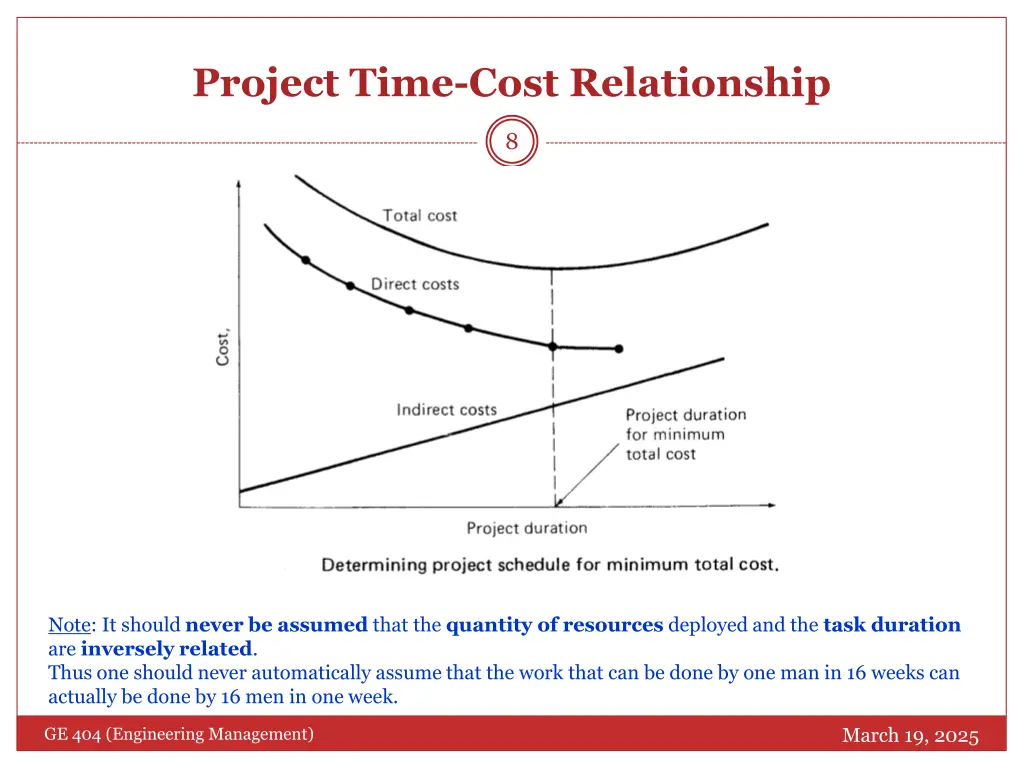
Types of Costs 7 Direct Costs Direct costs are those directly associated with project activities such as cost of labor, equipment and materials, salaries. If the duration of activities is decreased in order to decrease project completion time, the direct cost generally increase since more resources must be allocated to accelerate the activity. Indirect Costs Indirect costs are those overhead costs that are not directly associated with specific project activities such as office space, administrative staff, and taxes. Such costs tend to be relatively steady per unit time over the life of the project. Total indirect costs increase as the project duration increases. Note: Project cost is the sum of the direct and indirect costs. March 19, 2025 GE 404 (Engineering Management)
Project Time-Cost Relationship 8 Note: It should never be assumed that the quantity of resources deployed and the task duration are inversely related. Thus one should never automatically assume that the work that can be done by one man in 16 weeks can actually be done by 16 men in one week. March 19, 2025 GE 404 (Engineering Management)
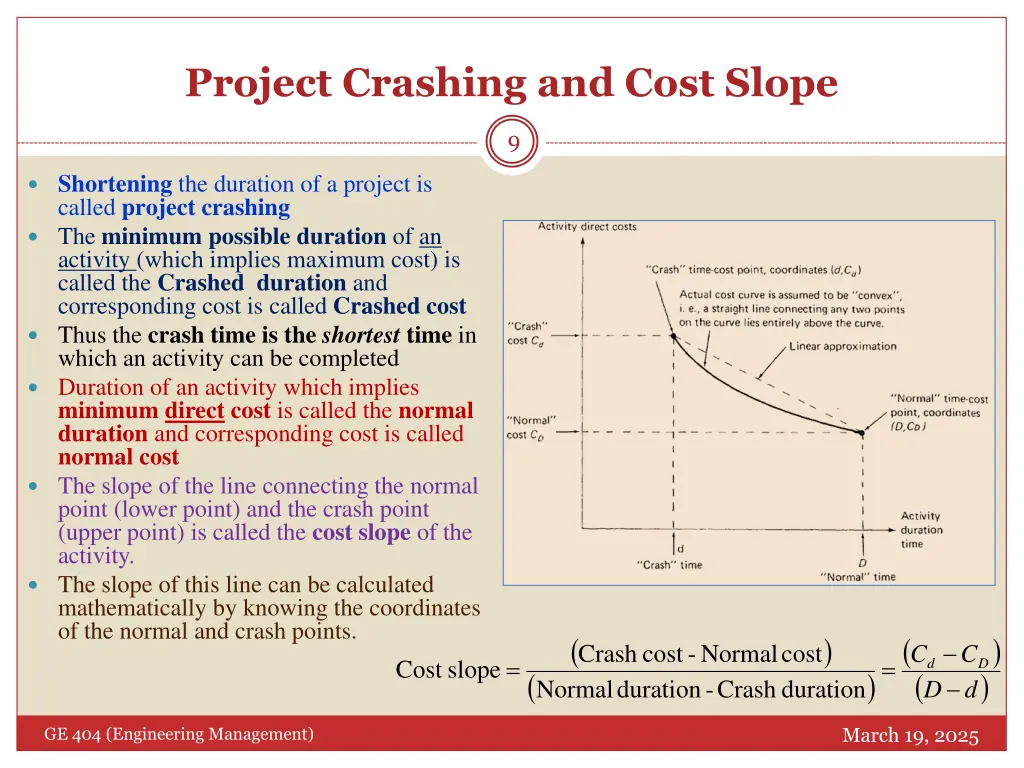
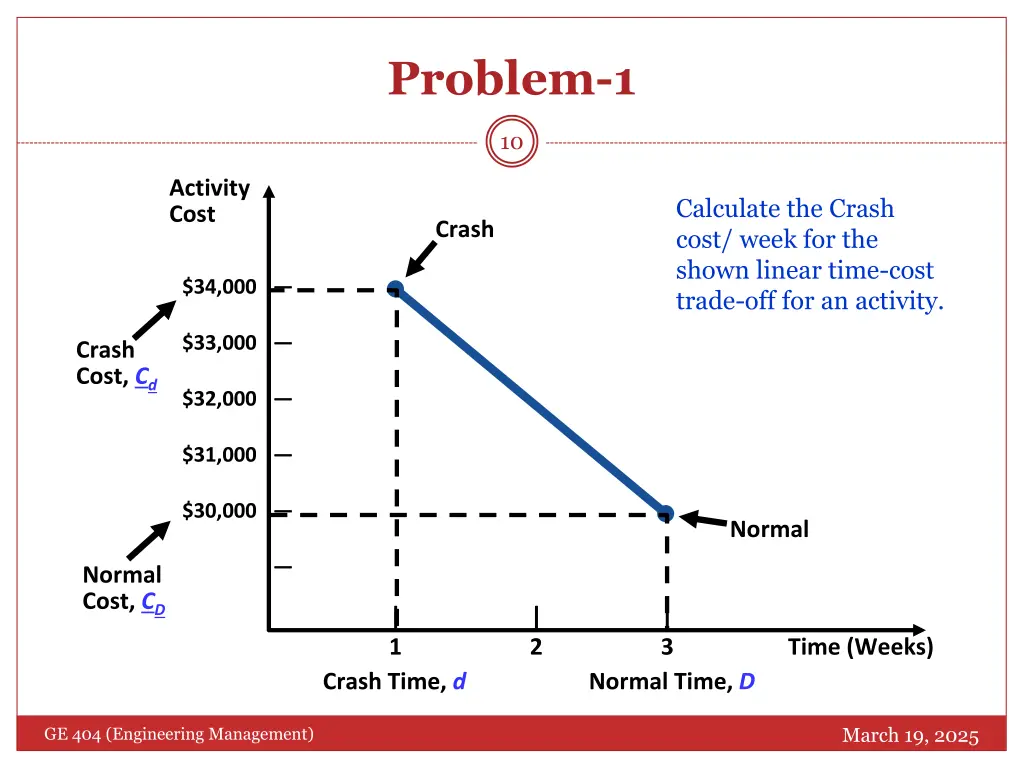
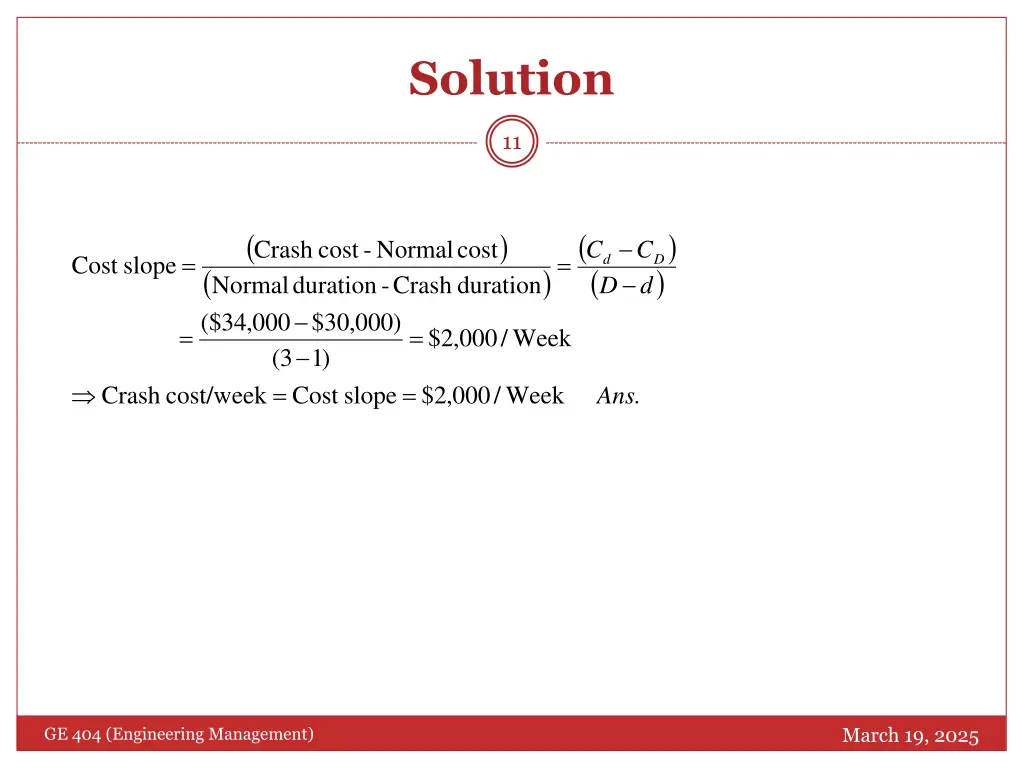
Project Crashing and Cost Slope 9 Shortening the duration of a project is called project crashing The minimum possible duration of an activity (which implies maximum cost) is called the Crashed duration and corresponding cost is called Crashed cost Thus the crash time is the shortest time in which an activity can be completed Duration of an activity which implies minimum direct cost is called the normal duration and corresponding cost is called normal cost The slope of the line connecting the normal point (lower point) and the crash point (upper point) is called the cost slope of the activity. The slope of this line can be calculated mathematically by knowing the coordinates of the normal and crash points. ( ) ( ) Crash cost - Normal cost C C = = Cost slope d D ( ) ( ) Normal duration - Crash duration D d March 19, 2025 GE 404 (Engineering Management)
Problem-1 10 Activity Cost Calculate the Crash cost/ week for the shown linear time-cost trade-off for an activity. Crash $34,000 $33,000 Crash Cost, Cd $32,000 $31,000 $30,000 Normal Normal Cost, CD | 1 | 2 | 3 Time (Weeks) Crash Time, d Normal Time, D March 19, 2025 GE 404 (Engineering Management)
Solution 11 ( ) ( ) Crash cost - Normal cost C C = = Cost slope d D ( ($ ) ( ) Normal duration - Crash duration D d 34 000 , 30 $ 000 , ) = = , 2 $ 000 / Week ) 1 3 ( = = Crash cost/week Cost slope , 2 $ 000 / Week Ans. March 19, 2025 GE 404 (Engineering Management)
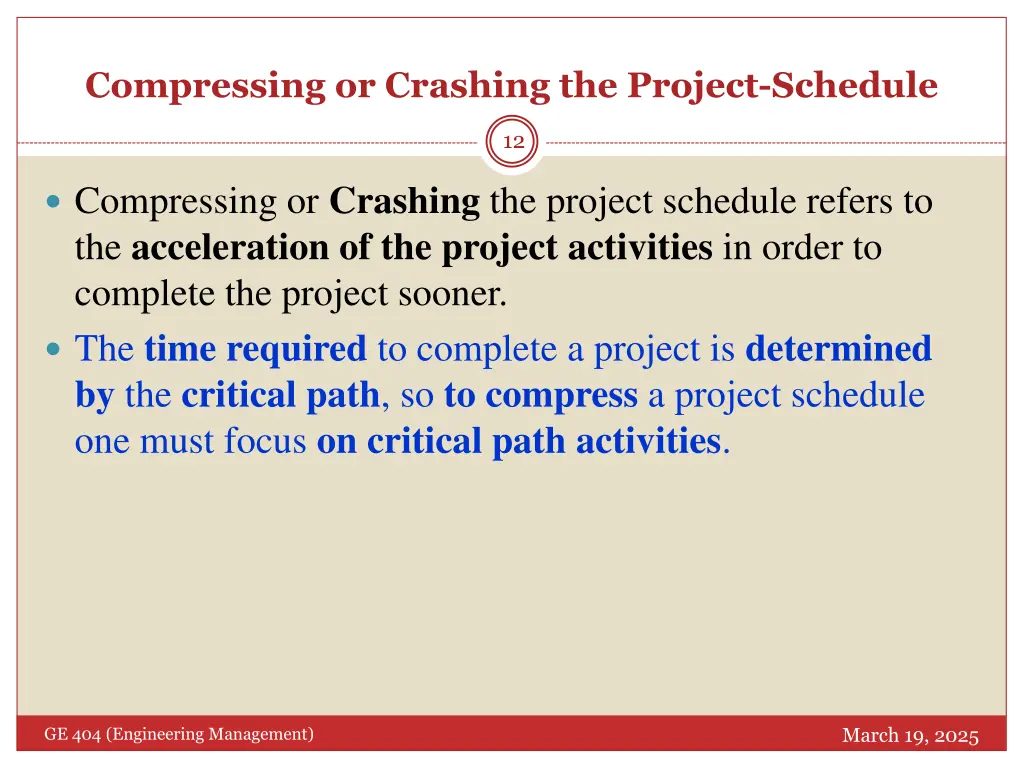
Compressing or Crashing the Project-Schedule 12 Compressing or Crashing the project schedule refers to the acceleration of the project activities in order to complete the project sooner. The time required to complete a project is determined by the critical path, so to compress a project schedule one must focus on critical path activities. March 19, 2025 GE 404 (Engineering Management)
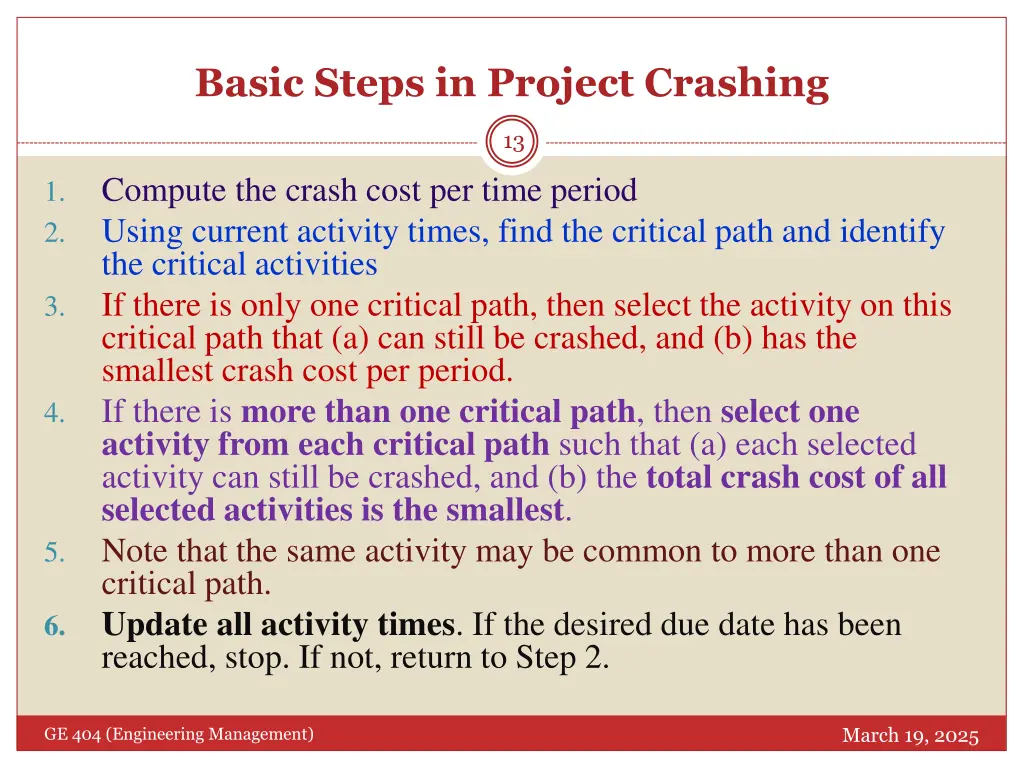
Basic Steps in Project Crashing 13 Compute the crash cost per time period Using current activity times, find the critical path and identify the critical activities If there is only one critical path, then select the activity on this critical path that (a) can still be crashed, and (b) has the smallest crash cost per period. If there is more than one critical path, then select one activity from each critical path such that (a) each selected activity can still be crashed, and (b) the total crash cost of all selected activities is the smallest. Note that the same activity may be common to more than one critical path. Update all activity times. If the desired due date has been reached, stop. If not, return to Step 2. 1. 2. 3. 4. 5. 6. March 19, 2025 GE 404 (Engineering Management)
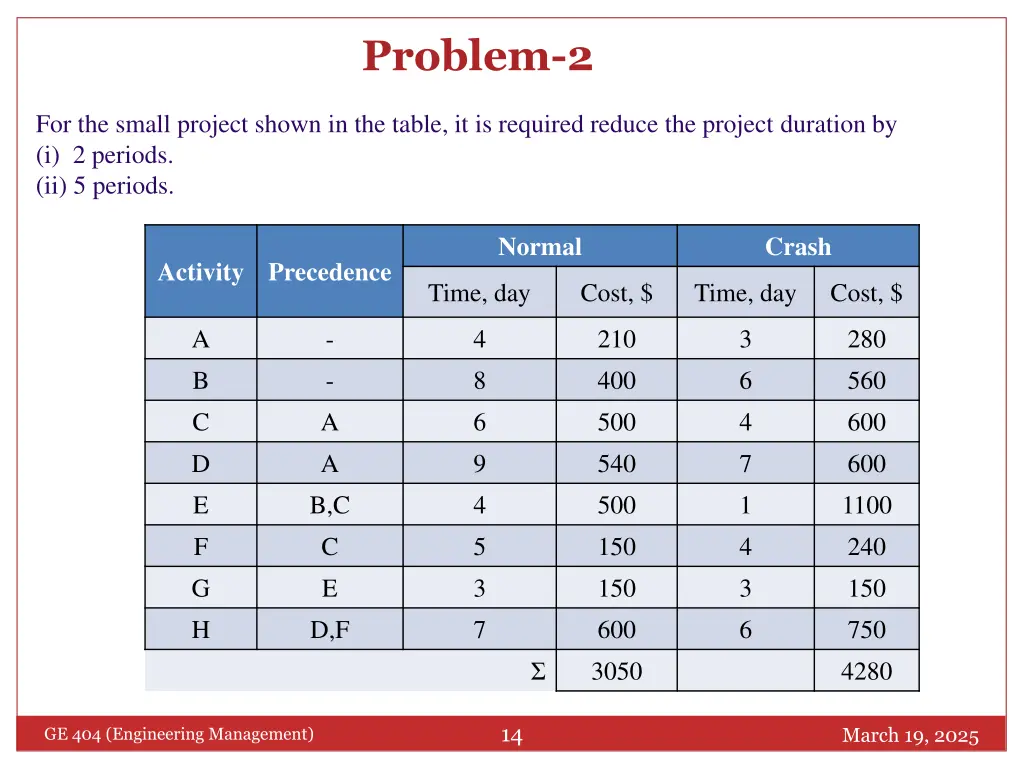
Problem-2 For the small project shown in the table, it is required reduce the project duration by (i) 2 periods. (ii) 5 periods. Normal Crash Activity Precedence Time, day Cost, $ Time, day Cost, $ A B C D E F G H - - 4 8 6 9 4 5 3 7 210 400 500 540 500 150 150 600 3050 3 6 4 7 1 4 3 6 280 560 600 600 1100 240 150 750 4280 A A B,C C E D,F 14 March 19, 2025 GE 404 (Engineering Management)
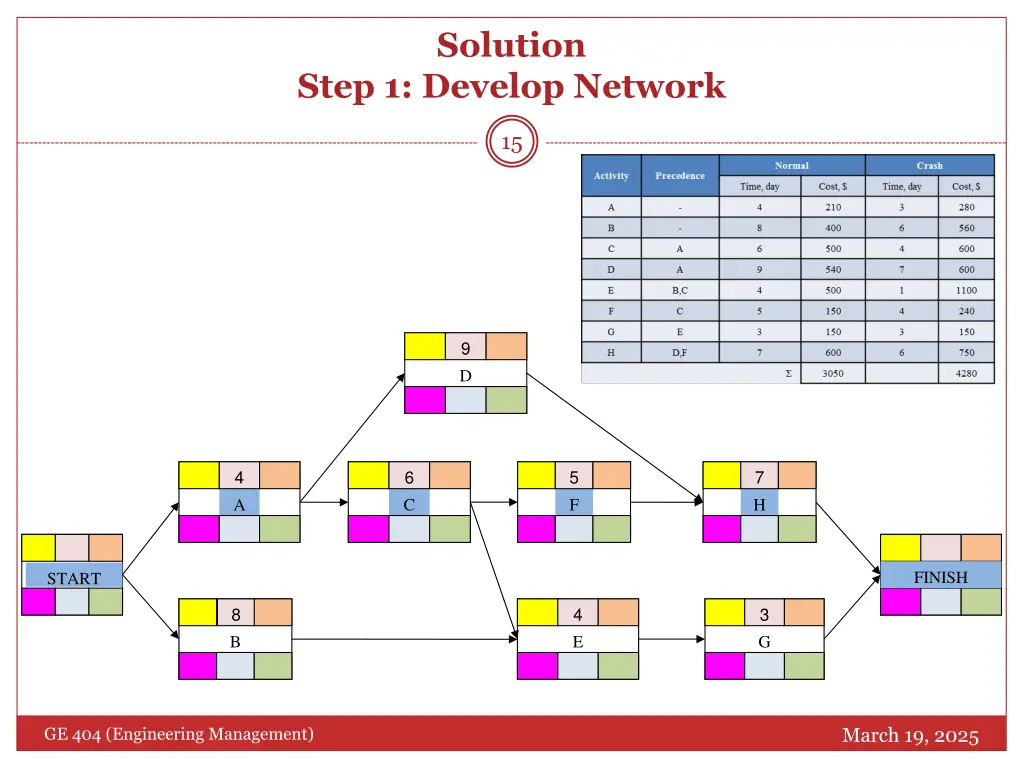
Solution Step 1: Develop Network 15 9 D 4 6 5 7 A C F H FINISH START 8 4 3 B E G March 19, 2025 GE 404 (Engineering Management)
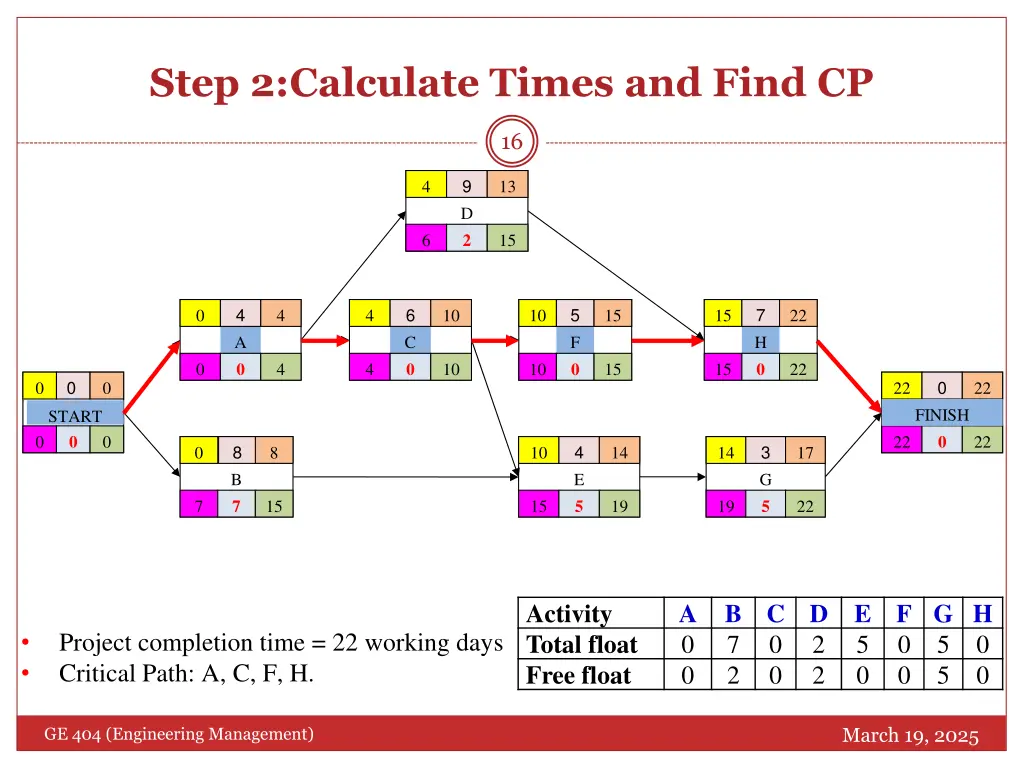
Step 2:Calculate Times and Find CP 16 9 4 13 D 2 6 15 4 6 5 7 0 4 4 10 10 15 15 22 A 0 C 0 F 0 H 0 0 4 4 10 10 15 15 22 0 0 0 0 22 22 FINISH START 0 0 0 0 22 22 8 4 3 0 8 10 14 14 17 B 7 E 5 G 5 7 15 15 19 19 22 Activity Total float Free float A 0 0 B 7 2 C 0 0 D 2 2 E 5 0 F G H 0 5 0 5 Project completion time = 22 working days Critical Path: A, C, F, H. 0 0 March 19, 2025 GE 404 (Engineering Management)
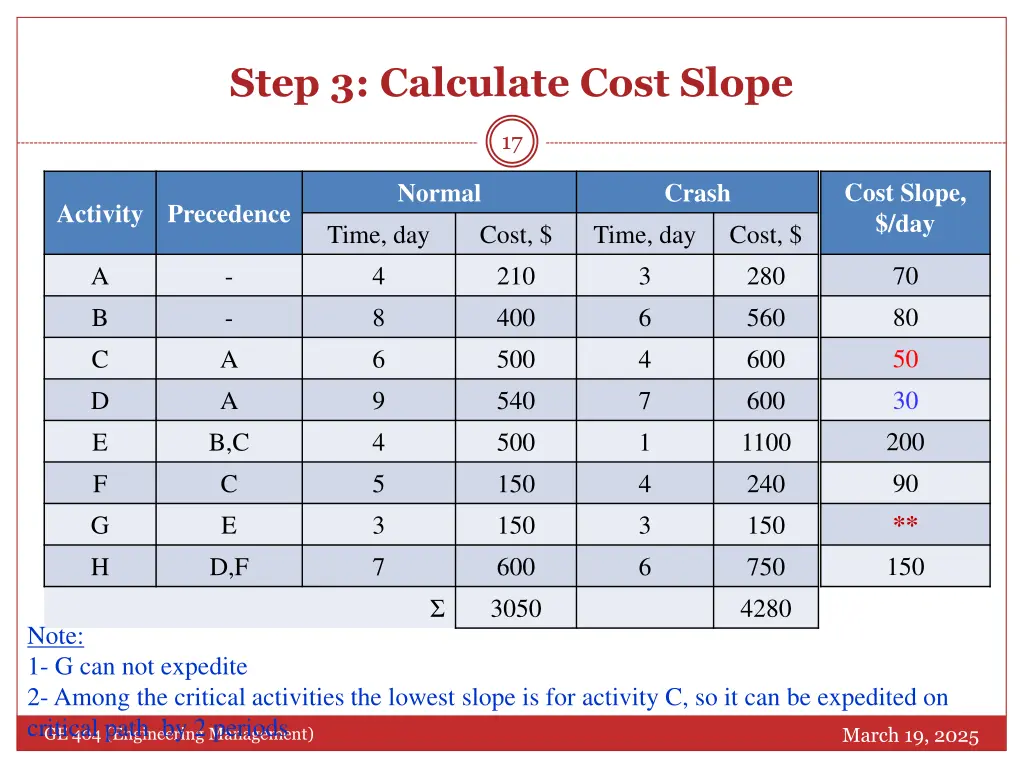
Step 3: Calculate Cost Slope 17 Cost Slope, $/day Normal Crash Activity Precedence Time, day 4 8 6 9 4 5 3 7 Cost, $ 210 400 500 540 500 150 150 600 3050 Time, day 3 6 4 7 1 4 3 6 Cost, $ 280 560 600 600 1100 240 150 750 4280 70 80 50 30 200 90 ** 150 A B C D E F G H - - A A B,C C E D,F Note: 1- G can not expedite 2- Among the critical activities the lowest slope is for activity C, so it can be expedited on GE 404 (Engineering Management) critical path by 2 periods March 19, 2025
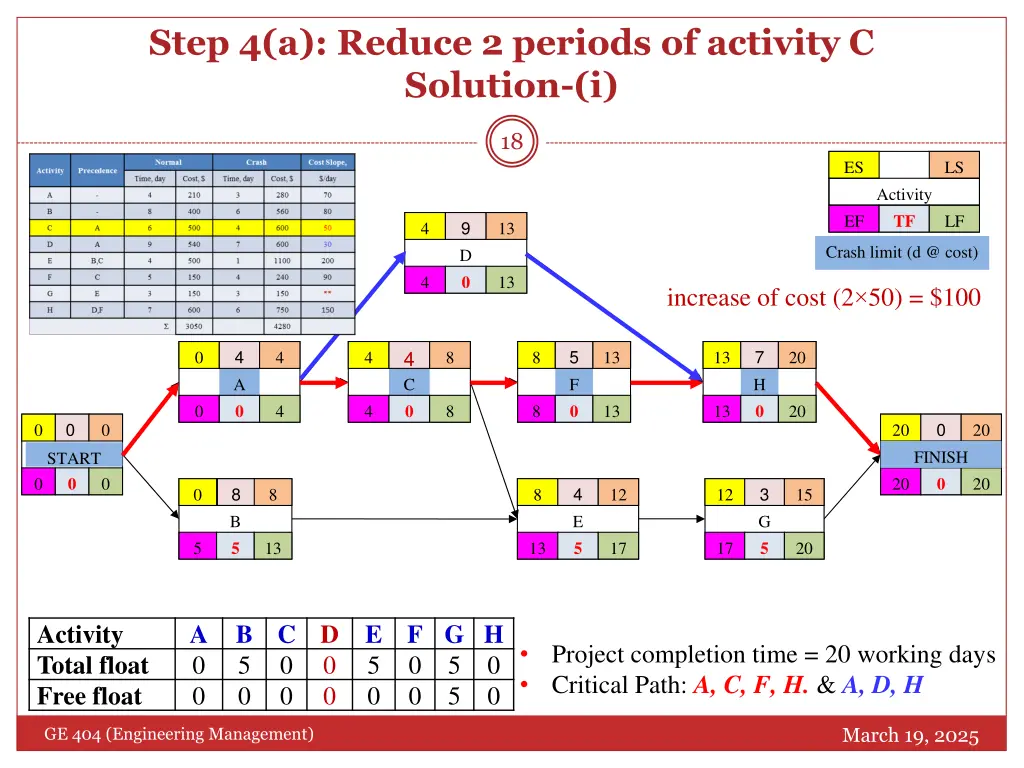
Step 4(a): Reduce 2 periods of activity C Solution-(i) 18 ES LS Activity TF EF LF 9 4 13 Crash limit (d @ cost) D 0 4 13 increase of cost (2 50) = $100 4 4 5 7 0 4 4 8 8 13 13 20 A 0 C 0 F 0 H 0 0 4 4 8 8 13 13 20 0 0 0 0 20 20 FINISH START 0 0 0 0 20 20 8 4 3 0 8 8 12 12 15 B 5 E 5 G 5 5 13 13 17 17 20 Activity Total float Free float A 0 0 B 5 0 C 0 0 D 0 0 E 5 0 F G H 0 5 0 5 Project completion time = 20 working days Critical Path: A, C, F, H. & A, D, H 0 0 March 19, 2025 GE 404 (Engineering Management)
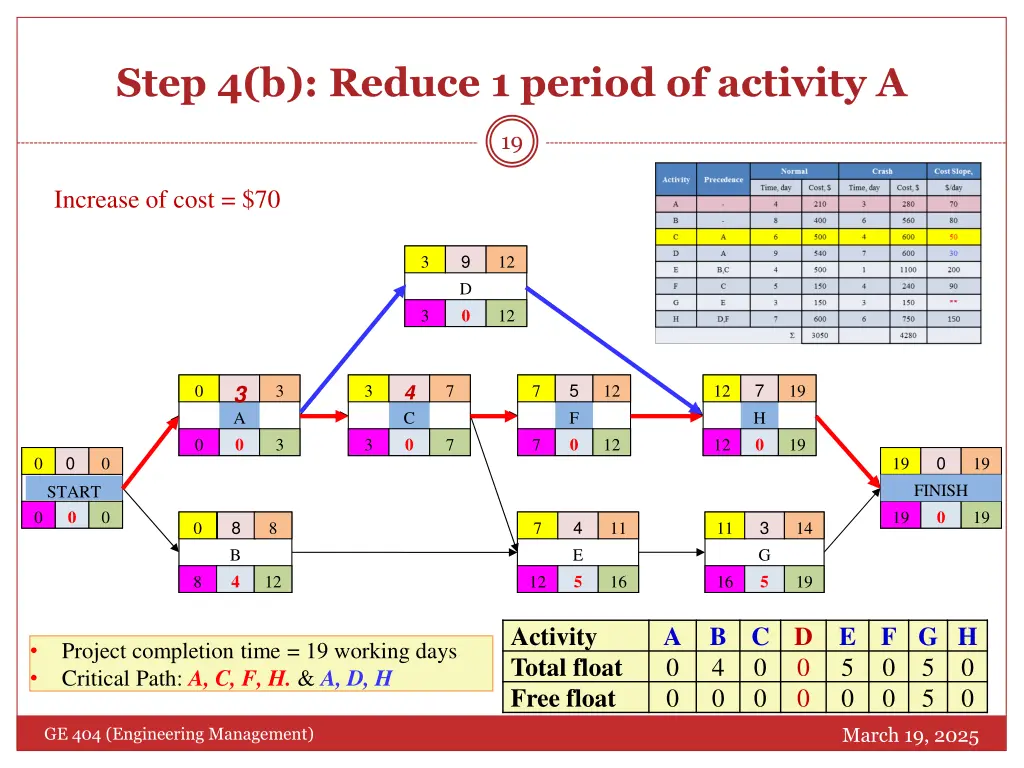
Step 4(b): Reduce 1 period of activity A 19 Increase of cost = $70 9 3 12 D 0 3 12 4 5 7 3 0 3 3 7 7 12 12 19 A 0 C 0 F 0 H 0 0 3 3 7 7 12 12 19 0 0 0 0 19 19 FINISH START 0 0 0 0 19 19 8 4 3 0 8 7 11 11 14 B 4 E 5 G 5 8 12 12 16 16 19 Activity Total float Free float A 0 0 B 4 0 C 0 0 D 0 0 E 5 0 F G H 0 5 0 5 Project completion time = 19 working days Critical Path: A, C, F, H. & A, D, H 0 0 March 19, 2025 GE 404 (Engineering Management)
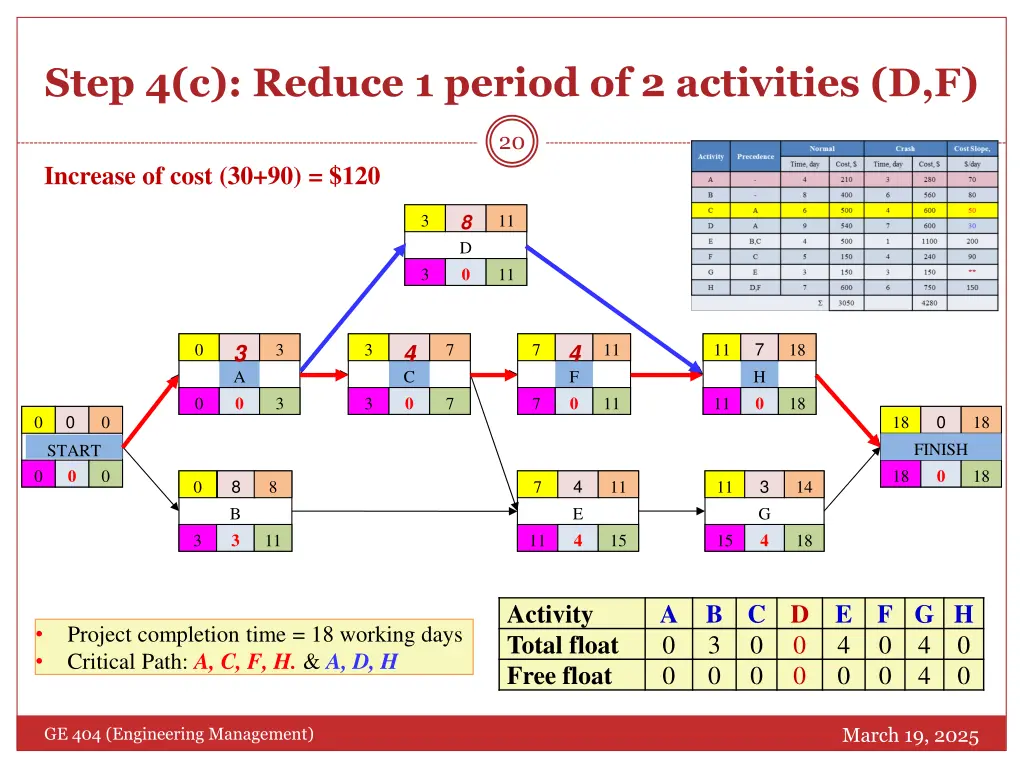
Step 4(c): Reduce 1 period of 2 activities (D,F) 20 Increase of cost (30+90) = $120 8 3 11 D 0 3 11 7 3 4 4 0 3 3 7 7 11 11 18 A 0 C 0 F 0 H 0 0 3 3 7 7 11 11 18 0 0 0 0 18 18 FINISH START 0 0 0 0 18 18 8 4 3 0 8 7 11 11 14 B 3 E 4 G 4 3 11 11 15 15 18 Activity Total float Free float A 0 0 B 3 0 C 0 0 D 0 0 E 4 0 F G H 0 4 0 4 Project completion time = 18 working days Critical Path: A, C, F, H. & A, D, H 0 0 March 19, 2025 GE 404 (Engineering Management)
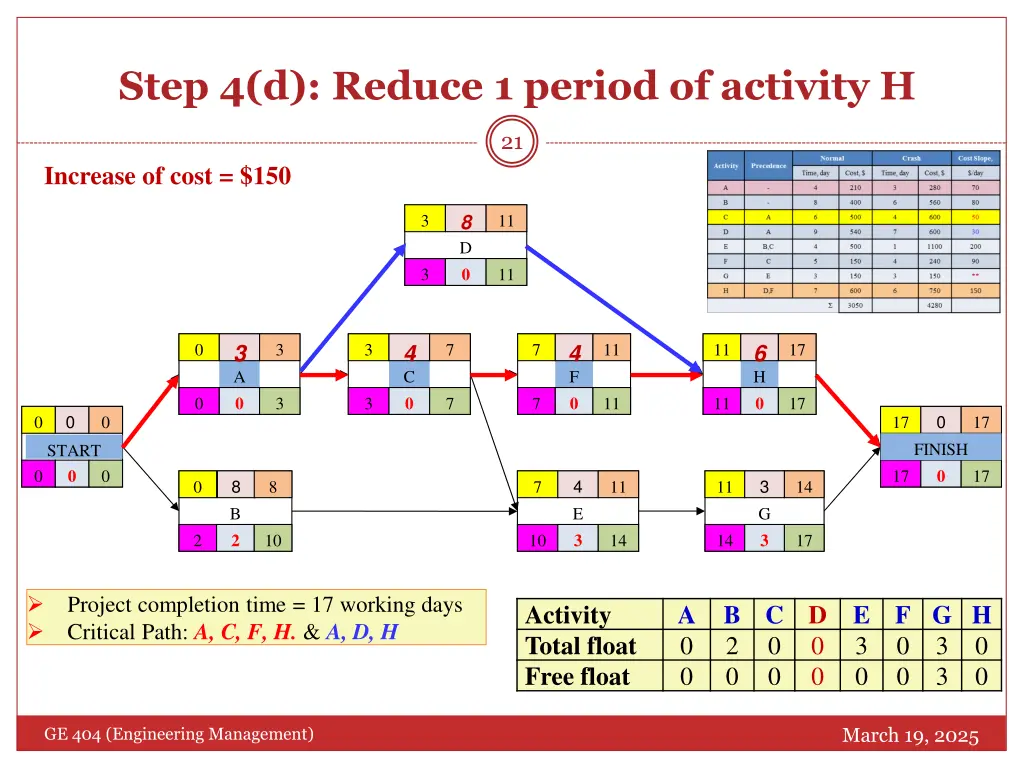
Step 4(d): Reduce 1 period of activity H 21 Increase of cost = $150 8 3 11 D 0 3 11 3 4 4 6 0 3 3 7 7 11 11 17 A 0 C 0 F 0 H 0 0 3 3 7 7 11 11 17 0 0 0 0 17 17 FINISH START 0 0 0 0 17 17 8 4 3 0 8 7 11 11 14 B 2 E 3 G 3 2 10 10 14 14 17 Project completion time = 17 working days Critical Path: A, C, F, H. & A, D, H Activity Total float Free float A 0 0 B 2 0 C 0 0 D 0 0 E 3 0 F G H 0 3 0 3 0 0 March 19, 2025 GE 404 (Engineering Management)
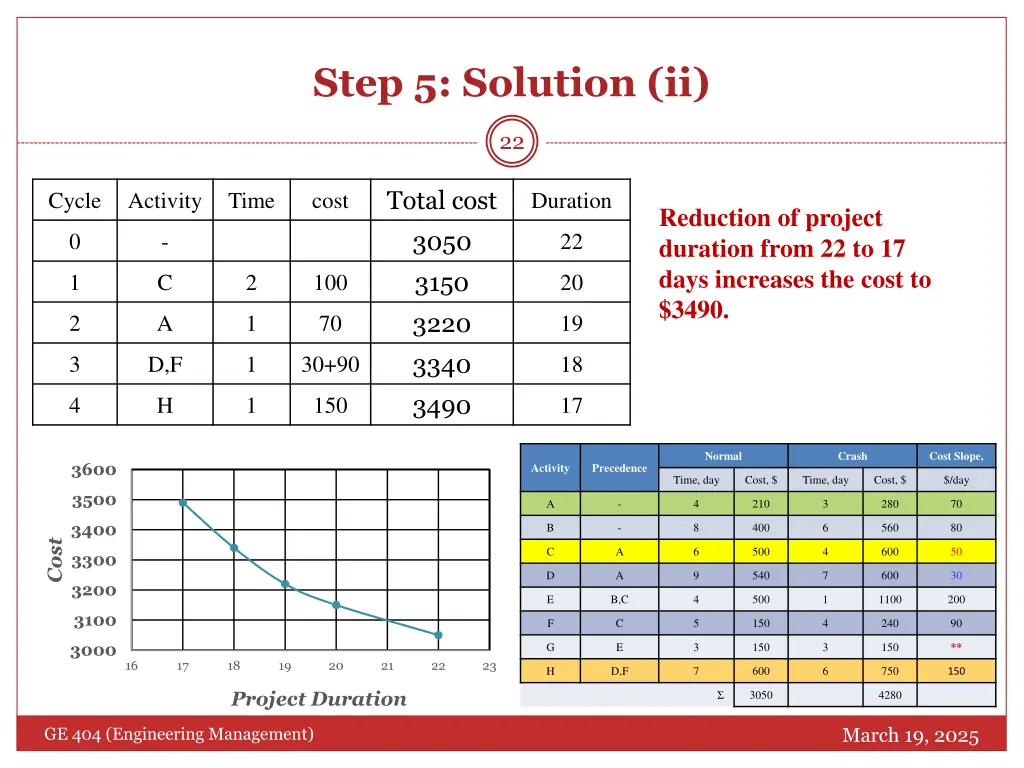
Step 5: Solution (ii) 22 Total cost 3050 3150 3220 3340 3490 Cycle Activity Time cost Duration Reduction of project duration from 22 to 17 days increases the cost to $3490. 0 - 22 1 C 2 100 20 2 A 1 70 19 3 D,F 1 30+90 18 4 H 1 150 17 Normal Crash Cost Slope, 3600 Activity Precedence Time, day Cost, $ Time, day Cost, $ $/day 3500 A - 4 210 3 280 70 3400 B - 8 400 6 560 80 Cost C A 6 500 4 600 50 3300 D A 9 540 7 600 30 3200 E B,C 4 500 1 1100 200 3100 F C 5 150 4 240 90 3000 ** G E 3 150 3 150 16 17 18 19 20 21 22 23 H D,F 7 600 6 750 150 Project Duration 3050 4280 March 19, 2025 GE 404 (Engineering Management)
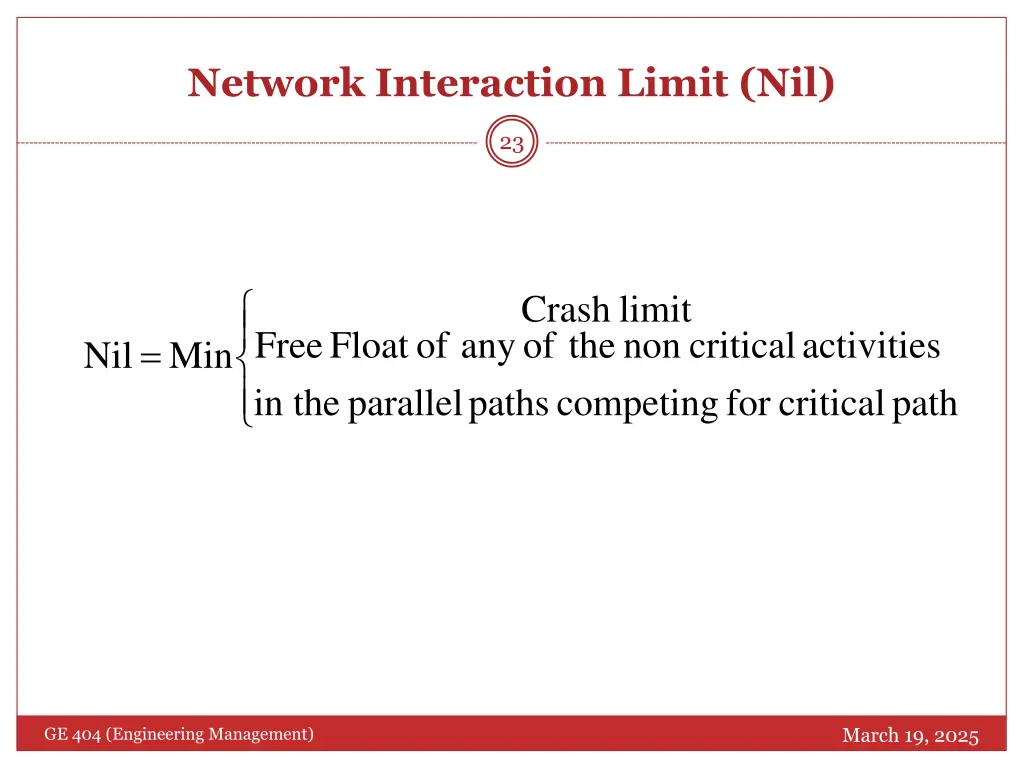
Network Interaction Limit (Nil) 23 Crash limit Free Float of any of the non critical activities = Nil Min competing paths parallel in the critical for path March 19, 2025 GE 404 (Engineering Management)
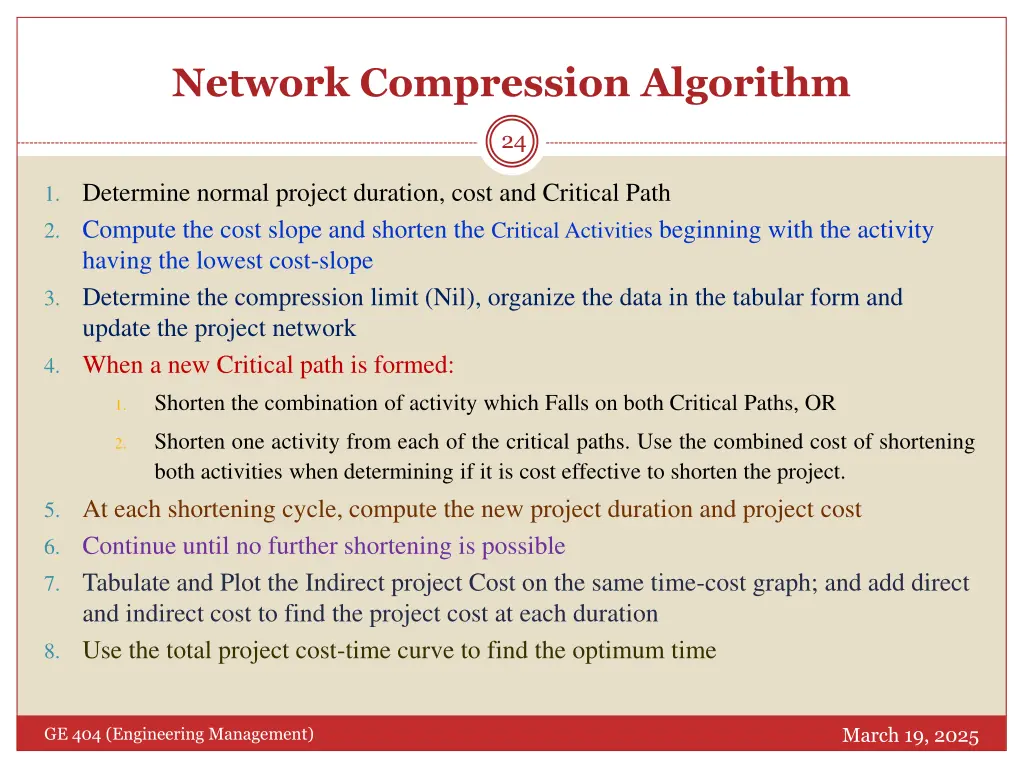
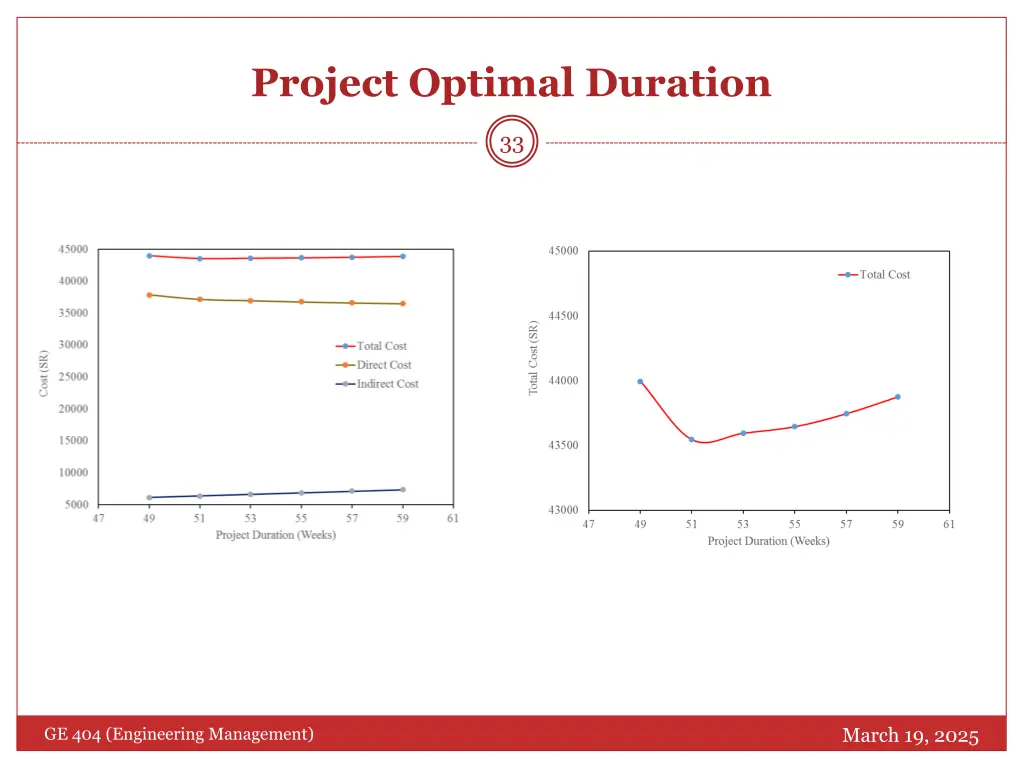
Network Compression Algorithm 24 1. Determine normal project duration, cost and Critical Path 2. Compute the cost slope and shorten the Critical Activities beginning with the activity having the lowest cost-slope 3. Determine the compression limit (Nil), organize the data in the tabular form and update the project network 4. When a new Critical path is formed: Shorten the combination of activity which Falls on both Critical Paths, OR 1. Shorten one activity from each of the critical paths. Use the combined cost of shortening both activities when determining if it is cost effective to shorten the project. 5. At each shortening cycle, compute the new project duration and project cost 6. Continue until no further shortening is possible 7. Tabulate and Plot the Indirect project Cost on the same time-cost graph; and add direct and indirect cost to find the project cost at each duration 8. Use the total project cost-time curve to find the optimum time 2. March 19, 2025 GE 404 (Engineering Management)
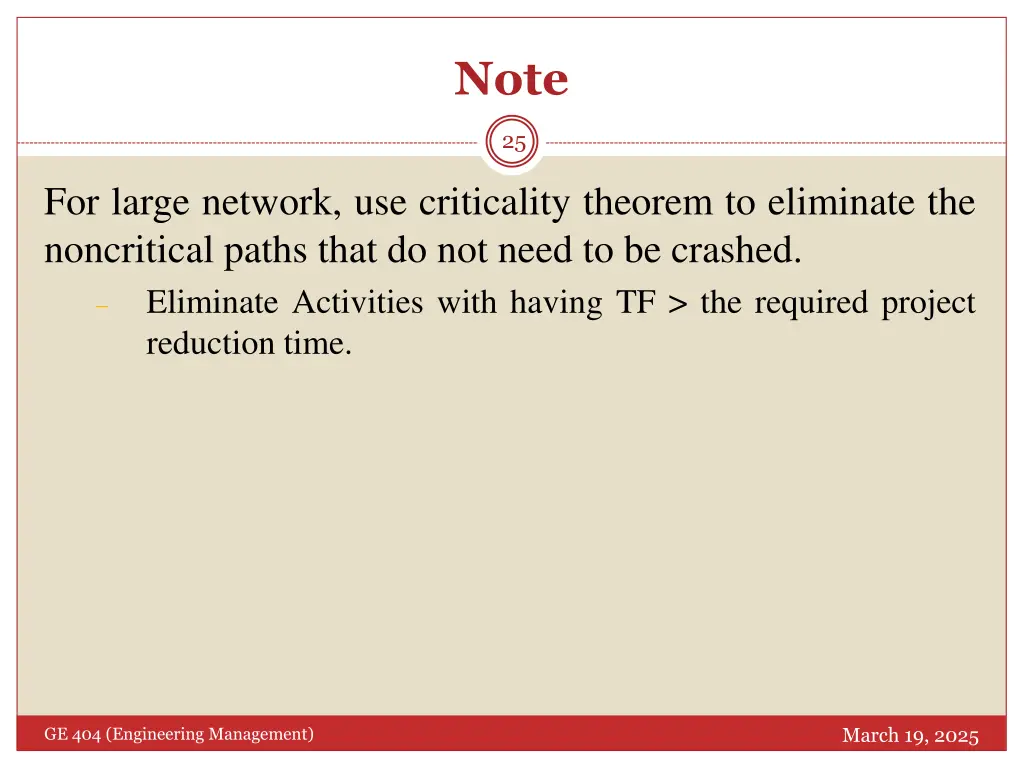
Note 25 For large network, use criticality theorem to eliminate the noncritical paths that do not need to be crashed. Eliminate Activities with having TF > the required project reduction time. March 19, 2025 GE 404 (Engineering Management)
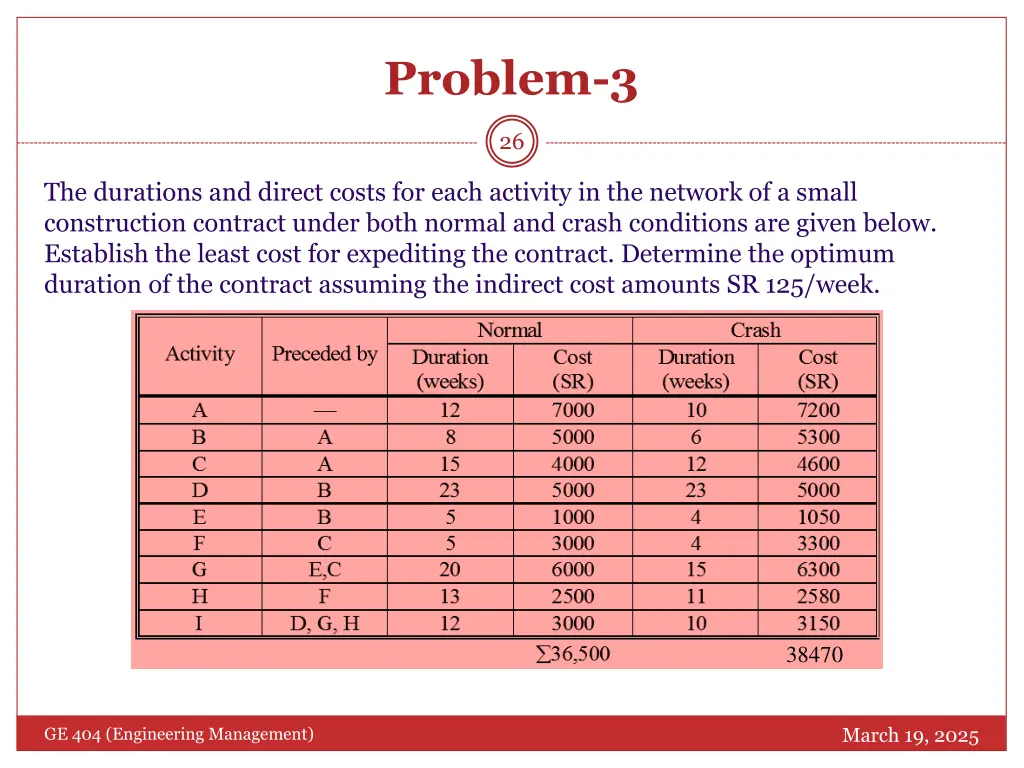
Problem-3 26 The durations and direct costs for each activity in the network of a small construction contract under both normal and crash conditions are given below. Establish the least cost for expediting the contract. Determine the optimum duration of the contract assuming the indirect cost amounts SR 125/week. 38470 March 19, 2025 GE 404 (Engineering Management)
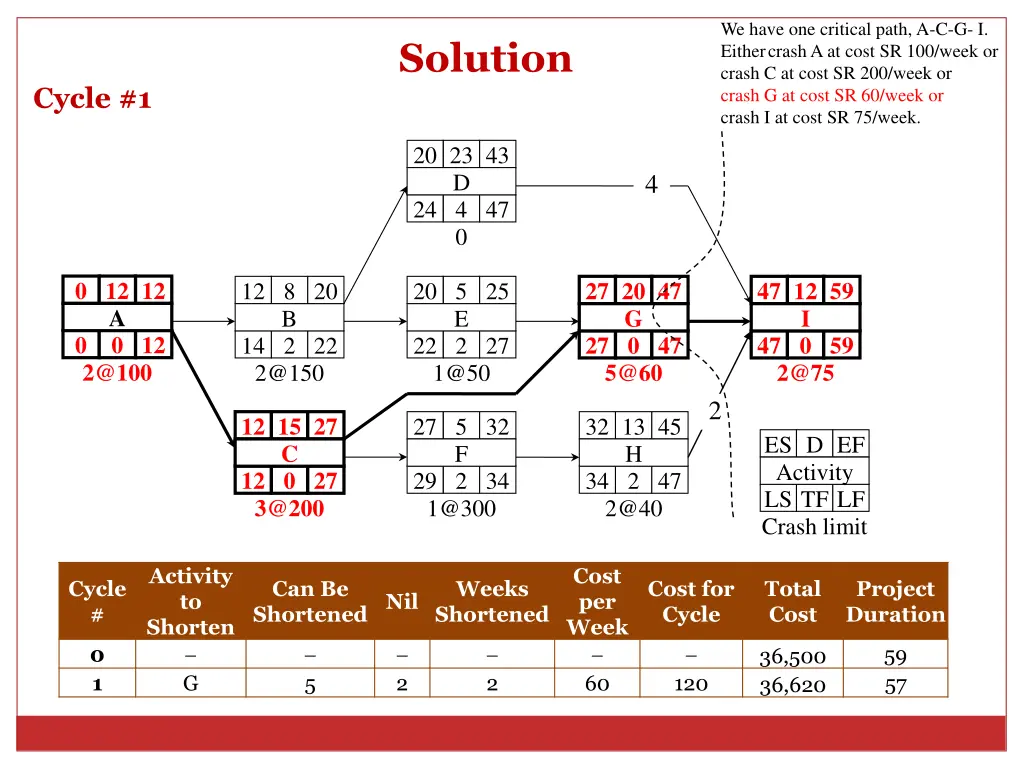
We have one critical path, A-C-G- I. Either crash A at cost SR 100/week or crash C at cost SR 200/week or crash G at cost SR 60/week or crash I at cost SR 75/week. Solution Cycle #1 20 23 43 D 4 24 4 47 0 0 12 12 A 27 20 47 G 47 12 59 I 12 8 20 B 20 5 25 E 0 0 12 27 0 47 47 0 59 14 2 22 22 2 27 2@100 5@60 2@75 2@150 1@50 2 12 15 27 C 27 5 32 F 32 13 45 H ES D EF Activity 12 0 27 29 2 34 34 2 47 LS TF LF Crash limit 3@200 1@300 2@40 Activity to Shorten G Cost per Week 60 Cycle # Can Be Shortened Weeks Shortened Cost for Cycle Total Cost Project Duration Nil 5 2 2 0 1 59 57 36,500 36,620 120
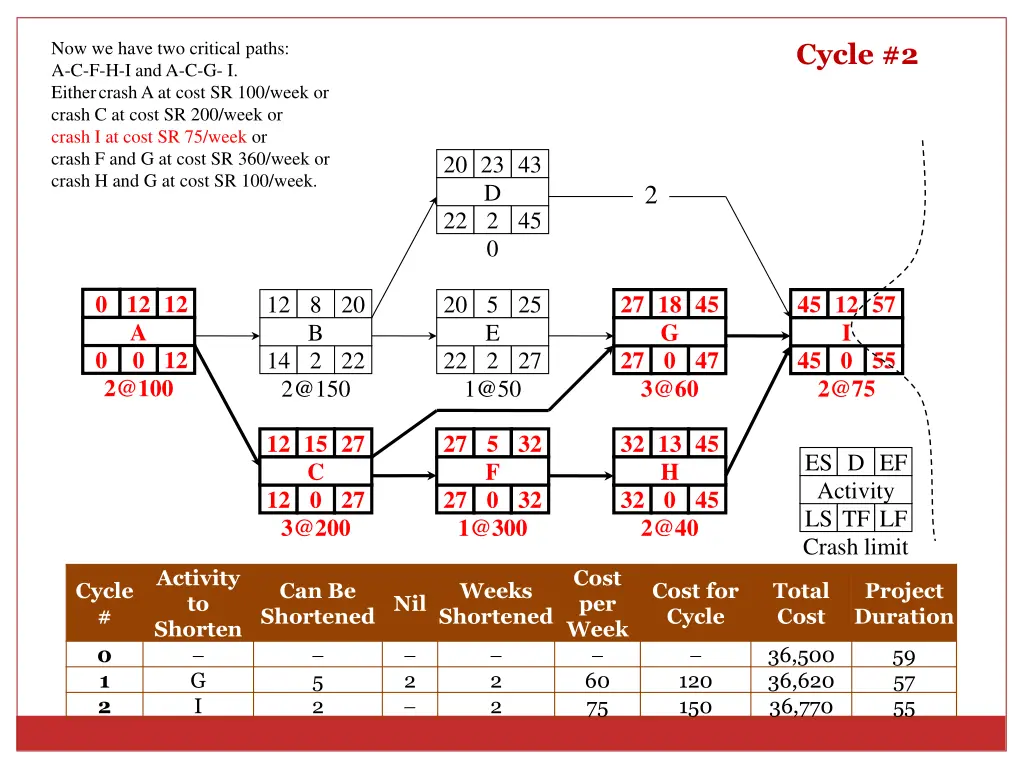
Now we have two critical paths: A-C-F-H-I and A-C-G- I. Either crash A at cost SR 100/week or crash C at cost SR 200/week or crash I at cost SR 75/week or crash F and G at cost SR 360/week or crash H and G at cost SR 100/week. Cycle #2 20 23 43 D 2 22 2 45 0 0 12 12 A 27 18 45 G 45 12 57 I 12 8 20 B 20 5 25 E 0 0 12 27 0 47 45 0 55 14 2 22 22 2 27 2@100 3@60 2@75 2@150 1@50 12 15 27 C 27 5 32 F 32 13 45 H ES D EF Activity 12 0 27 27 0 32 32 0 45 LS TF LF Crash limit 3@200 1@300 2@40 Activity to Shorten G I Cost per Week 60 75 Cycle # Can Be Shortened Weeks Shortened Cost for Cycle Total Cost Project Duration Nil 5 2 2 2 2 0 1 2 36,500 36,620 36,770 59 57 55 120 150
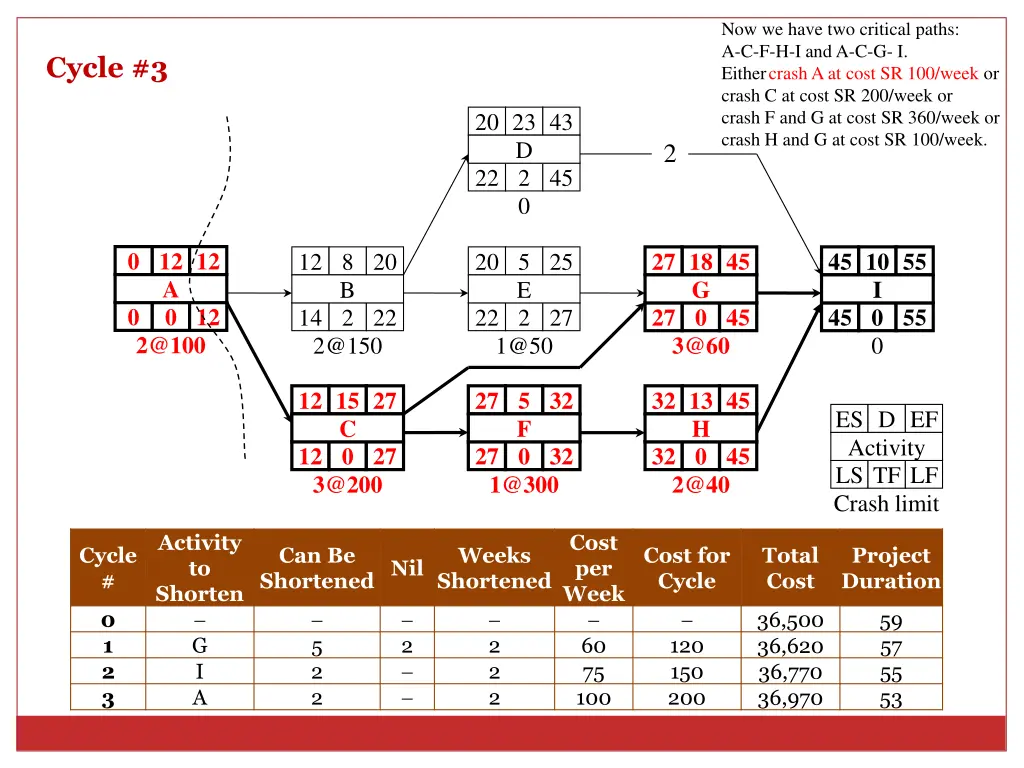
Now we have two critical paths: A-C-F-H-I and A-C-G- I. Either crash A at cost SR 100/week or crash C at cost SR 200/week or crash F and G at cost SR 360/week or crash H and G at cost SR 100/week. Cycle #3 20 23 43 D 2 22 2 45 0 0 12 12 A 27 18 45 G 45 10 55 I 12 8 20 B 20 5 25 E 0 0 12 27 0 45 45 0 55 14 2 22 22 2 27 2@100 3@60 2@150 1@50 0 12 15 27 C 27 5 32 F 32 13 45 H ES D EF Activity 12 0 27 27 0 32 32 0 45 LS TF LF Crash limit 3@200 1@300 2@40 Activity to Shorten G I A Cost per Week 60 75 100 Cycle # Can Be Shortened Weeks Shortened Cost for Cycle Total Cost Project Duration Nil 5 2 2 2 2 2 2 0 1 2 3 59 57 55 53 36,500 36,620 36,770 36,970 120 150 200
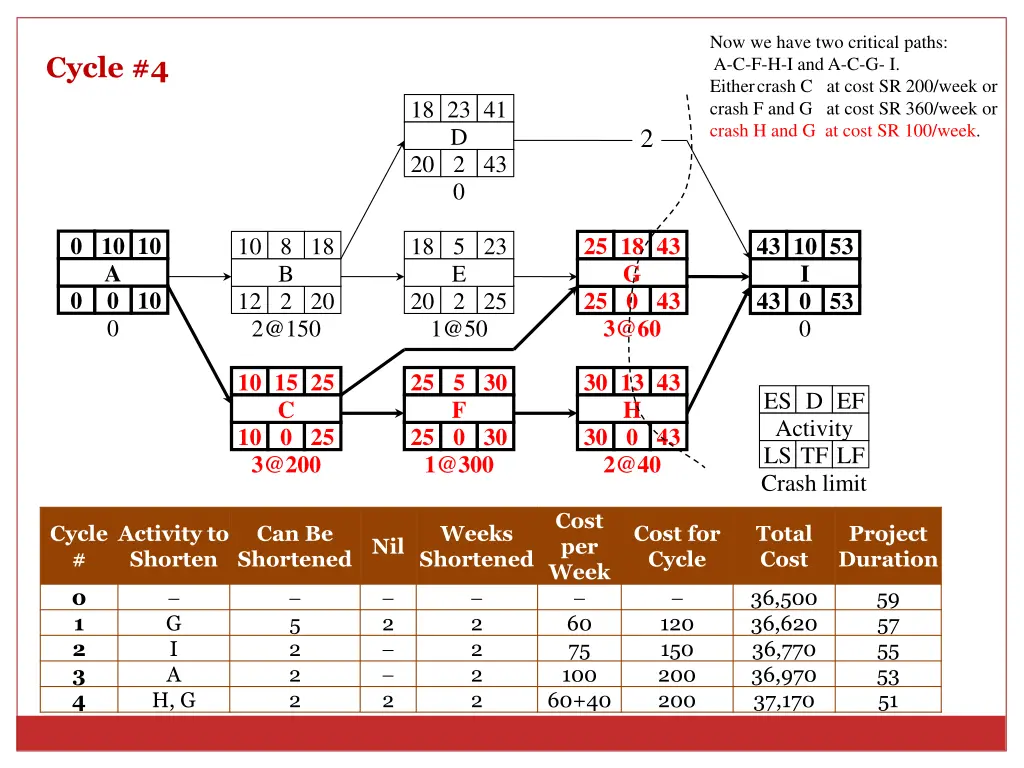
Now we have two critical paths: A-C-F-H-I and A-C-G- I. Either crash C at cost SR 200/week or crash F and G at cost SR 360/week or crash H and G at cost SR 100/week. Cycle #4 18 23 41 D 2 20 2 43 0 0 10 10 A 25 18 43 G 43 10 53 I 10 8 18 B 18 5 23 E 0 0 10 25 0 43 43 0 53 12 2 20 20 2 25 3@60 0 2@150 1@50 0 10 15 25 C 25 5 30 F 30 13 43 H ES D EF Activity 10 0 25 25 0 30 30 0 43 LS TF LF Crash limit 3@200 1@300 2@40 Cost per Week 60 75 100 60+40 Cycle # Activity to Shorten Can Be Shortened Weeks Shortened Cost for Cycle Total Cost Project Duration Nil G I A 5 2 2 2 2 2 2 2 2 2 0 1 2 3 4 36,500 36,620 36,770 36,970 37,170 59 57 55 53 51 120 150 200 200 H, G
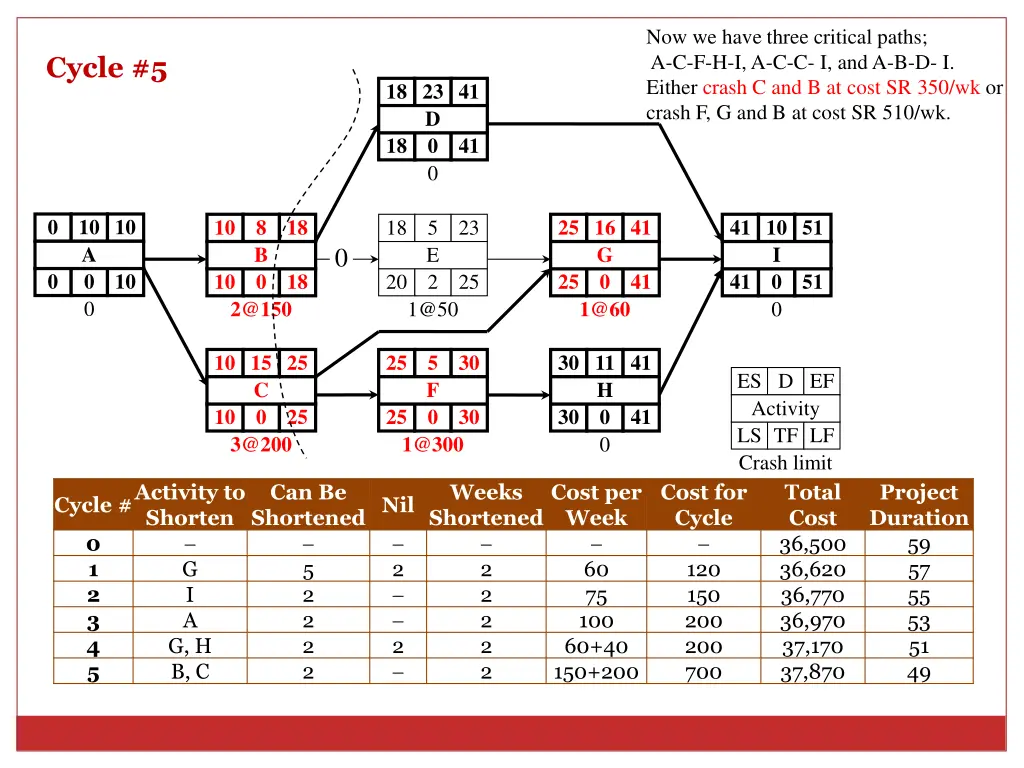
Now we have three critical paths; A-C-F-H-I, A-C-C- I, and A-B-D- I. Either crash C and B at cost SR 350/wk or crash F, G and B at cost SR 510/wk. Cycle #5 18 23 41 D 18 0 41 0 0 10 10 A 10 8 B 18 25 16 41 G 41 10 51 I 18 5 E 23 0 0 0 10 10 0 18 25 0 41 41 0 51 20 2 25 2@150 1@60 0 1@50 0 10 15 25 C 25 5 F 30 30 11 41 H ES D EF Activity 10 0 25 25 0 30 30 0 41 LS TF LF Crash limit Total Cost 36,500 36,620 36,770 36,970 37,170 37,870 3@200 1@300 0 Cycle #Activity to Shorten 0 1 2 3 4 5 Can Be Shortened 5 2 2 2 2 Weeks Shortened 2 2 2 2 2 Cost per Week 60 75 100 60+40 150+200 Cost for Cycle 120 150 200 200 700 Project Duration 59 57 55 53 51 49 Nil G I A 2 2 G, H B, C
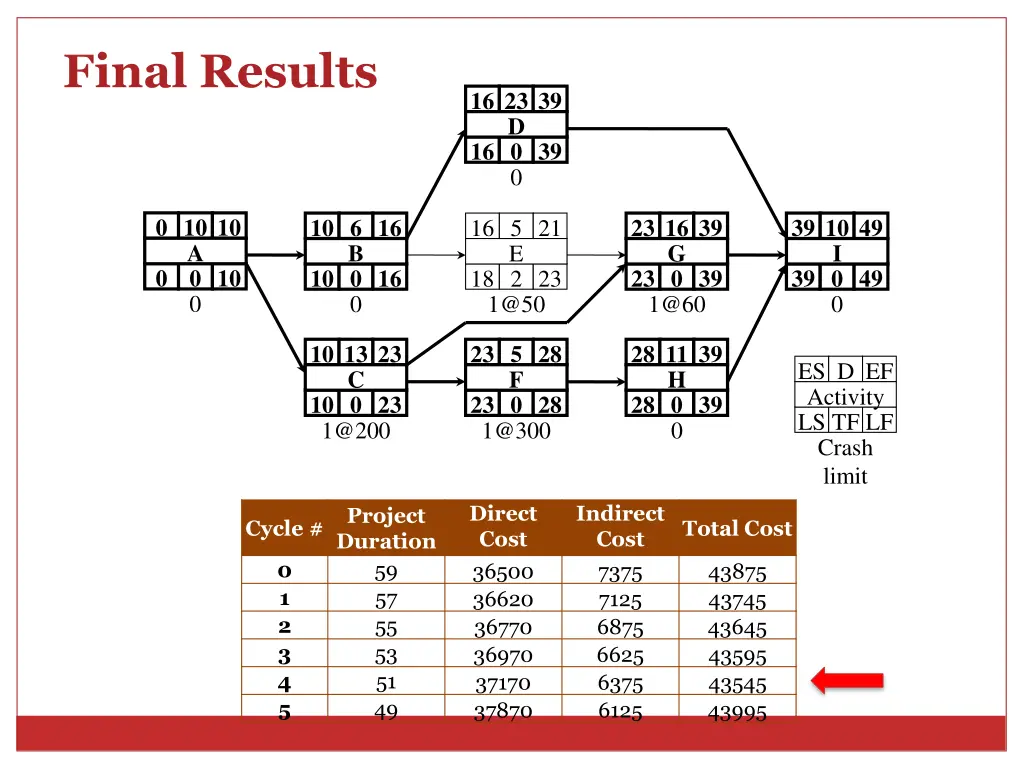
Final Results 16 23 39 D 16 0 39 0 0 10 10 A 10 6 16 B 23 16 39 G 39 10 49 I 16 5 21 E 0 0 10 10 0 16 23 0 39 39 0 49 18 2 23 0 0 1@50 1@60 0 10 13 23 C 23 5 28 F 28 11 39 H ES D EF Activity 10 0 23 23 0 28 28 0 39 LS TF LF Crash limit 1@200 1@300 0 Direct Cost 36500 36620 36770 36970 37170 37870 Indirect Cost 7375 7125 6875 6625 6375 6125 Project Duration 59 57 55 53 51 49 Cycle # Total Cost 0 1 2 3 4 5 43875 43745 43645 43595 43545 43995
Project Optimal Duration 33 March 19, 2025 GE 404 (Engineering Management)
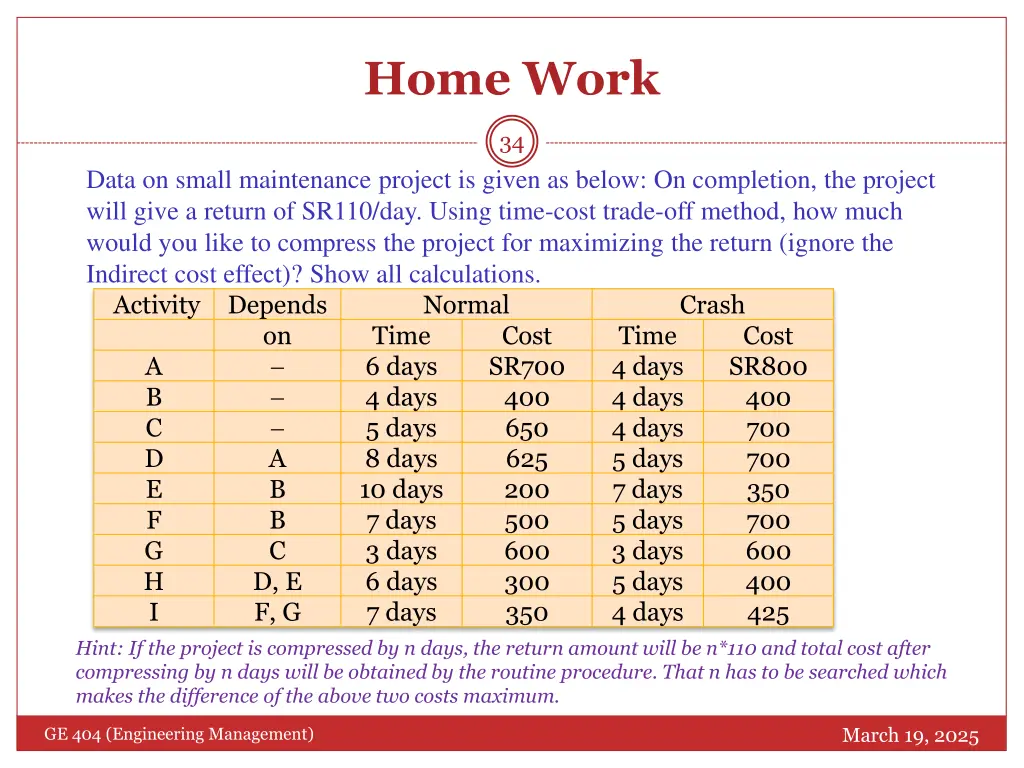
Home Work 34 Data on small maintenance project is given as below: On completion, the project will give a return of SR110/day. Using time-cost trade-off method, how much would you like to compress the project for maximizing the return (ignore the Indirect cost effect)? Show all calculations. Activity Depends Normal on Time Cost A 6 days SR700 B 4 days 400 C 5 days 650 D A 8 days 625 E B 10 days 200 F B 7 days 500 G C 3 days 600 H D, E 6 days 300 I F, G 7 days 350 Crash Time 4 days 4 days 4 days 5 days 7 days 5 days 3 days 5 days 4 days Cost SR800 400 700 700 350 700 600 400 425 Hint: If the project is compressed by n days, the return amount will be n*110 and total cost after compressing by n days will be obtained by the routine procedure. That n has to be searched which makes the difference of the above two costs maximum. March 19, 2025 GE 404 (Engineering Management)
Further Reading 35 Read more about the Time-Cost Trade-offs from: Jimmie W. Hinze. Construction Planning and Management, Fourth Edition, 2012, Pearson. March 19, 2025 GE 404 (Engineering Management)
Thank You 36 Questions Please March 19, 2025 GE 404 (Engineering Management)