Properties and Characteristics of Waves
Explore the fundamental properties of waves including transverse and longitudinal waves, describing wave parameters such as amplitude, wavelength, frequency, and time period. Learn how to calculate wave frequency and delve into the intriguing world of wave mechanics.

Download Presentation

Please find below an Image/Link to download the presentation.
The content on the website is provided AS IS for your information and personal use only. It may not be sold, licensed, or shared on other websites without obtaining consent from the author. If you encounter any issues during the download, it is possible that the publisher has removed the file from their server.
You are allowed to download the files provided on this website for personal or commercial use, subject to the condition that they are used lawfully. All files are the property of their respective owners.
The content on the website is provided AS IS for your information and personal use only. It may not be sold, licensed, or shared on other websites without obtaining consent from the author.
E N D
Presentation Transcript
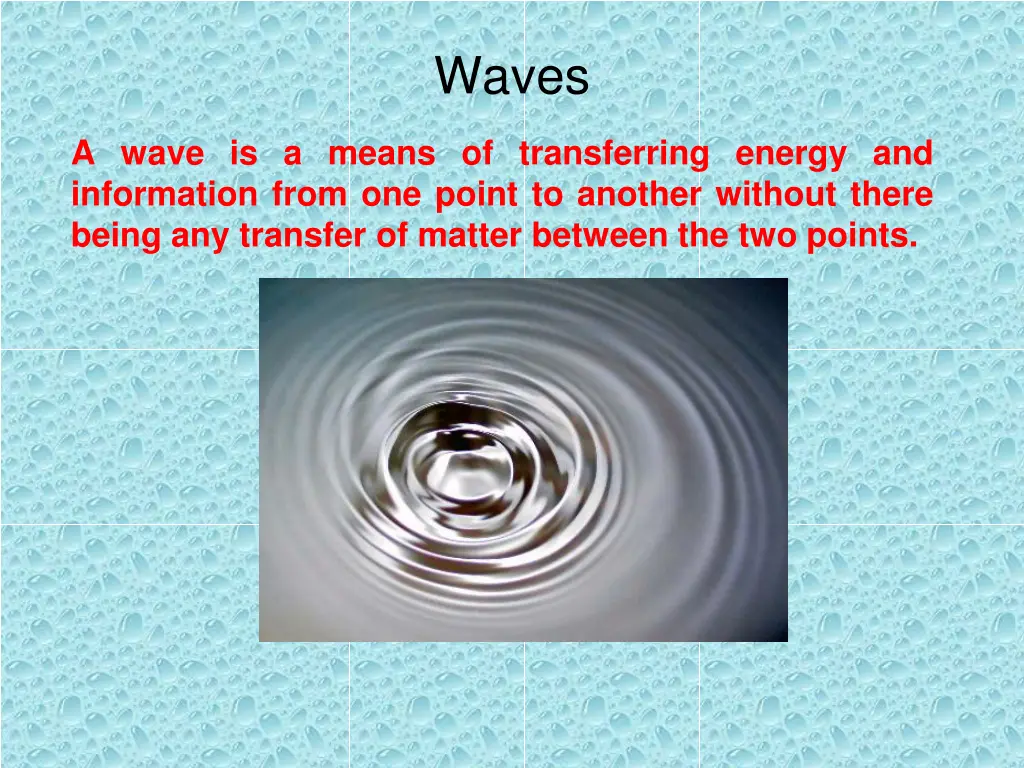
Waves A wave is a means of transferring energy and information from one point to another without there being any transfer of matter between the two points.
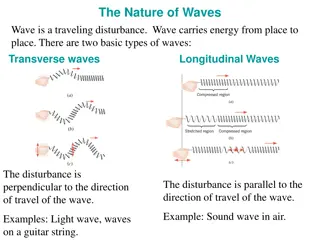
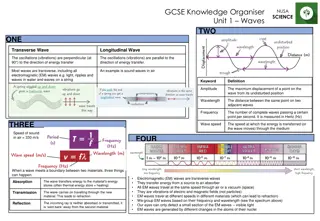
Transverse Waves Transverse waves are waves where the direction of vibrations is at 90 to the direction in which the wave travels. vibrations wave direction TRANSVERSE WAVE example: water waves
Longitudinal Waves vibrations Longitudinal waves are waves where the vibrations of the particles are along the direction in which the wave travels. wave direction LONGITUDINAL WAVE example: sound waves longitudinal wave in slinky
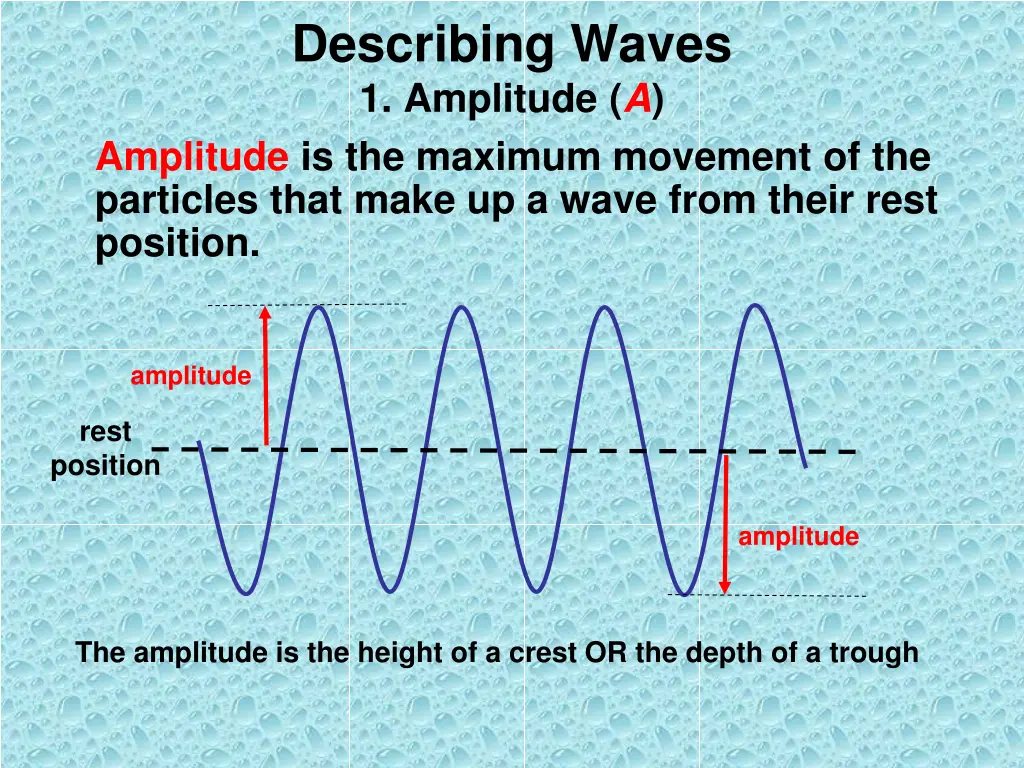
Describing Waves 1. Amplitude (A) Amplitude is the maximum movement of the particles that make up a wave from their rest position. amplitude rest position amplitude The amplitude is the height of a crest OR the depth of a trough
2. Wavelength () Wavelength is the distance between one wave peak and the next wave peak along the path of a wave. Wavelength is measured in metres. wavelength wavelength Wavelength is also the distance between the bottom of one trough to the next.
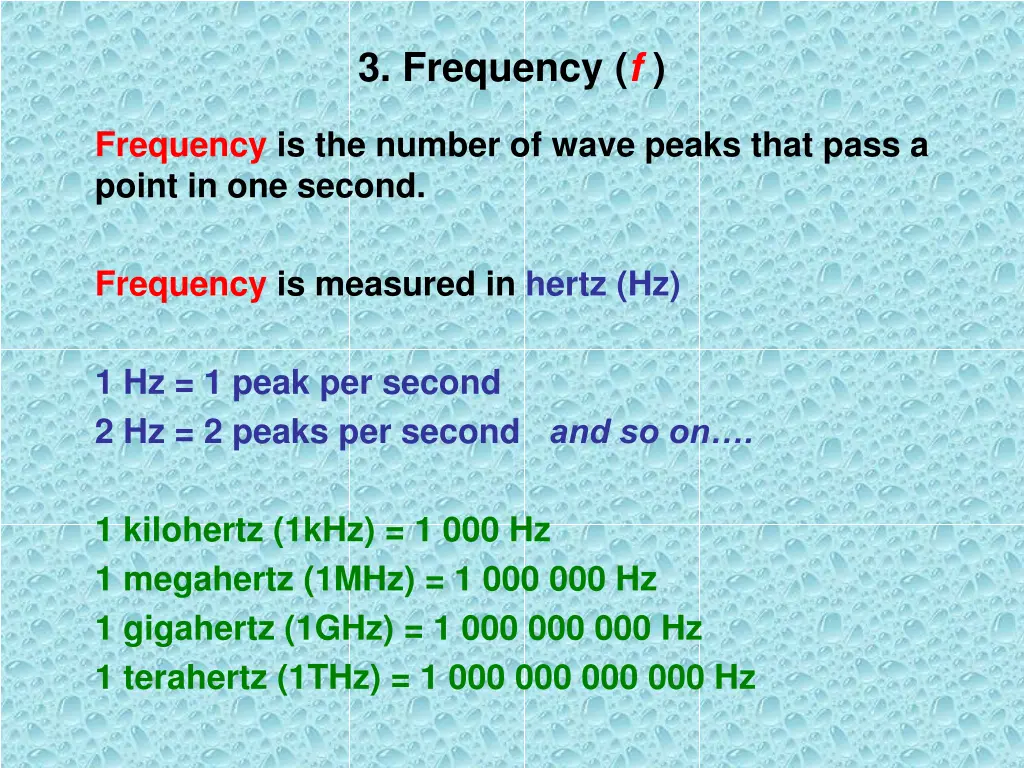
3. Frequency (f ) Frequency is the number of wave peaks that pass a point in one second. Frequency is measured in hertz (Hz) 1 Hz = 1 peak per second 2 Hz = 2 peaks per second and so on . 1 kilohertz (1kHz) = 1 000 Hz 1 megahertz (1MHz) = 1 000 000 Hz 1 gigahertz (1GHz) = 1 000 000 000 Hz 1 terahertz (1THz) = 1 000 000 000 000 Hz
4. Time period (T ) Time period is the time taken for a source to produce one wave. time period = 1 and: frequency = 1 T = 1 / f frequency f = 1 / T time period
Question 1 Calculate the frequency of a wave of time period 8.0 seconds. f = 1 / T = 1 / 8 frequency = 0.125 hertz
Question 2 Calculate the time period of a wave of frequency 50Hz. T = 1 / f = 1 / 50 time period = 0.020 second
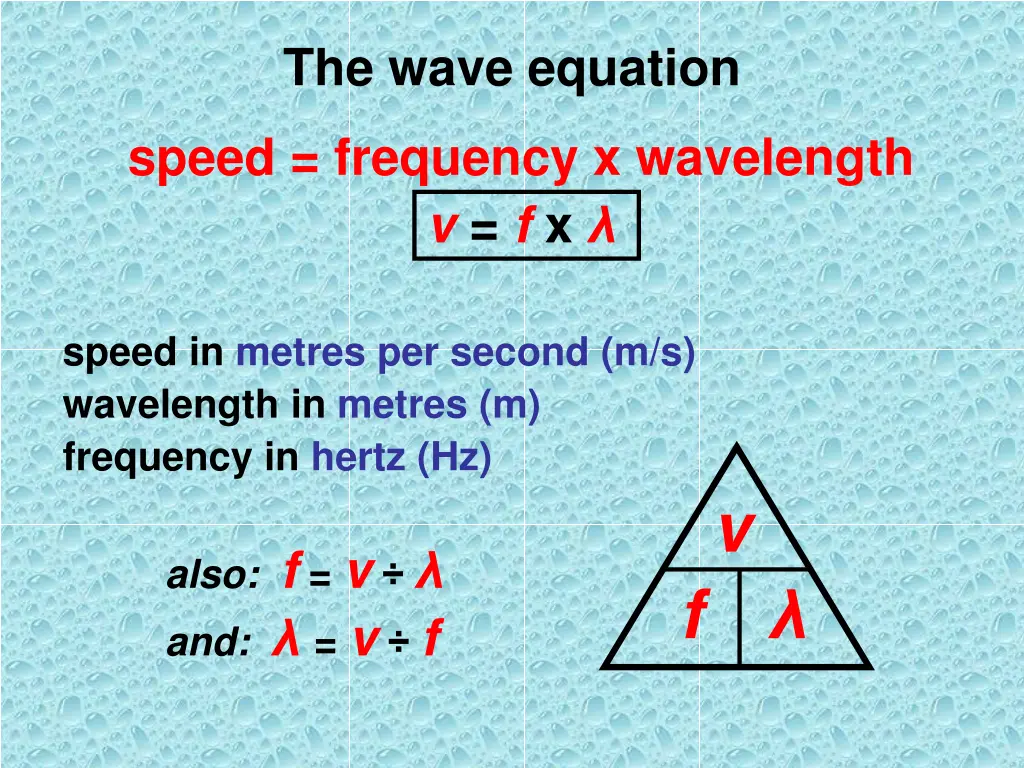
The wave equation speed = frequency x wavelength v = f x speed in metres per second (m/s) wavelength in metres (m) frequency in hertz (Hz) v also:f = v and: = v f f
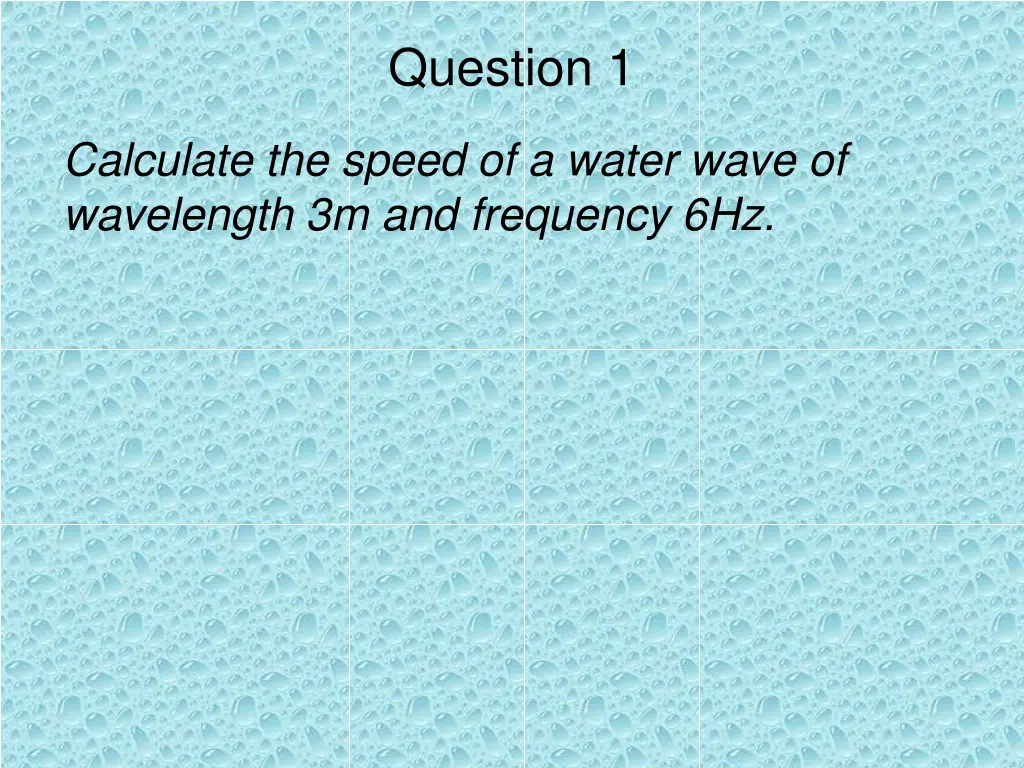
Question 1 Calculate the speed of a water wave of wavelength 3m and frequency 6Hz.
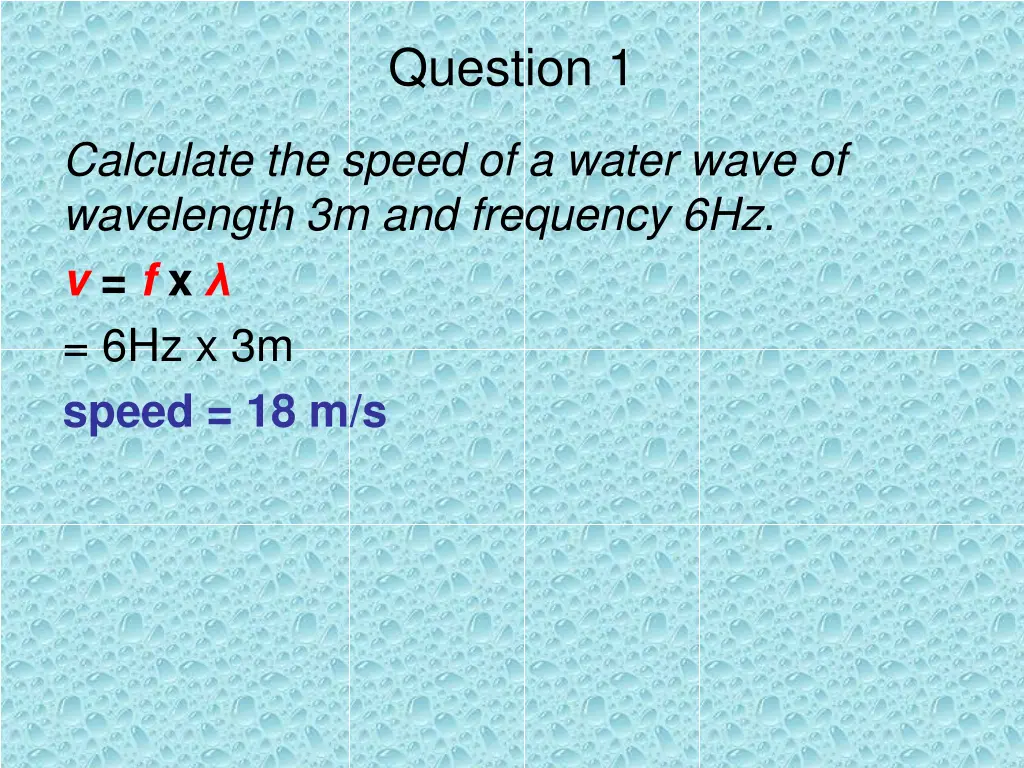
Question 1 Calculate the speed of a water wave of wavelength 3m and frequency 6Hz. v = f x = 6Hz x 3m speed = 18 m/s
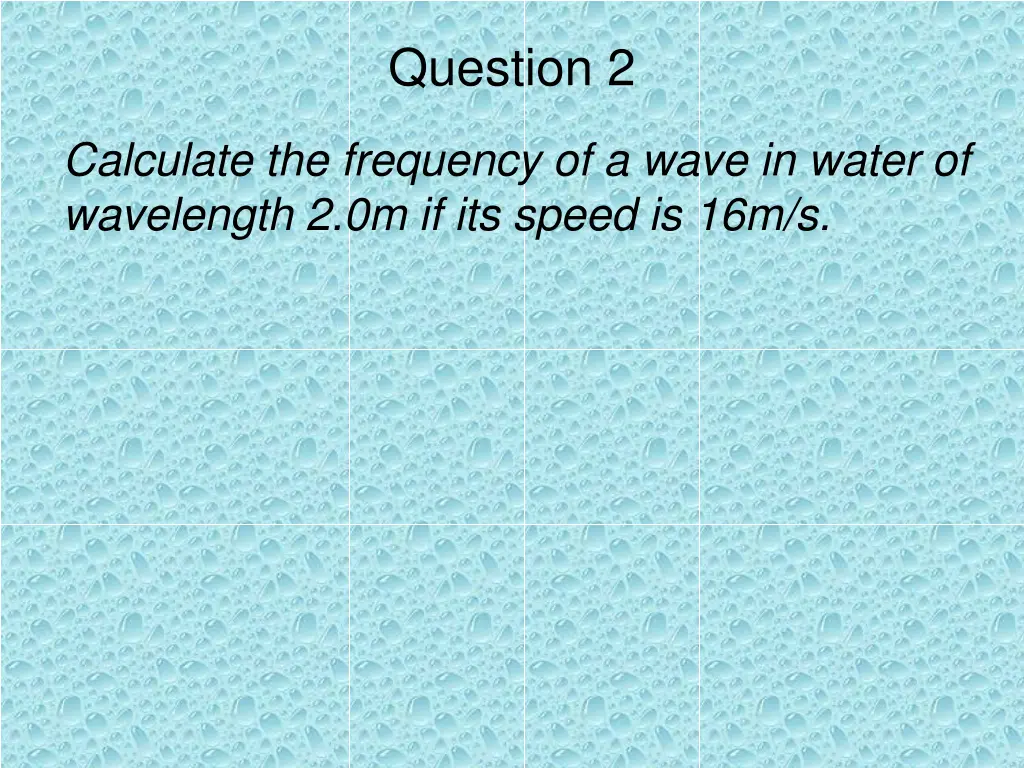
Question 2 Calculate the frequency of a wave in water of wavelength 2.0m if its speed is 16m/s.
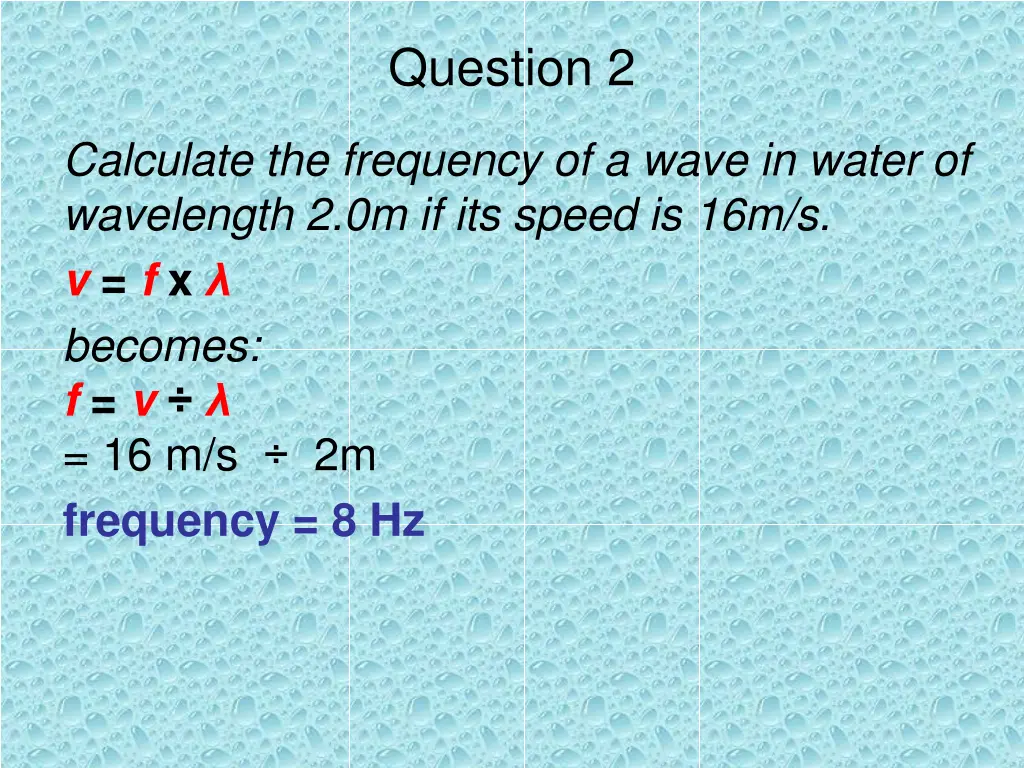
Question 2 Calculate the frequency of a wave in water of wavelength 2.0m if its speed is 16m/s. v = f x becomes: f = v = 16 m/s 2m frequency = 8 Hz
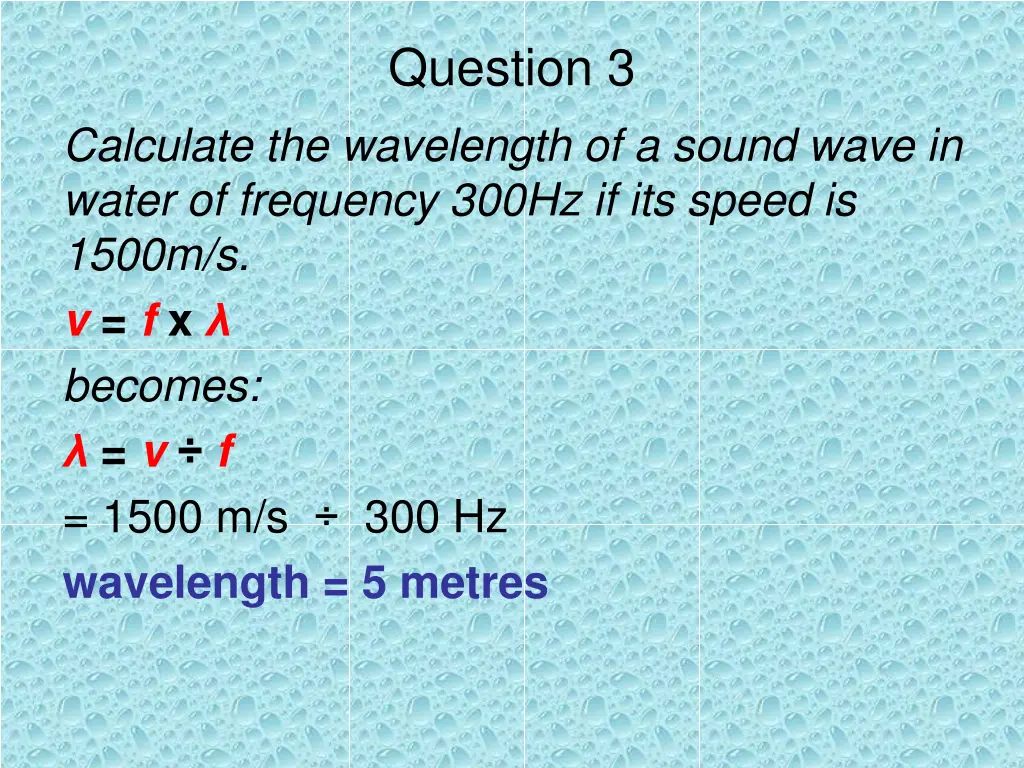
Question 3 Calculate the wavelength of a sound wave in water of frequency 300Hz if its speed is 1500m/s.
Question 3 Calculate the wavelength of a sound wave in water of frequency 300Hz if its speed is 1500m/s. v = f x becomes: = v f = 1500 m/s 300 Hz wavelength = 5 metres
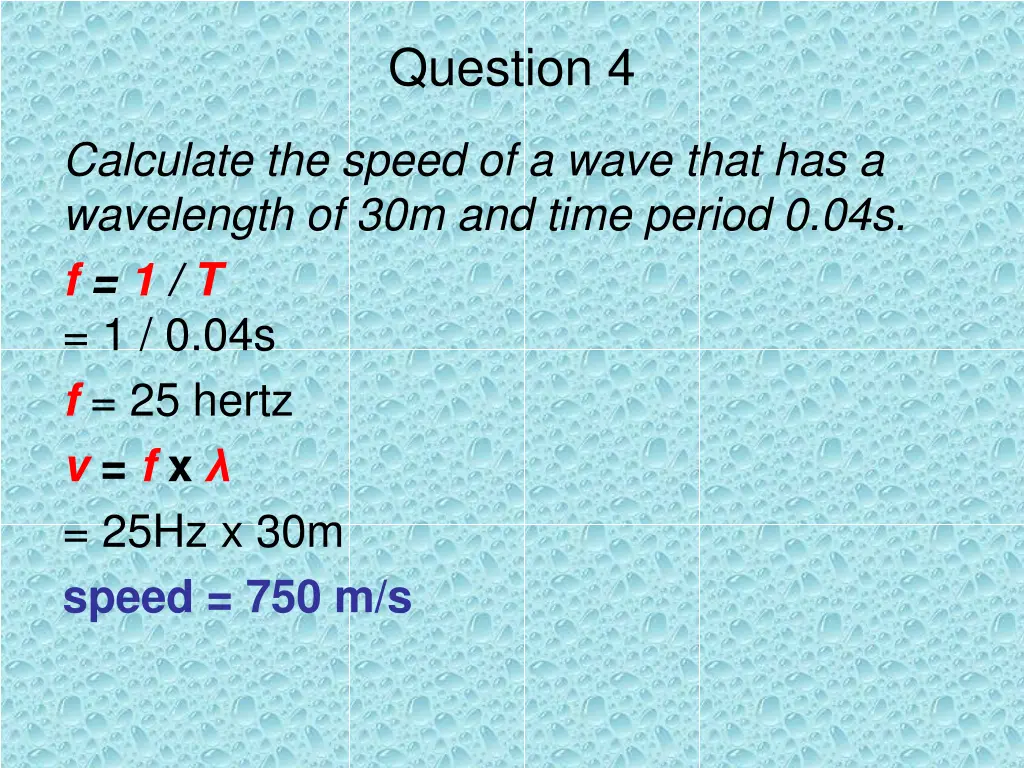
Question 4 Calculate the speed of a wave that has a wavelength of 30m and time period 0.04s.
Question 4 Calculate the speed of a wave that has a wavelength of 30m and time period 0.04s. f = 1 / T = 1 / 0.04s f= 25 hertz v = f x = 25Hz x 30m speed = 750 m/s