Explore the properties of inverse trigonometric functions such as sine, cosine, and tangent, along with their proofs. Discover relationships between these functions and learn how to derive various trigonometric identities. Dive into the world of trigonometry and expand your knowledge with detailed explanations and examples.
Please find below an Image/Link to download the presentation.
The content on the website is provided AS IS for your information and personal use only. It may not be sold, licensed, or shared on other websites without obtaining consent from the author. If you encounter any issues during the download, it is possible that the publisher has removed the file from their server.
You are allowed to download the files provided on this website for personal or commercial use, subject to the condition that they are used lawfully. All files are the property of their respective owners.
The content on the website is provided AS IS for your information and personal use only. It may not be sold, licensed, or shared on other websites without obtaining consent from the author.
E N D
Presentation Transcript
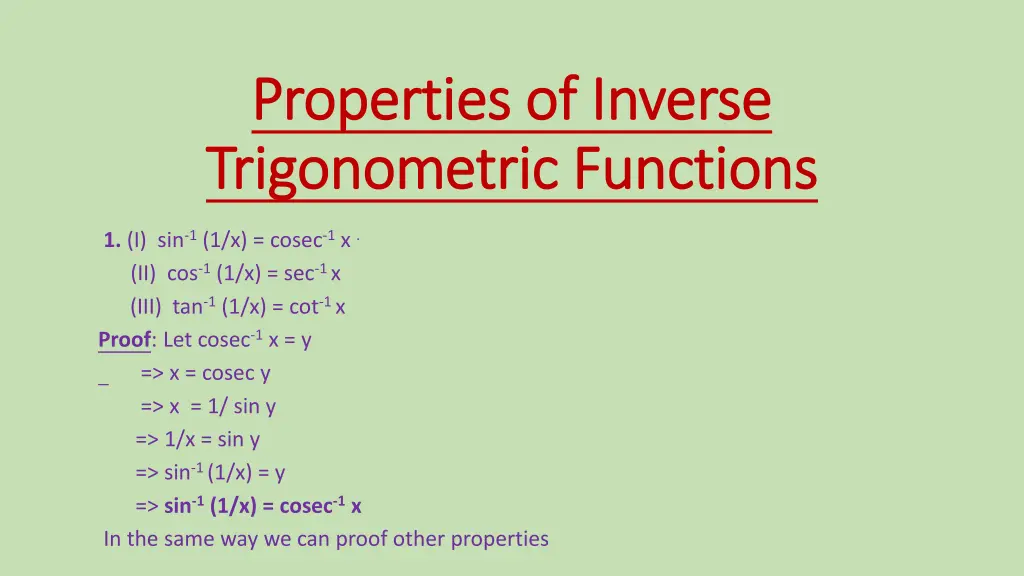
Properties of Inverse Properties of Inverse Trigonometric Functions Trigonometric Functions 1. (I) sin-1(1/x) = cosec-1x. (II) cos-1(1/x) = sec-1x (III) tan-1(1/x) = cot-1x Proof: Let cosec-1x = y => x = cosec y => x = 1/ sin y => 1/x = sin y => sin-1(1/x) = y => sin-1(1/x) = cosec-1x In the same way we can proof other properties
2. (I) sin-1x + cos-1x = /2 , x[-1,1] (II) tan-1x + cot-1x = /2 , x R (III) cosec-1x + sec-1x = /2, |x|>= 1 Proof : Let sin-1x = y Then x = sin y => x = cos(( /2)- y) => cos-1x = ( /2)- y => cos-1x + y = /2 => cos-1x + sin-1x = /2 Hence sin-1x + cos-1x = /2 In the same way we can proof other properties
3. (I) tan-1x + tan-1y = tan-1[(x + y)/(1 - x. y) ] (II) tan-1x tan-1 y = tan-1[(x y) /(1 + x. y) ] Proof: Let tan-1x = and tan-1y = Then we have x = tan and y = tan Now tan( + ) = (tan + tan )/(1 tan . tan ) => tan( + ) = (x + y) /(1 x. y) => + = tan-1[(x + y) /(1 x. y) ] hence tan-1x + tan-1y = tan-1[(x + y) /(1 x. y) ] In the same way we can proof second property
4. (I) 2tan-1x = sin-1[2x/(1 + x2)] (II) 2tan-1x = cos-1[(1 x2)/(1 + x2)] (III) 2tan-1x = tan-1[2x/(1 x2)] Proof : Let tan-1x = y Now sin-1[2x/(1 + x2)] = sin-1[2tan y/(1 + tan2y)] (putting value of y) = sin-1(sin 2y) = 2y. = 2tan-1x Hence 2tan-1x = sin-1[2x/(1 + x2)] (using identity of sin 2y) ( as sin-1(sin x) = x)
5. (I) sin-1x = tan-1[x/(1 x2)] (II) cos-1x = tan-1[( 1 x2)/x] Proof : Let x = sin y => y = sin-1x Therefor 1 x2= 1 sin2y = cos2y = cos y => tan-1[x/ 1 x2] = tan-1(sin y/ cos y) = tan-1(tan y) => tan-1[x/ 1 x2] = y => tan-1[x/ 1 x2] = sin-1x Hence sin-1x = tan-1[x/ 1 x2] Similarly we can proof second property. (as tan-1(tan x) = x)
6. (I) sin-1x = cos-11 x2 (II) cos-1x = sin-1 1 x2 (III) cos ( sin-1x) = sin ( cos-1x) = 1 x2 Proof : Do yourself Use trigonometric identity of sin x and cos x 7. (I) sin-1x + sin-1y = sin-1(x. 1 y2+ y. 1 x2) (II) sin-1x - sin-1y = sin-1(x. 1 y2- y. 1 x2) (III) cos-1x + cos-1y = cos-1(x.y - 1 x2. 1 y2) (iv) cos-1x - cos-1y = cos-1(x.y + 1 x2. 1 y2)
Proof : (I) sin-1x + sin-1y = sin-1(x 1 y2+ y 1 x2) Let sin-1x = and sin-1y = => sin-1(x 1 y2+ y 1 x2 = sin and y = sin => cos = 1 sin2 = 1 x2 And cos = 1 sin2 = 1 y2 Now sin ( + ) = sin . cos + cos . sin sin( + ) = x 1 y2+ y 1 x2 ( + ) = sin-1(x 1 y2+ y 1 x2 sin-1x+ sin-1y = sin-1(x 1 y2+ y 1 x2)
Proof : (III) cos-1x + cos-1y = cos-1(x.y - 1 x2. 1 y2) Let cos-1x = and cos-1y = Then x = cos and y = cos => sin = 1 cos2 and sin = 1 cos2 => sin = 1 x2and sin = 1 y2 Now cos( + ) = cos .cos sin . sin - cos .cos cos( + ) = x. y - 1 x2. 1 y2 = > + = cos-1(x.y - 1 x2. 1 y2) cos-1x + cos-1y = cos-1(x.y - 1 x2. 1 y2) Similarly we can proof other properties
8. (I) 3 sin-1x = sin-1(3x 4x3) (II) 3 cos-1x = cos-1(4x3 3x) (III) 3 tan-1x = tan-1[(3x x3)/(1 3x2)] Proof : Let sin-1x = y => x = sin y sin 3y = 3 sin y 4 sin3y = 3x 4x3 => 3y = sin-1(3x 4x3) => 3sin-1x = sin-1(3x 4x3) Similarly we can proof other properties.
1. Prove that sin-1(3/5) - sin-1(8/17) = cos-1(84/85) Sol. We have to prove that sin-1(3/5) + sin-1(8/17) = cos-1(8/85) L. H. S. sin-1(3/5) + sin-1(8/17) Let sin-1 (3/5) = x => sin x= 3/5 . => cos x = 1 sin2x => cos x = 1 (3/5)2 => cos x = 1 (9/25) => cos x = (25 9)/ 25 = 16/25= 4/5 Again Let sin-1(8/17) = y => sin y = 8/17
=> cos y = 1 sin2y= 1 (8/17)2 Cos y = 1 ( 64/289) = (289 64)/289 => cos y = 225/289= 15/17 Now cos ( x - y) = cos x. cosy + sin x. siny = 4/5. 15/17 + 3/5. 8/17 . = 60/85 + 24/85 = (60+24)/85 = 84/85 . => x y = cos-1(84/85) => sin-1(3/5) sin-1(8/17) = cos-1(84/85) 2. Prove that tan-1(1/5) + tan-1(1/7) + tan-1(1/3) + tan-1(1/8) = /4 ( hint : use the property of tan-1x + tan-1y = tan-1[ ( x + y)/ (1 x. y) ] 3. cos-1(12/13) + sin-1(3/5) = sin-1(56/64) ( solve as ex. 1 )




![❤[READ]❤ Robotic Exploration of the Solar System: Part I: The Golden Age 1957-19](/thumb/21623/read-robotic-exploration-of-the-solar-system-part-i-the-golden-age-1957-19.jpg)