Proposal for TG3e: Key Features of High-Rate Close Proximity PHY & MAC
Explore the detailed proposal by Itaru Maekawa from Japan Radio Co., Ltd., outlining key features of mm-wave HRCP, focusing on P2P connections, system concepts, and efficiency considerations for PHY & MAC technologies. Dive into aspects like data integrity, frame aggregation, and modulation schemes to understand the advancements proposed for TG3e in July 2015.

Download Presentation

Please find below an Image/Link to download the presentation.
The content on the website is provided AS IS for your information and personal use only. It may not be sold, licensed, or shared on other websites without obtaining consent from the author. If you encounter any issues during the download, it is possible that the publisher has removed the file from their server.
You are allowed to download the files provided on this website for personal or commercial use, subject to the condition that they are used lawfully. All files are the property of their respective owners.
The content on the website is provided AS IS for your information and personal use only. It may not be sold, licensed, or shared on other websites without obtaining consent from the author.
E N D
Presentation Transcript
July 2015 DCN: <15-15-0474-00-003e> Project: IEEE P802.15 Working Group for Wireless Personal Area Networks (WPANs) Submission Title: [JRC Proposal for TG3e CfP] Date Submitted: [08 July 2015] Source: [Itaru Maekawa] Company [Japan Radio Co.,Ltd.] Address [Mitaka, Tokyo, Japan] Voice: [+81.422.45.9228], E-Mail: [Maekawa.Itaru@jrc.co.jp] Re: [Proposed PHY&MAC for HRCP] Abstract: [This document describes various aspects of PHY&MAC for HRCP] Purpose: [To propose a full set of specifications for TG 3e] Notice: This document has been prepared to assist the IEEE P802.15. It is offered as a basis for discussion and is not binding on the contributing individual(s) or organization(s). The material in this document is subject to change in form and content after further study. The contributor(s) reserve(s) the right to add, amend or withdraw material contained herein. Release: The contributor acknowledges and accepts that this contribution becomes the property of IEEE and may be made publicly available by P802.15. 1 Submission Itaru Maekawa (JRC)
July 2015 DCN: <15-15-0474-00-003e> 802.15.3e PHY & MAC Submission for TG3e CfP Plenary session IEEE802.15.3e Itaru Maekawa (JRC: Japan Radio Co.,Ltd.) July 2015 @ Waikoloa, HI Slide 2 Submission Itaru Maekawa (JRC)
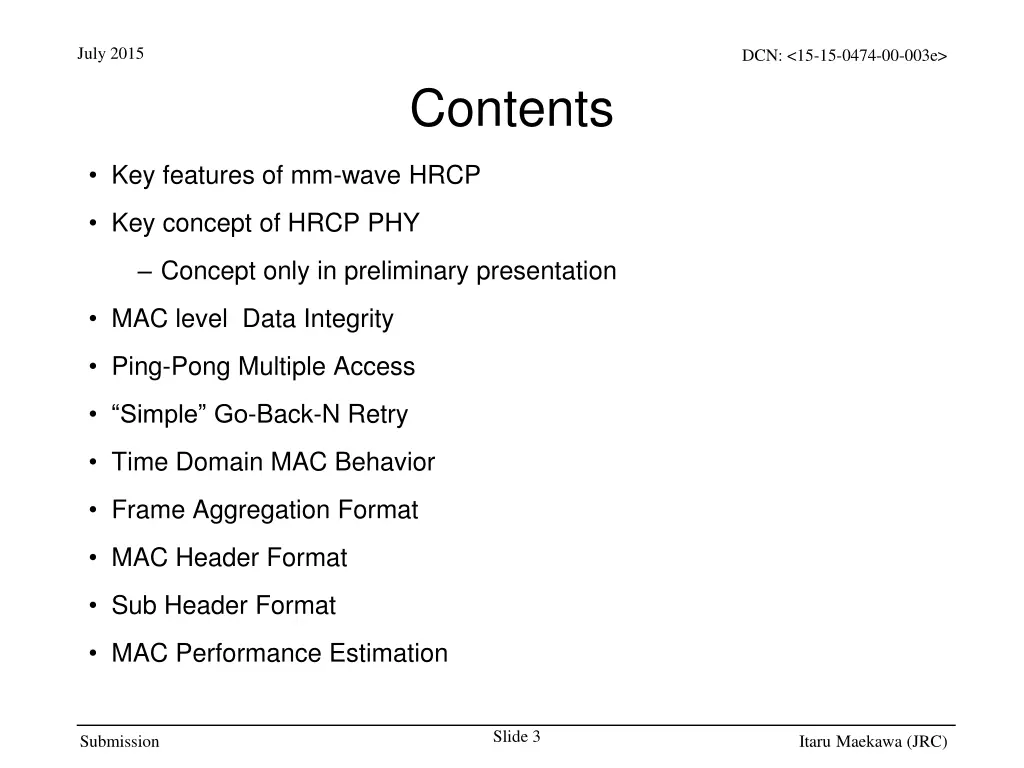
July 2015 DCN: <15-15-0474-00-003e> Contents Key features of mm-wave HRCP Key concept of HRCP PHY Concept only in preliminary presentation MAC level Data Integrity Ping-Pong Multiple Access Simple Go-Back-N Retry Time Domain MAC Behavior Frame Aggregation Format MAC Header Format Sub Header Format MAC Performance Estimation Slide 3 Submission Itaru Maekawa (JRC)
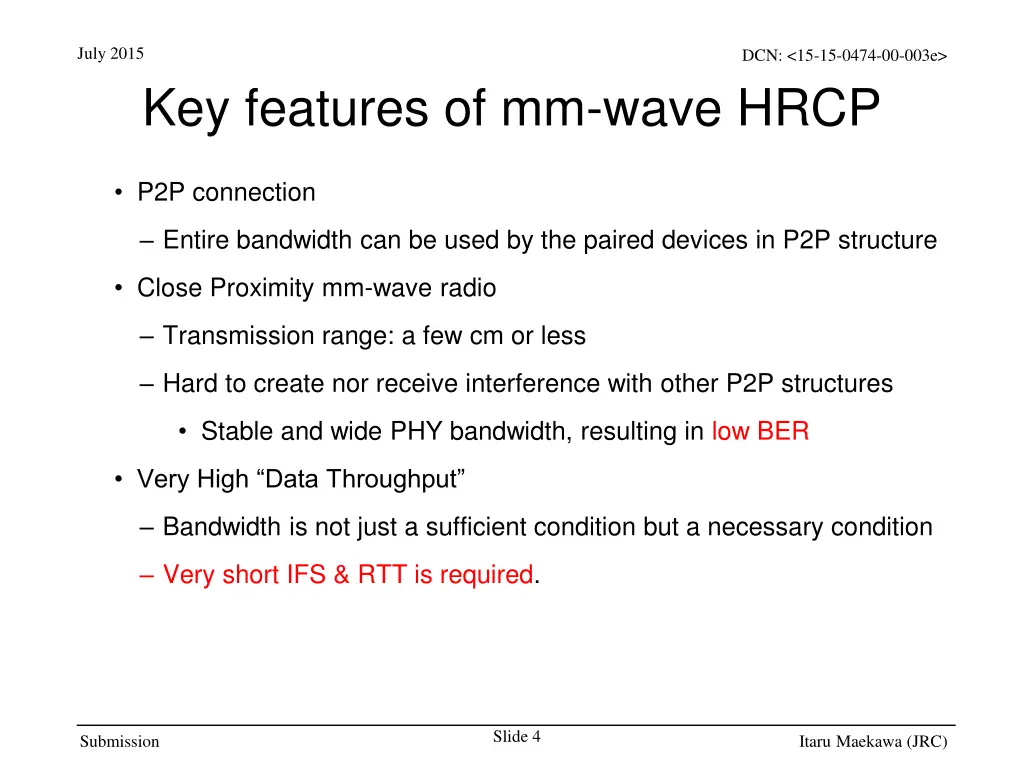
July 2015 DCN: <15-15-0474-00-003e> Key features of mm-wave HRCP P2P connection Entire bandwidth can be used by the paired devices in P2P structure Close Proximity mm-wave radio Transmission range: a few cm or less Hard to create nor receive interference with other P2P structures Stable and wide PHY bandwidth, resulting in low BER Very High Data Throughput Bandwidth is not just a sufficient condition but a necessary condition Very short IFS & RTT is required. Slide 4 Submission Itaru Maekawa (JRC)
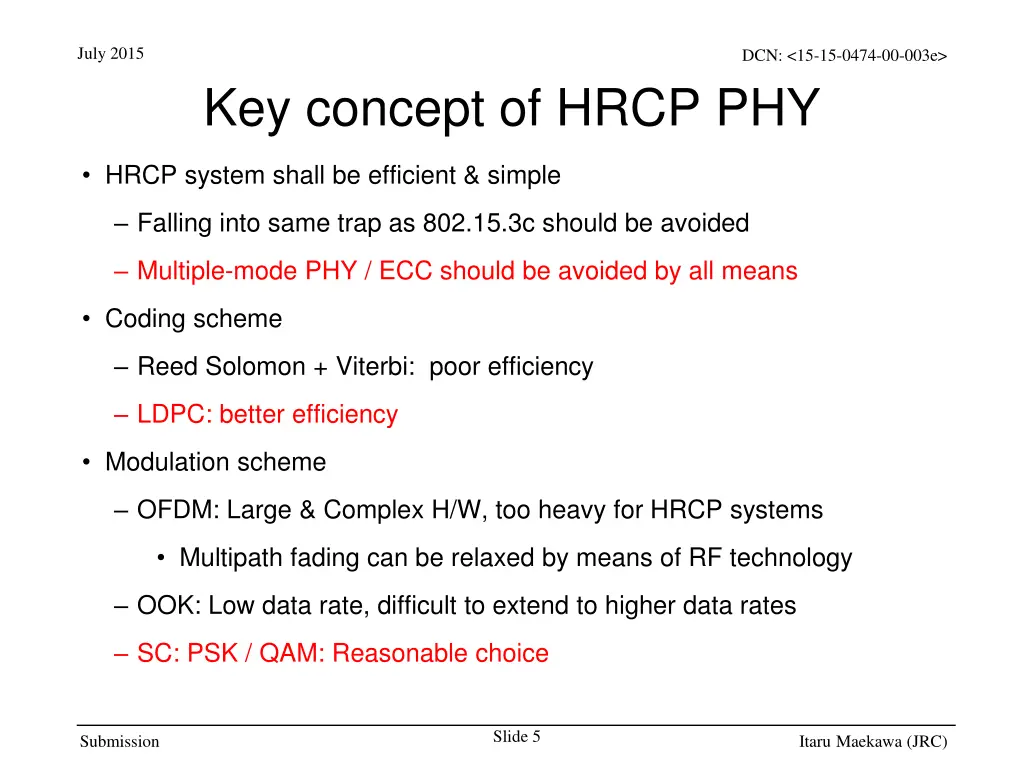
July 2015 DCN: <15-15-0474-00-003e> Key concept of HRCP PHY HRCP system shall be efficient & simple Falling into same trap as 802.15.3c should be avoided Multiple-mode PHY / ECC should be avoided by all means Coding scheme Reed Solomon + Viterbi: poor efficiency LDPC: better efficiency Modulation scheme OFDM: Large & Complex H/W, too heavy for HRCP systems Multipath fading can be relaxed by means of RF technology OOK: Low data rate, difficult to extend to higher data rates SC: PSK / QAM: Reasonable choice Slide 5 Submission Itaru Maekawa (JRC)
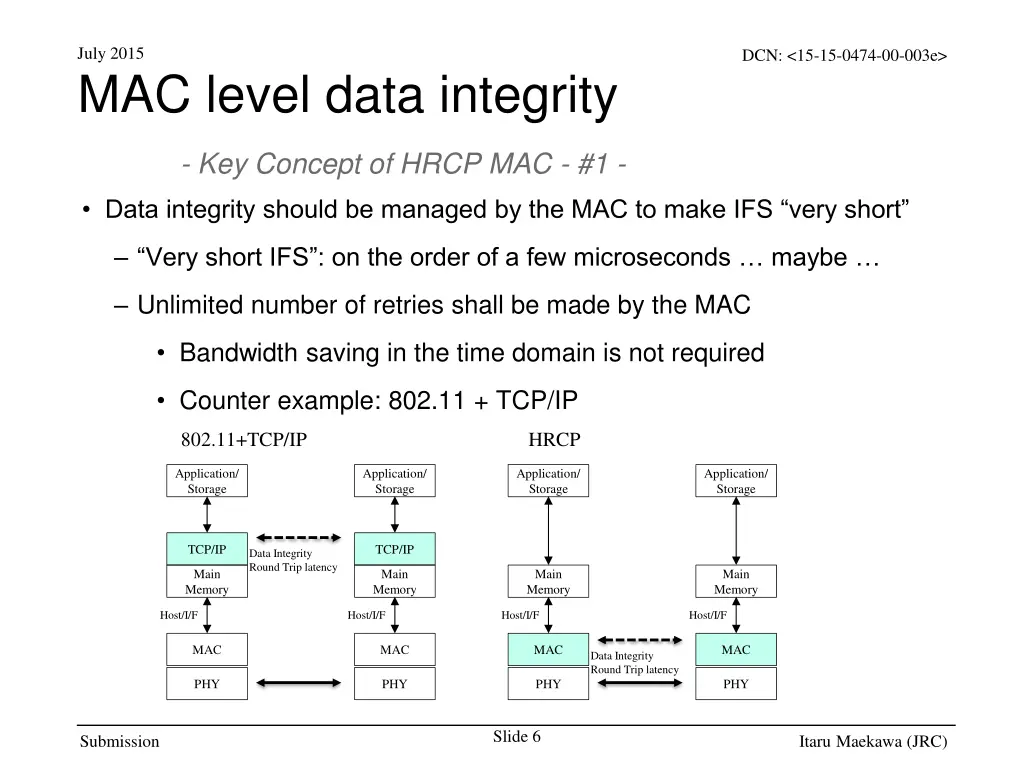
July 2015 MAC level data integrity DCN: <15-15-0474-00-003e> - Key Concept of HRCP MAC - #1 - Data integrity should be managed by the MAC to make IFS very short Very short IFS : on the order of a few microseconds maybe Unlimited number of retries shall be made by the MAC Bandwidth saving in the time domain is not required Counter example: 802.11 + TCP/IP 802.11+TCP/IP HRCP Application/ Storage Application/ Storage Application/ Storage Application/ Storage TCP/IP TCP/IP Data Integrity Round Trip latency Main Memory Main Memory Main Memory Main Memory Host/I/F Host/I/F Host/I/F Host/I/F MAC MAC MAC MAC Data Integrity Round Trip latency PHY PHY PHY PHY Slide 6 Submission Itaru Maekawa (JRC)
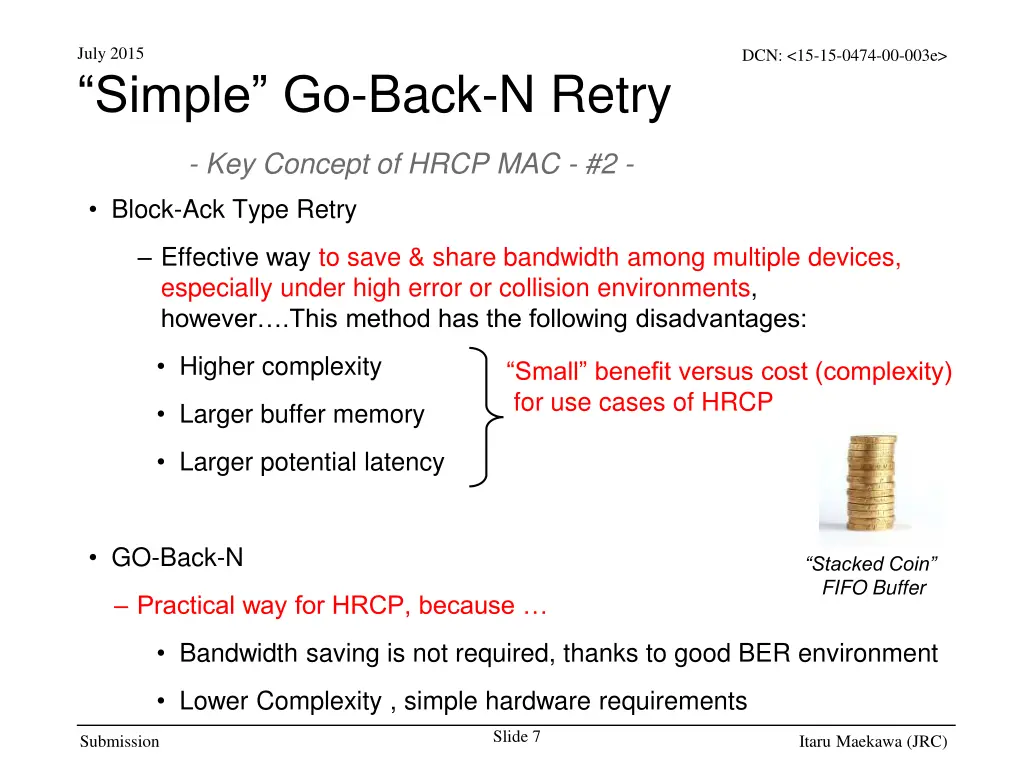
July 2015 Simple Go-Back-N Retry DCN: <15-15-0474-00-003e> - Key Concept of HRCP MAC - #2 - Block-Ack Type Retry Effective way to save & share bandwidth among multiple devices, especially under high error or collision environments, however .This method has the following disadvantages: Higher complexity Small benefit versus cost (complexity) for use cases of HRCP Larger buffer memory Larger potential latency GO-Back-N Stacked Coin FIFO Buffer Practical way for HRCP, because Bandwidth saving is not required, thanks to good BER environment Lower Complexity , simple hardware requirements Slide 7 Submission Itaru Maekawa (JRC)
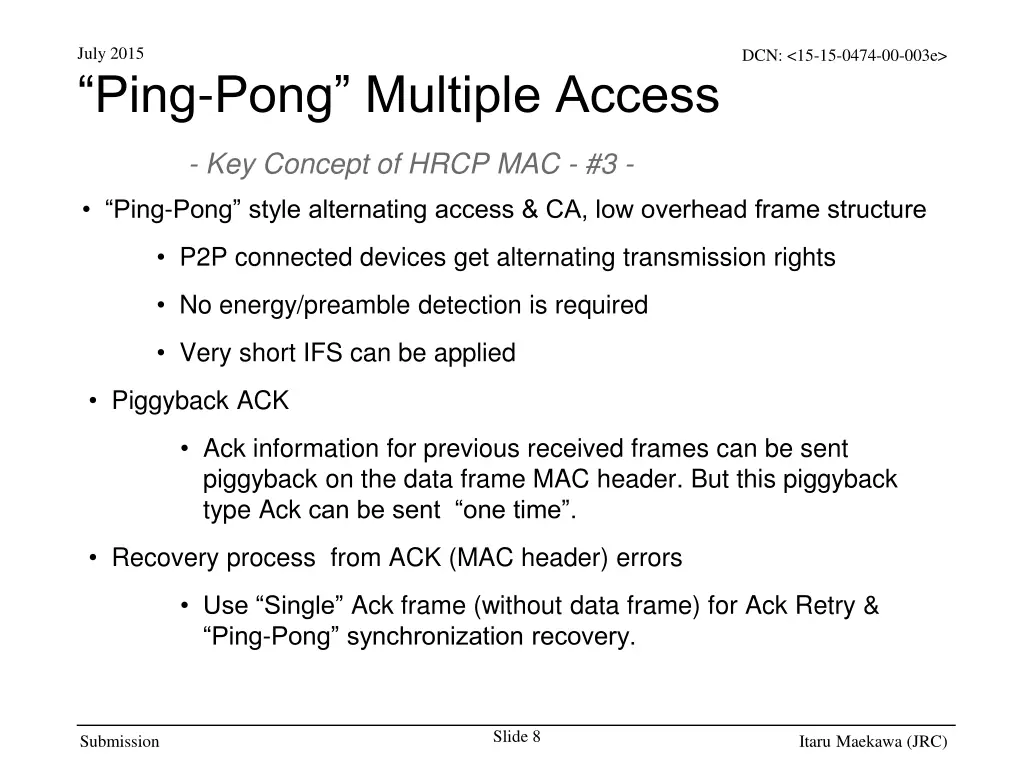
July 2015 Ping-Pong Multiple Access DCN: <15-15-0474-00-003e> - Key Concept of HRCP MAC - #3 - Ping-Pong style alternating access & CA, low overhead frame structure P2P connected devices get alternating transmission rights No energy/preamble detection is required Very short IFS can be applied Piggyback ACK Ack information for previous received frames can be sent piggyback on the data frame MAC header. But this piggyback type Ack can be sent one time . Recovery process from ACK (MAC header) errors Use Single Ack frame (without data frame) for Ack Retry & Ping-Pong synchronization recovery. Slide 8 Submission Itaru Maekawa (JRC)
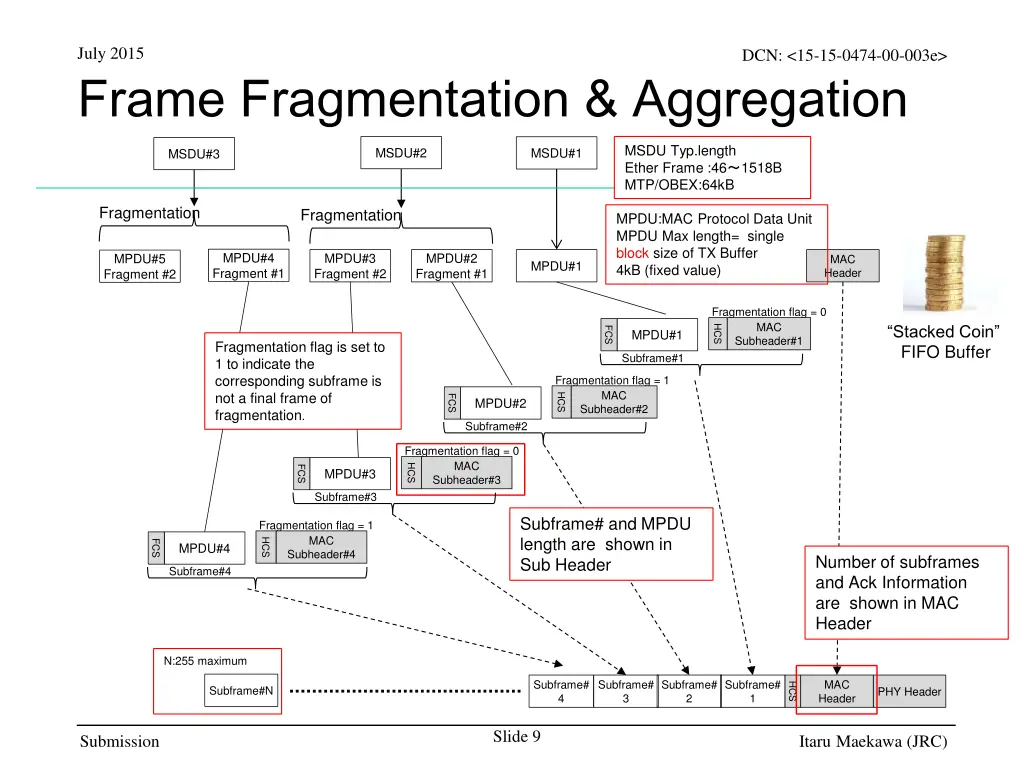
July 2015 Frame Fragmentation & Aggregation DCN: <15-15-0474-00-003e> MSDU Typ.length Ether Frame :46 1518B MTP/OBEX:64kB MSDU#2 MSDU#1 MSDU#3 Fragmentation Fragmentation MPDU:MAC Protocol Data Unit MPDU Max length= single block size of TX Buffer 4kB (fixed value) MPDU#4 Fragment #1 MPDU#3 Fragment #2 MPDU#2 Fragment #1 MPDU#5 Fragment #2 MAC Header MPDU#1 Fragmentation flag = 0 MAC Subheader#1 Stacked Coin FIFO Buffer HCS FCS MPDU#1 Fragmentation flag is set to 1 to indicate the corresponding subframe is not a final frame of fragmentation. Subframe#1 Fragmentation flag = 1 MAC Subheader#2 HCS FCS MPDU#2 Subframe#2 Fragmentation flag = 0 MAC Subheader#3 HCS FCS MPDU#3 Subframe#3 Subframe# and MPDU length are shown in Sub Header Fragmentation flag = 1 MAC Subheader#4 HCS FCS MPDU#4 Number of subframes and Ack Information are shown in MAC Header Subframe#4 N:255 maximum Subframe# 4 Subframe# 3 Subframe# 2 Subframe# 1 MAC Header HCS Subframe#N PHY Header Slide 9 Submission Itaru Maekawa (JRC)
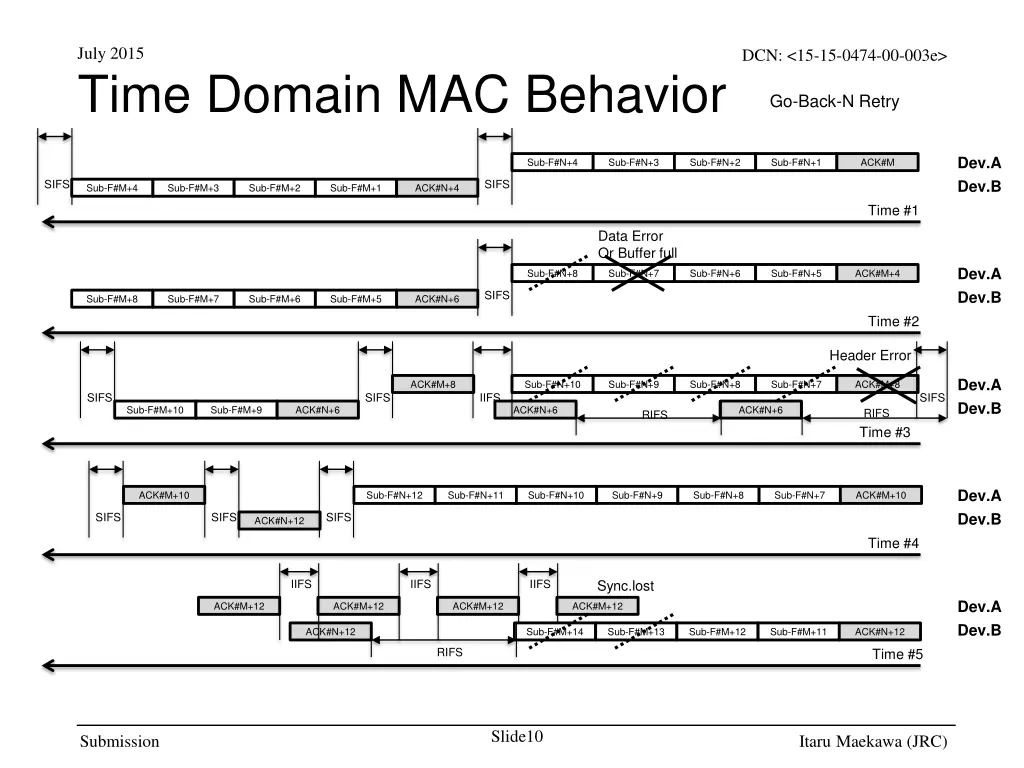
July 2015 Time Domain MAC Behavior DCN: <15-15-0474-00-003e> Go-Back-N Retry Dev.A Dev.B Sub-F#N+4 Sub-F#N+3 Sub-F#N+2 Sub-F#N+1 ACK#M SIFS SIFS Sub-F#M+4 Sub-F#M+3 Sub-F#M+2 Sub-F#M+1 ACK#N+4 Time #1 Data Error Or Buffer full Dev.A Dev.B Sub-F#N+8 Sub-F#N+7 Sub-F#N+6 Sub-F#N+5 ACK#M+4 SIFS Sub-F#M+8 Sub-F#M+7 Sub-F#M+6 Sub-F#M+5 ACK#N+6 Time #2 Header Error Dev.A Dev.B ACK#M+8 Sub-F#N+10 Sub-F#N+9 Sub-F#N+8 Sub-F#N+7 ACK#M+8 SIFS SIFS IIFS SIFS Sub-F#M+10 Sub-F#M+9 ACK#N+6 ACK#N+6 ACK#N+6 RIFS RIFS Time #3 Dev.A Dev.B ACK#M+10 Sub-F#N+12 Sub-F#N+11 Sub-F#N+10 Sub-F#N+9 Sub-F#N+8 Sub-F#N+7 ACK#M+10 SIFS SIFS SIFS ACK#N+12 Time #4 IIFS IIFS IIFS Sync.lost Dev.A Dev.B ACK#M+12 ACK#M+12 ACK#M+12 ACK#M+12 ACK#N+12 Sub-F#M+14 Sub-F#M+13 Sub-F#M+12 Sub-F#M+11 ACK#N+12 RIFS Time #5 Slide10 Submission Itaru Maekawa (JRC)
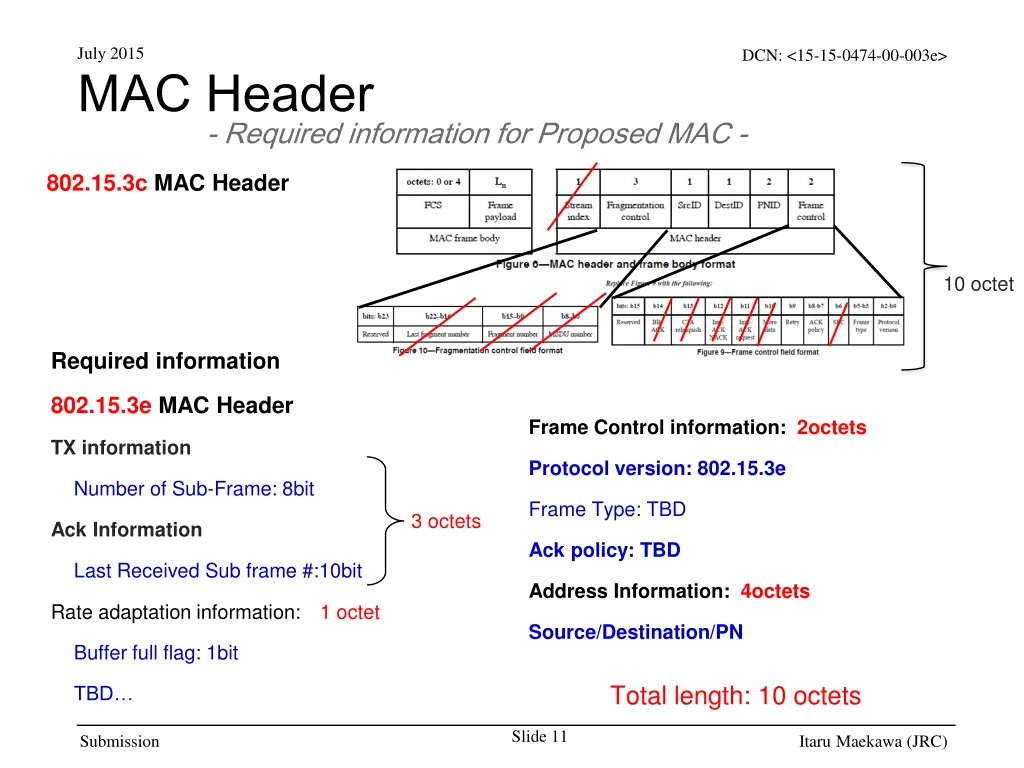
July 2015 MAC Header - Required information for Proposed MAC - DCN: <15-15-0474-00-003e> 802.15.3c MAC Header 10 octet Required information 802.15.3e MAC Header Frame Control information: 2octets TX information Protocol version: 802.15.3e Number of Sub-Frame: 8bit Frame Type: TBD 3 octets Ack Information Ack policy: TBD Last Received Sub frame #:10bit Address Information: 4octets Rate adaptation information: 1 octet Source/Destination/PN Buffer full flag: 1bit Total length: 10 octets TBD Slide 11 Submission Itaru Maekawa (JRC)
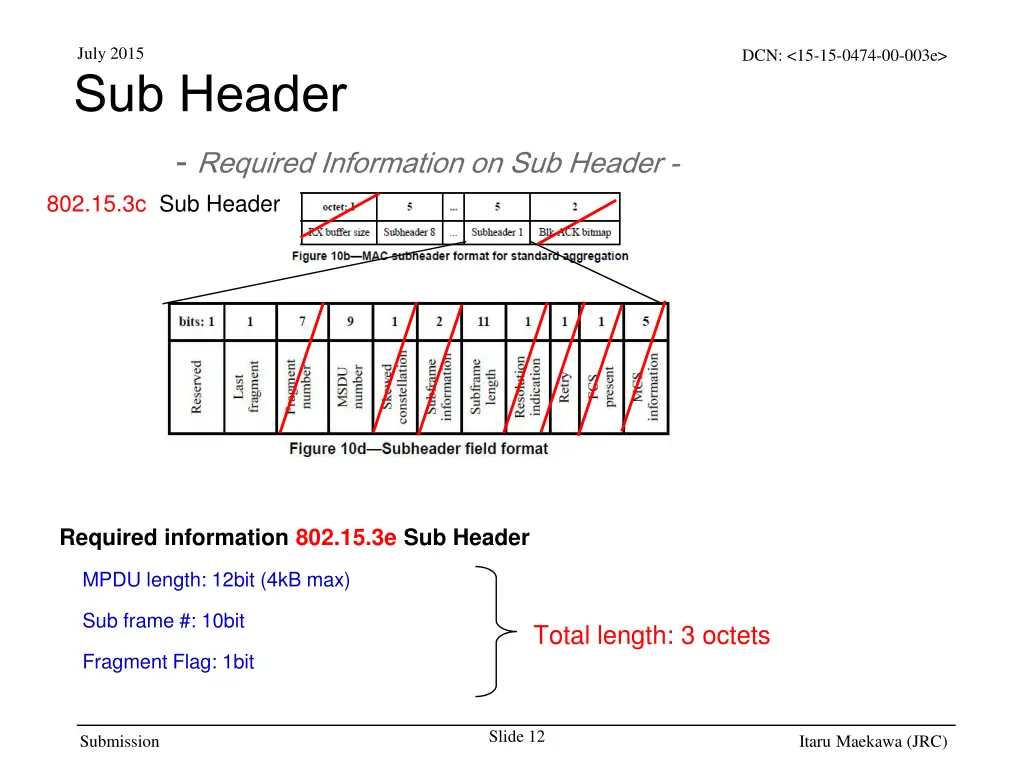
July 2015 Sub Header - Required Information on Sub Header - 802.15.3c Sub Header DCN: <15-15-0474-00-003e> Required information 802.15.3e Sub Header MPDU length: 12bit (4kB max) Sub frame #: 10bit Total length: 3 octets Fragment Flag: 1bit Slide 12 Submission Itaru Maekawa (JRC)
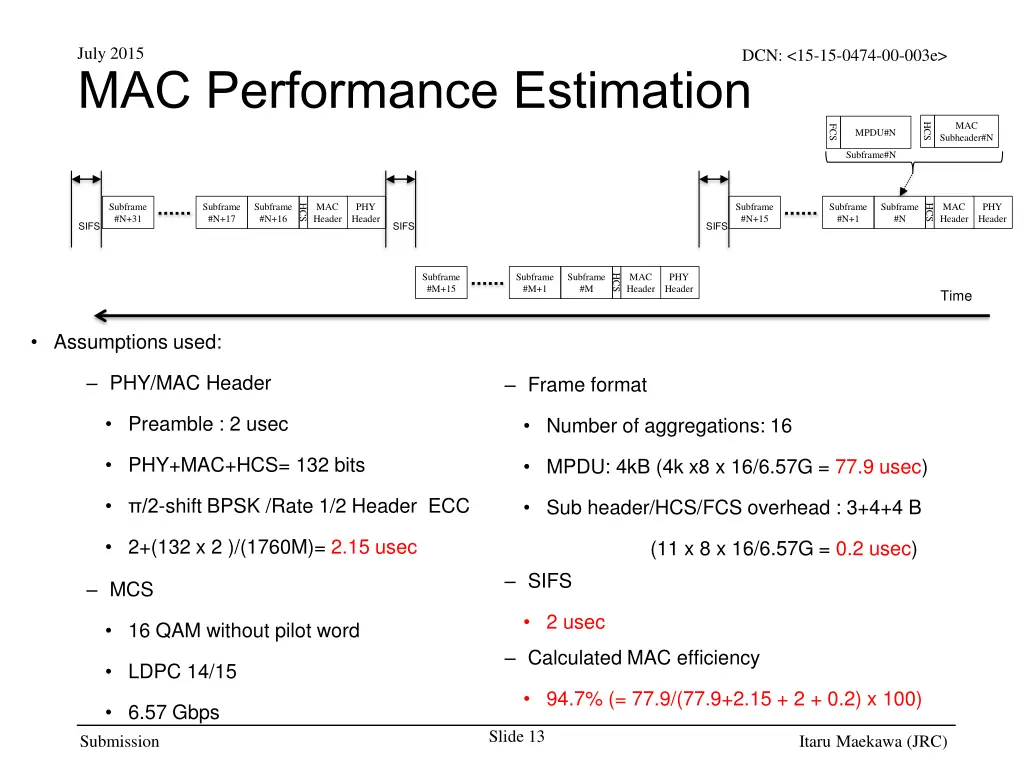
July 2015 MAC Performance Estimation DCN: <15-15-0474-00-003e> MAC HCS FCS MPDU#N Subheader#N Subframe#N Subframe #N+31 Subframe #N+17 Subframe #N+16 MAC Header PHY Header Subframe #N+15 Subframe #N+1 Subframe #N MAC Header PHY Header HCS HCS SIFS SIFS SIFS Subframe #M+15 Subframe #M+1 Subframe #M MAC Header PHY Header HCS Time Assumptions used: PHY/MAC Header Frame format Preamble : 2 usec Number of aggregations: 16 PHY+MAC+HCS= 132 bits MPDU: 4kB (4k x8 x 16/6.57G = 77.9 usec) /2-shift BPSK /Rate 1/2 Header ECC Sub header/HCS/FCS overhead : 3+4+4 B 2+(132 x 2 )/(1760M)= 2.15 usec (11 x 8 x 16/6.57G = 0.2 usec) SIFS MCS 2 usec 16 QAM without pilot word Calculated MAC efficiency LDPC 14/15 94.7% (= 77.9/(77.9+2.15 + 2 + 0.2) x 100) 6.57 Gbps Slide 13 Submission Itaru Maekawa (JRC)
July 2015 DCN: <15-15-0474-00-003e> Appendix Slide14 Submission Itaru Maekawa (JRC)
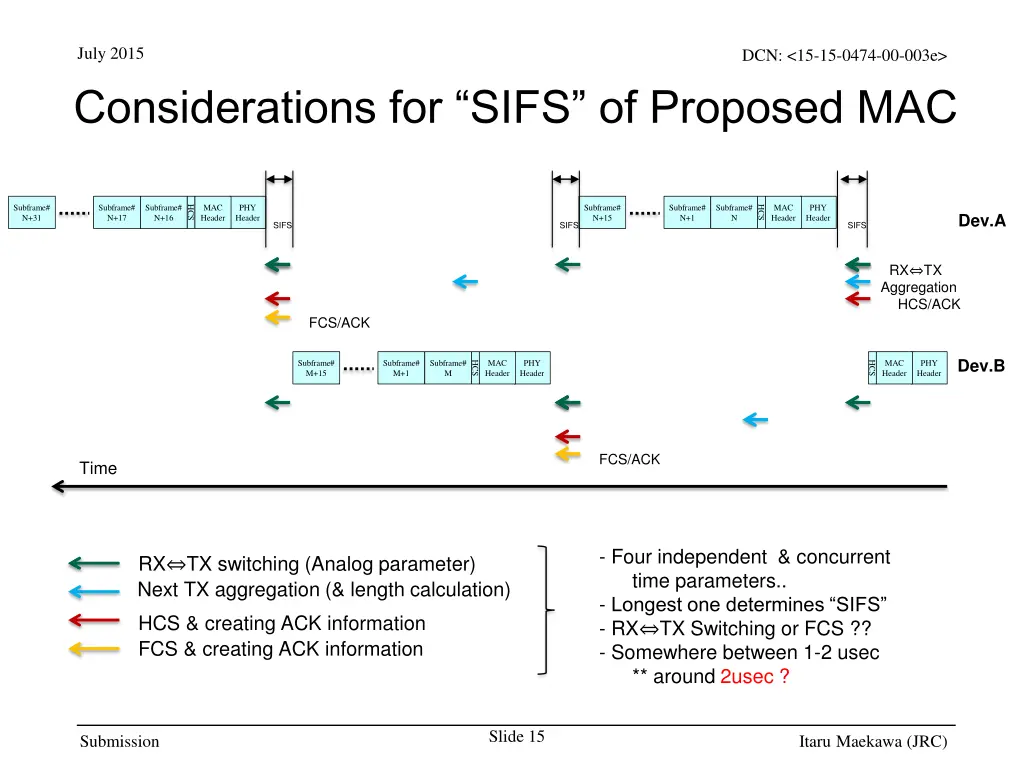
July 2015 Considerations for SIFS of Proposed MAC DCN: <15-15-0474-00-003e> Subframe# N+31 Subframe# N+17 Subframe# N+16 MAC Header PHY Header Subframe# N+15 Subframe# N+1 Subframe# N MAC Header PHY Header HCS HCS Dev.A SIFS SIFS SIFS RX TX Aggregation HCS/ACK FCS/ACK Dev.B Subframe# M+15 Subframe# M+1 Subframe# M MAC Header PHY Header MAC Header PHY Header HCS HCS FCS/ACK Time - Four independent & concurrent time parameters.. - Longest one determines SIFS - RX TX Switching or FCS ?? - Somewhere between 1-2 usec ** around 2usec ? RX TX switching (Analog parameter) Next TX aggregation (& length calculation) HCS & creating ACK information FCS & creating ACK information Slide 15 Submission Itaru Maekawa (JRC)