Learn about Protected Health Information (PHI) and its importance in research, including PHI identifiers, HIPAA regulations, and using PHI for research purposes while maintaining patient privacy and data security.
Please find below an Image/Link to download the presentation.
The content on the website is provided AS IS for your information and personal use only. It may not be sold, licensed, or shared on other websites without obtaining consent from the author. If you encounter any issues during the download, it is possible that the publisher has removed the file from their server.
You are allowed to download the files provided on this website for personal or commercial use, subject to the condition that they are used lawfully. All files are the property of their respective owners.
The content on the website is provided AS IS for your information and personal use only. It may not be sold, licensed, or shared on other websites without obtaining consent from the author.
E N D
Presentation Transcript
Using PHI in Research Procedures and Case Studies August 2023 Professor Mary Kennedy Vice Chair, IRB, Crean College of Health and Behavioral Sciences; Communication Sciences and Disorders Judith Tran Senior Compliance Administrator, Office of Research Michelle Christy, Linden Insights, Principal, Research Compliance Consultant, Office of Research
What is Protected Health Information? Protected health information (PHI) is any information in a medical record or designated record set that can be used to identify an individual and that was created, used, or disclosed while providing a health care service such as diagnosis or treatment. HIPAA (Health Insurance Portability and Accountability Act of 1996) regulations allow researchers to access and use PHI when necessary to conduct research. However, HIPAA applies only to research that uses, creates, or discloses PHI that enters the medical record or is used for healthcare services, such as treatment, payment, or operations. 2
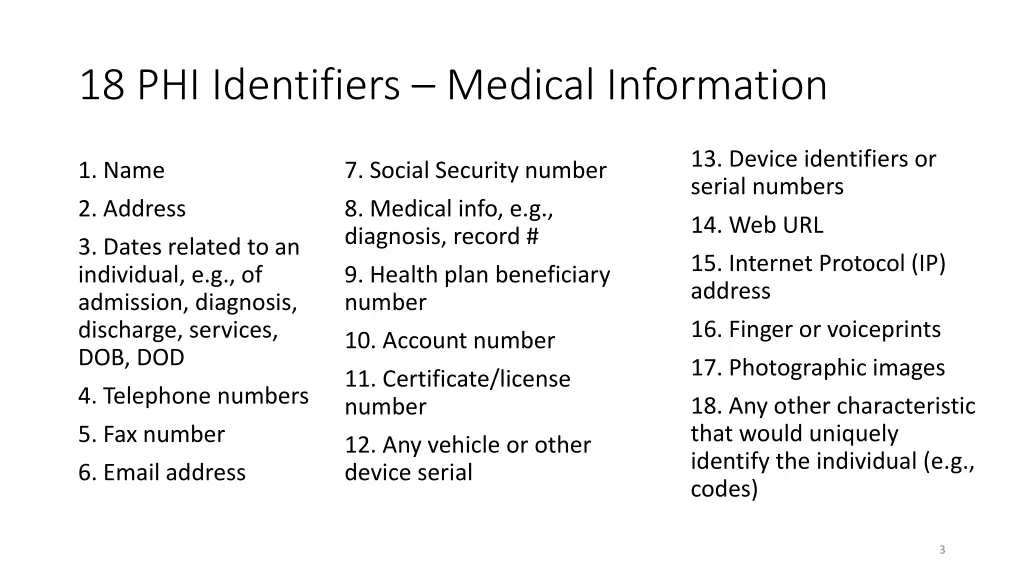
18 PHI Identifiers Medical Information 13. Device identifiers or serial numbers 1. Name 7. Social Security number 2. Address 3. Dates related to an individual, e.g., of admission, diagnosis, discharge, services, DOB, DOD 4. Telephone numbers 8. Medical info, e.g., diagnosis, record # 9. Health plan beneficiary number 10. Account number 14. Web URL 15. Internet Protocol (IP) address 16. Finger or voiceprints 17. Photographic images 18. Any other characteristic that would uniquely identify the individual (e.g., codes) 11. Certificate/license number 12. Any vehicle or other device serial 5. Fax number 6. Email address 3
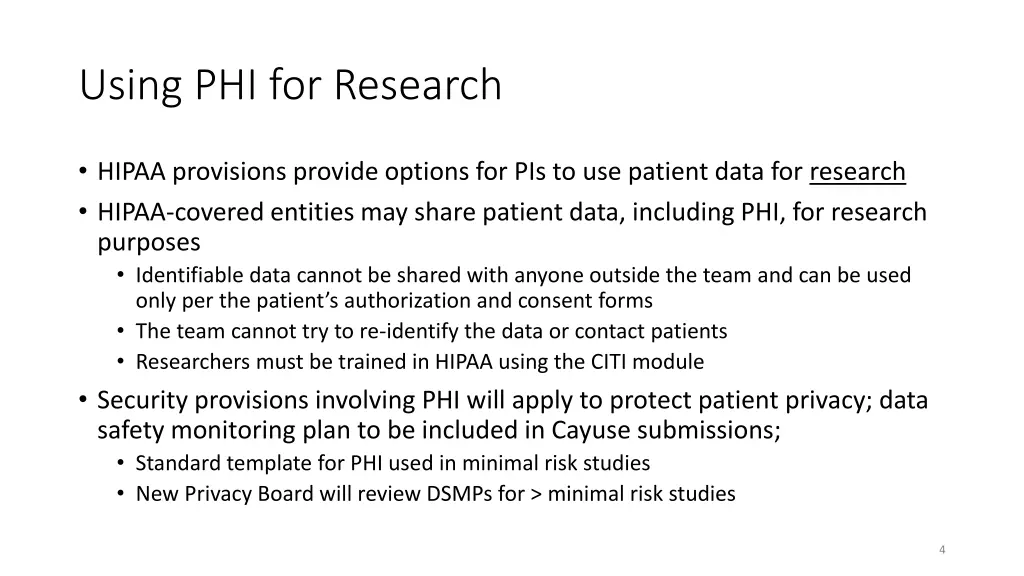
Using PHI for Research HIPAA provisions provide options for PIs to use patient data for research HIPAA-covered entities may share patient data, including PHI, for research purposes Identifiable data cannot be shared with anyone outside the team and can be used only per the patient s authorization and consent forms The team cannot try to re-identify the data or contact patients Researchers must be trained in HIPAA using the CITI module Security provisions involving PHI will apply to protect patient privacy; data safety monitoring plan to be included in Cayuse submissions; Standard template for PHI used in minimal risk studies New Privacy Board will review DSMPs for > minimal risk studies 4
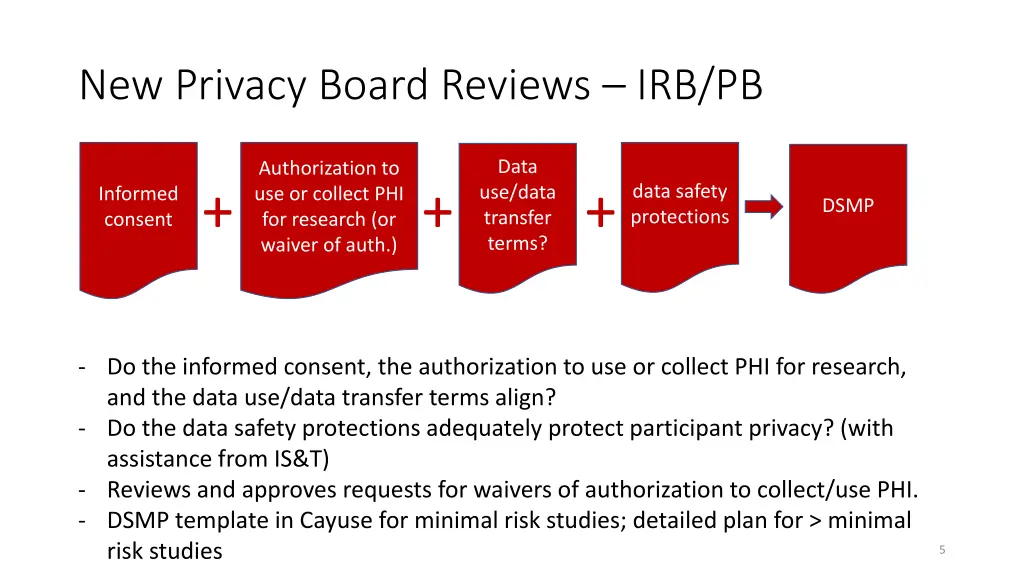
New Privacy Board Reviews IRB/PB Data use/data transfer terms? Authorization to use or collect PHI for research (or waiver of auth.) data safety protections + + + Informed consent DSMP - Do the informed consent, the authorization to use or collect PHI for research, and the data use/data transfer terms align? - Do the data safety protections adequately protect participant privacy? (with assistance from IS&T) - Reviews and approves requests for waivers of authorization to collect/use PHI. - DSMP template in Cayuse for minimal risk studies; detailed plan for > minimal risk studies 5
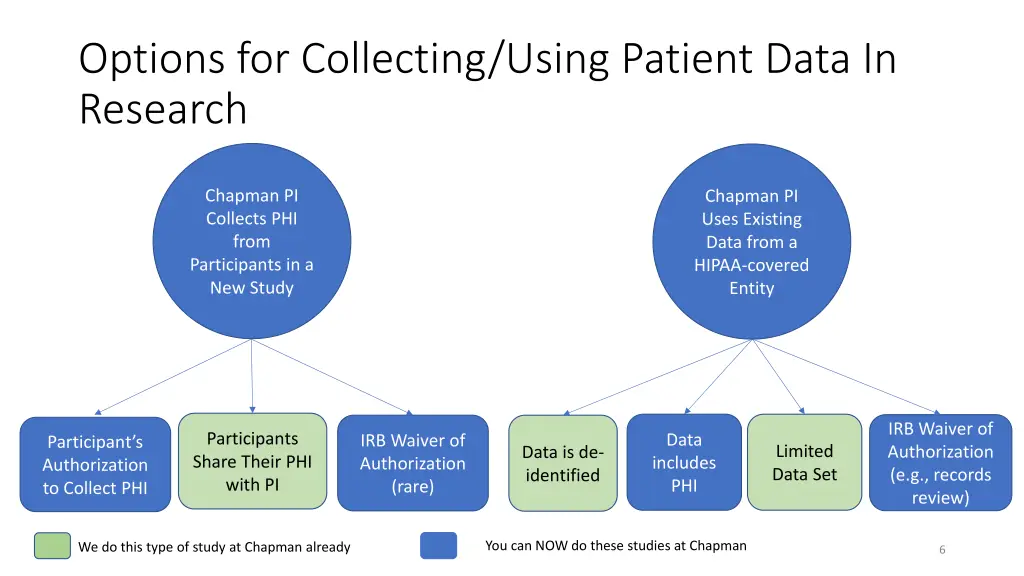
Options for Collecting/Using Patient Data In Research Chapman PI Collects PHI from Participants in a New Study Chapman PI Uses Existing Data from a HIPAA-covered Entity IRB Waiver of Authorization (e.g., records review) Participants Share Their PHI with PI Data includes PHI IRB Waiver of Authorization (rare) Participant s Authorization to Collect PHI Limited Data Set Data is de- identified You can NOW do these studies at Chapman We do this type of study at Chapman already 6
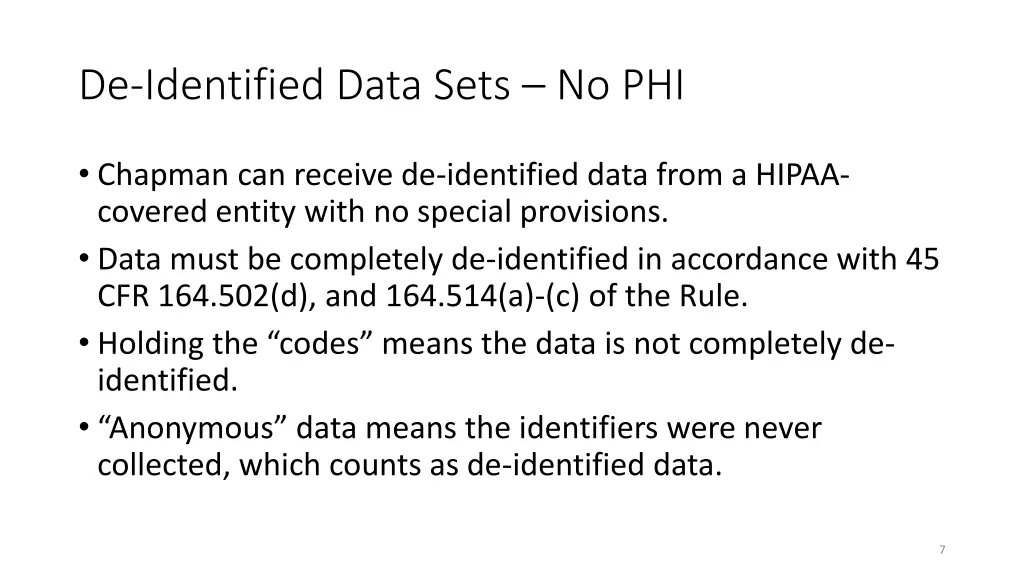
De-Identified Data Sets No PHI Chapman can receive de-identified data from a HIPAA- covered entity with no special provisions. Data must be completely de-identified in accordance with 45 CFR 164.502(d), and 164.514(a)-(c) of the Rule. Holding the codes means the data is not completely de- identified. Anonymous data means the identifiers were never collected, which counts as de-identified data. 7
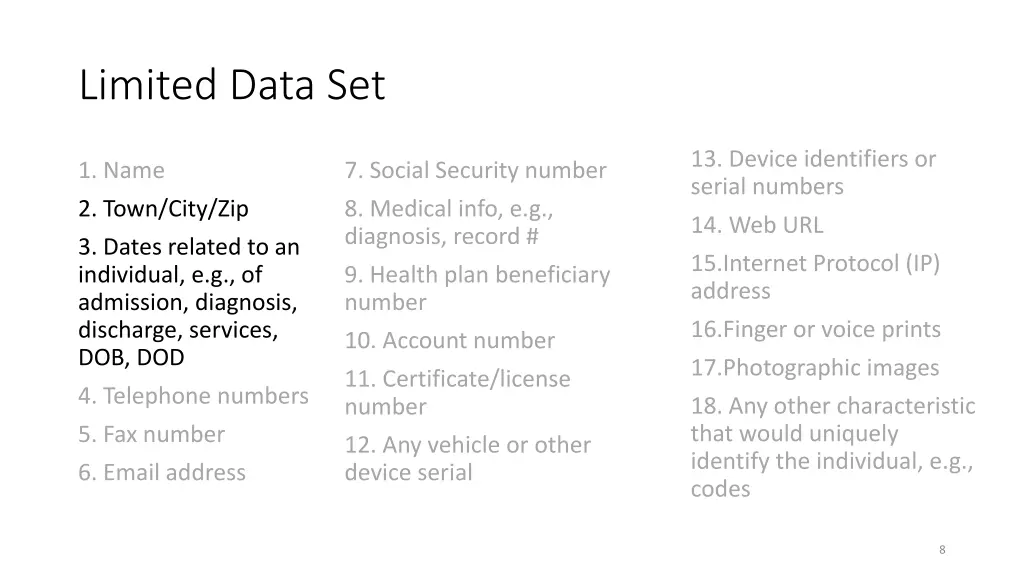
Limited Data Set 13. Device identifiers or serial numbers 1. Name 7. Social Security number 2. Town/City/Zip 3. Dates related to an individual, e.g., of admission, diagnosis, discharge, services, DOB, DOD 4. Telephone numbers 8. Medical info, e.g., diagnosis, record # 9. Health plan beneficiary number 10. Account number 14. Web URL 15.Internet Protocol (IP) address 16.Finger or voice prints 17.Photographic images 18. Any other characteristic that would uniquely identify the individual, e.g., codes 11. Certificate/license number 12. Any vehicle or other device serial 5. Fax number 6. Email address 8
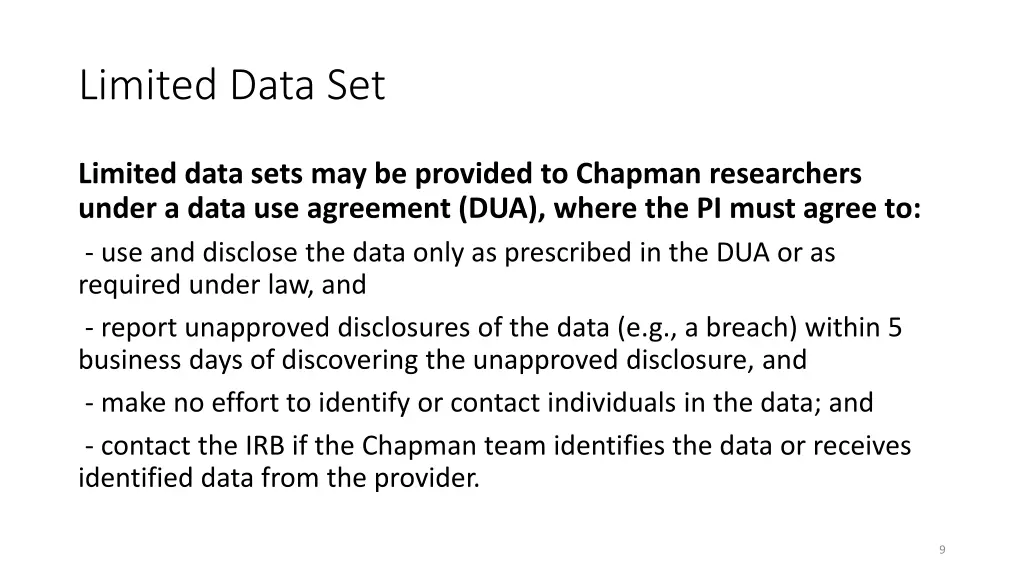
Limited Data Set Limited data sets may be provided to Chapman researchers under a data use agreement (DUA), where the PI must agree to: - use and disclose the data only as prescribed in the DUA or as required under law, and - report unapproved disclosures of the data (e.g., a breach) within 5 business days of discovering the unapproved disclosure, and - make no effort to identify or contact individuals in the data; and - contact the IRB if the Chapman team identifies the data or receives identified data from the provider. 9
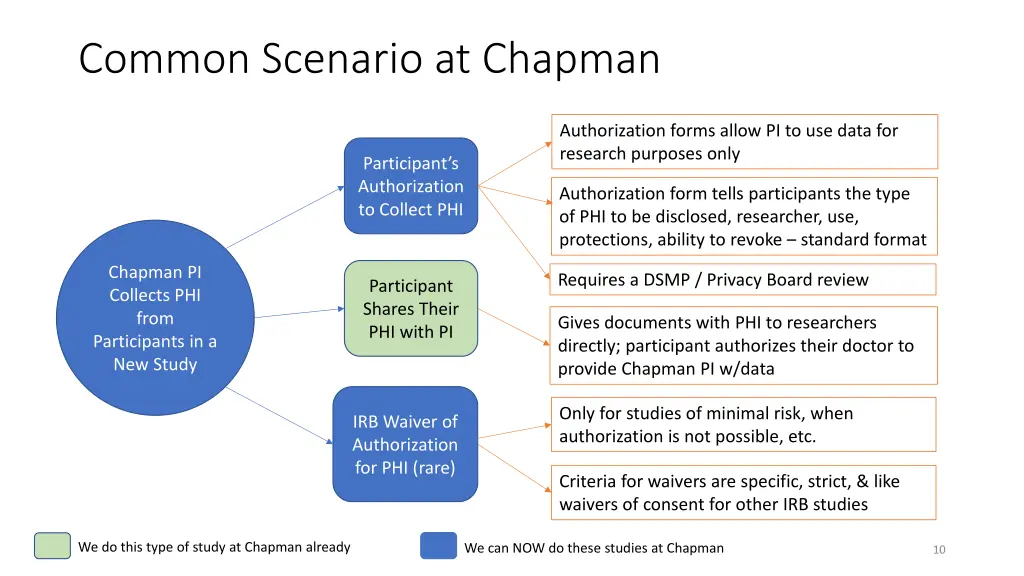
Common Scenario at Chapman Authorization forms allow PI to use data for research purposes only Participant s Authorization to Collect PHI Authorization form tells participants the type of PHI to be disclosed, researcher, use, protections, ability to revoke standard format Chapman PI Collects PHI from Participants in a New Study Requires a DSMP / Privacy Board review Participant Shares Their PHI with PI Gives documents with PHI to researchers directly; participant authorizes their doctor to provide Chapman PI w/data Only for studies of minimal risk, when authorization is not possible, etc. IRB Waiver of Authorization for PHI (rare) Criteria for waivers are specific, strict, & like waivers of consent for other IRB studies We do this type of study at Chapman already We can NOW do these studies at Chapman 10
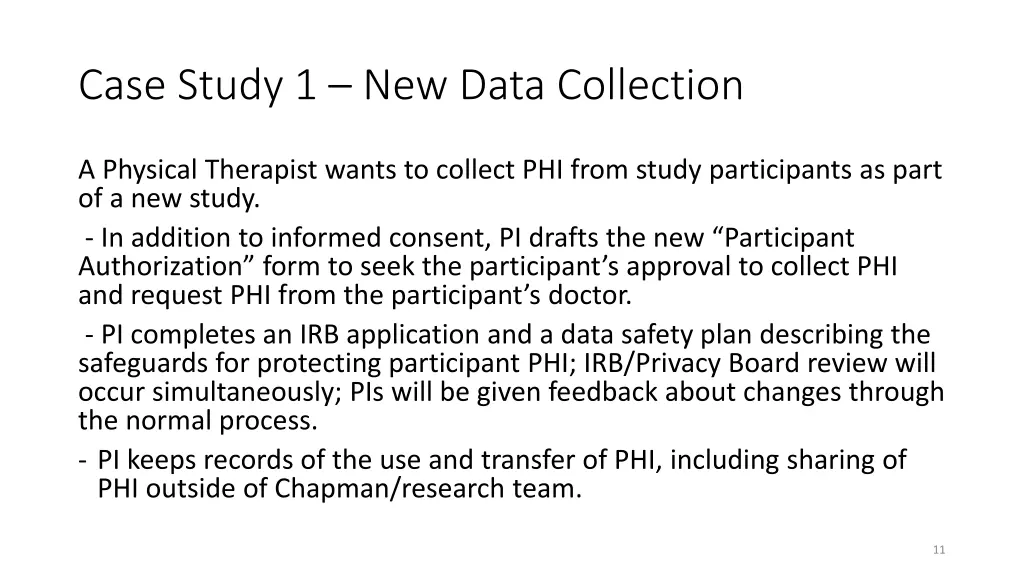
Case Study 1 New Data Collection A Physical Therapist wants to collect PHI from study participants as part of a new study. - In addition to informed consent, PI drafts the new Participant Authorization form to seek the participant s approval to collect PHI and request PHI from the participant s doctor. - PI completes an IRB application and a data safety plan describing the safeguards for protecting participant PHI; IRB/Privacy Board review will occur simultaneously; PIs will be given feedback about changes through the normal process. - PI keeps records of the use and transfer of PHI, including sharing of PHI outside of Chapman/research team. 11
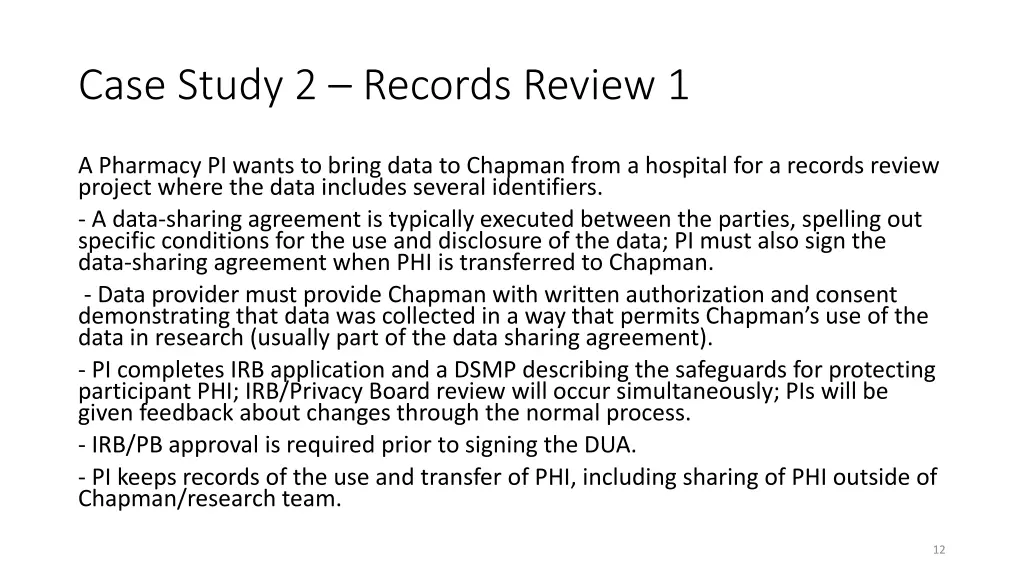
Case Study 2 Records Review 1 A Pharmacy PI wants to bring data to Chapman from a hospital for a records review project where the data includes several identifiers. - A data-sharing agreement is typically executed between the parties, spelling out specific conditions for the use and disclosure of the data; PI must also sign the data-sharing agreement when PHI is transferred to Chapman. - Data provider must provide Chapman with written authorization and consent demonstrating that data was collected in a way that permits Chapman s use of the data in research (usually part of the data sharing agreement). - PI completes IRB application and a DSMP describing the safeguards for protecting participant PHI; IRB/Privacy Board review will occur simultaneously; PIs will be given feedback about changes through the normal process. - IRB/PB approval is required prior to signing the DUA. - PI keeps records of the use and transfer of PHI, including sharing of PHI outside of Chapman/research team. 12
Case Study 3 Records Review 2 A Pharmacy PI wants to bring data to Chapman from a hospital for a records review project where the data includes only the following identifiers: city, state, zip code, dates of admission, discharge, service, DOB (and date of death), and the person s age. - No additional authorization from the provider is needed because the study uses a limited data set. - Data provider shares data set w/Chapman under a data sharing agreement; PI must also sign the data use agreement when PHI is transferred to Chapman. - PI completes an IRB application; neither a DSMP nor Privacy Board review is needed. IRB approval is required prior to signing the DUA. 13
Case Study 4 Research on Decedents A researcher plans to review medical records of deceased persons to verify biological specimen data using data from a California archive. If PHI is included in the records, IRB approval is needed before accessing records (CA law), whether the PHI will be collected or used in the study; PIs may be asked to show IRB approval before accessing the data. - HIPAA requires that the data be solely used for research, that it is necessary for the research project, and that the PI can document that information is needed from a deceased person. 14
Protecting PHI in Research Data safety standards - The team will collect the minimum PHI necessary to accomplish the project. - State how long identifiers will need to be retained. - The team will limit physical and electronic access to PHI whenever possible. - Laptops, tablets, phones, or other data collection devices and computers used to access PHI must be encrypted. For devices that cannot be encrypted, PHI will be immediately saved to a secure location & deleted from the device within 24 hours. - Store in OneDrive (exploring other options). 15
Protecting PHI in Research Cont Data safety standards - Separate (e.g., store in separate locations) PHI information from the linked data set, i.e., data that contains PHI and data sets where codes have replaced PHI. - Computer files with PHI must be password protected. - Store PHI in paper format in a locked Chapman office or lab and in a locked file cabinet. Only authorized researchers can access. - Avoid sending PHI through email whenever possible. Use SECUREMAIL if you must send PHI through email. 16
Who to Contact for Help Professor Mary Kennedy (IRB Vice Chair, College of Health and Behavioral Sciences) markenne@chapman.edu Judith Tran (Office of Research) estran@chapman.edu Michelle Christy (Office of Research) mich15571@chapman.edu Michelle Sypinero (IS&T) sypinero@chapman.edu Phillip Lyle (IS&T) plyle@chapman.edu