Public Attitudes about COVID-19 Vaccine Insights
This study by Dr. Erik C. Nisbet delves into public attitudes towards the COVID-19 vaccine, misinformation trends, and perceptions of vaccine safety, effectiveness, and necessity. It analyzes data from a panel survey of 1200 Americans conducted from December 2020 to June 2021, shedding light on the impact of online health information on risk perceptions, decision-making, and preventive health behaviors.

Download Presentation

Please find below an Image/Link to download the presentation.
The content on the website is provided AS IS for your information and personal use only. It may not be sold, licensed, or shared on other websites without obtaining consent from the author. If you encounter any issues during the download, it is possible that the publisher has removed the file from their server.
You are allowed to download the files provided on this website for personal or commercial use, subject to the condition that they are used lawfully. All files are the property of their respective owners.
The content on the website is provided AS IS for your information and personal use only. It may not be sold, licensed, or shared on other websites without obtaining consent from the author.
E N D
Presentation Transcript
Public Attitudes about COVID Public Attitudes about COVID- -19 Vaccine Vaccine 19 January 22, 2021 January 22, 2021 Dr. Erik C. Nisbet Dr. Erik C. Nisbet Associate Professor and Owen L. Coon Endowed Professor of Policy Analysis & Communication Director, Center for Communication & Public Policy
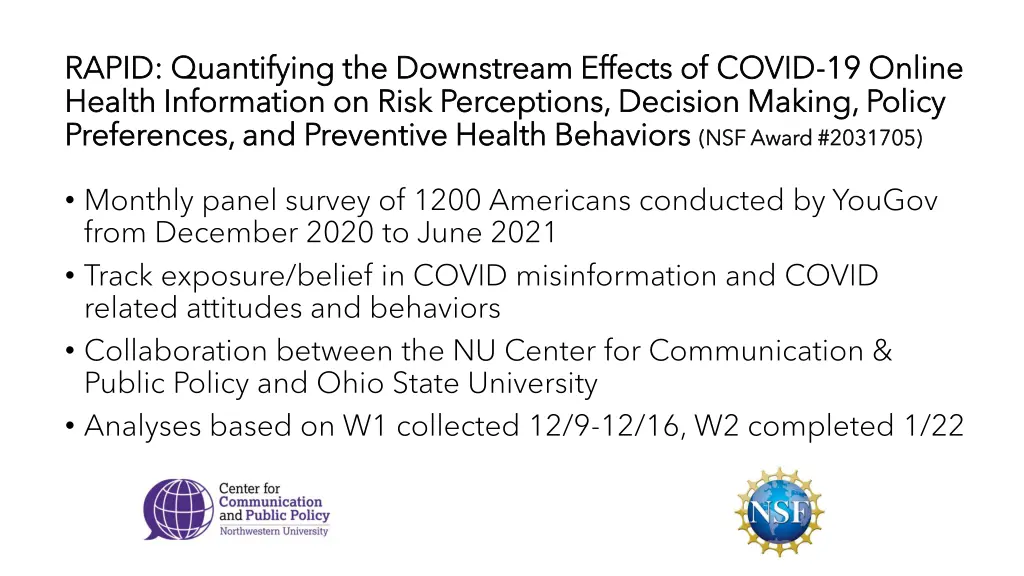
RAPID: Quantifying the Downstream Effects of COVID RAPID: Quantifying the Downstream Effects of COVID- -19 Online Health Information on Risk Perceptions, Decision Making, Policy Health Information on Risk Perceptions, Decision Making, Policy Preferences, and Preventive Health Behaviors Preferences, and Preventive Health Behaviors (NSF Award #2031705) 19 Online (NSF Award #2031705) Monthly panel survey of 1200 Americans conducted by YouGov from December 2020 to June 2021 Track exposure/belief in COVID misinformation and COVID related attitudes and behaviors Collaboration between the NU Center for Communication & Public Policy and Ohio State University Analyses based on W1 collected 12/9-12/16, W2 completed 1/22
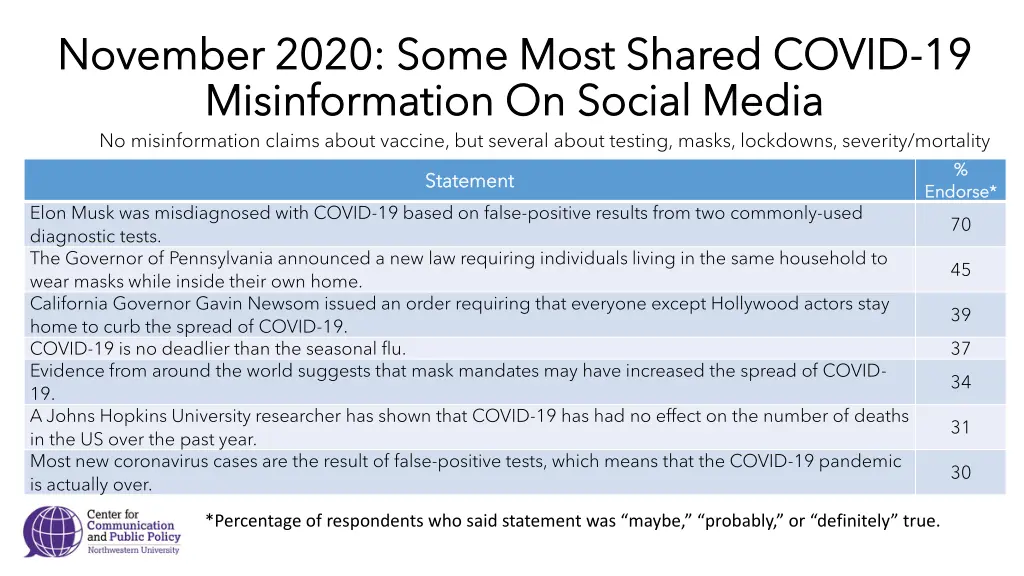
November 2020: Some Most Shared COVID November 2020: Some Most Shared COVID- -19 Misinformation On Social Media Misinformation On Social Media No misinformation claims about vaccine, but several about testing, masks, lockdowns, severity/mortality 19 % % Statement Statement Endorse* Endorse* Elon Musk was misdiagnosed with COVID-19 based on false-positive results from two commonly-used diagnostic tests. The Governor of Pennsylvania announced a new law requiring individuals living in the same household to wear masks while inside their own home. California Governor Gavin Newsom issued an order requiring that everyone except Hollywood actors stay home to curb the spread of COVID-19. COVID-19 is no deadlier than the seasonal flu. Evidence from around the world suggests that mask mandates may have increased the spread of COVID- 19. A Johns Hopkins University researcher has shown that COVID-19 has had no effect on the number of deaths in the US over the past year. Most new coronavirus cases are the result of false-positive tests, which means that the COVID-19 pandemic is actually over. 70 45 39 37 34 31 30 *Percentage of respondents who said statement was maybe, probably, or definitely true.
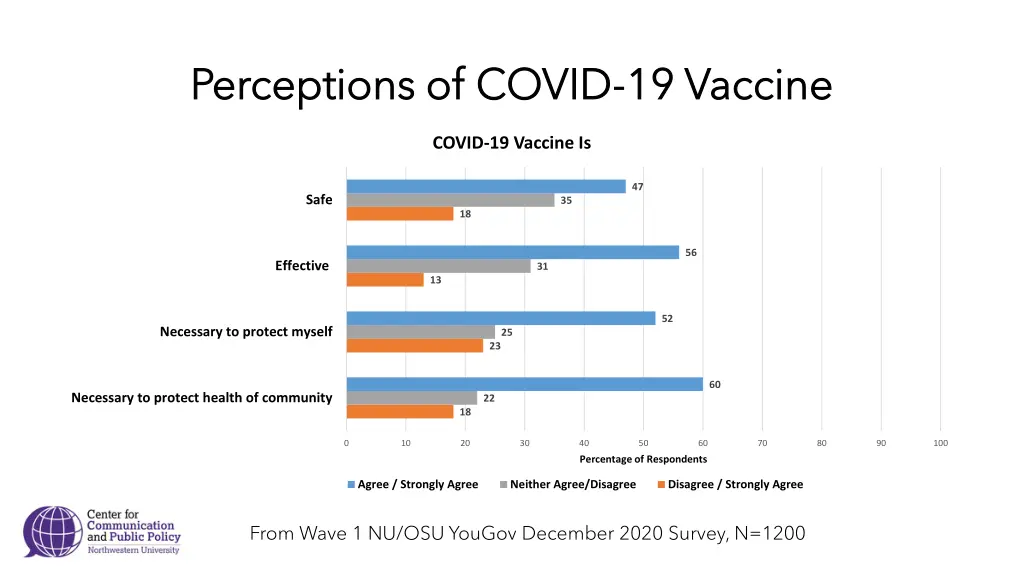
Perceptions of COVID Perceptions of COVID- -19 Vaccine 19 Vaccine COVID-19 Vaccine Is 47 Safe 35 18 56 Effective 31 13 52 Necessary to protect myself 25 23 60 Necessary to protect health of community 22 18 0 10 20 30 40 Percentage of Respondents 50 60 70 80 90 100 Agree / Strongly Agree Neither Agree/Disagree Disagree / Strongly Agree From Wave 1 NU/OSU YouGov December 2020 Survey, N=1200
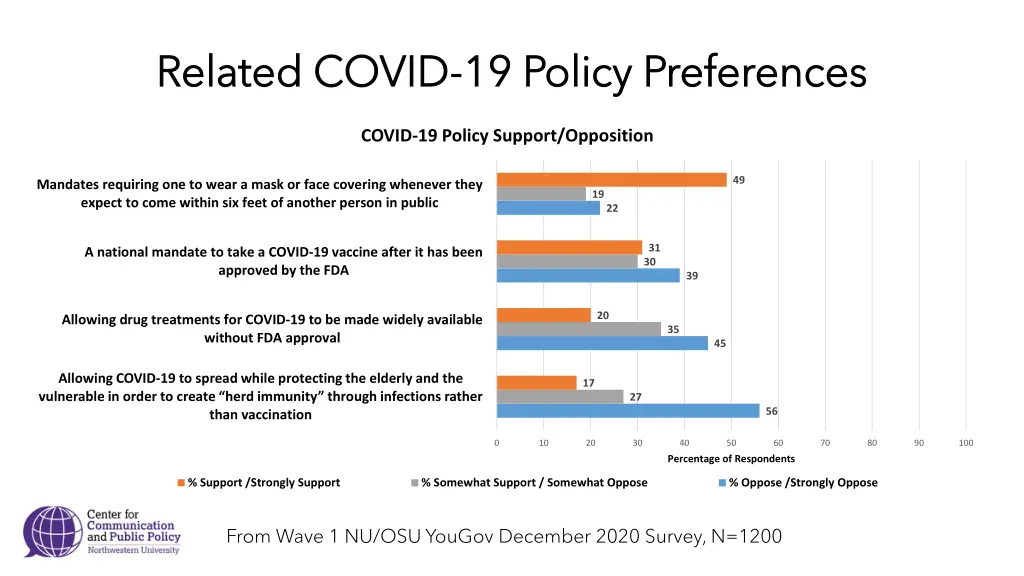
Related COVID Related COVID- -19 Policy Preferences 19 Policy Preferences COVID-19 Policy Support/Opposition 49 Mandates requiring one to wear a mask or face covering whenever they expect to come within six feet of another person in public 19 22 31 A national mandate to take a COVID-19 vaccine after it has been approved by the FDA 30 39 20 Allowing drug treatments for COVID-19 to be made widely available without FDA approval 35 45 Allowing COVID-19 to spread while protecting the elderly and the vulnerable in order to create herd immunity through infections rather than vaccination 17 27 56 0 10 20 30 40 50 60 70 80 90 100 Percentage of Respondents % Support /Strongly Support % Somewhat Support / Somewhat Oppose % Oppose /Strongly Oppose From Wave 1 NU/OSU YouGov December 2020 Survey, N=1200
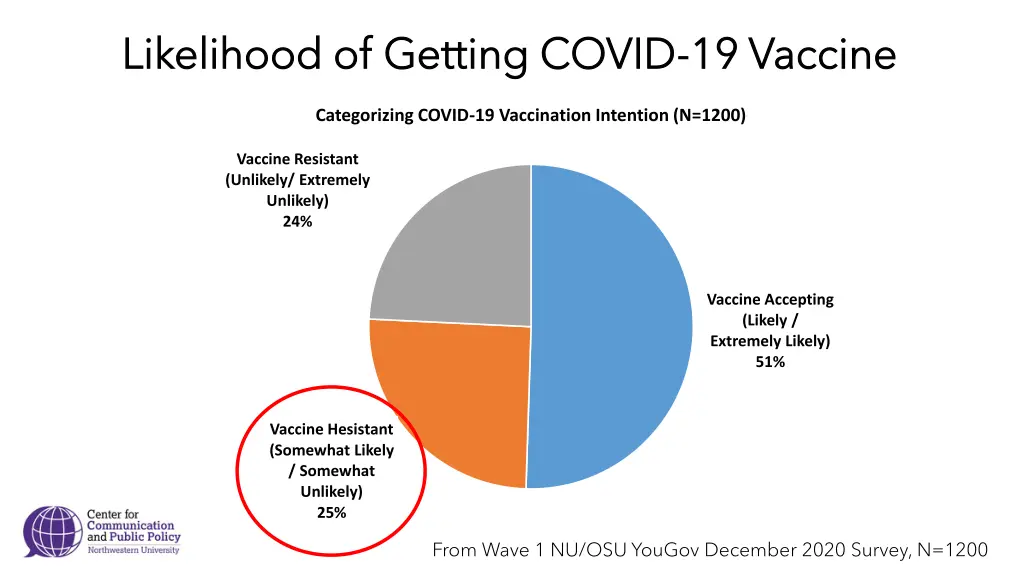
Likelihood of Getting COVID Likelihood of Getting COVID- -19 Vaccine 19 Vaccine Categorizing COVID-19 Vaccination Intention (N=1200) Vaccine Resistant (Unlikely/ Extremely Unlikely) 24% Vaccine Accepting (Likely / Extremely Likely) 51% Vaccine Hesistant (Somewhat Likely / Somewhat Unlikely) 25% From Wave 1 NU/OSU YouGov December 2020 Survey, N=1200
What significantly differentiates Vaccine Hesitant What significantly differentiates Vaccine Hesitant from Accepting? from Accepting? More likely female, Black, more religious, and less interested in news Less trusting of healthcare providers and public health experts Less likely to get annual flu shot Perceive COVID-19 vaccine as less safe and somewhat less effective Somewhat more conspiratorial mentality Somewhat more likely to believe COVID-19 misinformation, especially about severity/mortality Based on multinomial regression, Nagelkerke R-square=.61
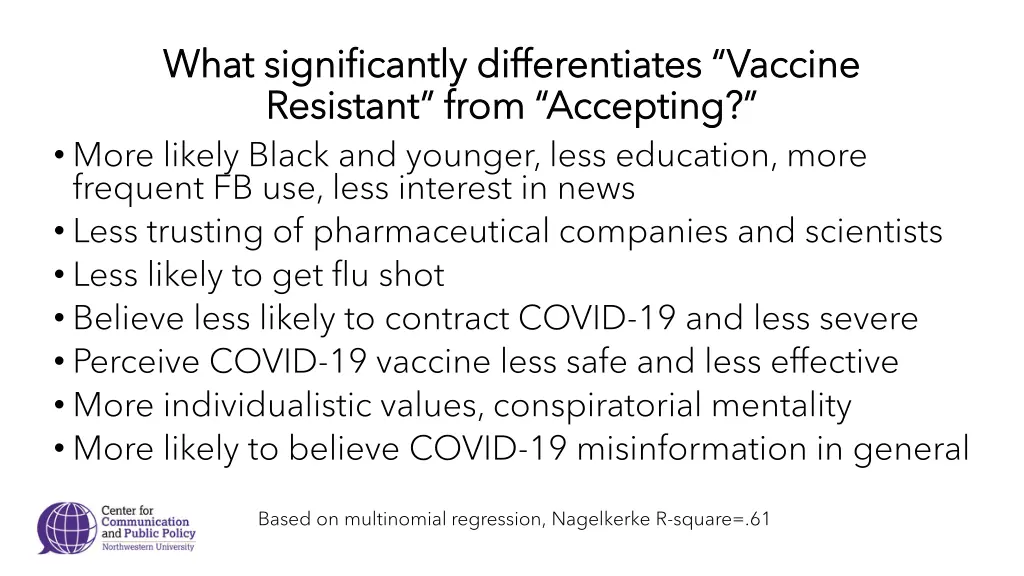
What significantly differentiates Vaccine What significantly differentiates Vaccine Resistant from Accepting? Resistant from Accepting? More likely Black and younger, less education, more frequent FB use, less interest in news Less trusting of pharmaceutical companies and scientists Less likely to get flu shot Believe less likely to contract COVID-19 and less severe Perceive COVID-19 vaccine less safe and less effective More individualistic values, conspiratorial mentality More likely to believe COVID-19 misinformation in general Based on multinomial regression, Nagelkerke R-square=.61
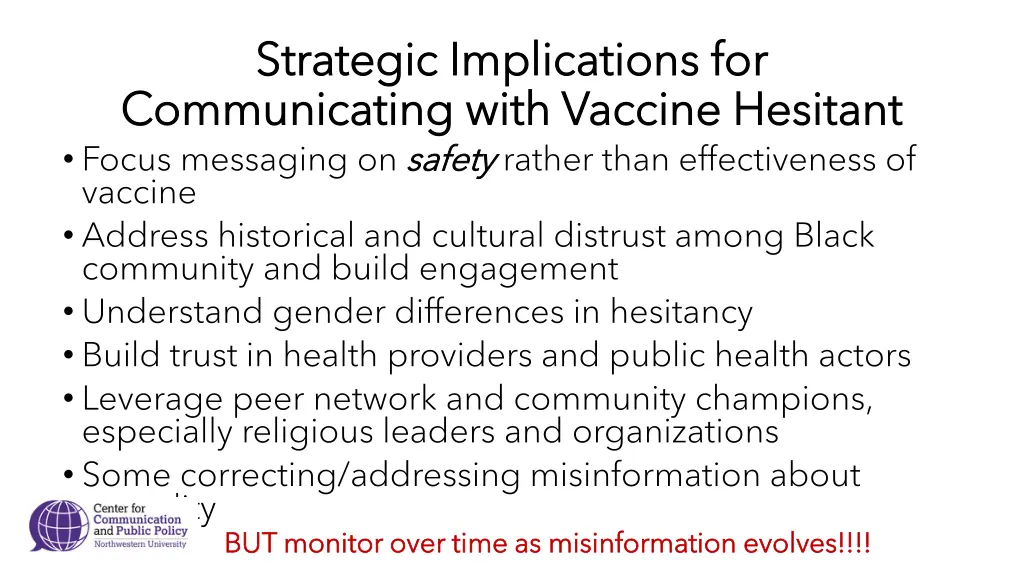
Strategic Implications for Strategic Implications for Communicating with Vaccine Hesitant Communicating with Vaccine Hesitant Focus messaging on safety safety rather than effectiveness of vaccine Address historical and cultural distrust among Black community and build engagement Understand gender differences in hesitancy Build trust in health providers and public health actors Leverage peer network and community champions, especially religious leaders and organizations Some correcting/addressing misinformation about mortality BUT monitor over time as misinformation evolves!!!! BUT monitor over time as misinformation evolves!!!!
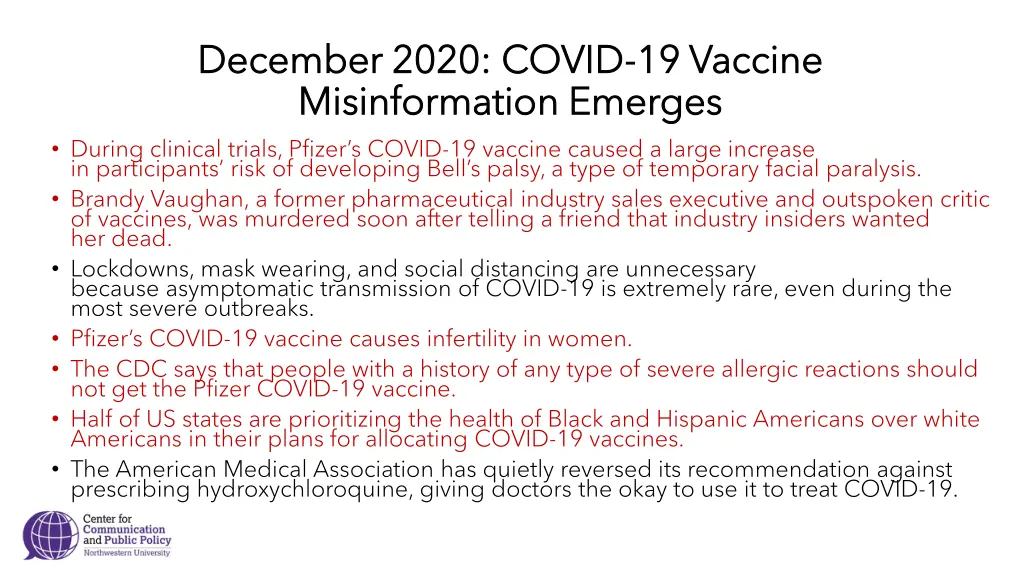
December 2020: COVID December 2020: COVID- -19 Vaccine Misinformation Emerges Misinformation Emerges During clinical trials, Pfizer s COVID-19 vaccine caused a large increase in participants risk of developing Bell s palsy, a type of temporary facial paralysis. Brandy Vaughan, a former pharmaceutical industry sales executive and outspoken critic of vaccines, was murdered soon after telling a friend that industry insiders wanted her dead. Lockdowns, mask wearing, and social distancing are unnecessary because asymptomatic transmission of COVID-19 is extremely rare, even during the most severe outbreaks. Pfizer s COVID-19 vaccine causes infertility in women. The CDC says that people with a history of any type of severe allergic reactions should not get the Pfizer COVID-19 vaccine. Half of US states are prioritizing the health of Black and Hispanic Americans over white Americans in their plans for allocating COVID-19 vaccines. The American Medical Association has quietly reversed its recommendation against prescribing hydroxychloroquine, giving doctors the okay to use it to treat COVID-19. 19 Vaccine
Thank You! Thank You! Collaborators Collaborators Kelly Garrett, Robert Bond, Graham Dixon, Shelly Hovick, Duane Wegener, Kilhoe Na, Yunkang Yang, Olivia Bullock, Camille Saucier, Rod Abhari * This data is based upon work supported by the National Science Foundation under Grant No. 2031705. Any opinions, findings, and conclusions or recommendations expressed in this material are those of the author(s) and do not necessarily reflect the views of the National Science Foundation.