Purposes,Goals,and Key Features of DLE Conceptual Framework
This presentation outlines the goals and purposes of the Diverse Learning Environments (DLE) conceptual framework and its assessment through a pilot survey. It aims to assist educators in enhancing the success of diverse students by increasing awareness of diversity and student learning. Key findings focus on improving student retention rates and creating favorable conditions for a diverse learning environment. The project draws on various research and practices to inform its approach.

Uploaded on Mar 05, 2025 | 0 Views
Download Presentation

Please find below an Image/Link to download the presentation.
The content on the website is provided AS IS for your information and personal use only. It may not be sold, licensed, or shared on other websites without obtaining consent from the author.If you encounter any issues during the download, it is possible that the publisher has removed the file from their server.
You are allowed to download the files provided on this website for personal or commercial use, subject to the condition that they are used lawfully. All files are the property of their respective owners.
The content on the website is provided AS IS for your information and personal use only. It may not be sold, licensed, or shared on other websites without obtaining consent from the author.
E N D
Presentation Transcript
Sylvia Hurtado Marcela Cuellar Cynthia Lua Alvarez AAC&U Meeting October 22, 2010 Houston, TX
Purposes, goals, & Key Features of Project Developing the DLE Conceptual Framework A New Assessment: Diverse Learning Environments Survey DLE Survey Pilot Findings
Purpose: Assist educators in advancing the success of diverse students Goals: Develop a greater awareness about diversity, student learning, and student success Assess undergraduate skills for work and citizenship in a pluralistic democracy Increase retention rates and improve the assessment of retention Create the conditions for realizing the benefits of diversity in the learning process
Research: Diverse Learning Environments Survey Campus Case Studies of 7 Institutions National Retention Study (Clearinghouse) Practice: Institute for the Critical Analysis of Quantitative Data Diversity Research Institute
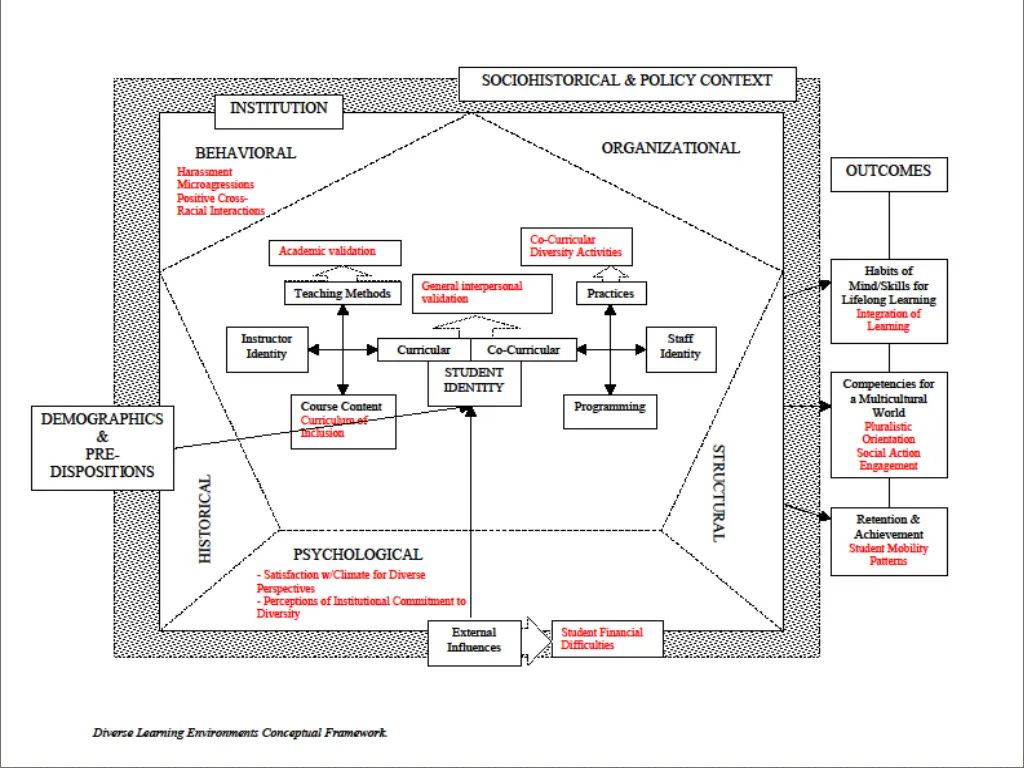
Habits of Mind/Skills for Lifelong Learning Competencies for a Multicultural World Achievement and Retention
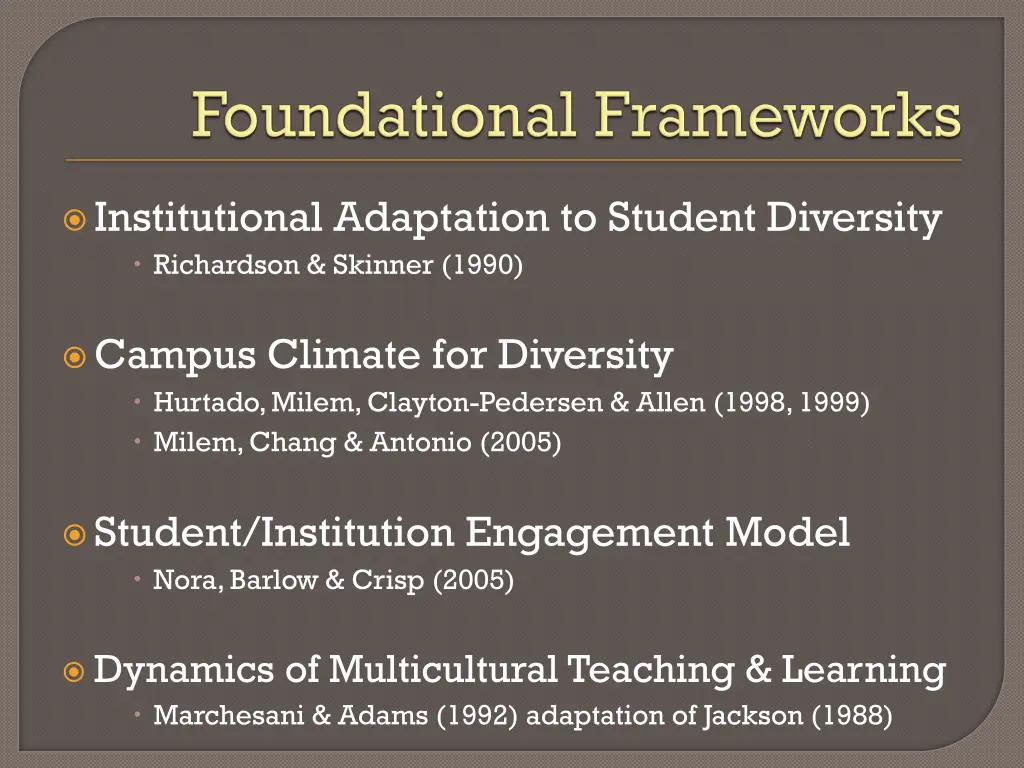
Institutional Adaptation to Student Diversity Richardson & Skinner (1990) Campus Climate for Diversity Hurtado, Milem, Clayton-Pedersen & Allen (1998, 1999) Milem, Chang & Antonio (2005) Student/Institution Engagement Model Nora, Barlow & Crisp (2005) Dynamics of Multicultural Teaching & Learning Marchesani & Adams (1992) adaptation of Jackson (1988)
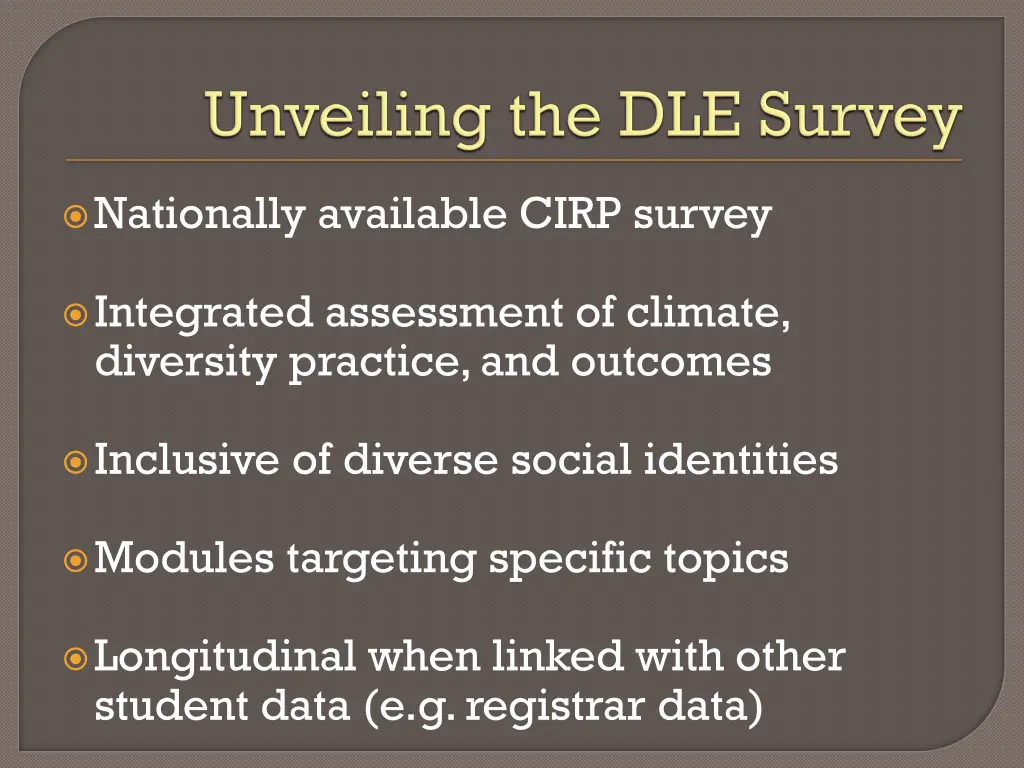
Nationally available CIRP survey Integrated assessment of climate, diversity practice, and outcomes Inclusive of diverse social identities Modules targeting specific topics Longitudinal when linked with other student data (e.g. registrar data)
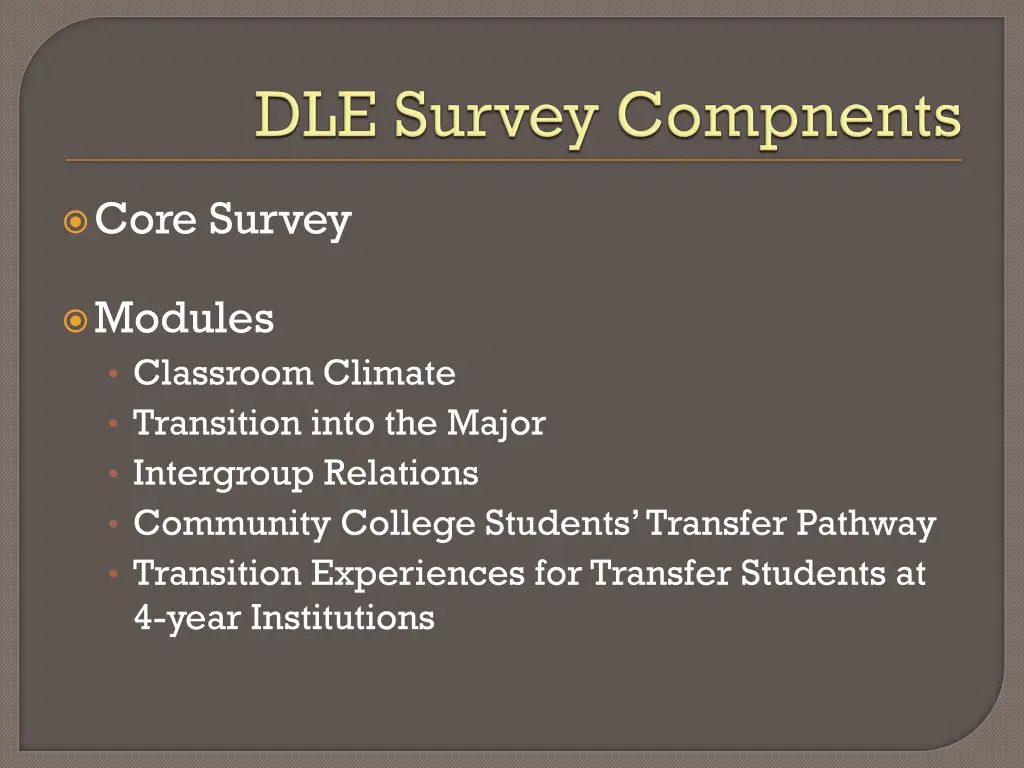
Core Survey Modules Classroom Climate Transition into the Major Intergroup Relations Community College Students Transfer Pathway Transition Experiences for Transfer Students at 4-year Institutions
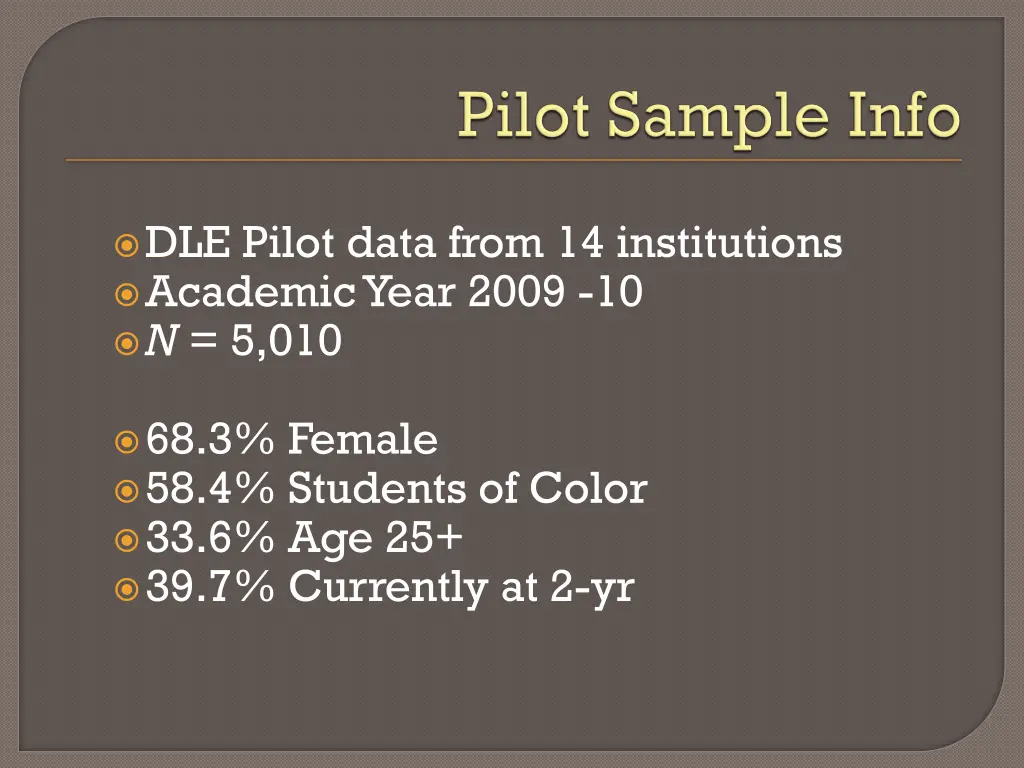
DLE Pilot data from 14 institutions Academic Year 2009 -10 N = 5,010 68.3% Female 58.4% Students of Color 33.6% Age 25+ 39.7% Currently at 2-yr
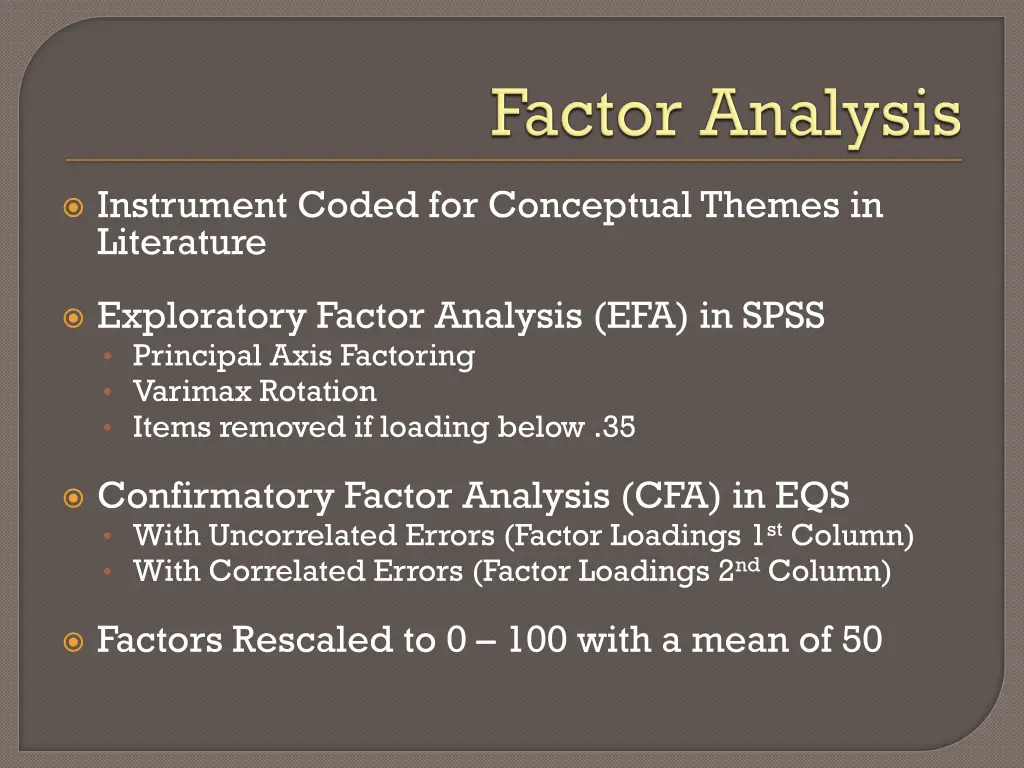
Instrument Coded for Conceptual Themes in Literature Exploratory Factor Analysis (EFA) in SPSS Principal Axis Factoring Varimax Rotation Items removed if loading below .35 Confirmatory Factor Analysis (CFA) in EQS With Uncorrelated Errors (Factor Loadings 1st Column) With Correlated Errors (Factor Loadings 2nd Column) Factors Rescaled to 0 100 with a mean of 50
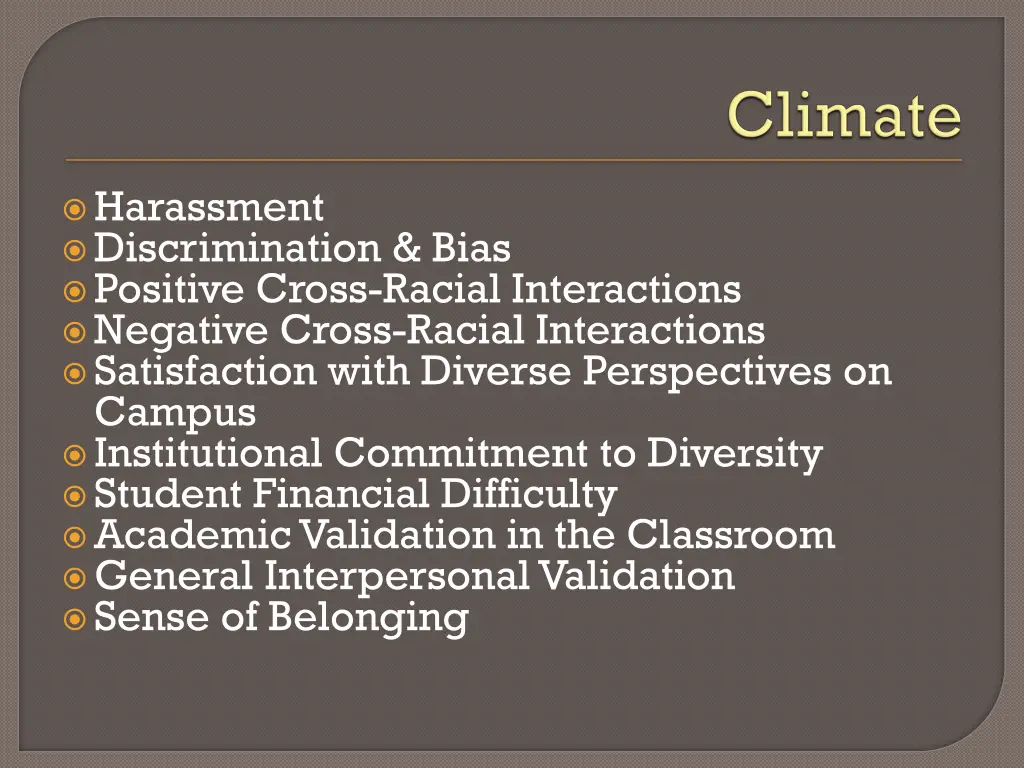
Harassment Discrimination & Bias Positive Cross-Racial Interactions Negative Cross-Racial Interactions Satisfaction with Diverse Perspectives on Campus Institutional Commitment to Diversity Student Financial Difficulty Academic Validation in the Classroom General Interpersonal Validation Sense of Belonging
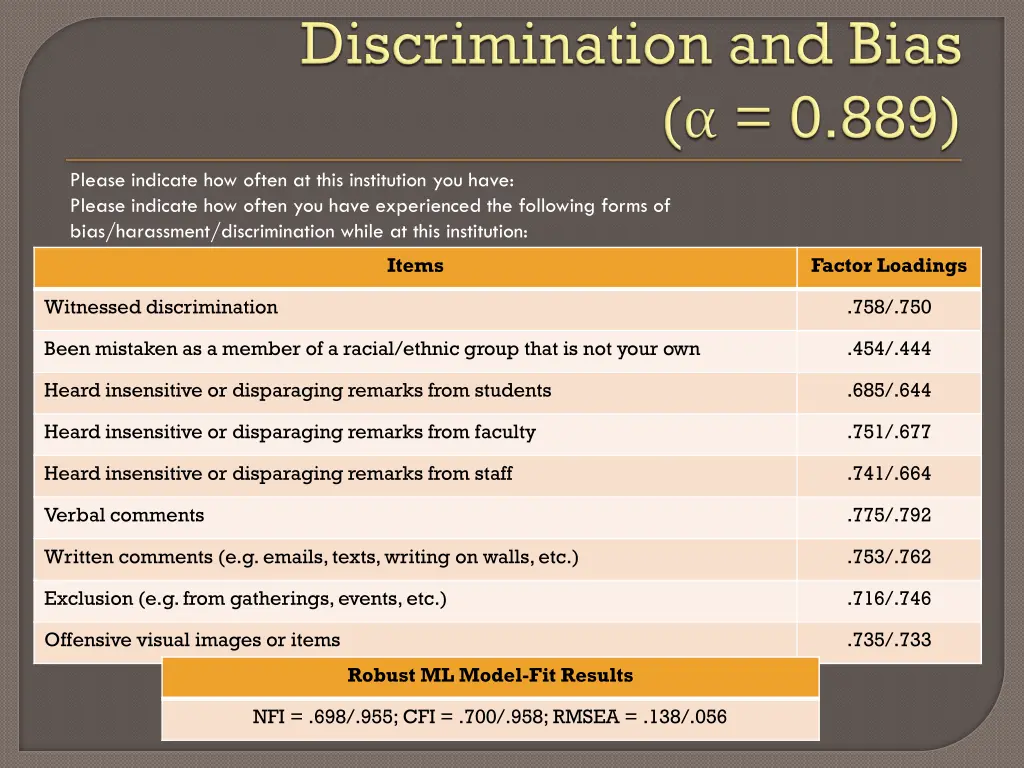
Please indicate how often at this institution you have: Please indicate how often you have experienced the following forms of bias/harassment/discrimination while at this institution: Items Factor Loadings Witnessed discrimination .758/.750 Been mistaken as a member of a racial/ethnic group that is not your own .454/.444 Heard insensitive or disparaging remarks from students .685/.644 Heard insensitive or disparaging remarks from faculty .751/.677 Heard insensitive or disparaging remarks from staff .741/.664 Verbal comments .775/.792 Written comments (e.g. emails, texts, writing on walls, etc.) .753/.762 Exclusion (e.g. from gatherings, events, etc.) .716/.746 Offensive visual images or items .735/.733 Robust ML Model-Fit Results NFI = .698/.955; CFI = .700/.958; RMSEA = .138/.056
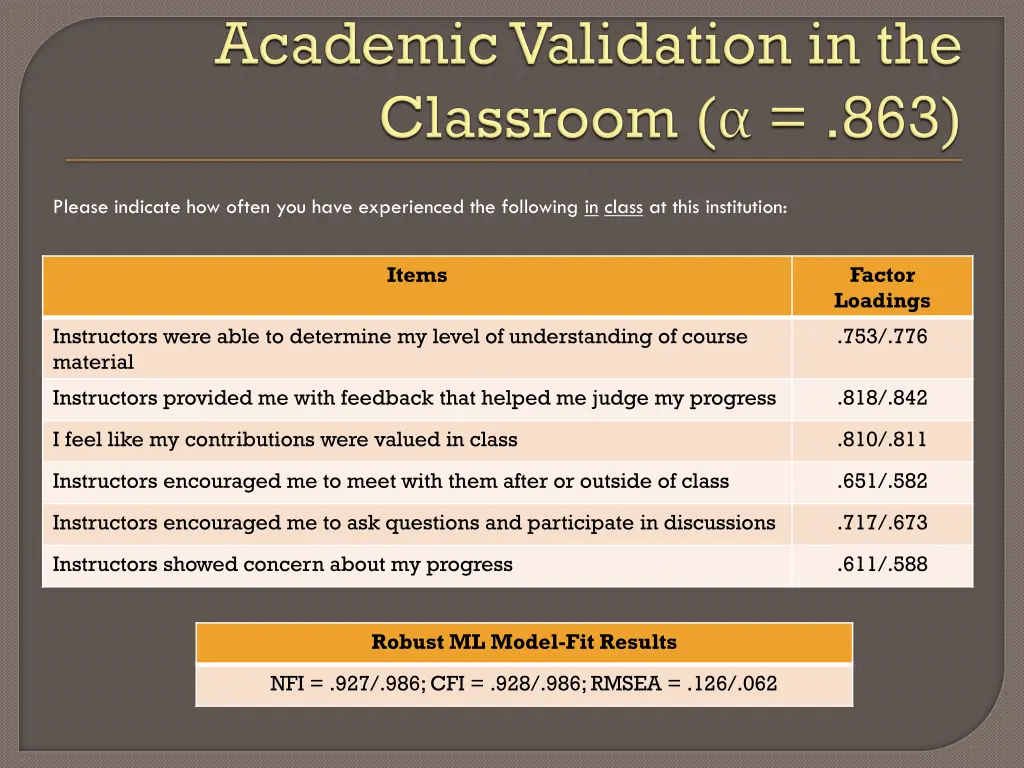
Please indicate how often you have experienced the following in class at this institution: Items Factor Loadings Instructors were able to determine my level of understanding of course material .753/.776 Instructors provided me with feedback that helped me judge my progress .818/.842 I feel like my contributions were valued in class .810/.811 Instructors encouraged me to meet with them after or outside of class .651/.582 Instructors encouraged me to ask questions and participate in discussions .717/.673 Instructors showed concern about my progress .611/.588 Robust ML Model-Fit Results NFI = .927/.986; CFI = .928/.986; RMSEA = .126/.062
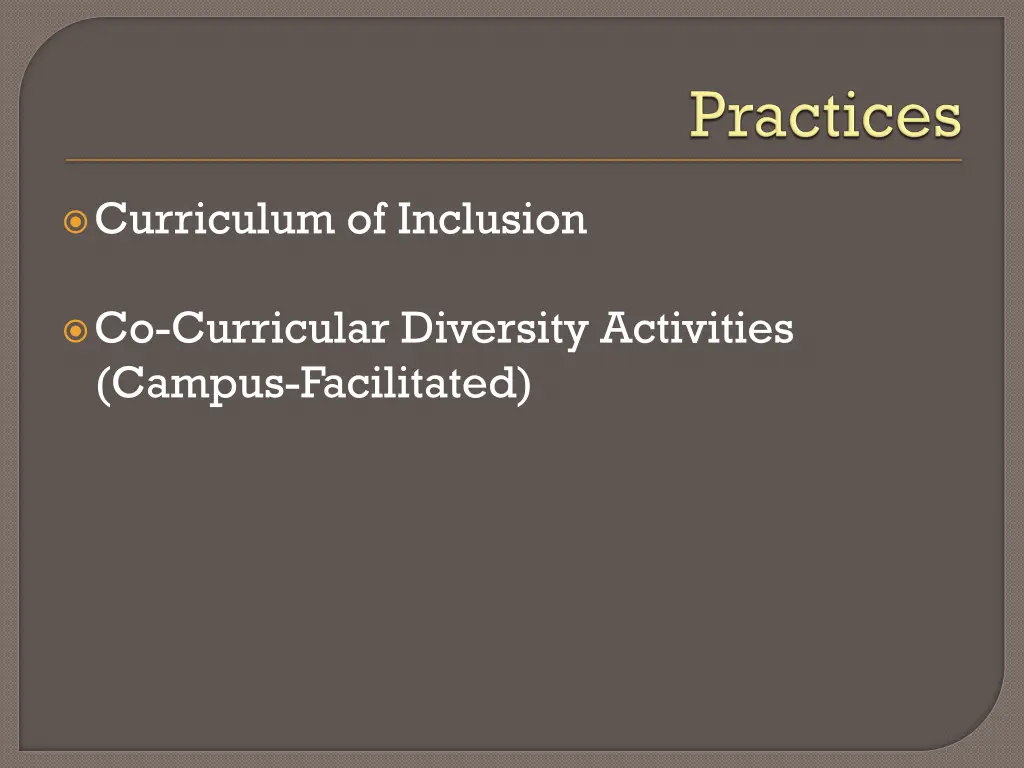
Curriculum of Inclusion Co-Curricular Diversity Activities (Campus-Facilitated)
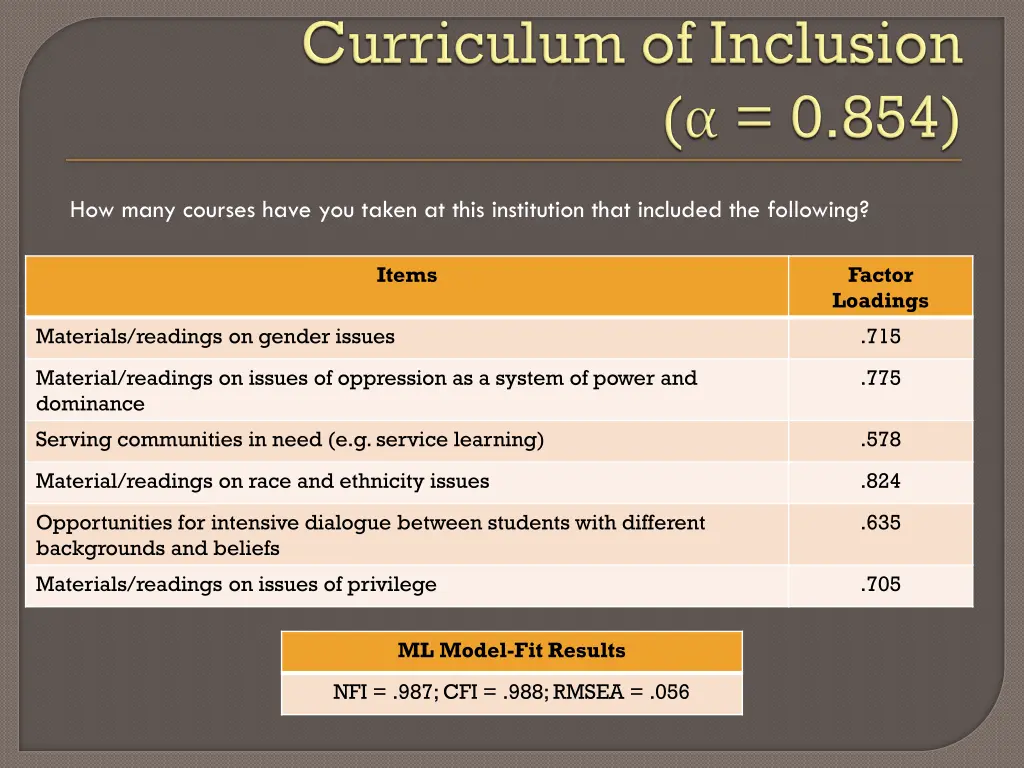
How many courses have you taken at this institution that included the following? Items Factor Loadings Materials/readings on gender issues .715 Material/readings on issues of oppression as a system of power and dominance .775 Serving communities in need (e.g. service learning) .578 Material/readings on race and ethnicity issues .824 Opportunities for intensive dialogue between students with different backgrounds and beliefs .635 Materials/readings on issues of privilege .705 ML Model-Fit Results NFI = .987; CFI = .988; RMSEA = .056
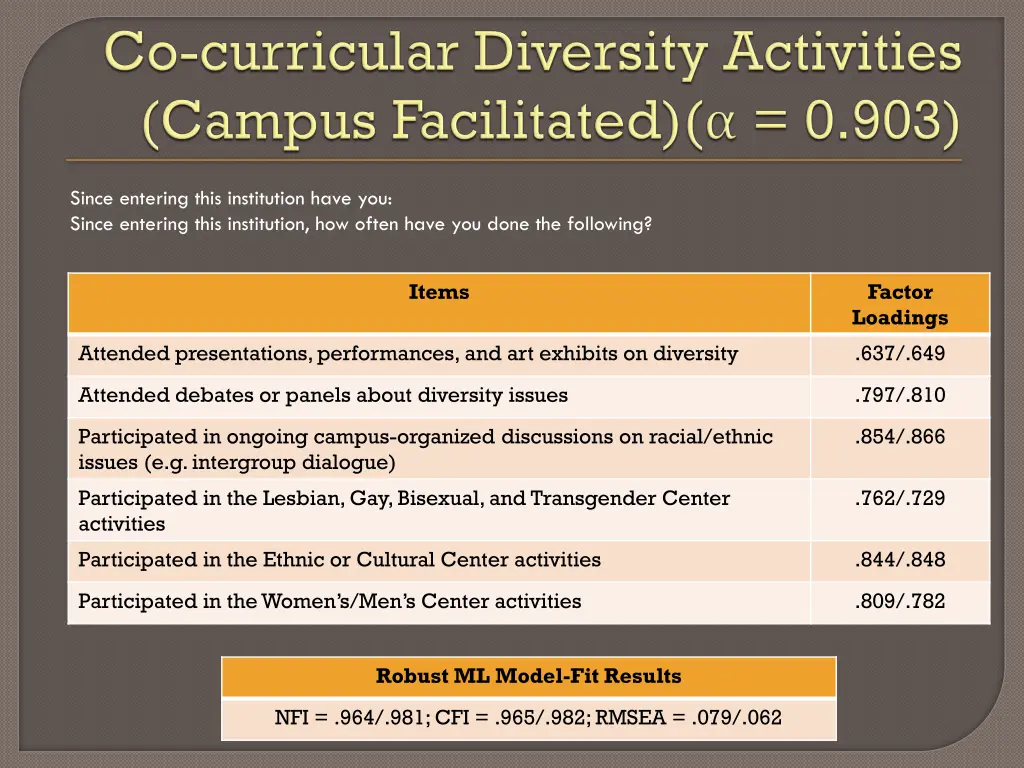
Since entering this institution have you: Since entering this institution, how often have you done the following? Items Factor Loadings Attended presentations, performances, and art exhibits on diversity .637/.649 Attended debates or panels about diversity issues .797/.810 Participated in ongoing campus-organized discussions on racial/ethnic issues (e.g. intergroup dialogue) .854/.866 Participated in the Lesbian, Gay, Bisexual, and Transgender Center activities .762/.729 Participated in the Ethnic or Cultural Center activities .844/.848 Participated in the Women s/Men s Center activities .809/.782 Robust ML Model-Fit Results NFI = .964/.981; CFI = .965/.982; RMSEA = .079/.062
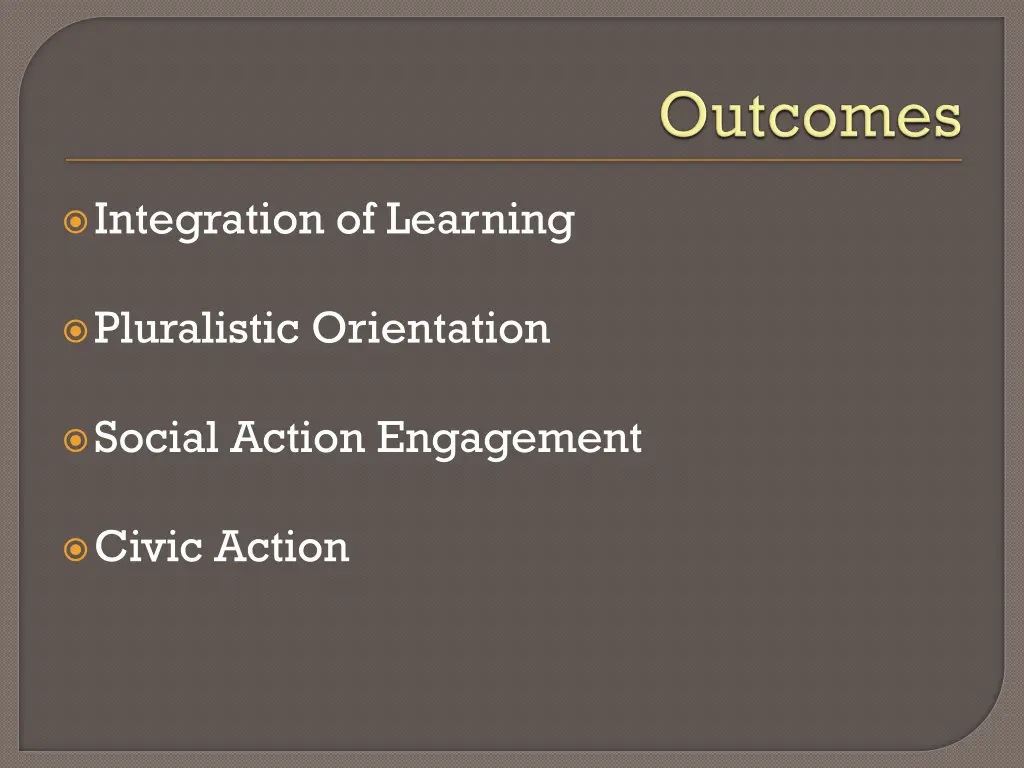
Integration of Learning Pluralistic Orientation Social Action Engagement Civic Action
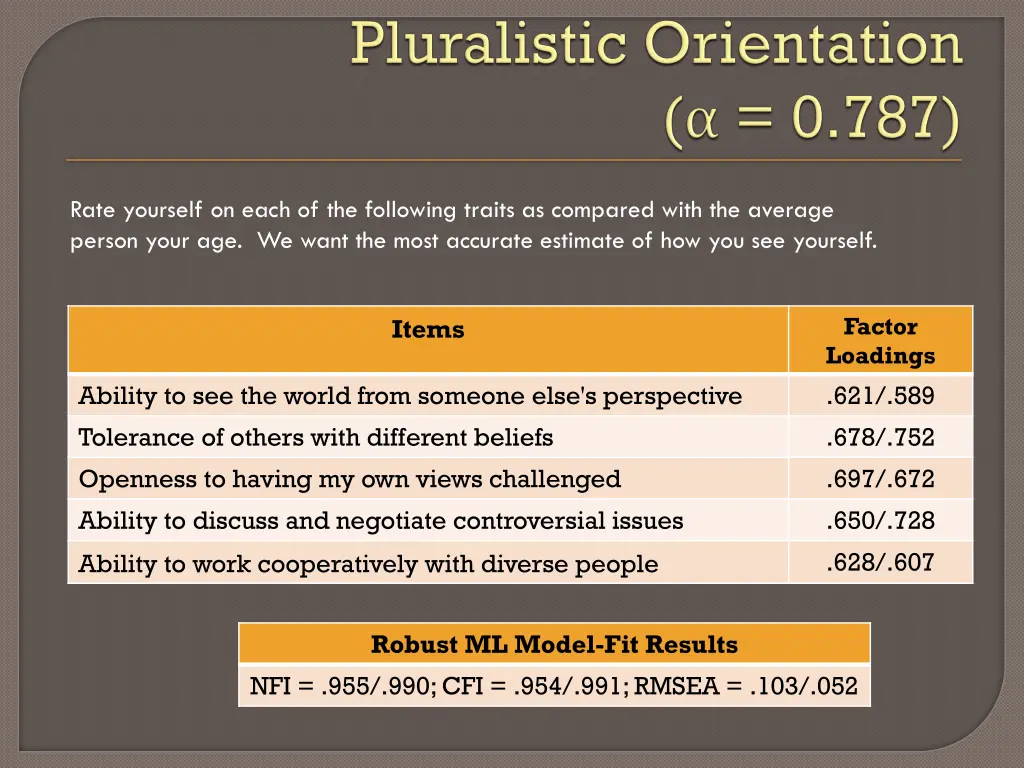
Rate yourself on each of the following traits as compared with the average person your age. We want the most accurate estimate of how you see yourself. Factor Loadings .621/.589 .678/.752 .697/.672 .650/.728 .628/.607 Items Ability to see the world from someone else's perspective Tolerance of others with different beliefs Openness to having my own views challenged Ability to discuss and negotiate controversial issues Ability to work cooperatively with diverse people Robust ML Model-Fit Results NFI = .955/.990; CFI = .954/.991; RMSEA = .103/.052
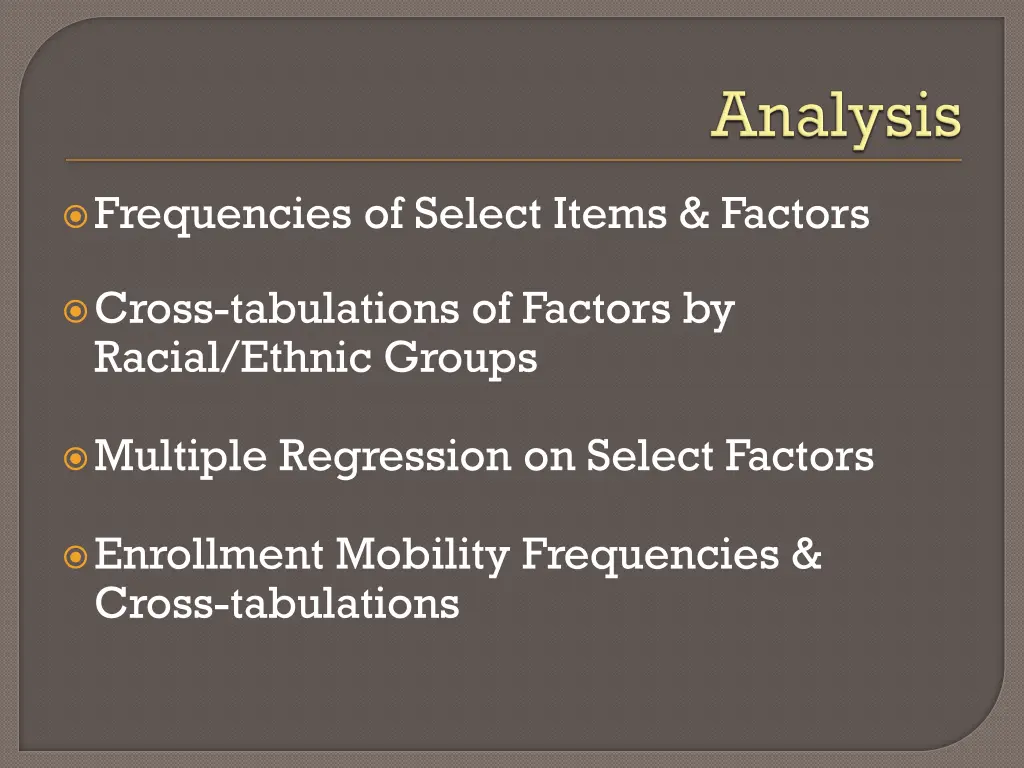
Frequencies of Select Items & Factors Cross-tabulations of Factors by Racial/Ethnic Groups Multiple Regression on Select Factors Enrollment Mobility Frequencies & Cross-tabulations
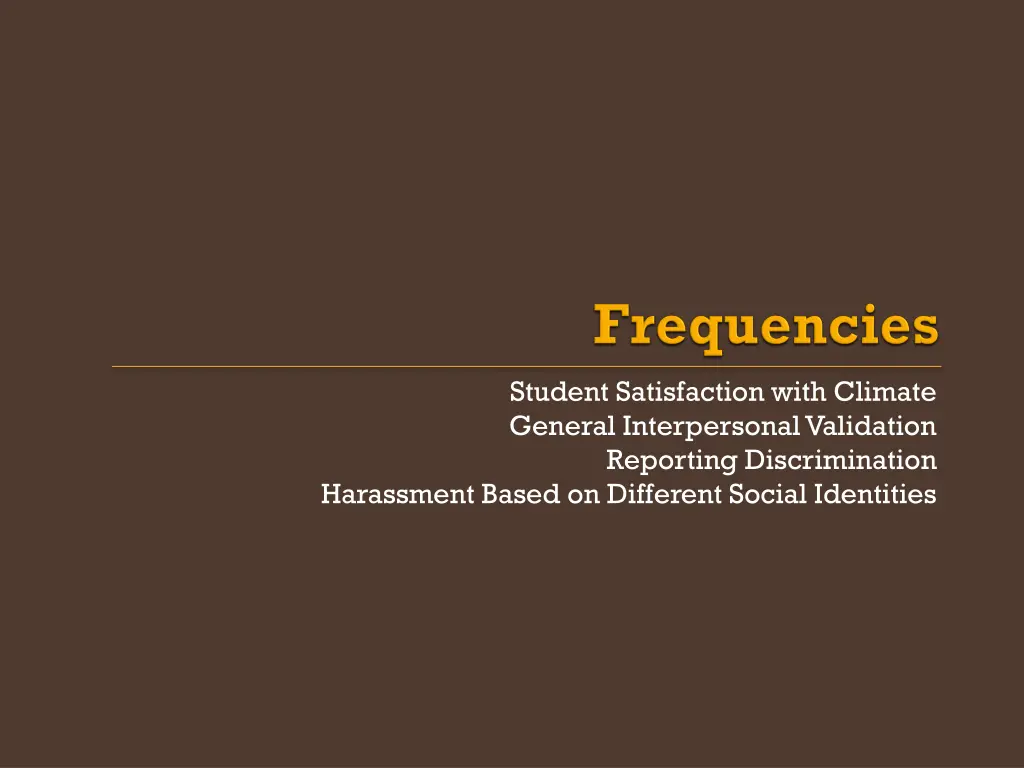
Student Satisfaction with Climate General Interpersonal Validation Reporting Discrimination Harassment Based on Different Social Identities
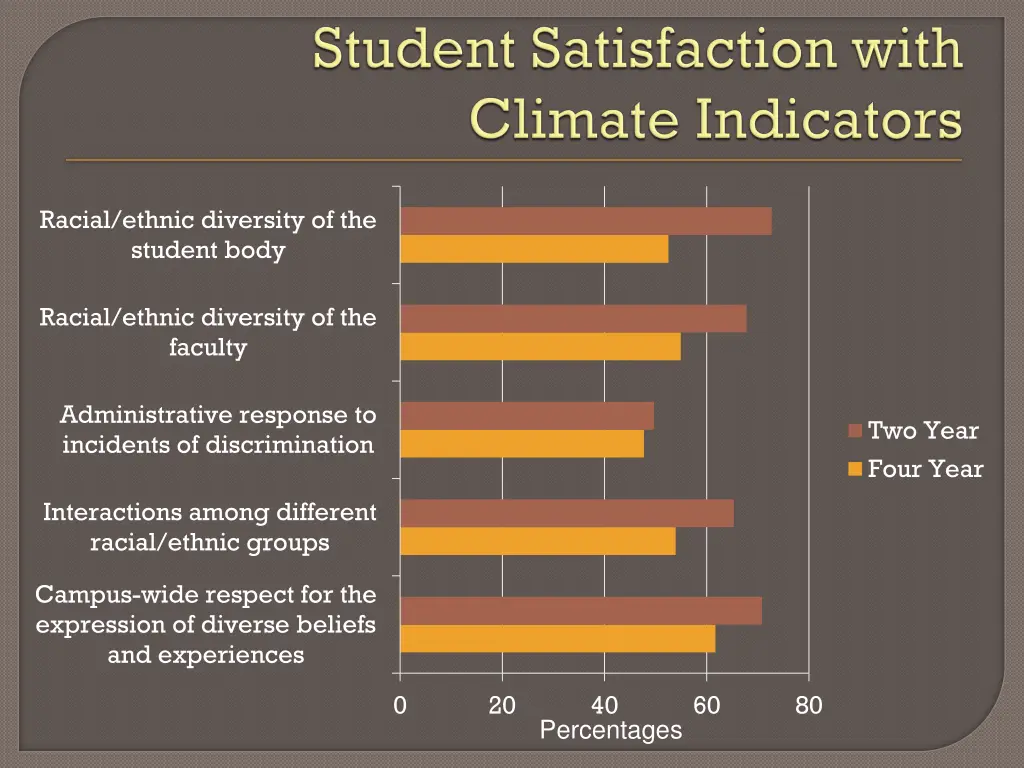
Racial/ethnic diversity of the student body Racial/ethnic diversity of the faculty Administrative response to incidents of discrimination Two Year Four Year Interactions among different racial/ethnic groups Campus-wide respect for the expression of diverse beliefs and experiences 0 20 40 60 80 Percentages
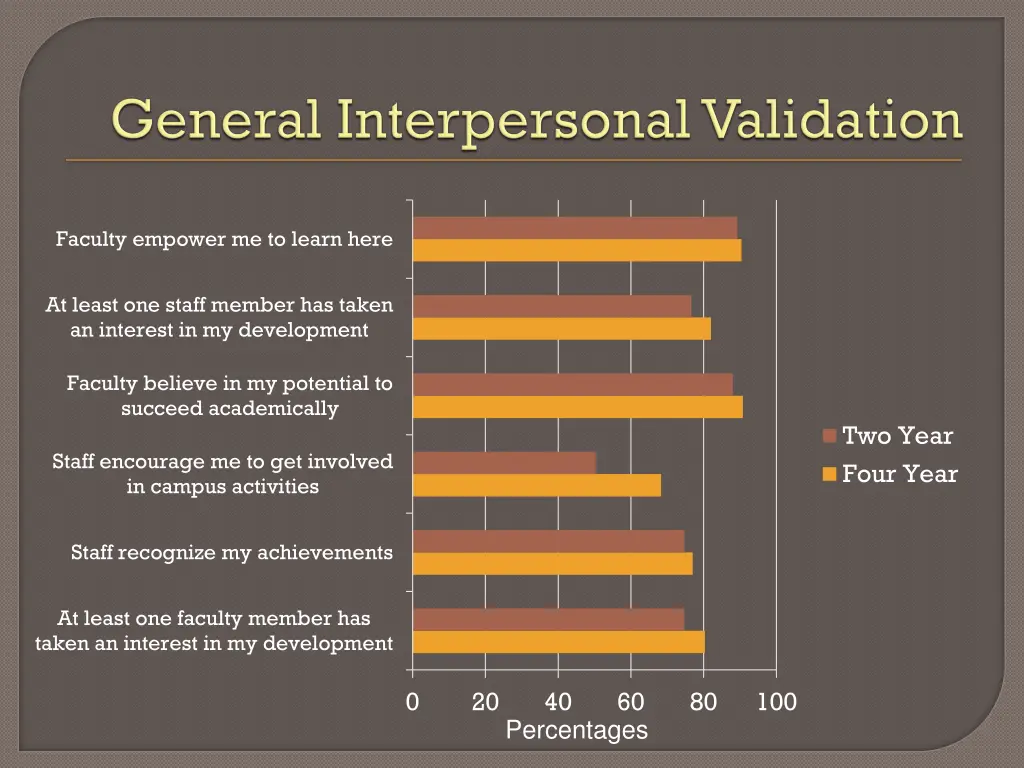
Faculty empower me to learn here At least one staff member has taken an interest in my development Faculty believe in my potential to succeed academically Two Year Four Year Staff encourage me to get involved in campus activities Staff recognize my achievements At least one faculty member has taken an interest in my development 0 20 40 60 80 100 Percentages
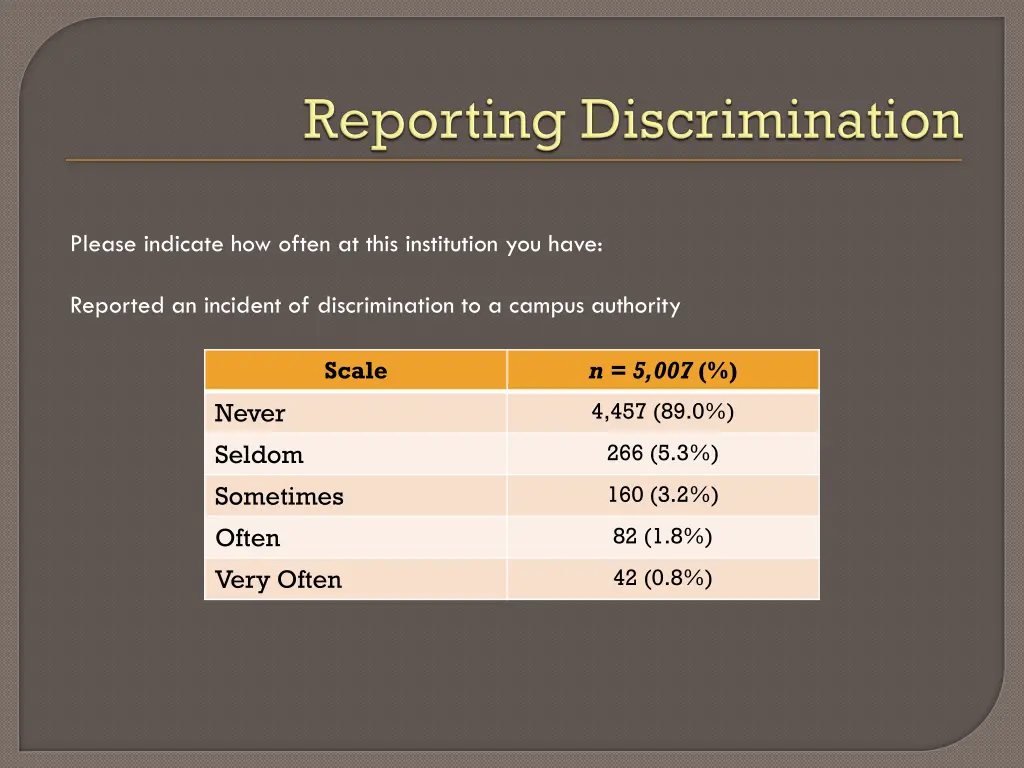
Please indicate how often at this institution you have: Reported an incident of discrimination to a campus authority Scale n = 5,007 (%) Never Seldom Sometimes Often Very Often 4,457 (89.0%) 266 (5.3%) 160 (3.2%) 82 (1.8%) 42 (0.8%)
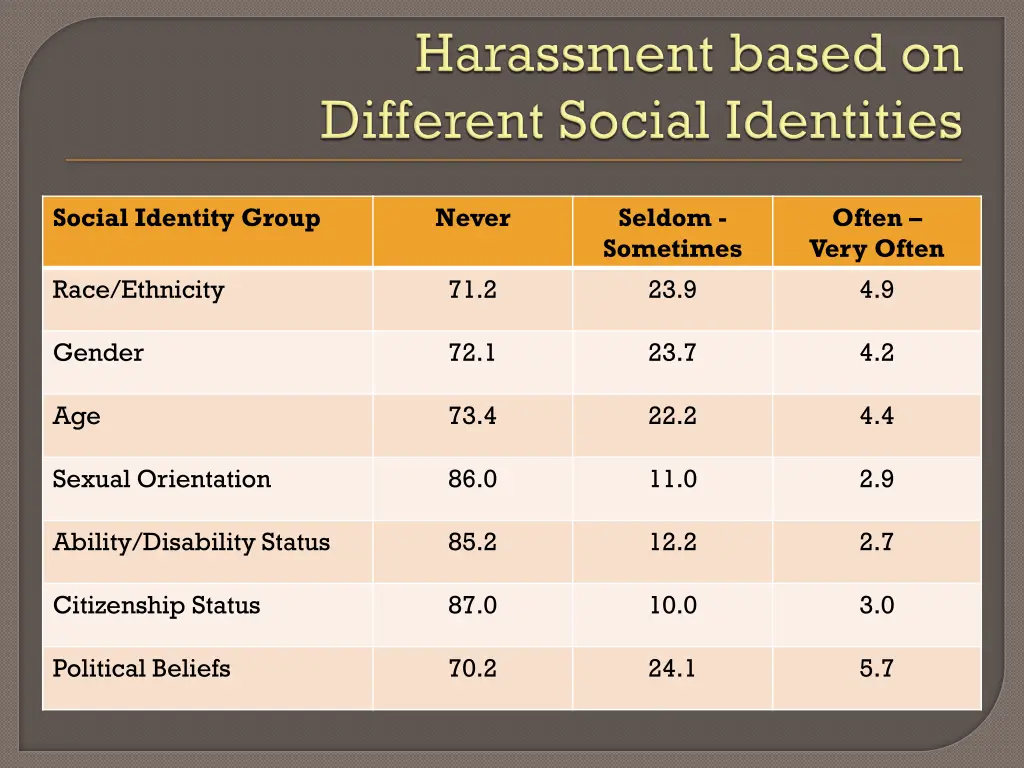
Social Identity Group Never Seldom - Sometimes 23.9 Often Very Often 4.9 Race/Ethnicity 71.2 Gender 72.1 23.7 4.2 Age 73.4 22.2 4.4 Sexual Orientation 86.0 11.0 2.9 Ability/Disability Status 85.2 12.2 2.7 Citizenship Status 87.0 10.0 3.0 Political Beliefs 70.2 24.1 5.7
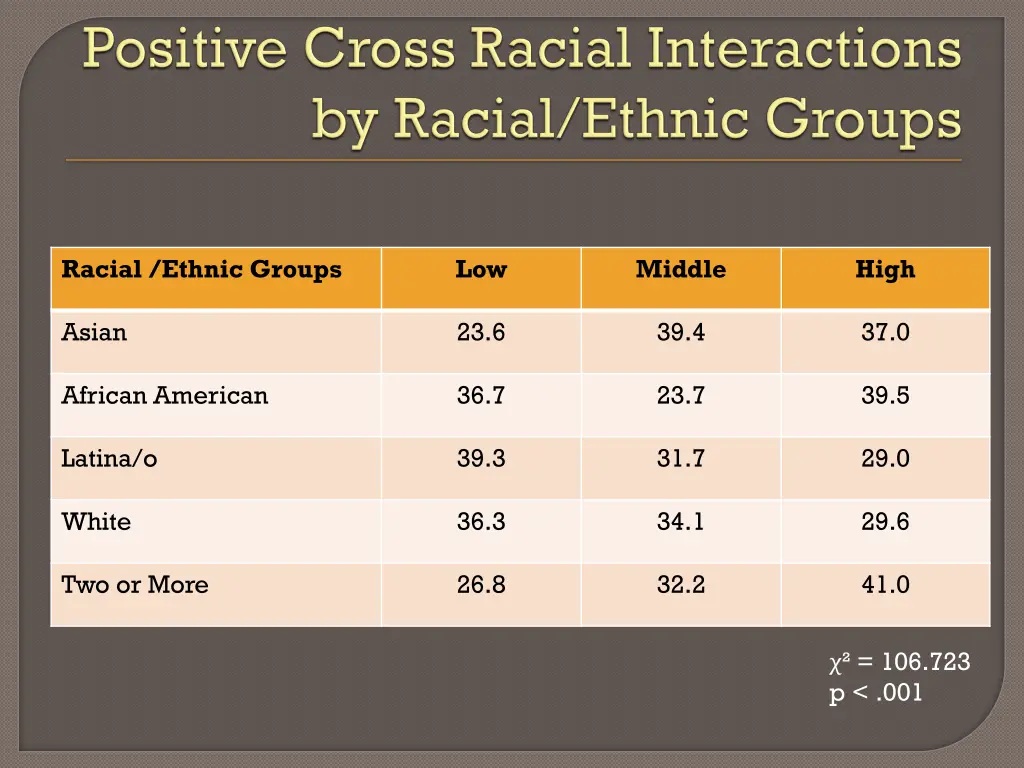
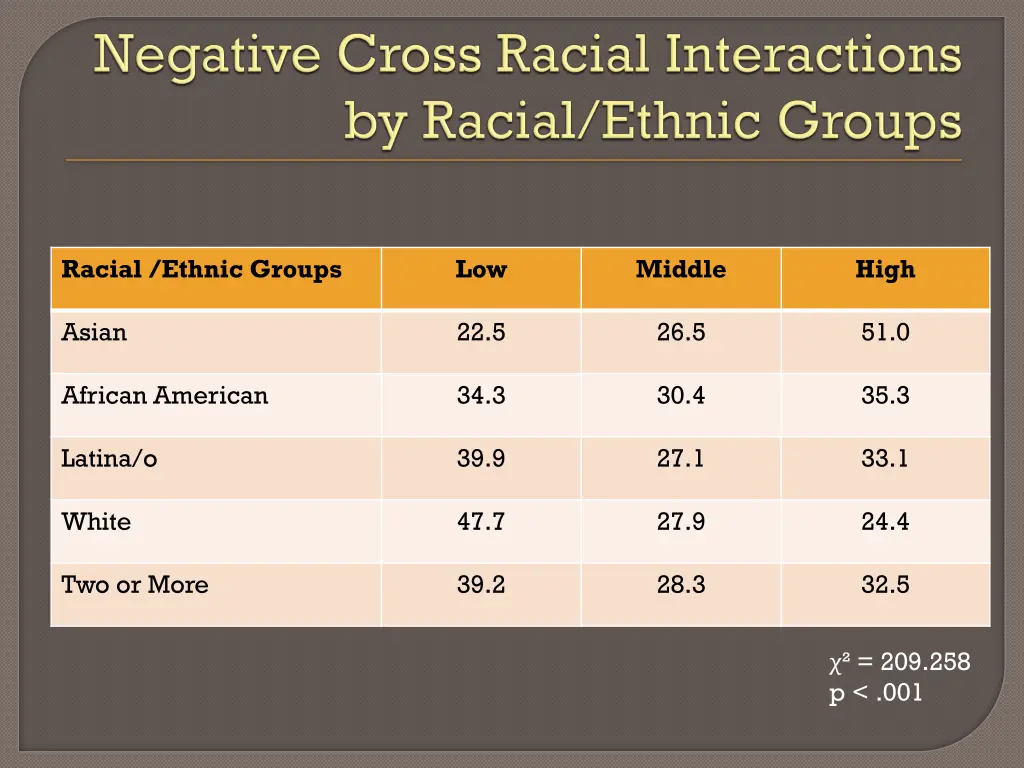
Discrimination & Bias Positive Cross Racial Interactions Negative Cross Racial Interactions
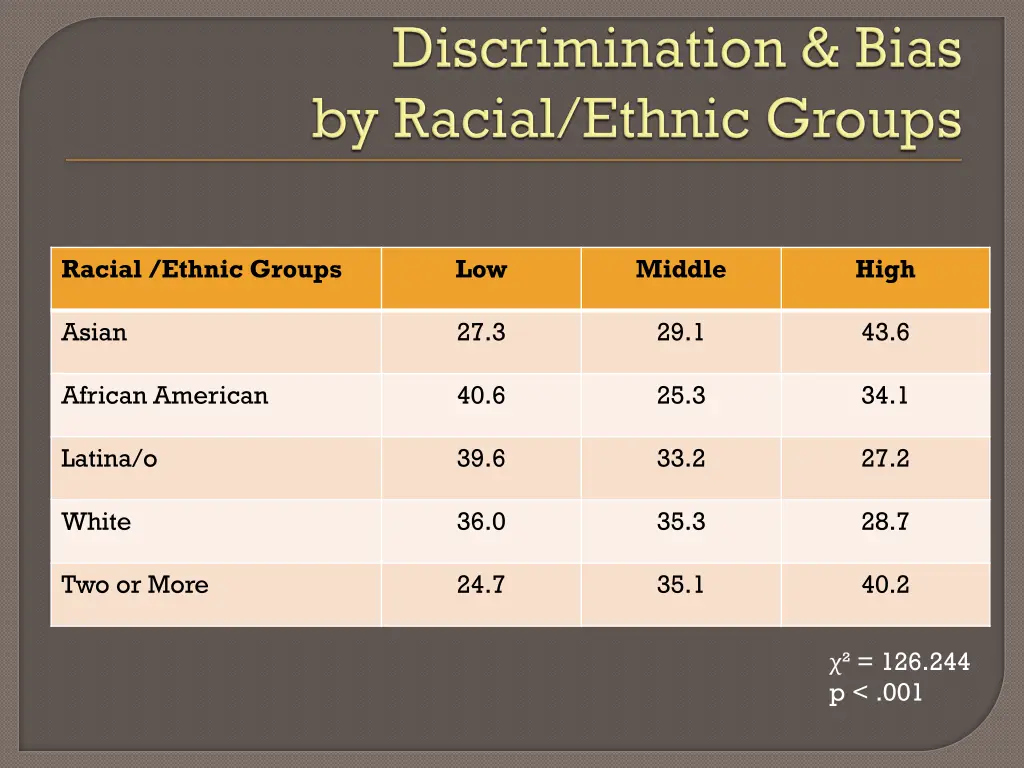
Racial /Ethnic Groups Low Middle High Asian 27.3 29.1 43.6 African American 40.6 25.3 34.1 Latina/o 39.6 33.2 27.2 White 36.0 35.3 28.7 Two or More 24.7 35.1 40.2 = 126.244 p < .001
Racial /Ethnic Groups Low Middle High Asian 23.6 39.4 37.0 African American 36.7 23.7 39.5 Latina/o 39.3 31.7 29.0 White 36.3 34.1 29.6 Two or More 26.8 32.2 41.0 = 106.723 p < .001
Racial /Ethnic Groups Low Middle High Asian 22.5 26.5 51.0 African American 34.3 30.4 35.3 Latina/o 39.9 27.1 33.1 White 47.7 27.9 24.4 Two or More 39.2 28.3 32.5 = 209.258 p < .001
General Interpersonal Validation Academic Validation in the Classroom Pluralistic Orientation
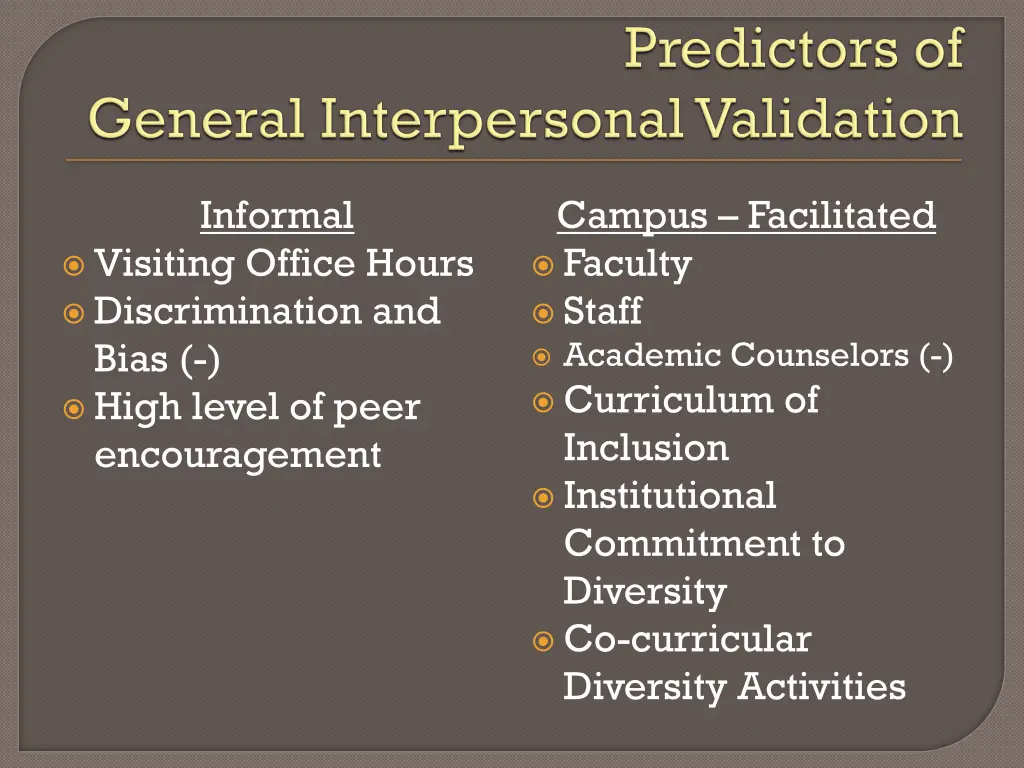
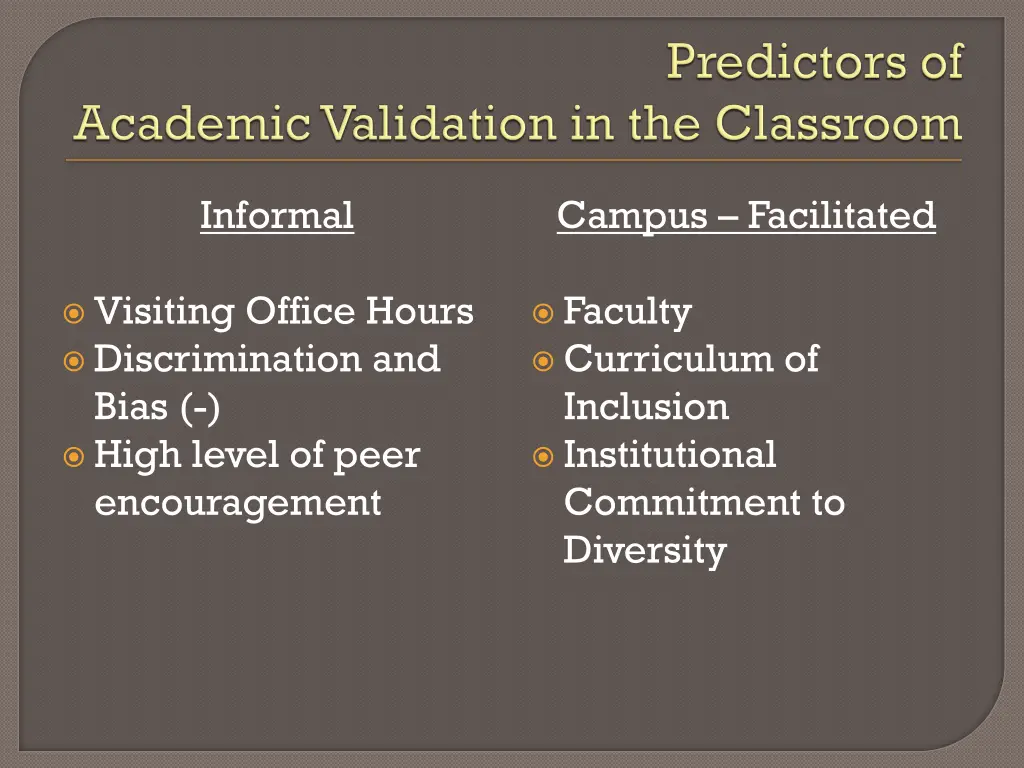
Informal Campus Facilitated Faculty Staff Academic Counselors (-) Curriculum of Inclusion Institutional Commitment to Diversity Co-curricular Diversity Activities Visiting Office Hours Discrimination and Bias (-) High level of peer encouragement
Informal Campus Facilitated Visiting Office Hours Discrimination and Bias (-) High level of peer encouragement Faculty Curriculum of Inclusion Institutional Commitment to Diversity
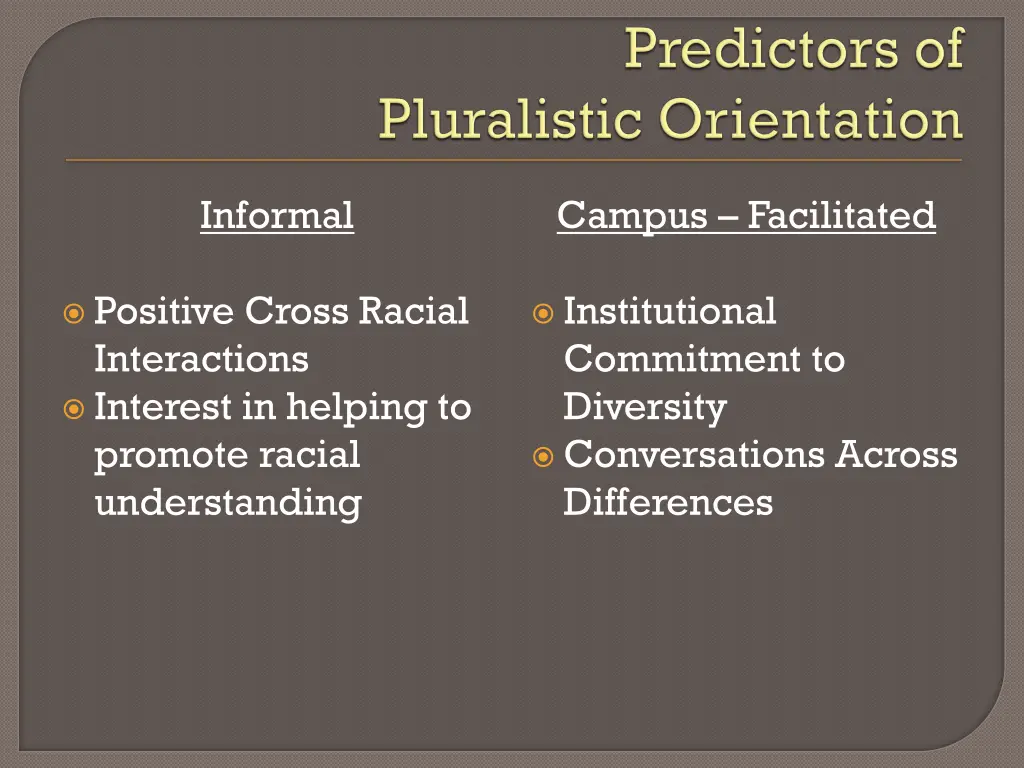
Informal Campus Facilitated Positive Cross Racial Interactions Interest in helping to promote racial understanding Institutional Commitment to Diversity Conversations Across Differences
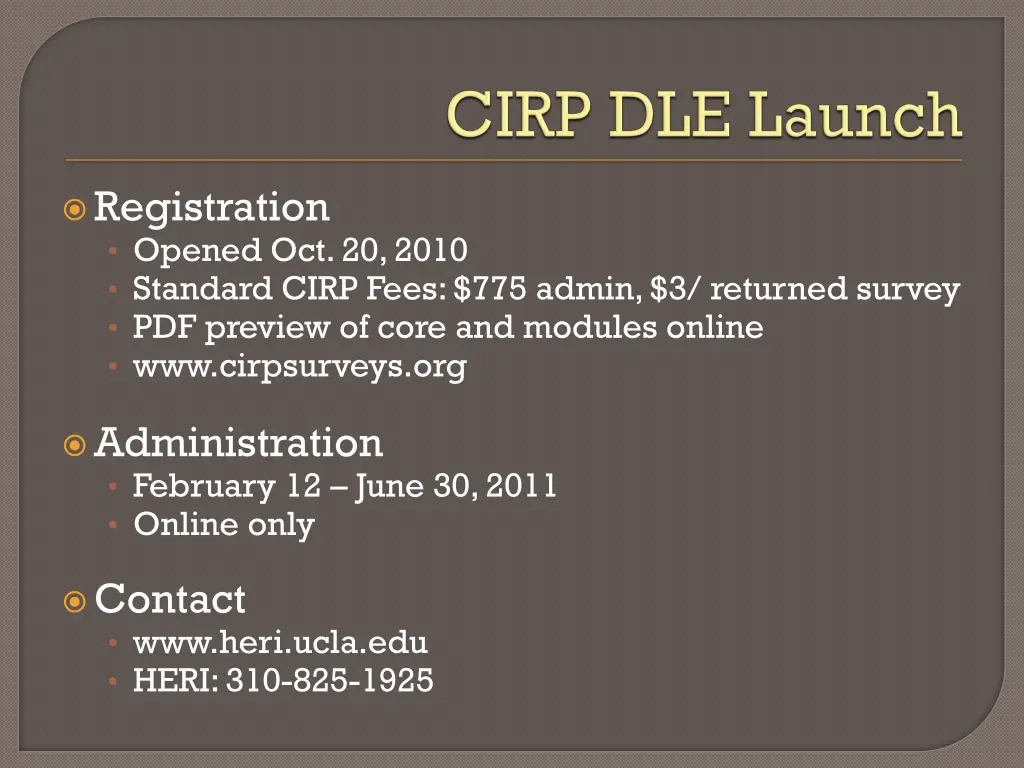
Registration Opened Oct. 20, 2010 Standard CIRP Fees: $775 admin, $3/ returned survey PDF preview of core and modules online www.cirpsurveys.org Administration February 12 June 30, 2011 Online only Contact www.heri.ucla.edu HERI: 310-825-1925
Conclusion Suggestions? Comments?