Putin's War in Ukraine: Political Economy Analysis
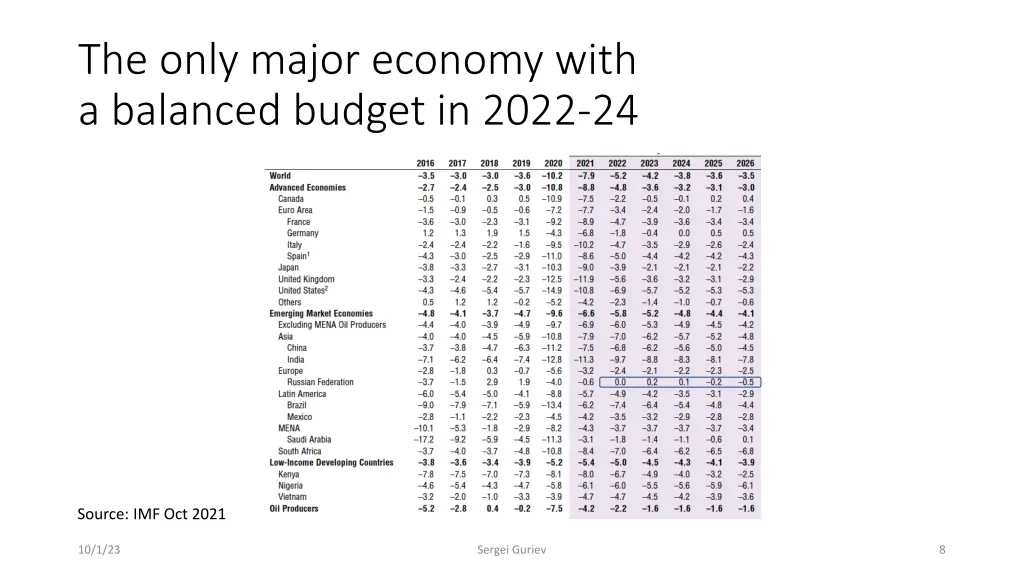
This analysis delves into the political economy of Putin's war in Ukraine, exploring aspects such as Putin's approval rating, pre-war economic outlook, the middle-income trap in Russia, real GDP trends, and Russia's position relative to India and China in terms of world GDP share. The content also highlights Russia's fiscal strength and its balanced budget in comparison to other major economies.

Download Presentation

Please find below an Image/Link to download the presentation.
The content on the website is provided AS IS for your information and personal use only. It may not be sold, licensed, or shared on other websites without obtaining consent from the author.If you encounter any issues during the download, it is possible that the publisher has removed the file from their server.
You are allowed to download the files provided on this website for personal or commercial use, subject to the condition that they are used lawfully. All files are the property of their respective owners.
The content on the website is provided AS IS for your information and personal use only. It may not be sold, licensed, or shared on other websites without obtaining consent from the author.
E N D
Presentation Transcript
Political Economy of Putins War in Ukraine Sergei Guriev January 10, 2023
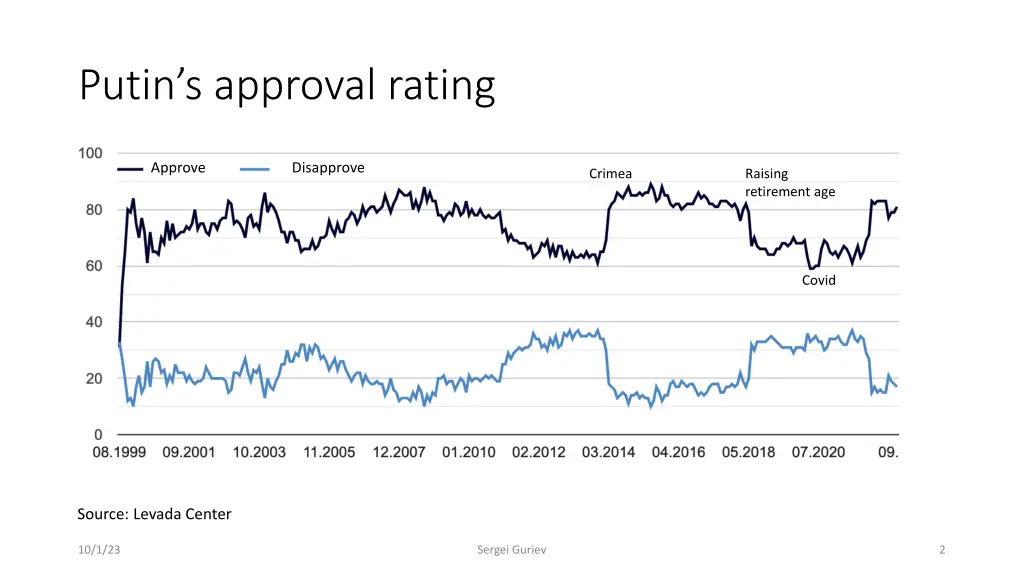
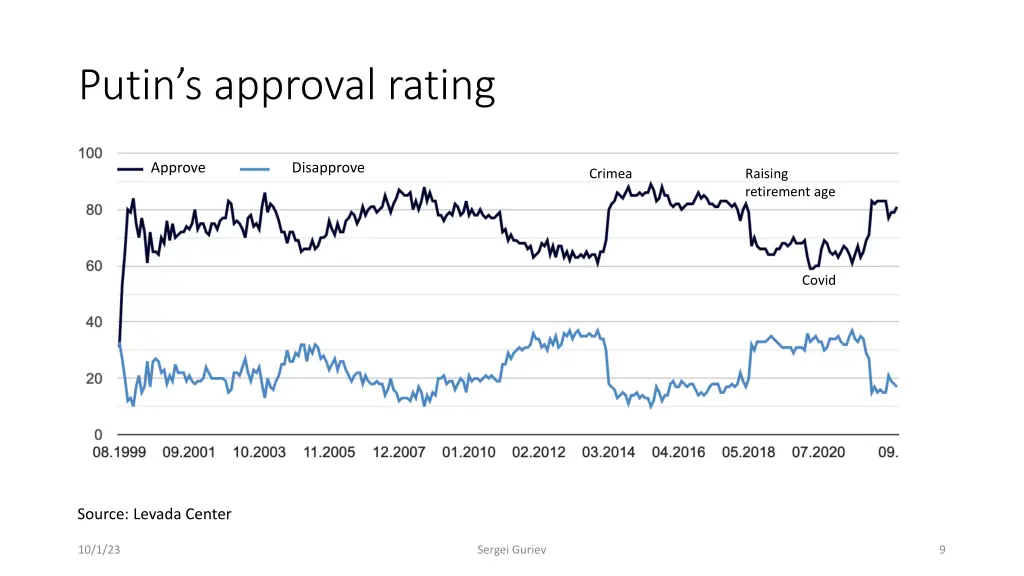
Putins approval rating Approve Disapprove Crimea Raising retirement age Covid Source: Levada Center 10/1/23 Sergei Guriev 2
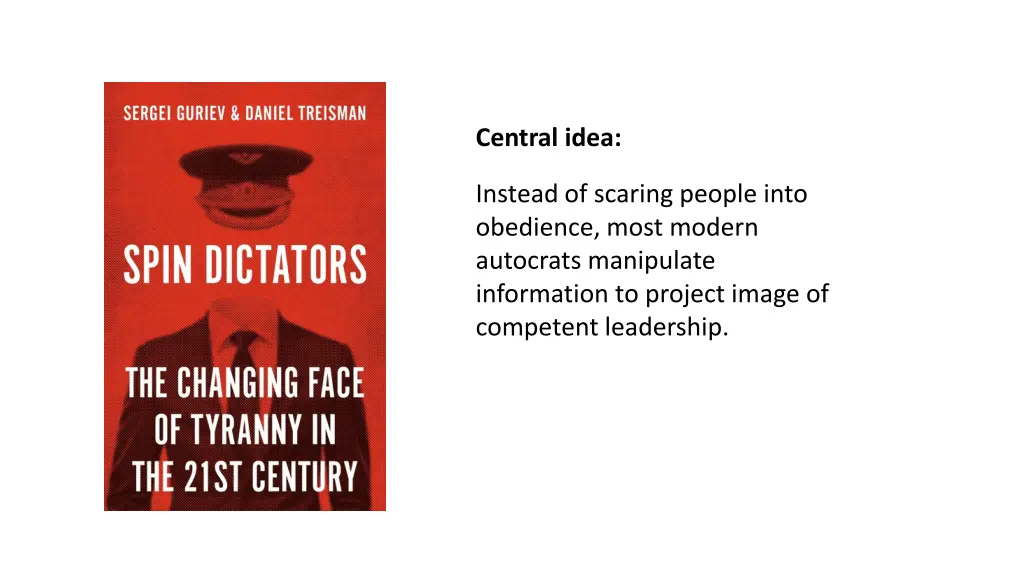
Central idea: Instead of scaring people into obedience, most modern autocrats manipulate information to project image of competent leadership.
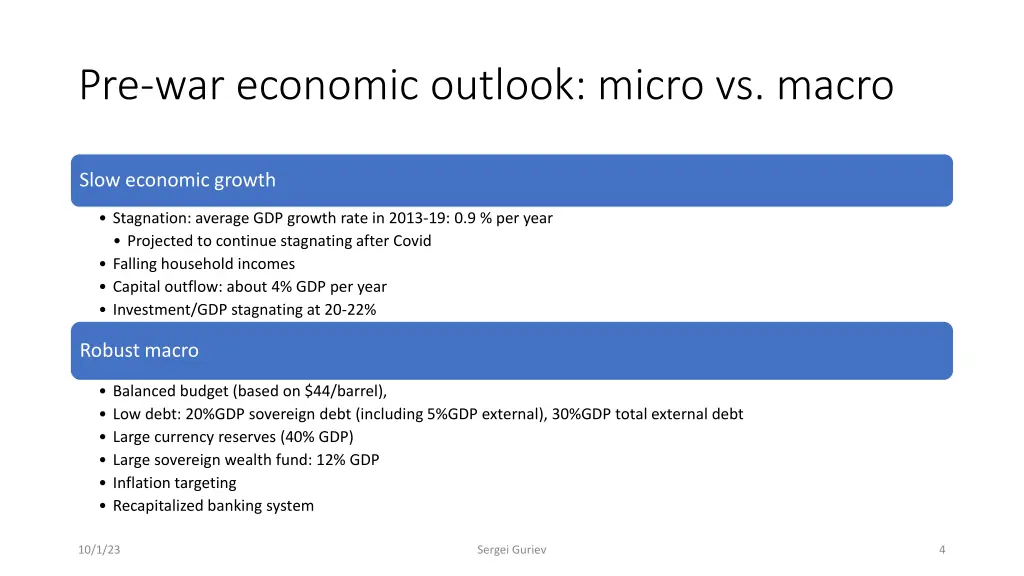
Pre-war economic outlook: micro vs. macro Slow economic growth Stagnation: average GDP growth rate in 2013-19: 0.9 % per year Projected to continue stagnating after Covid Falling household incomes Capital outflow: about 4% GDP per year Investment/GDP stagnating at 20-22% Robust macro Balanced budget (based on $44/barrel), Low debt: 20%GDP sovereign debt (including 5%GDP external), 30%GDP total external debt Large currency reserves (40% GDP) Large sovereign wealth fund: 12% GDP Inflation targeting Recapitalized banking system 10/1/23 Sergei Guriev 4
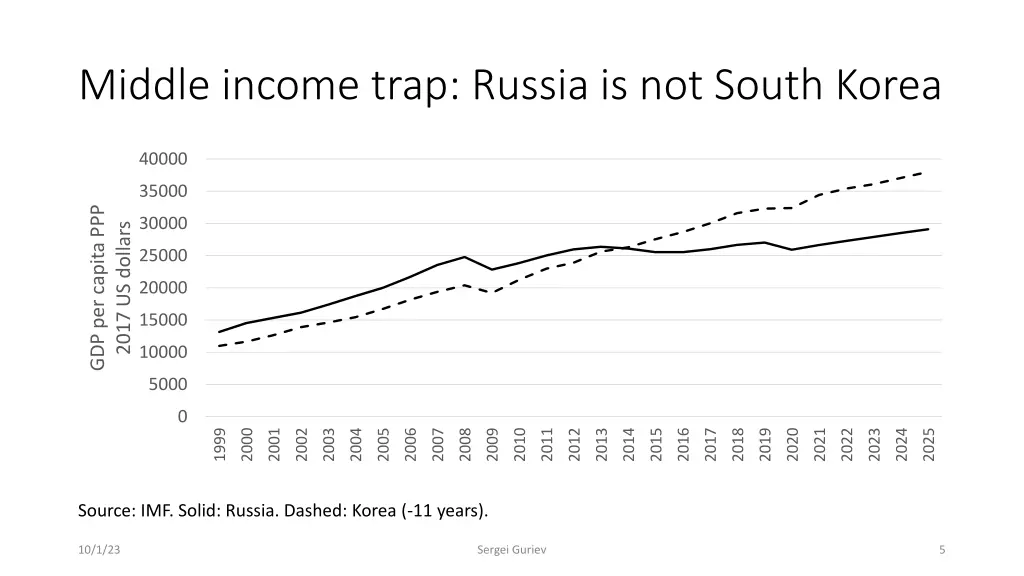
Middle income trap: Russia is not South Korea 40000 35000 GDP per capita PPP 30000 2017 US dollars 25000 20000 15000 10000 5000 0 2016 2018 1999 2000 2001 2002 2003 2004 2005 2006 2007 2008 2009 2010 2011 2012 2013 2014 2015 2017 2019 2020 2021 2022 2023 2024 2025 Source: IMF. Solid: Russia. Dashed: Korea (-11 years). 10/1/23 Sergei Guriev 5
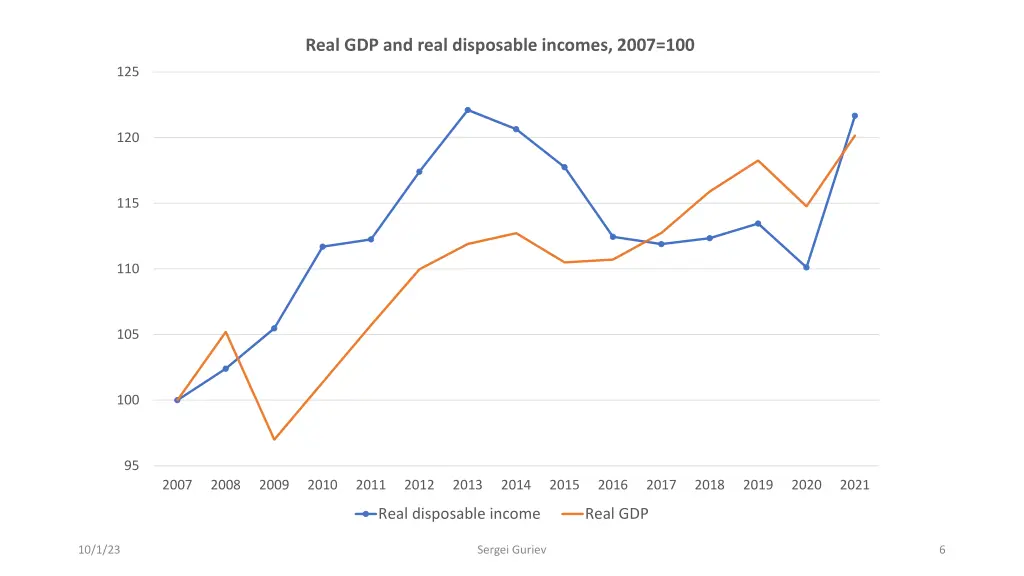
Real GDP and real disposable incomes, 2007=100 125 120 115 110 105 100 95 2007 2008 2009 2010 2011 2012 2013 2014 2015 2016 2017 2018 2019 2020 2021 Real disposable income Real GDP 10/1/23 Sergei Guriev 6
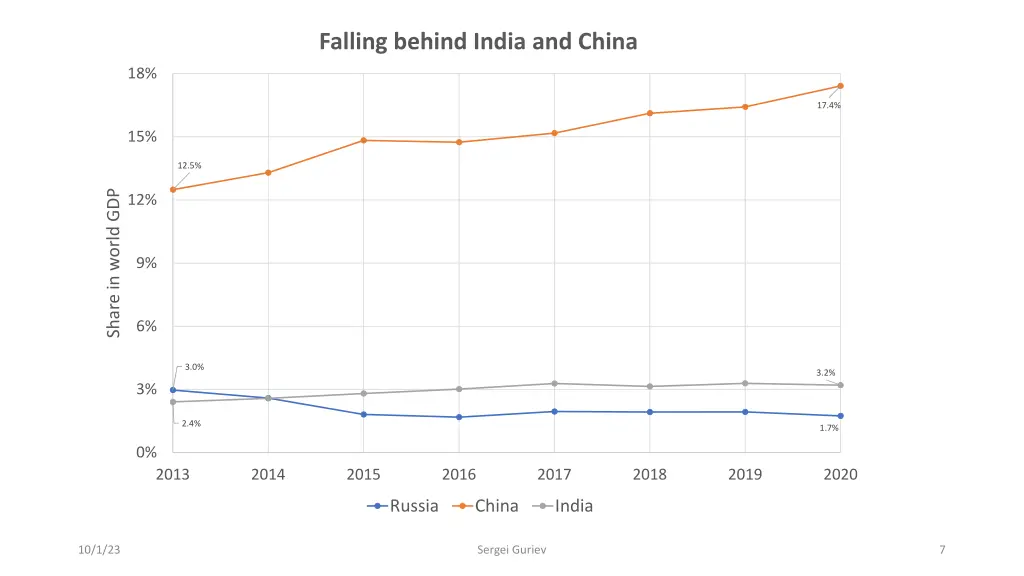
Falling behind India and China 18% 17.4% 15% 12.5% Share in world GDP 12% 9% 6% 3.0% 3.2% 3% 2.4% 1.7% 0% 2013 2014 2015 2016 2017 2018 2019 2020 Russia China India 10/1/23 Sergei Guriev 7
The only major economy with a balanced budget in 2022-24 Source: IMF Oct 2021 10/1/23 Sergei Guriev 8
Putins approval rating Approve Disapprove Crimea Raising retirement age Covid Source: Levada Center 10/1/23 Sergei Guriev 9
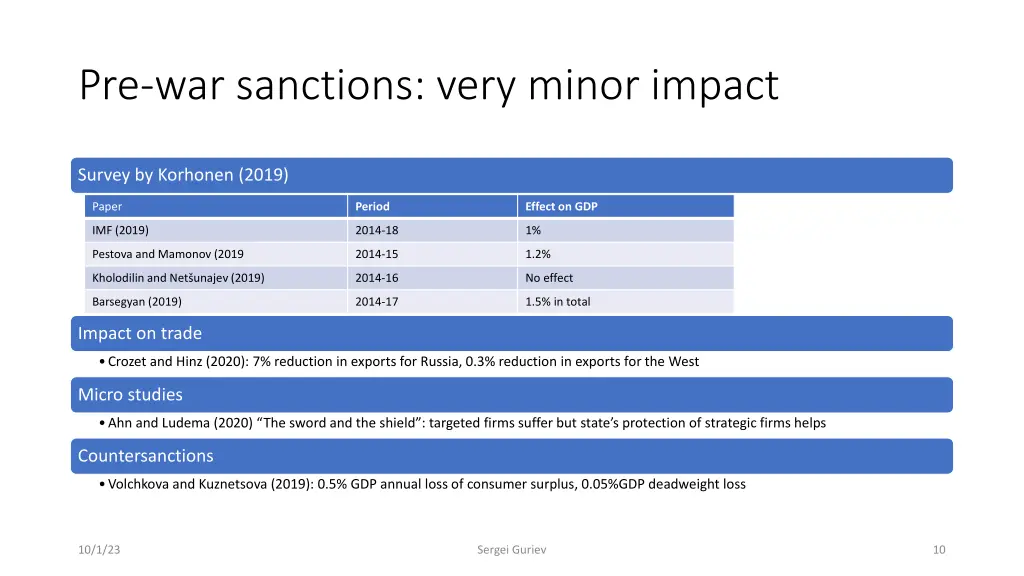
Pre-war sanctions: very minor impact Survey by Korhonen (2019) Paper Period Effect on GDP IMF (2019) 2014-18 1% Pestova and Mamonov (2019 2014-15 1.2% Kholodilin and Net unajev (2019) 2014-16 No effect Barsegyan (2019) 2014-17 1.5% in total Impact on trade Crozet and Hinz (2020): 7% reduction in exports for Russia, 0.3% reduction in exports for the West Micro studies Ahn and Ludema (2020) The sword and the shield : targeted firms suffer but state s protection of strategic firms helps Countersanctions Volchkova and Kuznetsova (2019): 0.5% GDP annual loss of consumer surplus, 0.05%GDP deadweight loss 10/1/23 Sergei Guriev 10
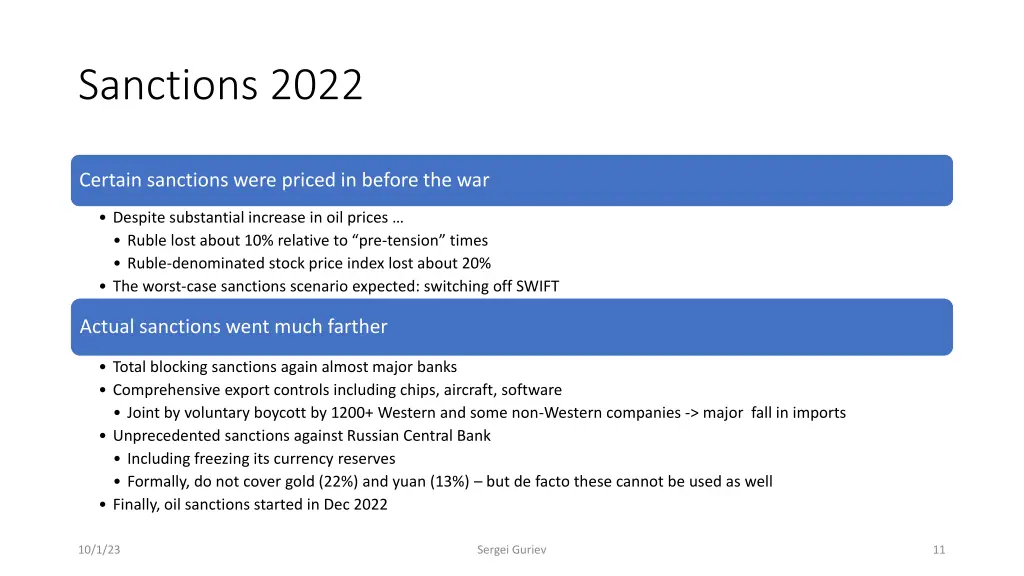
Sanctions 2022 Certain sanctions were priced in before the war Despite substantial increase in oil prices Ruble lost about 10% relative to pre-tension times Ruble-denominated stock price index lost about 20% The worst-case sanctions scenario expected: switching off SWIFT Actual sanctions went much farther Total blocking sanctions again almost major banks Comprehensive export controls including chips, aircraft, software Joint by voluntary boycott by 1200+ Western and some non-Western companies -> major fall in imports Unprecedented sanctions against Russian Central Bank Including freezing its currency reserves Formally, do not cover gold (22%) and yuan (13%) but de facto these cannot be used as well Finally, oil sanctions started in Dec 2022 10/1/23 Sergei Guriev 11
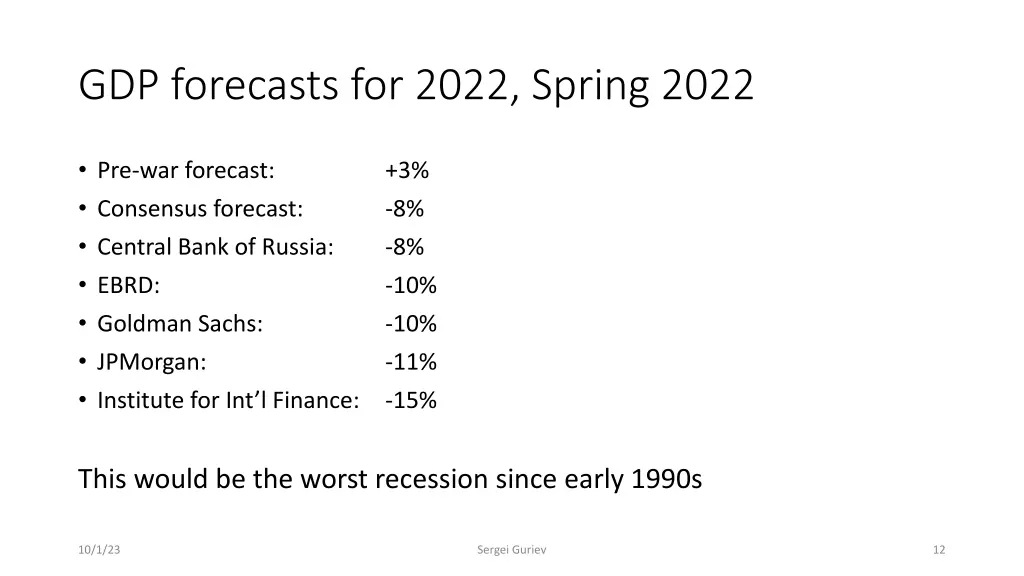
GDP forecasts for 2022, Spring 2022 Pre-war forecast: Consensus forecast: Central Bank of Russia: EBRD: Goldman Sachs: JPMorgan: Institute for Int l Finance: +3% -8% -8% -10% -10% -11% -15% This would be the worst recession since early 1990s 10/1/23 Sergei Guriev 12
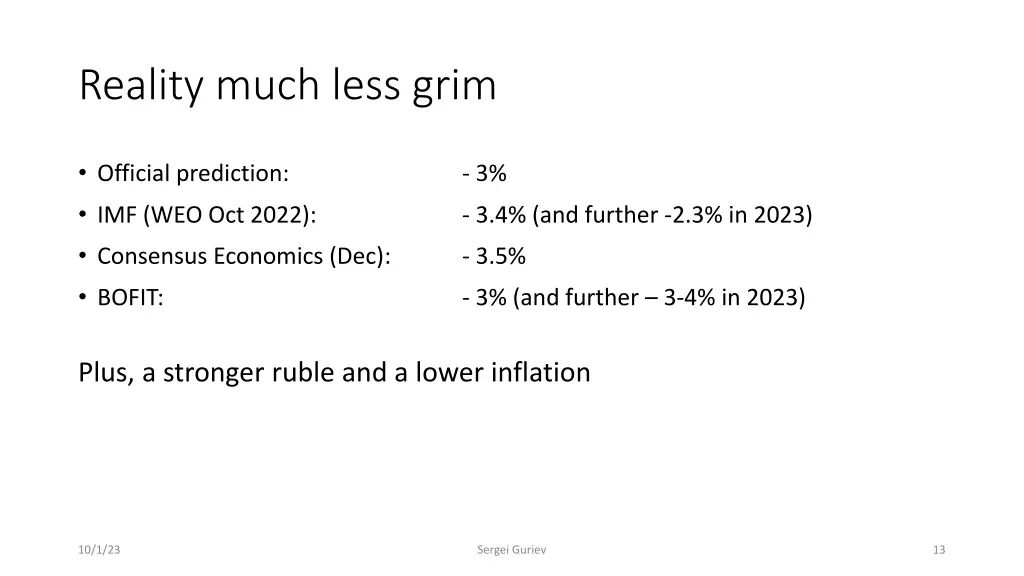
Reality much less grim Official prediction: IMF (WEO Oct 2022): Consensus Economics (Dec): BOFIT: - 3% - 3.4% (and further -2.3% in 2023) - 3.5% - 3% (and further 3-4% in 2023) Plus, a stronger ruble and a lower inflation 10/1/23 Sergei Guriev 13
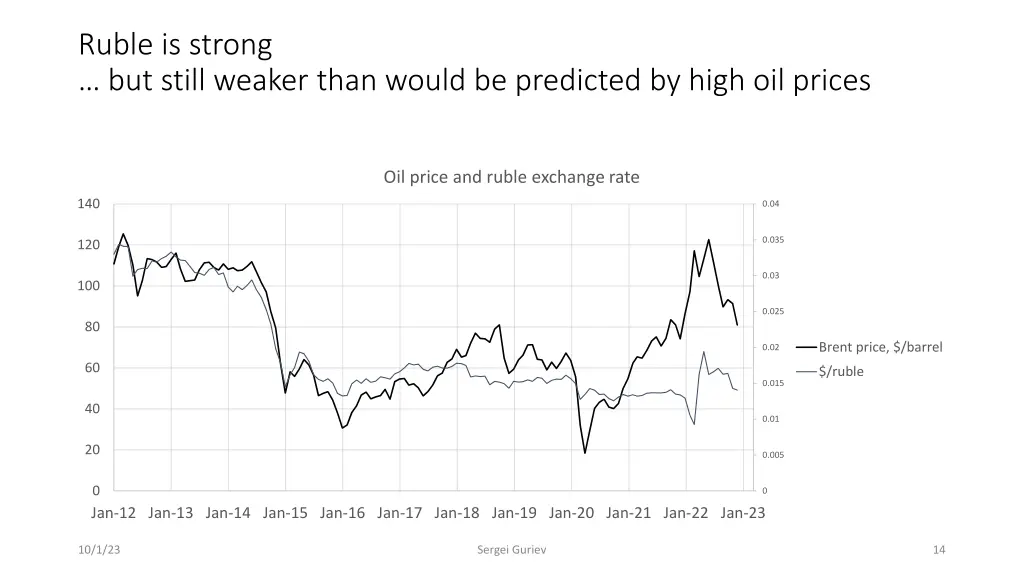
Ruble is strong but still weaker than would be predicted by high oil prices Oil price and ruble exchange rate 140 0.04 0.035 120 0.03 100 0.025 80 Brent price, $/barrel 0.02 60 $/ruble 0.015 40 0.01 20 0.005 0 Jan-12 Jan-13 Jan-14 Jan-15 Jan-16 Jan-17 Jan-18 Jan-19 Jan-20 Jan-21 Jan-22 Jan-23 0 10/1/23 Sergei Guriev 14
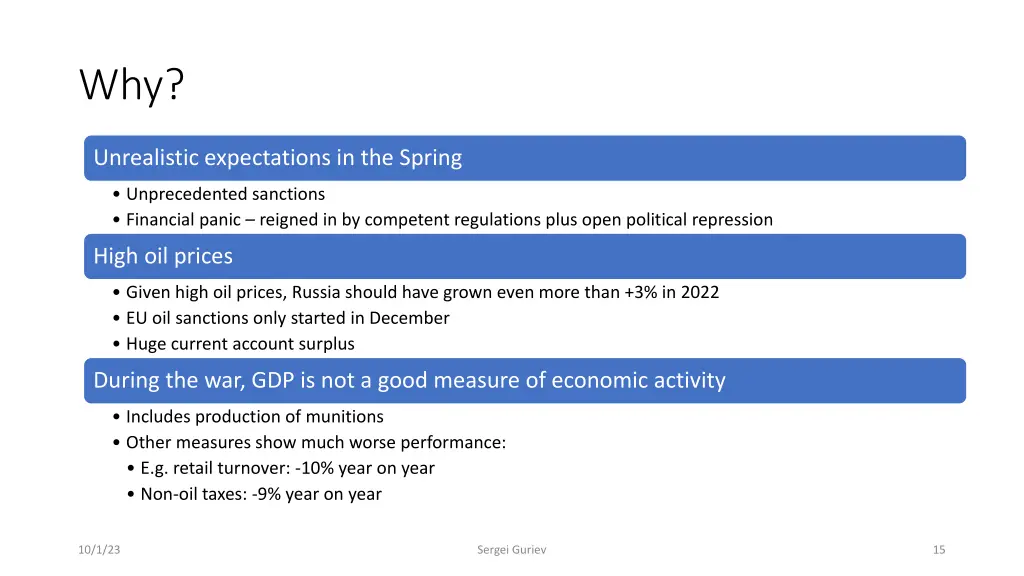
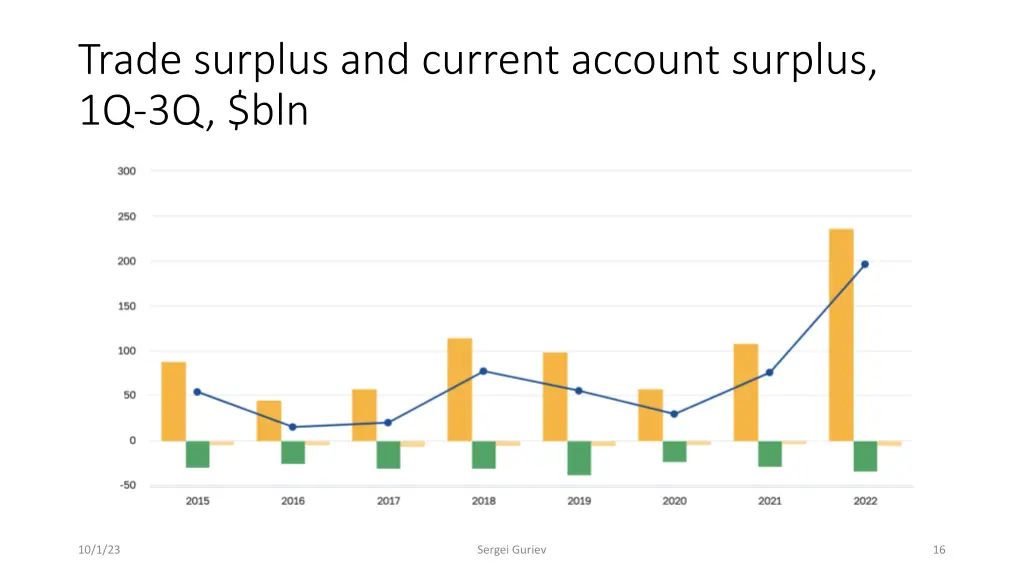
Why? Unrealistic expectations in the Spring Unprecedented sanctions Financial panic reigned in by competent regulations plus open political repression High oil prices Given high oil prices, Russia should have grown even more than +3% in 2022 EU oil sanctions only started in December Huge current account surplus During the war, GDP is not a good measure of economic activity Includes production of munitions Other measures show much worse performance: E.g. retail turnover: -10% year on year Non-oil taxes: -9% year on year 10/1/23 Sergei Guriev 15
Trade surplus and current account surplus, 1Q-3Q, $bln 10/1/23 Sergei Guriev 16
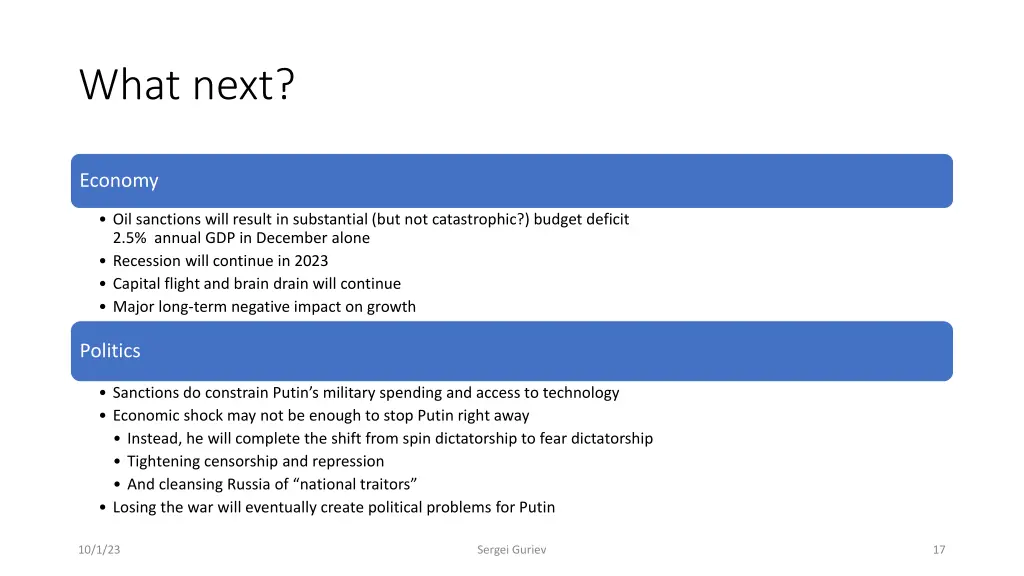
What next? Economy Oil sanctions will result in substantial (but not catastrophic?) budget deficit 2.5% annual GDP in December alone Recession will continue in 2023 Capital flight and brain drain will continue Major long-term negative impact on growth Politics Sanctions do constrain Putin s military spending and access to technology Economic shock may not be enough to stop Putin right away Instead, he will complete the shift from spin dictatorship to fear dictatorship Tightening censorship and repression And cleansing Russia of national traitors Losing the war will eventually create political problems for Putin 10/1/23 Sergei Guriev 17
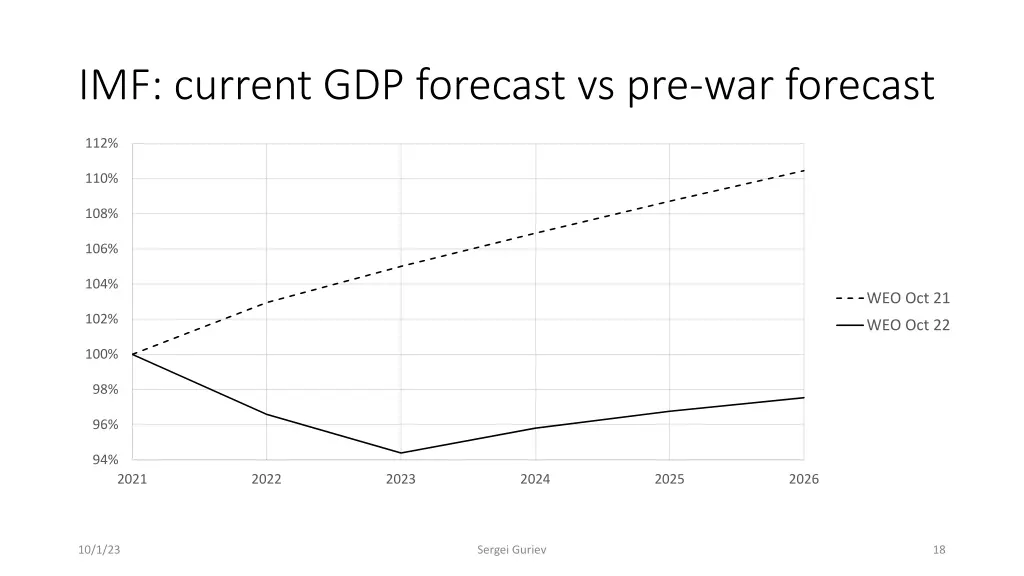
IMF: current GDP forecast vs pre-war forecast 112% 110% 108% 106% 104% WEO Oct 21 102% WEO Oct 22 100% 98% 96% 94% 2021 2022 2023 2024 2025 2026 10/1/23 Sergei Guriev 18
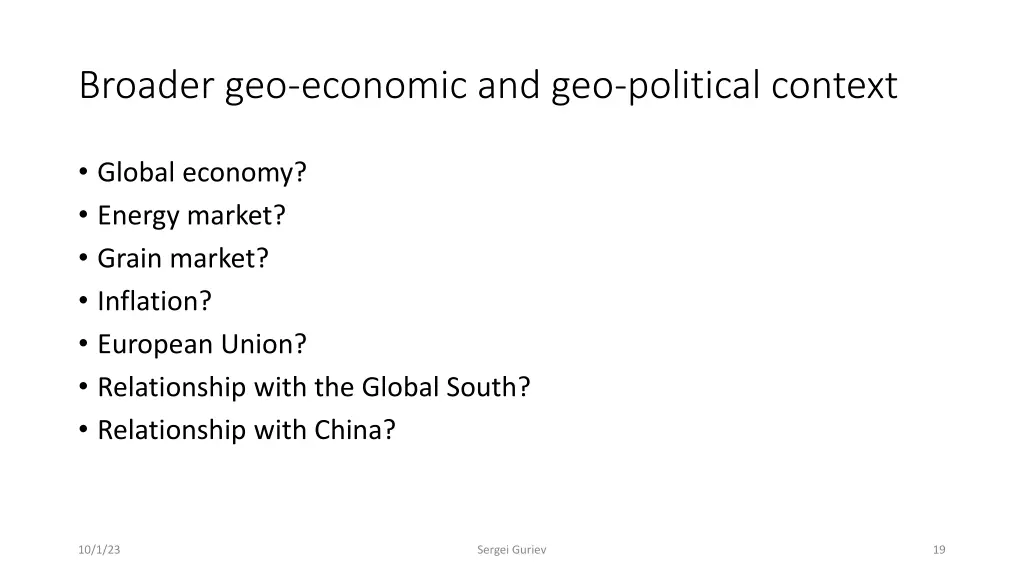
Broader geo-economic and geo-political context Global economy? Energy market? Grain market? Inflation? European Union? Relationship with the Global South? Relationship with China? 10/1/23 Sergei Guriev 19