Quality Assurance System and Development in Higher Education Programs
Learn about the implementation of quality assurance systems in higher education programs, including the role of EXOLAUNCH, quality indicators, and the Bologna Process. Explore steps to establish internal quality assurance systems and develop quality indicators for assessing program outcomes.

Download Presentation

Please find below an Image/Link to download the presentation.
The content on the website is provided AS IS for your information and personal use only. It may not be sold, licensed, or shared on other websites without obtaining consent from the author. If you encounter any issues during the download, it is possible that the publisher has removed the file from their server.
You are allowed to download the files provided on this website for personal or commercial use, subject to the condition that they are used lawfully. All files are the property of their respective owners.
The content on the website is provided AS IS for your information and personal use only. It may not be sold, licensed, or shared on other websites without obtaining consent from the author.
E N D
Presentation Transcript
Kick-Off Meeting Tashkent 3-5 March 2020 New study program in space systems and communications engineering SPACECOM Role of EXOLAUNCH in the project Role of EXOLAUNCH in the project (Quality Assurance System and other tasks) (Quality Assurance System and other tasks) Joint Project: Capacity Building in the Field of Higher Education ERASMUS+ 2018
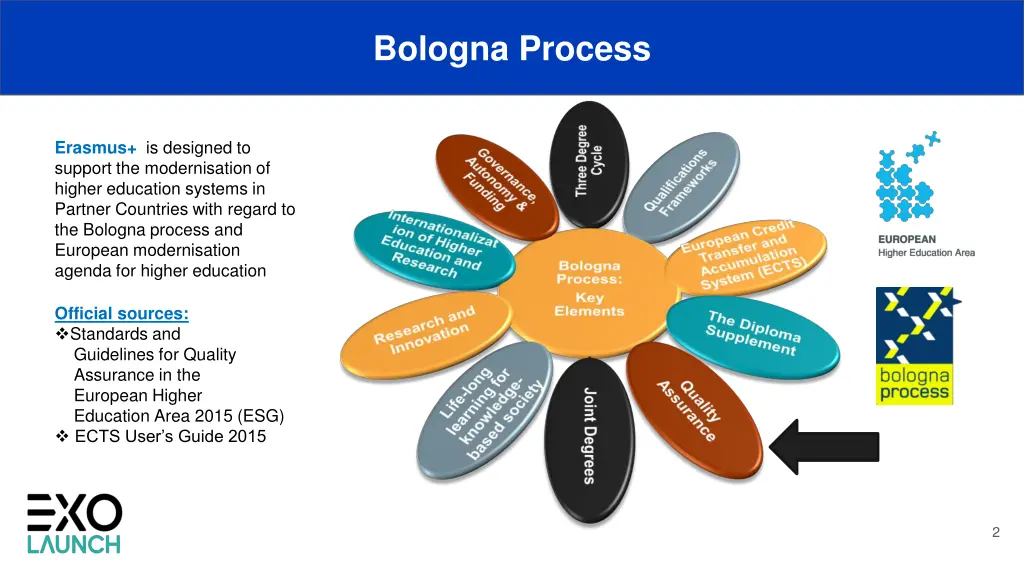
Bologna Process Erasmus+ is designed to support the modernisation of higher education systems in Partner Countries with regard to the Bologna process and European modernisation agenda for higher education Official sources: Standards and Guidelines for Quality Assurance in the European Higher Education Area 2015 (ESG) ECTS User s Guide 2015 2
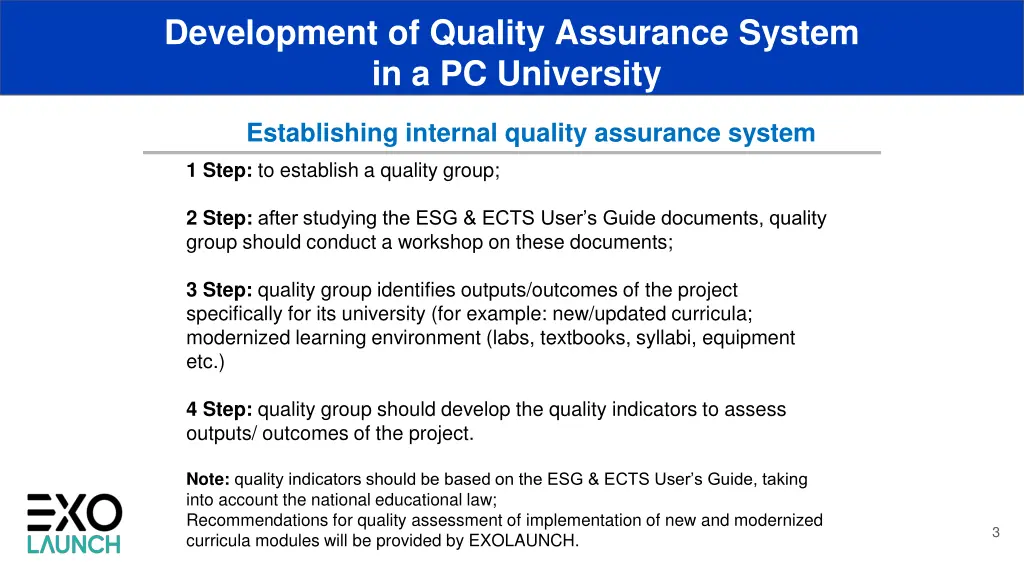
Development of Quality Assurance System in a PC University Establishing internal quality assurance system 1 Step: to establish a quality group; 2 Step: after studying the ESG & ECTS User s Guide documents, quality group should conduct a workshop on these documents; 3 Step: quality group identifies outputs/outcomes of the project specifically for its university (for example: new/updated curricula; modernized learning environment (labs, textbooks, syllabi, equipment etc.) 4 Step: quality group should develop the quality indicators to assess outputs/ outcomes of the project. Note: quality indicators should be based on the ESG & ECTS User s Guide, taking into account the national educational law; Recommendations for quality assessment of implementation of new and modernized curricula modules will be provided by EXOLAUNCH. 3
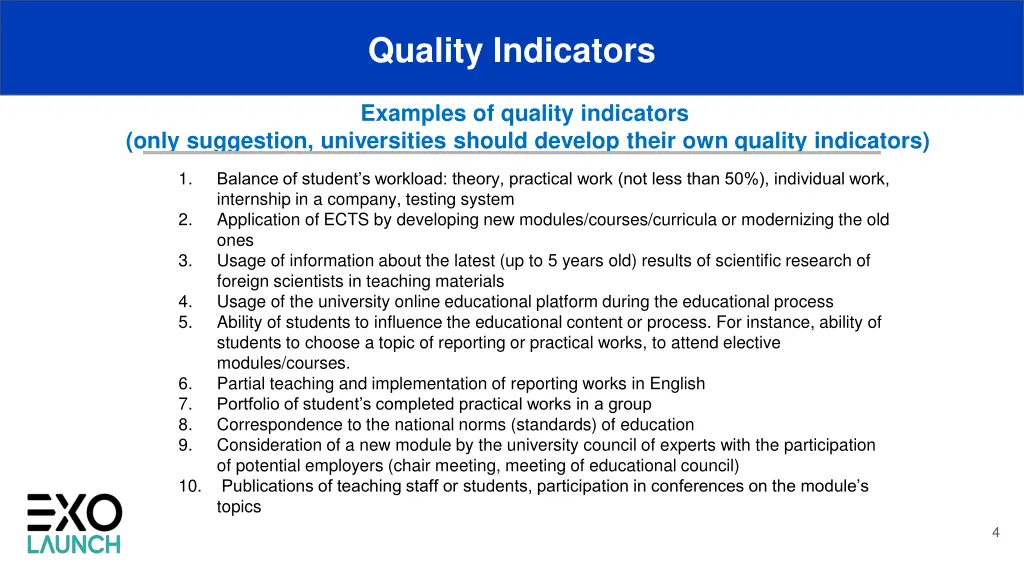
Quality Indicators Examples of quality indicators (only suggestion, universities should develop their own quality indicators) 1. Balance of student s workload: theory, practical work (not less than 50%), individual work, internship in a company, testing system Application of ECTS by developing new modules/courses/curricula or modernizing the old ones Usage of information about the latest (up to 5 years old) results of scientific research of foreign scientists in teaching materials Usage of the university online educational platform during the educational process Ability of students to influence the educational content or process. For instance, ability of students to choose a topic of reporting or practical works, to attend elective modules/courses. Partial teaching and implementation of reporting works in English Portfolio of student s completed practical works in a group Correspondence to the national norms (standards) of education Consideration of a new module by the university council of experts with the participation of potential employers (chair meeting, meeting of educational council) Publications of teaching staff or students, participation in conferences on the module s topics 2. 3. 4. 5. 6. 7. 8. 9. 10. 4
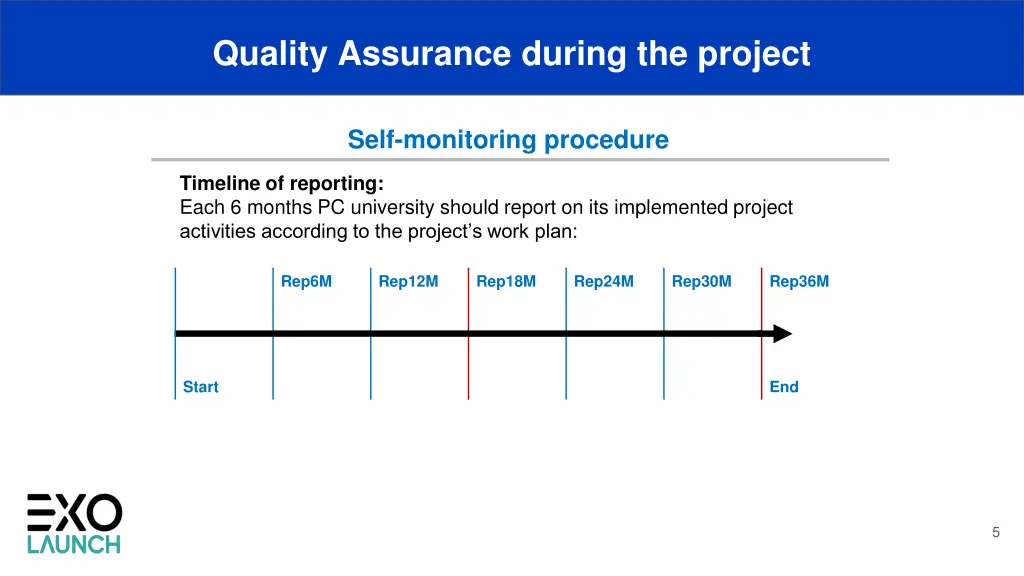
Quality Assurance during the project Self-monitoring procedure Timeline of reporting: Each 6 months PC university should report on its implemented project activities according to the project s work plan: Rep6M Rep12M Rep18M Rep24M Rep30M Rep36M Start End 5
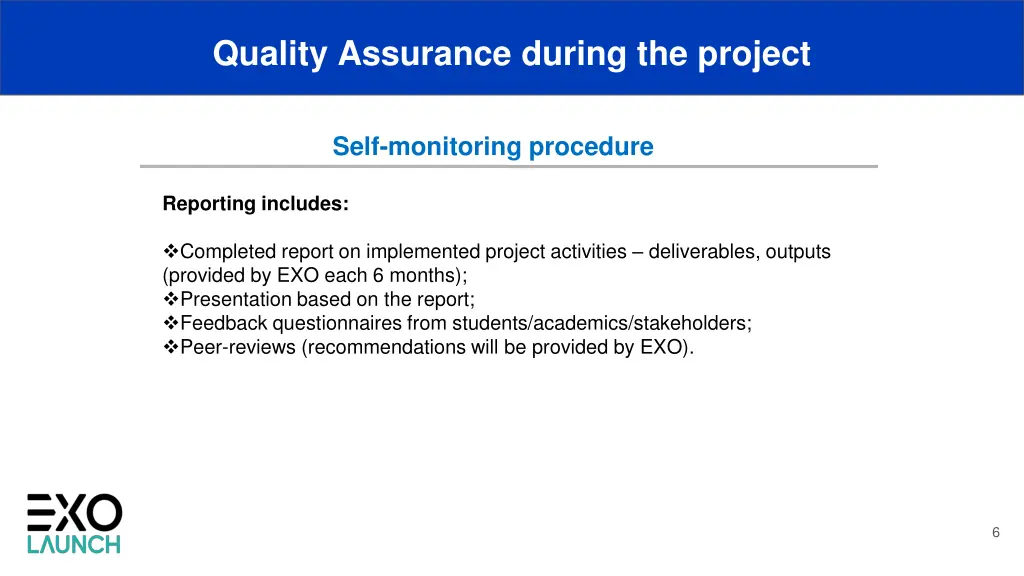
Quality Assurance during the project Self-monitoring procedure Reporting includes: Completed report on implemented project activities deliverables, outputs (provided by EXO each 6 months); Presentation based on the report; Feedback questionnaires from students/academics/stakeholders; Peer-reviews (recommendations will be provided by EXO). 6
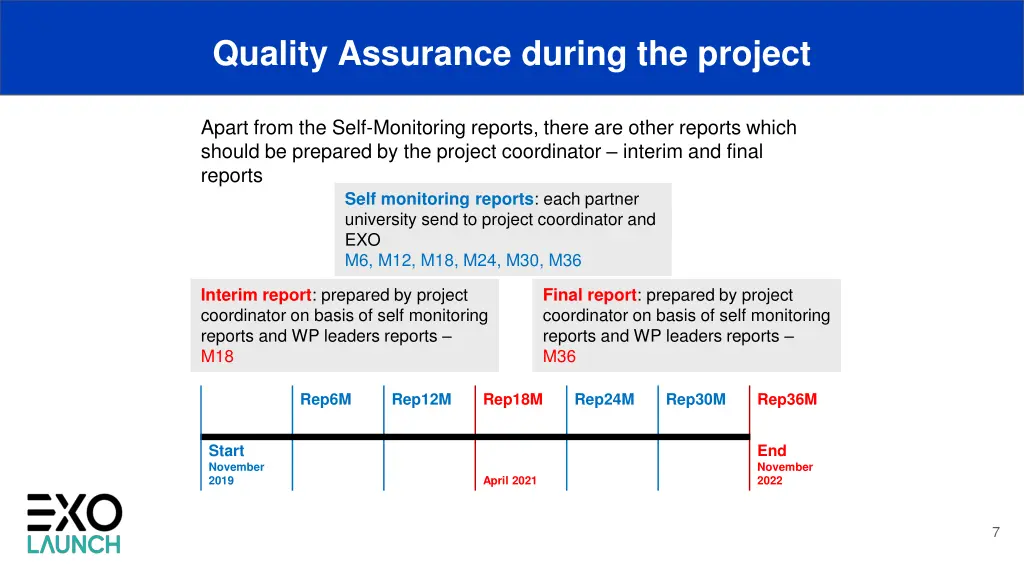
Quality Assurance during the project Apart from the Self-Monitoring reports, there are other reports which should be prepared by the project coordinator interim and final reports Self monitoring reports: each partner university send to project coordinator and EXO M6, M12, M18, M24, M30, M36 Interim report: prepared by project coordinator on basis of self monitoring reports and WP leaders reports M18 Final report: prepared by project coordinator on basis of self monitoring reports and WP leaders reports M36 Rep6M Rep12M Rep18M Rep24M Rep30M Rep36M Start November 2019 End November 2022 April 2021 7
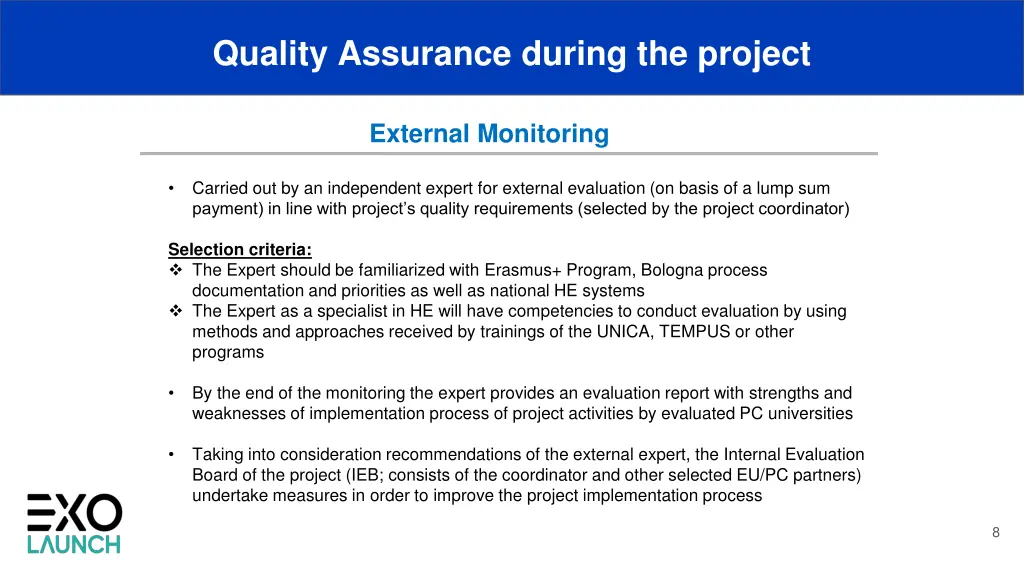
Quality Assurance during the project External Monitoring Carried out by an independent expert for external evaluation (on basis of a lump sum payment) in line with project s quality requirements (selected by the project coordinator) Selection criteria: The Expert should be familiarized with Erasmus+ Program, Bologna process documentation and priorities as well as national HE systems The Expert as a specialist in HE will have competencies to conduct evaluation by using methods and approaches received by trainings of the UNICA, TEMPUS or other programs By the end of the monitoring the expert provides an evaluation report with strengths and weaknesses of implementation process of project activities by evaluated PC universities Taking into consideration recommendations of the external expert, the Internal Evaluation Board of the project (IEB; consists of the coordinator and other selected EU/PC partners) undertake measures in order to improve the project implementation process 8
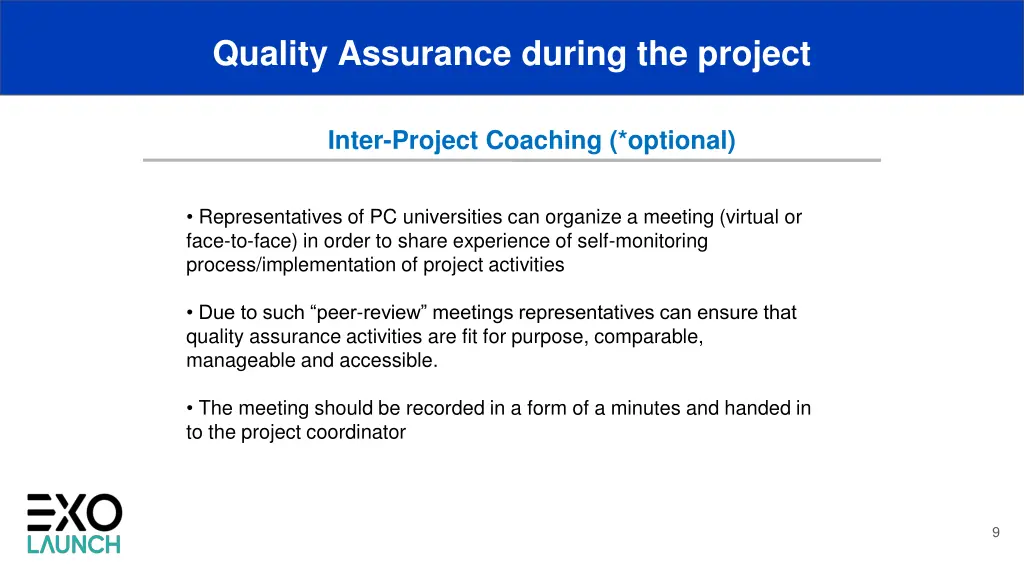
Quality Assurance during the project Inter-Project Coaching (*optional) Representatives of PC universities can organize a meeting (virtual or face-to-face) in order to share experience of self-monitoring process/implementation of project activities Due to such peer-review meetings representatives can ensure that quality assurance activities are fit for purpose, comparable, manageable and accessible. The meeting should be recorded in a form of a minutes and handed in to the project coordinator 9
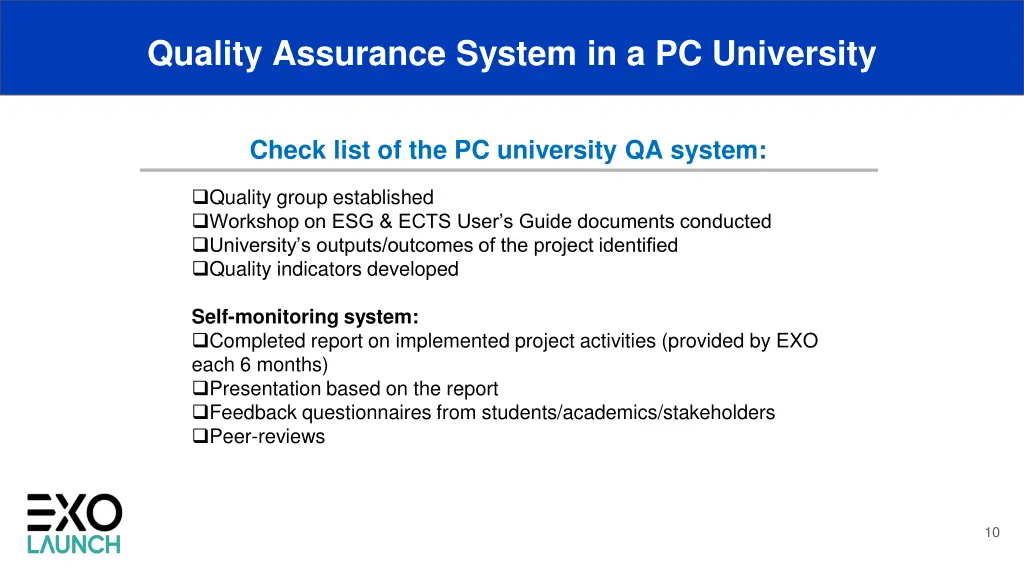
Quality Assurance System in a PC University Check list of the PC university QA system: Quality group established Workshop on ESG & ECTS User s Guide documents conducted University s outputs/outcomes of the project identified Quality indicators developed Self-monitoring system: Completed report on implemented project activities (provided by EXO each 6 months) Presentation based on the report Feedback questionnaires from students/academics/stakeholders Peer-reviews 10
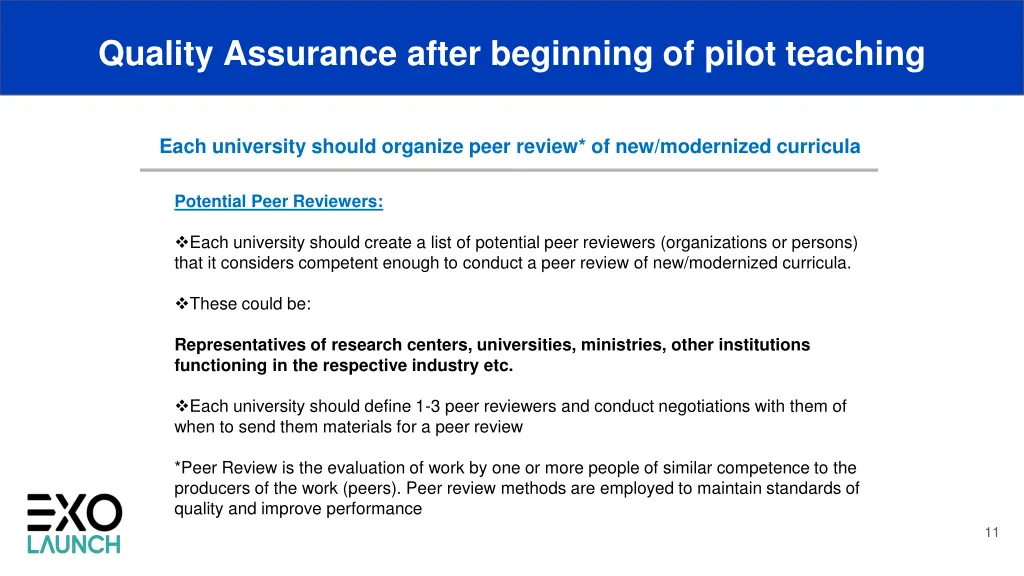
Quality Assurance after beginning of pilot teaching Each university should organize peer review* of new/modernized curricula Potential Peer Reviewers: Each university should create a list of potential peer reviewers (organizations or persons) that it considers competent enough to conduct a peer review of new/modernized curricula. These could be: Representatives of research centers, universities, ministries, other institutions functioning in the respective industry etc. Each university should define 1-3 peer reviewers and conduct negotiations with them of when to send them materials for a peer review *Peer Review is the evaluation of work by one or more people of similar competence to the producers of the work (peers). Peer review methods are employed to maintain standards of quality and improve performance 11
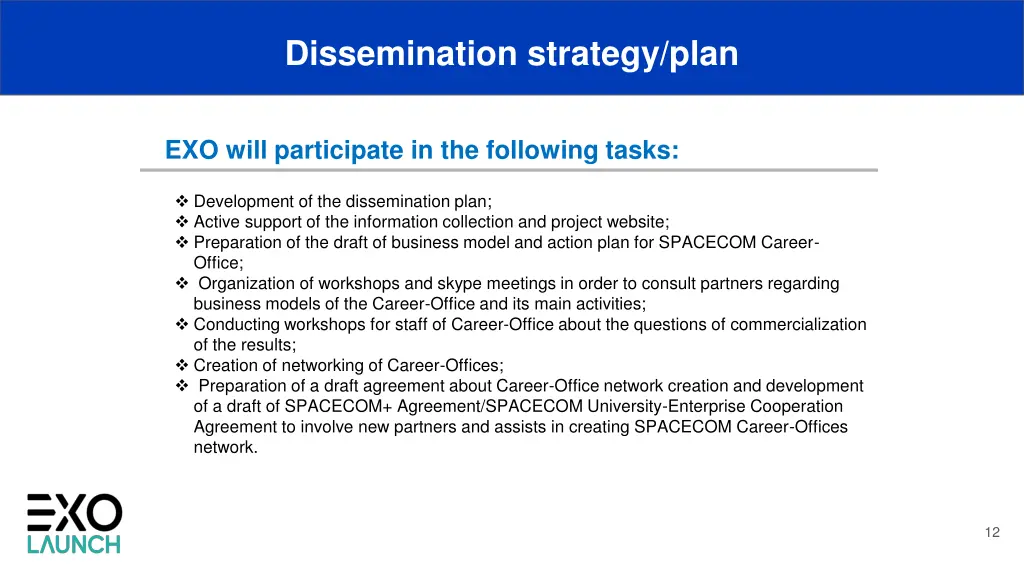
Dissemination strategy/plan EXO will participate in the following tasks: Development of the dissemination plan; Active support of the information collection and project website; Preparation of the draft of business model and action plan for SPACECOM Career- Office; Organization of workshops and skype meetings in order to consult partners regarding business models of the Career-Office and its main activities; Conducting workshops for staff of Career-Office about the questions of commercialization of the results; Creation of networking of Career-Offices; Preparation of a draft agreement about Career-Office network creation and development of a draft of SPACECOM+ Agreement/SPACECOM University-Enterprise Cooperation Agreement to involve new partners and assists in creating SPACECOM Career-Offices network. 12
Thank you for your attention! INSERT COUNTRY FLAG Thank you for your attention! Contacts: Dr. Arnold Sterenharz arnold.st@ecm-academy.de Svetlana Jasic svetlana.jasic@ecm-academy.de INSERT PRESENTER S TITLE/NAME/SURNAME 13