RAD and EPC Intersection for Energy Efficiency
"Explore how the RAD program and Energy Performance Contracts intersect to improve energy efficiency in public housing. Learn about benefits, considerations, and strategies for PHAs to optimize their resources smartly."

Download Presentation

Please find below an Image/Link to download the presentation.
The content on the website is provided AS IS for your information and personal use only. It may not be sold, licensed, or shared on other websites without obtaining consent from the author.If you encounter any issues during the download, it is possible that the publisher has removed the file from their server.
You are allowed to download the files provided on this website for personal or commercial use, subject to the condition that they are used lawfully. All files are the property of their respective owners.
The content on the website is provided AS IS for your information and personal use only. It may not be sold, licensed, or shared on other websites without obtaining consent from the author.
E N D
Presentation Transcript
Welcome to the Webinar on Welcome to the Webinar on How How green greencan RAD be? can RAD be? Friday, February 19, 2016 1:30 2:45pm EST For Audio please call: (866) 740-1260 Participant code: 4559813 Support for this training provided by Capital One Foundation.
Intersection Intersection of RAD and EPC of RAD and EPC UNDERSTANDING YOUR PHA S UNDERSTANDING YOUR PHA S OPTIONS OPTIONS
Todays Presenters Jaime Bordenave, President Dick Santangelo, President Kathleen Foster The Communities Group Apollo Engineering Solutions, LLC The RAD Collaborative Office: 202-667-3002 Office: 703-627-7161 Office: 704-607-6024 www.tcgdevelopment.com www.ApolloEngineeringSolutions.com www.clpha.org/articledetail/?aid=704 4
Todays Agenda What We ll Cover Today oRAD 101 oEPC 101 oEPC 201: understanding your options oCan EPCs and RAD work together? oWhen to use EPCs and RAD-- alone or together? oSpoiler alert: there s no magic bullet. 4
Todays Objectives To demonstrate that: oEPCs provide benefits to PHA, albeit with specific requirements oRAD also provides immediate benefits, including converting utility allowance dollars into contract rent dollars oAlthough beneficial, EPCs impact RAD conversion plans oIdentify which factors PHA s should focus on when recapitalizing oIn some situations where RAD transition is not immediately contemplated and energy related capital needs exist, EPCs can reduce utility costs and improve operating costs ratio 5
What is RAD? Demonstration program closings as of Jan 2015: 27k+ units in 258 developments Transforms public housing (ACC) asset into multi-family (Section-8) asset PHA chooses PBV or PBRA Preservation and long-term affordability 7
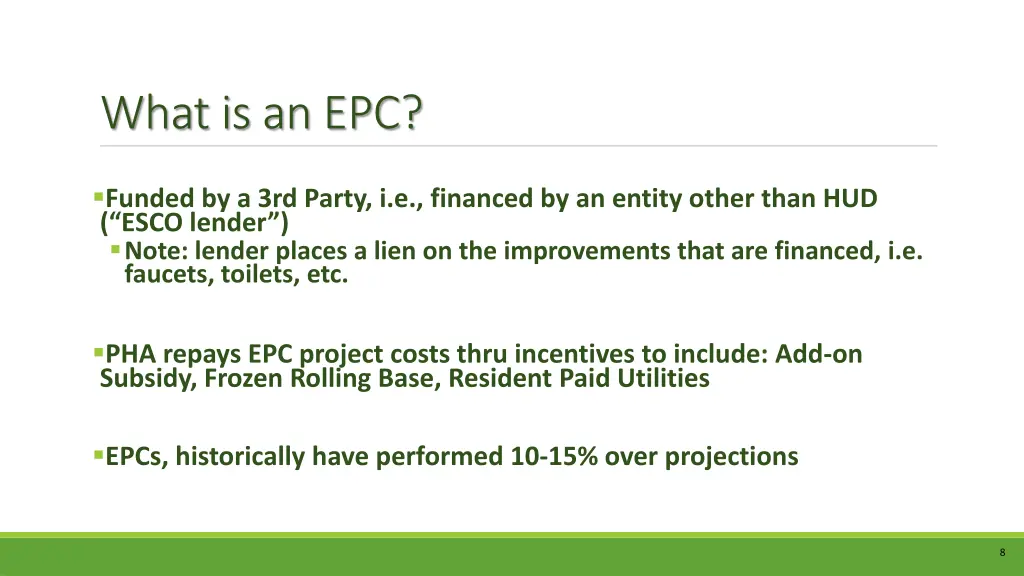
What is an EPC? Funded by a 3rd Party, i.e., financed by an entity other than HUD ( ESCO lender ) Note: lender places a lien on the improvements that are financed, i.e. faucets, toilets, etc. PHA repays EPC project costs thru incentives to include: Add-on Subsidy, Frozen Rolling Base, Resident Paid Utilities EPCs, historically have performed 10-15% over projections 8
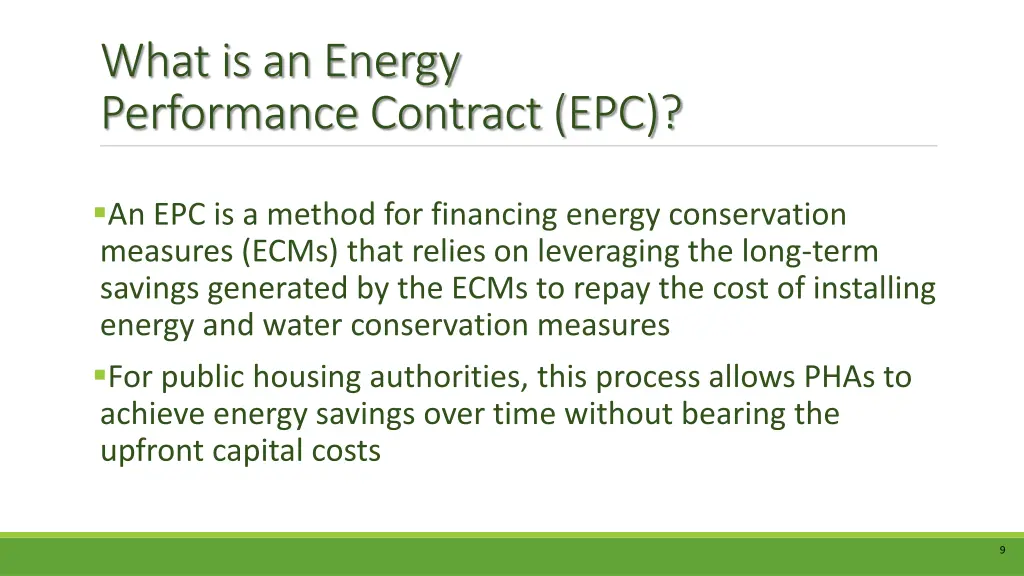
What is an Energy Performance Contract (EPC)? An EPC is a method for financing energy conservation measures (ECMs) that relies on leveraging the long-term savings generated by the ECMs to repay the cost of installing energy and water conservation measures For public housing authorities, this process allows PHAs to achieve energy savings over time without bearing the upfront capital costs 9
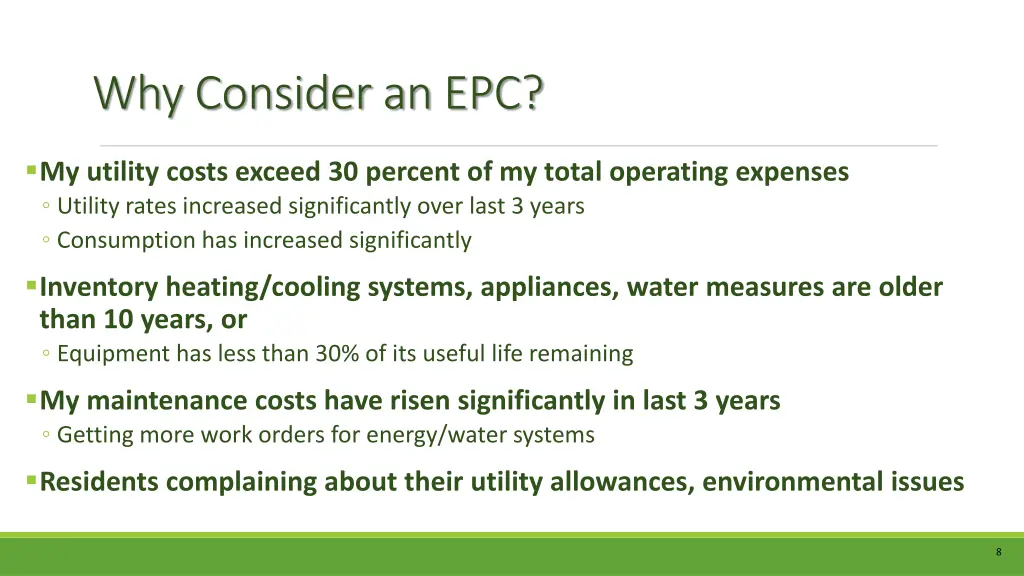
Why Consider an EPC? My utility costs exceed 30 percent of my total operating expenses Utility rates increased significantly over last 3 years Consumption has increased significantly Inventory heating/cooling systems, appliances, water measures are older than 10 years, or Equipment has less than 30% of its useful life remaining My maintenance costs have risen significantly in last 3 years Getting more work orders for energy/water systems Residents complaining about their utility allowances, environmental issues 8
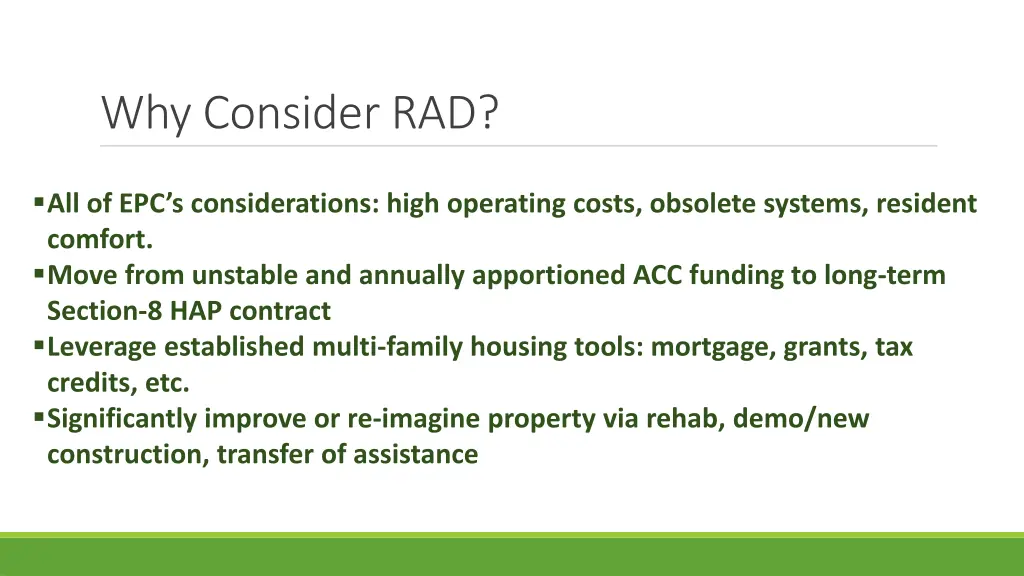
Why Consider RAD? All of EPC s considerations: high operating costs, obsolete systems, resident comfort. Move from unstable and annually apportioned ACC funding to long-term Section-8 HAP contract Leverage established multi-family housing tools: mortgage, grants, tax credits, etc. Significantly improve or re-imagine property via rehab, demo/new construction, transfer of assistance
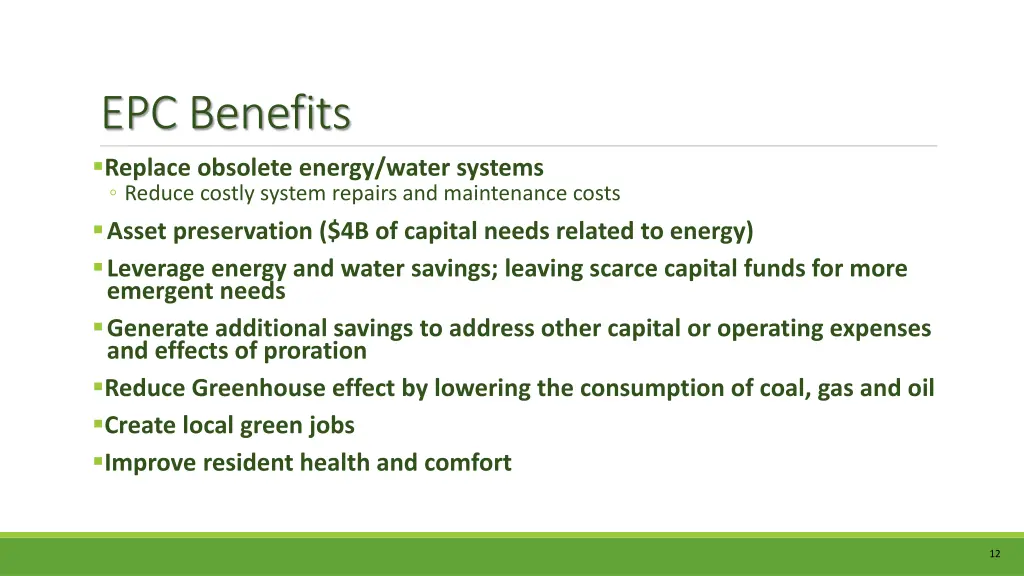
EPC Benefits Replace obsolete energy/water systems Reduce costly system repairs and maintenance costs Asset preservation ($4B of capital needs related to energy) Leverage energy and water savings; leaving scarce capital funds for more emergent needs Generate additional savings to address other capital or operating expenses and effects of proration Reduce Greenhouse effect by lowering the consumption of coal, gas and oil Create local green jobs Improve resident health and comfort 12
RAD Benefits Replace obsolete systems Reduce costly repairs and maintenance costs Asset preservation ($26B of capital needs) Leverage private dollars $1 public funds = $19 of private funds1 Provide long-term rental income stability through Section-8 Realign assets (AMPs) into logical groupings Opportunity to reconsider your authority s mission and strategy 1 ECONOMETRICA, INC. "STATUS OF HUD'S RENTAL ASSISTANCE DEMONSTRATION (RAD) EVALUATIION AND RESULTS TO DATE", SEPT. 30, 2014.
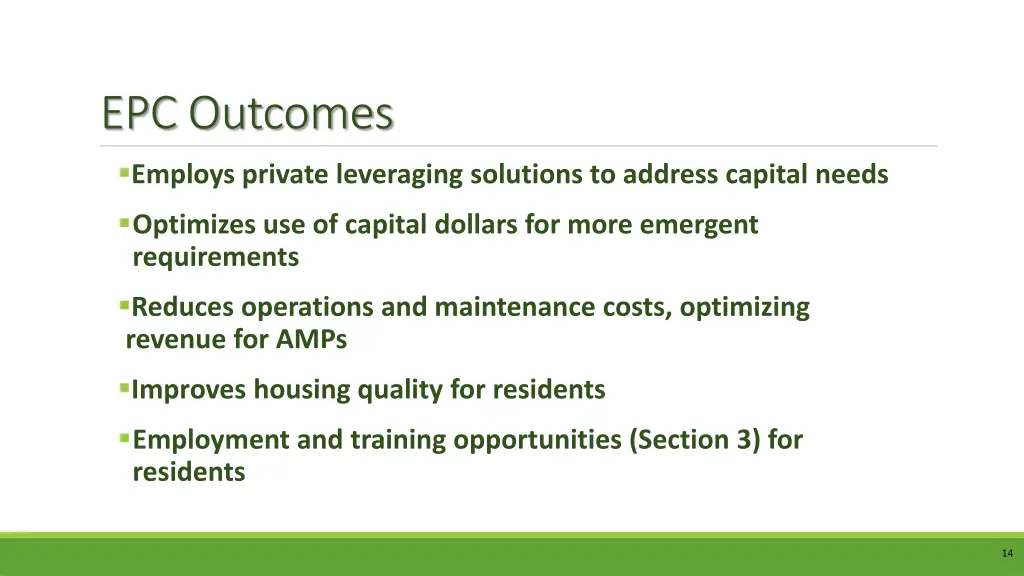
EPC Outcomes Employs private leveraging solutions to address capital needs Optimizes use of capital dollars for more emergent requirements Reduces operations and maintenance costs, optimizing revenue for AMPs Improves housing quality for residents Employment and training opportunities (Section 3) for residents 14
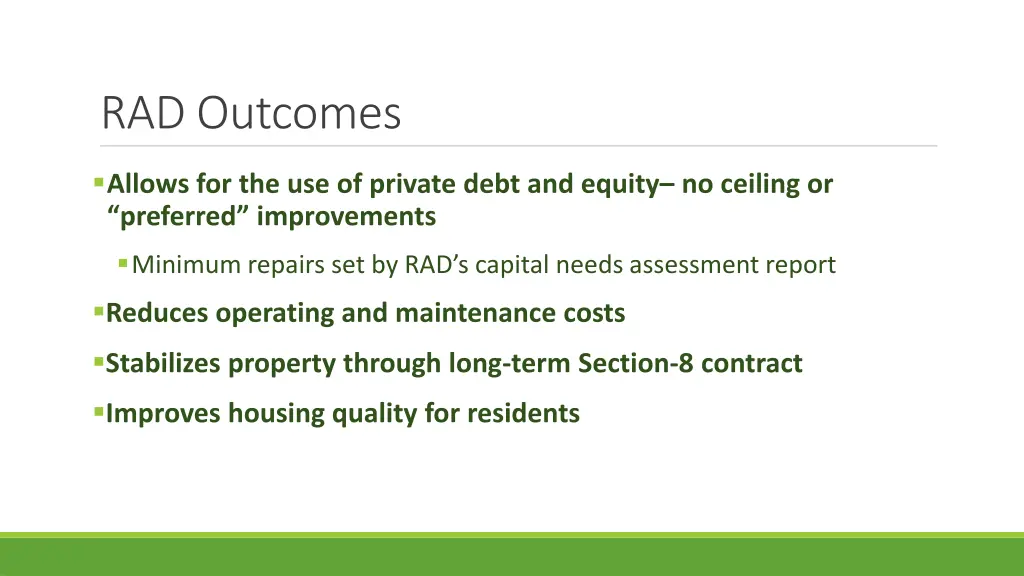
RAD Outcomes Allows for the use of private debt and equity no ceiling or preferred improvements Minimum repairs set by RAD s capital needs assessment report Reduces operating and maintenance costs Stabilizes property through long-term Section-8 contract Improves housing quality for residents
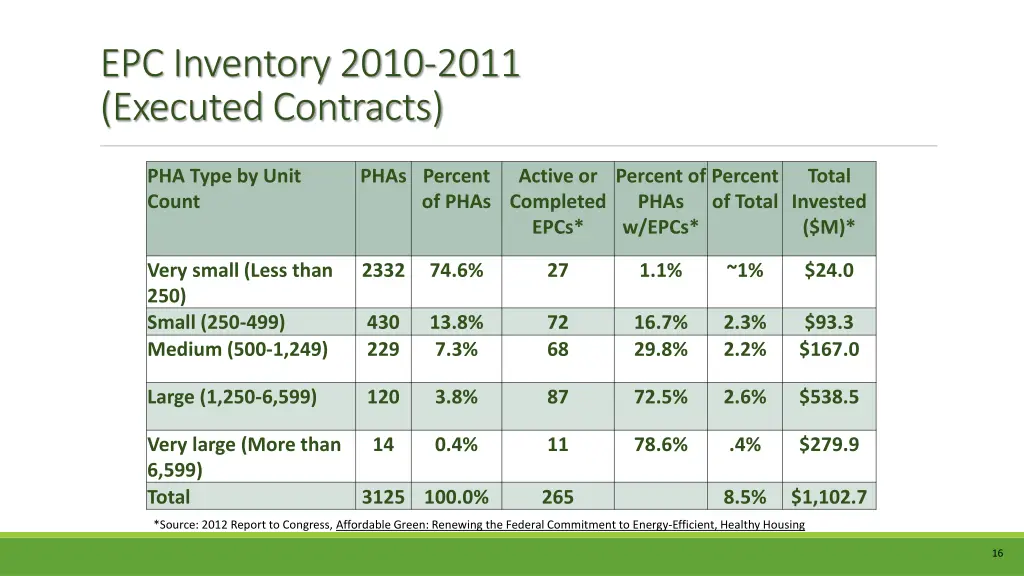
EPC Inventory 2010-2011 (Executed Contracts) PHA Type by Unit Count PHAs Percent of PHAs Active or Completed EPCs* Percent of PHAs w/EPCs* Percent of Total Total Invested ($M)* Very small (Less than 250) Small (250-499) Medium (500-1,249) 2332 74.6% 27 1.1% ~1% $24.0 430 229 13.8% 7.3% 72 68 16.7% 29.8% 2.3% 2.2% $93.3 $167.0 Large (1,250-6,599) 120 3.8% 87 72.5% 2.6% $538.5 Very large (More than 6,599) Total 14 0.4% 11 78.6% .4% $279.9 3125 100.0% 265 8.5% $1,102.7 *Source: 2012 Report to Congress, Affordable Green: Renewing the Federal Commitment to Energy-Efficient, Healthy Housing 16
HUDs Energy HUD s Energy Incentives Incentives 12
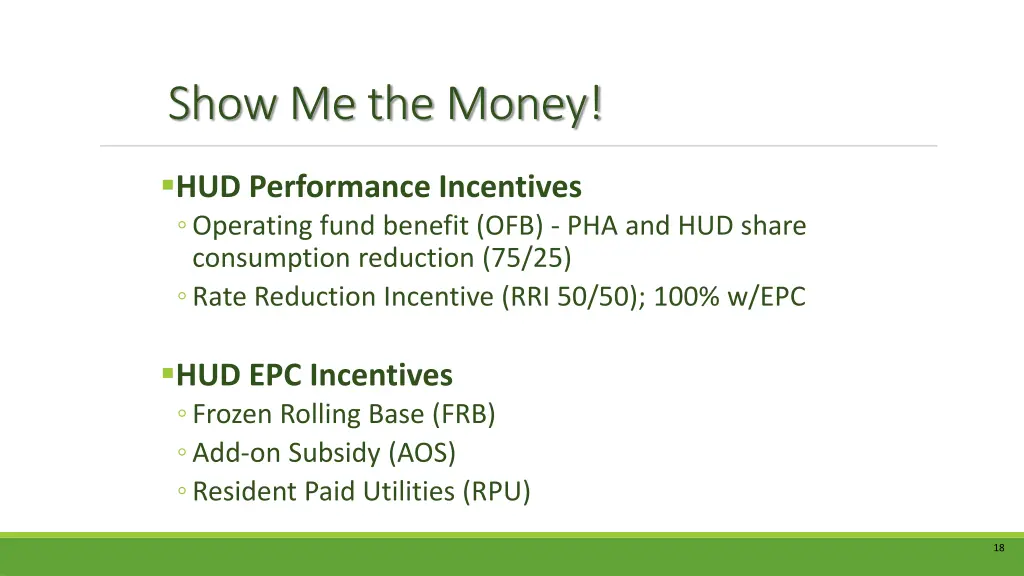
Show Me the Money! HUD Performance Incentives Operating fund benefit (OFB) - PHA and HUD share consumption reduction (75/25) Rate Reduction Incentive (RRI 50/50); 100% w/EPC HUD EPC Incentives Frozen Rolling Base (FRB) Add-on Subsidy (AOS) Resident Paid Utilities (RPU) 18
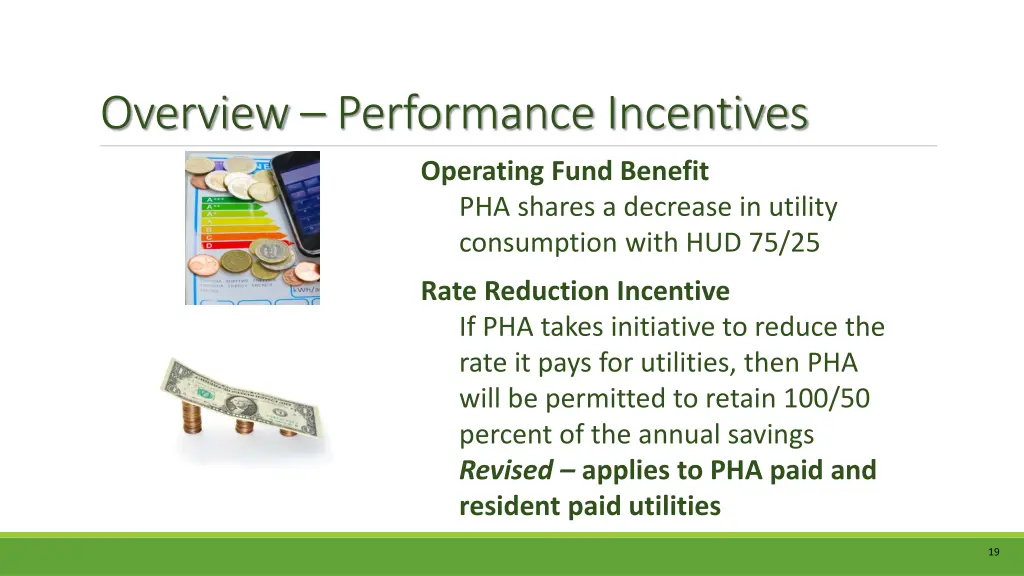
Overview Performance Incentives Operating Fund Benefit PHA shares a decrease in utility consumption with HUD 75/25 Rate Reduction Incentive If PHA takes initiative to reduce the rate it pays for utilities, then PHA will be permitted to retain 100/50 percent of the annual savings Revised applies to PHA paid and resident paid utilities 19
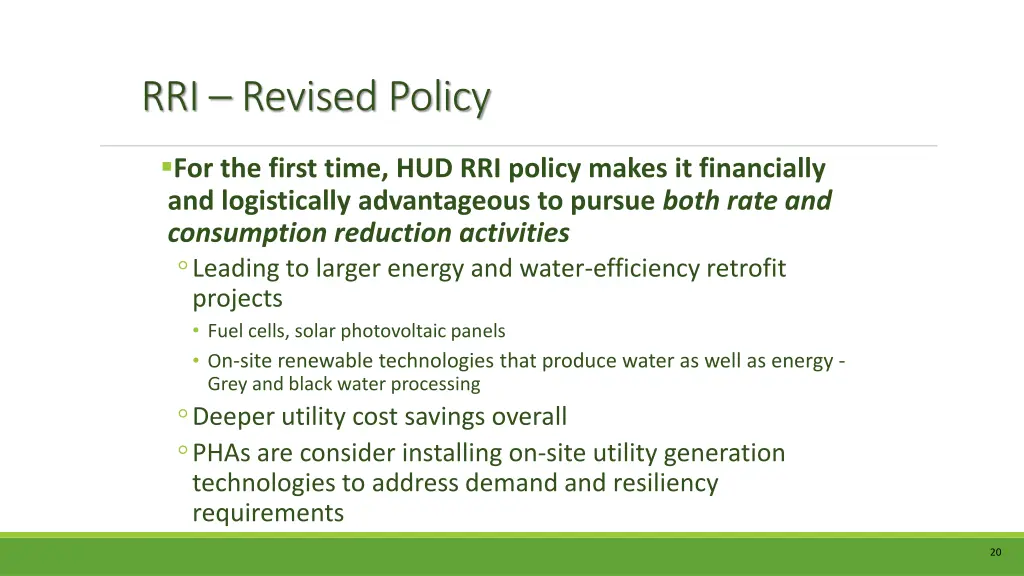
RRI Revised Policy For the first time, HUD RRI policy makes it financially and logistically advantageous to pursue both rate and consumption reduction activities Leading to larger energy and water-efficiency retrofit projects Fuel cells, solar photovoltaic panels On-site renewable technologies that produce water as well as energy - Grey and black water processing Deeper utility cost savings overall PHAs are consider installing on-site utility generation technologies to address demand and resiliency requirements 20
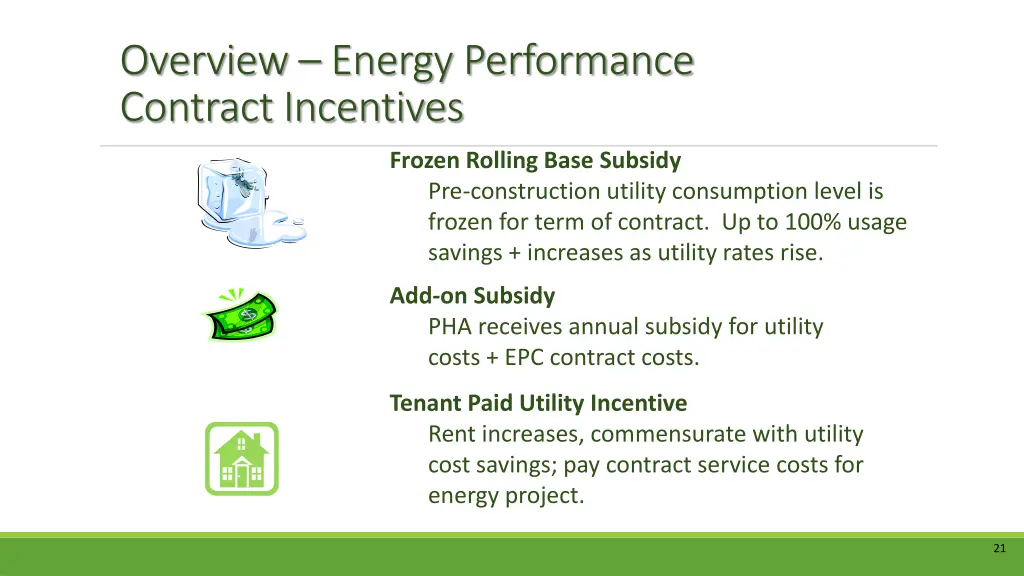
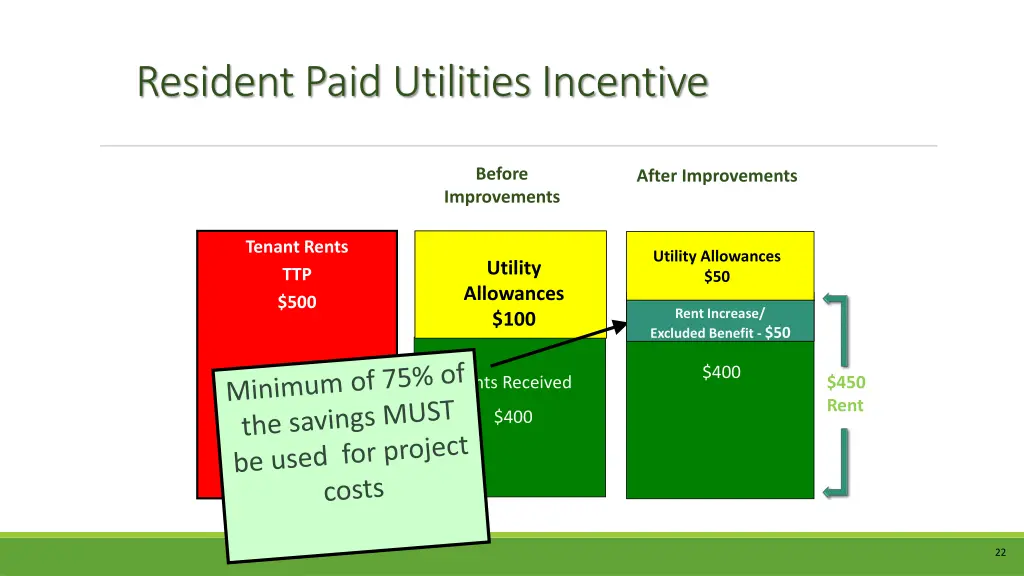
Overview Energy Performance Contract Incentives Frozen Rolling Base Subsidy Pre-construction utility consumption level is frozen for term of contract. Up to 100% usage savings + increases as utility rates rise. Add-on Subsidy PHA receives annual subsidy for utility costs + EPC contract costs. Tenant Paid Utility Incentive Rent increases, commensurate with utility cost savings; pay contract service costs for energy project. 21
Resident Paid Utilities Incentive Before Improvements After Improvements Tenant Rents TTP $500 Utility Allowances $50 Utility Allowances $100 Rent Increase/ Excluded Benefit - $50 $400 Rents Received $450 Rent $400 22
What Are My Options What Are My Options For An EPC? For An EPC? 23
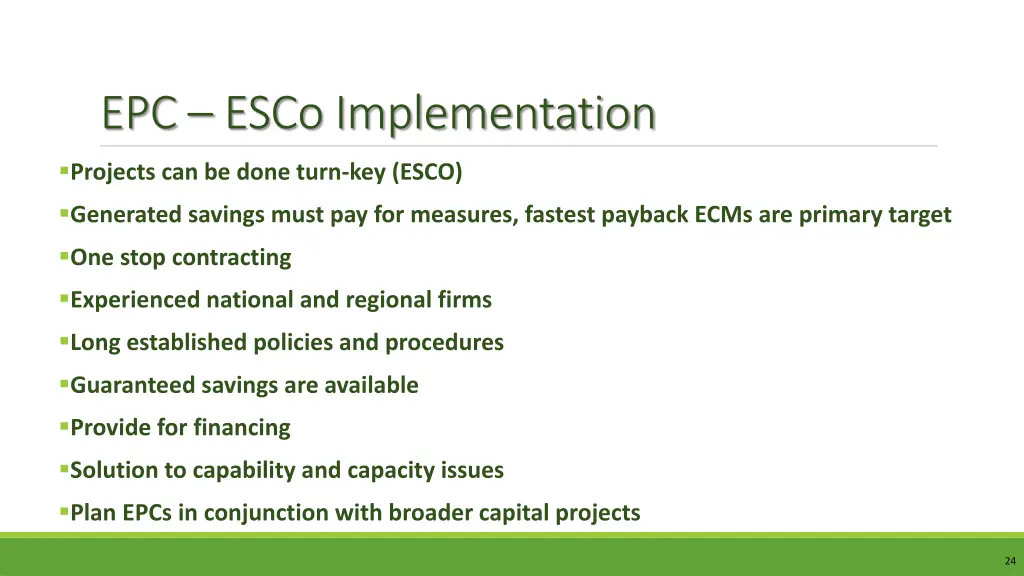
EPC ESCo Implementation Projects can be done turn-key (ESCO) Generated savings must pay for measures, fastest payback ECMs are primary target One stop contracting Experienced national and regional firms Long established policies and procedures Guaranteed savings are available Provide for financing Solution to capability and capacity issues Plan EPCs in conjunction with broader capital projects 24
EPC Self Managed Implementation Lower overall costs no overhead and profits Can mean more project More flexibility with capital fund projects More flexibility capturing outside resources, e.g., rebates and weatherization Leverages in-house staff capability and capacity Possible solution for small agencies; self-assessment Plan EPCs in conjunction with broader capital projects No guarantee; cash flows are adjusted for risk 25
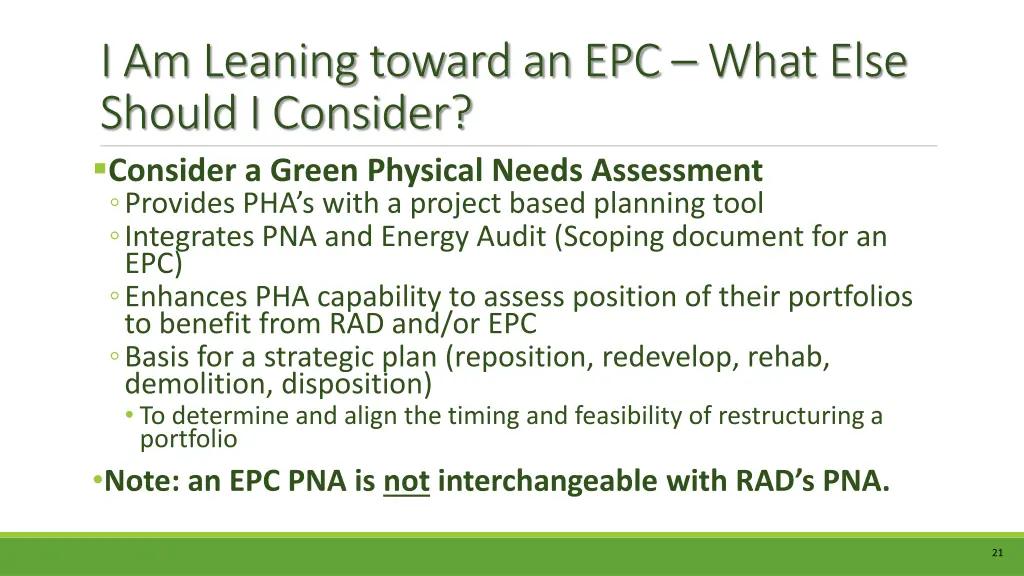
I Am Leaning toward an EPC What Else Should I Consider? Consider a Green Physical Needs Assessment Provides PHA s with a project based planning tool Integrates PNA and Energy Audit (Scoping document for an EPC) Enhances PHA capability to assess position of their portfolios to benefit from RAD and/or EPC Basis for a strategic plan (reposition, redevelop, rehab, demolition, disposition) To determine and align the timing and feasibility of restructuring a portfolio Note: an EPC PNA is not interchangeable with RAD s PNA. 21
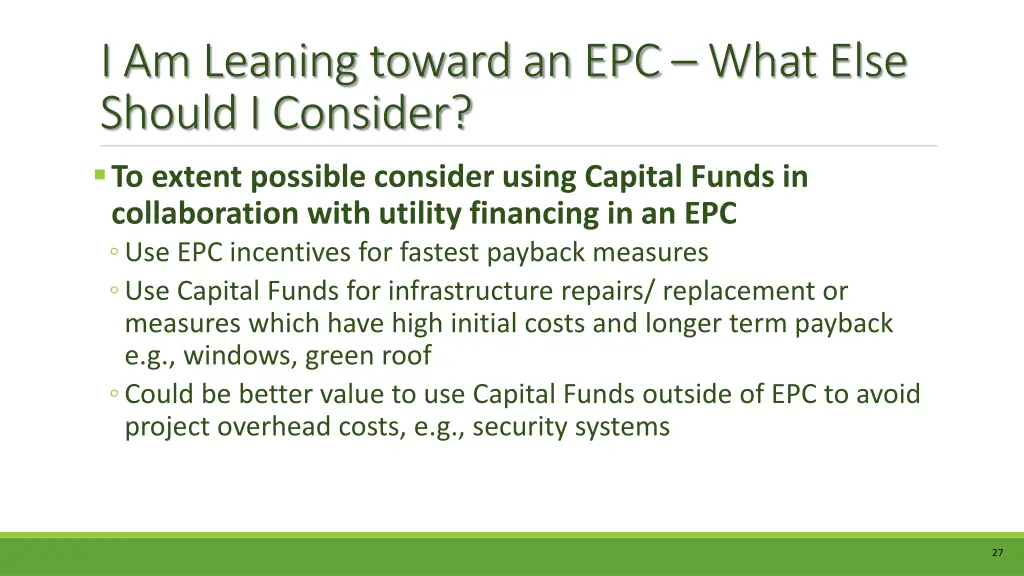
I Am Leaning toward an EPC What Else Should I Consider? To extent possible consider using Capital Funds in collaboration with utility financing in an EPC Use EPC incentives for fastest payback measures Use Capital Funds for infrastructure repairs/ replacement or measures which have high initial costs and longer term payback e.g., windows, green roof Could be better value to use Capital Funds outside of EPC to avoid project overhead costs, e.g., security systems 27
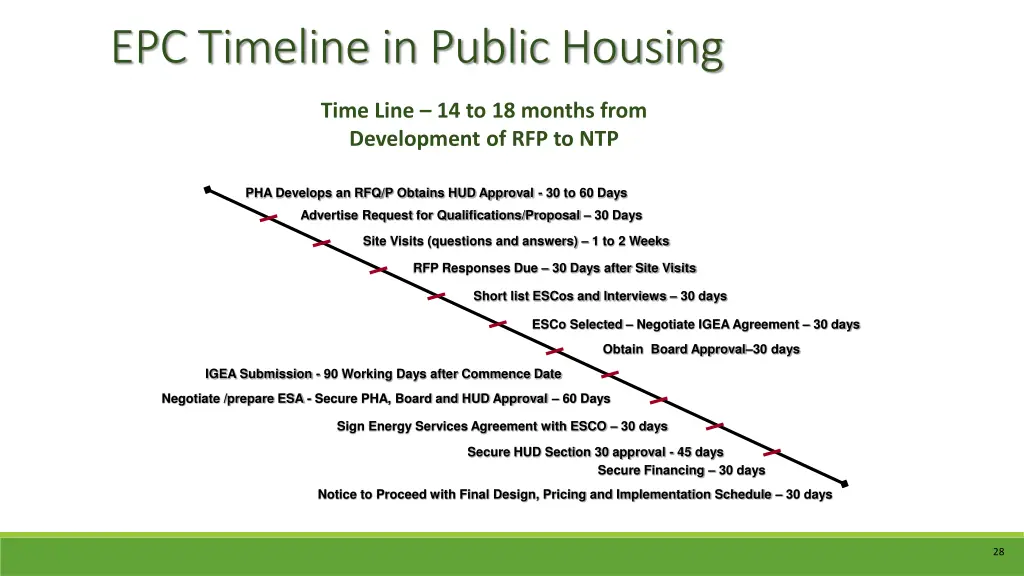
EPC Timeline in Public Housing Time Line 14 to 18 months from Development of RFP to NTP PHA Develops an RFQ/P Obtains HUD Approval - 30 to 60 Days Advertise Request for Qualifications/Proposal 30 Days Site Visits (questions and answers) 1 to 2 Weeks RFP Responses Due 30 Days after Site Visits Short list ESCos and Interviews 30 days ESCo Selected Negotiate IGEA Agreement 30 days Obtain Board Approval 30 days IGEA Submission - 90 Working Days after Commence Date Negotiate /prepare ESA - Secure PHA, Board and HUD Approval 60 Days Sign Energy Services Agreement with ESCO 30 days Secure HUD Section 30 approval - 45 days Secure Financing 30 days Notice to Proceed with Final Design, Pricing and Implementation Schedule 30 days 28
Intersection of Energy Intersection of Energy Performance Contracting and the Performance Contracting and the Rental Assistance Demonstration Rental Assistance Demonstration (RAD) (RAD) 24
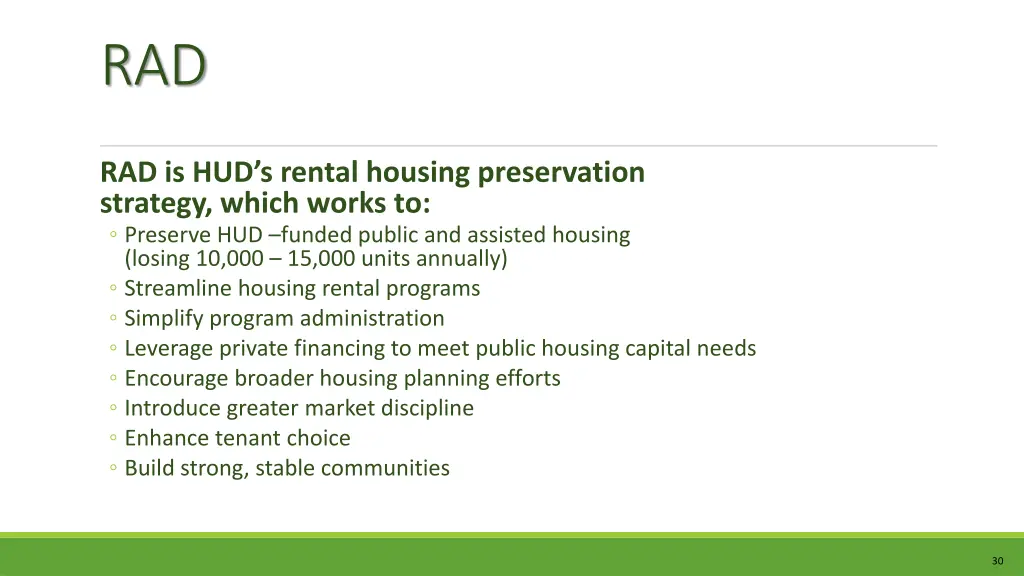
RAD RAD is HUD s rental housing preservation strategy, which works to: Preserve HUD funded public and assisted housing (losing 10,000 15,000 units annually) Streamline housing rental programs Simplify program administration Leverage private financing to meet public housing capital needs Encourage broader housing planning efforts Introduce greater market discipline Enhance tenant choice Build strong, stable communities 30
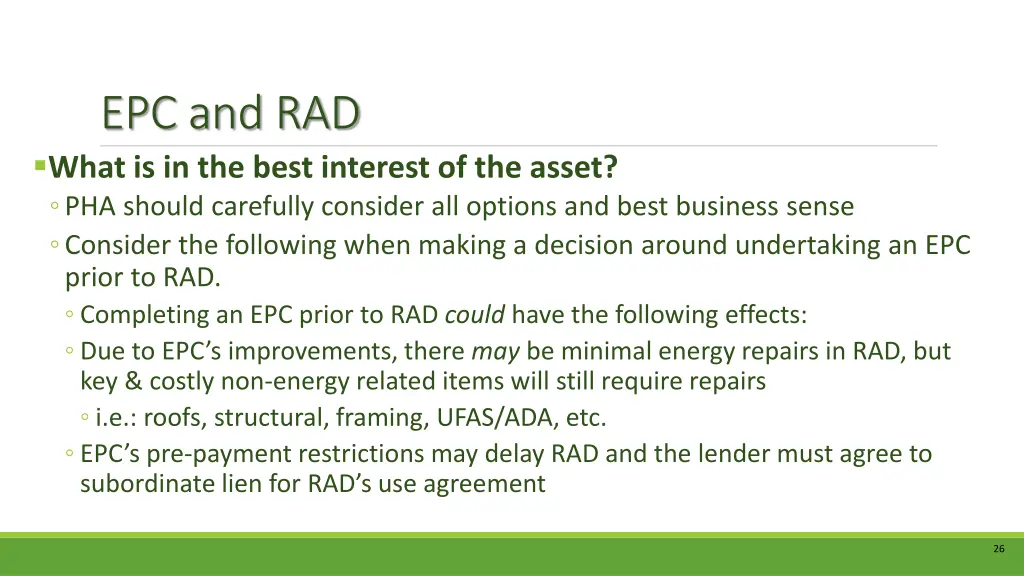
EPC and RAD What is in the best interest of the asset? PHA should carefully consider all options and best business sense Consider the following when making a decision around undertaking an EPC prior to RAD. Completing an EPC prior to RAD could have the following effects: Due to EPC s improvements, there may be minimal energy repairs in RAD, but key & costly non-energy related items will still require repairs i.e.: roofs, structural, framing, UFAS/ADA, etc. EPC s pre-payment restrictions may delay RAD and the lender must agree to subordinate lien for RAD s use agreement 26
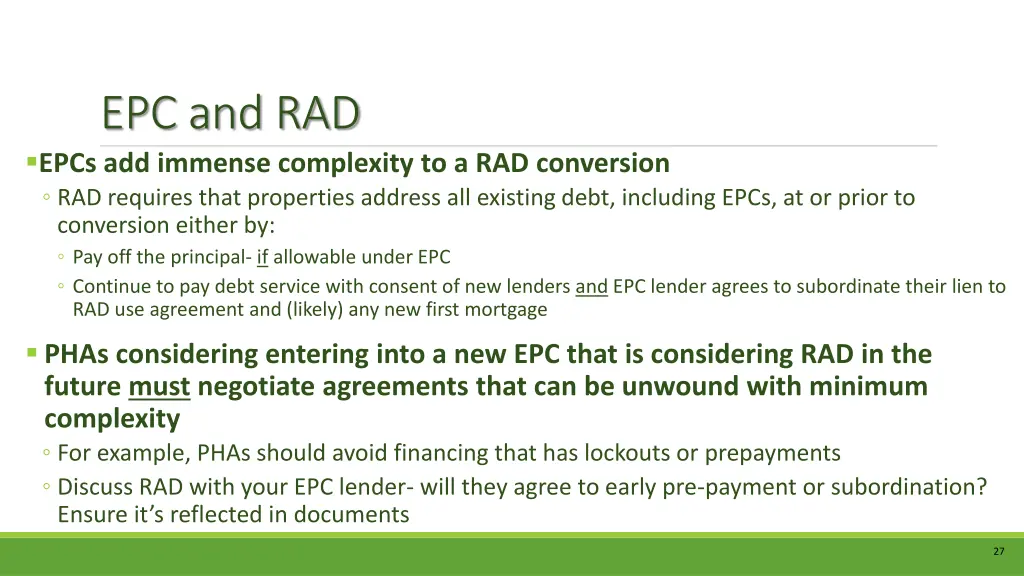
EPC and RAD EPCs add immense complexity to a RAD conversion RAD requires that properties address all existing debt, including EPCs, at or prior to conversion either by: Pay off the principal- if allowable under EPC Continue to pay debt service with consent of new lenders and EPC lender agrees to subordinate their lien to RAD use agreement and (likely) any new first mortgage PHAs considering entering into a new EPC that is considering RAD in the future must negotiate agreements that can be unwound with minimum complexity For example, PHAs should avoid financing that has lockouts or prepayments Discuss RAD with your EPC lender- will they agree to early pre-payment or subordination? Ensure it s reflected in documents 27
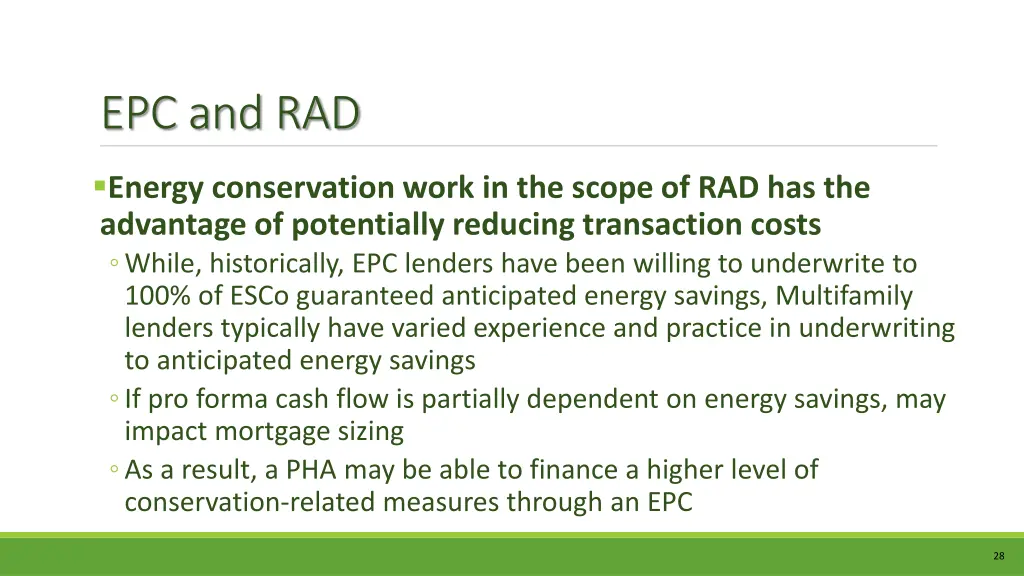
EPC and RAD Energy conservation work in the scope of RAD has the advantage of potentially reducing transaction costs While, historically, EPC lenders have been willing to underwrite to 100% of ESCo guaranteed anticipated energy savings, Multifamily lenders typically have varied experience and practice in underwriting to anticipated energy savings If pro forma cash flow is partially dependent on energy savings, may impact mortgage sizing As a result, a PHA may be able to finance a higher level of conservation-related measures through an EPC 28
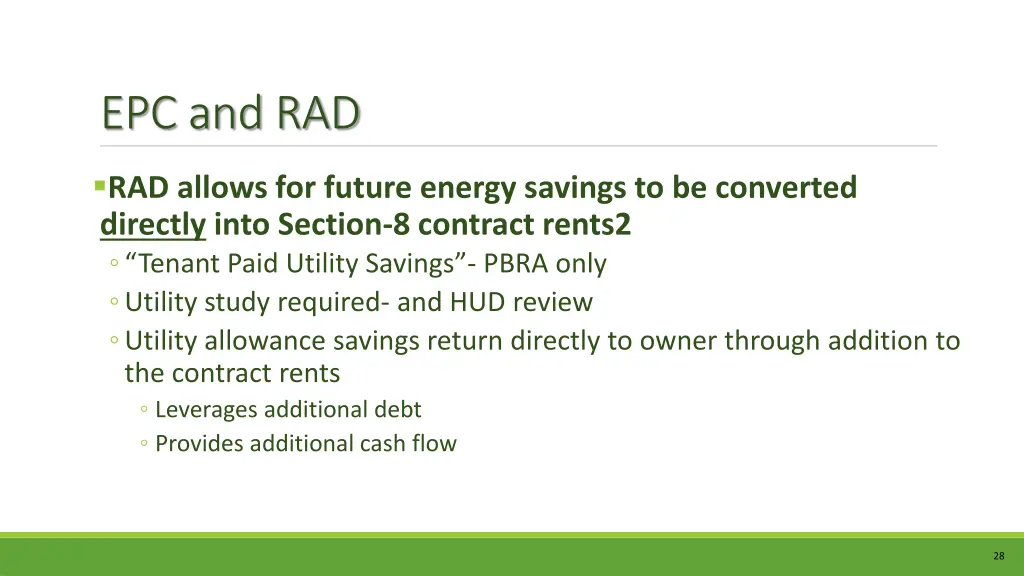
EPC and RAD RAD allows for future energy savings to be converted directly into Section-8 contract rents2 Tenant Paid Utility Savings - PBRA only Utility study required- and HUD review Utility allowance savings return directly to owner through addition to the contract rents Leverages additional debt Provides additional cash flow 28
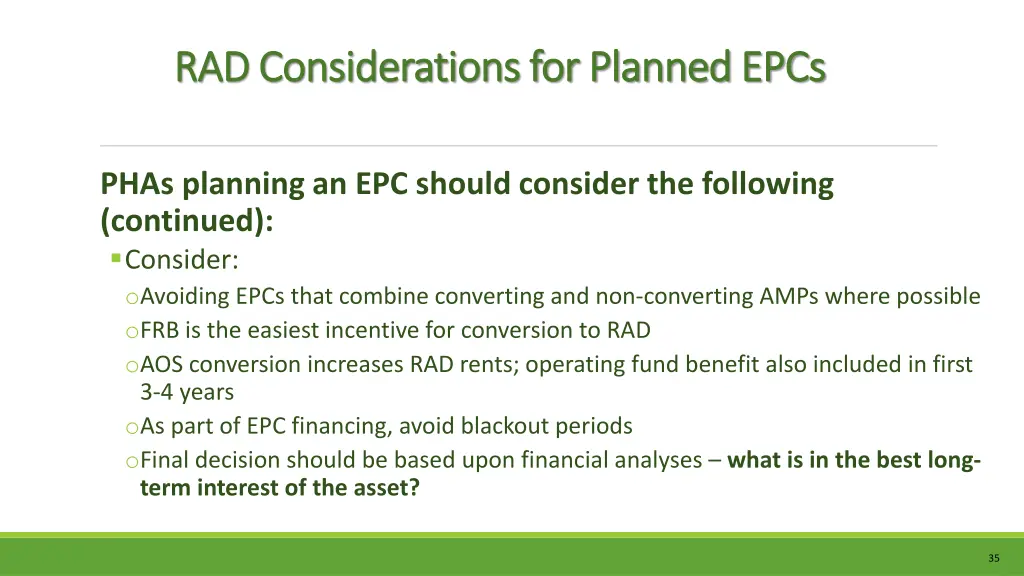
RAD Considerations for Planned EPCs RAD Considerations for Planned EPCs PHAs planning an EPC should consider the following (continued): Consider: oAvoiding EPCs that combine converting and non-converting AMPs where possible oFRB is the easiest incentive for conversion to RAD oAOS conversion increases RAD rents; operating fund benefit also included in first 3-4 years oAs part of EPC financing, avoid blackout periods oFinal decision should be based upon financial analyses what is in the best long- term interest of the asset? 35
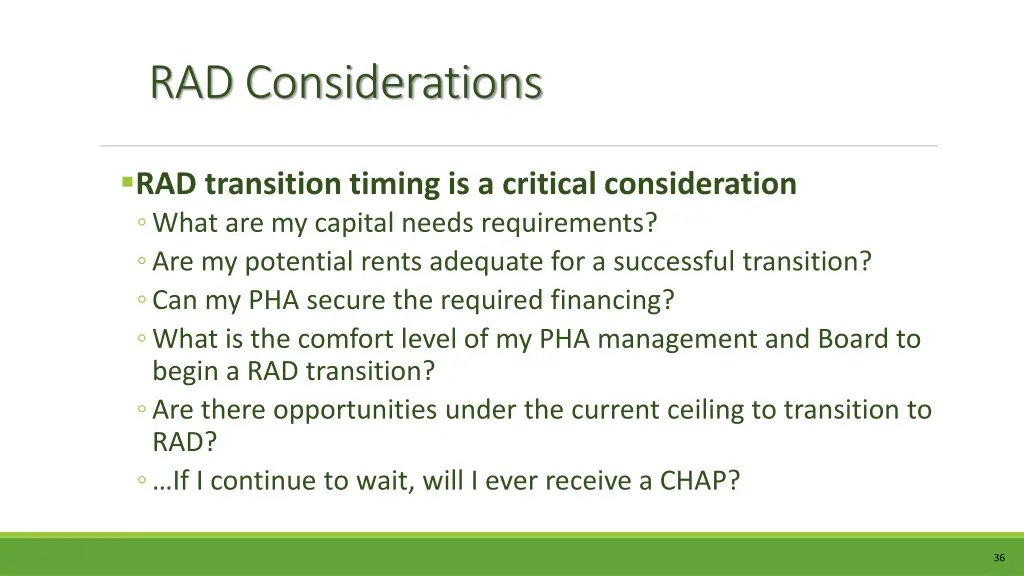
RAD Considerations RAD transition timing is a critical consideration What are my capital needs requirements? Are my potential rents adequate for a successful transition? Can my PHA secure the required financing? What is the comfort level of my PHA management and Board to begin a RAD transition? Are there opportunities under the current ceiling to transition to RAD? If I continue to wait, will I ever receive a CHAP? 36
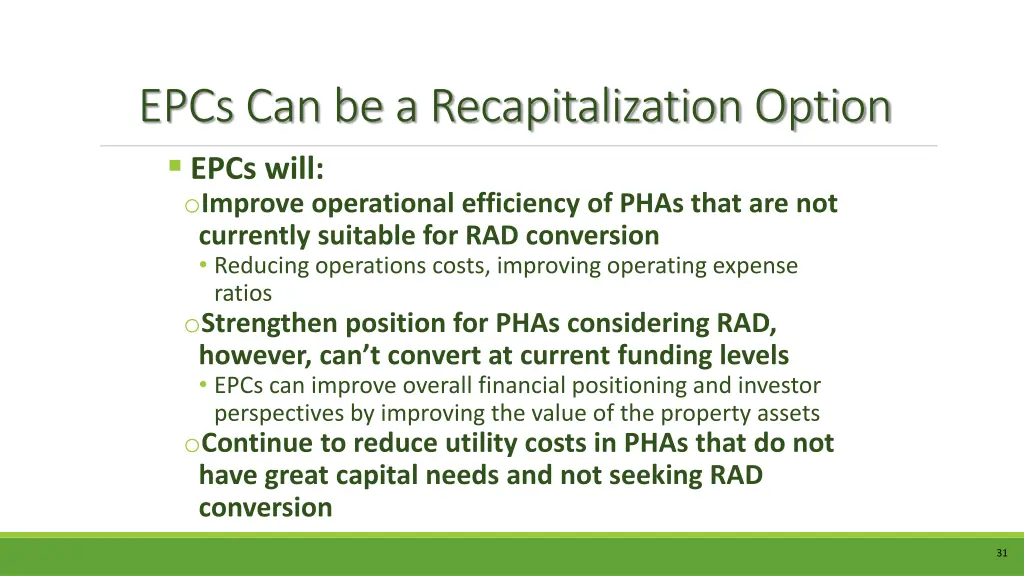
EPCs Can be a Recapitalization Option EPCs will: oImprove operational efficiency of PHAs that are not currently suitable for RAD conversion Reducing operations costs, improving operating expense ratios oStrengthen position for PHAs considering RAD, however, can t convert at current funding levels EPCs can improve overall financial positioning and investor perspectives by improving the value of the property assets oContinue to reduce utility costs in PHAs that do not have great capital needs and not seeking RAD conversion 31
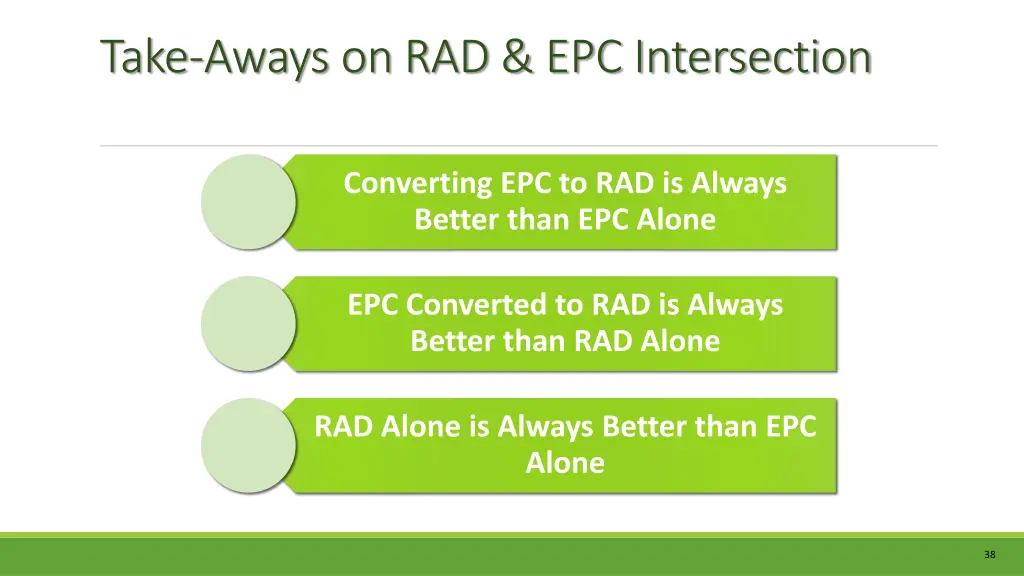
Take-Aways on RAD & EPC Intersection Converting EPC to RAD is Always Better than EPC Alone EPC Converted to RAD is Always Better than RAD Alone RAD Alone is Always Better than EPC Alone 38
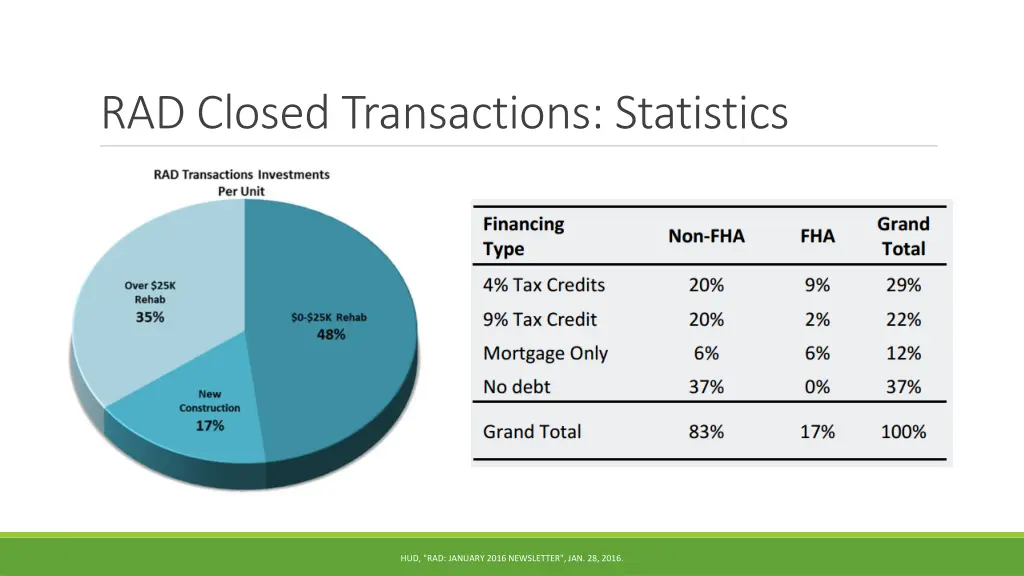
RAD Closed Transactions: Statistics HUD, "RAD: JANUARY 2016 NEWSLETTER", JAN. 28, 2016.
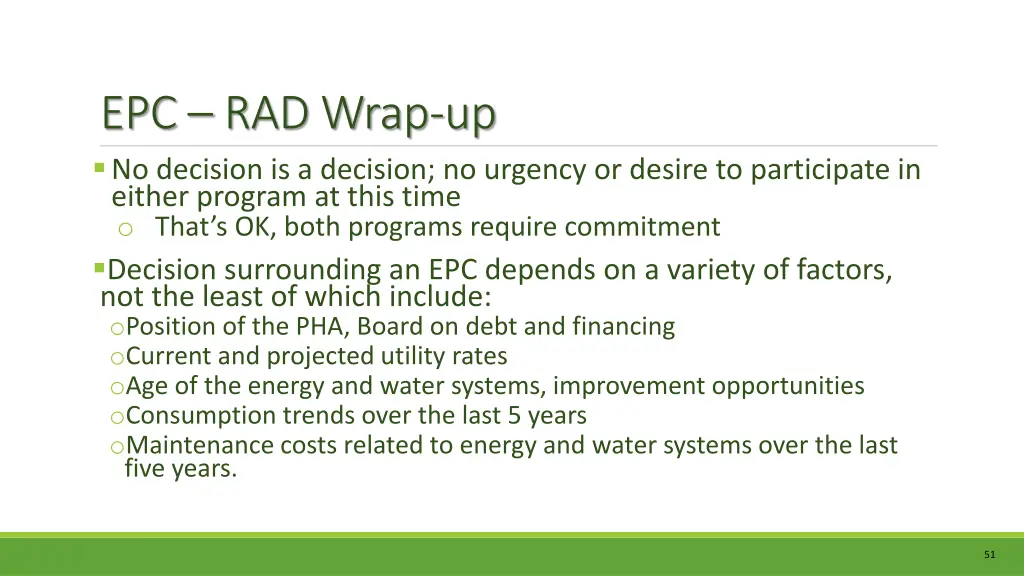
EPC RAD Wrap-up No decision is a decision; no urgency or desire to participate in either program at this time o That s OK, both programs require commitment Decision surrounding an EPC depends on a variety of factors, not the least of which include: oPosition of the PHA, Board on debt and financing oCurrent and projected utility rates oAge of the energy and water systems, improvement opportunities oConsumption trends over the last 5 years oMaintenance costs related to energy and water systems over the last five years. 51
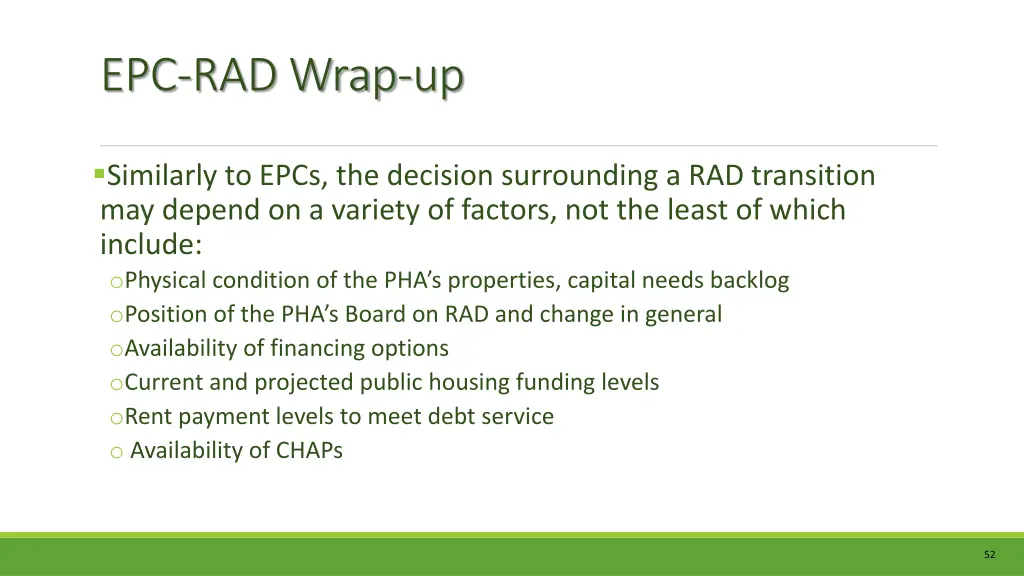
EPC-RAD Wrap-up Similarly to EPCs, the decision surrounding a RAD transition may depend on a variety of factors, not the least of which include: oPhysical condition of the PHA s properties, capital needs backlog oPosition of the PHA s Board on RAD and change in general oAvailability of financing options oCurrent and projected public housing funding levels oRent payment levels to meet debt service o Availability of CHAPs 52
QUESTIONS? Thank you all for attending!