Radial Flow to Confined Aquifer Analysis
Examine the drawdown in a confined aquifer due to pumping from a well, calculate hydraulic conductivity, transmissivity, and more. Understand the principles and applications of groundwater hydrology through practical examples and range of values. Solve problems related to radial flow in confined and unconfined aquifers based on given data and equations.

Download Presentation

Please find below an Image/Link to download the presentation.
The content on the website is provided AS IS for your information and personal use only. It may not be sold, licensed, or shared on other websites without obtaining consent from the author.If you encounter any issues during the download, it is possible that the publisher has removed the file from their server.
You are allowed to download the files provided on this website for personal or commercial use, subject to the condition that they are used lawfully. All files are the property of their respective owners.
The content on the website is provided AS IS for your information and personal use only. It may not be sold, licensed, or shared on other websites without obtaining consent from the author.
E N D
Presentation Transcript
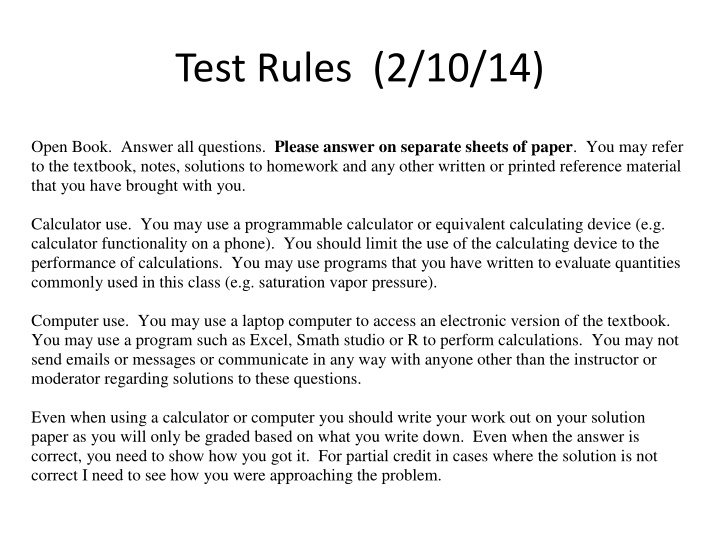
Test Rules (2/10/14) Open Book. Answer all questions. Please answer on separate sheets of paper. You may refer to the textbook, notes, solutions to homework and any other written or printed reference material that you have brought with you. Calculator use. You may use a programmable calculator or equivalent calculating device (e.g. calculator functionality on a phone). You should limit the use of the calculating device to the performance of calculations. You may use programs that you have written to evaluate quantities commonly used in this class (e.g. saturation vapor pressure). Computer use. You may use a laptop computer to access an electronic version of the textbook. You may use a program such as Excel, Smath studio or R to perform calculations. You may not send emails or messages or communicate in any way with anyone other than the instructor or moderator regarding solutions to these questions. Even when using a calculator or computer you should write your work out on your solution paper as you will only be graded based on what you write down. Even when the answer is correct, you need to show how you got it. For partial credit in cases where the solution is not correct I need to see how you were approaching the problem.
Radial flow to a confined aquifer Examine how much the piezometric surface is drawn down by pumping from a well penetrating a confined aquifer ? ln(?/??) ? = 2??? ?=?ln ?/?? 2??? From Mays, 2011, Ground and Surface Water Hydrology
Example A well fully penetrates a 25 m thick confined aquifer. After a long period of pumping at a constant rate of 0.05 m3/s, the drawdowns at distances of 50 and 150 m from the well were observed to be 3 and 1.2 m respectively. Determine the hydraulic conductivity and the transmissivity. What type of unconsolidated deposit would you expect this to be? If a contaminant enters the well 50 m away, how long will it take to get to the pumping well. ?1 ?2=?ln ?2?1 2??? From Mays, 2011, Ground and Surface Water Hydrology
Range of values of Hydraulic Conductivity From Mays, 2011, Ground and Surface Water Hydrology
Example A 1 m diameter well penetrates vertically through a confined aquifer 30 m thick. When the well is pumped at 113 m3/hr, the drawdown in a well 15 m away is 1.8 m; in another well 50 m away, it is 0.5 m. What is the approximate head in the pumped well for steady state conditions and what is the approximate drawdown in the well? Also compute the transmissivity of the aquifer and the radius of influence of the pumping well. Take the initial piezometric level as 40 m above the datum ?1 ?2=?ln ?2?1 2??? From Mays, 2011, Ground and Surface Water Hydrology
Radial Flow to an Unconfined Aquifer 2 1 2 ? =?? 2 ln ?2/?1 ? ??ln ?2/?1 2 1 2= 2 From Mays, 2011, Ground and Surface Water Hydrology
Example A well penetrates an unconfined aquifer. Prior to pumping, the water level (head) is ho = 25 m. After a long period of pumping at a constant rate of 0.05 m3/s, the drawdowns at distances of 50 and 150 m from the well were observed to be 3 and 1.2 m, respectively. Compute the hydraulic conductivity of the aquifer and the radius of influence of the pumping well. What type of deposit is the aquifer material. 2 1 2 ? =?? 2 ln ?2/?1 ? ??ln ?2/?1 2 1 2= 2 From Mays, 2011, Ground and Surface Water Hydrology
Unconfined Aquifer with Uniform Recharge ? ??ln ??/? 2?(?2 ??2) 2 2= +? ? See Example 4.2.5 From Mays, 2011, Ground and Surface Water Hydrology