Radioactivity and Isotopes in Medicine

Radioactivity is a natural phenomenon where unstable isotopes emit energetic radiations, useful in medicine but potentially harmful. Isotopes have varying neutron numbers affecting stability. Radioisotopes are unstable isotopes that decay over time, emitting radiation until reaching stability.

Download Presentation

Please find below an Image/Link to download the presentation.
The content on the website is provided AS IS for your information and personal use only. It may not be sold, licensed, or shared on other websites without obtaining consent from the author.If you encounter any issues during the download, it is possible that the publisher has removed the file from their server.
You are allowed to download the files provided on this website for personal or commercial use, subject to the condition that they are used lawfully. All files are the property of their respective owners.
The content on the website is provided AS IS for your information and personal use only. It may not be sold, licensed, or shared on other websites without obtaining consent from the author.
E N D
Presentation Transcript
Medical chemistry Professor Dr. Hayder H. Abd B.Sc. M.Sc. Ph.D. Clinical biochemistry
The chemical basis of life General organic and biological chemistry for health science George H. Schmid
Radioactivity and Isotopes Application In Medicine
Radioactivity is a phenomenon that occurs naturally in a number of substances substance (unstable) (isotopes) spontaneously emit invisible but energetic radiations, which can penetrate materials opaque to visible light . Atoms of the that are
The effects of these radiations can be harmful to living cells but, when used in the right way, they have a wide range of beneficial applications, medicine. particularly in
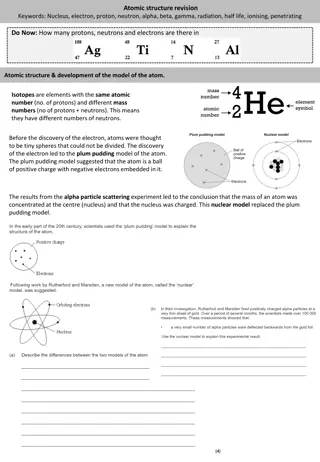
Isotopes An isotope is a variant of a particular chemical element. While all isotopes of a given element have the same number of protons, each isotope has a different number of neutrons. For example, hydrogen has three isotopes (or variants): Hydrogen-1 (contains one proton and no neutrons) Hydrogen-2, which is called deuterium (contains one proton and one neutron) Hydrogen-3, which is called tritium (contains one proton and two neutrons)
Another example is uranium-235, which has 92 protons and 143 neutrons, as opposed to uranium-238, which has 92 protons and 146 neutrons. An isotope is stable when it has a balanced number of neutrons and protons. In general, when an isotope is small and stable, it contains close to an equal number of protons and neutrons.
Radioisotopes Isotopes that are not stable and emit radiation are called radioisotopes. A radioisotope is an isotope of an element that undergoes spontaneous decay and emits radiation as it decays. During the decay process, it becomes less radioactive over time, eventually becoming stable. Once an atom reaches a stable configuration, it no longer gives off radiation. For this reason, radioactive sources or sources that spontaneously emit energy in the form of ionizing radiation as a result of the decay of an unstable atom become weaker with time.
Unites The amount of radioactivity in a source is measured by the rate at which atoms undergo radioactive The curie C =level of radioactivity caused by 3.7X10 disintegrations per seconds . 1 curi =3.7X10¹⁰ 10 radioactivity becquerel
Half life The time taken for the activity to fall to half of its original value is called the half- life of the source .However the activity does not fall at a steady rate, so it is not the case that the activity will have fallen to nothing after two half-lives .
The atom The nucleus of an atom is composed of protons and neutrons. protons in the nucleus is called the atomic number, and is given the symbol Z . Because the protons each have a charge of +1 unit and the neutrons have no charge, the total charge of the nucleus is +Z units. The number of
Electrostatic attraction between the positively charged nucleus and the negatively charged electrons holds exactly Z electrons in orbit around the nucleus when the atom is in its normal state. The overall charge on the atom is then zero.
total mass of the atom is given by the sum of the number of protons, Z, and the number of neutrons, N, that it contains, Thus the mass number, A, of the atom is given by A =Z +N .The term nuclide is used to describe a particular nuclear species with a given combination of A and Z.
127 I 53 Where 127 is the mass number, A, and 53 is the atomic number, Z .This nuclide therefore has 53 protons and 74 neutrons ( to make a total of 127 nucleons )in its nucleus and 53 orbiting electrons.
Types of radiation Alpha radiation ( radiation): it s a stream of particle moving at about one-tenth the speed of light. Each particle contains two protons and two neutrons and has a charge +2 . Beta radiations ( ): it s a stream of electrons, its produces within the nucleus by the transformation of neutron into proton and an electron. Exposure to beta radiation cause skin burned .
Gamma radiation (): but a form of energy similar to light waves, radio wave, or x-ray. radiation has high energy and can penetrate deep within body and cause serious damage . Electron Capture radiation or ionization radiation : it s not particles, This
Radiation dose When ionizing radiations , alpha, beta, gamma or X-rays )pass through matter they pass on some or all of their energy to the material by ionizing and exciting the atoms of the material through the processes described above. The damage done by this depends both on the energy deposited and the amount of material involve.
The concept of absorbed dose applies to all types of material but, when we need to assess the effect on biological tissues, we also need to take account of the fact that some types of radiation are more harmful than others. because they are so ionizing, alpha particles are about twenty times as effective at killing cells as beta particles, gamma rays or X-rays . For example,
RAD: one rad is equal to 2.4X10⁻³ absorbed by 1 kg of tissues converted to heat that raise the temperature of tissues only few thousands of degrees. cal of energy REM: the rem is I rad multiplied by factor called relative biological equivalence (RBE). Where the RBE take into account the differences in biological damage causes by different kinds of ionized radiation of the same energy. For example alpha cause 10 times damage by beta of same energy. The REM more accurate and compatible measuring of biological damage.
Nuclear reaction Atoms do changes occurs from one kind to another when they emit nuclear radiation. When this happens, the nucleus gain or lose positive charge and its atomic number is changed which mean one elements changes to another 14 14 0 6 C----- 7N+ -1 B
Detectors Gas-Filled Detectors : Gas-filled detectors are typically utilize an electric potential is set up between a cylindrical detector wall and a center electrode passing through the center of the cylinder. detection medium in negatively charged electrons that are released by ionizing radiation in the gas are collected on the center electrode. Geiger counter A gas is used as the this cylinder and the
Solid State Detectors Radiation interacts with a solid state material, similar to the silicon based materials used for electronic devices .As for gas- filled detectors, created by radiation interactions is collected and processed . the charge
Types include intrinsic (high purity) germanium detectors, diodes, CdTe, CdZnTe, diamond. Solid State detectors are more expensive, portable, and they provide information on the energy of the radiation, thus giving expanded analytical capabilities. p-n junction HgI2, and typically are not
Medical application of isotopes This include ordinary x-ray film, the use of contrast media, fluorescent screens, image intensifiers, CT and the use of digital technology to all x-ray systems. In order to complete the diagnostic field we shall mention a couple of other methods such as magnetic resonance (MR or MRI) and ultrasound. In the case of MR electromagnetic radiation is used in combination with a strong magnetic field. The electromagnetic radiation is within the radio frequency field and can not ionize. Ultrasound is sound waves with a frequency above 20 kHz.
The half-life must be long enough for isotope to do its job and short to diaper from the body. medical application no alpha radiation was in use because its cause damage to all tissues. main mechanism for isotopes application either externally ( such as Co-60) or internally I - 131 . In The
131 I - 8 days Thyroid cancer 60 Co . 3 5 years Different types of cancer - 32 P - 143 days Leukemia
24 Na 15 hrs Circulation system - 59 Fe 456 days Red blood cells -