Raymond Williams, EP Thompson, and Stuart Hall's Cultural Perspectives
Concerns about the meanings of culture in post-war Britain highlighted by Thompson's belief in culture as a whole way of life, challenging the notion that it is exclusive to the elite. Williams argued for the complexity of modern culture, emphasizing its fragmented and multifaceted nature. Both scholars critiqued the homogeneity of national culture in the 1950s, advocating for recognition of diverse cultural expressions across classes, ethnic groups, and generations. Their work called into question the validity of traditional academic approaches to culture.

Download Presentation

Please find below an Image/Link to download the presentation.
The content on the website is provided AS IS for your information and personal use only. It may not be sold, licensed, or shared on other websites without obtaining consent from the author.If you encounter any issues during the download, it is possible that the publisher has removed the file from their server.
You are allowed to download the files provided on this website for personal or commercial use, subject to the condition that they are used lawfully. All files are the property of their respective owners.
The content on the website is provided AS IS for your information and personal use only. It may not be sold, licensed, or shared on other websites without obtaining consent from the author.
E N D
Presentation Transcript
Raymond Williams, EP Thompson and Stuart Hall and Cultural Studies Day 3
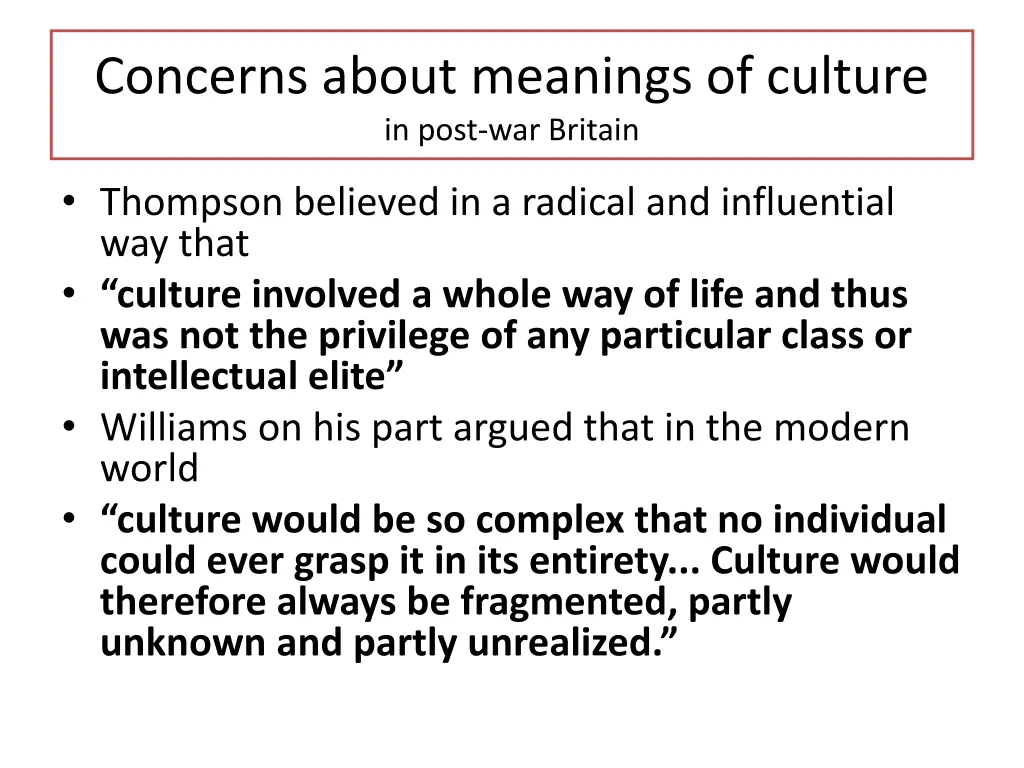
Concerns about meanings of culture in post-war Britain Thompson believed in a radical and influential way that culture involved a whole way of life and thus was not the privilege of any particular class or intellectual elite Williams on his part argued that in the modern world culture would be so complex that no individual could ever grasp it in its entirety... Culture would therefore always be fragmented, partly unknown and partly unrealized.
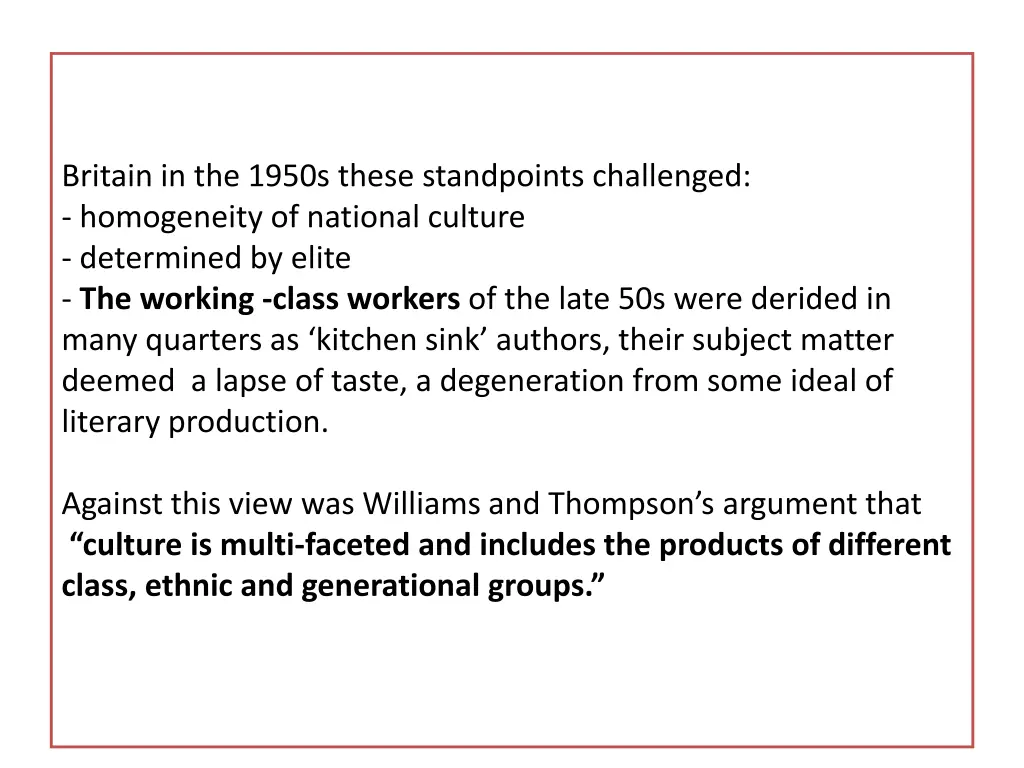
Britain in the 1950s these standpoints challenged: - homogeneity of national culture - determined by elite - The working -class workers of the late 50s were derided in many quarters as kitchen sink authors, their subject matter deemed a lapse of taste, a degeneration from some ideal of literary production. Against this view was Williams and Thompson s argument that culture is multi-faceted and includes the products of different class, ethnic and generational groups.
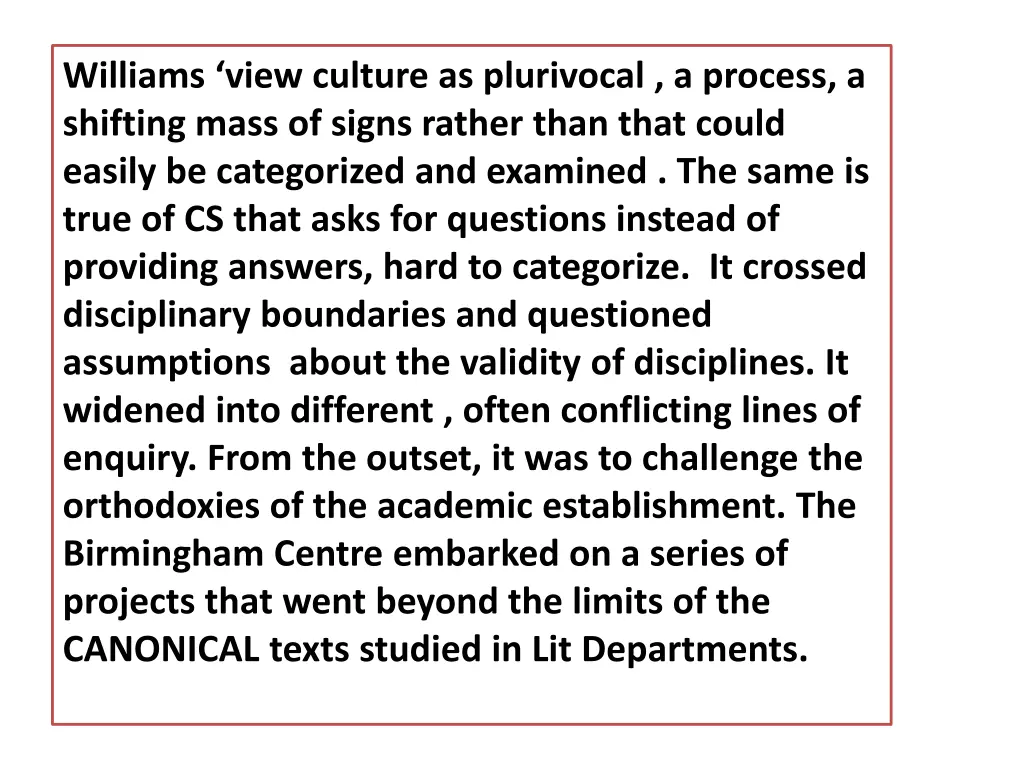
Williams view culture as plurivocal , a process, a shifting mass of signs rather than that could easily be categorized and examined . The same is true of CS that asks for questions instead of providing answers, hard to categorize. It crossed disciplinary boundaries and questioned assumptions about the validity of disciplines. It widened into different , often conflicting lines of enquiry. From the outset, it was to challenge the orthodoxies of the academic establishment. The Birmingham Centre embarked on a series of projects that went beyond the limits of the CANONICAL texts studied in Lit Departments.
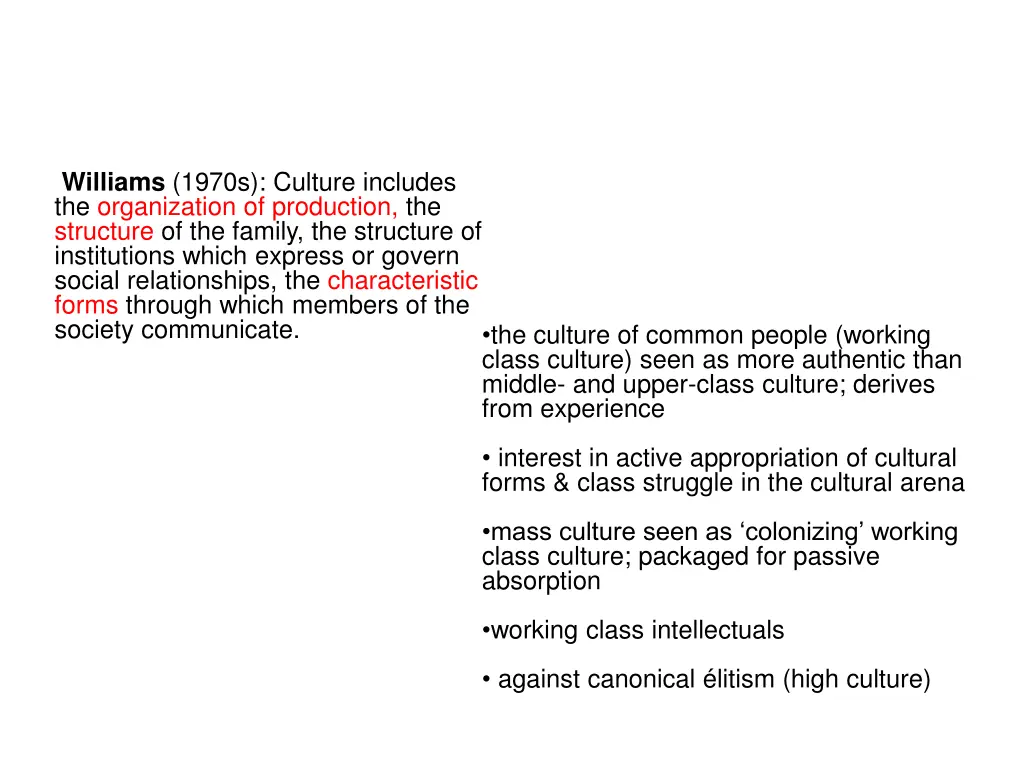
Williams (1970s): Culture includes the organization of production, the structure of the family, the structure of institutions which express or govern social relationships, the characteristic forms through which members of the society communicate. the culture of common people (working class culture) seen as more authentic than middle- and upper-class culture; derives from experience interest in active appropriation of cultural forms & class struggle in the cultural arena mass culture seen as colonizing working class culture; packaged for passive absorption working class intellectuals against canonical litism (high culture)
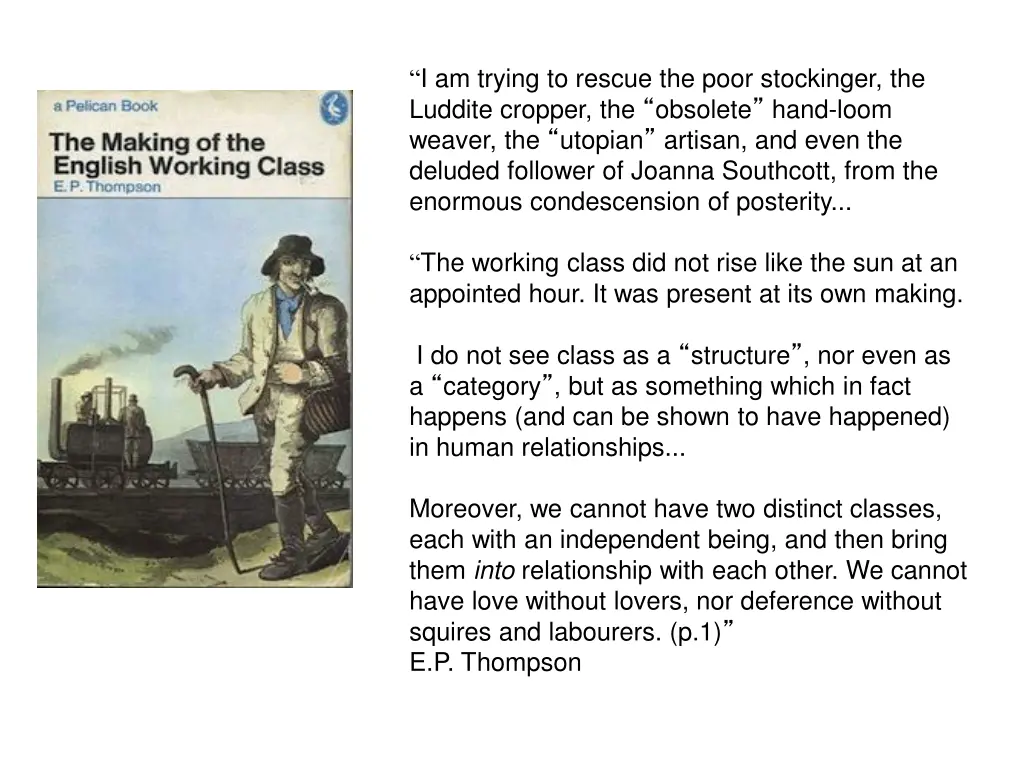
I am trying to rescue the poor stockinger, the Luddite cropper, the obsolete hand-loom weaver, the utopian artisan, and even the deluded follower of Joanna Southcott, from the enormous condescension of posterity... The working class did not rise like the sun at an appointed hour. It was present at its own making. I do not see class as a structure , nor even as a category , but as something which in fact happens (and can be shown to have happened) in human relationships... Moreover, we cannot have two distinct classes, each with an independent being, and then bring them into relationship with each other. We cannot have love without lovers, nor deference without squires and labourers. (p.1) E.P. Thompson
Cultural Studies and Hegemony? Study of relations between social relations and meanings (how social divisions are made meaningful) Culture is terrain on which hegemony (ideological representations of class, gender, race) are enforced, and contested by social groups validating their experience Hegemony operates in the realm of representations and consciousness; implies power inequality in different segments of society; naturalizes a class ideology and renders it in the form of common sense; it is exercised through authority not physical force; it operates through institutions (educational system, media and the family) Cultural studies focus on analysis of cultural forms and their meaning in the context of power relations in society
Representation and Identity A basic definition of representation: to describe, or depict something; to call it up in the mind by description, portrayal or imagination. To represent also means to symbolise, to stand for, to be a specimen of or to substitute for (Davis 2009: 79). Quite simply, a image and text has meaning written into it.
Difference Social groups categorised and classified Who does this? State, media for eg. Major axes: Gender, race, class etc. How does this come to be represented With regard to the representation of difference: the portrayal by image and text applies to social groups and identities.
Stuart Hall Key Theorist Members of society, when making and communicating ordinary distinctions between groups and identities, rely on a specific difference scheme in order to do so (i.e. The cultural contingency of identity). Stuart Hall (1997) calls this the representational regime of difference. This entails that all identity distinctions we ordinarily make are historically and culturally specific The media is of course a key site at which these representations are rendered and accessed.
Mass Media and Representation Media representations are most commonly associated with the images and meanings disseminated at the level of mass, popular media. Mass media source of much representation How does the representational regime of difference. operate in the media? Examples: Tiger Wood, Amir Khan etc.
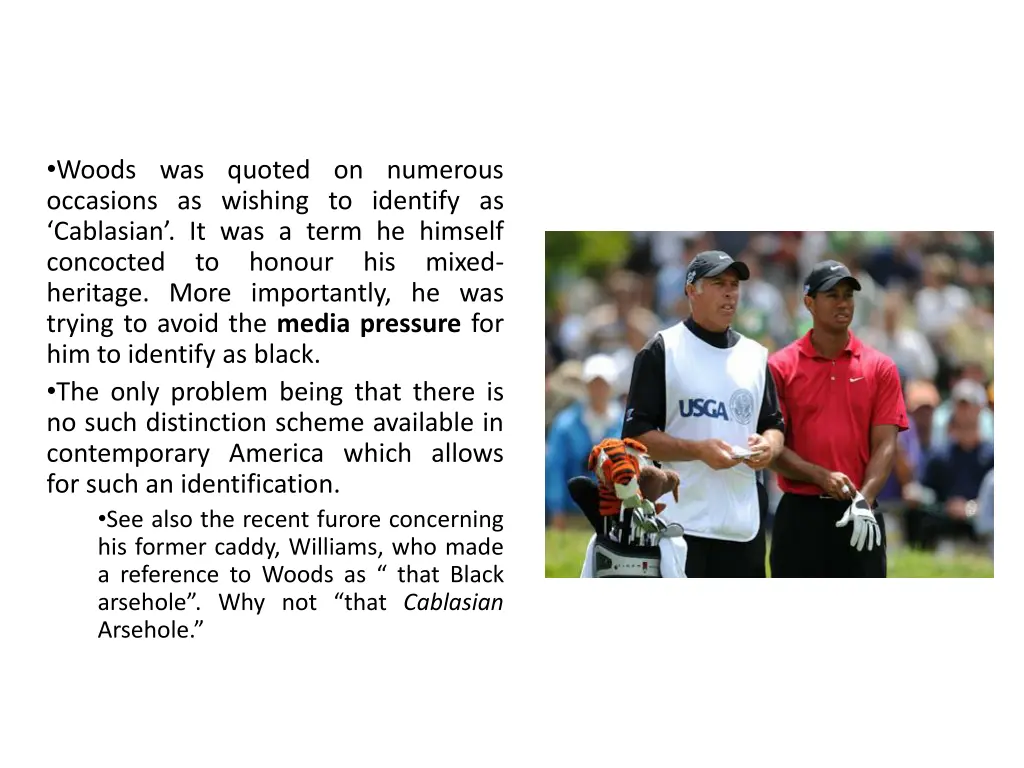
Woods was quoted on numerous occasions as wishing to identify as Cablasian . It was a term he himself concocted to honour heritage. More importantly, he was trying to avoid the media pressure for him to identify as black. The only problem being that there is no such distinction scheme available in contemporary America which allows for such an identification. See also the recent furore concerning his former caddy, Williams, who made a reference to Woods as that Black arsehole . Why not that Cablasian Arsehole. his mixed-
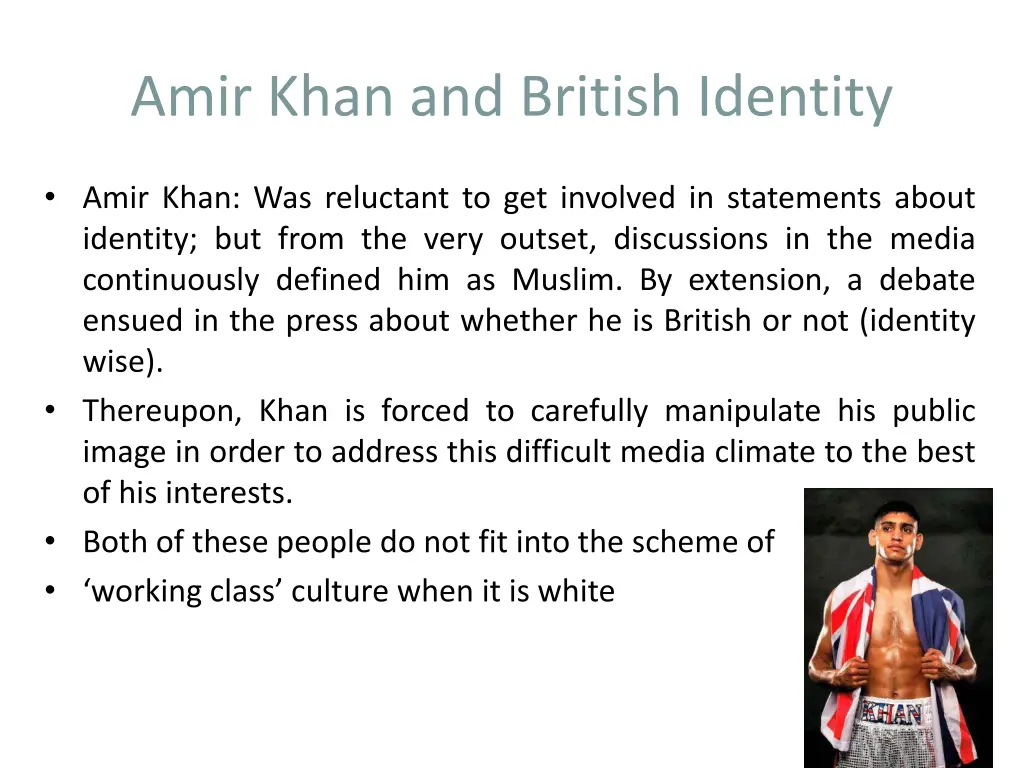
Amir Khan and British Identity Amir Khan: Was reluctant to get involved in statements about identity; but from the very outset, discussions in the media continuously defined him as Muslim. By extension, a debate ensued in the press about whether he is British or not (identity wise). Thereupon, Khan is forced to carefully manipulate his public image in order to address this difficult media climate to the best of his interests. Both of these people do not fit into the scheme of working class culture when it is white
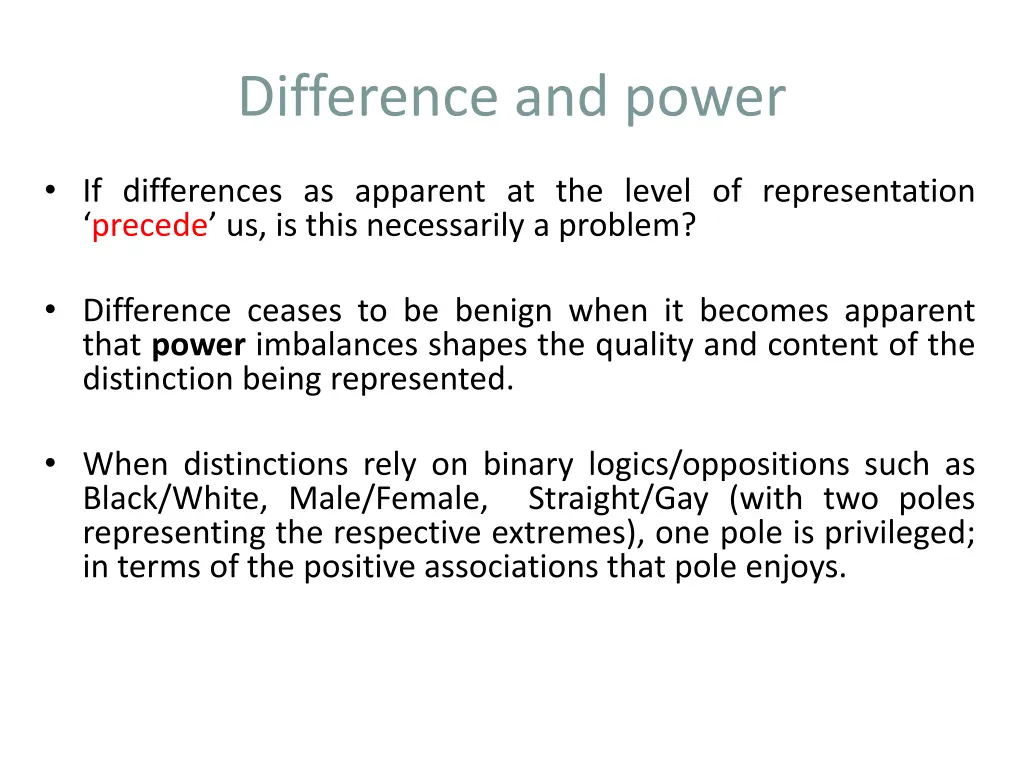
Difference and power If differences as apparent at the level of representation precede us, is this necessarily a problem? Difference ceases to be benign when it becomes apparent that power imbalances shapes the quality and content of the distinction being represented. When distinctions rely on binary logics/oppositions such as Black/White, Male/Female, representing the respective extremes), one pole is privileged; in terms of the positive associations that pole enjoys. Straight/Gay (with two poles
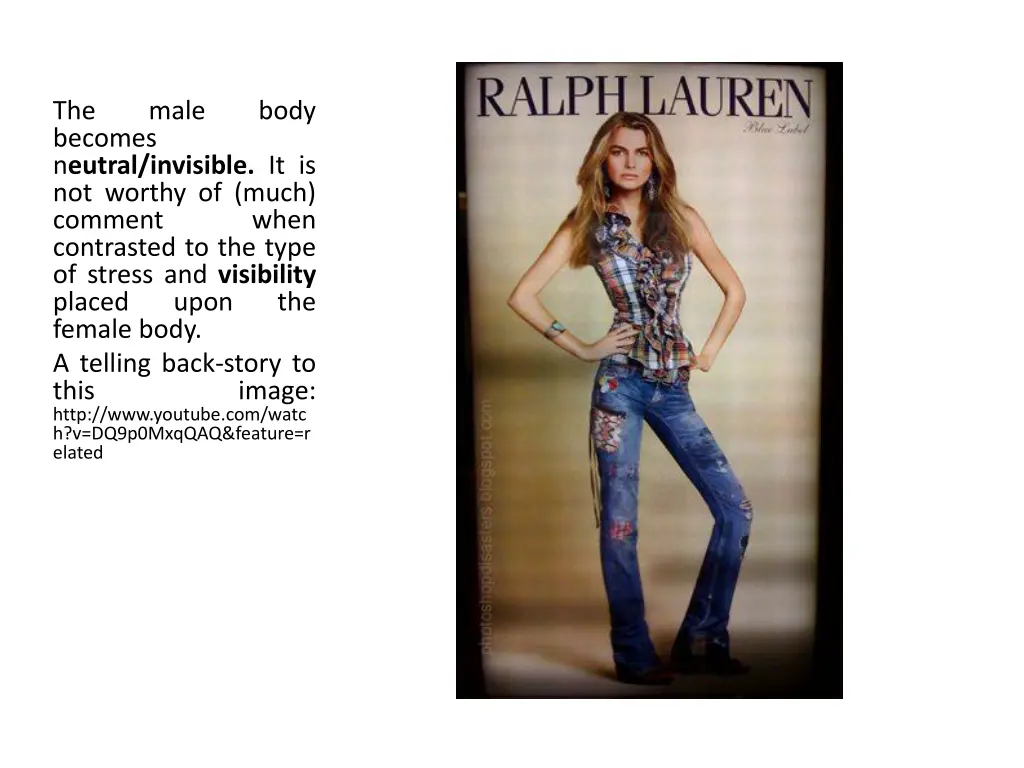
The becomes neutral/invisible. It is not worthy of (much) comment contrasted to the type of stress and visibility placed upon female body. A telling back-story to this http://www.youtube.com/watc h?v=DQ9p0MxqQAQ&feature=r elated male body when the image:
Stereotype It is now easier to grasp what is meant by stereotype with regard to representation. But what is the purpose of stereotype/the representation? Why does it materialise in the first place? negative The privileged role/type/identity becomes the normative ideal (high status and also neutral), whilst the latter stereotype (an often caricatured, grossly simplistic, constricting representation of the relevant identity/group). Only can be understood within the context of inequality. becomes a fixed and Negative representations do not emerge of themselves and/or arbitrarily.
Hegemony Stereotypes/negative representations serve, in what is known in Gramscian terms, a hegemonic end. With regard to hegemony, stereotypes allow for current inequities to be excused through reference to the meanings which emanate from those negative representations. For example, if certain groups are commonly represented as inferior in terms of mental ability or as fundamentally lazy, it becomes easier to explain(rationalise/legitimise) why that group is at at the bottom of the social ladder. Even the group represented in this negative mode might subscribe to this representation and thereby rationalise their lower social position. For instance, Fanon(1952) argued that the black masses subject to colonial rule internalised the many derogatory meanings associated with black people. They believed in their own inferiority (their limited rational faculties) and were thereby less hostile to their oppression.
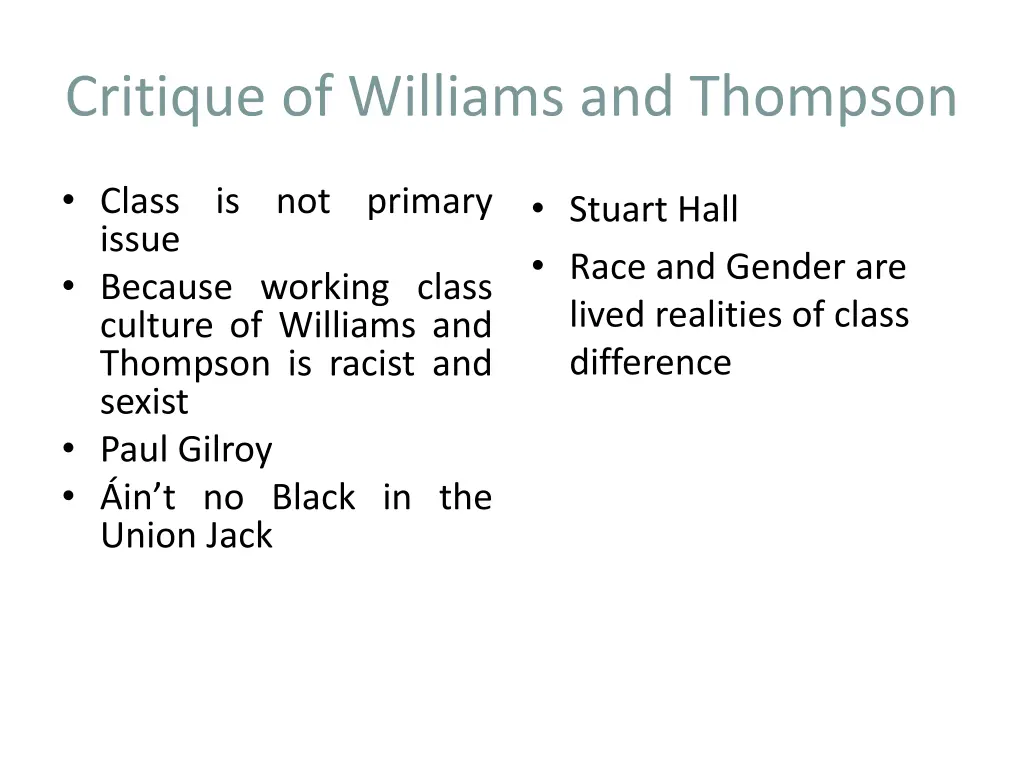
Critique of Williams and Thompson Class is not primary issue Because working class culture of Williams and Thompson is racist and sexist Paul Gilroy in t no Black in the Union Jack Stuart Hall Race and Gender are lived realities of class difference
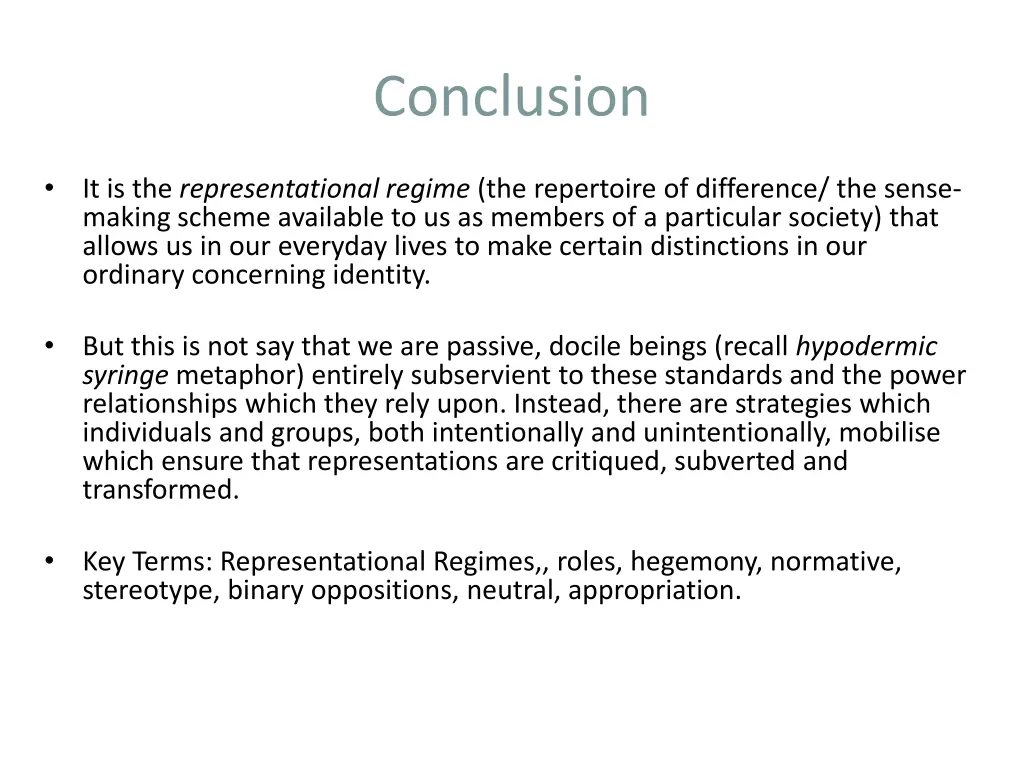
Conclusion It is the representational regime (the repertoire of difference/ the sense- making scheme available to us as members of a particular society) that allows us in our everyday lives to make certain distinctions in our ordinary concerning identity. But this is not say that we are passive, docile beings (recall hypodermic syringe metaphor) entirely subservient to these standards and the power relationships which they rely upon. Instead, there are strategies which individuals and groups, both intentionally and unintentionally, mobilise which ensure that representations are critiqued, subverted and transformed. Key Terms: Representational Regimes,, roles, hegemony, normative, stereotype, binary oppositions, neutral, appropriation.