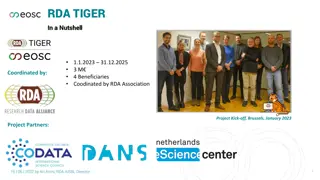
RDA Data Foundation and Terminology: Abstract Data Model

Comprehensive data organization framework integrating diverse data management terms within the RDA domain. Learn about the PID record system, metadata linkage, and attribute storage. Discover the foundational work and accomplishments of the DFT IG in structuring data models and defining key terminology.

Download Presentation

Please find below an Image/Link to download the presentation.
The content on the website is provided AS IS for your information and personal use only. It may not be sold, licensed, or shared on other websites without obtaining consent from the author.If you encounter any issues during the download, it is possible that the publisher has removed the file from their server.
You are allowed to download the files provided on this website for personal or commercial use, subject to the condition that they are used lawfully. All files are the property of their respective owners.
The content on the website is provided AS IS for your information and personal use only. It may not be sold, licensed, or shared on other websites without obtaining consent from the author.
E N D
Presentation Transcript
OPTIMIZING THE SELECTION OF AUTHENTIC MATERIALS USING VOCABULARY PROFILERS Theresa A. Antes University of Florida ACTFL 2023, Chicago, IL
OVERVIEW OF PRESENTATION Why use authentic materials? Why the focus on vocabulary in particular? How do we define a word and how do we profile it? Word profilers / demonstration
BENEFITS OF USING AUTHENTIC MATERIALS Language in context Interest Relevance Satisfaction
POTENTIAL DIFFICULTIES WITH AUTHENTIC MATERIALS Locating materials that fit a theme; Determining if students are ready for them; As teachers, we may have a sense of whether we have provided learners with the necessary background information to understand a text. But how do we reliably assess the linguistic content of a text, and students preparedness for it?
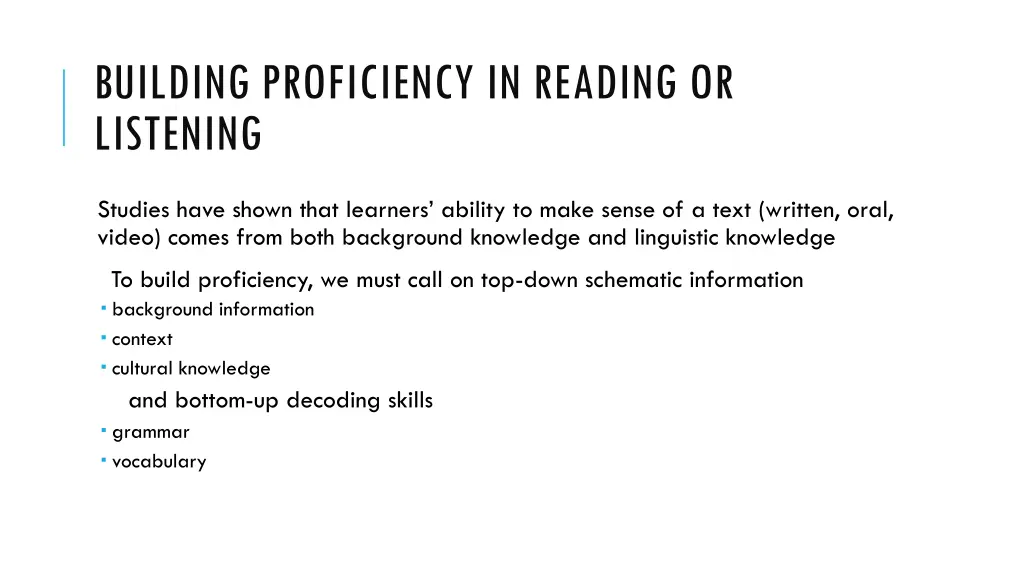
BUILDING PROFICIENCY IN READING OR LISTENING Studies have shown that learners ability to make sense of a text (written, oral, video) comes from both background knowledge and linguistic knowledge To build proficiency, we must call on top-down schematic information background information context cultural knowledge and bottom-up decoding skills grammar vocabulary
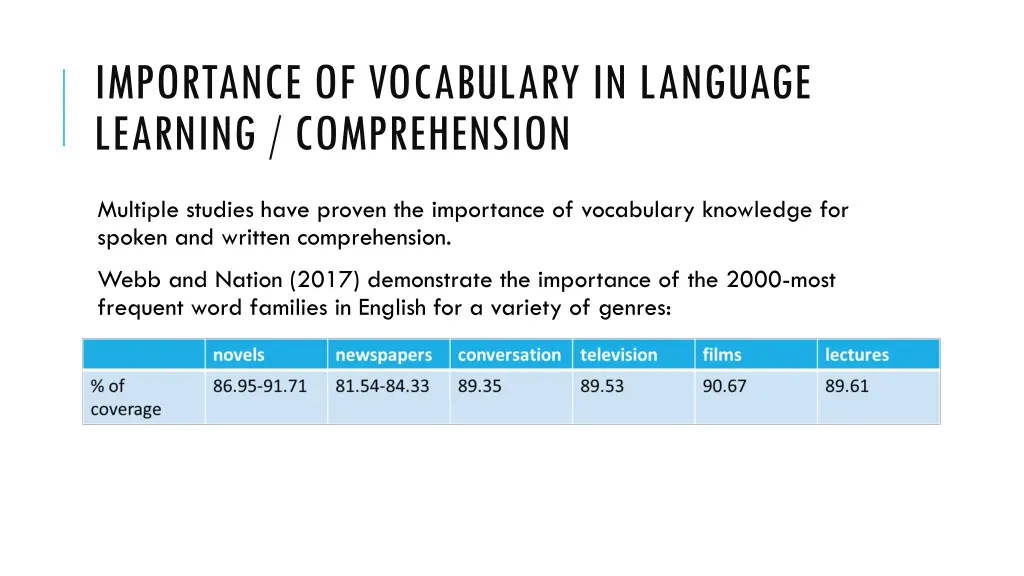
IMPORTANCE OF VOCABULARY IN LANGUAGE LEARNING / COMPREHENSION Multiple studies have proven the importance of vocabulary knowledge for spoken and written comprehension. Webb and Nation (2017) demonstrate the importance of the 2000-most frequent word families in English for a variety of genres:
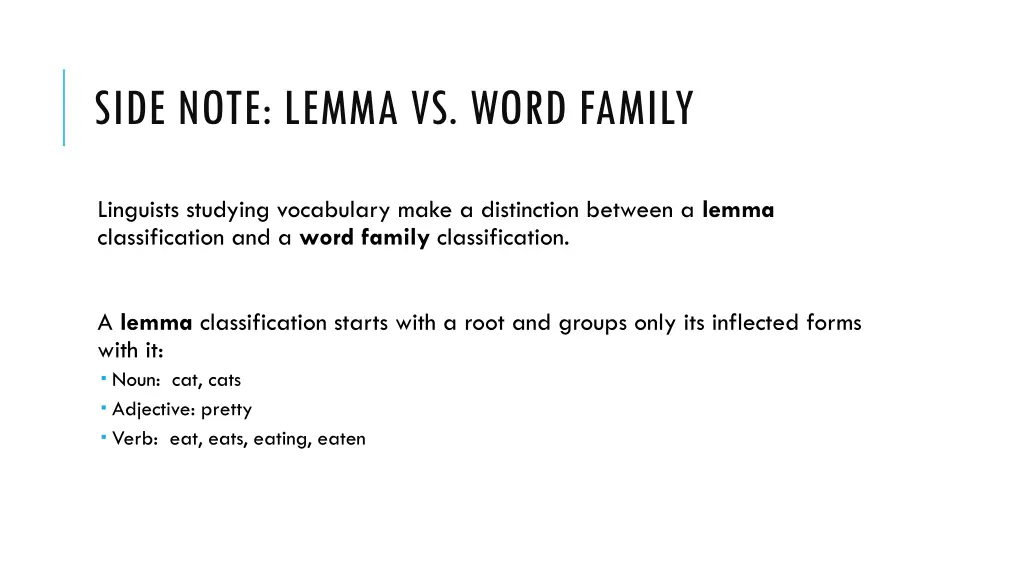
SIDE NOTE: LEMMA VS. WORD FAMILY Linguists studying vocabulary make a distinction between a lemma classification and a word family classification. A lemma classification starts with a root and groups only its inflected forms with it: Noun: cat, cats Adjective: pretty Verb: eat, eats, eating, eaten
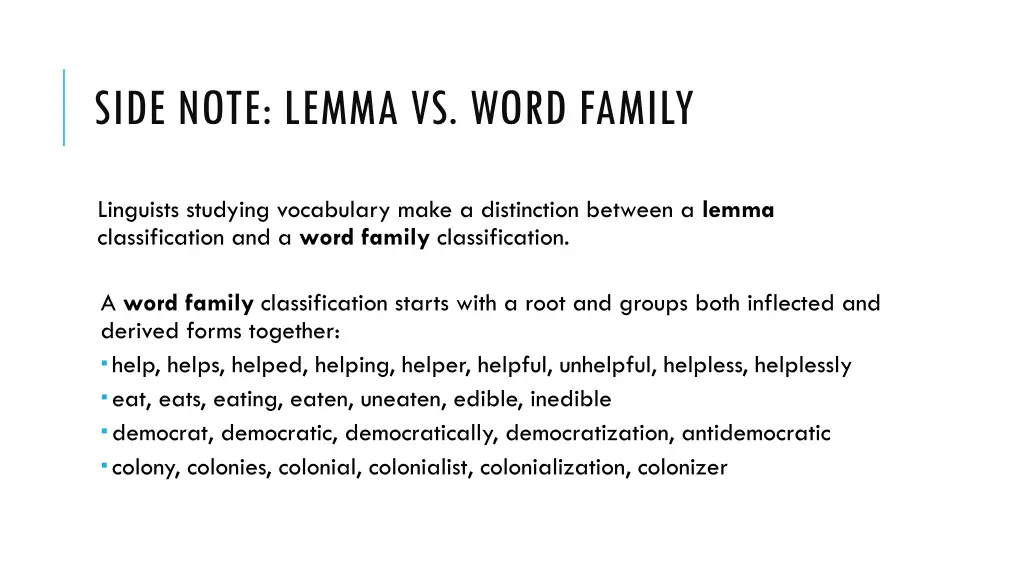
SIDE NOTE: LEMMA VS. WORD FAMILY Linguists studying vocabulary make a distinction between a lemma classification and a word family classification. A word family classification starts with a root and groups both inflected and derived forms together: help, helps, helped, helping, helper, helpful, unhelpful, helpless, helplessly eat, eats, eating, eaten, uneaten, edible, inedible democrat, democratic, democratically, democratization, antidemocratic colony, colonies, colonial, colonialist, colonialization, colonizer
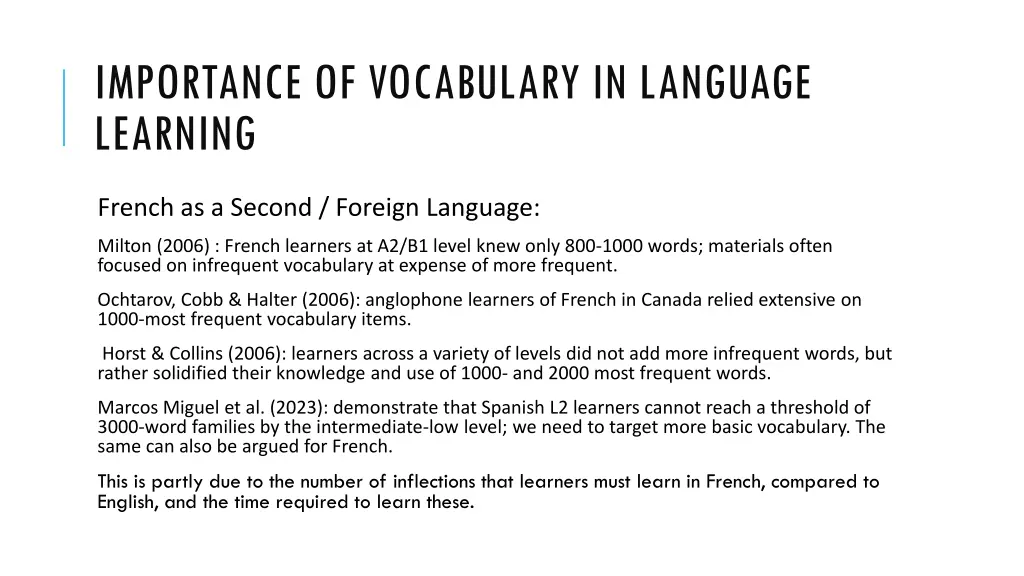
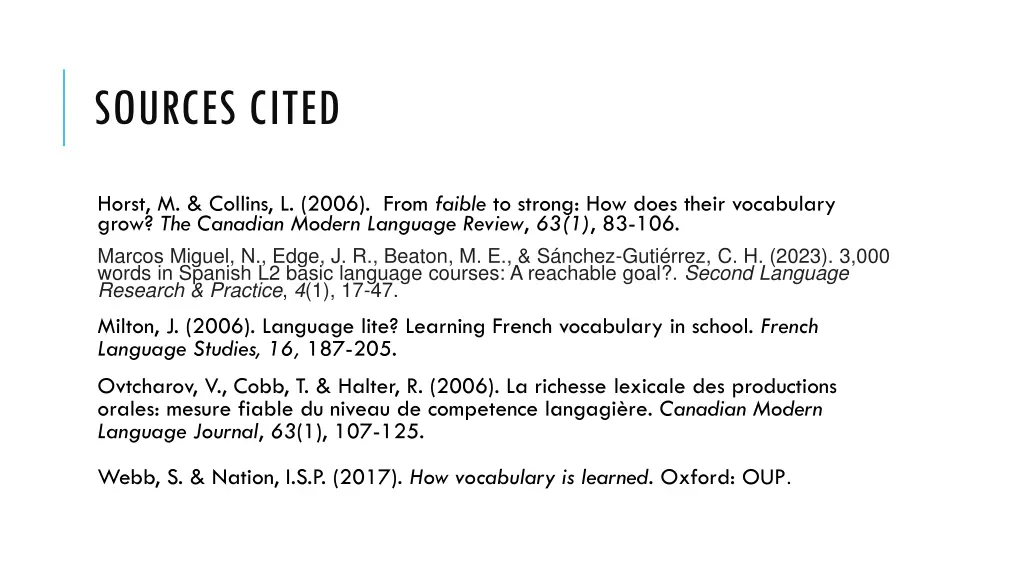
IMPORTANCE OF VOCABULARY IN LANGUAGE LEARNING French as a Second / Foreign Language: Milton (2006) : French learners at A2/B1 level knew only 800-1000 words; materials often focused on infrequent vocabulary at expense of more frequent. Ochtarov, Cobb & Halter (2006): anglophone learners of French in Canada relied extensive on 1000-most frequent vocabulary items. Horst & Collins (2006): learners across a variety of levels did not add more infrequent words, but rather solidified their knowledge and use of 1000- and 2000 most frequent words. Marcos Miguel et al. (2023): demonstrate that Spanish L2 learners cannot reach a threshold of 3000-word families by the intermediate-low level; we need to target more basic vocabulary. The same can also be argued for French. This is partly due to the number of inflections that learners must learn in French, compared to English, and the time required to learn these.
CORPUS DATA AND WORD FREQUENCY Recent work with corpus data has allowed us better understand which vocabulary is included in a text. This can help us to determine if a text might be suitable for learners at a given level. While not the only index that we should use, it can be a helpful one when choosing authentic materials for a world language course.
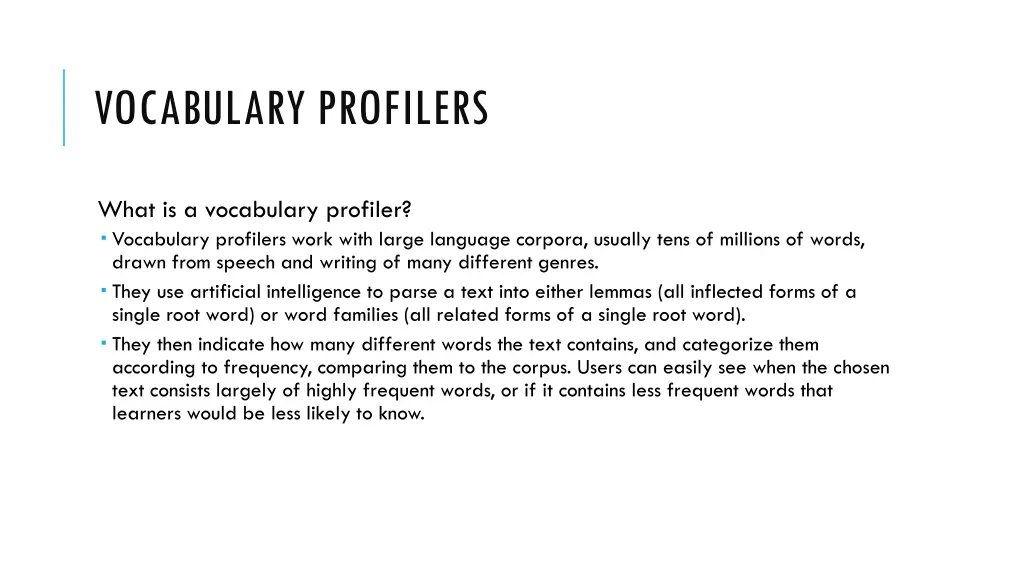
VOCABULARY PROFILERS What is a vocabulary profiler? Vocabulary profilers work with large language corpora, usually tens of millions of words, drawn from speech and writing of many different genres. They use artificial intelligence to parse a text into either lemmas (all inflected forms of a single root word) or word families (all related forms of a single root word). They then indicate how many different words the text contains, and categorize them according to frequency, comparing them to the corpus. Users can easily see when the chosen text consists largely of highly frequent words, or if it contains less frequent words that learners would be less likely to know.
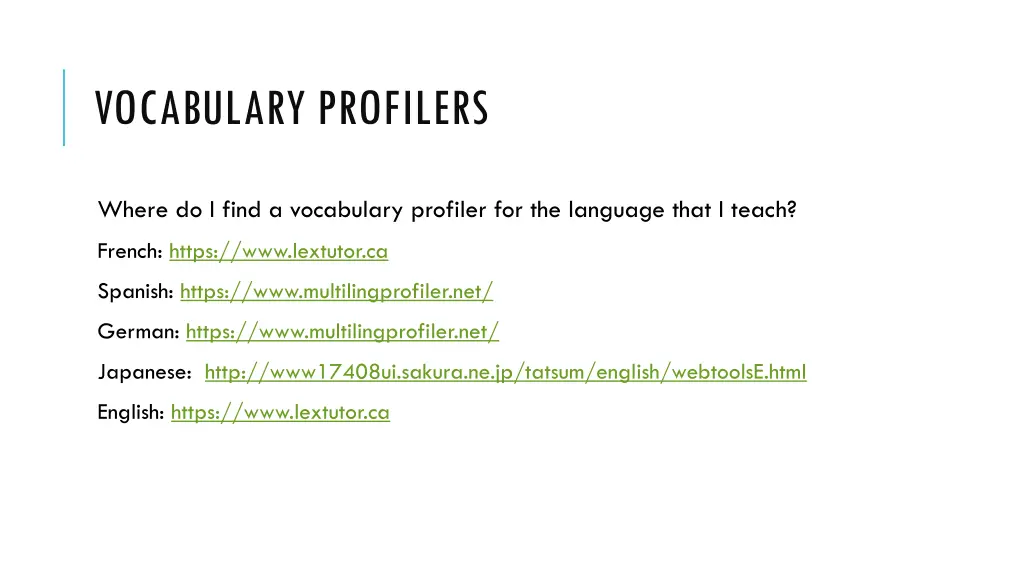
VOCABULARY PROFILERS Where do I find a vocabulary profiler for the language that I teach? French: https://www.lextutor.ca Spanish: https://www.multilingprofiler.net/ German: https://www.multilingprofiler.net/ Japanese: http://www17408ui.sakura.ne.jp/tatsum/english/webtoolsE.html English: https://www.lextutor.ca
VOCABULARY PROFILERS How do I use a vocabulary profiler? Select a text (authentic or not) that you want to profile. Select the appropriate profiler.
DEMONSTRATION In my ready room there is a handout with sample texts from a variety of genres. Using lextutor.ca, we ll analyze the vocabulary in each of them.
HOW CAN VOCABULARY PROFILERS HELP US? First and foremost, they show us the overall frequency of high and low frequency words in a text that we have chosen. Ideally, we want to target texts with a majority of high-frequency words. They also show which words recur in a text. Lower-frequency words that are used repeatedly are items that we can focus on during pre-reading / listening activities, or that we might choose to replace with other, higher-frequency synonyms.
HOW CAN VOCABULARY PROFILERS HELP US? If choosing between two texts, a profiler can help to determine if one text contains more vocabulary that would be known to learners, or if it contains thematic vocabulary that we are focusing on. Sophisticated vocabulary profilers can also help us to determine the number of cognates, sentences, type/token ratio (how many different words in a text), etc.
YOUR TURN! Find a text that you d like to profile and insert it into lextutor.ca What did you find out about it? What limitations (if any) did you encounter? What questions do you have?
SOURCES CITED Horst, M. & Collins, L. (2006). From faible to strong: How does their vocabulary grow? The Canadian Modern Language Review, 63(1), 83-106. Marcos Miguel, N., Edge, J. R., Beaton, M. E., & S nchez-Guti rrez, C. H. (2023). 3,000 words in Spanish L2 basic language courses: A reachable goal?. Second Language Research & Practice, 4(1), 17-47. Milton, J. (2006). Language lite? Learning French vocabulary in school. French Language Studies, 16, 187-205. Ovtcharov, V., Cobb, T. & Halter, R. (2006). La richesse lexicale des productions orales: mesure fiable du niveau de competence langagi re. Canadian Modern Language Journal, 63(1), 107-125. Webb, S. & Nation, I.S.P. (2017). How vocabulary is learned. Oxford: OUP.
FURTHER QUESTIONS? Contact me at antes@ufl.edu Visit my website starting Monday for a copy of the slides: www.people.clas.ufl.edu/antes
DO YOU TEACH FRENCH AT THE A2 LEVEL? If so, and you can spare 30-40 minutes to help with my current vocabulary research project, please complete my survey on teachers perceptions of the usefulness, relevance and cognateness of 100 French vocabulary items. Link here: