Reaching Ethical Maturity in Public Relations Practice
Ethical development in public relations through different models, such as press agentry, public information, and two-way asymmetrical. Discusses ethical advantages and disadvantages, application of ethical codes, and the importance of diverse perspectives for ethical growth.

Download Presentation

Please find below an Image/Link to download the presentation.
The content on the website is provided AS IS for your information and personal use only. It may not be sold, licensed, or shared on other websites without obtaining consent from the author.If you encounter any issues during the download, it is possible that the publisher has removed the file from their server.
You are allowed to download the files provided on this website for personal or commercial use, subject to the condition that they are used lawfully. All files are the property of their respective owners.
The content on the website is provided AS IS for your information and personal use only. It may not be sold, licensed, or shared on other websites without obtaining consent from the author.
E N D
Presentation Transcript
Reaching Ethical Maturity: The Ethical Development of Public Relations Practice Module Two | Lesson Two
Lesson Two | Principles Lesson Overview Ethical development in public relations Public relations models: Press agentry/publicity Public information Two-way asymmetrical Two-way symmetrical TARES Pillars of public relations ethics
Lesson Two | Principles Ethical Progression of Moral Obligations Themselves Clients Organizations/employers Profession/colleagues Society
Lesson Two | Principles Press Agentry Model Publicity Focus on self-interest Teleology orientation Outcome more important than the process
Lesson Two | Principles Discussion Question Explain how the press agentry model exemplifies a teleological approach. What are the ethical advantages/ disadvantages of this practice of public relations?
Lesson Two | Principles Public Information Model Journalist in residence Focus on truthful and accurate information Deontology orientation Professional codes of ethics guide behavior
Lesson Two | Principles Discussion Question How does the application of the PRSA code of ethics represent a deontological approach in the public information model of public relations?
Lesson Two | Principles Two-Way Asymmetrical Model Persuasive communication Feedback loop offers an other ethical perspective Teleology orientation Risks/Benefits assessment to maximize benefit and minimize harm
Lesson Two | Principles Discussion Question How does the two-way asymmetrical public relations model offer an other perspective absent from the two lesser models? Why is this perspective important to ethical development?
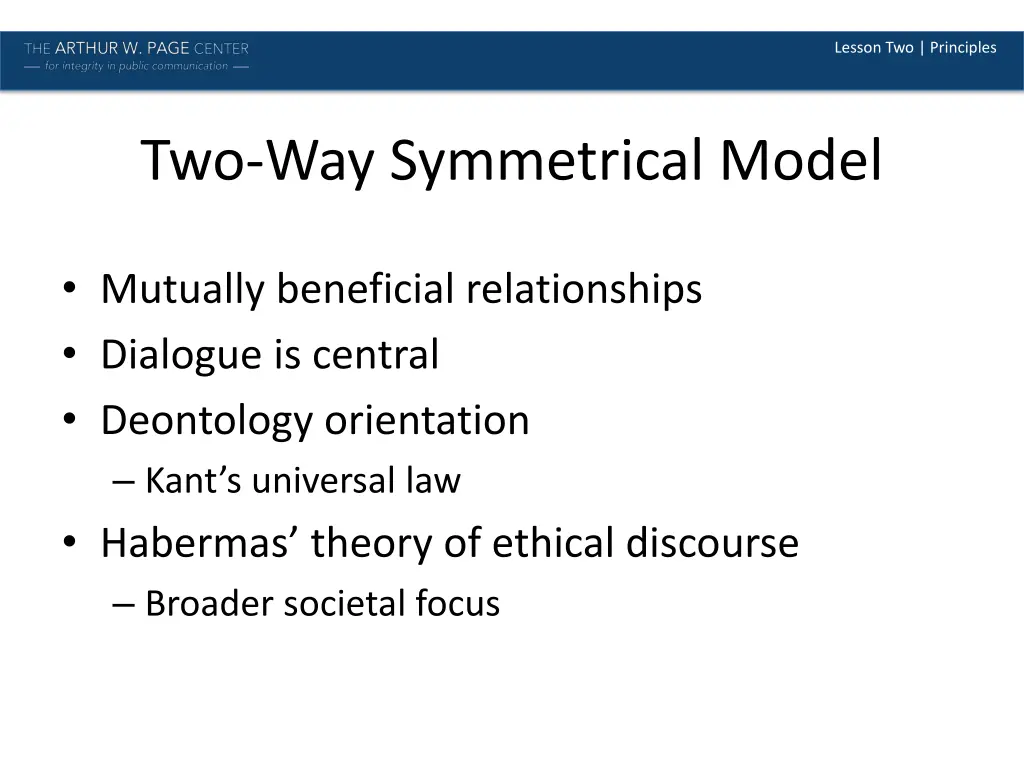
Lesson Two | Principles Two-Way Symmetrical Model Mutually beneficial relationships Dialogue is central Deontology orientation Kant s universal law Habermas theory of ethical discourse Broader societal focus
Lesson Two | Principles Discussion Question How does Habermas theory of ethical discourse support the ethical practice of two-way symmetrical public relations?
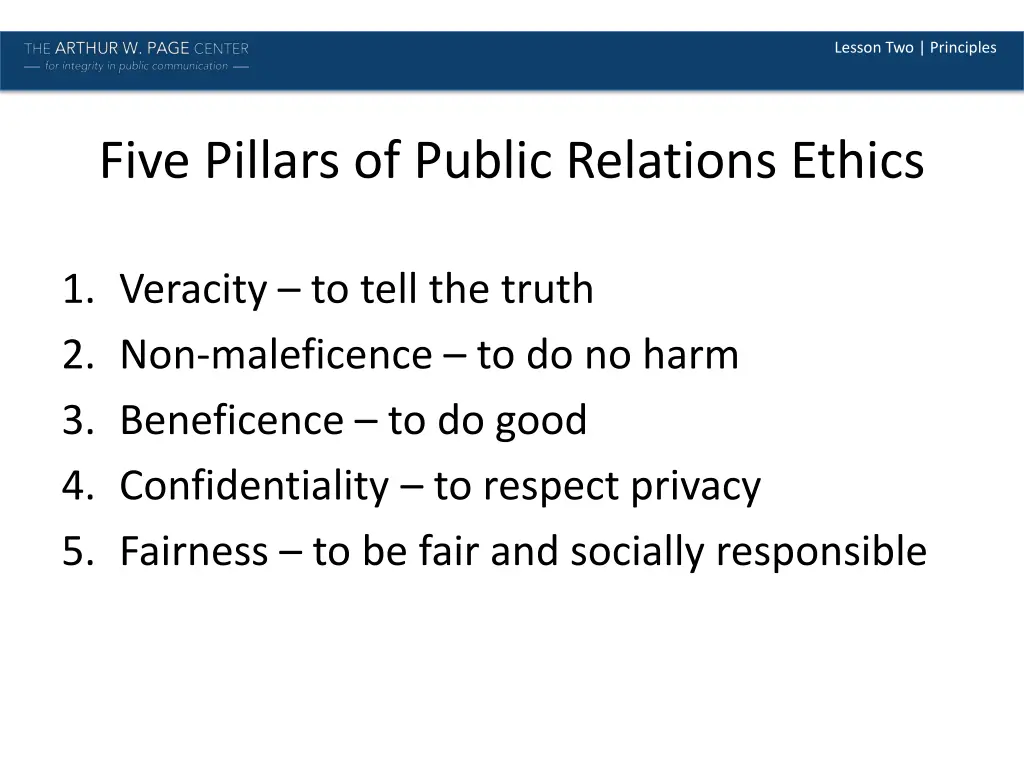
Lesson Two | Principles Five Pillars of Public Relations Ethics 1. Veracity to tell the truth 2. Non-maleficence to do no harm 3. Beneficence to do good 4. Confidentiality to respect privacy 5. Fairness to be fair and socially responsible
Lesson Two | Principles Discussion Question How might the pillars of ethical public relations guide the ethical behavior of public relations professionals?