Reading Disabilities and Mental Health in College-Age Adults
This study examines the impact of anxiety, stress, depression, and stigma on college students with reading disorders. It delves into the significance of understanding these issues in older learners and aims to identify potential effects and solutions related to reading disabilities in this demographic.

Download Presentation

Please find below an Image/Link to download the presentation.
The content on the website is provided AS IS for your information and personal use only. It may not be sold, licensed, or shared on other websites without obtaining consent from the author.If you encounter any issues during the download, it is possible that the publisher has removed the file from their server.
You are allowed to download the files provided on this website for personal or commercial use, subject to the condition that they are used lawfully. All files are the property of their respective owners.
The content on the website is provided AS IS for your information and personal use only. It may not be sold, licensed, or shared on other websites without obtaining consent from the author.
E N D
Presentation Transcript
Reading Disabilities and Anxiety, Stress, Depression, and Stigma among College-Age Adults By: Hannah Crespy
Background - One of the most prevalent reading disorders in the United States affecting approximately 4-5% of all school-age children is dyslexia.1 - Dyslexia is characterized as difficulty with either reading, spelling, or processing words or letters.1 - Adolescence is a formative time in a person s life. The inability to accurately and efficiently read and write can lead to heavy self-criticism, low self-esteem and confidence, as these children might need to rely on others for educational and social support.1 - These struggles may contribute to severe anxiety and or depression, making everyday life very stressful.1 1. (Undheim & Sund, 2008)
Significance Why is this important? - Most of the research on reading disabilities focuses on young learners, there are limited studies that look at college-aged individuals who have reading disorders. - Out of the limited research, there are conflicting findings on whether adults with reading disabilities have significantly higher levels of anxiety and depression.2,3 - Large amounts of stigma surrounds reading disorders. - Previous research has found that half of the public believes or strongly believes that the term learning disability is code for laziness.4 2. (Carroll & Iles, 2006), 3. (Nelson & Gregg, 2012), 4. (Daley & Rappolt-Schlichtmann, 2018).
Aims of this study AIM 1: Determine the effects anxiety, stress, and depression has on college students with a reading disorder. Hypothesis 1: College-aged adults with a reading disorder will have higher levels of anxiety, stress, and depression relative to people without a reading disability.
Aims of this study continued AIM 2: Identify the potential deleterious ways that stigma impacts college-students who have a reading disorder. Hypothesis 2: Students with reading disorders that have had enriched education and emotional support systems will have lower anxiety, stress, and depression scores than adults with reading disabilities that did not receive the same level of support. Hypothesis 3: The educational and emotional resources that are surrounded by higher perceived stigma levels are less effective and less utilized. Hypothesis 4: Individuals with reading disorders perceive that there are high levels of stigma towards having a reading disorder relative to those without reading disorders.
Aims of this study continued Exploratory AIM 3: Examine participant demographics (i.e., sex, race) as potential moderators of observed findings. Hypothesis 5: Females with a reading disorder, relative to males, will have higher levels of anxiety, stress, depression, and perceived stigma. Hypothesis 6: Lower socioeconomic status during primary school years will positively correlate with higher anxiety, stress, depression, and perceived stigma scores.
Methodology: Participants - College students with and without a reading disorder (RD) will be recruited for study enrollment. - Recruitment outreach efforts will entail contacting disability student service centers within the PASSHE system. - Outreach correspondence will share IRB approval documentation, the research portal weblink enabling completion of study measures, and a request to forward the study announcement and weblink to students receiving academic accommodations. - The study aims to recruit 400 participants (n=200 RD; n=200 No-RD).
Methodology: Materials Demographic Questionnaire: Self-report measure of general demographic information (i.e., sex, age, race, year in college). Depression Anxiety Stress Scale (DASS-21; Lovibond & Lovibond, 1995): 21-item self-report measure assessing depression, anxiety, and stress. College Chronic Life Stress Survey (CCLSS; Towbes & Cohen, 1996): 54-item self-report measure of stress among college students. Stigma Consciousness Questionnaire Learning Disabilities (SCQ-LD; Daley, Rappolt-Schlichtmann, 2018): 12-item self-report measure of stigma attitudes related to learning disabilities. Perceived Stigma of Support Systems (PSSS): Researcher generated self-report questionnaire measuring stigma related to social support and academic service use for people with reading disorders.
Methodology: Design - Between-group comparisons (i.e., RD vs No-RD) will be tested with independent samples T-Tests to evaluate group differences on anxiety, chronic stress, and depression. - The research uses a within-subjects test model when measuring levels of educational and emotional support in relation to anxiety, chronic stress, and depression. - A within-subjects model will also be used when looking at the levels of stigma surrounding resources, and the levels of stigma surrounding having a reading disability. - Due to specific selection criteria to be in each group, randomization of participants will not be possible. - The independent variable is the existence or absence of a reading disorder. The dependent variables are the presence of anxiety, stress, depression, and stigma within the experimental group.
Methodology: Procedures - The first phase of this research will be coordinated over the summer and will include preparation and submission of an IRB proposal, correspondence with University disability centers, and addressing all technical aspects of online data acquisition platforms (i.e., Qualtrics). - The second phase of this proposal will occur during the Fall 2021 semester and will entail on- going data collection, statistical analysis of data, and preparation of work products.
Methodology: Consent and Risks - These study procedures are relatively low risk. - Participants may experience some distress when answering questions about anxiety, stress, and depression. - Study participation will be voluntary, and all participants will complete informed consent procedures prior to enrollment. - Mental health resources will be provided to all participants at the end of the survey.
Results - After study completion, the data will be analyzed. - Group comparisons (RD vs No-RD) will for anxiety, stress, and depression. - The measures are done to test stigma surrounding different emotional and educational resources, and the levels of stigma related to having a reading disability will be statistically compared within the experimental group.
Results Continued - All results will be analyzed based on the outcomes predicted from the hypotheses. - Previous research surrounding adults with reading disorders have not specifically looked at the impact of the demographics, especially socioeconomic and race factors. - there are mixed conclusions surrounding sex in relation to anxiety and depression. These demographics and sex factors will be evaluated as covariates in all statistical analyses.
Discussion Limitations - Due to stigma, having a reading disorder may not be a disability that people will be comfortable sharing. The negative stigma may make it difficult to recruit participants considering that individuals might feel less comfortable acknowledging that a reading disorder is a struggle they face. - Recruitment methods may inform future studies to continue to seek creative ways to find people who have a reading disability to participate. - Obtaining school approval to send out links for the study. While this study will allow participants to remain anonymous, some schools may decide that they are unable to share the survey with students due to confidentiality concerns. Acknowledging this limitation, the researcher is prepared to research out to the Pennsylvania Branch of the International Dyslexia Association (PBIDA), to expand recruitment efforts if needed.
Discussion Continued - As there is limited research done on adults with a reading disorder, this study will be foundational to future research on this topic. - If significance is found for all that is hypothesized, the results may be fruitful in several ways. - There is a gap in the literature surrounding reading disorders in adults, this research can form future studies. - This data can be used as a way to change legislation surrounding reading disorders in public schools. - The literature already suggests how children feel when they struggle with dyslexia, but it has not coherently demonstrated the possible lasting effects into adulthood. - This data is needed to provide aggressive early intervention in schools in order to potentially prevent significant emotional distress later in life.
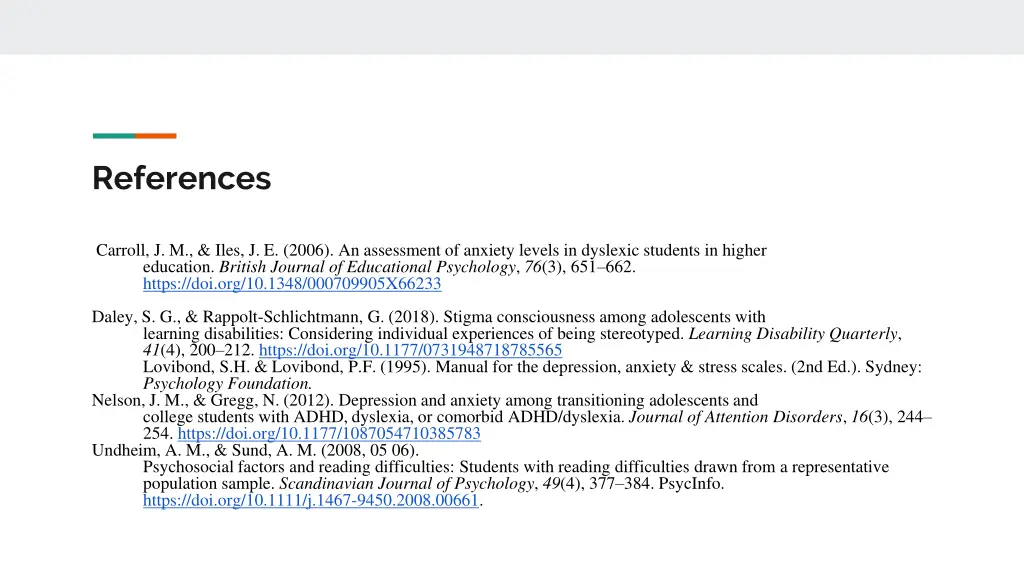
References Carroll, J. M., & Iles, J. E. (2006). An assessment of anxiety levels in dyslexic students in higher education. British Journal of Educational Psychology, 76(3), 651 662. https://doi.org/10.1348/000709905X66233 Daley, S. G., & Rappolt-Schlichtmann, G. (2018). Stigma consciousness among adolescents with learning disabilities: Considering individual experiences of being stereotyped. Learning Disability Quarterly, 41(4), 200 212. https://doi.org/10.1177/0731948718785565 Lovibond, S.H. & Lovibond, P.F. (1995). Manual for the depression, anxiety & stress scales. (2nd Ed.). Sydney: Psychology Foundation. Nelson, J. M., & Gregg, N. (2012). Depression and anxiety among transitioning adolescents and college students with ADHD, dyslexia, or comorbid ADHD/dyslexia. Journal of Attention Disorders, 16(3), 244 254. https://doi.org/10.1177/1087054710385783 Undheim, A. M., & Sund, A. M. (2008, 05 06). Psychosocial factors and reading difficulties: Students with reading difficulties drawn from a representative population sample. Scandinavian Journal of Psychology, 49(4), 377 384. PsycInfo. https://doi.org/10.1111/j.1467-9450.2008.00661.