Reading Skills Development for Key Stage 1
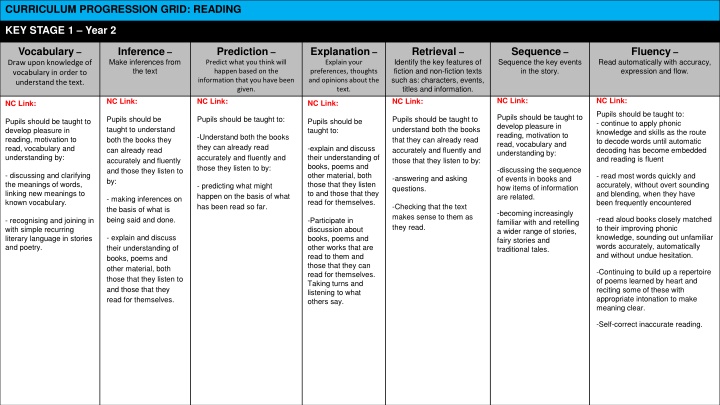
Enhance reading skills among Year 2 students by focusing on vocabulary, inference, prediction, explanation, retrieval, sequence, and fluency. The curriculum progression grid outlines activities such as discussing word meanings, making inferences, predicting story outcomes, and participating in book discussions. Emphasis is placed on reading fluently, understanding texts, and building a repertoire of stories and poems. By implementing these strategies, students can develop a love for reading and improve comprehension abilities.

Download Presentation

Please find below an Image/Link to download the presentation.
The content on the website is provided AS IS for your information and personal use only. It may not be sold, licensed, or shared on other websites without obtaining consent from the author.If you encounter any issues during the download, it is possible that the publisher has removed the file from their server.
You are allowed to download the files provided on this website for personal or commercial use, subject to the condition that they are used lawfully. All files are the property of their respective owners.
The content on the website is provided AS IS for your information and personal use only. It may not be sold, licensed, or shared on other websites without obtaining consent from the author.
E N D
Presentation Transcript
CURRICULUM PROGRESSION GRID: READING KEY STAGE 1 Year 2 Vocabulary Draw upon knowledge of vocabulary in order to understand the text. Inference Make inferences from the text Prediction Predict what you think will happen based on the information that you have been given. NC Link: Explanation Explain your preferences, thoughts and opinions about the text. Retrieval Identify the key features of fiction and non-fiction texts such as: characters, events, titles and information. NC Link: Sequence Sequence the key events in the story. Fluency Read automatically with accuracy, expression and flow. NC Link: NC Link: NC Link: NC Link: NC Link: Pupils should be taught to: - continue to apply phonic knowledge and skills as the route to decode words until automatic decoding has become embedded and reading is fluent Pupils should be taught to develop pleasure in reading, motivation to read, vocabulary and understanding by: Pupils should be taught to understand both the books they can already read accurately and fluently and those they listen to by: Pupils should be taught to: Pupils should be taught to understand both the books that they can already read accurately and fluently and those that they listen to by: Pupils should be taught to develop pleasure in reading, motivation to read, vocabulary and understanding by: Pupils should be taught to: -Understand both the books they can already read accurately and fluently and those they listen to by: -explain and discuss their understanding of books, poems and other material, both those that they listen to and those that they read for themselves. -discussing the sequence of events in books and how items of information are related. - discussing and clarifying the meanings of words, linking new meanings to known vocabulary. - read most words quickly and accurately, without overt sounding and blending, when they have been frequently encountered -answering and asking questions. - predicting what might happen on the basis of what has been read so far. - making inferences on the basis of what is being said and done. -Checking that the text makes sense to them as they read. -becoming increasingly familiar with and retelling a wider range of stories, fairy stories and traditional tales. -read aloud books closely matched to their improving phonic knowledge, sounding out unfamiliar words accurately, automatically and without undue hesitation. - recognising and joining in with simple recurring literary language in stories and poetry. -Participate in discussion about books, poems and other works that are read to them and those that they can read for themselves. Taking turns and listening to what others say. - explain and discuss their understanding of books, poems and other material, both those that they listen to and those that they read for themselves. -Continuing to build up a repertoire of poems learned by heart and reciting some of these with appropriate intonation to make meaning clear. -Self-correct inaccurate reading.
CURRICULUM PROGRESSION GRID: READING KEY STAGE 1 Year 2 Vocabulary Inference Prediction Explanation Retrieval Sequence Fluency Builds On: Year 1: Builds On: Year 1: Builds On: Year 1: Builds On: Year 1: Builds On: Year 1: Builds On: Year 1: Builds On: Year 1: -discussing word meanings, linking new meanings to those already known. - drawing on what they already know or on background information and vocabulary provided by the teacher. - making inferences on the basis of what is being said and done. - predicting what might happen on the basis of what has been read so far. -answering and asking questions. - becoming very familiar with key stories, fairy stories and traditional tales, retelling them and considering their particular characteristics. - read aloud and re-read accurately books that are consistent with their developing phonic knowledge and that do not require them to use other strategies to work out words. -checking that the text makes sense to them as they read and correcting inaccurate reading. -Learning to recite some poetry. Intent (overarching success criteria) -explain clearly their understanding of what is read to them. Intent (overarching success criteria) Intent (overarching success criteria) Intent (overarching success criteria) Intent (overarching success criteria) Intent (overarching success criteria) Intent (overarching success criteria) -Children will answer simple questions (what, where, how, why and when) about what has just happened in a text. -Children will give their answers verbally, visually or/and in writing. - Children will retrieve specific information from a short extract by scanning for key words. -Children will ask pertinent questions about what they have read. -Children will monitor what they have read, checking words they have decoded, to ensure they fit within the text they have already read. -Children will discuss new word meanings. -Children will use own knowledge, as well as what has happened so far in a story, to make sensible predictions. -Children will retell a wide range of stories both verbally and in writing. -Children will apply phonic knowledge and skills to read most common or familiar words quickly and accurately. -Children will decode automatically. -Children will read aloud books closely matched to their improving phonic knowledge. -Children will sound out unfamiliar words accurately, automatically and without undue hesitation. -Children will re-read books to build up their fluency and confidence. -Children will learn poetry by heart, using correct intonation. -Children will explain their favourite characters and settings. -Children will make inferences about the reasons for a characters actions, feelings or behaviour. --They will use what the character says or does to infer. -Children will find clues suggested in the pictures, speech or actions of the characters. -Children will track pronouns through sentences to ensure coherent connections are made. -Children will understand the relationships between characters. - They will link them to words that they already know, including root words. -Children will explain their understanding of texts and stories in full sentences. -Children will sequence main events from texts in pictures and /or writing. -They give explanations of their predictions verbally and/or in writing. -Children will explain changes they would make to stories. -They will use pictures and clues from the text to help them work out the meaning of new words. -Children will explain why they do or do not like particular stories and authors. -Children will join in with recurring literary language within stories and poems. -Children will use because to help them explain their ideas clearly.
KEY STAGE 1 Year 2 Vocabulary Inference Prediction Explanation Retrieval Sequence Fluency Vocabulary: Vocabulary: Vocabulary: Vocabulary: Vocabulary: Vocabulary: Vocabulary: word phrase meaning root noun/verb/adjective explain why feelings because I can see.. This tells me predict prediction I think that because... find copy what where who how why sequence re-tell main events order first, second, last etc.. beginning/ middle/ end fluent flow blend segment re-read explain why/ why not tell me more I would like to I would not like to I think I would change because Sample question stems: Sample question stems: Sample question stems: Sample question stems: Sample question stems: Sample question stems: Can you find a noun/adjective/ verb that tells/shows you that ? Why do you think the author used the word to describe ? Which other word on the page means the same as ? Find an adjective in the text that describes ? Which word best describes ? Find and copy the word which means Why was . feeling ..? Why did happen? Why did . say .? How has the author made us think that ? How does . make you feel? What do you think means? Why/how/when/ where do you think ? Look at the book cover/blurb/ title what do you think this book will be about? Where do you think will go next? What do you think will do/ say next? Why? What do you think will happen next? What makes you think this? How does the choice of character or setting affect what will happen next? What do you think the last paragraph suggests will happen next? Who do you think has done it? Why? What might say about that? Number these events 1-4 in the order that they happened? What happened after/ before .? What was the first thing that happened in the story? Can you summarise in a sentence the opening/middle/end of the story? In what order do these chapter headings come in the story? Retell the story in less than 20 words. Who is/ are the main character/s? Explain what is similar/ different about two characters. Explain why did that ? Is this as good as ? Why/ why not? Which is better and why? Does the picture help us and how? Would you like to live in this setting? Why or why not? Is there anything you would change about this story? Why/ why not? Do you agree with the author s ? Why/ why not? Explain the dilemma in the story. When/ where is this story set? How do you know? Which is the funniest/ scariest/ best part of the story? Tell me three facts you have learned from the text. Find the part where What type of text is this ? How do you know? What happened to . at the end of the story? Find and copy .
KEY STAGE 1 Year 2 Vocabulary Inference Prediction Explanation Retrieval Sequence Fluency Classroom Ideas: Classroom Ideas: Classroom Ideas: Classroom Ideas: Classroom Ideas: Classroom Ideas: Classroom Ideas: Verbally answer using modelled sentence structure. Continue the story to the end of the page. Retrieve verbally Act out the story. Label pictures with appropriate vocabulary. Model correct and incorrect intonation. (WABOLL & WAGOLL) Verbally explain. True or false quiz written or verbal Re-tell in own words and from memory. Verbal and written. Discuss with a partner first. Predict from part blanked out pictures of the front cover and/or title. Construct a simple written answer using same sentence structure as above. Sort words with similar meanings. Quickfire quiz questions Construct a written response using modelled sentence structure. Model correct use of punctuation and discuss. Sequence pictures and writing from the text. Comprehension tennis Intensity scale. Provide object/ words mentioned in the text and children predict what the story will be about. Use empty speech and thought bubbles. Children write ideas in. Fastest finger first. Play guess my word . Number simple sentences from the text 1-4. Choral response to a repeated phrase/ word. Write answers on a whiteboard. Venn diagram to compare discuss/ sort statements/ write simple statements. Find and copy Look at the pictures and spot the clues. Label inferences. Fastest finger first Make a quick quiz for a friend. Construct written answers using modelled sentence stems. Echo read. Definition bingo Become reading detectives and search for clues in the text and pictures. Write three facts about the text. Oral repeated reading. Match words/pics/ definitions. Use Where s Wally pictures to practise scanning. Draw what you read. Given choices, choose the most sensible prediction and explain why. Teacher read text and spot the teacher s mistake. Inference calculations Feelings graph Dilemma wheel (part filled) Listen to and learn a poem. Generic classroom ideas: Teacher models use of sentence stems then children use them verbally and in writing. Teacher models use of a word banks then children use the word bank orally and in writing. Transcribe children s oral responses into written responses and model how to use written structures. Have the text or snips of the text on display or on the visualiser. Teacher points at the text as he/she reads the text to the children. Teacher underlines or circles key words as discussed with the class. Children have a go highlighting or circling key words in a sentence. Teacher circles key evidence in pictures as discussed with the class. Teacher provides choices and class decide which is the best option and discuss why. Children try forming a written response using modelled sentence stem/s.