Real-time Systems and Task Communication Final Review
Explore the final review topics for Real-time Systems and Task Communication, featuring discussions on memory management, scheduling algorithms, and concurrent programming. Get prepared with tips on studying effectively and avoiding mistakes for the upcoming exam on December 11, 2019.

Download Presentation

Please find below an Image/Link to download the presentation.
The content on the website is provided AS IS for your information and personal use only. It may not be sold, licensed, or shared on other websites without obtaining consent from the author. If you encounter any issues during the download, it is possible that the publisher has removed the file from their server.
You are allowed to download the files provided on this website for personal or commercial use, subject to the condition that they are used lawfully. All files are the property of their respective owners.
The content on the website is provided AS IS for your information and personal use only. It may not be sold, licensed, or shared on other websites without obtaining consent from the author.
E N D
Presentation Transcript
Final Review CSE321 B.Ramamurthy 6/16/2025 B.Ramamurthy 1
Date, Time and Place December 11, 2019 8.00 11.00AM 121 Cooke Please bring Pencils, pens and erasers. Any form of ID with photograph Closed book exam 6/16/2025 B.Ramamurthy 2
Topics 1. Task communications Ch. 7, Ch.8 (pp.165-166,173-180) Signal and signal handlers forks for creating multiple processes (pingpong.c and other programs) 2. Memory management issues and pointers (See the course page for details: pointers, dynamic memory allocation, deallocation, and memory leaks) 3. Priority-based scheduling, priority inversion, priority inheritance 4. Earliest deadline (EDS), and rate monotonic scheduling (RMS) 5. Pseudo code solution for problems with concurrent tasks, critical resources and sections, mutual exclusion (mutex) based solutions 6/16/2025 B.Ramamurthy 3
Format One question per topic discussed above. Each question may have subsections No programming: but pseudo code may be required Given a piece of code you will identify the purpose Use diagrams/figures where ever possible 6/16/2025 B.Ramamurthy 4
How to study? Prepare? Come prepared: there is no substitute for hard work View the videos and follow class handouts Review class notes; Understand project work and class work Find ways to efficiently answer questions Find ways to avoid silly mistakes Create a mental checklist to make sure you have not missed anything important on the exam (like your name of the exam paper!) Read the question paper and strategize on the order in which you will answer the questions Build up competencies as you are reviewing the course material and not deficiencies Good luck. 6/16/2025 B.Ramamurthy 5
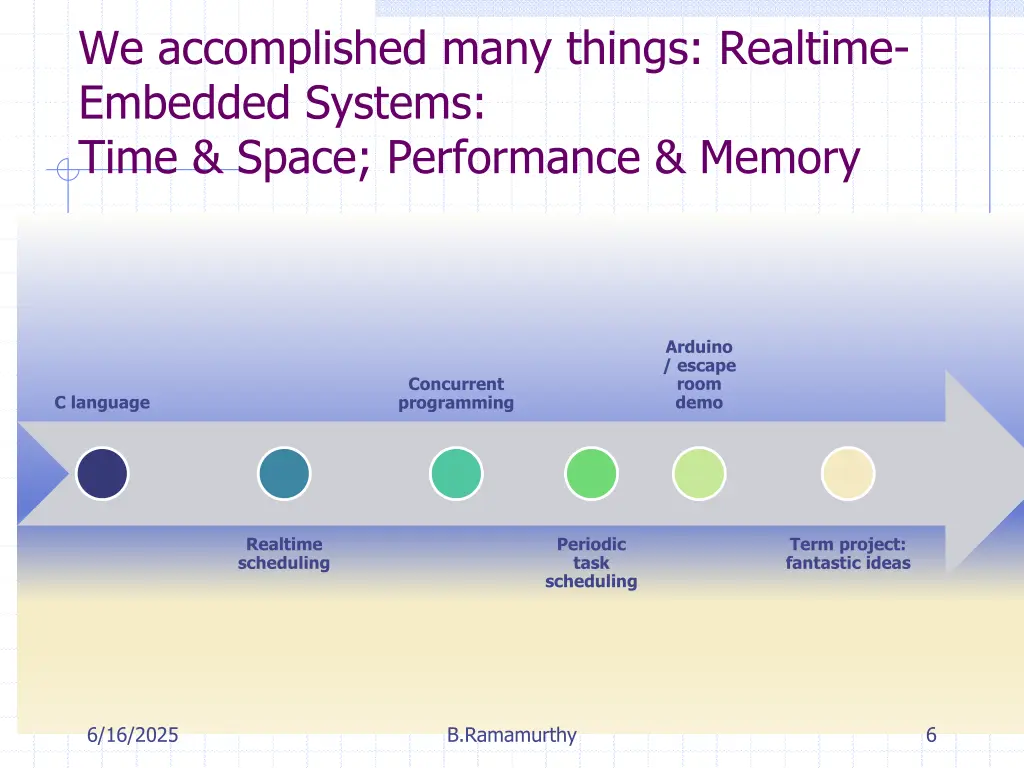
We accomplished many things: Realtime- Embedded Systems: Time & Space; Performance & Memory Arduino / escape room demo Concurrent programming C language Realtime scheduling Periodic task scheduling Term project: fantastic ideas 6/16/2025 B.Ramamurthy 6