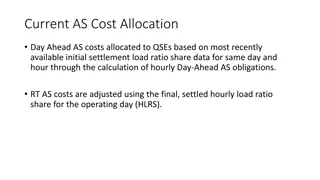
Real-Time Value of Lost Load and System-Wide Offer Cap
Key principles and processes for capping prices in real-time energy markets, including insights on SWOC, VOLL, PBPC, and more. Learn about the critical parameters affecting energy pricing and the implications of capping prices on market dynamics.

Download Presentation

Please find below an Image/Link to download the presentation.
The content on the website is provided AS IS for your information and personal use only. It may not be sold, licensed, or shared on other websites without obtaining consent from the author.If you encounter any issues during the download, it is possible that the publisher has removed the file from their server.
You are allowed to download the files provided on this website for personal or commercial use, subject to the condition that they are used lawfully. All files are the property of their respective owners.
The content on the website is provided AS IS for your information and personal use only. It may not be sold, licensed, or shared on other websites without obtaining consent from the author.
E N D
Presentation Transcript
HV testing Ian Input from S. Lusin 6 April 2019
Free charge, on the metal surfaces, Surface charge and bound charge within the dielectric, Volume charge density leaks onto the surface The latter goes to the former by induction ? Dielectric absorbtion or Soakage . These two aspects are not the capacitive charge that is removed instantaneously
The test method A box that ensures that the environmental conditions remain the same. The cable is tested with no resistance, so that the current drawn does not hide the current taken by the cable itself. We did not discuss charge up current due to capacitance and polarisation, interesting, length etc A 10Mohm to bring the cable back to 0 Volt and then quickly to the short in the box then put the clip on to ensure that no charge leaks back to the surface and so avoiding a shock. The box must be metallic and grouded so avoiding static build up. This is the case with the PS in a float configuration.
The charge(Vol) will come back after the test, to the surface, and so must be equalised by maintaining a contact between the inner conductor and the outer one. Solutions; use a shorted out connector at one or both ends Or. Devise some form of a clip that is cheaper BUT must remain in place for years until the chambers and/or PS are connected.