Discover how a team from Sungkyunkwan University and Samsung Electronics in Korea tackles the issue of excessive journaling overhead in mobile devices using small-sized NVRAM technology. Learn about the motivation, system design, and evaluation of this innovative solution aimed at improving performance and extending device lifetimes.
Please find below an Image/Link to download the presentation.
The content on the website is provided AS IS for your information and personal use only. It may not be sold, licensed, or shared on other websites without obtaining consent from the author. If you encounter any issues during the download, it is possible that the publisher has removed the file from their server.
You are allowed to download the files provided on this website for personal or commercial use, subject to the condition that they are used lawfully. All files are the property of their respective owners.
The content on the website is provided AS IS for your information and personal use only. It may not be sold, licensed, or shared on other websites without obtaining consent from the author.
E N D
Presentation Transcript
Reducing Excessive Journaling Overhead in Mobile Devices with Small-Sized NVRAM Junghoon Kim , Changwoo Min , and Young Ik Eom Sungkyunkwan University, Korea Samsung Electronics, Korea
Outline Background Motivation System Design Evaluation Conclusion 2
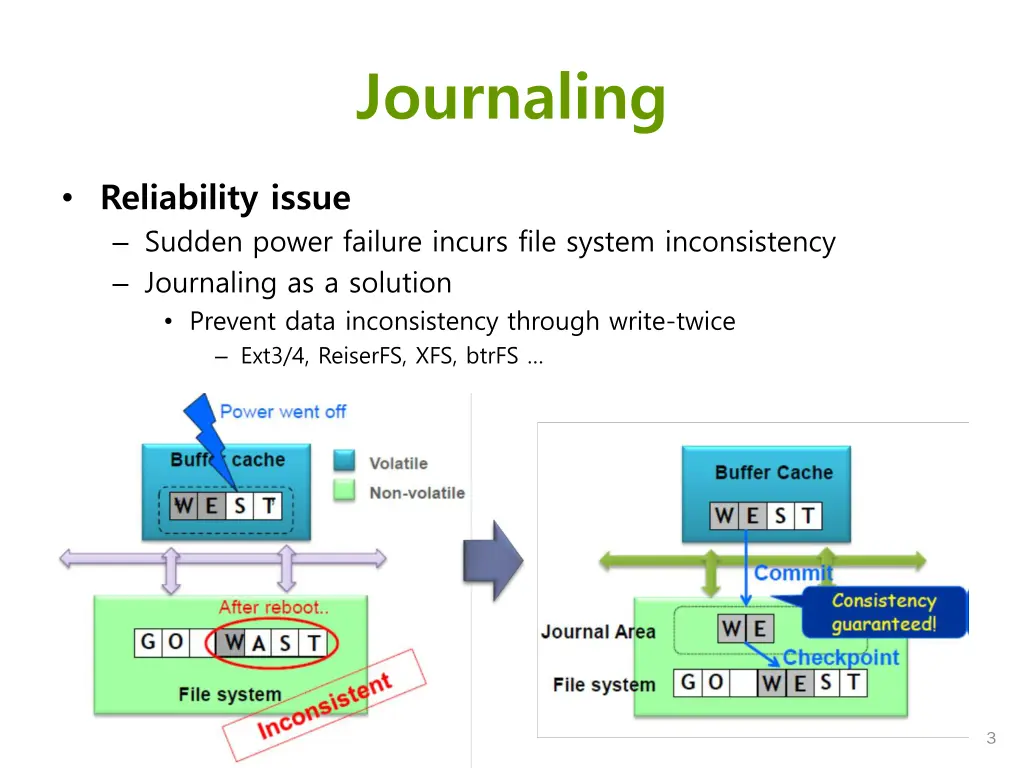
Journaling Reliability issue Sudden power failure incurs file system inconsistency Journaling as a solution Prevent data inconsistency through write-twice Ext3/4, ReiserFS, XFS, btrFS 3
Journaling overhead in mobile devices SQLite Generates approximately 80% of writes in mobile devices frequently calls fsync system call to guarantee data consistency The frequent fsync calls incur the excessive journaling NAND flash storage Used for secondary storage in mobile devices Asymmetric read/write latency Limited program/erase (P/E) cycles Excessive journaling is the major source of degrading performance and shortening lifetime! 4
NVRAM as a solution? NVRAM technology In the short term, there are limitations for whole storage system to be replaced with NVRAM Limited density High cost 7
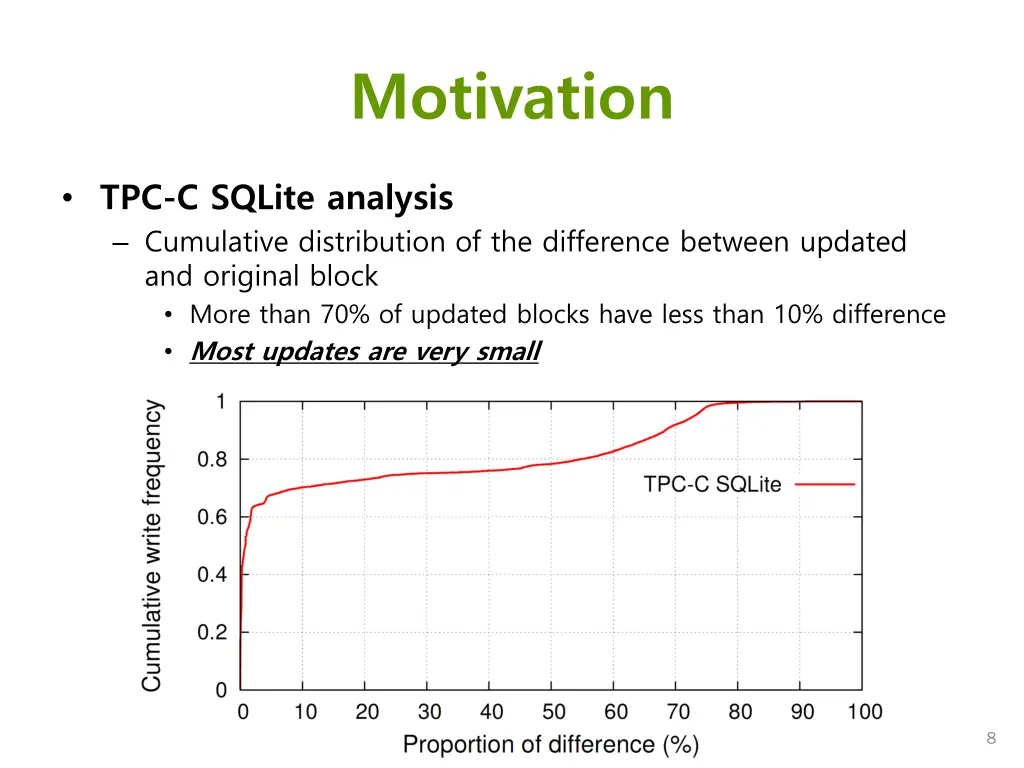
Motivation TPC-C SQLite analysis Cumulative distribution of the difference between updated and original block More than 70% of updated blocks have less than 10% difference Most updates are very small 8
System Architecture Delta Journaling To reduce the excessive journaling overhead Use small-sized NVRAM as the compressed delta journal area NVRAM 10
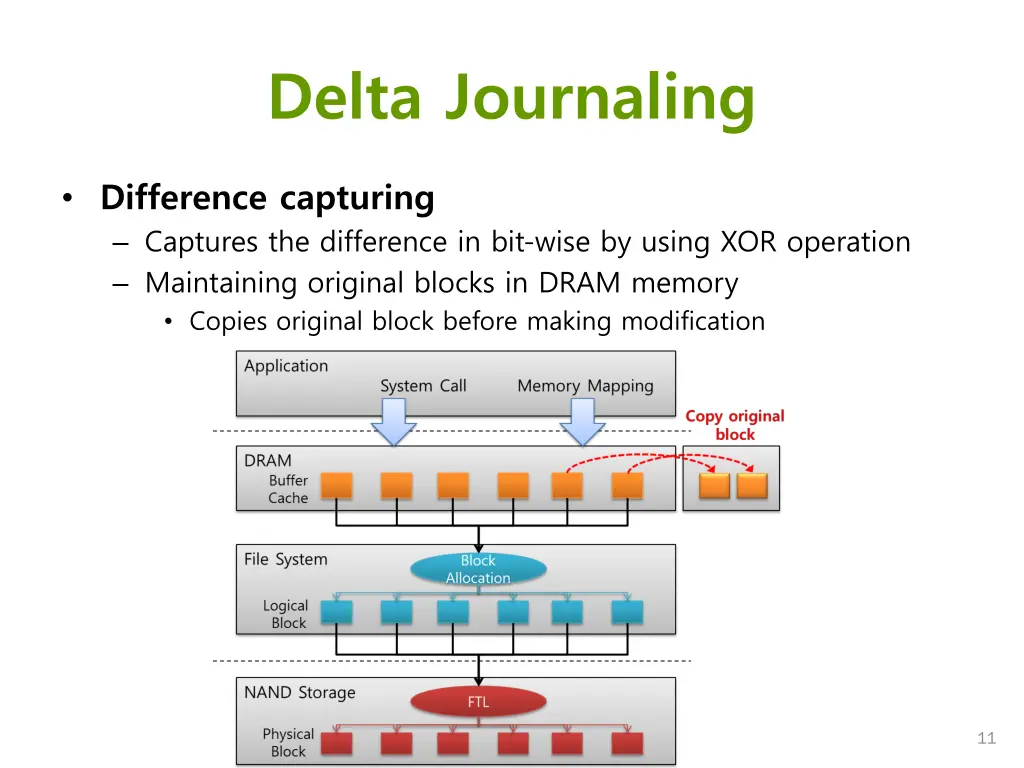
Delta Journaling Difference capturing Captures the difference in bit-wise by using XOR operation Maintaining original blocks in DRAM memory Copies original block before making modification 11
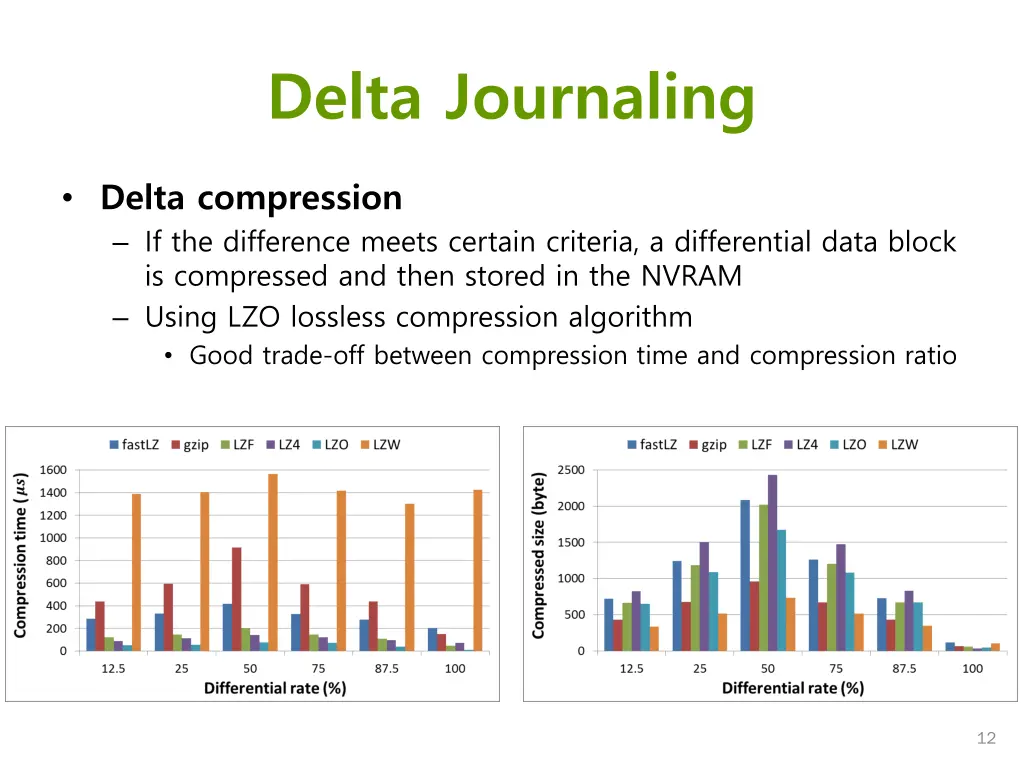
Delta Journaling Delta compression If the difference meets certain criteria, a differential data block is compressed and then stored in the NVRAM Using LZO lossless compression algorithm Good trade-off between compression time and compression ratio 12
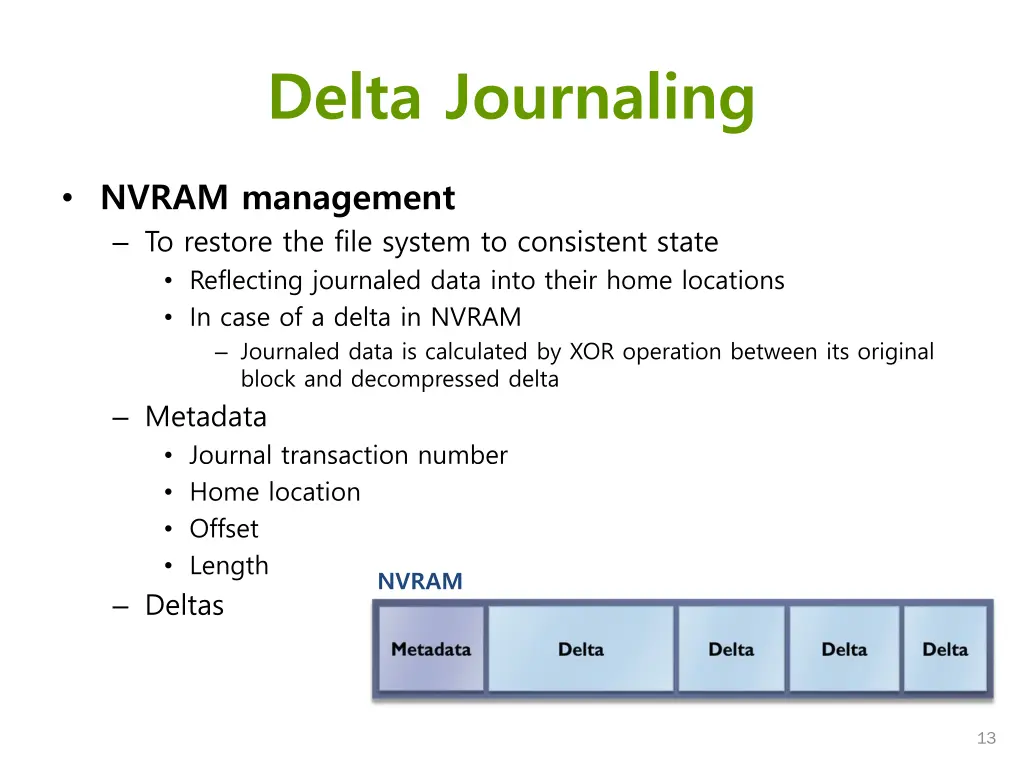
Delta Journaling NVRAM management To restore the file system to consistent state Reflecting journaled data into their home locations In case of a delta in NVRAM Journaled data is calculated by XOR operation between its original block and decompressed delta Metadata Journal transaction number Home location Offset Length Deltas NVRAM 13
Prototype Evaluation Experimental setup Hardware CPU Dual-core mobile processor Memory 2 GB DRAM SCM 16 MB of the DRAM is used for delta journal region NAND flash storage 16 GB A-Data microSD Commit period 5 seconds (default) Checkpointing A fourth of either journal or delta journal area is filled Five minutes (default) 15
Prototype Evaluation Synthetic workloads 256 MB and 512 MB overwrites with various proportions of difference DJ outperforms EXT4 by 16.8 times and 2.3 times in 256 MB and 512 MB overwrites, respectively TPC-C SQLite DJ achieved about 20% improvement in tpmC The number of journal writes in NAND flash is reduced by 58% 16
Conclusion Delta Journaling For reducing the excessive journaling overhead in mobile devices Stores a commit block as a compressed delta in the small-sized NVRAM only when the compressed delta is small enough Can improve the performance and the lifetime of NAND flash storage with only 16 MB NVRAM Future work Optimizing our prototype implementation Finding out optimal threshold of NVRAM for checkpointing Extending targets for delta journaling Journal descriptor block Journal commit block 17