Explore how IEEE 802.11 addresses latency reduction through preemption in UHR PAR, focusing on protection issues post-preemption and solutions to maintain transmission integrity and minimize impact on initial TXOP duration.
Please find below an Image/Link to download the presentation.
The content on the website is provided AS IS for your information and personal use only. It may not be sold, licensed, or shared on other websites without obtaining consent from the author. If you encounter any issues during the download, it is possible that the publisher has removed the file from their server.
You are allowed to download the files provided on this website for personal or commercial use, subject to the condition that they are used lawfully. All files are the property of their respective owners.
The content on the website is provided AS IS for your information and personal use only. It may not be sold, licensed, or shared on other websites without obtaining consent from the author.
E N D
Presentation Transcript
Dec. 2024 doc.: IEEE 802.11-24/2148r0 TXOP protection after preemption Date: 2024-12-27 Authors: Name Affiliations Address Phone email Hang Yang yanghang1@ruijie.com.cn Ke Zhong zhongke@ruijie.com.cn Ruijie Networks Co., Ltd. Hui Che chehui@ruijie.com.cn Fachang Guo Submission Slide 1 Hang Yang., Ruijie Networks Co., Ltd
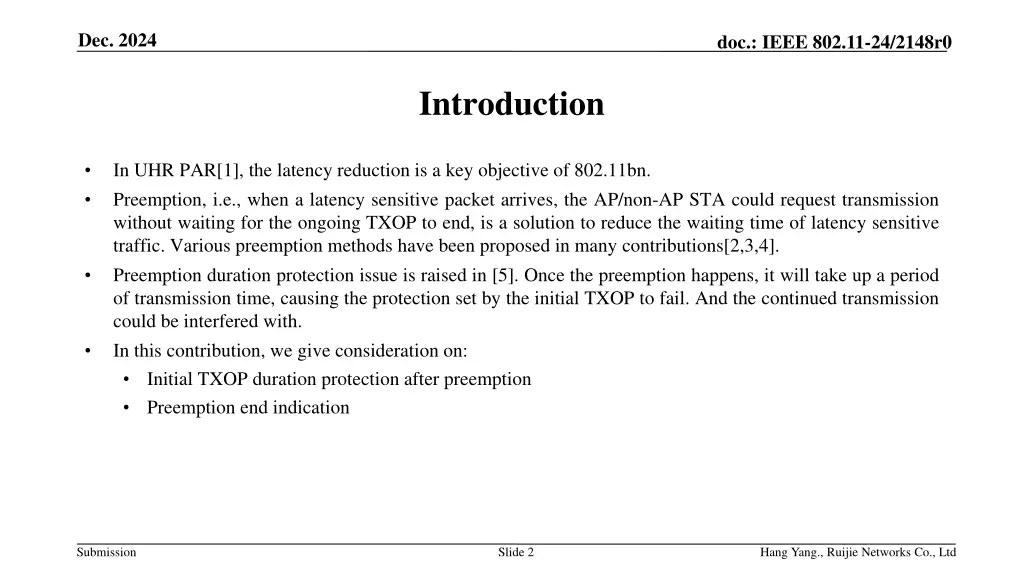
Dec. 2024 doc.: IEEE 802.11-24/2148r0 Introduction In UHR PAR[1], the latency reduction is a key objective of 802.11bn. Preemption, i.e., when a latency sensitive packet arrives, the AP/non-AP STA could request transmission without waiting for the ongoing TXOP to end, is a solution to reduce the waiting time of latency sensitive traffic. Various preemption methods have been proposed in many contributions[2,3,4]. Preemption duration protection issue is raised in [5]. Once the preemption happens, it will take up a period of transmission time, causing the protection set by the initial TXOP to fail. And the continued transmission could be interfered with. In this contribution, we give consideration on: Initial TXOP duration protection after preemption Preemption end indication Submission Slide 2 Hang Yang., Ruijie Networks Co., Ltd
Dec. 2024 doc.: IEEE 802.11-24/2148r0 Protection Issue caused by Preemption TXOP holder and responder set the initial protected TXOP duration T via RTS/CTS exchange Preemption happened in TXOP and occupied time tp To prevent current transmission after preemption from being transmitted without protect: Option 1: Continues to transmit data and ends the transmission before time T No further frame required The remaining data may not be fully transmitted Option 2: Extend the protection duration and continues to transmit remaining data Frames are needed to indicate new duration All the data in initial TXOP could be fully transmitted To minimize the impact to the initial TXOP, Option 2 is preferred Transmission w/o protect = tp Protected TXOP duration set by initial RTS/CTS = T Current transmission before preemption TF Preemption transmission Current transmission after preemption ACK PPDU 1 PPDU 2 PRI SIFS ACK ACK LL PPDU RTS CTS Preemption = tp Remain transmission after preemption ???????= ? ?1 Hang Yang., Ruijie Networks Co., Ltd Transmission before preemption = t1 Submission Slide 3
Dec. 2024 doc.: IEEE 802.11-24/2148r0 Preemption end process using RTS/CTS In DL TXOP, when preemption ends, AP1 (TXOP holder) and STA1 (TXOP responder) send RTS/CTS before continuing the transmission RTS/CTS indicates new protected TXOP duration of remain traffic Related STAs may update the NAV timer according to RTS/CTS frame Protected TXOP duration set by initial RTS/CTS = T New TXOP duration PPDU 1 PPDU 2 RTS RTS AP 1 Preemption transmission time = tp Current transmission before preemption SIFS SIFS SIFS xIFS ACK CTS ACK CTS STA1 Cancel the transmission PPDU STA 2 (hidden from AP 1) NAV NAV Submission Slide 4 Hang Yang., Ruijie Networks Co., Ltd
Dec. 2024 doc.: IEEE 802.11-24/2148r0 Preemption end process using RTS/CTS In UL TXOP, when preemption ends, AP1 (TXOP responder) send a CTS to STA1 (TXOP holder) As the preemption end indication, the CTS frame solicits STA1 to continue transmission CTS indicates new protected TXOP duration of remain traffic Related STAs may update the NAV timer according to CTS frame STAs hidden from AP1 could listen PPDU from STA1, and set NAV according to PPDU s duration field Protected TXOP duration set by initial RTS/CTS = T Indicate new TXOP duration Cancel the transmission PPDU STA 2 (hidden from STA 1) NAV NAV PPDU 1 CTS CTS ACK AP 1 Preemption transmission time = tp Current transmission before preemption SIFS SIFS xIFS RTS PPDU ACK STA1 STA 3 (hidden from AP 1) Medium Busy NAV NAV Submission Slide 5 Hang Yang., Ruijie Networks Co., Ltd
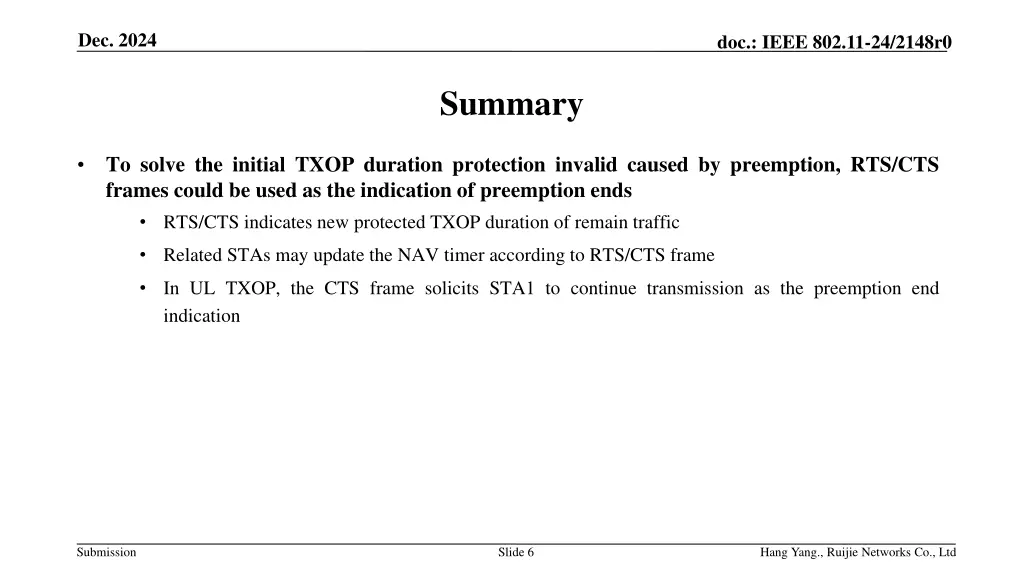
Dec. 2024 doc.: IEEE 802.11-24/2148r0 Summary To solve the initial TXOP duration protection invalid caused by preemption, RTS/CTS frames could be used as the indication of preemption ends RTS/CTS indicates new protected TXOP duration of remain traffic Related STAs may update the NAV timer according to RTS/CTS frame In UL TXOP, the CTS frame solicits STA1 to continue transmission as the preemption end indication Submission Slide 6 Hang Yang., Ruijie Networks Co., Ltd
Dec. 2024 doc.: IEEE 802.11-24/2148r0 References [1] IEEE 802.11-23/480r3, UHR Proposed PAR [2] IEEE 802.11-23/1174r0, TXOP Preemption Follow Up [3] IEEE 802.11-23/1886r3, Preemption techniques to meet low-latency (LL) targets [4] IEEE 802.11-24/0390r0, A Uniform Procedure for Preemption [5] IEEE 802.11-24/1074r0, Preemption TXOP Submission Slide 7 Hang Yang., Ruijie Networks Co., Ltd